Billboards near Golden Glades, FL
No Minimum Spend. No Long-Term Contracts. Just Results.
Trusted by Leading Brands


Billboard advertising
near Golden Glades has never been easier



How much is a billboard near Golden Glades?
Why Choose Blip for Billboard Advertising near Golden Glades
Blip lets you launch fast on Golden Glades’ I-95, Turnpike, and SR 826 corridors—perfect for catching 300K+ daily vehicle movements.
Use Golden Glades daytime, commute, or weekend dayparting to reach Miami-Gardens event traffic, beachbound drivers, and Broward commuters when they’re most attentive.
No contracts means you can test Golden Glades billboards with a small budget, then scale for Hard Rock Stadium games or winter tourist surges.
Track Golden Glades performance in real time and shift spend toward the corridors driving results, from Hialeah workers to Aventura shoppers.
Blip’s creative tools make it easy to run bilingual ads for Golden Glades’ Spanish-speaking and Haitian Creole audiences without slowing your launch.
Frequently Asked Questions About Billboard Advertising near Golden Glades
How much does a billboard cost near Golden Glades, Florida with Blip?
With Blip’s pay-per-blip model, you control exactly how much you spend on Golden Glades billboards by setting a daily budget that fits your business. Each blip is a short 7.5 to 10-second ad display, and you only pay for the blips you receive, making billboard advertising in the Golden Glades area more accessible than traditional options. The cost per blip for billboards near Golden Glades, Florida varies based on when and where your ad shows and on advertiser demand, and you can adjust your budget at any time.
Where can I advertise with Blip near Golden Glades, Florida?
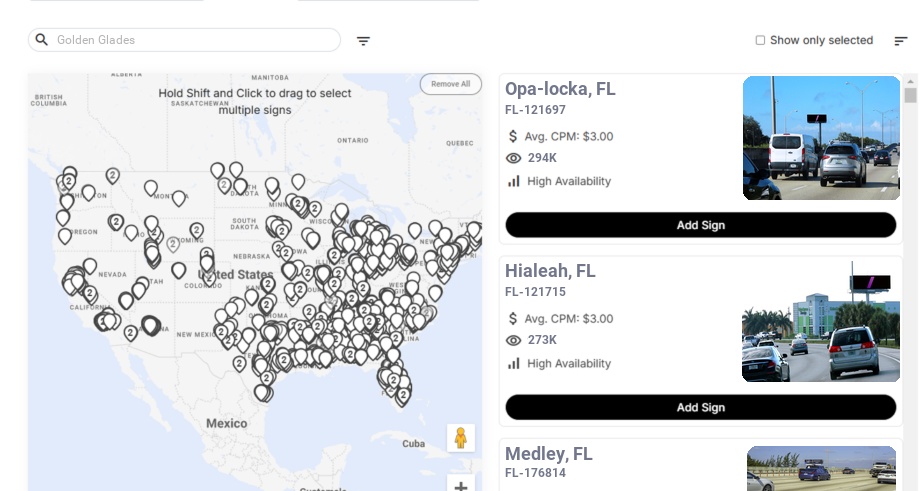
There are 95 digital billboards serving the Golden Glades area within roughly a 10-mile radius. Nearby cities include North Miami, Miami Gardens, North Miami Beach, Aventura, Hollywood, Hialeah, Miami Gardens, Opa-locka, and more. These boards are positioned along high-traffic corridors and commercial zones to help you reach commuters, shoppers, and visitors moving between Miami-Dade and Broward County.
Why is Golden Glades, Florida a good place for billboard advertising?
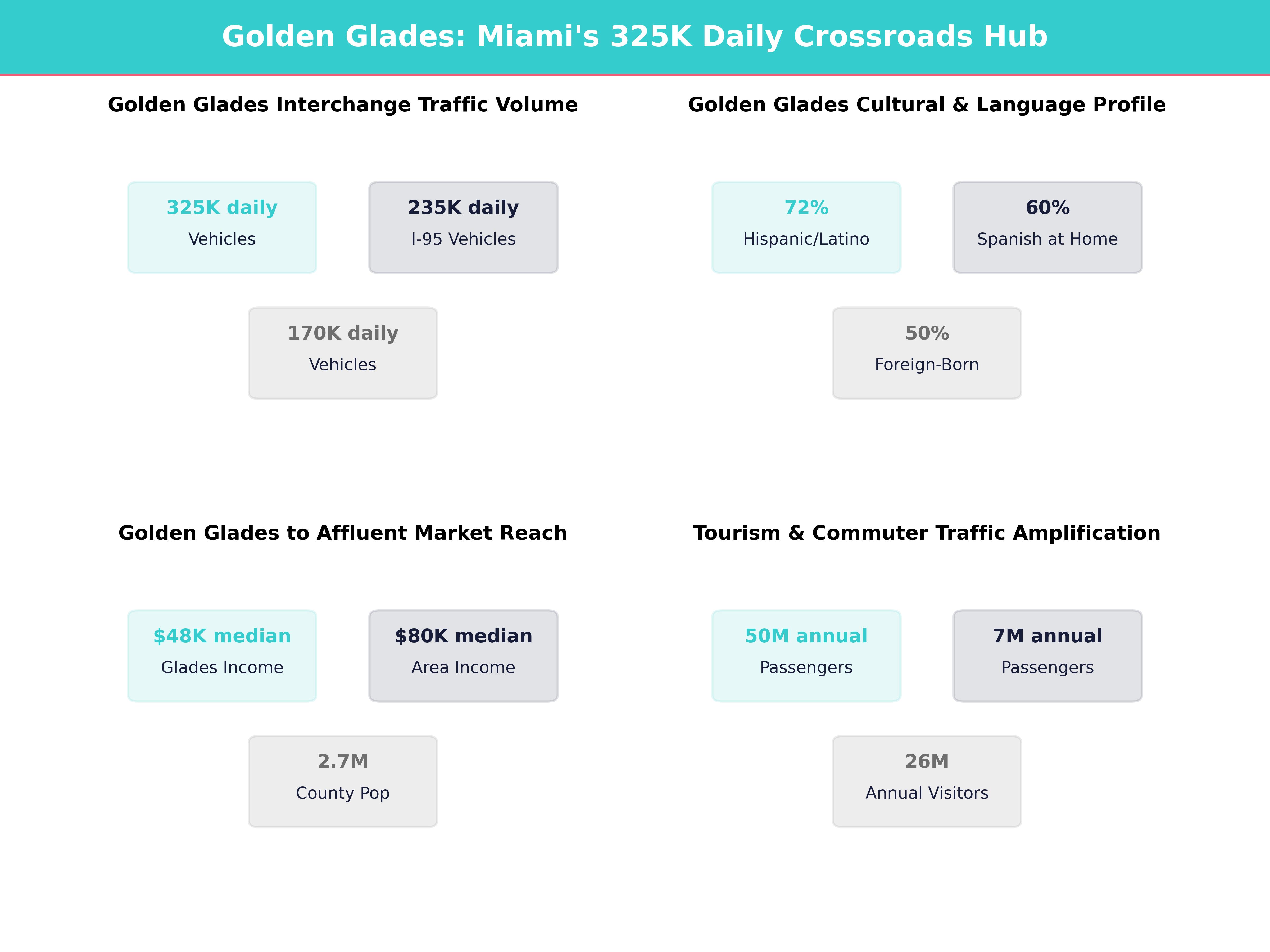
The Golden Glades area sits at the junction of some of the busiest roads in Florida, including I-95, Florida’s Turnpike, State Road 826, and U.S. 441 / NW 7th Ave. Combined, the broader Golden Glades Interchange area sees well over 300,000–350,000 vehicle movements per day, making it one of the most heavily used interchanges in Florida. This convergence funnels commuters, tourists, port traffic, and local shoppers traveling between Miami’s urban core, the northern suburbs, and the beaches.
What kind of audience will see billboards near Golden Glades, Florida?
The Golden Glades area is deeply multicultural, with about 72% of Miami-Dade residents Hispanic or Latino and more than 60% speaking Spanish at home. The area also has strong Caribbean influences, including Haitian, Jamaican, and Bahamian communities, and more than half of county residents are foreign-born. Golden Glades skews relatively young, with a median age in the early 30s, which makes it a strong market for working adults, young families, and emerging professionals.
When is the best time to run billboards near Golden Glades, Florida with Blip?
The Golden Glades area has distinct weekday and weekend traffic rhythms that you can leverage in your scheduling. Morning commute, midday, and evening commute windows all offer strong exposure, and weekend shopping, leisure, events, and nightlife can create additional spikes. With Blip, you can schedule your ads to appear only during these high-value windows, stretching your budget while maximizing impressions.
Do I need a contract to advertise with Blip near Golden Glades?
No, Blip has no long-term contracts or minimum commitments. You can start, pause, or stop your campaign at any time.
How fast can I launch a billboard campaign with Blip near Golden Glades?
You can have your campaign live in minutes. Create a free account, select your locations, set your budget, upload your design, and start running once approved.
Where can I advertise with Blip near Golden Glades?
Blip has digital billboards near Golden Glades. You can browse available locations on a map, choose the ones that fit your audience, and start advertising right away.
Still have questions? Launch a campaign in minutes — no contracts, no commitments.
Start Your CampaignGolden Glades Billboard Advertising Guide
The Golden Glades area is one of South Florida’s most important transportation and commercial crossroads. With 95 nearby digital billboards in key neighboring cities like North Miami Miami Gardens Hialeah, Hollywood Aventura Miami, Broward County, Miami Beach, and beyond. This guide walks through how to use Blip’s flexibility and targeting tools to build an effective digital billboard strategy serving the Golden Glades area, whether you’re looking for billboards near Golden Glades for brand awareness, direct response, or hyper‑local promotions.
Why the Golden Glades Area Is a Billboard Powerhouse
The Golden Glades area sits at the junction of some of the busiest roads in Florida. The Golden Glades Interchange connects:
- I‑95
- Florida’s Turnpike
- State Road 826 (Palmetto Expressway)
- U.S. 441 / NW 7th Ave
According to the Florida Department of Transportation ( FDOT District Six Miami‑Dade Transportation Planning Organization, these corridors carry some of the heaviest traffic volumes in the state:
- I‑95 in northeast Miami‑Dade regularly exceeds 220,000–250,000 vehicles per day on key segments near Golden Glades.
- The Palmetto Expressway (SR 826) and Florida’s Turnpike near Golden Glades each carry 150,000–190,000 vehicles per day on many stretches.
- U.S. 441 / NW 7th Ave through the Golden Glades area typically carries 40,000–55,000 vehicles per day, depending on segment.
- Combined, the broader Golden Glades Interchange area sees well over 300,000–350,000 vehicle movements per day, making it one of the most heavily used interchanges in Florida.
This convergence funnels commuters, tourists, port traffic, and local shoppers traveling between:
- Miami’s urban core and the northern suburbs
- Miami‑Dade and Broward County
- The beaches (Miami Beach, North Beach, Sunny Isles Beach) and inland communities
The region’s role as a gateway is reinforced by:
- Miami International Airport (MIA) processing over 50 million passengers per year (with more than 33 million domestic and 17 million international passengers in a recent year), as tracked by Miami‑Dade Aviation Department.
- PortMiami, branded as the “Cruise Capital of the World,” regularly handling over 7 million cruise passengers annually, according to PortMiami.
- Broward’s Fort Lauderdale‑Hollywood International Airport (FLL) and Port Everglades sending tens of thousands of additional visitors onto I‑95 and the Turnpike daily, a significant share of whom pass near Golden Glades en route to Miami and the beaches.
With 95 digital billboards serving the Golden Glades area within roughly a 10‑mile radius, we can position your message along these high‑impact paths in nearby cities like North Miami (0.9 miles away), Miami Gardens (3.2 miles), North Miami Beach (3.3 miles), Aventura (5.1 miles), and Hollywood (8.1 miles). Within that radius, typical daily traffic counts on major arterials routinely range from 30,000 to more than 100,000 vehicles per corridor, supporting sustained, repeat exposure for campaigns that rely on high‑visibility Golden Glades billboards.
Understanding the Golden Glades Area Audience
To build effective creative and scheduling, it helps to understand who moves through and lives around Golden Glades.
Population and age profile
- The Golden Glades census‑designated place has about 33,000–34,000 residents, and is part of the larger Miami‑Dade County population of roughly 2.7 million.
- The broader Miami‑Fort Lauderdale‑West Palm Beach metro area now exceeds 6.2 million residents, according to regional estimates cited by Miami‑Dade County.
- Miami‑Dade adds tens of thousands of residents each year; over the last decade, the county’s population has grown by roughly 8–10%, increasing the pool of daily commuters.
- Golden Glades skews relatively young, with a median age in the early 30s, compared with a Miami‑Dade median age of around 41. That age mix is ideal for advertisers targeting working adults, young families, and emerging professionals who are in peak spending and household‑formation years.
Income and spending power
- Median household income in the Golden Glades area is typically in the mid‑$40,000s to low‑$50,000s, but it sits between higher‑income pockets in Aventura, North Miami Beach, and coastal neighborhoods, where median incomes frequently run $70,000–$90,000+ and household spending power is substantially higher.
- In Aventura, for example, condo and single‑family home values in many buildings and neighborhoods routinely exceed $500,000–$700,000, supporting strong demand for premium retail, dining, and services.
- Miami‑Dade County’s taxable sales in retail and food services regularly reach tens of billions of dollars annually. Pre‑pandemic, countywide taxable sales exceeded $30 billion per year, and recent recovery data show retail and hospitality spending surpassing those levels again, as detailed by the Miami‑Dade Regulatory & Economic Resources Department
- Tourism is a major driver of local spending: the Greater Miami Convention & Visitors Bureau reports that Greater Miami and Miami Beach regularly attract 25–27 million overnight and day visitors annually, generating billions of dollars in visitor expenditures across hotels, restaurants, entertainment, and shopping.
That mix gives advertisers a spectrum: value‑oriented messaging that resonates with Golden Glades and Hialeah residents, alongside premium, lifestyle, and luxury offers that appeal to commuters from Aventura, Miami Beach, and coastal neighborhoods passing nearby and seeing billboards near Golden Glades on their daily routes.
Language and culture
The Golden Glades area is deeply multicultural:
- In Miami‑Dade County, about 72% of residents are Hispanic or Latino, and more than 60% of people speak Spanish at home.
- Non‑Hispanic Black residents make up roughly 16–17% of the county, with strong Caribbean influences (Haitian, Jamaican, Bahamian).
- Haitian Creole is widely spoken in pockets of North Miami 20%+ of residents report speaking Creole at home.
- More than half of county residents are foreign‑born, which shapes everything from food preferences to financial services and healthcare choices.
What this implies for billboard creative:
- Consider bilingual Spanish–English ads when you’re targeting broad consumer audiences; bilingual or Spanish‑first creative can be relevant for 60–70% of everyday drivers in many Golden Glades‑adjacent corridors.
- For hyper‑local campaigns (e.g., a Haitian restaurant, money transfer services, local clinics), testing English + Haitian Creole can significantly increase relevance in areas where Creole‑speaking residents can make up one in five households or more.
- Culturally resonant imagery—Caribbean food, Latin music events, beach and nightlife visuals—tends to perform well in this market and aligns with the area’s high participation in cultural festivals and nightlife, which draw hundreds of thousands of attendees per year across the county.
Where Our Billboards Are Located Near Golden Glades
Our 95 digital billboards serving the Golden Glades area are distributed across high‑traffic corridors and commercial zones in nearby cities, including:
-
North Miami & North Miami Beach (0.9–3.3 miles)
- Heavily traveled routes linking Golden Glades to Biscayne Boulevard, FIU Biscayne Bay Campus 40,000–70,000 vehicles per day.
- Strong exposure to students, young professionals, and beach‑bound traffic heading to Sunny Isles Beach, Haulover Beach Park Bal Harbour.
- Check out local info via the City of North Miami City of North Miami Beach.
-
Miami Gardens & Opa‑locka (2.8–3.2 miles)
- Major commuter and local shopping corridors near Hard Rock Stadium 65,000 spectators, and marquee events can push nearby traffic volumes up by 20–40% on event days, according to game‑day traffic advisories from the City of Miami Gardens
- High visibility to working‑class residents, event goers, and logistics workers using the nearby Palmetto Expressway and Turnpike access points.
- Learn more from the City of Miami Gardens City of Opa‑locka
-
Aventura & Hallandale Beach (5.1–5.8 miles)
- Premium retail and entertainment traffic around Aventura Mall, Gulfstream Park more than 300 retailers and reported annual visitor counts in the tens of millions.
- Ideal for higher‑end retail, healthcare, real estate, automotive, and dining, as average household incomes in nearby zip codes commonly exceed $70,000–$100,000.
- See local details at the City of Aventura City of Hallandale Beach
-
Hialeah, Hialeah Gardens, Medley (7–9.3 miles)
- Dense residential and industrial areas with major worker and freight traffic. Hialeah alone has 220,000+ residents, making it one of the largest cities in Florida, while Medley and Hialeah Gardens host extensive warehouse and logistics operations.
- Major corridors like Okeechobee Road, West 49th Street, and the Palmetto Expressway carry 60,000–120,000 vehicles per day, much of it repeat commuter and truck traffic.
- Strong for automotive, logistics, staffing, home services, and value retail.
- Refer to the City of Hialeah and City of Hialeah Gardens
-
Hollywood, Miramar, West Park (5.4–9.2 miles)
- Broward County commuters heading south through the Golden Glades area toward Miami. Roughly 28–30% of Broward’s workforce commutes outside their home city, and many use I‑95, the Turnpike, or parallel arterials that feed into Golden Glades, as noted by the Broward Metropolitan Planning Organization.
- Great for businesses that draw from both counties (education, healthcare, casinos, entertainment, and professional services).
- Learn more via the City of Hollywood City of Miramar.
-
Miami Beach & North Bay Village (5.1–9.9 miles)
- Beach traffic, nightlife, tourism, and hospitality audiences, especially on causeways and key routes to the barrier islands. The Greater Miami Convention & Visitors Bureau reports that hotel occupancy in Miami Beach often hovers in the 70–80% range during peak winter and spring months, with average daily rates among the highest in the state.
- Causeways such as the Julia Tuttle, 79th Street, and Broad Causeway 40,000–60,000 vehicles per day, much of it visitors and local nightlife traffic.
- For tourism and events, use insights from the Greater Miami Convention & Visitors Bureau and local updates from outlets like Miami Beach News via the City of Miami Beach.
Because Blip sells individual “blips” (single plays of your ad), you can mix and match these locations to build a route‑based strategy that follows your customer’s actual drive between home, work, shopping, and entertainment. That flexibility makes it easy to assemble a custom network of billboards near Golden Glades without committing to a single static face for months at a time.
Key Traffic Patterns in the Golden Glades Area
The Golden Glades area has distinct weekday and weekend traffic rhythms that you can leverage in your scheduling. FDOT traffic monitoring and regional congestion reports from the Miami‑Dade Transportation Planning Organization and Broward MPO show predictable peaks that digital billboards can capture.
Weekday patterns
-
Morning commute (6:30–9:30 a.m.)
- Heavy southbound traffic on I‑95 and the Turnpike as commuters head toward downtown Miami, Miami Beach, and employment centers in the Airport and Doral areas. During peak hours, travel speeds on I‑95 near Golden Glades can drop below 30 mph, extending exposure time to your creative.
- Many vehicles originating from Hollywood, Miramar, and West Park funnel through the Golden Glades area; Broward‑to‑Miami commute flows number in the tens of thousands of trips per weekday.
-
Midday (11 a.m.–2 p.m.)
- Strong local traffic for shopping, schools, medical appointments, and service errands around North Miami, Hialeah, Miami Gardens, and Aventura. Retail and restaurant‑oriented corridors often retain 60–75% of peak‑hour traffic volumes at midday.
- Ideal for restaurants, quick‑service food, healthcare, and same‑day services that benefit from “I’m already out” decision‑making.
-
Evening commute (4–7:30 p.m.)
- Heavy northbound and westbound flows as workers return toward Broward County and inland communities like Hialeah and Miramar. Some segments of the Palmetto and I‑95 show 3–4 hours of sustained congestion in the evening, according to FDOT travel time reports.
- This is premium time for branding, after‑work activities, and impulse‑friendly offers, especially when combined with short‑term promotions that match paydays (e.g., 1st and 15th of the month).
Weekend patterns
-
Shopping and leisure (10 a.m.–7 p.m.)
- High volumes around Aventura Mall, shopping plazas in Miami Gardens and North Miami Beach, and coastal routes toward Miami Beach and Hollywood Beach Dolphin Mall 50,000+ visitors per day on busy weekends.
- Strong for retailers, attractions, entertainment venues, and restaurants, especially when highlighting weekend‑only offers or events.
-
Events and nightlife (Thursday–Sunday evenings)
- Traffic spikes linked to sporting events and concerts at Hard Rock Stadium in Miami Gardens, as well as nightlife flows toward Miami Beach, Wynwood Downtown Miami 10,000–20,000+ vehicles in the stadium area on event days, as reflected in special event traffic plans published by the City of Miami Gardens
- Perfect for bars, clubs, casinos, live music, and ride‑share promotions, and for campaigns aimed at visitors staying in hotels across Greater Miami and Broward.
With Blip, you can schedule your ads to appear only during these high‑value windows, stretching your budget while maximizing impressions and making your billboard advertising near Golden Glades feel tightly aligned with real‑world traffic.
Crafting Creative That Works in the Golden Glades Area
Given the visual clutter and fast‑moving traffic around the Golden Glades area, creative discipline is critical. Drivers typically have 6–8 seconds to process a billboard message at highway speeds; your ad must communicate almost instantly.
Keep it instantly readable
- Aim for 6–8 words or fewer of main text, which matches industry best practices for legibility within that 6‑ to 8‑second viewing window.
- Use large, high‑contrast fonts that read clearly from 400–600 feet.
- Avoid thin typefaces or detailed script fonts; they get lost against Miami’s bright daylight and during quick glances from drivers moving at 40–65 mph.
Leverage local context
- Reference recognizable destinations: “Minutes from Aventura Mall,” “Just off the Golden Glades Interchange,” “On 441 near Golden Glades.” These cues reduce mental effort and can significantly lift response, especially for local brick‑and‑mortar.
- Use simple directional cues: “Next Exit,” “2 Lights Ahead,” “On 163rd Street,” to convert commuters to store visitors.
- Visual cues like the beach, palm trees, stadium lights, or skyline silhouettes can quickly signal “local,” connecting your brand to familiar imagery from tourism campaigns led by organizations like the Greater Miami Convention & Visitors Bureau.
Play to cultural diversity
- Test bilingual creatives (English + Spanish) in locations serving the Golden Glades area where Hispanic audiences are heavy: North Miami, Hialeah, Miami Gardens, Aventura, Hollywood. A bilingual execution can address the 60%+ of residents who speak Spanish at home without alienating English‑dominant viewers.
- For niche campaigns, consider tailored language splits (e.g., an English/Spanish version for Aventura + North Miami Beach and an English/Creole‑sensitive theme near North Miami and Miami Gardens).
- Use imagery and references tied to regional events—Carnaval Miami, Calle Ocho‑style visuals, Caribbean festivals—that frequently draw tens of thousands of attendees, as highlighted in local coverage by outlets like the Miami Herald
Design for weather and lighting
- South Florida’s intense sun can wash out low‑contrast designs. Stick with bold colors and strong contrast (e.g., dark backgrounds with white or yellow text).
- Afternoon thunderstorms are common—during the wet season, Miami can see 15–20 rainy days per month—so vivid colors and simple layouts remain legible in rain and low‑light conditions.
- Consider daypart‑specific creatives: bright, clean designs for daytime; more atmospheric or nightlife‑oriented visuals for evening rotations, especially near areas like Miami Beach, Wynwood, and Downtown Miami where nightlife traffic peaks after 9 p.m.
Using Blip’s Flexibility for the Golden Glades Area
Blip’s model of buying individual ad plays lets you align your spending with real behaviors in the Golden Glades area.
1. Dayparting around commute and shopping waves
-
Increase bids for:
- Morning southbound commute windows to influence professionals heading toward downtown and the beaches. Southbound I‑95 near Golden Glades can carry 8,000–10,000 vehicles per hour during peak.
- Evening northbound commute windows to stay top‑of‑mind as people move back through the Golden Glades area to Broward and northwest Miami‑Dade, when northbound volumes are similarly high.
- Dial spending down overnight or in lower‑value periods if your business doesn’t need late‑night impressions. Many arterials drop to 25–35% of peak volume after midnight, which may not justify higher bids unless you serve nightlife or 24‑hour categories.
2. Geo‑clustering locations
Use clusters of boards to dominate individual corridors:
- I‑95 and Turnpike corridors near North Miami, Miami Gardens, and Hollywood to reach high‑volume commuters. These freeway segments frequently appear on regional “top congestion” lists from the Miami‑Dade TPO and Broward MPO, ensuring repeated daily impressions for the same drivers.
- US‑1 / Biscayne Blvd through Aventura and North Miami Beach to capture shoppers and coastal traffic, including visitors heading to high‑spend areas like Bal Harbour Shops and Sunny Isles.
- Industrial and commercial zones in Hialeah, Medley, and Miramar for B2B, staffing, and logistics messaging, where a large share of weekday traffic is made up of fleet vehicles and tradespeople.
Because you can choose which specific boards and times to bid on, you can build “routes” that mirror your best customers’ commutes—for example, combining Aventura‑area boards with Golden Glades‑adjacent locations to hit the same commuter twice per day and create a cohesive set of Golden Glades billboards that reinforce each other.
3. Dynamic budgeting for events and seasonality
- Increase bids around major events at Hard Rock Stadium (NFL games, college football, concerts) when traffic around Miami Gardens surges. Event calendars and special notices from the City of Miami Gardens WSVN 7News are good sources to time these boosts.
- Adjust budgets during peak tourism seasons (winter and spring) when visitor volumes rise, especially on routes to Miami Beach, Aventura, and Hollywood. In some peak months, Miami‑Dade hotel demand can increase by 10–20% compared with slower periods, concentrating more visitors on key corridors, as reported by the Greater Miami Convention & Visitors Bureau.
- Scale up before big local shopping seasons—back‑to‑school, Black Friday, and holiday periods—when national retail data and local tax collections consistently show double‑digit percentage increases in spending compared with typical months.
- Consider hurricane‑season messaging windows (June–November). When storms or watches are in the forecast, local outlets like NBC 6 South Florida and Miami‑Dade County Emergency Management see heightened engagement, and billboards can support preparedness or insurance messages.
Example Strategies by Industry
Here are practical ways different advertisers can use digital billboards near Golden Glades.
Local retail & shopping centers
- Focus boards near Aventura, North Miami, Miami Gardens, and Hialeah where retail trips are frequent. In many of these zones, retail centers report weekend foot traffic increases of 30–50% over weekdays, making weekend‑weighted schedules particularly effective.
- Run call‑to‑action messages like “Exit Now – 10% Off Today Only” during high shopping windows (lunchtime and early evening, plus weekends). Short‑term sales often drive 2–3x the response of generic branding for price‑sensitive shoppers.
- Use short promotions and rotate creatives frequently to keep content fresh; Blip lets you upload multiple creatives and test them without long‑term commitments, allowing you to change offers weekly or even daily.
Restaurants and quick‑service food
- Target boards along I‑95, the Palmetto, and main arterials feeding Golden Glades during commute and lunch hours, when quick‑service restaurants capture a large share of the 11 a.m.–2 p.m. traffic spike.
- Use distance‑based messaging: “Tacos – 2 Miles Ahead on 163rd” or “Next Exit, Right on 441.” Simple distance cues can lift visit intent, especially given the 6–8 second viewing window.
- Promote time‑sensitive offers (happy hour, lunch specials, late‑night) by only running those creatives during the relevant hours. In nightlife corridors like Miami Beach or Wynwood, late‑night traffic can remain at 60%+ of daytime levels on weekends, which makes targeted night creatives valuable.
Healthcare & clinics
- Many residents in the Golden Glades area rely on nearby urgent care, primary care, and specialty clinics rather than distant hospitals; in Miami‑Dade, urgent care visits have grown by double‑digit percentages over the past decade as people seek convenient, lower‑cost options.
- Place boards in Miami Gardens, North Miami, and Hialeah emphasizing convenience: “Same‑Day Appointments – 5 Minutes from Golden Glades.” Proximity statements matter for time‑sensitive care decisions, especially along congested corridors where a “5‑minute” promise stands out.
- Use trust‑building copy—“Bilingual Staff,” “Walk‑Ins Welcome,” “Most Insurance Accepted”—especially on boards near working‑class and immigrant communities, where insurance coverage, language access, and price clarity are top decision drivers.
Automotive sales & services
- With the enormous daily vehicle volume around Golden Glades—300,000+ daily vehicle movements through the interchange—the area is a natural fit for auto dealers and repair shops.
- Position creative near Hialeah, Miramar, and Medley targeting commuters with service reminders: “Oil Change This Weekend? Exit at 441.” Service departments can generate 40–60% of dealership profits, making incremental service traffic highly valuable.
- Promote regional price or trade‑in events on boards along I‑95 and the Turnpike: “$0 Down – 10 Minutes from Golden Glades.” Coordinate timing with key sales moments—tax refund season (February–April) or holiday sale periods—when auto sales commonly spike 10–20% over baseline months.
Education & training
- For colleges, trade schools, and certification programs, focus on commuters in their mid‑20s to late‑30s—age groups that make up a large portion of Golden Glades‑area drivers and who frequently upskill or change careers.
- Run ads during morning and evening commutes with clear benefits: “Electrician Program – Start in 30 Days,” “Nursing Assistant Training – Near Golden Glades.” Programs promising job placement often see higher enrollment; highlight “Job Placement Support” or “Graduate in 6–12 Months.”
- Emphasize flexible schedules, bilingual instruction, and job placement to resonate with working adults, many of whom balance 40‑hour workweeks with family responsibilities.
Tourism, attractions, and nightlife
- Use boards near Miami Beach, Aventura, North Bay Village, and Hollywood to reach visitors heading to or from the beaches and resort areas. With 25–27 million visitors annually in Greater Miami and Miami Beach, even a small share of that flow translates into hundreds of thousands of potential impressions along your selected routes.
- Promote time‑bound messages such as “Tonight Only,” “Weekend Brunch,” or “Latin Night Fridays.” Visitors often make spontaneous decisions within the same day based on what they see en route from their hotel to the beach or dining districts.
- Coordinate with regional campaigns promoted by organizations like the Greater Miami Convention & Visitors Bureau to reinforce your presence, and monitor local nightlife and event listings from outlets like NBC 6 South Florida to time your creatives with high‑traffic evenings.
Measuring and Refining Your Campaign
To get the most value from your digital billboard investment in the Golden Glades area, connect your Blip campaign to your own data:
- Track by time and location: Compare website traffic, store footfall, or call volume during periods when your Blip ads run versus when they do not. For example, measure changes in sessions or calls during 6:30–9:30 a.m. and 4–7:30 p.m. on days with active campaigns vs. control days.
- Use short, trackable URLs or QR codes: Even though many people won’t scan or type long URLs while driving, short, memorable website paths (e.g., “Brand.com/GL”) can give you signal when used in other media as well. For pedestrian‑heavy locations (near malls, stadiums, or transit hubs), QR codes can be effective, with scan rates typically in the 1–3% range when clearly visible and incentivized.
- Align with local news cycles: When weather events, traffic disruptions, or major news stories affect the Golden Glades area, adjust your creative or timings accordingly. Local outlets like the Miami Herald NBC 6 South Florida can help you stay ahead of trends, from tropical storm coverage to new construction that may shift traffic patterns.
- A/B test creative: Run two versions of your ad on the same set of boards at similar times. Over several weeks, compare downstream results (calls, store visits, online conversions) to identify the stronger message. A/B tests that run for at least 2–4 weeks across consistent dayparts generally provide enough data to make confident decisions.
Bringing It All Together
The Golden Glades area is more than just an interchange—it is a live, constantly moving marketplace that connects Miami‑Dade and Broward residents, commuters, and visitors. By combining:
- High‑impact placements on 95 digital billboards near Golden Glades,
- Smart scheduling around commute, shopping, and event patterns grounded in local traffic data, and
- Creative that reflects the area’s diverse, bilingual, and highly mobile population,
we can help you build a billboard strategy that reaches the right people at the right moments. Whether you need flexible billboard advertising near Golden Glades for a short‑term promotion or ongoing billboard rental near Golden Glades to anchor your brand locally, Blip gives you the control to match your visibility to your goals.
Using Blip, you can start small, test relentlessly, and then scale the locations, times, and messages that work best for your goals in the Golden Glades area, supported by real‑world traffic, demographic, and performance data.