Billboards in Wildwood, FL
No Minimum Spend. No Long-Term Contracts. Just Results.
Trusted by Leading Brands


Billboard advertising
in Wildwood has never been easier



How much is a billboard in Wildwood?
Why Choose Blip for Billboard Advertising in Wildwood
Blip lets you launch in Wildwood fast and self-serve, reaching I-75 Exit 329 and Florida's Turnpike without sales calls.
Set flexible daily budgets in Wildwood and stretch spend across SR 44 and U.S. 301, where local errands and visits repeat daily.
Use dayparting in Wildwood to hit morning commuters, midday retirees, or evening Brownwood traffic when they're most likely to act.
No contracts in Wildwood means you can test seasonal bursts for the Sumter County Fair, winter snowbirds, or summer travel.
Blip's real-time analytics show what's working in Wildwood, so you can shift from interstate awareness to The Villages-area conversions.
Create and swap billboard copy fast for Wildwood with Blip, tailoring messages for healthcare, dining, or road-trip travelers.
Frequently Asked Questions About Billboard Advertising in Wildwood
How much does a billboard cost in Wildwood with Blip?
With Blip, billboard advertising in Wildwood can be surprisingly affordable because you only pay when your ad actually displays. Each “blip” is a 7.5-to-10-second spot on a rotating digital billboard, starting at just $0.01 per display. Pricing changes based on time of day, location, and advertiser demand, so costs stay flexible instead of fixed.
Where can I advertise with Blip in Wildwood for the biggest reach?
I-75 is the broadest-reach corridor in the market, and nearby segments near Exit 329 generally sit in the 70,000 to 80,000 vehicles-per-day range. Florida’s Turnpike near Exit 304 commonly lands in the 50,000 to 60,000 AADT band, giving access to a different traveler mix. These routes work well for regional travelers, destination retail, hospitality, and healthcare awareness.
Why is Wildwood a strong billboard market with Blip?
Wildwood gives us an unusually efficient billboard market because a fast-growing local population sits beside one of the state’s most important highway crossroads. The City of Wildwood grew from 6,709 residents in 2010 to 15,730 in 2020, while Sumter County grew from 93,420 to 129,752 over the same decade. Add in the daily commercial pull of nearby The Villages, and we get a market where local errands, retiree spending, and long-distance road travel overlap in the same drive shed.
What kind of audience will I reach on Wildwood billboards with Blip?
This market skews older than the typical Florida growth corridor, with community profiles for Sumter County routinely placing the median age at around 68. That helps explain why healthcare, financial services, hearing, vision, dental, home remodeling, legal services, and destination dining often perform well. Wildwood also includes commuters, trades, local households, and travelers, so roadside media can reach several overlapping audiences.
What are the best roads for billboard advertising in Wildwood?
Wildwood’s road network is the reason the market punches above its population size. The city sits at the junction of Interstate 75 and Florida’s Turnpike, plus major surface corridors like U.S. 301 and State Road 44. U.S. 301 is better for local intent and repeated exposure, while State Road 44 is ideal for reaching the eastbound gateway to The Villages.
Do I need a contract to advertise with Blip in Wildwood?
No, Blip has no long-term contracts or minimum commitments. You can start, pause, or stop your campaign at any time.
How fast can I launch a billboard campaign with Blip in Wildwood?
You can have your campaign live in minutes. Create a free account, select your locations, set your budget, upload your design, and start running once approved.
Where can I advertise with Blip in Wildwood?
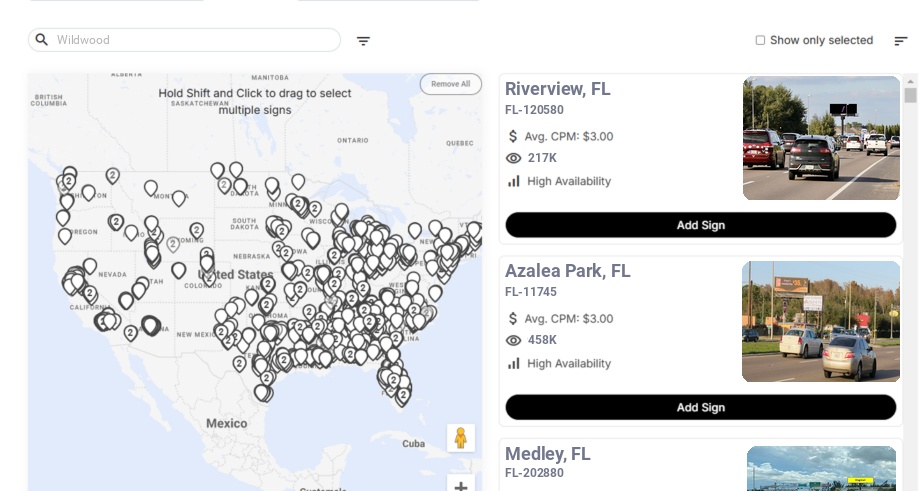
Blip has digital billboards in Wildwood. You can browse available locations on a map, choose the ones that fit your audience, and start advertising right away.
Still have questions? Launch a campaign in minutes — no contracts, no commitments.
Start Your CampaignWildwood Billboard Advertising Guide
Wildwood, Florida City of Wildwood 6,709 residents in 2010 to 15,730 in 2020, while Sumter County 93,420 to 129,752 over the same decade. Add in the daily commercial pull of nearby The Villages, which reached 79,077 residents in 2020, and we get a market where local errands, retiree spending, and long-distance road travel overlap in the same drive shed. That mix makes Wildwood especially strong for billboard campaigns that need both broad reach and practical, drive-to-action visibility.
Wildwood Market Overview
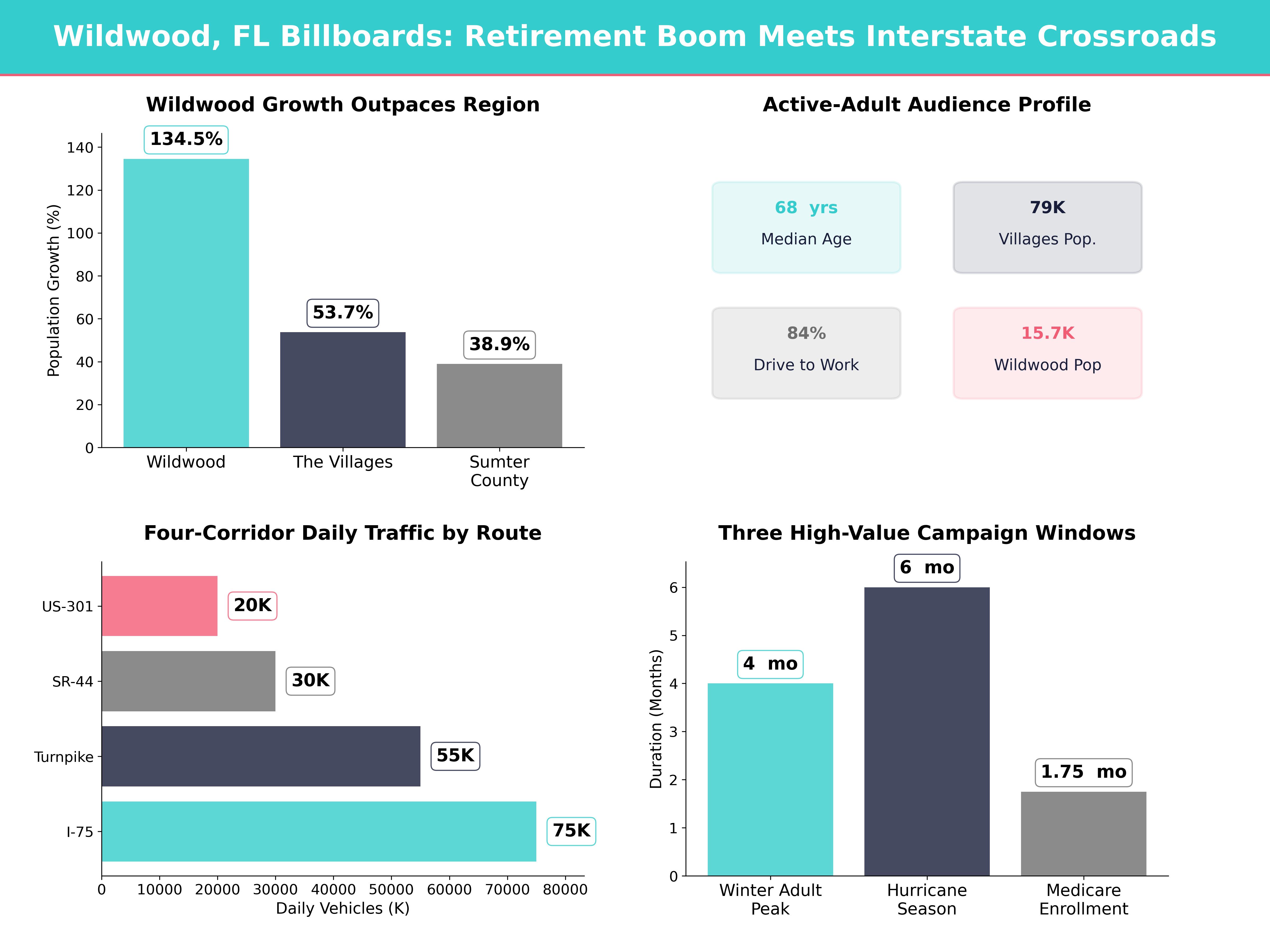
Wildwood is not a small-town billboard market in the traditional sense. It is a growth market, a regional service market, and a pass-through travel market at the same time. Between 2010 and 2020, Wildwood added 9,021 residents, which works out to 134.5% population growth. Over that same period, Sumter County added 36,332 residents, or 38.9% growth, which helps explain why the area keeps attracting new retail, healthcare, home services, and hospitality investment.
Population Growth and Demographic Shape in Wildwood
Wildwood now represents about 12.1% of all residents in Sumter County, which is a meaningful share for one city in a largely suburban-and-rural county. The nearby The Villages community reached 79,077 residents in 2020, up from 51,442 in 2010, which was an increase of 27,635 people, or 53.7%. Because The Villages spans 3 counties— Sumter County Lake County, and Marion County
This market also skews older than the typical Florida growth corridor. Community profiles for Sumter County routinely place the median age at around 68, which helps us understand why healthcare, financial services, hearing, vision, dental, home remodeling, legal services, and destination dining often perform well. We are not advertising into a purely commuter-first metro core here. We are advertising into a market where active-adult households, service providers, caregivers, and visiting family members all generate steady roadside impressions.
Economic and Mobility Conditions That Matter for Wildwood Billboards
Wildwood’s economy benefits from a rare combination of local rooftops and through-traffic. The city sits at the junction of 2 major limited-access routes, Interstate 75, and Florida’s Turnpike, plus 2 major surface corridors, U.S. 301 and State Road 44. Sumter County also borders 6 other counties, which increases the regional draw for shopping, medical appointments, dining, and leisure trips.
Auto travel dominates local behavior. In recent community mobility profiles, roughly 84% of workers in Sumter County commute by car, truck, or van, which means roadside media remains one of the most dependable ways for us to build repeat exposure. That matters because Wildwood’s strongest advertiser categories are the ones that benefit from repeated practical reminders, including healthcare groups, urgent care, restaurants, financial firms, real estate, home services, legal practices, and travel-oriented businesses. The membership mix at the Sumter County Chamber of Commerce The Villages Area Chamber of Commerce reinforces that point. The local business base leans heavily toward service categories that need visibility where people already drive every day.
Key Traffic Corridors for Wildwood Billboards
Wildwood’s road network is the reason the market punches above its population size. When we buy the right boards here, we can reach interstate travelers, local households, Villages residents, and regional shoppers in one campaign. The key is matching each corridor to the audience mindset on that route.
Interstate 75 Through Wildwood
I‑75 is the broadest-reach corridor in the market. At the Wildwood interchange area near Exit 329, FDOT Traffic Online 70,000 to 80,000 vehicles-per-day range, depending on the exact segment and year. That is major exposure for a city of Wildwood’s size.
This corridor works especially well for advertisers that need statewide or regional travelers, including these categories:
- Hotels, QSRs, fuel brands, and convenience retail perform well because travelers are actively making stop decisions while approaching exits.
- Attractions and destination venues perform well because I‑75 carries leisure traffic moving between Central Florida, Tampa Bay, and North Florida.
- Healthcare systems, legal services, and insurance brands benefit from scale because the route reaches both local drivers and nonlocal visitors.
- Truck-related services benefit because interstate travel through this junction includes a visible freight component.
On I‑75, we should treat the creative like true high-speed media. Vehicles are moving at up to 70 mph, so simple copy, strong contrast, and clear directional cues matter more than long explanations.
Florida’s Turnpike at Wildwood
Florida’s Turnpike is the second major pillar of Wildwood visibility. Near Exit 304, FDOT traffic counts commonly place Turnpike segments in the area in the 50,000-plus AADT range, with many counts landing in the 50,000 to 60,000 band. That gives us access to a different traveler mix than I‑75. The Turnpike brings stronger Orlando, South Florida, and long-haul toll-road travel behavior into the market.
Turnpike-facing boards are especially effective for these goals:
- Destination retail and entertainment can intercept travelers before they choose where to stop.
- Medical specialists and elective healthcare providers can build broad awareness among regional households already familiar with The Villages and Central Florida.
- Hospitality and food-service brands can capture immediate intent near Wildwood exits.
- Recruiting campaigns can reach drivers moving through a labor market that stretches beyond one county.
If we want fast recognition rather than deep explanation, the Turnpike is often the better fit. Drivers on toll-road trips are usually making fewer stops, which gives practical, location-based messages extra value.
U.S. 301 Through Wildwood
U.S. 301 is where Wildwood feels most local. FDOT counts through the commercial spine commonly place this route in the 20,000-plus vehicles-per-day range, with many segments landing in the 20,000s. The speed is lower than the interstate, and the dwell time is better, so we can use 301 for more local intent.
U.S. 301 is a strong fit for these advertisers:
- Restaurants, grocery, and neighborhood retail can speak to daily routines rather than one-time travel stops.
- Banks, credit unions, and insurance agencies benefit from repeated weekday exposure.
- Auto dealers, tire shops, and repair centers match the route’s practical-trip mindset.
- Primary care, urgent care, dental, and specialty clinics can build frequency with residents who travel the corridor often.
When we want to convert familiar local drivers instead of only generating impressions, U.S. 301 deserves serious attention.
State Road 44 and the Eastbound Gateway to The Villages
State Road 44 is the bridge between Wildwood and the eastern growth engine around Brownwood Paddock Square, Lake Sumter Landing Market Square, and Spanish Springs Town Square. FDOT counts on the eastern side of Wildwood commonly push into the 30,000-plus AADT range, especially as traffic moves toward The Villages commercial districts.
This corridor is ideal for advertisers that want relevance more than raw pass-through scale. We can reach active-adult households, family visitors, healthcare patients, dining traffic, and home-service demand all on one route. State Road 44 is particularly strong for:
- Home improvement, roofing, HVAC, plumbing, and pest control because the surrounding housing base keeps expanding.
- Healthcare, med spas, hearing, vision, and dental providers because the nearby audience is older and highly service-oriented.
- Entertainment, dining, and event promotion because the corridor feeds evening activity.
- Real estate and financial planning because many trips are tied to lifestyle decisions and household spending.
Wildwood Audience Segments
Wildwood billboards work best when we stop thinking about one audience and start thinking about overlapping travel occasions. In this market, a single board can speak to a retiree headed to dinner, a contractor heading to a job, a daughter visiting parents in The Villages, and a road-tripper deciding where to exit.
Active Adults and Retirees Around Wildwood
The biggest audience difference between Wildwood and many other Florida cities is the concentration of active-adult consumers nearby. The Villages is one of the best-known retirement communities in the country, and the local lifestyle infrastructure is substantial. The community promotes 3 major town squares, nightly entertainment 365 days a year, and 50-plus golf courses across the broader development. Those are not just lifestyle details. They are advertising clues.
This audience responds well to categories that improve convenience, comfort, health, safety, and leisure. We should think about orthopedic care, dental, vision, hearing, primary care, estate planning, home remodeling, moving services, restaurants, arts venues, and financial advice. We should also remember that older audiences still travel frequently. Venues such as The Sharon L. Morse Performing Arts Center, The Savannah Center The Villages Polo Club
Commuters, Trades, and Local Households in Wildwood
Even in a retiree-heavy county, there is a large supporting workforce that drives every day. Healthcare staff, retail employees, public-sector workers, construction crews, landscapers, delivery drivers, and home-service technicians all use Wildwood’s corridors repeatedly. Because auto commuting remains above 80% of worker trips, repeated billboard frequency can do a lot of work here.
This is why we often see strong fit for these categories:
- Home services benefit from repeated local exposure and urgent seasonal demand.
- Auto services align with a market that spends a lot of time on the road.
- Quick-service restaurants and coffee brands can reach morning and midday routine trips.
- Cellular, internet, storage, and moving brands can capitalize on continued household turnover and expansion.
Wildwood’s own population of 15,730 means there is now a meaningful city-scale base to support local-service campaigns, not just regional pass-through advertising.
Travelers, Visitors, and Pass-Through Traffic Near Wildwood
Few Florida cities of this size sit at the meeting point of I‑75 and the Turnpike. That means Wildwood billboards can influence both locals and nonlocals at the same time. Travelers headed toward Ocala Marion County Ocala/Marion County Visitors and Convention Bureau move north on I‑75, while travelers headed toward Leesburg, Lady Lake Lake County are frequently visible on the east and south corridors.
This audience is ideal for travel-oriented messages, including hotels, fuel, food, family attractions, roadside retail, RV services, and legal help. It is also valuable for regional awareness campaigns that want to be seen by Floridians from multiple metros without paying big-city rates.
Students, Families, and Education-Oriented Audiences in Wildwood
Wildwood is not only a retirement-adjacent market. It also includes students, parents, and workforce learners. Lake-Sumter State College serves 8,000-plus students annually, and its regional footprint helps create demand for education, healthcare, apartments, financial services, and affordable dining. Sumter County Schools and The Villages Charter School add another layer of recurring weekday movement.
For advertisers in education, tutoring, healthcare, youth services, quick-service food, and back-to-school retail, those patterns matter. Morning and afternoon dayparts can be especially useful when we want to align with school and campus routines.
Seasonal and Timing Opportunities in Wildwood
Wildwood is a year-round market, but it is not a flat market. Demand changes with snowbird movement, school schedules, weather, and event calendars. If we time creative and budgets to those swings, we can often gain efficiency without increasing spend.
Winter in Wildwood
From January through April, Central Florida’s active-adult population is especially visible. This is the season when many seasonal residents, visiting relatives, and leisure outings are at their highest. Dining, entertainment, healthcare, home upgrades, and lifestyle services all benefit from stronger daytime and early-evening activity.
This is a good window for campaigns tied to elective healthcare, hearing and vision services, legal planning, home renovation, restaurants, arts venues, and destination shopping. It is also a strong time to increase coverage on State Road 44, U.S. 301, and eastbound Villages-facing boards.
Spring Events and High-Mobility Periods in Wildwood
Spring keeps traffic elevated because local events and regional leisure travel stack together. The Sumter County Fair creates a reliable seasonal advertising moment each March, while ongoing entertainment programming in The Villages keeps local trips active. Spring also brings strong categories for lawn care, landscaping, allergy care, tax help, and home-improvement services.
For advertisers tied to events, dining, family retail, or civic campaigns, spring is often a sweet spot. The weather is favorable, the roads stay busy, and consumers are unusually willing to get out and spend.
Summer Travel and Storm-Season Messaging in Wildwood
Summer changes the traffic mix. From Memorial Day through Labor Day, we usually see more family road trips and vacation travel on I‑75 and the Turnpike, even as some seasonal residents spend less time in the area. That shift makes interstate boards especially useful for food, fuel, lodging, attractions, urgent care, and travel services.
Summer is also the start of Florida’s hurricane season, which runs from June 1 through November 30. Even though Wildwood is inland, storm-season messaging still matters for roofers, generators, HVAC companies, insurance brands, tree services, and emergency-preparedness retailers. When we use seasonal creative here, relevance goes up quickly.
Fall and Year-End Campaigns in Wildwood
Late summer and fall are strong for school-year routines, healthcare reminders, and year-end spending. The annual Medicare enrollment window runs from October 15 through December 7, which makes Wildwood especially attractive for insurers, pharmacy brands, clinics, hearing providers, vision centers, and primary care groups serving older adults.
Holiday dining, local retail, gifting, and event promotion also rise as year-end approaches. Because The Villages and surrounding communities maintain strong social calendars, evening and weekend dayparts remain valuable deep into the fourth quarter.
Billboard Design Tips for the Wildwood Market
Wildwood rewards practical creative. We are speaking to drivers who are often making a choice about where to stop, who to call, or which provider to trust. The best-performing designs in this market usually feel clear, useful, and locally aware.
Design for an Older, Service-Oriented Wildwood Audience
In a market shaped by active-adult households, legibility matters more than cleverness. We should use larger type, stronger contrast, and simpler calls to action than we might use in a younger downtown market. Dark blue, green, black, and other high-contrast backgrounds paired with white or bright text tend to read well in strong Florida daylight.
Local trust signals also help. Creative that references “Wildwood,” “The Villages area,” “SR 44,” or “next exit” often feels more useful than generic branding. For healthcare, finance, legal, and home-service advertisers, we should favor reassurance, credentials, convenience, and phone-first messaging over abstract brand storytelling.
Design for Interstate Speed in Wildwood
On I‑75 and the Turnpike, we should design for 70 mph viewing conditions. That means one idea, one brand, and one immediate next step. Exit numbers such as 329 on I‑75 and 304 on the Turnpike can be powerful because they turn awareness into action. Travel-service brands should lean into distance markers, food cues, fuel cues, and unmistakable logos.
This is also a good market for directional messaging like “Next Exit,” “2 Miles,” or “East on 44.” Those cues are not generic here. They are part of how people actually navigate Wildwood.
Design for The Villages-Facing Creative
When we target eastbound or Villages-oriented boards, the creative can shift from travel utility to lifestyle fit. Images of active adults, golf, dining, live entertainment, comfortable homes, and professional service teams often resonate better than edgy urban imagery. References to convenience, appointment availability, same-day help, and stress-free service tend to perform well because the surrounding audience values simplicity and reliability.
We should also think about time-of-day context. An evening dining or entertainment message near Brownwood Paddock Square works differently from a morning healthcare message near a commuter route. Wildwood is not one creative market. It is several adjacent mindsets.
Regional Strategies Around Wildwood
A strong Wildwood campaign usually mixes broad-reach boards with locally relevant boards. We do not need every placement to do the same job. In fact, the market works better when we let each sub-area play its role.
The Wildwood Interchange Core
Boards near the I‑75 and Turnpike junction are our scale placements. This is where we build broad awareness, intercept travelers, and capture people before they decide where to stop or spend. Travel services, hospitality, legal, insurance, recruiting, and region-wide healthcare are natural fits here.
If our goal is reach, this should be the starting zone.
East Wildwood, Brownwood, and The Villages Edge
Boards along SR 44 east of the interstate and toward Brownwood Paddock Square give us a more locally qualified audience. These placements are ideal for healthcare groups, restaurants, home services, med spas, dental practices, hearing and vision providers, real estate professionals, and financial planners.
If our goal is conversion from nearby residents and repeat local visitors, this zone often matters more than the interstate.
South and East Toward Leesburg and Lake County
Campaigns that need to reach people moving between Wildwood, Leesburg, Lady Lake Lake County should think regionally. These trips often combine shopping, healthcare, family visits, and dining. Advertisers with multiple locations, regional clinics, destination retail, and entertainment offers can do well by pairing Wildwood boards with boards deeper into the Lake County side of the corridor.
Northbound Toward Ocala and Marion County
Northbound strategies work well for brands that want Marion County crossover, tourism traffic, logistics exposure, or event-related travel. Trips toward Ocala World Equestrian Center – Ocala Marion County
Smaller Sumter County Communities Around Wildwood
Not every Wildwood campaign should focus on only The Villages. Nearby communities such as Bushnell Sumter County
Using Blip Tools in Wildwood
Wildwood is a market where flexibility really helps. We can use Blip’s map-based buying to separate interstate awareness boards from local-conversion boards, then adjust budgets as seasonal traffic changes. That is especially useful when we want heavier winter coverage near The Villages, stronger summer spend on I‑75, or event-specific bursts around the Sumter County Fair.
Dayparting also matters here. Morning and late-afternoon schedules often make sense on commuter-heavy local routes, while midday and early evening can be more effective for Villages-oriented lifestyle categories such as dining, healthcare, entertainment, and home services. If we are promoting dinner, live shows, or a nightlife-adjacent venue, we can bias delivery into the hours when people are choosing where to go.
Blip’s analytics help us compare corridor roles instead of guessing. We can watch how an I‑75 awareness board complements a State Road 44 conversion board, and we can refine based on what the market is actually doing. We can also build multiple versions of our creative so the interstate message stays simple and directional while the local message becomes more specific to Wildwood or The Villages. That kind of local tailoring is valuable in a market with such different driving contexts.
Getting Started with Billboard Rental in Wildwood
The easiest way to start in Wildwood is to define what we want the campaign to do before we choose boards. If our goal is regional awareness, we should begin near the I‑75 and Turnpike interchange. If our goal is qualified local traffic, we should prioritize SR 44 and U.S. 301. If our goal is a blend of both, we should combine a scale board with one or two boards closer to the local commercial flow.
What to Expect When Renting a Billboard in Wildwood
Wildwood is not a market where every board serves the same purpose. Some locations are pure high-speed reach plays. Others are practical reminder media for people already familiar with the area. We should evaluate each location by asking four questions:
- What kind of trip is happening here? A travel stop, a daily errand, a medical visit, or an evening outing all call for different creative.
- How fast is traffic moving? Interstate boards need simpler messages than local arterial boards.
- How close is the board to an action point? Restaurants, fuel brands, and urgent-care providers usually benefit from short decision windows.
- How often will the same audience pass this location? Repeat exposure matters more for healthcare, financial services, legal help, and home services.
How Blip Simplifies Wildwood Billboard Rental
Traditional billboard buying in a market like Wildwood can feel slow and inflexible because we often have to negotiate around long terms, limited availability, and broad packages that include locations we do not really need. Blip simplifies that process by letting us choose specific digital boards, control timing, and adjust strategy without a drawn-out sales cycle.
That matters in Wildwood because the market is dynamic. Population is rising, commercial activity keeps shifting east and south, and seasonal demand changes throughout the year. A self-serve approach lets us test, learn, and refine instead of committing to a rigid plan too early.
How We Should Evaluate Wildwood Billboard Locations
For most advertisers, a good first Wildwood test includes at least 2 location types. We can start with one broad-reach board near the interstate or Turnpike, then pair it with one more local board on SR 44 or U.S. 301. That gives us a clearer read on whether our category needs scale, local repetition, or both.
We should also match creative to placement instead of forcing one design everywhere. A board near Exit 329 can focus on immediate action, while a board east toward Brownwood can focus on trust, lifestyle, or appointment setting. When we respect the route, the audience, and the timing, Wildwood becomes one of Florida’s more efficient billboard markets for both local and regional advertisers.