Billboards near Coral Gables, FL
No Minimum Spend. No Long-Term Contracts. Just Results.
Trusted by Leading Brands


Billboard advertising
near Coral Gables has never been easier
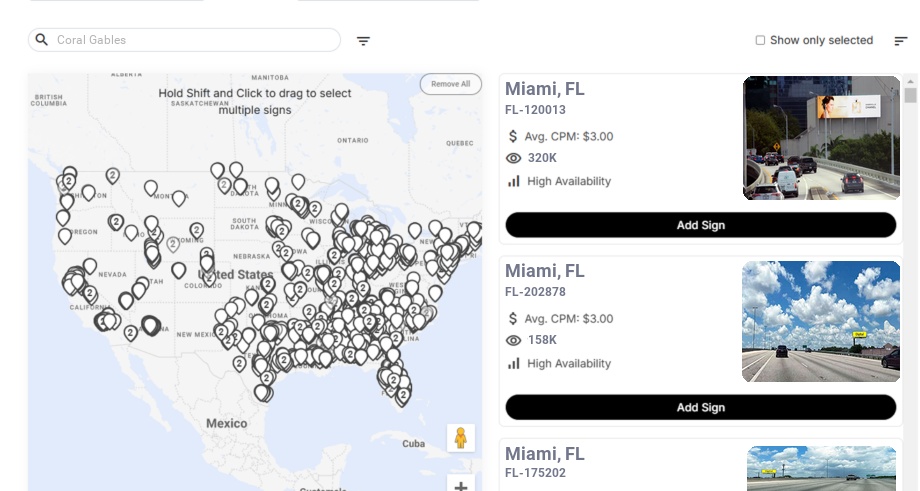



How much is a billboard near Coral Gables?
Why Choose Blip for Billboard Advertising near Coral Gables
Blip lets you launch fast in Coral Gables and hit US-1, Le Jeune Road, and SR-836 commuters with self-serve control.
Set flexible budgets in Coral Gables and test ads near UM, Miracle Mile, and Merrick Park without long-term commitments.
Use dayparting in Coral Gables to reach weekday rush-hour professionals and lunch-hour students when traffic is highest.
Track Coral Gables campaign results in real time, then shift spend toward boards driving traffic from MIA, PortMiami, and the city core.
Build bilingual Coral Gables creative with Blip and tailor messages for affluent families, execs, and international visitors.
Frequently Asked Questions About Billboard Advertising near Coral Gables
How much does a billboard cost near Coral Gables, Florida with Blip?
With Blip, you can advertise on digital Coral Gables billboards on any budget, choosing precisely how much you want to spend each day while Blip automatically keeps your campaign within that limit. Each 7.5 to 10-second “blip” runs on rotating digital billboards serving the Coral Gables area, and you pay only for the blips you receive. The price of billboards near Coral Gables, Florida varies based on when and where your ads appear and current advertiser demand, so you stay in control whether you want steady visibility or short bursts of exposure.
Where can I advertise with Blip near Coral Gables, Florida?
Tap into 35 digital billboards near Coral Gables, Florida, set your own budget, and run eye-catching messages exactly when your audience is cruising the Coral Gables area. With 35 digital billboards near Coral Gables serving the area from nearby Miami, we can help you reach residents, commuters, students, and visitors where they move, shop, and play. Our 35 digital billboards serving the Coral Gables area are strategically placed in nearby Miami along high-traffic routes.
Who can I reach with Coral Gables, Florida billboards from Blip?
The Coral Gables area offers one of South Florida’s most desirable, affluent, and internationally connected audiences. The market includes affluent professionals and executives, the University of Miami community, luxury shoppers and diners, international visitors and business travelers, and local families and long-term residents. Advertisers using Coral Gables billboards are not just reaching local residents; they are reaching decision-makers, professionals, and globally connected households.
What roads near Coral Gables, Florida get the most billboard traffic for Blip ads?
Major roadways influencing the Coral Gables area include US-1 / South Dixie Highway, Le Jeune Road, the Dolphin Expressway (SR-836), and the Palmetto Expressway (SR-826). Segments of US-1 near Coral Gables can see 80,000–100,000+ vehicles per day, while Le Jeune handles 50,000–70,000 vehicles per day in many sections. Busy segments of the expressways feeding the Coral Gables area can see over 150,000 vehicles daily.
When is the best time to advertise in Coral Gables, Florida with Blip billboards?
Weekday rush hours from 6:30–9:30 a.m. and 4:00–7:00 p.m. are best for professional services, B2B, financial services, healthcare, real estate, and anything targeting office workers commuting to and from Coral Gables. Midday is great for quick-service restaurants, cafés, gyms, and retailers appealing to office workers and UM students, while evenings and weekends are strong for dining, nightlife, entertainment, family activities, grocery, and e-commerce. Many advertisers find that concentrating impressions in 20–40% of the week’s hours yields better cost efficiency than a 24/7 schedule.
Do I need a contract to advertise with Blip near Coral Gables?
No, Blip has no long-term contracts or minimum commitments. You can start, pause, or stop your campaign at any time.
How fast can I launch a billboard campaign with Blip near Coral Gables?
You can have your campaign live in minutes. Create a free account, select your locations, set your budget, upload your design, and start running once approved.
Where can I advertise with Blip near Coral Gables?
Blip has digital billboards near Coral Gables. You can browse available locations on a map, choose the ones that fit your audience, and start advertising right away.
Still have questions? Launch a campaign in minutes — no contracts, no commitments.
Start Your CampaignCoral Gables Billboard Advertising Guide
The Coral Gables area offers one of South Florida’s most desirable, affluent, and internationally connected audiences. With 35 digital billboards near Coral Gables serving the area from nearby Miami, we can help you reach residents, commuters, students, and visitors where they move, shop, and play—using flexible, data-driven campaigns tailored to this unique market.
Understanding the Coral Gables Market
Coral Gables is a compact but powerful economic and cultural hub in Miami-Dade County.
- The City of Coral Gables reports a resident population of roughly 49,000–50,000 people spread over just 13 square miles, creating a dense, urban customer base. That’s close to 3,800 residents per square mile, before counting the daily influx of workers and visitors.
- The City of Coral Gables has noted that more than 70% of its occupied housing units are owner-occupied, and that single-family home values regularly exceed $1 million in many neighborhoods, underscoring the community’s high purchasing power.
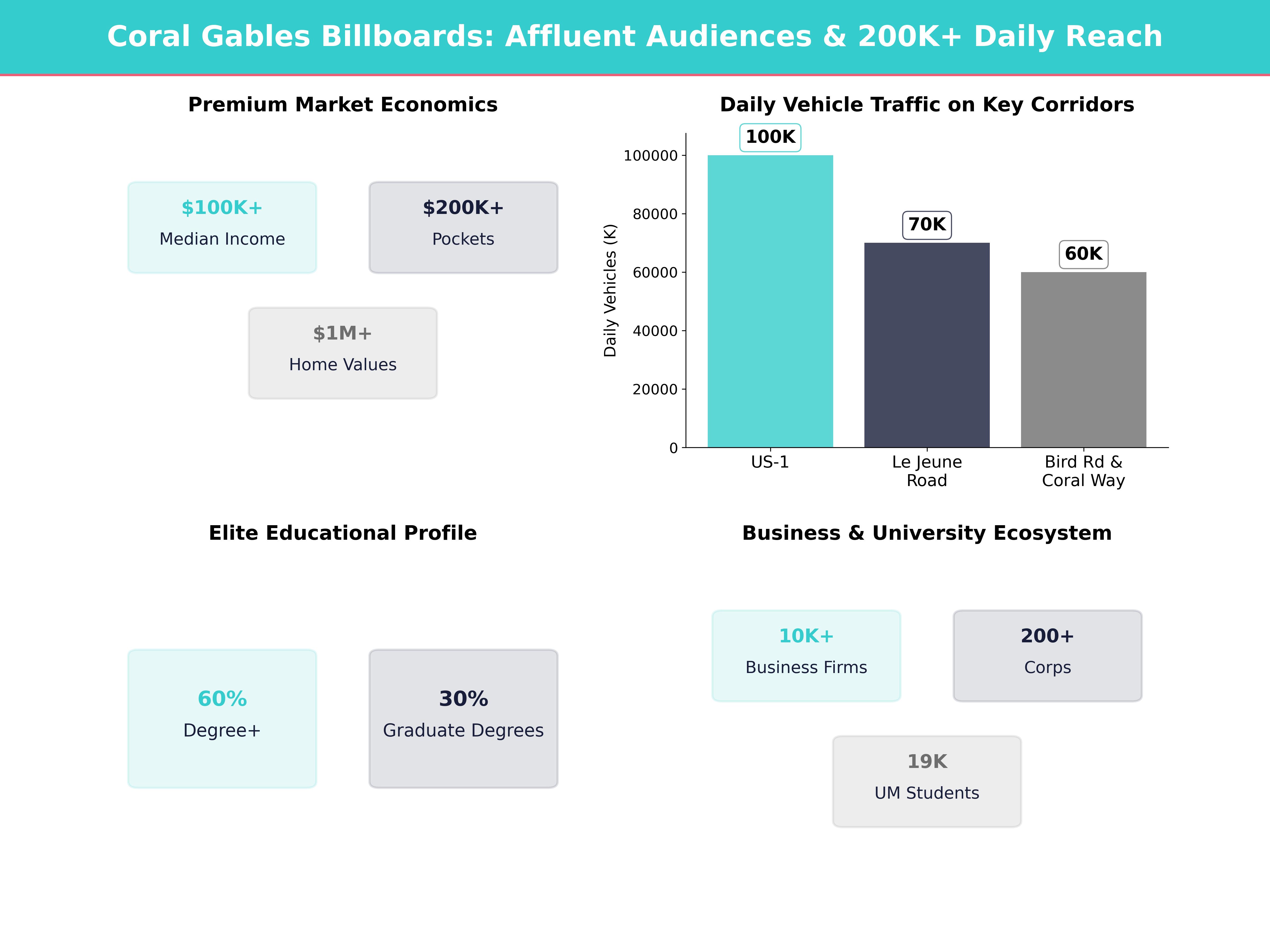
- It is one of the most affluent areas in South Florida, with a median household income well above $100,000, and large pockets of households over $200,000. In several census tracts near the Miracle Mile and Biltmore Hotel areas, average household incomes climb into the $150,000–$200,000+ range.
- Coral Gables is highly educated: more than 55–60% of adults hold a bachelor’s degree or higher, and a sizable share—often 30%+ in many tracts—hold graduate or professional degrees, supported by the strong presence of the University of Miami.
- The market is strongly bilingual and multicultural. Across the broader Miami-Dade area, about 72% of residents speak a language other than English at home, primarily Spanish (Miami-Dade County), and Coral Gables mirrors that trend with a large Hispanic and international population. Countywide, more than 69–70% of residents identify as Hispanic or Latino, shaping local media habits and brand expectations.
- The Coral Gables business community includes more than 10,000 businesses and professional firms across finance, law, health care, hospitality, technology, and retail, generating billions in annual economic activity ( Coral Gables Chamber of Commerce
This mix of high income, high education, and cultural diversity means messaging can be more sophisticated, lifestyle-oriented, and often bilingual. Advertisers using Coral Gables billboards are not just reaching “local residents”; they are reaching decision-makers, professionals, and globally connected households who are frequent travelers, early adopters, and heavy users of premium products and services.
Key Audience Segments You Can Reach Near Coral Gables
The Coral Gables area brings together several distinct, high-value audiences that our nearby Miami billboards can reach. When you choose billboard advertising near Coral Gables, you’re putting your brand in front of:
-
Affluent professionals and executives
- Coral Gables has a dense concentration of finance, law, real estate, consulting, and corporate headquarters, especially around Downtown Coral Gables and Ponce de Leon Boulevard. The City of Coral Gables cites more than 200 multinational corporations with a presence in the city, and a workforce that swells daytime population well beyond its 50,000 residents.
- Professional services, finance, and insurance collectively employ tens of thousands of workers in and around the Coral Gables central business district, with many roles in senior management and high-compensation fields.
- Office workers commute from across Miami-Dade, many using US-1 (South Dixie Highway), Le Jeune Road, and the Dolphin Expressway (SR-836) corridors—where our Miami billboards can intercept them. The Miami-Dade Transportation Planning Organization reports over 100,000 vehicles per day along several segments of US-1 and 80,000–150,000 vehicles per day along key expressways feeding the Coral Gables area (Miami-Dade TPO).
-
University of Miami community
- The University of Miami in Coral Gables serves about 19,000 students total, including more than 12,000 undergraduates, plus 3,000+ graduate students and thousands of faculty and staff.
- UM’s student body includes representation from all 50 U.S. states and more than 110 countries, making it a prime audience for brands targeting both domestic and international young adults.
- This creates a steady demand for housing, food and beverage, entertainment, tutoring, healthcare, and lifestyle brands appealing to 18–34 year olds. National higher-ed data and UM’s own reports show that roughly 60–65% of students live off campus in nearby neighborhoods, frequently traveling key billboard corridors between Coral Gables, South Miami, Brickell, and Downtown.
- Major UM events—such as football home games at Hard Rock Stadium, commencement ceremonies, and orientation periods—can each draw tens of thousands of visitors and family members into Greater Miami throughout the year, boosting traffic volume and ad exposure windows.
-
Luxury shoppers and diners
- Miracle Mile and the surrounding Downtown Coral Gables district feature more than 350+ retailers, restaurants, and cultural venues, with a strong emphasis on fine dining, bridal and special-event services, and boutique fashion ( Downtown Coral Gables & Miracle Mile
- The Shops at Merrick Park includes over 90 high-end retailers and restaurants, with anchors like luxury fashion and lifestyle brands, and draws shoppers from across Miami-Dade County and neighboring Broward County.
- Trade and tourism organizations report that luxury visitors to Greater Miami spend significantly more than average tourists—often 2–3x higher daily spend—on dining, shopping, and nightlife, a pattern clearly visible in Coral Gables’ restaurant and boutique mix.
- Upscale retail, fine dining, and boutique service brands can use eye-catching creative on Miami billboards that sit on the main access routes leading toward Coral Gables, capturing both destination shoppers and affluent locals running daily errands.
-
International visitors and business travelers
- Miami International Airport (MIA)—just a few miles north of Coral Gables—handled about 52 million passengers in 2023, one of the busiest airports in the U.S. Roughly 80–85% of that traffic is domestic and 15–20% international, with particularly strong volumes from Latin America, the Caribbean, and Europe.
- MIA is the leading U.S. airport for international freight and a top gateway for passengers from Latin America, which helps sustain a constant flow of executives, investors, and high-net-worth travelers who often overnight or hold meetings in Coral Gables hotels and offices.
- PortMiami recorded around 7 million cruise passengers in 2023, maintaining its reputation as the “Cruise Capital of the World.” Many cruise passengers arrive early or extend their stay, booking hotels and experiences throughout Greater Miami, including Coral Gables.
- Greater Miami tourism officials note that international visitors account for roughly 30–35% of total visitors but a disproportionate share of total tourism spending. Many visitors are from Latin America and Europe, making bilingual or visually led creative particularly effective.
-
Local families and long-term residents
- Coral Gables’ tree-lined neighborhoods, parks, and top-rated schools attract high-income families. The city manages more than 60 parks and green spaces and over 40 miles of tree-lined streets, reinforcing its “City Beautiful” brand ( City of Coral Gables Parks & Recreation
- The Coral Gables Preparatory Academy zone and nearby public and private schools consistently receive high marks in county and state evaluations, helping maintain strong demand for family services and education-related spending.
- These households are strong targets for private schools, healthcare, financial services, home improvement, and family entertainment. Household surveys from Miami-Dade indicate that local families spend a substantial share of disposable income on dining out, after-school activities, and health services—categories that benefit heavily from high-visibility roadside messaging.
When designing a campaign serving the Coral Gables area, decide which of these core segments matters most, then align your board selection, dayparts, and creative accordingly. Layering segment-specific creatives (e.g., one for UM students, one for executives, one for families) allows you to tap into multiple high-value audiences simultaneously with the same set of billboards near Coral Gables.
How People Move Around the Coral Gables Area
To make the most of digital billboards near Coral Gables, it’s critical to understand mobility patterns:
- In Miami-Dade County, about 75–80% of workers commute by car, truck, or van, with the majority driving alone, according to regional transportation summaries from the Miami-Dade TPO. Fewer than 5% use public transit as their primary mode to work, and an even smaller share walk or bike.
- The average one-way commute time is around 30 minutes, with many Coral Gables–area commutes from western and southern suburbs exceeding 35–40 minutes, which means long stretches of time for drivers and passengers to see roadside media.
-
Major roadways influencing the Coral Gables area include:
- US-1 / South Dixie Highway (north–south, linking Coral Gables to Downtown Miami and southern suburbs like Kendall and Pinecrest). Segments of US-1 near Coral Gables can see 80,000–100,000+ vehicles per day based on local traffic counts.
- Le Jeune Road (NW/SW 42nd Ave) connecting Coral Gables to MIA and the airport hotel cluster. Le Jeune handles 50,000–70,000 vehicles per day in many sections, including a mix of business travelers, airport employees, and local commuters.
- Dolphin Expressway (SR-836) and Palmetto Expressway (SR-826), both key commuter and logistics corridors. Florida Department of Transportation (FDOT) data show daily traffic volumes over 150,000 vehicles on busy segments of these expressways ( FDOT District Six
- Bird Road (SW 40th St) and Coral Way (SW 22nd St), major east–west arterials feeding residential neighborhoods, often carrying 40,000–60,000 vehicles per day through key commercial stretches.
- The Miami-Dade TPO estimates that the Greater Miami area sees more than 20 million vehicle miles traveled (VMT) per day, reflecting a highly auto-dependent regional culture.
Our 35 digital billboards serving the Coral Gables area are strategically placed in nearby Miami along these and other high-traffic routes, making them ideal for:
- Reaching commuters heading to offices in the Coral Gables business district, where daytime population can exceed resident population by 50–100% due to inbound workers.
- Targeting residents driving from suburban neighborhoods toward Miracle Mile, Merrick Park, or the University of Miami campus for shopping, dining, school runs, and events.
- Capturing airport-bound travelers and cruise passengers who book hotels or meetings near Coral Gables, including the many who transit between MIA, PortMiami, and the Coral Gables/South Miami hotel clusters.
When you select billboard rental near Coral Gables on these high-traffic corridors, you tap into a consistent flow of both local and visitor traffic that keeps your message in front of high-intent audiences all day.
Timing Your Campaign for Maximum Impact
Coral Gables has distinct seasonal and weekly patterns that should shape your scheduling strategy for billboard advertising near Coral Gables:
Seasonal patterns
-
Winter high season (December–April):
- Greater Miami attracted over 26 million overnight visitors and around 7–8 million day visitors annually in recent pre-pandemic years, and tourism has strongly rebounded, with hotel occupancy in peak months often exceeding 80–85% (Greater Miami Convention & Visitors Bureau).
- Visitor spending in Greater Miami has been estimated in the $18–20 billion range annually in recent years, with a large share occurring in premium neighborhoods like Coral Gables.
- Events like Art Basel Miami Beach, the Miami International Boat Show, and the Carnaval on the Mile and Calle Ocho in nearby areas bring surges of affluent visitors. For example, Carnaval on the Mile can attract tens of thousands of attendees over a weekend, boosting local traffic along US-1, Coral Way, and Miracle Mile.
- This is prime time for luxury retail, dining, hotels, attractions, events, and real estate campaigns near Coral Gables, as both occupancy and average daily rates (ADR) in area hotels can rise 20–40% compared with slower months.
-
Spring and fall shoulder seasons (May–June, September–November):
- These periods see steady business travel and conference activity, with many events held in Coral Gables’ hotels and venues such as the Biltmore Hotel and University of Miami facilities.
- Corporate and association events can bring hundreds to thousands of attendees per conference, increasing demand for dining, transportation, and local experiences.
-
Summer (June–August):
- Family travel, summer school at the University of Miami, and local “staycations” increase regional movement. The GMCVB frequently promotes summer value programs, encouraging residents from nearby counties to spend weekends in Greater Miami.
- School breaks and UM’s summer sessions sustain a large population of teens and young adults in the region, a prime audience for entertainment, education, and seasonal employment campaigns.
- Use this window for promotions targeting local families, education offerings, kids’ activities, and healthcare, especially as many families schedule annual checkups and back-to-school shopping.
-
Hurricane season (June–November):
- Brands offering insurance, home improvement, backup power, and emergency services can run preparedness-themed messaging leading into peak storm months (August–October).
- Local governments and utilities frequently conduct public-awareness campaigns during this period, which you can complement with your own safety or resilience messaging for added relevance.
Weekly and daily patterns
-
Weekday rush hours (6:30–9:30 a.m., 4:00–7:00 p.m.):
- Best for professional services, B2B, financial services, healthcare, real estate, and anything targeting office workers commuting to and from Coral Gables.
- Traffic data from FDOT and the Miami-Dade TPO show some corridors experiencing 30–40% higher volumes during peak hours versus midday, amplifying impressions during these windows.
- Morning and evening commuter boards can generate repeated exposures for the same audience segments 5 days per week, building frequency quickly.
-
Midday (11:00 a.m.–2:00 p.m.):
- Great for quick-service restaurants, cafés, gyms, and retailers appealing to office workers and UM students deciding where to eat or shop.
- Local consumer surveys in Greater Miami indicate that a large share of downtown and university-area workers eat lunch away from home or office 3–4 days per week, making lunchtime messaging particularly actionable.
- Billboards near Miracle Mile, Merrick Park, and along US-1 and Le Jeune can intercept both local employees and visitors making midday trips.
-
Evenings and weekends:
- Focus on dining, nightlife, entertainment, family activities, grocery, and e-commerce—especially for billboards along routes leading toward Miracle Mile, Merrick Park, or Downtown Miami.
- Entertainment and dining districts in Coral Gables and nearby Brickell and Downtown Miami see weekend peaks, with many venues reporting Friday–Sunday foot traffic that is 1.5–2x weekday levels.
- Sports events, concerts, and UM games can create additional weekend surges on expressways and arterial roads that connect to Coral Gables.
With our flexible scheduling tools, you can emphasize specific hours or days—such as only weekday mornings heading toward the Coral Gables area—to match your audience’s real-world behavior and protect your budget. Many advertisers find that concentrating impressions in 20–40% of the week’s hours (their true peak windows) yields better cost efficiency than a 24/7 schedule.
Creative Strategy for the Coral Gables Area
Coral Gables’ audience is sophisticated and visually oriented. Your billboard creative should reflect that so your Coral Gables billboards stand out in a crowded visual environment.
1. Visual quality and minimalism
- Traffic speeds on expressways can reach 50–60 mph, leaving only 3–7 seconds for impact, depending on sightlines and congestion levels.
-
Use:
- 7 words or fewer for your main headline.
- Large, high-contrast typography sized to be legible at 300–500 feet.
- One clear call-to-action (CTA) that can be processed instantly (e.g., “Exit Now,” “Book Today,” “Text GABLES”).
- Lean on strong photography or illustration rather than dense copy. A single striking image often outperforms collages in fast-moving traffic.
- Maintain brand consistency—studies across digital and traditional out-of-home have shown that consistent brand colors and logos can increase ad recall by 20–30% versus constantly changing formats.
2. Bilingual and culturally aware messaging
Given Miami-Dade’s language profile and Coral Gables’ strong Hispanic presence:
-
Consider:
- English headline + Spanish sub-line for broad reach.
- Separate English and Spanish creatives rotated by board or time of day (e.g., more Spanish-heavy messaging during evening commutes on routes heavily used by Hispanic households).
-
Avoid direct translations; adapt messaging culturally. For example:
- Hospitality and dining can highlight “familia”, celebration, and sharing.
- Financial and real estate messaging can reference multigenerational planning and investment.
- Local media consumption data show that many bilingual residents regularly switch between English- and Spanish-language TV, radio, and digital content throughout the day. Mirroring this pattern on billboards (e.g., alternating languages across creatives) can make your brand feel more native to the market.
- Reference trusted local institutions or neighborhoods—such as the University of Miami, Miracle Mile, or Giralda Plaza—to signal familiarity with the community.
3. Align with Coral Gables’ “City Beautiful” image
Coral Gables brands itself as “The City Beautiful” and is known for Mediterranean Revival architecture, lush greenery, and strict aesthetic standards ( City of Coral Gables
-
Reflect that premium, elegant positioning:
- Use refined color palettes (deep greens, terracotta, golds, navy).
- Highlight architecture, tree-lined streets, or iconic local landmarks visually, such as the Biltmore Hotel, Venetian Pool, or historic entrances into the city.
- Feature high-quality photography and clean compositions; low-quality or cluttered creative can feel out of place in a city where design regulation is strict and aesthetics are highly valued.
- If your brand is budget-oriented, emphasize value without looking “cheap”—clean design and professional photography are essential. In affluent markets, research shows that price-driven messages perform better when paired with cues of quality and trust (e.g., “Award-Winning,” “Family-Owned Since 1980,” “Locally Trusted”).
4. Geo-specific messaging
Because our boards serving the Coral Gables area are placed throughout nearby Miami, you can tailor creative based on where drivers are headed:
-
On boards positioned along routes approaching the Coral Gables area:
- “5 minutes to Miracle Mile – Brunch at [Your Restaurant].”
- “Just south of Merrick Park – Luxury Living Starts at [Your Property].”
- “Next Exit for Coral Gables – Visit [Your Store] Today.”
-
For airport- or cruise-oriented boards:
- “Business meeting near Coral Gables? Stay at [Hotel Name].”
- “Cruising from PortMiami? Park, Stay & Shuttle near Coral Gables.”
- “Only 10 minutes from MIA – Meetings in Coral Gables Made Easy.”
- Even a simple reference like “Minutes from Coral Gables” can significantly increase perceived relevance. Studies in location-based marketing indicate that adding location cues can lift engagement and recall by 10–20%, particularly in dense urban markets where audiences see many competing messages.
Using Blip’s Flexibility for Local Targeting
Digital billboards serving the Coral Gables area let you act more like a digital marketer than a traditional out-of-home buyer. While the mechanics of our platform are straightforward, here’s how to think strategically about billboard rental near Coral Gables:
-
Start hyper-local, then expand
- Begin by focusing budget on boards closest to the main approaches to the Coral Gables area (US-1, Le Jeune, Coral Way). These corridors collectively carry well over 200,000 vehicle trips per day, giving you broad reach with a tightly focused footprint.
- Once you see which boards generate more engagement (via web traffic lifts, search volume, call tracking, or promo code usage), expand to a wider ring of boards around Miami, including routes that connect Coral Gables to Brickell, Downtown, and Key Biscayne.
- Local advertisers often see stronger initial response when limiting their first campaigns to 5–10 key boards, then scaling to 15–20+ once patterns emerge.
-
Daypart for intent
- Run “Visit us for lunch today” campaigns during mid-morning and late morning (e.g., 10:30 a.m.–12:30 p.m.).
- Promote happy hour or dinner offers starting mid-afternoon and early evening (3:00–8:00 p.m.).
- Show brand-building or financial service messages during morning commute when people are more cognitively focused and less distracted by end-of-day fatigue.
- National and regional out-of-home studies suggest that dayparting can improve response rates by 15–25% when messages are tightly aligned with likely actions (e.g., lunchtime restaurant ads during pre-lunch hours).
-
Use multiple creatives to speak to multiple segments
- One creative for UM students (student discounts, events, apartments).
- Another for professionals (corporate services, health care, luxury purchase).
- Another for families (weekend activities, pediatric care, private schools).
- Rotate different creatives on the same boards, then adjust based on performance indicators.
- Advertisers that use 3–5 creative variations targeted to distinct segments often see better overall performance than those that use a single generic message, because each audience finds at least one ad that feels “for them.”
-
Sync with digital campaigns
- Align billboard messaging with your search, social, and display campaigns targeting Coral Gables and adjacent ZIP codes (like 33134, 33146, 33143).
- Use the same key phrase or unique URL on billboards so you can better measure lifts in branded search and direct traffic.
- Local businesses that synchronize out-of-home with digital have reported 20–30% higher conversion rates than digital-only campaigns, as billboards raise awareness that later converts via mobile or desktop.
Industry Ideas: Who Should Advertise Near Coral Gables?
Many industries can see strong returns from campaigns serving the Coral Gables area. Choosing billboards near Coral Gables helps each of these sectors stay visible to affluent locals and high-value visitors:
-
Real estate and development
- Median home values in Coral Gables are significantly above the national and state averages, frequently well into the $900,000+ range for single-family homes, and often above $1.2–1.5 million in many central neighborhoods.
- Luxury condos and townhomes in and near Coral Gables regularly list at $800,000–$3 million+, with ultra-luxury properties exceeding $5 million.
- Use billboards to introduce new luxury condos, townhomes, or office developments, especially during peak winter buying season and major international events, when foreign buyers and seasonal residents are highly active in the market.
- Highlight limited inventory or time-sensitive incentives—Coral Gables and nearby submarkets often experience low housing inventory (in many periods below 3–4 months of supply), which increases urgency.
-
Healthcare and wellness
- High-income, family-oriented residents create strong demand for medical specialists, dental practices, cosmetic procedures, and wellness centers.
- Coral Gables and neighboring districts host major facilities associated with the University of Miami Health System, specialty clinics, and private practices, drawing patients from throughout South Florida.
- Cosmetic, concierge, and elective health services are particularly well-suited to this market; national data show that utilization of such services is 2–3x higher in high-income urban ZIP codes compared with average markets.
- Nearby medical hubs and hospitals in Miami offer natural referral and co-branding opportunities, and billboards along commuter routes can help providers capture attention from both residents and regional visitors.
-
Education
- Private K–12 schools, test prep centers, tutoring services, and language schools can all benefit from visibility near Coral Gables’ family neighborhoods and the University of Miami campus.
- Greater Miami is home to dozens of private schools, many with annual tuitions exceeding $20,000–$30,000, indicating strong parental investment in education.
- Rotate seasonally: enrollment periods (late winter to early spring), back-to-school (July–September), and exam seasons (SAT/ACT and AP exam windows in spring).
- For adult education and language schools targeting professionals and international residents, campaigns can highlight evening and weekend programs that fit busy schedules.
-
Hospitality, dining, and entertainment
- With tens of millions of visitors passing through MIA and PortMiami annually, plus a thriving local population, hotels, restaurants, and entertainment venues should maintain a year-round presence with extra weight during winter and major events.
- Coral Gables hotels often report occupancy levels that track or exceed county averages, and boutique hotels can command premium ADR thanks to location and amenities.
- Feature timely hooks: “Tonight only,” “This weekend,” “New menu,” or “Live music Fridays.” Time-sensitive messaging can leverage the immediacy of digital billboards, especially along corridors where average trip lengths are 15–30 minutes and decisions are made on the way.
- For entertainment, highlight proximity to Coral Gables landmarks (“Steps from Miracle Mile,” “Near UM Campus”) to draw both locals and visitors.
-
Financial and professional services
- Wealth management, legal firms, insurance brokers, and B2B providers can reinforce credibility with consistent visibility along commuter routes used by Coral Gables executives.
- Coral Gables’ concentration of high-net-worth households and business owners makes it ideal for campaigns promoting estate planning, corporate law, tax strategy, and commercial banking.
- Professional services often see the best returns from sustained campaigns—6–12 months of steady presence—rather than short bursts, as trust builds with repeated impressions.
-
Automotive and mobility
- Given the region’s heavy reliance on personal vehicles, auto dealers, luxury car brands, EV charging networks, and mobility services can all benefit from high-traffic boards near Coral Gables.
- Many Miami-Dade households own 2+ vehicles, and luxury vehicle registrations are well above national averages in affluent ZIP codes around Coral Gables.
Measuring Success in the Coral Gables Area
While billboards are a top-of-funnel channel, you can still track performance effectively, even when your focus is billboard advertising near Coral Gables:
-
Unique URLs or landing pages
- Example:
YourBrand.com/Gablesto monitor traffic from your campaign. - Track metrics like sessions, time on page, and conversions from Coral Gables–area IP addresses and nearby cities like South Miami and Coconut Grove.
- Example:
-
Promo codes or phrases
- “Mention GABLES for 10% off” or “Use code CORAL10 online.”
- Compare redemption counts during your campaign versus prior periods; many local advertisers see measurable lifts of 10–30% in offer redemptions during active billboard flights.
-
Lift in branded search
- Monitor changes in search volume and direct visits by ZIP codes around Coral Gables during and after your campaign run.
- Tie billboard start and end dates to changes in Google Search Console impressions, Google Trends at the metro level, or analytics by region. Out-of-home studies often show 5–20% lifts in branded search volume tied to major campaigns.
-
Call and lead tracking
- Use unique phone numbers or call-tracking lines on your boards to pinpoint calls generated during the campaign window.
- For B2B or high-ticket categories (real estate, medical, legal), even a modest lift of 5–10 incremental qualified calls per month can justify a robust billboard budget.
-
Store visitation
- Track changes in foot traffic to Coral Gables–area locations, using POS data or mobile analytics partners if available.
- Compare same-store sales and visit counts year-over-year for the same months or against similar stores not supported by billboards as a control group.
By targeting the right boards, time windows, and messages, campaigns serving the Coral Gables area can be both highly visible and highly accountable, even for brands used to digital-only performance metrics.
Putting It All Together
The Coral Gables area offers a rare combination: affluent residents, a major university, strong tourism and business travel, and constant commuter traffic from across Greater Miami. With 35 digital billboards serving the Coral Gables area from nearby Miami, we can help you:
- Reach precisely the audiences that matter most to your brand—whether that’s 50,000 local residents, 19,000 UM students, or a share of the 52 million annual MIA passengers and 7 million PortMiami cruise travelers.
- Adjust your budget dynamically by time, board, and creative so you’re most visible during the hours, seasons, and corridors that drive your revenue.
- Align messaging with local culture, language, and seasonal trends, including bilingual creative, high season tourism, and major events like Carnaval on the Mile.
- Measure real impact on awareness, traffic, and revenue with clear KPIs—web visits, calls, store traffic, and offer redemptions.
By combining smart local insights—from commuting patterns and language preferences to seasonal tourism flows—with the flexibility of digital out-of-home, you can build campaigns that fully tap into the economic power of the Coral Gables area and stand out in one of South Florida’s most valuable markets for billboard advertising near Coral Gables.