Billboards near Pinewood, FL
No Minimum Spend. No Long-Term Contracts. Just Results.
Trusted by Leading Brands


Billboard advertising
near Pinewood has never been easier
How much is a billboard near Pinewood?
Why Choose Blip for Billboard Advertising near Pinewood
Blip lets you launch in Pinewood in minutes, reaching I-95 and US-441 commuters without contracts.
Set flexible budgets for Pinewood billboards and keep pace with rush-hour traffic on NW 79th St and SR-826.
Daypart your Pinewood ads for AM school runs, midday errands, or PM commutes to Miami Gardens and Hialeah.
Track Pinewood performance in real time, then shift spend toward the routes driving the most family shoppers and commuters.
Use Blip's creative tools to make bilingual Pinewood ads that speak to Spanish and Haitian Creole households near Miami-Dade.
Frequently Asked Questions About Billboard Advertising near Pinewood
How much does a billboard cost near Pinewood, Florida with Blip?
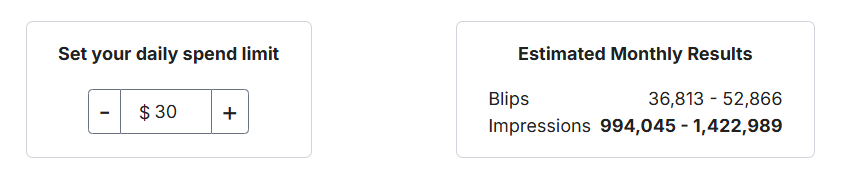
With Blip, advertising on Pinewood billboards is flexible and affordable for any budget, because you only pay for the individual blips—those 7.5 to 10-second ad displays—your campaign receives. You set a daily budget during campaign creation, and Blip automatically keeps your ads for billboards near Pinewood, Florida within that amount, so you stay in control. Costs per blip change based on when and where you choose to advertise in the Pinewood area and how much demand there is from other advertisers, but you can adjust your budget or schedule at any time.
Where can I advertise with Blip in Pinewood, Florida?
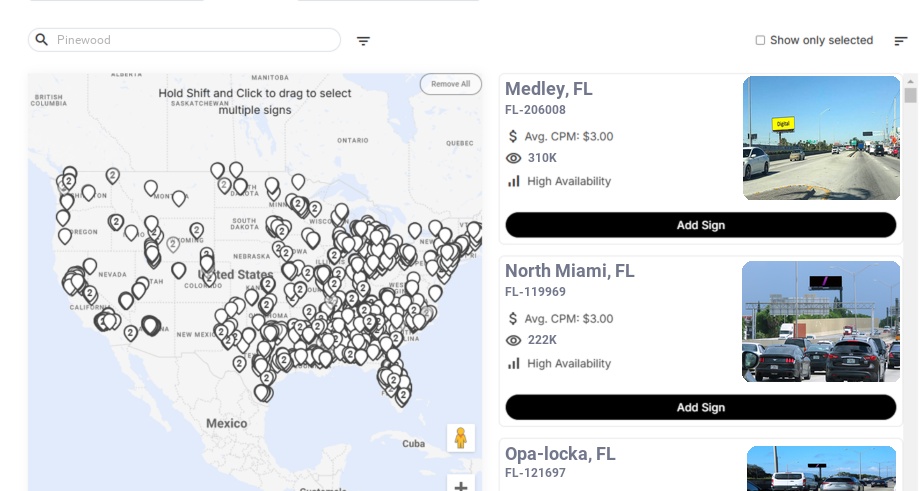
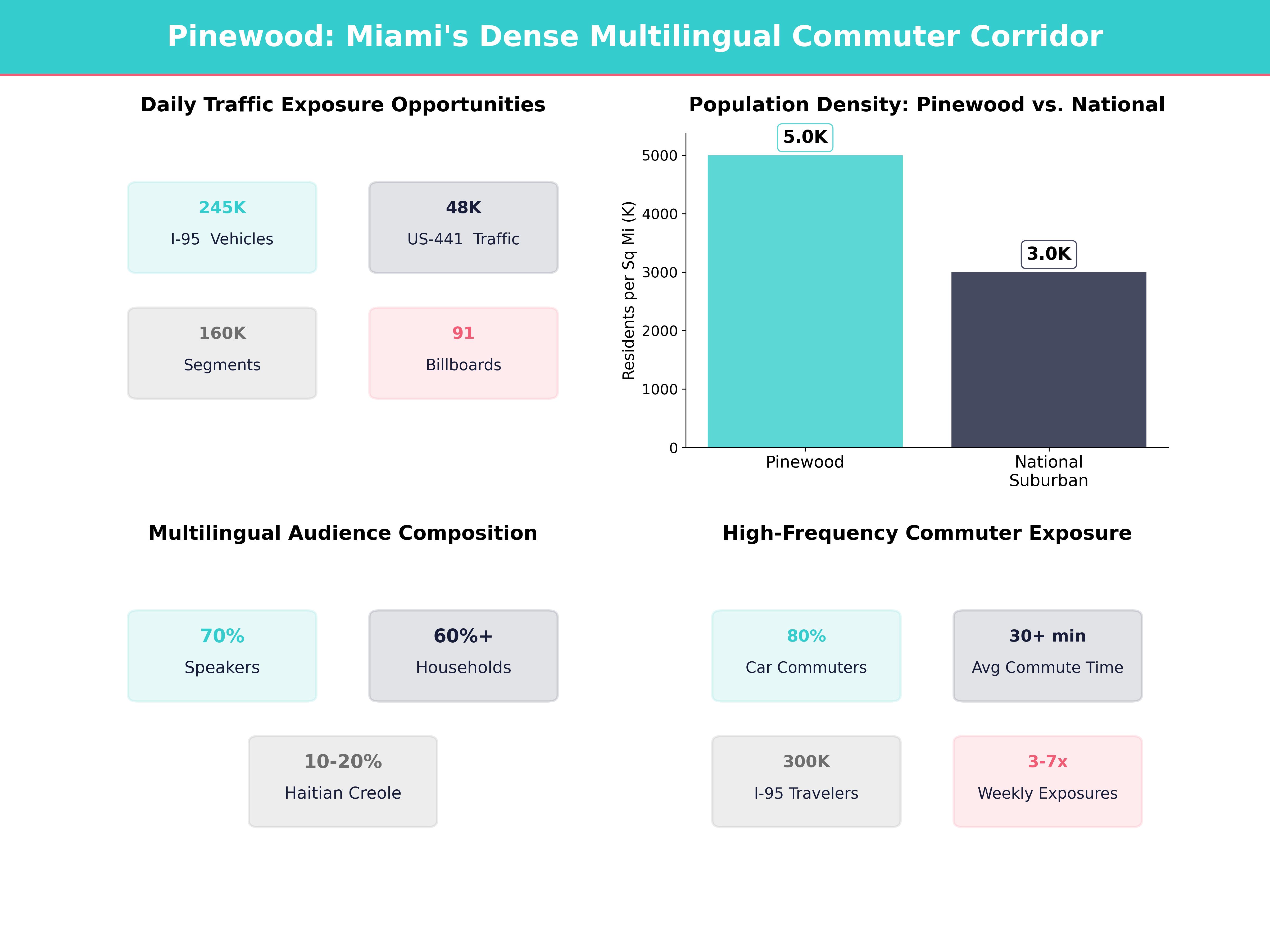
The Pinewood area has 91 digital billboards serving it from nearby cities like North Miami, Miami, Hialeah, Miami Gardens, and Miami Beach. This concentration of billboards near Pinewood makes it easy to reach both everyday commuters and local shoppers with finely targeted digital campaigns. Our 91 digital billboards within 10 miles of the Pinewood area are distributed across key nearby cities, providing a flexible framework for billboard rental near Pinewood tailored to your exact audience.
What kind of audience do Pinewood, Florida billboards reach?
The Pinewood area is a compact but densely populated community in unincorporated Miami-Dade County, just northwest of Miami’s urban core, making it an ideal hub for Pinewood billboards that reach nearby households multiple times per week. The Pinewood CDP has around 16,500 residents within roughly 3 square miles, yielding an estimated residential density above 5,000 residents per square mile. Miami-Dade County is about 69% Hispanic or Latino and about 17% Black or African American, and the Pinewood area has a particularly strong Caribbean influence, including a large Haitian-American population.
What roads around Pinewood, Florida get the most billboard traffic with Blip?
The Pinewood area sits between some of Miami-Dade’s most heavily traveled north–south and east–west roadways. Near NW 79th St and NW 103rd St interchanges, I‑95 carries roughly 230,000–260,000 vehicles per day, and US‑441 / NW 7th Ave typically carries tens of thousands of vehicles daily. NW 79th St and NW 95th St can carry 25,000–40,000 vehicles per day, with significant weekend activity as residents travel to shopping centers and beaches.
When is the best time to run billboards near Pinewood, Florida?
Weekdays are strong during the AM drive, midday, and PM drive, with many corridors seeing 30–40% of daily traffic during the combined morning and evening peaks. Saturdays and Sundays are especially good for boards in shopping and leisure destinations such as Aventura, Miami Beach, and retail corridors in Hialeah, Miami Gardens, and North Miami. With Blip’s flexibility, we can increase your ad frequency on the specific days and times that matter most for your business, rather than paying for blanket exposure 24/7.
Do I need a contract to advertise with Blip near Pinewood?
No, Blip has no long-term contracts or minimum commitments. You can start, pause, or stop your campaign at any time.
How fast can I launch a billboard campaign with Blip near Pinewood?
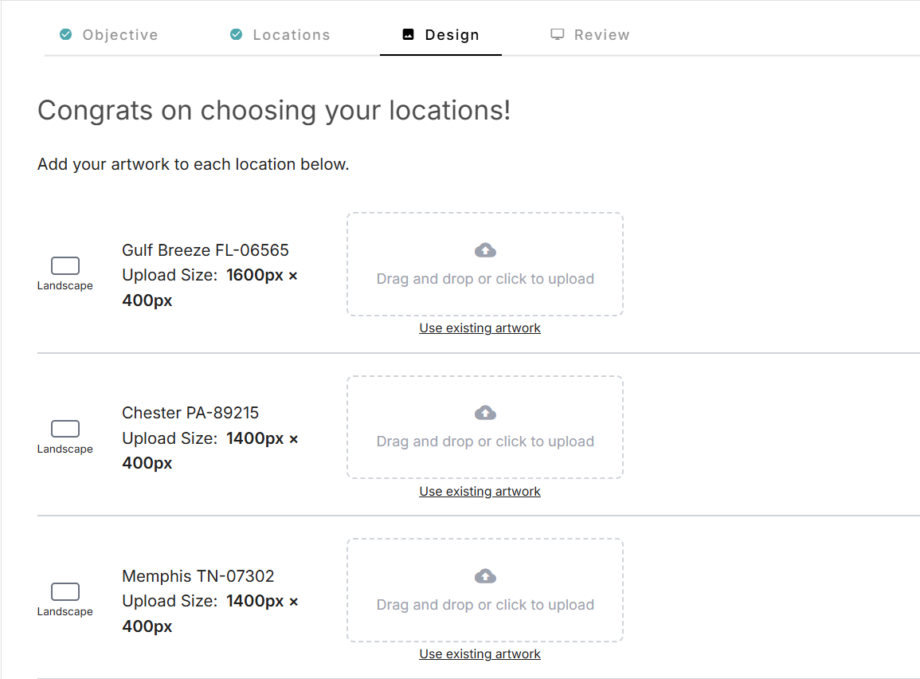
You can have your campaign live in minutes. Create a free account, select your locations, set your budget, upload your design, and start running once approved.
Where can I advertise with Blip near Pinewood?
Blip has digital billboards near Pinewood. You can browse available locations on a map, choose the ones that fit your audience, and start advertising right away.
Still have questions? Launch a campaign in minutes — no contracts, no commitments.
Start Your CampaignPinewood Billboard Advertising Guide
The Pinewood area sits at the heart of northern Miami-Dade County, surrounded by dense residential neighborhoods, major commuter corridors, and some of South Florida’s busiest commercial districts. With 91 digital billboards serving the Pinewood area from nearby cities like North Miami, Miami, Hialeah, Miami Gardens, and Miami Beach, we can tap into a high-frequency, high-diversity audience that lives, works, shops, and drives just minutes from Pinewood. This concentration of billboards near Pinewood makes it easy to reach both everyday commuters and local shoppers with finely targeted digital campaigns.
Understanding the Pinewood Area Audience
The Pinewood area is a compact but densely populated community in unincorporated Miami-Dade County, just northwest of Miami’s urban core, making it an ideal hub for Pinewood billboards that reach nearby households multiple times per week.
- Population and density: The Pinewood CDP has around 16,500 residents within roughly 3 square miles, yielding an estimated residential density above 5,000 residents per square mile—significantly higher than the national suburban average, which is often under 3,000 residents per square mile. Nearby unincorporated communities in Miami-Dade County show similar densities, creating a continuous band of close-knit neighborhoods around Pinewood.
- Households and families: County planning data indicate that more than 70% of households in nearby unincorporated neighborhoods are family households, with average household sizes often in the 2.8–3.2 range—meaning many billboards are viewed by decision-making families rather than single-person households.
- Age: Miami-Dade County overall has a median age around 40, but the Pinewood area skews younger, with a strong presence of working-age adults and families with children. In comparable nearby communities, roughly 25–28% of residents are under age 18 and about 55–60% are between 18 and 64, giving advertisers access to a large base of working adults and parents.
-
Diversity:
- Miami-Dade County is about 69% Hispanic or Latino and about 17% Black or African American, according to county data from local planning and economic development reports.
- County estimates show that more than 50% of residents are foreign-born, and in some northern neighborhoods that share characteristics with Pinewood, that share can exceed 60%.
- The Pinewood area has a particularly strong Caribbean influence, including a large Haitian-American population, alongside African American and Latino communities. In nearby tracts, residents of Caribbean origin can represent 30–40% or more of the population.
-
Language:
- Over 70% of Miami-Dade residents speak a language other than English at home, with Spanish and Haitian Creole being the dominant non‑English languages.
- In some north-county neighborhoods, Spanish speakers can account for more than 60% of households, while Haitian Creole is spoken in 10–20% of households, making multilingual messaging a practical necessity rather than a luxury.
- For campaigns near the Pinewood area, bilingual (English/Spanish) or English plus Haitian Creole can significantly increase relevance and response, especially in categories like healthcare, education, financial services, and community-oriented retail.
Local government and planning information from Miami-Dade County and Miami-Dade County’s planning department
Implications for advertisers
- Use bilingual or trilingual creative when possible—English + Spanish, and consider Haitian Creole for services benefiting local families, healthcare, remittance, and education.
- Highlight family-friendly value propositions: affordable prices, education opportunities, after-school activities, and essential services, reflecting the high share of family households and school-age children.
- Localize copy (e.g., “Serving families near NW 79th St & 7th Ave” or “Just minutes from the Pinewood area”) so residents recognize their neighborhood and feel spoken to directly when they see Pinewood billboards.
- Consider including “Se habla Español” or “Nou pale Kreyòl” in categories where trust and communication matter (legal, healthcare, financial services), since more than 7 in 10 residents countywide speak a non‑English language at home.
Key Traffic Corridors and Commuting Patterns Near Pinewood
The Pinewood area sits between some of Miami-Dade’s most heavily traveled north–south and east–west roadways. According to transportation data from the Florida Department of Transportation District Six Miami-Dade Transportation Planning Organization Miami-Dade Transit, several nearby corridors see very high daily traffic volumes that are ideal for digital billboards near Pinewood:
-
I‑95 (Miami–Fort Lauderdale corridor)
- Near NW 79th St and NW 103rd St interchanges (just east of the Pinewood area), I‑95 carries roughly 230,000–260,000 vehicles per day, placing it among the busiest segments in South Florida.
- Peak-hour speeds can drop below 30 mph during rush hour, increasing dwell time and billboard exposure.
- This interstate is a primary commuter route for residents heading to Downtown Miami, Miami Beach, and north into Broward County; regional estimates suggest that more than 300,000 people cross county lines daily along this corridor.
-
US‑441 / NW 7th Ave
- Running directly along the western edge of the Pinewood area, this corridor typically carries tens of thousands of vehicles daily (often in the 35,000–60,000 range), according to FDOT count stations.
- It is heavily used for local trips—groceries, schools, churches, and workplaces—not just long-distance commuting. On some segments, local trips can account for more than 60% of vehicle movements.
-
NW 79th St and NW 95th St
- Key east–west connectors tying the Pinewood area to I‑95, North Miami, Hialeah, and Miami Beach.
- Depending on the segment, these roads can carry 25,000–40,000 vehicles per day, with significant weekend activity as residents travel to shopping centers and beaches.
- These corridors move local residents to retail and job centers in North Miami, Hialeah, and central Miami; county traffic studies show that retail hubs along these routes can attract visitors from a 5–10 mile radius.
-
Gratigny Parkway (SR‑924) and Palmetto Expressway (SR‑826)
- To the west and northwest of the Pinewood area, these expressways move traffic between Hialeah, Miami Gardens, and the broader metro area, with many drivers originating from or passing near the Pinewood area.
- Combined, some segments of SR‑924 and SR‑826 see daily traffic volumes in the 120,000–200,000 vehicle range, offering repeated exposure for commuters linking industrial, warehouse, and residential zones.
With 91 digital billboards positioned within a 10‑mile radius—especially in North Miami, Miami Gardens, Hialeah, and Miami—we can intersect these traffic flows multiple times per week (or per day) for the average driver from the Pinewood area. Given that typical commuters in Miami-Dade make about 2–4 car trips per day, well-placed boards near Pinewood can easily generate dozens of impressions per person per week for heavily traveled categories like grocery, healthcare, and quick-service restaurants. This makes billboard advertising near Pinewood a cost-effective way to stay top of mind for core local audiences.
Implications for advertisers
- Focus heavier impressions on commuter corridors like I‑95 and key connectors such as NW 79th St for broad awareness, taking advantage of their 200,000+ daily vehicle volumes with Pinewood billboards that drivers see repeatedly.
- Supplement with boards in North Miami, Hialeah, and Miami Gardens to capture residents running errands and working near the Pinewood area; these corridors often see stable traffic across both weekdays and weekends.
-
Use time-of-day targeting to match commuting windows:
- Morning: 6:30–9:30 a.m.
- Evening: 3:30–7:00 p.m.
- Midday: 11:00 a.m.–2:00 p.m. for errands and lunch traffic.
- Consider weekend-heavy schedules on routes leading to shopping corridors and beaches, where Saturday and Sunday traffic can rival or exceed weekday volumes on some arterials.
Strategic Use of Blip’s 91 Digital Billboards Serving the Pinewood Area
Our 91 digital billboards within 10 miles of the Pinewood area are distributed across key nearby cities, providing a flexible framework for billboard rental near Pinewood tailored to your exact audience:
-
Closest to the Pinewood area
- North Miami (about 2.3 miles away)
- North Bay Village (3.9 miles)
- Opa‑locka (4.2 miles)
- Miami Gardens (4.6 miles)
- Hialeah (5.3 miles)
- North Miami Beach (5.8 miles)
-
Within a broader 10‑mile ring
- Medley and Miami (about 7.4 miles)
- Hialeah Gardens
- Aventura (7.9 miles)
- Miami Beach (8.0 miles)
- West Park
- Hallandale Beach (8.9 miles)
This footprint allows us to:
-
Blanket the northern Miami urban beltline.
Combine billboards in Hialeah, Miami Gardens, North Miami, and Opa‑locka to reach the majority of weekday drivers from the Pinewood area. In these cities, daytime populations swell well above residential counts due to inbound workers; in some cases, daytime population can be 20–40% higher than nighttime population, increasing the pool of potential viewers for billboard advertising near Pinewood. -
Bridge local and visitor audiences.
By adding boards in Miami Beach, North Bay Village, and Aventura, we reach not only local residents from the Pinewood area but also tourists and shoppers traveling to the beaches and upscale malls. Visitor-heavy zones like Miami Beach and Aventura routinely report millions of annual visitors through hotels and major shopping centers, multiplying the incremental reach of your message beyond local households. -
Layer reach and frequency.
- A Pinewood-area commuter who drives from NW 95th St to Downtown Miami can see your ad on multiple boards in one day (on I‑95, then in central Miami). If that commuter makes this round trip 5 days a week, they might pass the same board up to 10 times weekly, supporting high-frequency campaigns.
- Another commuter heading toward Hialeah or Miami Gardens for work can encounter your message on different boards across several routes throughout the week. If they alternate between SR‑826 and local arterials, a distributed board mix can still maintain 3–7 weekly exposures per person.
Because Blip allows fine-grained control over when and where your ad appears, we can:
- Start with a cluster of boards closest to the Pinewood area to nail local relevance, focusing on corridors that collectively see over 100,000 daily vehicles and give your Pinewood billboards dense local coverage.
- Gradually add boards in Miami Beach, Aventura, and Hallandale Beach when you’re promoting tourist-facing offerings, large sales, or seasonal events that benefit from the millions of annual visitors reported by tourism authorities.
- Allocate more frequent “blips” during your peak business hours while still maintaining a budget-conscious presence at other times, using performance data from your own traffic, calls, and online analytics to refine the schedule.
Creative Best Practices for the Pinewood Area
To convert impressions into action in the Pinewood area, creative must be quick to understand and culturally resonant so your billboards near Pinewood stand out in a crowded visual environment.
1. Language and cultural relevance
-
Consider:
- English + Spanish on a single design (“English headline / Spanish subline”), or alternate English and Spanish creatives. Since nearly 7 in 10 county residents identify as Hispanic or Latino, Spanish-inclusive creative can substantially widen your addressable audience.
- Separate English and Haitian Creole versions if you serve a high proportion of Haitian-American residents (healthcare, banking, schools, community services). In nearby north-county neighborhoods, Haitian Creole speakers can represent more than 1 in 10 residents.
- Keep translations simple and large; avoid small, dense text in multiple languages at once. Remember that at 40–60 mph, viewers only have seconds to process messages in any language.
2. Message simplicity
Drivers at 40–60 mph have 5–8 seconds to process your message:
-
Aim for:
- 7 words or fewer in the main headline.
- 1 CTA (e.g., “Exit at 79th St,” “Call 305‑XXX‑XXXX,” or “Visit PinewoodAuto.com”).
- Use large, high-contrast color schemes—bright colors on dark backgrounds or vice versa.
- Avoid more than 1–2 key visual elements; cluttered designs can reduce recall and lower response, especially for bilingual executions.
3. Neighborhood-based targeting in copy
Pinewood-area residents identify with both their immediate cross streets and the nearby cities they frequent:
-
Example hooks:
- “Just 5 minutes from NW 95th & 7th Ave”
- “Serving families near the Pinewood area”
- “North Miami location – Easy drive from the Pinewood area”
- When using nearby city names, mention travel time or routes the Pinewood area uses, like “off NW 79th St” or “near I‑95”.
- Where appropriate, reference known destinations such as local parks, schools, or civic centers listed by Miami-Dade Parks, Recreation and Open Spaces to help people orient themselves.
4. Visual cues that resonate
Consider imagery that matches daily life near the Pinewood area:
- Diverse families, students, blue-collar and service workers, and entrepreneurs that reflect Miami-Dade’s majority-minority makeup.
- Visuals of local-style food, urban neighborhoods, public transit, and churches or community centers.
- Avoid overly generic “stock” images that don’t reflect the area’s racial and cultural diversity.
- For community or nonprofit messages, include subtle visual references to local institutions (schools, churches, community centers) that many residents pass daily.
5. Mobile-friendly CTAs
Miami-Dade has high smartphone penetration and heavy use of social and messaging apps; industry estimates for large metros like Miami commonly place smartphone adoption above 85–90% of adults.
-
Use:
- Simple URLs (short domains or vanity URLs).
- Phone numbers with clear labels (“Call now”).
- Clear brand names that people can easily search online.
- For campaigns aligned with social media, use a unified, easy-to-remember hashtag or handle.
- Consider tying billboard flights to digital pushes on local platforms and news sites such as the Miami Herald NBC 6 South Florida, where many residents consume daily news.
Timing and Seasonality in the Pinewood Area
South Florida’s climate and tourism patterns shape when and how we should invest in digital billboard campaigns near the Pinewood area.
1. Tourism and visitors
The Greater Miami Convention & Visitors Bureau reports that the Miami area attracts tens of millions of visitors annually (both overnight and day visitors), with visitor spending in the tens of billions of dollars. In recent years, the region has reported well over 20 million overnight visitors in a typical year, generating more than $20 billion in direct visitor spending on lodging, food, entertainment, and shopping.
The heaviest influx of tourism is typically:
- December–April (peak winter “snowbird” and vacation season), when some hotels and vacation rentals report occupancy rates above 80–90%.
- Spring break periods in March and early April, when Miami Beach and nearby barrier islands can see daily visitor counts spike significantly.
- Long holiday weekends (Memorial Day, Labor Day) and major event weeks (music festivals, sporting events, cultural festivals).
Although the Pinewood area itself is residential, many residents work in tourism-related industries or travel daily to tourist-heavy areas like Miami Beach, Downtown Miami, and Aventura. Tourism accounts for tens of thousands of jobs countywide, meaning a large share of Pinewood’s working adults either serve visitors or work in businesses that benefit indirectly from tourism activity. That means:
- Seasonal tourism campaigns (restaurants, attractions, events) should emphasize boards in Miami Beach, North Bay Village, Aventura, and central Miami, while still maintaining presence on corridors residents from the Pinewood area use to commute.
- Businesses that cater to both locals and visitors (e.g., malls, restaurants, entertainment venues) can leverage mixed placements to reach employees on their commute and visitors near their destination.
2. Weather and storm season
Hurricane season (June–November) and the summer rainy season affect driving conditions and consumer priorities:
- South Florida averages more than 50–60 inches of rain annually, with the bulk falling in summer and early fall. During this period, drivers pay extra attention to safety and reliability.
- During summer, longer daylight hours mean more visibility for bright, colorful creatives; sunrise can be before 6:30 a.m. and sunset after 8:00 p.m. at peak, extending high-visibility windows.
- Messaging around home services, insurance, auto repair, and disaster prep can be particularly timely from June through October, especially when local media and emergency management agencies ramp up communication.
- Hyper-local service messages (“Rapid response near the Pinewood area”) can stand out when storm topics dominate local news from outlets like the Miami Herald WSVN 7 News, and county emergency updates via Miami-Dade Office of Emergency Management.
3. Weekly and daily rhythms
Based on typical Miami-Dade commute and shopping patterns, supported by local transit and planning studies:
-
Weekdays
- AM drive (6:30–9:30 a.m.): Great for coffee, quick-service food, transportation, education, and job recruitment. In many corridors, 30–40% of daily traffic occurs during the combined morning and evening peaks.
- Midday (11:00 a.m.–2:00 p.m.): Ideal for lunch spots, healthcare appointments, banking, and government/administrative services, as many workers take breaks or run errands.
- PM drive (3:30–7:00 p.m.): Best for retail, grocery, childcare, after-school programs, and entertainment. Parents commuting from work to home and school pickups generate repeated exposures along the same routes.
-
Weekends
- Saturdays and Sundays: Increase focus on boards in shopping and leisure destinations such as Aventura, Miami Beach, and retail corridors in Hialeah, Miami Gardens, and North Miami. Retail and entertainment centers often report some of their highest foot traffic on weekends, especially between 11:00 a.m. and 8:00 p.m.
With Blip’s flexibility, we can increase your ad frequency on the specific days and times that matter most for your business, rather than paying for blanket exposure 24/7. Over time, you can match impression schedules with in-store sales and website analytics to see which hours produce the best returns, and then align future billboard rental near Pinewood with those high-performing periods.
Sample Campaign Approaches for Common Advertisers
Below are practical ways different types of businesses can use billboards serving the Pinewood area effectively.
Local Retailers & Services (near the Pinewood area)
Examples: grocery stores, auto repair, barbershops, beauty salons, laundromats, tax prep, insurance, cell phone stores.
- Target boards in North Miami, Hialeah, and Miami Gardens that line commuter routes from the Pinewood area. These areas include major plazas and shopping corridors that attract customers from multiple zip codes and are ideal for billboards near Pinewood that drive quick visits.
-
Messaging ideas:
- “Affordable groceries 5 minutes from the Pinewood area – NW 79th St & 27th Ave”
- “Free estimates – Auto repair near US‑441 & NW 95th St”
-
Tactics:
- Run heavier during end-of-month and payday weeks when spending spikes; many households receive paychecks biweekly or monthly, and retailers often see 10–20% sales lifts around these cycles.
- Use Spanish and English; for services with many Haitian customers, add a Creole version of your most important message.
- Reference nearby landmarks or cross streets identified on Miami-Dade County neighborhood maps
Healthcare, Clinics, and Social Services
Examples: community clinics, urgent care, dental, pediatric, behavioral health, immigration support, nonprofit services.
- Target boards closest to I‑95 and US‑441, plus boards near hospital or clinic locations in North Miami, Hialeah, or central Miami. Major medical centers draw patients from 5–15 miles away, including Pinewood.
-
Messaging ideas:
- “Walk‑in clinic – No insurance? No problem. Near the Pinewood area.”
- “Free after-school tutoring – Serving families near NW 79th St.”
-
Tactics:
- Run consistent, all-week presence for general awareness, then layer in short bursts with more impressions during health campaigns (e.g., back‑to‑school vaccinations, open enrollment, or seasonal flu shots).
- Include clear hours and walk-in availability, since a high share of local residents work variable shifts in service and hospitality sectors.
Education and Training
Examples: charter schools, private schools, adult education, language schools, trades training.
- Target boards on routes parents and students use: NW 79th St, I‑95, connectors to North Miami, Hialeah, and Miami Gardens. Many local schools draw from catchment areas of 3–7 miles, making these corridors critical.
-
Messaging ideas:
- “Now enrolling – K‑8 charter, minutes from the Pinewood area.”
- “Train for a new career – HVAC, electrical, medical assistant.”
-
Tactics:
- Heavier runs before and during enrollment windows (spring/summer) and just before the academic year starts, when parents are actively comparing schools.
- Use strong visuals of diverse students and clear CTAs (“Apply today at…”, “Call now”).
- Highlight measurable benefits: graduation rates, job placement rates, or scholarship availability where applicable.
Real Estate, Apartments, and Home Services
Examples: apartment complexes, homebuilders, real estate agents, roofing, AC repair, landscaping.
- Target boards in all surrounding cities (North Miami, Hialeah, Miami Gardens, Miami, Hialeah Gardens, Medley) to reach renters and homeowners who may be looking to move or need services. In many Miami-Dade neighborhoods, more than half of households are renters, so proximity messaging is powerful.
-
Messaging ideas:
- “New 2–3 BR apartments 10 mins from the Pinewood area – From $X/mo.”
- “Emergency AC repair – 24/7 service for homes near the Pinewood area.”
-
Tactics:
- Time campaigns with hot-weather months (AC, roofing), tax refund season (home upgrades), and new school-year periods (moving and leasing), when housing moves and service requests often rise.
- Emphasize fast response times and local crews, especially during storm season when roof and AC calls spike after heavy rain or high winds.
Entertainment, Dining, and Events
Examples: local restaurants, nightclubs, festivals, churches, concerts, community events.
- Target boards toward destination areas—Miami, Miami Beach, North Bay Village, Aventura—plus commuter routes from the Pinewood area. Entertainment districts in these areas can attract thousands of visitors per night during peak seasons.
-
Messaging ideas:
- “Caribbean food worth the drive – 10 mins from the Pinewood area.”
- “Sunday service – All are welcome – Just off I‑95.”
-
Tactics:
- Concentrated bursts 1–2 weeks leading up to events or openings to drive RSVPs and buzz.
- Weekend-heavy scheduling for nightlife and dining, concentrating impressions between 4:00 p.m. and midnight on Fridays and Saturdays.
- Coordinate messaging with event listings on local outlets like NBC 6 South Florida or community calendars promoted by the Greater Miami Convention & Visitors Bureau.
Measuring and Optimizing Your Campaign
To make sure your campaign near the Pinewood area delivers ROI, we should continuously test and refine.
1. Align with your local data
-
Compare billboard flight dates with:
- Website traffic by zip code (look for zip codes adjacent to the Pinewood area).
- In-store foot traffic and POS data.
- Call volume or form submissions.
- Note which boards and time windows align with spikes in interest or sales. For example, a 15–25% bump in calls from specific zip codes during a billboard push suggests your location mix is working.
- Use tools from your point-of-sale or CRM platform to track promo codes or “how did you hear about us?” responses tied to billboards.
2. Test creative variations
-
Run multiple creatives:
- English-only vs. bilingual.
- Price-focused vs. brand/benefit focused.
- Different CTAs (call, visit website, exit directions).
- Rotate creatives across the same board locations to see which versions coincide with better outcomes in your internal metrics.
- In multilingual communities like Pinewood’s surroundings, monitor whether bilingual ads increase response rates in Spanish- or Creole-speaking segments.
3. Adjust location mix
- If you see strong response from customers mentioning Miami Gardens or Hialeah locations, increase impressions on boards in those specific cities.
- If your business draws from tourism and beachgoers, shift more impressions toward Miami Beach, North Bay Village, and Aventura boards during peak visitor seasons outlined by the Greater Miami Convention & Visitors Bureau.
- For hyper-local services, emphasize boards within 3–5 miles of your storefront, which is often the primary trade area for everyday services like grocery, auto repair, and healthcare, and where concentrated billboard advertising near Pinewood can have the biggest impact.
4. Stay tuned to local news and events
- Local outlets like the Miami Herald NBC 6 South Florida, and WSVN 7 News regularly cover transportation projects, major events, and neighborhood developments that can affect traffic patterns near the Pinewood area.
- When new construction, roadwork, or events change routes (e.g., detours off I‑95 or along US‑441), we can quickly redirect your spend to boards along the new traffic flows.
- Monitor updates from Miami-Dade County’s transportation pages and local municipalities like City of North Miami and City of Hialeah for information on road projects and festivals that may boost or shift traffic.
By tapping into the 91 digital billboards serving the Pinewood area and the surrounding cities of North Miami, Hialeah, Miami Gardens, Miami, and Miami Beach, we can build campaigns that are hyper-local yet far-reaching. With precise control over timing, location, and creative, Blip lets us tailor your message to the diverse, mobile, and media-savvy audience that lives and works near the Pinewood area. Whether you’re testing your first billboard rental near Pinewood or scaling a multi-city push, this network turns daily commutes and errands into powerful moments of brand connection.