Billboards near Miami Lakes, FL
No Minimum Spend. No Long-Term Contracts. Just Results.
Trusted by Leading Brands


Billboard advertising
near Miami Lakes has never been easier



How much is a billboard near Miami Lakes?
Why Choose Blip for Billboard Advertising near Miami Lakes
Blip lets you launch Miami Lakes billboards fast on SR 826, I-75, and US 27 commuter corridors—no media-buying hassle.
Use flexible daily budgets in Miami Lakes to reach bilingual shoppers, families, and logistics workers without overcommitting.
Daypart your Miami Lakes ads for rush hour, midday errands, or Hard Rock Stadium game traffic—then switch anytime.
No contracts make it easy to test Miami Lakes creative near Hialeah, Medley, and Miami Gardens, then scale what works.
Track Miami Lakes campaign results in real time and adjust for traffic spikes, storm season, and back-to-school demand.
Blip's creative tools help you build bilingual Miami Lakes ads that stand out on fast-moving highways and local shopping routes.
Frequently Asked Questions About Billboard Advertising near Miami Lakes
How much does a billboard cost near Miami Lakes, Florida with Blip?
With Blip’s pay-per-blip digital advertising, you control exactly how much you spend on Miami Lakes billboards by setting a daily budget that can be adjusted at any time. Each blip is a quick 7.5 to 10-second display, and you only pay for the blips you receive, so even modest budgets can get visibility on billboards near Miami Lakes, Florida serving the Miami Lakes area. Pricing for each blip changes based on when you run your ads and local advertiser demand, making it easy to scale up during key times or stay lean during slower periods.
Where can I advertise with Blip near Miami Lakes, Florida?
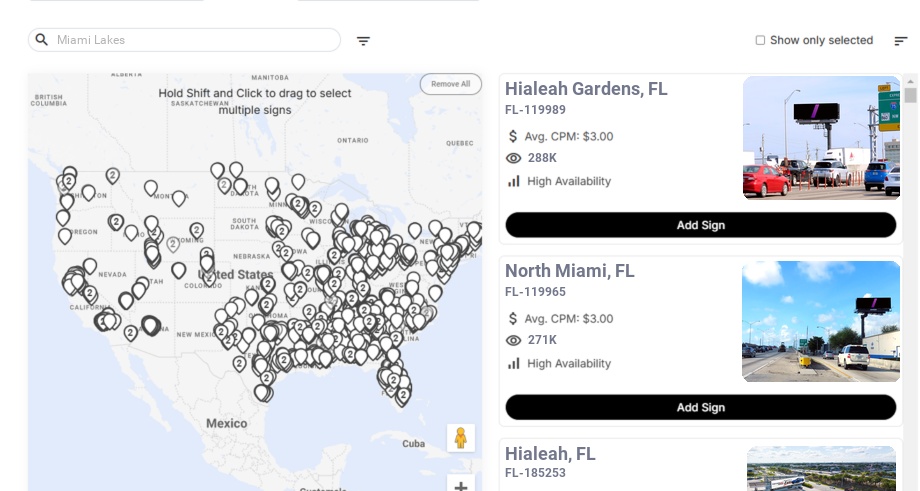
There are 62 digital billboards serving the Miami Lakes area from nearby cities like Hialeah Gardens, Hialeah, Medley, Miami Gardens, and Miramar. These boards are strategically placed on major corridors such as SR 826, I-75, Gratigny Parkway, US 27, and Miami Gardens Drive to intercept commuters and shoppers. By selecting specific Blip boards in surrounding cities, you can reach drivers who move around Miami Lakes every day.
Why is Miami Lakes, Florida a strong market for billboard advertising with Blip?
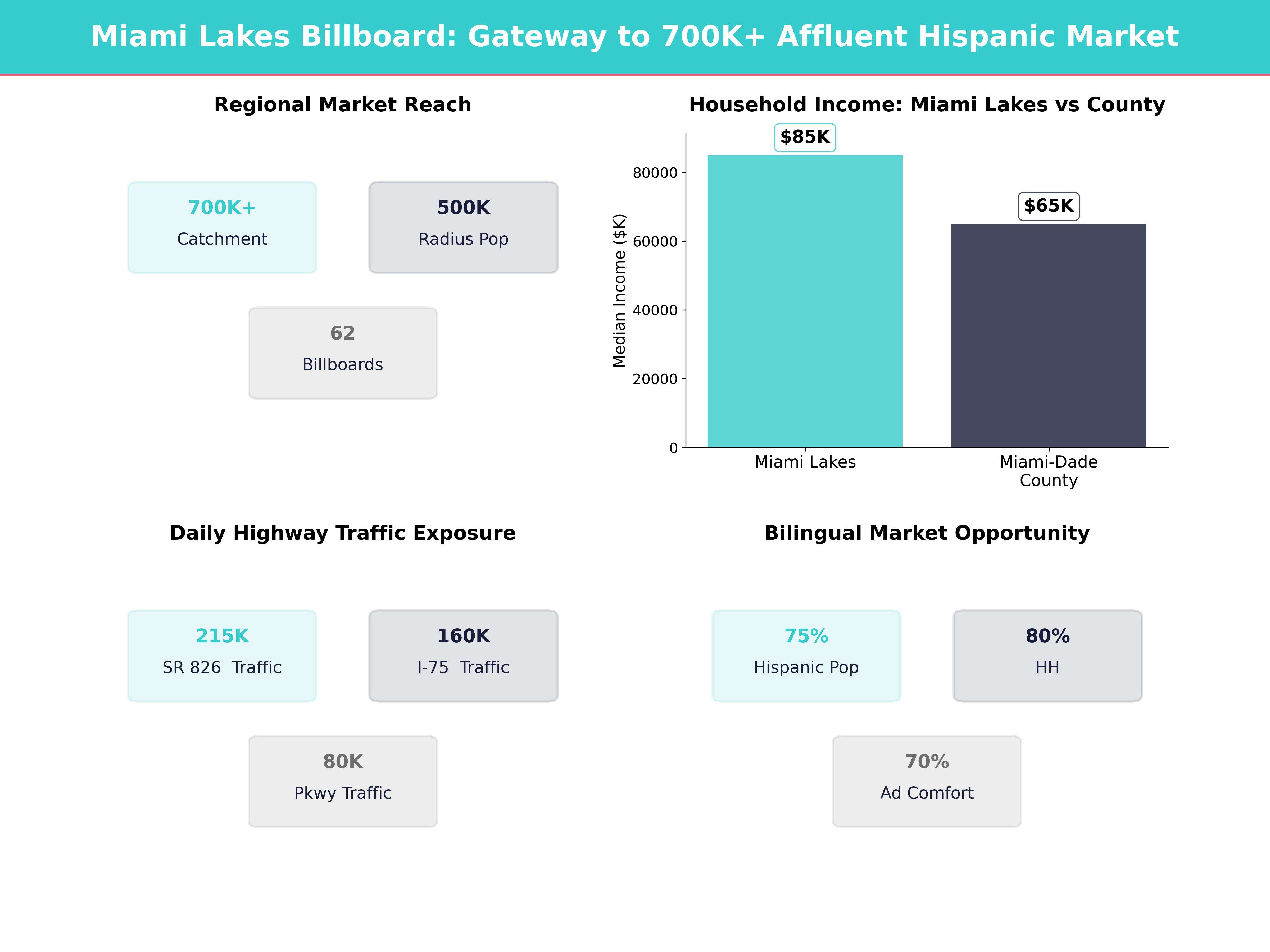
Miami Lakes sits at the crossroads of some of Miami-Dade County’s busiest commuter, shopping, and logistics corridors. The area combines steady local traffic, regional commuters, and spillover from the broader Miami–Fort Lauderdale metro, making it a powerful option for advertisers that want consistent visibility. Nearby communities create a combined market of almost 500,000 people within roughly a 10-mile radius, with the broader catchment topping 700,000+.
What kind of audience can I reach on Miami Lakes billboards with Blip?
The Miami Lakes area reaches a dense, high-income, largely bilingual audience that lives, works, shops, and drives nearby every day. Many surrounding municipalities have Hispanic or Latino populations in the 90–95% range, and in several nearby zip codes 80–90% of households report speaking a language other than English at home, predominantly Spanish. The area is also family-oriented and commuter-heavy, which makes it a strong fit for local service, retail, and family-focused campaigns.
When is the best time to run Miami Lakes, Florida billboard ads with Blip?
Traffic near Miami Lakes follows predictable patterns that you can capitalize on with time-of-day targeting. Morning peak is typically 7:00–9:00 a.m., while the evening peak is generally 4:30–7:00 p.m., with weekday congestion often lasting 2–3 hours. Weekends and midday hours are also strong for shopping, dining, family outings, and appointments.
Do I need a contract to advertise with Blip near Miami Lakes?
No, Blip has no long-term contracts or minimum commitments. You can start, pause, or stop your campaign at any time.
How fast can I launch a billboard campaign with Blip near Miami Lakes?
You can have your campaign live in minutes. Create a free account, select your locations, set your budget, upload your design, and start running once approved.
Where can I advertise with Blip near Miami Lakes?
Blip has digital billboards near Miami Lakes. You can browse available locations on a map, choose the ones that fit your audience, and start advertising right away.
Still have questions? Launch a campaign in minutes — no contracts, no commitments.
Start Your CampaignMiami Lakes Billboard Advertising Guide
Miami Lakes sits at the crossroads of some of Miami‑Dade County's busiest commuter, shopping, and logistics corridors. With 62 digital billboards serving the Miami Lakes area from nearby cities like Hialeah Gardens Hialeah, Medley, Miami Gardens, and Miramar, we can help you reach a dense, high‑income, largely bilingual audience that lives, works, shops, and drives near Miami Lakes every day. These billboards near Miami Lakes give you regional reach while still feeling hyper‑local to residents who identify strongly with the community.
Why the Miami Lakes Area Is a High‑Value Billboard Market
The Miami Lakes area offers a rare combination of steady local traffic, regional commuters, and spillover from the broader Miami–Fort Lauderdale metro, making Miami Lakes billboards a powerful option for advertisers that want consistent visibility:
- Population density nearby: Miami Lakes itself is home to roughly 31,000–32,000 residents packed into about 6.5 square miles, for a density of nearly 4,800–5,000 residents per square mile, according to town planning and county demographic reports from the Town of Miami Lakes and Miami‑Dade County. Neighboring Hialeah (about 220,000 residents), Miami Gardens (about 112,000–115,000 residents), and Miramar (about 135,000–140,000 residents) create a combined nearby market of almost 500,000 people within roughly a 10‑mile radius, with the broader northwest Miami‑Dade/Broward catchment topping 700,000+ when you include Medley, Opa‑locka, and North Miami.
- Affluent consumer base: According to town data from the Town of Miami Lakes, median household income in the Miami Lakes community is in the $80,000–$90,000 range, compared with roughly $60,000–$70,000 for Miami‑Dade County overall based on county economic reports. In several master‑planned neighborhoods, median household incomes exceed $100,000, supporting higher‑ticket purchases—automotive, home services, financial products, healthcare, and premium retail.
- Bilingual majority: Many municipalities serving the Miami Lakes area, such as Hialeah and Hialeah Gardens, report Hispanic/Latino populations in the 90–95% range, and Miami Lakes itself is majority Hispanic with estimates often in the 70–80% range of residents identifying as Hispanic or Latino. In several nearby zip codes, 80–90% of households report speaking a language other than English at home, predominantly Spanish. That makes bilingual or Spanish‑forward billboard creative an especially powerful lever.
- Regional economic engine: Miami‑Dade County has more than 2.7 million residents and supports over 1.3 million non‑farm jobs and 90,000+ business establishments, according to the Miami‑Dade County government and county economic development reports. The county’s gross regional product is estimated at more than $175 billion annually, with trade, logistics, healthcare, and tourism as major drivers. A large share of those workers and customers move along highways and arterials near Miami Lakes every day, which our 62 nearby digital billboards can tap into.
For advertisers, this means you’re not just speaking to one small town—you’re leveraging a regional, commuter‑heavy, high‑spend audience concentrated around the Miami Lakes area, and billboard advertising near Miami Lakes lets you reach that audience repeatedly as they move between home, work, and leisure.
Understanding the Miami Lakes‑Area Audience
Designing effective billboard campaigns near Miami Lakes starts with understanding who you’re talking to and how they move through the area. When you plan billboard advertising near Miami Lakes with the local audience in mind, creative and placement decisions become much clearer.
Key demographic and lifestyle traits
- Family‑oriented: Miami Lakes is known for master‑planned neighborhoods, parks, and schools. The town maintains more than 100 park sites and mini‑parks and supports youth programs, leagues, and events promoted via the Town of Miami Lakes community calendar. A large share of local households are family households, and nearby communities like Hialeah and Miami Gardens also show 35–40% of residents under age 30, indicating strong demand for family‑centric products and services. Family‑centric messaging—education, healthcare, financial planning, family dining, and entertainment—tends to perform well.
- Commuter workforce: Many Miami Lakes residents commute to job centers in Doral, downtown Miami, Miami International Airport, and Fort Lauderdale Miami‑Dade Transportation Planning Organization indicate that over 60% of workers in northwest Miami‑Dade commute across municipal boundaries, and average one‑way commutes often run 30–35 minutes, with many exceeding 45 minutes. That means repeated daily exposure to roadside media.
- Language: In surrounding municipalities, Spanish is spoken at home by 70–90% of residents. In the Miami Lakes area, it’s safe to assume that well over two‑thirds of drivers are comfortable consuming ads in Spanish, and in certain corridors (Hialeah, Hialeah Gardens, and parts of Miami Gardens) the share of Spanish‑dominant households is often 75–85%. English remains essential, but Spanish and bilingual headlines can dramatically expand your reach.
- Car‑dependent: Miami‑Dade’s transit ridership is relatively low compared to car usage. County statistics and transportation surveys consistently show 80–85% of workers commuting by car, truck, or van, with transit capturing under 10% of commute trips in many northwest Miami‑Dade tracts. Average commute times hover in the 30–35 minute range and can spike higher during peak congestion. This makes roadside digital billboards a particularly efficient medium here.
Implications for your campaign
- Use clear, simple messaging that works at 55+ mph and appeals to family priorities and convenience.
- Include Spanish or bilingual variants where possible to maximize response.
- Emphasize time‑saving and value (e.g., “Same‑day AC repair,” “Under 30‑minute oil change,” “Order now, pickup today”).
Where Our Billboards Reach Drivers Near Miami Lakes
Our 62 digital billboards serving the Miami Lakes area are strategically placed in nearby cities to intercept commuters and shoppers flowing around and through the community. While the boards are located in neighboring municipalities, they are positioned on routes that Miami Lakes residents and visitors use every day, so Miami Lakes billboards on these corridors still feel local and relevant.
High‑impact corridors served by nearby boards
-
Palmetto Expressway (SR 826) and connectors
- SR 826 is one of Miami‑Dade’s busiest expressways, with Florida Department of Transportation (FDOT) counts often exceeding 200,000–230,000 vehicles per day on key segments near Hialeah and Hialeah Gardens, according to FDOT District Six
- In some interchanges near the Miami Lakes area, combined peak‑hour volumes can exceed 10,000 vehicles per hour in each direction during the morning and evening rush.
-
Boards near Hialeah Gardens and Hialeah can capture:
- Miami Lakes residents commuting south toward Doral, the airport, and Coral Gables
- Shoppers heading to nearby retail clusters, including major centers along NW 103rd St and NW 138th St
- Use this corridor for broad‑reach branding campaigns and offers that appeal to county‑wide audiences, not just local neighborhoods, especially when you want billboards near Miami Lakes that also pull from a wider metro.
-
I‑75 and Gratigny Parkway (SR 924) approaches
- I‑75 near Miami Lakes and Miramar frequently sees 150,000–170,000 vehicles per day, serving commuters between Broward County and northwest Miami‑Dade.
- In regular weekday peaks, speed‑flow data from regional transportation reports shows that average travel speeds can drop below 35 mph, increasing dwell time within sightlines of digital billboards.
- The Gratigny (SR 924) connects I‑75 and SR 826 and is heavily used for east‑west commuting, with daily traffic volumes commonly in the 70,000–90,000 vehicles per day range on key segments.
-
Boards near Miramar, Miami Gardens, and Opa‑locka are ideal for:
- Reaching Broward–Miami‑Dade cross‑border commuters, a flow that can exceed 100,000 daily trips in aggregate
- Promoting regional services (healthcare, higher education, auto dealers, and large retail centers)
-
Okeechobee Road (US 27) and industrial corridors
- US 27/Okeechobee Road running through Medley and Hialeah regularly reaches 80,000–100,000 vehicles per day in some stretches, according to FDOT and Miami‑Dade TPO count programs.
- This corridor is a spine for warehouses, manufacturers, and logistics companies; Medley alone hosts hundreds of industrial and logistics firms and thousands of daily truck movements.
- The share of commercial vehicles on this route is significantly higher than typical arterials, making it one of the top freight corridors in the county.
-
Perfect for:
- B2B and workforce advertising (recruiting drivers, warehouse employees, trades)
- Local services that workers can access on their way home (quick‑serve restaurants, gyms, auto repair).
-
Miami Gardens Drive / NW 183rd–186th streets
- Roads near Miami Gardens, West Park 50,000–70,000 vehicles per day.
-
These areas bring in:
- Visitors to Hard Rock Stadium in Miami Gardens for NFL games, concerts, and events—stadium attendance can exceed 65,000 fans for major games and 50+ large events per year including Miami Dolphins home games, college football, F1, and concerts.
- Residents heading toward Miami Lakes’ shopping and dining destinations, including Main Street Miami Lakes
- Consider event‑linked campaigns that ramp up on Dolphins game days or major concerts.
By selecting specific Blip boards in Hialeah Gardens, Medley, Miami Gardens, and other nearby cities, we can tightly match your audience’s commuting patterns around the Miami Lakes area and ensure your billboard advertising near Miami Lakes appears in the places your customers actually drive every day.
Timing Your Campaign Around Local Traffic Patterns
Traffic near Miami Lakes follows predictable patterns that you can capitalize on with time‑of‑day targeting. Smart scheduling turns static Miami Lakes billboards into dynamic campaigns that reach different audiences throughout the week.
Weekday rush hours
- Morning peak: Typically 7:00–9:00 a.m., with heavy inflow from Miramar, Miami Gardens, Hialeah, and North Miami toward job centers and industrial zones. On SR 826, I‑75, and US 27, morning peak‑hour volumes often represent 10–12% of total daily traffic, concentrating impressions.
- Evening peak: Generally 4:30–7:00 p.m., with outbound congestion on SR 826, I‑75, US 27, and east‑west connectors. Evening congested periods on weekdays can extend for 2–3 hours, especially on Fridays.
-
Use Blip’s tools to:
- Bid more aggressively during rush hours for commuter‑focused messages (auto care, fast food, banking, health clinics).
-
Show different creative in the morning vs evening. Example:
- Morning: “Skip cooking tonight—Order now, pickup at 6 p.m.”
- Evening: “Car trouble today? Schedule tomorrow’s repair in 60 seconds.”
Midday and weekend patterns
- Miami Lakes is a hub for shopping and dining, with places like Main Street Miami Lakes 90%+ occupancy, indicating strong, stable consumer demand.
- Weekends see more family outings, sports, religious services, and errands. Local event calendars from the Town of Miami Lakes and nearby municipalities frequently list dozens of community events per month, from youth sports to cultural festivals.
-
Consider:
- Running retail, dining, and entertainment messaging more heavily on Friday–Sunday and mid‑day hours.
- Promoting appointments and experiences when people have time to act (midday weekdays, Saturday mornings).
Seasonality in the Miami Lakes area
-
Tourist peak (roughly November–April):
- Greater Miami and Miami Beach welcomed about 26–27 million overnight visitors in recent pre‑pandemic years and has since returned to or exceeded those levels, with overall visitor expenditures estimated at more than $17–18 billion annually, according to the Greater Miami Convention & Visitors Bureau.
- Hotel occupancy in the greater Miami area can climb into the 70–80% range during peak months, pushing more visitors into inland hotels and driving corridors that pass near Miami Lakes and Miami Gardens.
- While Miami Lakes is not a beachfront destination, hotel guests, sports visitors, and business travelers drive through the area.
- Ideal for hotels, attractions, events, and restaurant campaigns that want to tap into out‑of‑town spending.
-
Rainy/hurricane season (approximately June–November):
- South Florida’s wet season brings 50+ inches of annual rainfall, with the majority falling between June and September, according to state and regional climate summaries used by Miami‑Dade County for resilience planning.
- Local emergency‑management messaging typically ramps up before the historical peak of hurricane season in August–October, and home‑improvement stores often see spikes in sales of generators, shutters, and roofing materials.
- Storm‑preparedness products, home services, insurance, and generators can leverage weather‑responsive creative and seasonal urgency.
-
Back‑to‑school (August–September):
- Miami‑Dade County Public Schools is one of the largest school districts in the U.S., serving 330,000+ students across the county, with numerous schools in and around Miami Lakes, including Miami Lakes Educational Center
- Families in the Miami Lakes area support strong demand for tutoring, school supplies, uniforms, after‑school programs, and medical visits. Local health systems and clinics frequently run immunization and sports‑physical campaigns during this period.
- Increase bids during late July–September and target boards along school and shopping routes.
Creative Strategies That Resonate Near Miami Lakes
To stand out on digital billboards near Miami Lakes, we recommend tailoring creative to local culture, commuting realities, and language preferences so every impression on your Miami Lakes billboards works as hard as possible.
1. Bilingual and culturally tuned messaging
- Use simple Spanish headlines, especially on boards reaching Hialeah, Hialeah Gardens, Medley, and Miami Gardens, where Hispanic shares often exceed 80–90% of residents.
-
A/B test:
- Version A: English only
- Version B: Spanish headline + English call‑to‑action
-
Examples:
- “Seguro de auto en minutos — Call Now”
- “¿Calor en casa? Same‑day AC repair”
Even modest Spanish usage can boost recognition and trust among the heavily Hispanic drivers in the Miami Lakes area, where local surveys consistently show that a majority of residents are bilingual or Spanish‑dominant.
2. Hyper‑local references
Local references signal relevance and can nudge response:
-
Mention key landmarks and neighborhoods:
- “Just off Main Street in the Miami Lakes area”
- “5 minutes from Palmetto (826) & NW 154th St”
- “Serving families near Miami Lakes Educational Center”
-
Highlight proximity:
- “Next right after the exit”
- “Across from Miami Lakes AutoMall” (if accurate to your location; see Miami Lakes AutoMall
- Reference well‑known destinations like Hard Rock Stadium Miami Dade College North Campus for student‑oriented messaging.
Just ensure all references are geographically accurate and easy to understand at a glance.
3. Design for fast‑moving traffic
Given high highway speeds:
- Keep to 7 words or fewer in your main headline; legibility research for roadside advertising often shows a sharp drop in comprehension beyond 7–10 words at 55+ mph.
- Use one strong visual focus (product, face, or bold icon).
- Make phone numbers short and easy (or omit entirely in favor of URLs/QR‑friendly vanity domains).
- Use high‑contrast colors that cut through Florida’s bright sun and afternoon glare (dark text on light background or vice versa, avoid thin fonts).
4. Leverage digital flexibility
Blip allows rotating artworks and quick swaps, so you can:
- Run multiple offers (e.g., “Oil Change $39” vs “AC Service 20% Off”) and see which correlates with more calls or web traffic.
-
Highlight time‑sensitive promos:
- “Today only”
- “This weekend”
- “Book by midnight”
-
Align creative with local news or events from outlets like the Miami Herald WPLG Local 10, NBC 6 South Florida, or WSVN 7 News:
- Game‑day specials near Hard Rock Stadium
- Back‑to‑school checkups when local school calendars (see Miami‑Dade County Public Schools) indicate start dates.
- Weather‑related offers aligned with storm coverage or heat advisories.
Strategies for Key Business Types in the Miami Lakes Area
Different industries can exploit the Miami Lakes area’s highways and demographics in distinct ways, whether you’re testing a single billboard rental near Miami Lakes or scaling up to a full regional presence.
Local retail & restaurants
- Focus on boards closest to your location in Hialeah Gardens, Medley, Miami Gardens, or North Miami, depending on your store. Retail‑trade data for Miami‑Dade indicates per‑capita retail sales in the county exceeding $15,000–$16,000 per year, underscoring strong consumer spending.
-
Use distance‑based CTAs:
- “2 miles ahead, next exit”
- “Turn right on NW 154th St”
-
Try dayparting:
- Breakfast promos: 6–10 a.m.
- Lunch specials: 11 a.m.–2 p.m.
- Dinner & nightlife: 4–9 p.m. and weekends.
- Consider highlighting delivery and pickup, as regional surveys show that 40–50% of diners in metro Miami use takeout or delivery at least weekly.
Auto dealers and service centers
Auto is huge in this car‑dependent region:
- Target SR 826, I‑75, and US 27 boards to reach high‑mileage commuters; many local commuters log 15,000–20,000+ miles per year, well above national averages in some segments due to longer commutes.
-
Rotate creative:
- “Lease from $299/mo”
- “0% APR this weekend”
- “Service specials today”
- Use strong urgency for end‑of‑month or holiday sales (Memorial Day, Fourth of July, Labor Day) when auto‑sales data routinely shows volume spikes of 10–20% compared with average months.
- Consider partnering messaging with well‑known local dealerships such as Miami Lakes AutoMall
Healthcare, dental, and clinics
-
The family‑oriented demographics around the Miami Lakes area respond well to convenience and trust:
- “Walk‑in urgent care near Miami Lakes area”
- “Open late & weekends”
- County health assessments for Miami‑Dade show that a substantial share of residents—often 20–30% in some neighborhoods—lack a regular primary‑care provider, increasing reliance on urgent care and retail clinics.
-
Emphasize:
- Bilingual staff (important in an area where 70–80% of residents speak Spanish at home in many tracts)
- Insurance acceptance
- Nearby location and easy parking
- Tap back‑to‑school and flu season with targeted bursts in August–October and January–March, when vaccination and checkup demand rises.
Education and training
Between local schools and campuses like nearby Miami Dade College North Campus, the region has a large student and workforce‑upskilling population:
- Miami Dade College serves more than 90,000 students across its campuses, with thousands attending North Campus just east of Miami Lakes.
- Advertise enrollment deadlines, scholarship windows, and open houses.
- Utilize commuter corridors to capture working adults going to and from jobs in Medley, Opa‑locka, and Hialeah.
- Emphasize outcomes: “Graduate in 12 months,” “Job placement support,” “ESL & GED programs.”
- Target key decision windows: community college and trade‑school enrollment typically spikes in July–September and December–January.
Home services (HVAC, roofing, landscaping, insurance)
Florida weather and homeownership rates in suburbs around Miami Lakes favor home‑service campaigns:
- In many northwest Miami‑Dade and south Broward neighborhoods, owner‑occupancy rates often fall in the 55–70% range, creating a solid base of homeowners responsible for maintenance decisions.
-
Use weather‑aware messaging:
- Ahead of storm season: “Hurricane‑ready roof inspections”
- On hot days: “AC repair today, sleep cool tonight” (summer heat indices in the Miami area routinely exceed 100°F on many days).
- Concentrate budgets on late afternoon and weekend slots, when homeowners are more likely to make service calls.
- Emphasize financing and insurance support; property‑insurance premiums in South Florida have risen significantly in recent years, making risk‑reduction services (roofing, shutters, impact windows) more top‑of‑mind.
Using Blip’s Flexibility to Optimize in the Miami Lakes Area
Blip’s platform lets you treat your Miami Lakes–area billboard buys more like digital media: test, learn, and refine quickly. This approach works whether you’re experimenting with a single billboard rental near Miami Lakes or managing a complex, multi‑corridor schedule.
1. Start with a tightly defined strategy
- Choose 10–20 of the 62 available boards nearest your core customers (e.g., around Hialeah Gardens for west‑side focus, or Miami Gardens/North Miami for east‑side reach).
- Use traffic data from resources like the Miami‑Dade Transportation Planning Organization and municipal planning departments to align boards with the highest average daily traffic (ADT) in your target radius.
- Set a daily budget aligned with your goals (for example, enough to achieve dozens to hundreds of “blips” per day on priority boards).
2. Test variables systematically
Run controlled experiments:
- Language: English vs bilingual
- Offer: Percentage discount vs dollar amount vs “No interest for 12 months”
- CTA: “Call now” vs “Visit today” vs “Order online”
- Timing: Rush hour only vs all‑day
Monitor performance through your own metrics (calls, web traffic, promo codes, appointment volume) to see which combinations correlate with higher response. Even shifts of 10–20% in response rate can dramatically improve ROI when scaled across tens of thousands of weekly impressions.
3. Align with local calendars and news
-
Use information from:
- The Town of Miami Lakes events calendar
- Miami‑Dade County holiday and public events
- Regional news outlets like the Miami Herald WSVN 7 News, NBC 6 South Florida, and WPLG Local 10
-
Increase your presence during:
- Major events at Hard Rock Stadium
- Town festivals and parades in the Miami Lakes area
- Tax season (January–April), holiday shopping season (November–December), and hurricane preparedness events (late spring and early summer)
4. Scale what works
Once you’ve identified winning creatives and time windows:
- Expand to more of the 62 boards serving the Miami Lakes area to increase reach. On major corridors, each board can deliver tens of thousands of daily impressions, so scaling from 10 to 30+ boards can quickly multiply your exposure.
- Extend successful dayparts and reduce spend on weaker ones.
- Refresh creative frequently so repeat commuters on SR 826, I‑75, and Okeechobee Road see new messages over time, not the same design for months. In commuter corridors where drivers may pass the same billboard 200–400 times per year, fresh creative can help maintain attention and recall.
By combining a strong understanding of the Miami Lakes area’s demographics, traffic flows, and cultural nuances with Blip’s flexible, data‑driven buying model, we can build billboard campaigns that do more than just look good—they deliver measurable impact. Whether you’re a local shop searching for billboards near Miami Lakes to drive neighborhood traffic or a regional brand seeking high‑value suburban consumers with scalable billboard advertising near Miami Lakes, the 62 digital billboards serving the Miami Lakes area give you the reach and precision to grow your business.