Billboards in Feather Sound, FL
No Minimum Spend. No Long-Term Contracts. Just Results.
Trusted by Leading Brands


Billboard advertising
in Feather Sound has never been easier



How much is a billboard in Feather Sound?
Why Choose Blip for Billboard Advertising in Feather Sound
Blip lets you launch fast in Feather Sound and target I-275 and the Howard Frankland Bridge commuters without contracts or minimums.
Use Blip in Feather Sound to auto-fit your budget and timing across Ulmerton Road and PIE traffic, where drivers are making quick decisions.
Feather Sound campaigns can daypart for rush hour, lunch, or weekends—Blip helps you hit Tampa Bay commuters, airport travelers, and beach-bound visitors.
Track Feather Sound results in real time and shift spend as Pinellas traffic changes from weekday office runs to spring events and tourism peaks.
Create and update billboard creative in Blip for Feather Sound fast, so your message stays clear for healthcare, B2B, and local service audiences.
Frequently Asked Questions About Billboard Advertising in Feather Sound
How much does a billboard cost in Feather Sound with Blip?
With Blip, billboard advertising in Feather Sound can be surprisingly affordable because you only pay when your ad actually appears. Pricing starts at just $0.01 per display, and cost per blip changes based on time of day, location, and demand. You set a daily budget, and Blip’s algorithm uses it to bid on open ad slots, helping stretch your spend for the best possible reach.
Where can I advertise with Blip in Feather Sound to reach commuters and airport traffic?
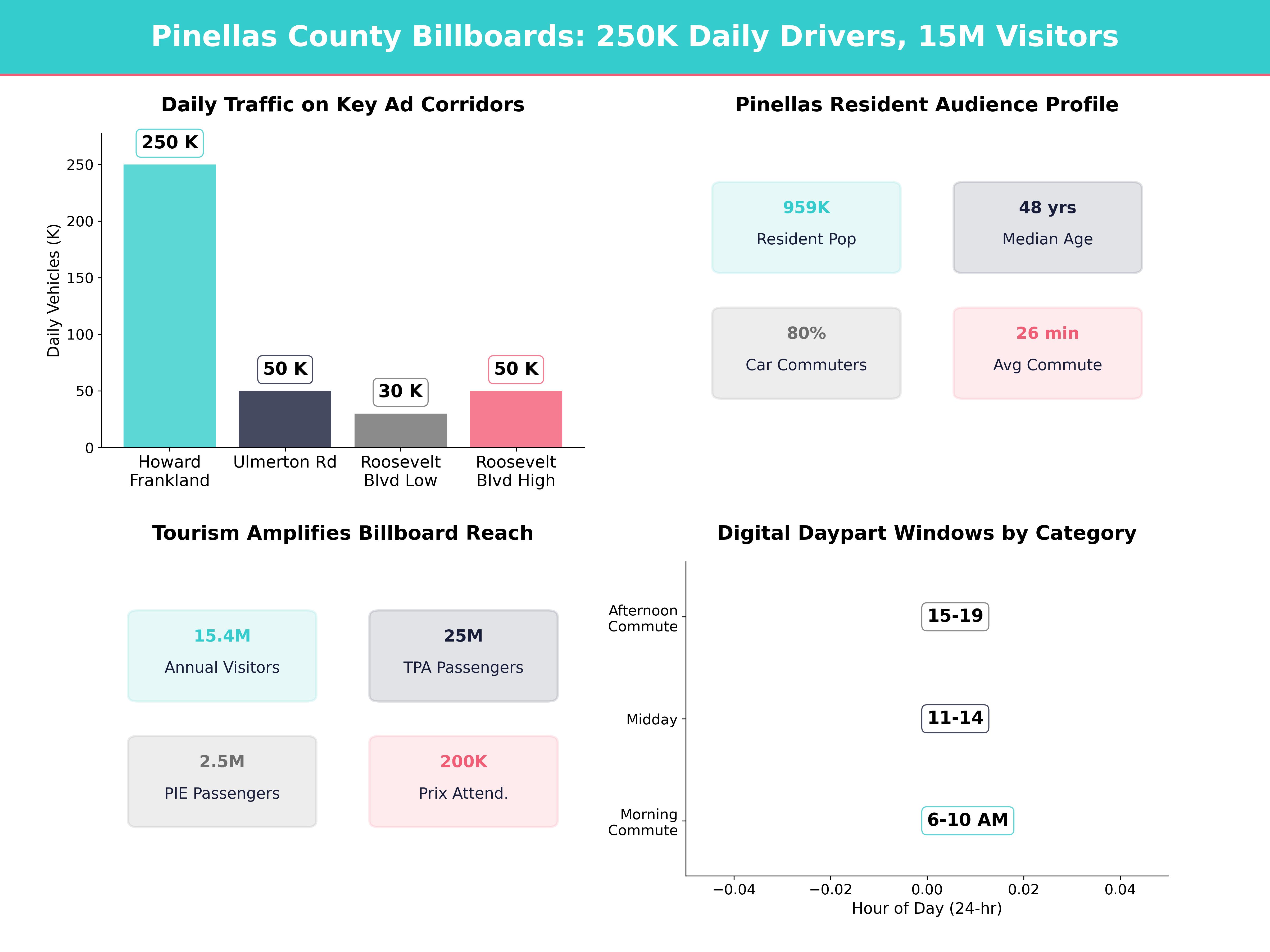
The most important Feather Sound corridor is I-275, especially near the Howard Frankland Bridge project, which carries nearly 250,000 motorists per day. Ulmerton Road is the key east-west spine for Feather Sound and connects the area to St. Pete-Clearwater International Airport, Largo, Clearwater, and US 19. Roosevelt Boulevard is another business connector that ties Feather Sound to the Gateway area of St. Petersburg and nearby employment clusters.
Why is Feather Sound a strong market for billboard advertising with Blip?
Feather Sound is positioned in central Pinellas County, between St. Petersburg, Clearwater, and the Tampa side of the bay, so ads can reach commuters, airport travelers, office workers, and beach-bound visitors in the same day. Pinellas County had 959,107 residents in 2020 and grew 4.6% from 2010 to 2020, even though it is already a highly built-out market. That combination of density, car dependence, and year-round visitation from roughly 15.4 million annual visitors makes Feather Sound a strong place to build frequency with digital billboards.
What kinds of businesses work well on Feather Sound billboards with Blip?
Feather Sound sits near a business-heavy part of the county, and that gives us more than residential exposure. This mix is ideal for B2B buyers during the week, retail and restaurant customers on evenings and weekends, and travelers nearly every day of the year. It is also especially useful for healthcare, financial, legal, staffing, recruiting, and local service advertisers.
When is the best time to run billboard ads in Feather Sound?
Winter and spring are the strongest visibility seasons for many Feather Sound campaigns, especially from roughly January through April. The region benefits from snowbird demand, stronger weather, and elevated tourism, and major events like the Firestone Grand Prix of St. Petersburg and spring training add more traffic. Summer can also be productive for family travel, beach activity, and practical categories like roofing, generators, insurance, HVAC, storm prep, and home repair.
Do I need a contract to advertise with Blip in Feather Sound?
No, Blip has no long-term contracts or minimum commitments. You can start, pause, or stop your campaign at any time.
How fast can I launch a billboard campaign with Blip in Feather Sound?
You can have your campaign live in minutes. Create a free account, select your locations, set your budget, upload your design, and start running once approved.
Where can I advertise with Blip in Feather Sound?
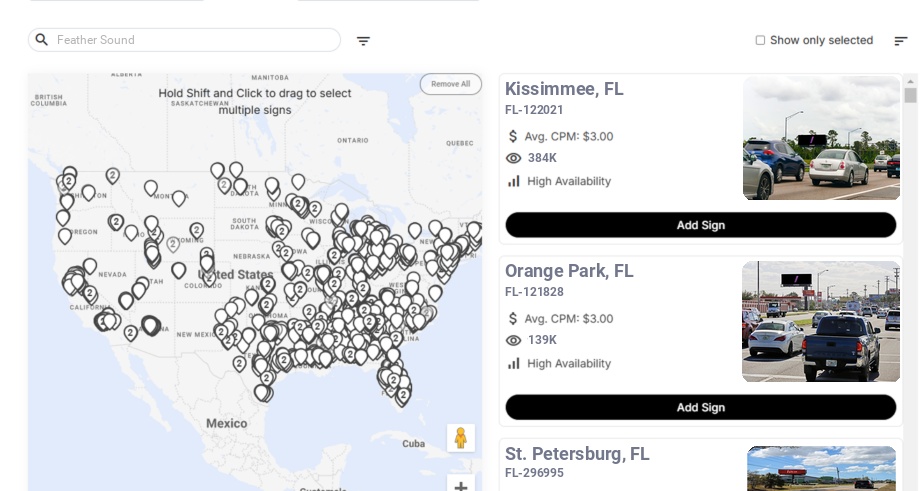
Blip has digital billboards in Feather Sound. You can browse available locations on a map, choose the ones that fit your audience, and start advertising right away.
Still have questions? Launch a campaign in minutes — no contracts, no commitments.
Start Your CampaignFeather Sound Billboard Advertising Guide
Feather Sound is one of those Florida locations where a small footprint creates outsized billboard value, especially in a county with 959,107 residents packed into about 280 land square miles. We are positioned in central Pinellas County, between St. Petersburg, Clearwater, and the Tampa side of the bay, so our ads can reach commuters, airport travelers, office workers, and beach-bound visitors in the same day. The county had 959,107 residents in 2020, and it grew 4.6% from 2010 to 2020, even though it is already a highly built-out market. That combination of density, car dependence, and year-round visitation from roughly 15.4 million annual visitors makes Feather Sound a strong place to build frequency with digital billboards.
Feather Sound Market Overview
What the Feather Sound trade area really includes
When we talk about advertising in Feather Sound, we are not relying only on the neighborhood itself. We are buying into a much larger Pinellas and Tampa Bay movement pattern that includes St. Petersburg, Clearwater, Largo, and cross-bay traffic headed toward Tampa. That matters because Pinellas County packs 959,107 residents into roughly 280 land square miles, which works out to about 3,400 residents per square mile.
The nearby population centers add scale quickly. St. Petersburg had 258,308 residents in 2020, Clearwater had 116,674, and Largo had 82,485. Combined, that is more than 457,000 residents in just those three cities. In practical billboard terms, that means Feather Sound works as a connector market, not just a neighborhood market.
Why density, age, and car dependence matter in Feather Sound
Pinellas County is older than many fast-growth Sun Belt counties, with a median age of about 48. That older profile is useful for categories such as healthcare, financial services, elective care, senior living, home improvement, and local professional services. It also increases the value of clear, legible billboard creative, because we are often speaking to drivers who respond best to simple, high-contrast messages.
Travel behavior is just as important. Roughly 4 in 5 workers in Pinellas County commute by car, and the average commute is about 26 minutes. Even with service from the Pinellas Suncoast Transit Authority, this is still an overwhelmingly auto-oriented market, so roadside impressions accumulate fast.
What the local economy means for billboard advertisers
Feather Sound sits near a business-heavy part of the county, and that gives us more than residential exposure. Employers and institutions such as BayCare, Johns Hopkins All Children's Hospital Jabil, St. Petersburg College, and the University of South Florida keep workers, students, patients, and vendors moving throughout the region. Organizations such as the St. Petersburg Area Chamber of Commerce, and the Clearwater Regional Chamber of Commerce
For billboard strategy, that mix is ideal. We can use Feather Sound placements to reach B2B buyers during the week, retail and restaurant customers on evenings and weekends, and travelers nearly every day of the year.
Key Traffic Corridors for Feather Sound Billboard Campaigns
I-275 and the Howard Frankland Bridge
The most important Feather Sound corridor is I-275, especially near the Howard Frankland Bridge project FDOT 250,000 motorists per day, which makes it one of the region's most powerful commuter funnels. Boards near this corridor can reach people traveling between Pinellas and Hillsborough counties, including office workers, airport users, and higher-income professional households in a two-county region of roughly 2.4 million residents.
This corridor is especially strong for:
- Healthcare advertisers, because we can catch drivers before or after work with urgent, specialty, or elective care messages.
- Financial, legal, and professional services, because repeated weekday exposure builds familiarity with office-based audiences.
- Recruiting campaigns, because the bridge corridor reaches workers who already think regionally about where they work.
- Events and attractions, because weekend and evening traffic includes leisure trips in both directions.
Ulmerton Road, State Road 688, and the PIE approach
Ulmerton Road is the key east-west spine for Feather Sound. It connects the area to St. Pete-Clearwater International Airport, Largo, Clearwater, and US 19. FDOT and Forward Pinellas corridor counts regularly place the busiest sections near the interstate and airport above 50,000 vehicles per day.
That makes Ulmerton especially effective for advertisers that need near-term action. Hotels, airport parking operators, rental car services, urgent care clinics, casual dining, self-storage brands, and home services all benefit from drivers who are already in decision mode. Because many of these trips are functional rather than scenic, direct offers and location cues tend to work better than broad brand slogans.
Roosevelt Boulevard, State Road 686, and the Gateway business district
Roosevelt Boulevard is the business connector that ties Feather Sound to the Gateway area of St. Petersburg and nearby employment clusters. Busy segments in this district commonly run in roughly the 30,000 to 50,000 daily vehicle range, depending on the exact location and count station. Traffic here is often more local and work-oriented than on the interstate, which gives us a slightly different billboard job.
This corridor works well for:
- B2B and office-support brands, because the audience includes workers making routine weekday trips.
- Lunch, coffee, and after-work dining, because repeat local traffic supports short-distance decisions.
- Apartment, condo, and townhouse communities, because many viewers are already familiar with the submarket.
- Medical, dental, and wellness providers, because residents and workers can act on nearby service messages quickly.
Cross-bay extension routes from Feather Sound
Feather Sound campaigns often perform best when we think regionally, not just locally. If our target market includes broader Tampa Bay travel, we can pair Feather Sound-area boards with placements serving the Courtney Campbell Causeway
For many advertisers, this is where Feather Sound becomes a bridge strategy. We can use local boards to build repetition in Pinellas, then extend into cross-bay routes when we want more reach among Tampa-oriented commuters.
Audience Segments We Can Reach in Feather Sound
Commuters, office workers, and business-service buyers
The Feather Sound audience is commuter-first. With roughly 80% of workers traveling by car and commute times around 26 minutes, daily repetition is one of the market's biggest advantages. We are often reaching the same drivers on the same routes multiple times per week, which is exactly what helps billboard campaigns stay memorable.
That pattern is ideal for:
- Professional services.
- Staffing and recruiting.
- Healthcare systems.
- Insurance and legal brands.
- Local retailers with a clear geographic draw.
Air travelers and airport-driven consumers
Feather Sound is unusually strong for airport-related advertising because it sits between two meaningful aviation assets. Tampa International Airport 25 million passengers a year and offers more than 90 nonstop destinations. St. Pete-Clearwater International Airport handled nearly 2.5 million passengers in 2023.
That combination gives us access to several high-value traveler groups at once. We can reach business travelers, vacationers, visiting friends and relatives, rideshare users, airport employees, and people making last-minute parking, hotel, dining, and service decisions. For brands with a short booking window, Feather Sound is one of the better billboard zones in the county.
Tourists, beach visitors, and eventgoers
Tourism is a major reason billboards work so well in this part of Florida. Visit St. Pete-Clearwater 15.4 million visitors in 2023, and the destination markets 35 miles of beaches across 24 communities. Many of those visitors move through central Pinellas on the way to beach hotels, attractions, restaurants, and event venues.
That audience is useful for more than tourism brands. Attractions such as Clearwater Marine Aquarium, The Dalí Museum the St. Pete Pier Ruth Eckerd Hall, and the Mahaffey Theater create constant leisure movement. If we sell dining, entertainment, retail, or family activities, Feather Sound can help us intercept visitors before they spread across the county.
Families, students, and healthcare audiences
Local-service advertisers should not overlook the everyday resident audience. Pinellas County Schools serves more than 90,000 students, which creates consistent school-year travel patterns for parents, staff, and service providers. The University of South Florida enrolls nearly 50,000 students systemwide, and St. Petersburg College adds a large commuter-student base across the county.
Healthcare is especially relevant in this market. The county's older median age, combined with the presence of providers such as BayCare, Johns Hopkins All Children's Hospital HCA Florida Largo Hospital, means we can effectively promote primary care, specialty care, urgent care, imaging, rehab, and elective procedures. Feather Sound boards are particularly useful when we need nearby awareness, not just broad metro branding.
Seasonal and Timing Opportunities in Feather Sound
Winter and spring in Feather Sound
Winter and spring are the strongest visibility seasons for many Feather Sound campaigns. From roughly January through April, the region benefits from snowbird demand, stronger weather, and elevated tourism. This is also when baseball and major events amplify travel across Pinellas.
The Firestone Grand Prix of St. Petersburg is a major example. The event spans 3 days and regularly draws more than 200,000 attendees and spectators. Spring training also matters, with games at BayCare Ballpark in Clearwater, and TD Ballpark Valspar Championship 4-day window for visitor and sponsor traffic in March.
For advertisers, this is the season to lean harder into restaurants, attractions, healthcare, real estate, hospitality, transportation, and premium retail.
Summer in Feather Sound
Summer is different, but not weaker. Family travel remains strong, beach activity increases, and local residents spend more time on errands, entertainment, and indoor escapes from the heat and rain in a county that sees 15.4 million visitors a year. If our business serves families, attractions, casual dining, or weather-driven needs, summer can be very productive.
This is also when practical categories gain relevance. Hurricane season runs from June 1 through November 30, so messages tied to roofing, generators, insurance, HVAC, storm prep, and home repair often feel more urgent. In a market like Feather Sound, where many drivers are homeowners or established households, that urgency can translate well to billboards.
Fall and holiday opportunities in Feather Sound
Fall brings two helpful shifts. First, the school year creates more predictable weekday traffic because parents, students, and teachers return to routine travel patterns in a district serving more than 90,000 students. Second, holiday travel begins to build through the airport corridor, especially from November into December.
For many brands, August and September are ideal for back-to-school, healthcare, fitness, and service resets. November and December work well for retail, gifting, travel parking, restaurants, and event promotion. If we operate near Tampa International Airport St. Pete-Clearwater International Airport, holiday timing deserves a dedicated budget push.
Best dayparts for Feather Sound campaigns
Feather Sound responds well to dayparting because local travel intent changes by hour. We usually see four especially useful windows:
- 6 a.m. to 10 a.m. works best for commuting, healthcare, coffee, recruiting, and professional services.
- 11 a.m. to 2 p.m. works well for lunch, same-day appointments, hotels, and airport-support businesses.
- 3 p.m. to 7 p.m. is strong for return-commute reminders, dining, retail, and family services.
- Friday afternoons and weekends are ideal for beaches, attractions, entertainment, and hospitality.
Billboard Design Tips for the Feather Sound Market
Use location cues that locals recognize immediately
In Feather Sound, vague branding is usually less effective than geographic precision. Drivers respond well when we mention a known route, exit, or destination cue such as “Next Exit,” “Before the Bridge,” “Near PIE,” or “Ulmerton Ahead.” That works because so much of the audience is in transit between clear destinations.
If our business depends on immediate action, we should make distance tangible. Phrases such as “5 Minutes from PIE,” “Next Right on Roosevelt,” or “2 Miles to Check-In” fit the local mindset better than abstract taglines.
Match our creative to Feather Sound's business-travel mix
Feather Sound is not purely a beach market and not purely a suburban market. It is a business-travel corridor with tourism layered on top. That means our creative should match the road we buy.
On office-oriented routes, polished layouts, restrained color palettes, and credibility signals often perform best. On leisure routes, brighter colors, lifestyle photography, and destination-oriented copy can work harder. If we are advertising healthcare, finance, legal services, or B2B offerings, we should emphasize trust and clarity. If we are advertising dining, attractions, or retail, we should emphasize ease, proximity, and immediate payoff.
Design for bright light and faster driving speeds
Florida light is intense, and Feather Sound traffic often moves fast. On arterials, drivers may be moving 45 to 55 mph, and on I-275 they may be moving 65 to 70 mph when traffic is flowing. That means our designs need strong contrast, larger type, and fewer elements.
We should usually keep messages very short, use one dominant image, and avoid fine detail. Bold blues, teals, whites, and warm accent colors can feel locally relevant, but they still need strong contrast against the background. A board that looks elegant on a laptop can disappear completely in bright daylight if the contrast is weak.
Adjust imagery by corridor and season
The same advertiser can use different creative across the Feather Sound area. A hotel near the airport might use efficiency-focused copy on Ulmerton, then switch to leisure imagery on westbound routes toward the beaches. A healthcare system might use symptom or service messages during weekday commutes, then broader brand creative on weekends.
Seasonal swaps also matter here. Winter and spring can lean into visitors, events, and outdoor activity. Summer can shift toward convenience, indoor comfort, and storm readiness. Because digital inventory is flexible, we do not have to force one static design to do every job.
Regional Strategies Around Feather Sound
Feather Sound and the I-275 office core
Boards closest to Feather Sound and I-275 are usually best for broad awareness among workers and cross-bay commuters. We should use these locations when our goal is repeated exposure to professionals, patients, recruits, or service buyers who travel the same route regularly.
This sub-area is especially useful for medical groups, law firms, financial advisors, colleges, staffing firms, and regional employers. If our message benefits from seeing it several times in a workweek, this is where we start.
Ulmerton and the airport service corridor
The Ulmerton corridor is more transactional. People here are often headed to the airport, returning from travel, commuting to service jobs, or making quick errand decisions. That creates a strong fit for hotels, parking, rental cars, repair shops, urgent care, quick-service restaurants, and convenience-oriented retail.
When we buy this zone, we should focus on immediacy. Clear offers, short travel cues, and simple calls to action usually outperform brand-only messaging.
Gateway, downtown St. Petersburg, and southbound demand
If our target includes the business districts of St. Petersburg, we should think about southbound and city-oriented extensions. The Gateway area gives us access to office parks and corporate traffic, while the route toward downtown adds nightlife, events, cultural attractions, and affluent neighborhoods.
This is where entertainment, dining, multifamily housing, universities, healthcare systems, and city-based events can perform well. It is also a smart area for campaigns that need to connect Feather Sound visibility with a more urban destination.
Clearwater, Largo, and westbound leisure traffic
Westbound strategy matters if our customer base includes residents and visitors headed toward Clearwater, Largo, and the beaches. This audience often responds to restaurants, attractions, family entertainment, home services, furniture, and healthcare.
Because this traffic mix includes both locals and visitors, our creative should stay very plainspoken. Boards that quickly answer “What is it?” and “How close is it?” tend to do well on these routes.
Cross-bay Tampa reach from Feather Sound
Feather Sound also works as a launch point for cross-bay campaigns. If our business serves both Pinellas and Hillsborough, we can use Feather Sound boards to own the Pinellas side of the story, then add Tampa-facing boards for scale. That is especially useful for healthcare systems, universities, financial brands, event venues, and regional employers.
The key is to treat Feather Sound as a hinge. It is not just a place to buy local impressions. It is a place to connect westbound local intent with eastbound metro reach.
Using Blip Tools in Feather Sound
When manual selection works best in Feather Sound
Manual placement is especially helpful when we know the exact travel behavior we want. If our goal is to reach morning bridge commuters, westbound airport traffic, or a specific business corridor, we can pick those boards directly and align our schedule to the strongest windows.
That approach is often ideal for advertisers with clear geographic goals, such as a hotel near St. Pete-Clearwater International Airport, a medical office near Feather Sound, or a restaurant that depends on office lunch traffic.
When Blip optimization is the smarter Feather Sound play
Optimization is often the better option when we want the system to balance reach, timing, and efficiency across multiple boards. In a market like Feather Sound, where audience mix shifts by hour and season, optimization can help us capture the strongest windows without managing every location manually.
This is especially useful during spring tourism peaks, event-heavy weeks, or campaigns that cover several audience types at once. A healthcare brand, for example, may want weekday commuter strength, while a hospitality brand may want a heavier mix of midday and weekend delivery.
How we can test and refine quickly in Feather Sound
Feather Sound is a good market for structured testing. We can rotate one message for commuters, one for travelers, and one for local service buyers, then watch which boards and times produce the best response. We can also update artwork around weather, holidays, or local events without rebuilding the whole campaign from scratch.
Because digital boards report performance in real time, we can make smarter decisions faster. In a corridor-heavy market like Feather Sound, that speed matters.
Getting Started with Billboard Rental in Feather Sound
Start with the goal, not the board
The best Feather Sound campaigns begin with one question: who are we actually trying to intercept? If we want daily professionals, we should start near I-275 and the bridge approaches. If we want airport users, we should prioritize Ulmerton and nearby connectors. If we want family or leisure traffic, we should think farther west or layer in weekend-heavy schedules.
A simple starting framework helps:
- If our goal is awareness, we should prioritize high-frequency commuter corridors.
- If our goal is immediate action, we should prioritize boards close to our location or a decision point.
- If our goal is regional reach, we should combine Feather Sound with cross-bay or westbound extensions.
Evaluate Feather Sound billboard locations with local context
Not every billboard in the same ZIP code does the same job. We should evaluate locations by travel direction, approach speed, nearby exits, lane changes, and what the driver is trying to do in that moment. A board before an exit often performs differently than one after it. A board facing weekday commuter traffic may not be the best choice for weekend tourism.
In Feather Sound, we should pay close attention to:
- Whether the board serves bridge commuters, airport traffic, or local circulation.
- Whether drivers have enough dwell time to absorb the message.
- Whether our destination is close enough to feel actionable.
- Whether our creative matches the intent of that road.
Launch a practical test and scale what works in Feather Sound
For many advertisers, a 2- to 4-week test is the best starting point. We can begin with 3 to 5 digital boards across the corridor mix that best fits our audience, then review which locations and times create the strongest lift in searches, website visits, calls, or in-store traffic.
This is where Blip is simpler than traditional billboard buying. Instead of committing to a rigid package and hoping it works, we can test Feather Sound with a manageable budget, learn from actual delivery, and scale the combinations that perform best. That flexibility is especially valuable in a market where commute patterns, event calendars, and tourism volumes all change the opportunity from month to month.
If we approach Feather Sound with local context, corridor discipline, and creative built for fast-moving drivers, it can become one of the most efficient billboard markets in the Tampa Bay area.