Billboards in Orlovista, FL
No Minimum Spend. No Long-Term Contracts. Just Results.
Trusted by Leading Brands


Billboard advertising
in Orlovista has never been easier



How much is a billboard in Orlovista?
Why Choose Blip for Billboard Advertising in Orlovista
Blip lets you launch in Orlovista fast and self-serve, reaching SR 50 commuters and west Orlando drivers without old-school buying hassles.
Choose Blip-optimized campaigns in Orlovista and let the platform steer spend toward I-4, Turnpike, or SR 408 traffic that fits your goal.
No contracts in Orlovista means you can test budgets around tourist peaks, school starts, or OCPS traffic and pause anytime.
Daypart your Orlovista ads for rush hour, lunch, or evening return trips to match commuter flow on Colonial, Kirkman, and the expressways.
Track Orlovista performance in real time with Blip, then shift creative or budget as visitor, student, and family traffic changes by season.
Frequently Asked Questions About Billboard Advertising in Orlovista
How much does a billboard cost in Orlovista with Blip?
With Blip, billboard advertising in Orlovista can fit a wide range of budgets because you only pay when your ad actually appears. Each “blip” is a 7.5-to-10-second display on a rotating digital billboard, with prices starting at $0.01 per display. Costs can change based on time of day, location, and advertiser demand, so your total spend is simply the sum of the blips your ad earns over time.
Where can I advertise in Orlovista with Blip to reach local commuters?
Orlovista’s billboard value comes from being close to several of west and central Orlando’s busiest corridors. State Road 50, West Colonial Drive is one of the most practical corridors for businesses that want local frequency rather than one-time pass-through visibility, with FDOT count stations commonly falling in the 45,000 to 60,000 vehicles per day range. State Road 408 and Florida’s Turnpike also give access to major commuter and regional traffic.
Who can Orlovista billboard ads reach in the Orlando market?
We can use that combination to reach local households, daily commuters, tourism workers, convention visitors, and destination travelers with the same campaign. Orlovista also sits within the broader Orlando metro, and the page says its trade area includes a diversified economy with tourism, healthcare, education, construction, retail, and logistics demand. That makes it a strong fit for restaurants, legal services, hospitals, home services, staffing firms, colleges, retailers, attractions, and local events.
What makes Orlovista a good billboard market for Blip?
Orlovista gives us something billboard advertisers value highly: a compact residential community inside one of Florida’s busiest visitor and commuter ecosystems. Because west Orlando is still heavily road-oriented, and because Orlovista sits near major routes feeding downtown, the attractions area, and fast-growing western suburbs, digital billboards here can deliver both repetition and regional reach. The market also benefits from consistent tourism, commuter flow, and nearby population growth.
When should I run billboard ads in Orlovista to get the best results?
Tourism peaks create reliable windows for Orlovista campaigns, especially during spring break, summer family travel, and the holiday season. Back-to-school timing is also very important, and late July through early September is described as a strong period for healthcare, retail, apartments, wireless, tutoring, banking, and quick-service restaurants. The page also notes that mornings, afternoons, evenings, and weekends can each be useful depending on whether you want commuters, shoppers, or tourism traffic.
Do I need a contract to advertise with Blip in Orlovista?
No, Blip has no long-term contracts or minimum commitments. You can start, pause, or stop your campaign at any time.
How fast can I launch a billboard campaign with Blip in Orlovista?
You can have your campaign live in minutes. Create a free account, select your locations, set your budget, upload your design, and start running once approved.
Where can I advertise with Blip in Orlovista?
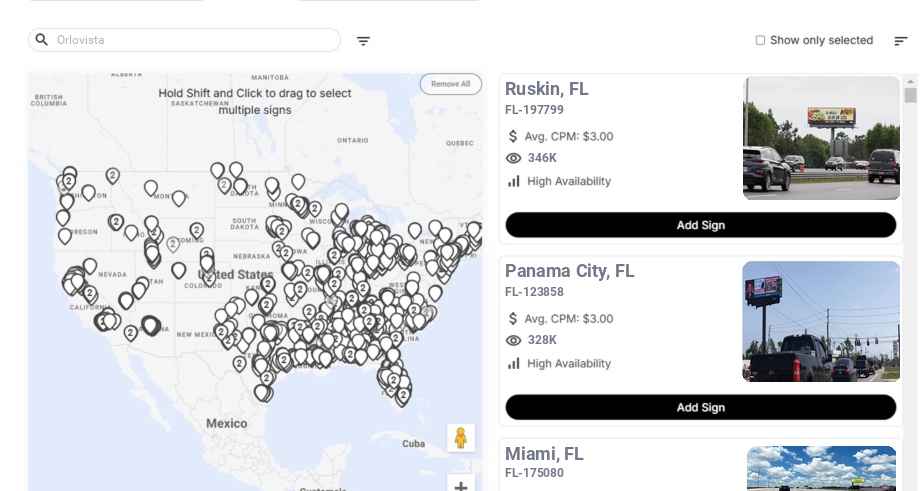
Blip has digital billboards in Orlovista. You can browse available locations on a map, choose the ones that fit your audience, and start advertising right away.
Still have questions? Launch a campaign in minutes — no contracts, no commitments.
Start Your CampaignOrlovista Billboard Advertising Guide
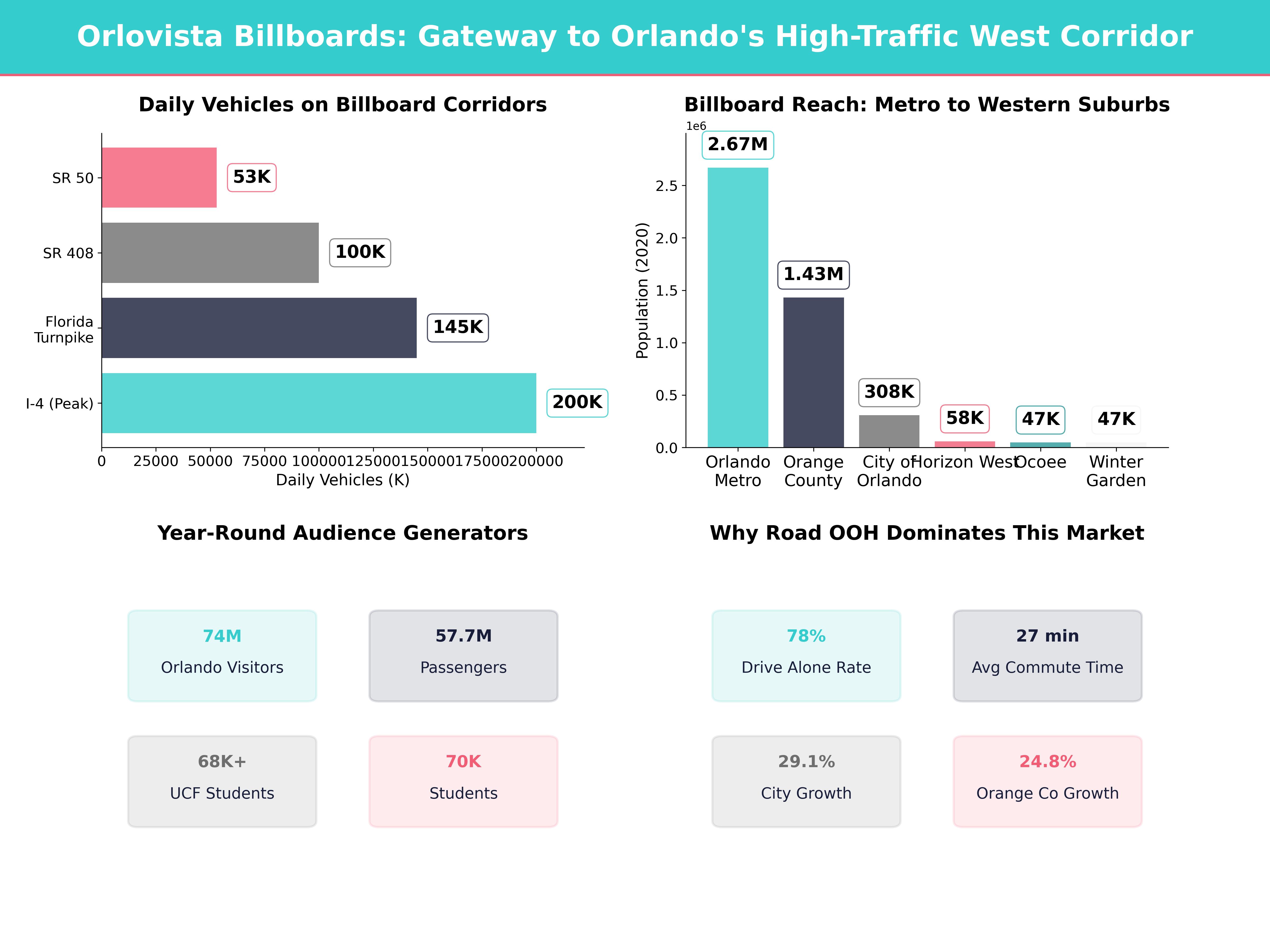
Orlovista gives us something billboard advertisers value highly: a compact residential community inside one of Florida’s busiest visitor and commuter ecosystems, which helped Orlando draw 74 million visitors in 2022 and anchored a metro area that counted 2,673,376 people in 2020. Orlovista itself has roughly 6,000 residents, but it sits within Orange County, which reached 1,429,908 residents in 2020, and within the broader Orlando metro, which counted 2,673,376 people in 2020. Because west Orlando is still heavily road-oriented, and because Orlovista sits near major routes feeding downtown, the attractions area, and fast-growing western suburbs, digital billboards here can deliver both repetition and regional reach. We can use that combination to reach local households, daily commuters, tourism workers, convention visitors, and destination travelers with the same campaign.
Orlovista Market Overview
Orlovista is small, but its trade area is very large.
When we advertise in Orlovista, we are not buying exposure to only one census-designated place. We are buying into the west side of the Orlando market, where local trips, commuter flows, and tourism spillover overlap. The City of Orlando grew to 307,573 residents in 2020, and Orange County grew by 24.8% from 2010 to 2020. Orlando’s city population grew even faster, rising 29.1% over the same decade.
That growth matters because Orlovista sits near several expanding population centers. Ocoee 47,295 residents in 2020, Winter Garden 46,964, and Horizon West 58,101. Even Windermere, at 3,030 residents, contributes to a higher-income western suburban draw that feeds west-east commuting and destination shopping.
Orlovista benefits from a diversified Orlando economy.
The west Orlando market is not dependent on one industry alone. Visit Orlando, Universal Orlando Resort, Walt Disney World SeaWorld Orlando, AdventHealth, Orlando Health, University of Central Florida, and Valencia College all help create a market with tourism, healthcare, education, construction, retail, and logistics demand.
That diversity is good news for billboard advertisers. It means we can run campaigns for restaurants, legal services, hospitals, home services, staffing firms, colleges, retailers, attractions, and local events without depending on a narrow audience window.
Car dependence keeps billboard exposure strong around Orlovista.
Orange County commuting patterns remain overwhelmingly road-based. Census commuting data consistently show that about 78% of workers drive alone to work, while transit represents only a low single-digit share of roughly 2%. The average one-way commute is roughly 27 minutes, which gives roadside advertising repeated weekday exposure.
LYNX does provide regional transit across about 2,500 square miles, and SunRail 61-mile, 17-station commuter rail line. Even so, most trips around Orlovista, MetroWest, Ocoee, Winter Garden, and the tourism corridor still happen by car. For billboard advertisers, that translates to a practical advantage: more daily impressions from people who are already in motion and already making location-based decisions.
Key Traffic Corridors Around Orlovista
Orlovista’s billboard value comes from being close to several of west and central Orlando’s busiest corridors. Traffic volumes vary by segment and count year, but data from the Florida Department of Transportation, the Central Florida Expressway Authority, and Florida’s Turnpike Enterprise consistently show strong daily vehicle counts on the routes that matter most.
State Road 50, West Colonial Drive
West Colonial Drive is the street-level spine of this market. FDOT count stations on west Orlando segments of SR 50 commonly fall in the 45,000 to 60,000 vehicles per day range, depending on the exact segment. That makes it one of the most practical corridors for businesses that want local frequency rather than one-time pass-through visibility.
This corridor works especially well because it connects neighborhoods and destinations in one continuous path, including west Orlando, Orlovista, nearby retail clusters, Ocoee Winter Garden
- Retail and restaurant brands can use SR 50 boards to catch drivers who are already in shopping mode and close to an immediate turn.
- Healthcare providers, urgent care clinics, dentists, and pharmacies can use SR 50 for neighborhood-level reach with high repetition.
- Auto service, legal, insurance, and home service companies can benefit because the audience includes repeat local drivers, not just occasional visitors.
Florida’s Turnpike near Orlovista
The Florida’s Turnpike Enterprise corridor gives us regional scale. Mainline segments around the SR 50 and SR 408 area often exceed 120,000 AADT, and nearby stretches can approach 170,000. That is a very different audience from SR 50 because the Turnpike pulls longer-distance commuters, regional shoppers, airport travelers, and leisure traffic moving across Central Florida.
Turnpike placements are usually best for broad-market advertisers. They also help brands reach travelers moving across Central Florida with strong repetition.
- Regional healthcare systems, universities, and major employers can use the Turnpike for market-wide awareness.
- Attractions, hotels, and entertainment brands can benefit from capturing travelers headed toward Orlando’s tourism core.
- Real estate developers, homebuilders, and financial services firms can use this corridor to reach households moving between older west Orlando communities and growth markets farther west and southwest.
State Road 408, East-West Expressway
The Central Florida Expressway Authority operates SR 408, and west-side segments commonly run around 90,000 to 110,000 AADT. This is one of the most useful commuter corridors for campaigns that need to bridge Orlovista with downtown Orlando, east Orlando, and the employment centers spread across the metro.
The strength of SR 408 is directional relevance. Morning westbound and eastbound patterns can differ materially from evening flows, so we can use time-based scheduling to match the audience we want.
- Downtown-facing professional services can use SR 408 in morning drive times to reach office workers and business decision-makers.
- Entertainment, events, and nightlife advertisers can use afternoon and evening windows to catch return traffic from the urban core.
- Colleges, continuing education, and recruiting campaigns can benefit because SR 408 also helps connect to the wider student and young-professional market.
I-4, Kirkman Road, and the tourism connectors
While I-4 does not cut through Orlovista itself, it is close enough to shape the local advertising map. Through Orlando’s tourism and downtown sections, I-4 regularly exceeds 180,000 vehicles per day, and the busiest segments top 200,000. Nearby connectors such as Kirkman Road, Conroy Road, and the roads feeding Universal Orlando Resort, The Mall at Millenia International Drive, SeaWorld Orlando, and the Orange County Convention Center make this corridor essential for visitor-facing campaigns.
This network is especially effective for advertisers with destination appeal. It also supports consistent messaging across the travel routes visitors use to reach Orlando’s attractions.
- Hotels, attractions, dinner shows, and ticketed events can use this corridor to intercept travelers already moving toward entertainment districts.
- Quick-service restaurants, fuel, and convenience brands can benefit from same-day decision-making traffic.
- Convention-oriented B2B brands can use these routes to reach attendees traveling between hotels, venues, and after-hours destinations.
Audience Segments We Can Reach in Orlovista
Daily commuters and local errand traffic
Orlovista’s first audience is the everyday west Orlando driver. Because so much of the area’s travel still happens by car, we can build strong weekly frequency with commuters moving between neighborhoods, jobs, schools, shopping centers, and service businesses. This is one reason Orlovista works so well for practical categories such as healthcare, legal, auto, insurance, retail, restaurants, and home services.
The west side also includes plenty of shift-based workers who travel outside a classic 9-to-5 schedule. Employees tied to the region’s hospitality, healthcare, retail, warehouse, and education sectors often move early in the morning, midafternoon, or late at night, which creates additional daypart opportunities.
Tourists, conventioneers, and airport arrivals
Orlando’s visitor economy is massive, and Orlovista sits close enough to benefit from it. Visit Orlando reported 74 million visitors in 2022. Orlando International Airport 57.7 million passengers in 2023, and the Orange County Convention Center offers 7 million square feet of total space, including 2.1 million square feet of exhibition space.
Those figures matter because tourism does not stay confined to one street. Visitors move from the airport to hotels, from hotels to theme parks, from parks to shopping and dining, and from convention halls to nightlife. Brands that want visitor spending do not need to sit directly on International Drive to benefit. They need to sit on the paths people actually travel.
Students and young adults
Orlando also offers a large education audience. The University of Central Florida enrolls more than 68,000 students, and Valencia College serves roughly 70,000 students annually across its campuses. That creates a substantial market for apartments, part-time jobs, banking, wireless service, affordable dining, healthcare, entertainment, and personal services.
This audience is especially useful for digital billboard advertising because students and young professionals respond well to timely promotions, simple calls to action, and location cues. In west Orlando, proximity to Valencia College West Campus makes the Orlovista area even more relevant for student-facing campaigns.
Families, parents, and household decision-makers
Families are another core audience in and around Orlovista. Orange County Public Schools serves more than 200,000 students—about 205,000 in recent enrollment counts—and is the 8th-largest school district in the United States. That scale creates constant demand for pediatric care, tutoring, after-school programs, family dining, orthodontics, insurance, home improvement, and retail.
This family audience extends beyond Orlovista into fast-growing western suburbs. Households in Ocoee Winter Garden Horizon West Windermere often move through the same road network, even if their spending patterns differ. We can use creative and placement choices to speak differently to value-oriented urban families and higher-income suburban households without leaving the same general market.
Seasonal and Timing Opportunities for Orlovista Campaigns
Tourism peaks create reliable windows for Orlovista campaigns.
Orlando has tourism all year, but some periods deserve more aggressive flighting. Spring break, summer family travel, and the holiday season all raise visitor volume. Convention traffic also strengthens many midweek periods, especially when large trade shows fill the Orange County Convention Center and nearby hotels.
For tourism-driven campaigns, we should usually think in waves rather than one flat annual schedule. A restaurant, attraction, outlet center, or entertainment venue can push harder during spring, summer, and late-year holiday travel, then shift to commuter-heavy messaging during slower visitor periods.
School calendars and sports schedules add predictable demand.
Back-to-school timing is very important in west Orlando. Orange County Public Schools ramps back up in August, and college traffic rises around August and January. That makes late July through early September a strong period for healthcare, retail, apartments, wireless, tutoring, banking, and quick-service restaurants.
Sports and event calendars also create useful bursts of traffic. The Orlando Magic 41 regular-season home games, and Orlando City SC typically hosts 17 MLS home matches. We can also build around annual event spikes at the Kia Center, Camping World Stadium, the Dr. Phillips Center for the Performing Arts MegaCon Orlando, and the Florida Classic.
Weather matters more in Central Florida than many advertisers expect.
Florida’s hurricane season runs from June 1 through November 30, and Central Florida’s summer pattern also includes frequent afternoon rain and intense heat. That affects both message timing and creative strategy.
This seasonality creates strong windows for several categories. They include summer- and storm-focused urgency, indoor behavior shifts, and preparedness messaging.
- HVAC, roofing, storm repair, insurance, and urgent care advertisers can increase urgency during the summer and storm months.
- Indoor entertainment, shopping, and dining brands can perform well when heat and rain push people toward indoor plans.
- Preparedness-oriented public messaging and community campaigns can use short bursts before major weather events.
Billboard Design Tips for the Orlovista Market
We should design differently for SR 50 than for the expressways.
One of the biggest local creative mistakes is treating every road the same. On SR 50 and similar arterial roads, drivers experience traffic lights, lower speeds, and repeat weekly exposure. On the Turnpike and SR 408, speeds are higher and reading time is shorter. That means we can afford a little more specificity on West Colonial than we can on a fast expressway panel.
For Orlovista-area arterials, we should lean into practical clarity. That means prioritizing quick comprehension and location relevance.
- We should use clear location cues such as “On Colonial,” “Next Exit,” “Near Ocoee,” or “Minutes from I-Drive.”
- We should feature offer-driven language when the brand benefits from immediacy, especially for food, healthcare, and local services.
- We should keep the visual hierarchy simple enough to read in one glance, even when traffic is moving slowly but unpredictably.
For expressways, we should simplify even further. One bold headline, one recognizable brand element, and one memorable takeaway usually beat a crowded layout.
Bilingual and culturally aware creative can improve local relevance.
West Orlando is diverse, and that should affect how we build campaigns. In many categories, especially healthcare, retail, legal, home services, and community events, bilingual English-and-Spanish creative can feel more local and more welcoming. We do not need to make every ad bilingual, but we should consider it when the target customer base is broad and neighborhood-oriented.
We should also match tone to the audience. A value-focused Orlovista or West Colonial message may work best with a direct price point, a simple service promise, and an easy location cue. A Horizon West or Windermere message may perform better with cleaner design, stronger lifestyle imagery, and a premium framing of convenience, quality, or time savings.
Local imagery and local references make the message feel immediate.
Creative performs better when it sounds like it belongs in the market. References to Colonial, the Turnpike, downtown Orlando, Universal, Winter Garden, or International Drive feel more actionable than generic “Central Florida” language. The same principle applies to visuals. Family entertainment, sunshine, palms, sports, shopping, and resort-adjacent leisure cues feel natural here in a way they might not in another metro.
Because Central Florida light is intense, we should also favor high contrast, bold typography, and uncluttered backgrounds. Bright daylight, reflective pavement, sudden rain, and nighttime glare all reward simplicity.
Regional Strategies Around Orlovista
Orlovista, West Colonial, and nearby west Orlando neighborhoods
This is our frequency zone. Boards here are best for advertisers that want repeated local exposure and quick-action responses. Healthcare, urgent care, grocery-adjacent retail, legal services, telecom, restaurants, auto repair, payday alternatives, education, and municipal or nonprofit messaging can all work well.
We should treat this area as a practical-decision market. Drivers are often commuting, running errands, or making same-day choices. Price, convenience, and proximity usually matter more here than abstract brand storytelling.
MetroWest, Valencia, and the Universal-adjacent west side
The MetroWest Master Association area and the roads leading toward Valencia College West Campus, Universal Orlando Resort, and The Mall at Millenia
We should use more segmentation here. A lunch-driven restaurant message, a weekend entertainment message, and a student recruiting message can all live in the same broad area, but they should not all run at the same times or on the same boards.
Ocoee, Winter Garden, Horizon West, and Windermere
This is our suburban growth strategy. Ocoee Winter Garden Horizon West Windermere represent a mix of established and rapidly expanding residential markets. The population totals alone, 47,295, 46,964, 58,101, and 3,030, show how much household concentration sits west of Orlovista.
This subregion is especially strong for the following categories.
- Home services and remodeling brands can reach homeowners with repeated commute exposure.
- Healthcare systems, specialists, and pediatric services can build trust with family-oriented households.
- Real estate, financial services, and premium retail brands can use cleaner, more aspirational creative than they would on a value-led urban corridor.
Downtown Orlando and the event core
When we expand eastward, we gain access to downtown professionals, sports fans, concertgoers, and event traffic. Downtown Orlando Kia Center, Camping World Stadium, and the Dr. Phillips Center for the Performing Arts
We should generally reserve these placements for campaigns that benefit from higher-intensity timing, such as ticketed events, restaurants, legal services, healthcare, entertainment, and B2B convention support.
Using Blip Tools for Orlovista Billboard Campaigns
We can match the tool to the local strategy.
In Orlovista, the smartest approach is often to start broad and then narrow. We can use a Blip-optimized campaign to spread budget across west Orlando and learn which corridors, times, and audience windows respond best. Once we identify strong performers, we can shift part of the spend into a manual campaign focused on specific boards along SR 50, the Turnpike, SR 408, or tourism connectors.
That approach is especially useful in a market with several overlapping audiences. A home service brand may discover that commuter-heavy west suburban boards outperform tourism-facing boards. A restaurant or attraction may find the opposite.
Dayparting is unusually valuable in this market.
Because Orlovista sits near commuter routes and visitor routes, time targeting can improve efficiency quickly. We can think about the day in several useful blocks.
- 6:00 a.m. to 9:00 a.m. is often best for commuter services, healthcare, legal, and recruiting.
- 11:00 a.m. to 2:00 p.m. can work well for restaurants, retail, and same-day appointments.
- 3:00 p.m. to 7:00 p.m. is strong for family dining, entertainment, shopping, and after-work errands.
- Evenings and weekends are especially useful for attractions, hotels, events, nightlife, and tourism-facing brands.
Because west Orlando includes both local and destination travel, we can also run separate creative versions for weekdays versus weekends without rebuilding the whole strategy.
Creative testing and analytics help us localize faster.
Orlovista is not a one-message market. We often need one version for neighborhood drivers, one version for suburban households, and one version for tourism-related traffic. Blip’s artwork tools and reporting make that kind of iteration practical.
We should use performance data to answer local questions such as these: Are SR 50 boards producing better consistency than expressway boards. Are evening tourism messages outperforming morning commuter messages. Is English-only creative enough, or does bilingual creative improve response in west Orlando. Those are the kinds of optimization decisions that matter in a market this layered.
Getting Started With Billboard Rental in Orlovista
We should begin with the business goal, not the board.
The best Orlovista billboard plan starts by defining what success means. If the goal is neighborhood awareness, we should prioritize local arterials such as SR 50. If the goal is broad regional reach, the Turnpike and SR 408 become more important. If the goal is visitor spending, we should emphasize I-4, Kirkman, and the routes feeding International Drive, the Orange County Convention Center, and the theme parks.
A simple way to evaluate locations is to ask four questions.
- Are we trying to reach locals, commuters, tourists, or a mix of all three.
- Does the board sit on a road where that audience actually travels.
- Is the message relevant to that audience at that time of day.
- Is the location close enough to a store, office, attraction, or service area to prompt action.
We should expect digital billboard planning to be simpler than the old process.
Traditional billboard buying often means long conversations, fixed packages, and less flexibility once the campaign is live. With Blip, we can review available digital locations on a map, choose specific boards when precision matters, or let the platform optimize when scale matters more. That makes Orlovista easier to test because we do not have to overcommit before we understand which roads are strongest for our goals.
It also helps that digital boards run short ad rotations. A typical blip lasts 7.5 to 10 seconds, so concise creative matters. In practical terms, that means we should enter the campaign with one strong message, one clear brand cue, and one easy next step.
We should launch, measure, and refine.
For most advertisers, the best first move is a controlled test across a few logical corridors. A local service business might start with SR 50 and nearby west Orlando placements. A regional healthcare group might add the Turnpike and SR 408. A visitor-facing brand might include I-4 and the convention-tourism connectors.
From there, we can improve the plan quickly.
- We can shift budget toward the corridors that produce the best reach and relevance.
- We can change creative by submarket, such as value-led messaging in Orlovista and more lifestyle-led messaging in Horizon West.
- We can align flights with school starts, sports seasons, convention dates, summer travel, and weather-driven demand.
That is the real advantage of renting a billboard in Orlovista through a flexible digital platform. We get access to a market with local repetition, regional mobility, and year-round visitor energy, and we can shape the campaign around how people actually move through west Orlando rather than forcing the market into a one-size-fits-all media plan.