Billboards near Lake Magdalene, FL
No Minimum Spend. No Long-Term Contracts. Just Results.
Trusted by Leading Brands


Billboard advertising
near Lake Magdalene has never been easier




How much is a billboard near Lake Magdalene?
Why Choose Blip for Billboard Advertising near Lake Magdalene
Blip lets you launch Lake Magdalene ads fast, reaching I-275, Dale Mabry, and Bearss/Fletcher commuters without the usual billboard hassle.
Set flexible budgets for Lake Magdalene and scale as results grow—ideal for tapping USF, Temple Terrace, and north Tampa traffic.
Daypart Lake Magdalene campaigns for 7-9 a.m. and 4-7 p.m., when commuters stack up on I-275 and Fowler.
No contracts mean you can test Lake Magdalene billboards during USF season, Gasparilla, or storm prep, then shift if needed.
Track Lake Magdalene performance in real time and move spend toward the corridors driving the most responses.
Use Blip creative tools to tailor Lake Magdalene messages for families, students, and healthcare workers near USF and local hospitals.
Frequently Asked Questions About Billboard Advertising near Lake Magdalene
How much does a billboard cost near Lake Magdalene, Florida with Blip?
With Blip, you control exactly what you spend on Lake Magdalene billboards by setting a daily budget that can be adjusted anytime, making it easy to start small and scale up as you see results. Each “blip” is a brief 7.5–10 second ad on digital billboards near Lake Magdalene, Florida, and you only pay for the blips you receive. Pricing varies based on when and where you choose to advertise and current advertiser demand, so your total cost is simply the sum of those individual blips over time.
Where can I advertise near Lake Magdalene with Blip?
There are 65 digital billboards near Lake Magdalene, primarily in Tampa and Temple Terrace, that can help you reach families, students, commuters, and professionals moving through the north Tampa corridor every day. The Tampa placements capture traffic along major corridors such as I-275, I-4, Dale Mabry, and Fowler, while Temple Terrace placements are especially effective for USF students, faculty, staff, and medical workers. By activating boards on both sides of the Lake Magdalene area, your campaigns can wrap the community and reach residents as they travel to work, school, shopping, and entertainment.
What kind of people can Lake Magdalene billboards reach?
The Lake Magdalene area sits at a crossroads of several valuable audience segments, including suburban families, students and young professionals, healthcare and medical professionals, and affluent older adults. Nearby communities have strong homeownership rates, and USF and the surrounding medical district bring tens of thousands of students, faculty, staff, and healthcare workers into the area. The wider Tampa area is also diverse, so advertisers can benefit from bilingual or culturally tailored messaging on high-visibility boards.
When is the best time to run Blip ads near Lake Magdalene?
The Lake Magdalene area has strong commuter traffic during 7–9 a.m. and 4–7 p.m., especially on I-275, Dale Mabry, and Fletcher/Bearss. Midday hours from 11 a.m.–2 p.m. are useful for lunchtime and errands, while Friday through Sunday brings more leisure, shopping, and tourism traffic. Blip’s scheduling tools let you adjust your budget by hour, day, and season so you can match your spending to the times your target customers are most likely to be on the road.
How does the Lake Magdalene area traffic help billboard advertising?
Lake Magdalene is directly north of Tampa, where suburban neighborhoods, major commuting corridors, and university life intersect. I-275, E Bearss Avenue / E Fletcher Avenue, N Dale Mabry Highway, Bruce B. Downs Boulevard, and Fowler Avenue all carry heavy daily vehicle volumes, creating strong exposure for roadside ads. This blend of stable suburban residents plus regional and visitor traffic makes the area a strong candidate for digital billboard campaigns.
Do I need a contract to advertise with Blip near Lake Magdalene?
No, Blip has no long-term contracts or minimum commitments. You can start, pause, or stop your campaign at any time.
How fast can I launch a billboard campaign with Blip near Lake Magdalene?
You can have your campaign live in minutes. Create a free account, select your locations, set your budget, upload your design, and start running once approved.
Where can I advertise with Blip near Lake Magdalene?
Blip has digital billboards near Lake Magdalene. You can browse available locations on a map, choose the ones that fit your audience, and start advertising right away.
Still have questions? Launch a campaign in minutes — no contracts, no commitments.
Start Your CampaignLake Magdalene Billboard Advertising Guide
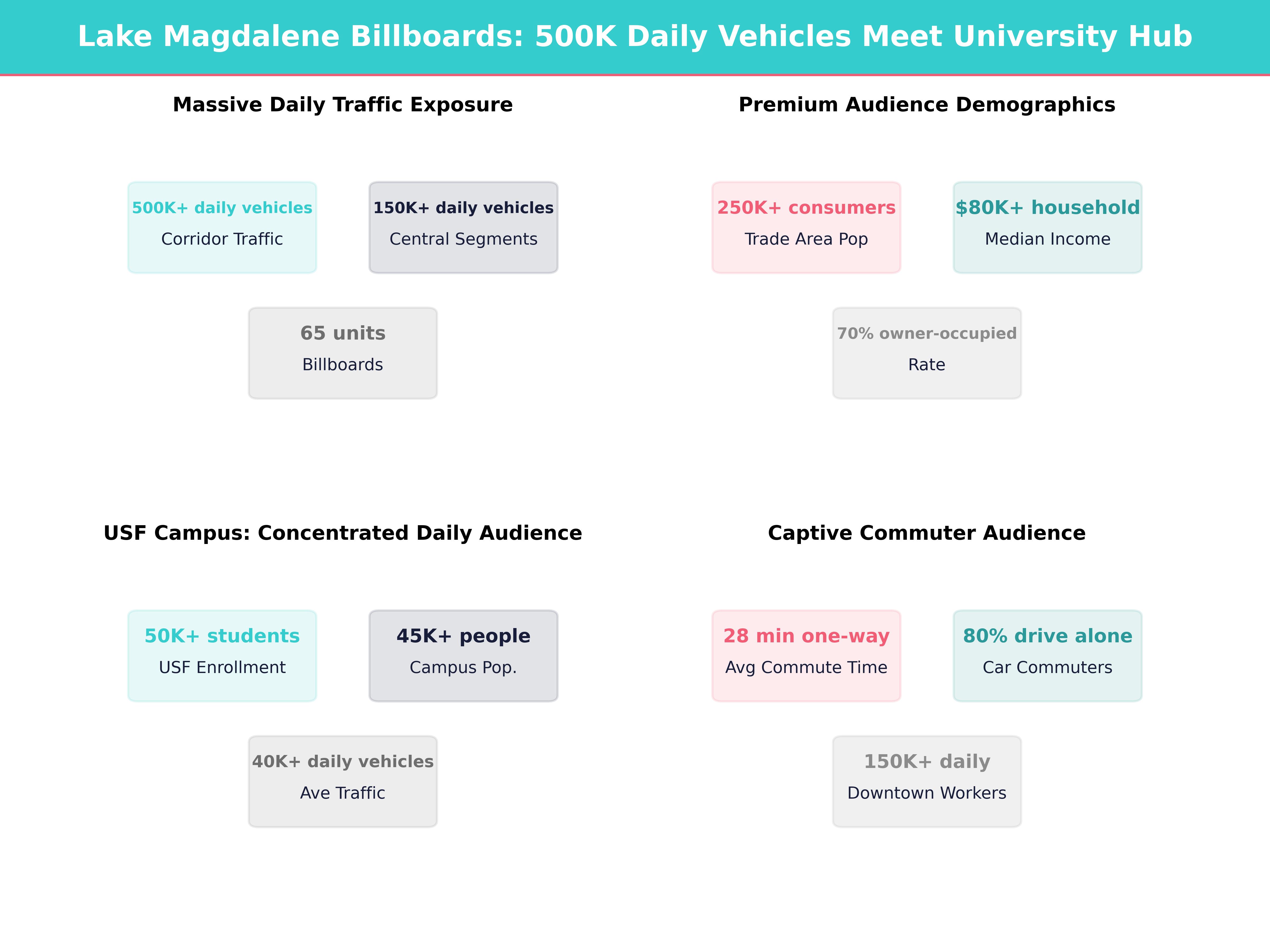
The Lake Magdalene area sits just north of Tampa, where suburban neighborhoods, major commuting corridors, and university life intersect. With 65 digital billboards near Lake Magdalene—primarily in Tampa and Temple Terrace
Understanding the Lake Magdalene Area Market
Lake Magdalene is an unincorporated community in Hillsborough County, directly north of the City of Tampa. As of 2020, the Lake Magdalene area had roughly 30,700 residents, with substantial daily movement into nearby Tampa and Temple Terrace for work, school, shopping, and healthcare. Local planning estimates indicate that more than 70% of residents live in owner‑occupied housing and that roughly 2 in 3 workers commute out of the immediate community to jobs elsewhere in the county, underscoring how reliant the area is on surrounding employment centers and how frequently residents drive past Lake Magdalene billboards.
Key regional context:
-
Population & growth
- The broader City of Tampa has grown to more than 400,000 residents, up over 13% since 2010, according to city and county summaries from the City of Tampa and Hillsborough County. Tampa has added well over 45,000 residents in just over a decade, fueling consistent traffic growth on major corridors that Lake Magdalene drivers use.
- Hillsborough County (which includes Lake Magdalene, Tampa, and Temple Terrace) has over 1.5 million residents and has added more than 275,000 residents since 2010, making it one of Florida’s fastest‑growing counties. County planning projections anticipate the population passing 1.7 million within the next decade, as detailed in long‑range plans from Plan Hillsborough.
- Within a 10–15 minute drive of Lake Magdalene, the north Tampa trade area pulls from a consumer base of well over 250,000 people, including residents of Carrollwood, Northdale, Temple Terrace, and New Tampa.
-
Income & demographics
- Median household income in the Lake Magdalene area is in the mid‑$60,000s, slightly above the statewide median, with nearby north Tampa and Carrollwood pockets rising into the $80,000–$90,000+ range. This supports a healthy mix of value‑oriented and premium offerings.
- Age distribution is balanced: local demographic profiles show roughly 1 in 5 residents under 18, just over 60% in the prime working‑age range of 18–64, and about 18–20% aged 65+. This creates opportunities for everything from family entertainment and retail to healthcare, retirement, and financial services.
- The wider Tampa area is notably diverse, with no single racial or ethnic group making up an overwhelming majority. In many north Tampa ZIP codes, residents identifying as Hispanic or Latino make up roughly 25–35% of the population, while Black residents commonly account for 15–25% and Asian residents for 5–10%, depending on the specific neighborhood. Advertisers can benefit from bilingual or culturally tailored messaging on high‑visibility boards.
-
Education hub nearby
- The University of South Florida (USF), located just east of Lake Magdalene, enrolls over 50,000 students across its campuses, with more than 37,000 on the Tampa campus alone. Combined with faculty and staff, the daily campus population easily exceeds 45,000–50,000 people when school is in session. Learn more at USF.
- USF’s surrounding “University Area” includes student apartments, research parks, and medical facilities. Local estimates suggest that more than 10,000 beds of purpose‑built student housing cluster around the campus, with thousands more student renters in nearby neighborhoods such as New Tampa and Temple Terrace.
- This student and staff population flows along major roads near Lake Magdalene (Fletcher, Fowler, Bruce B. Downs, I‑275), making youth and young‑adult targeting especially potent for food, entertainment, housing, telecom, and education‑adjacent services.
-
Tourism & regional draw
- The Tampa Bay region welcomed approximately 25–27 million visitors annually in the most recent pre‑pandemic and post‑recovery years, according to tourism reports from Visit Tampa Bay. Visitor spending in Hillsborough County alone is commonly estimated at more than $7–8 billion per year, supporting tens of thousands of local jobs.
- Tampa International Airport 23–24 million passengers per year, and Port Tampa Bay
- Attractions like Busch Gardens Tampa Bay, ZooTampa at Lowry Park, the Tampa Riverwalk, and professional sports events at Raymond James Stadium and Amalie Arena Tampa Bay Buccaneers home game can draw more than 65,000 fans, and the Tampa Bay Lightning routinely averages 18,000+ attendees per home game, contributing to heavy evening and weekend traffic.
- Regional tourism and event calendars published by Visit Tampa Bay and local media such as the Tampa Bay Times help advertisers sync messaging with peak visitor periods.
This blend of stable suburban residents plus regional and visitor traffic makes the Lake Magdalene area a strong candidate for digital billboard campaigns that can be carefully geofocused using our Tampa and Temple Terrace locations. For many advertisers, these become the core Lake Magdalene billboards they rely on to stay visible year‑round.
Traffic Patterns and Commuter Flows Near Lake Magdalene
Understanding how people move near Lake Magdalene is crucial for timing and placement:
-
Primary roadways influencing the area
- I‑275 runs just west of Lake Magdalene, carrying more than 150,000 vehicles per day on some central segments, per estimates from the Florida Department of Transportation District 7 180,000–200,000 vehicles, which means a single well‑placed digital board can generate millions of monthly impressions.
- E Bearss Avenue / E Fletcher Avenue (SR 678) is one of the main east‑west connectors between Carrollwood, Lake Magdalene, USF, and Temple Terrace. Many segments record 35,000–45,000 vehicles per day, supporting strong exposure for neighborhood‑oriented businesses and quick‑service restaurants.
- N Dale Mabry Highway (US 41) is one of Tampa’s major commercial spines. In north Tampa, corridor counts frequently exceed 60,000–70,000 vehicles per day, linking Lake Magdalene drivers to retail centers, car dealerships, and dining hubs further south toward Raymond James Stadium and Midtown Tampa.
- Bruce B. Downs Boulevard (CR 581) and Fowler Avenue (SR 582) to the east bring in large volumes of campus, medical, and office traffic related to USF and nearby hospitals. Daily traffic on key Fowler segments routinely sits in the 40,000–55,000 vehicles per day range, while Bruce B. Downs carries heavy commuter flows from New Tampa and Wesley Chapel into the USF medical area.
- Additional collectors such as Linebaugh Avenue, Busch Boulevard, and Ehrlich Road, together with I‑4 and the Veterans Expressway, expand the effective reach of boards serving Lake Magdalene by linking drivers across the metro area.
-
Commute behavior
- In Hillsborough County, the average one‑way commute is about 28 minutes, slightly higher than the national average, reflecting regional congestion reported in county transportation and mobility plans from Plan Hillsborough. Many north Tampa commuters spend 45 minutes or more on the road each day when combining both directions.
- Local data indicates that more than 80% of workers commute alone by car, with a smaller share carpooling or using transit. This car‑heavy pattern means roadside billboards are a particularly efficient way to reach working adults.
- Significant rush‑hour congestion appears between 7–9 a.m. and 4–7 p.m., especially on I‑275, Dale Mabry, and Fletcher/Bearss. Travel time reliability studies show that peak‑period trips on I‑275 can take 20–30% longer than during free‑flow conditions, giving drivers additional dwell time within view of billboards.
-
Transit influence
- The Hillsborough Area Regional Transit Authority (HART) operates bus routes connecting north Tampa, USF, and parts of the Lake Magdalene area, including high‑ridership lines serving the University Area and Fowler/Fletcher corridors. HART reports several million annual passenger trips—more than 7 million rides in a recent year—concentrated along key arterial routes. See route maps at HART.
- TECO Line Streetcar and other downtown circulators help connect regional travelers to entertainment districts that Lake Magdalene residents visit on evenings and weekends.
- Even if most impressions come from drivers, transit riders add valuable dwell time at intersections and stops where digital billboards near Lake Magdalene can reinforce brand recall, especially for campaigns targeting students, service workers, and younger demographics who use transit at higher rates.
With Blip, we can concentrate your budget into the peak periods and corridors that line up with your target customers’ daily routines, using traffic‑volume data and corridor‑specific impressions to guide board selection for billboard advertising near Lake Magdalene.
Who You Can Reach in the Lake Magdalene Area
The Lake Magdalene area sits at a crossroads of several valuable audience segments:
-
Suburban families
- Nearby communities include long‑established neighborhoods and newer developments with a strong presence of homeowners. In many north Tampa ZIP codes, homeownership rates exceed 65–70%, and typical household sizes sit near 2.5–3.0 people, indicating a high share of family households.
- Hillsborough County Public Schools is one of the largest school districts in the U.S., serving over 220,000 students across more than 240 schools and sites. Local high schools, middle schools, and magnet programs draw students from Lake Magdalene into and across north Tampa every school day.
- Family‑oriented services (healthcare, childcare, education, home improvement, local restaurants, and entertainment) perform well with consistent, neighborhood‑focused messaging that emphasizes proximity (“5 minutes from home”) and convenience, which can be reinforced on multiple Lake Magdalene billboards along common school and commute routes.
-
Students and young professionals
- USF and surrounding institutions support tens of thousands of students and early‑career professionals living and socializing near the Lake Magdalene area. Local housing statistics show that in many campus‑adjacent neighborhoods, renters make up 60–70% of households, and median ages cluster in the early‑ to mid‑20s.
- This group spends heavily on food, nightlife, experiences, and connectivity. Regional surveys of university‑area spending patterns frequently show dining and entertainment accounting for 30–40% of discretionary student budgets.
-
This group is highly responsive to:
- Food and nightlife
- Fitness and wellness
- Technology and telecom
- Housing and roommate‑oriented offers
- Events, festivals, and live entertainment
- Boards along Fowler, Fletcher, Bruce B. Downs, and near USF entry points are especially effective for these audiences, complementing digital and social media campaigns.
-
Healthcare and medical professionals
- The area near Lake Magdalene is close to the USF health and medical district, the James A. Haley Veterans’ Hospital, and multiple major hospitals and clinics including AdventHealth Tampa and HCA Florida Healthcare facilities. Collectively, the USF‑Tampa medical area supports tens of thousands of jobs in healthcare, research, and support services.
- Healthcare is one of Hillsborough County’s largest employment sectors, with medical and social assistance jobs accounting for a significant share of county employment in local economic reports.
- Healthcare providers, medical staffing agencies, and higher‑end services (cosmetic, dental, specialty clinics) can leverage commuter‑heavy routes near these campuses to reach both professionals and patients traveling in daily from Lake Magdalene and neighboring suburbs.
-
Affluent and older adults
- Parts of north Tampa and communities near the Lake Magdalene area, including pockets of Carrollwood and gated developments along the Veterans Expressway corridor, have higher‑income and 55+ residents. In some of these census tracts, median household incomes exceed $100,000, and the share of residents aged 55+ can reach 25–30%.
-
This segment has higher average net worth, more stable homeownership, and greater demand for:
- Retirement communities
- Financial and legal services
- Luxury retail and vehicles
- Travel and leisure
- Elective medical and wellness services
- Boards positioned along north–south arteries like Dale Mabry and I‑275 can efficiently reach these older, higher‑spending consumers as they travel between home, medical appointments, and leisure destinations.
By grouping creatives and dayparts around these segments, we can design campaigns that stay sharply targeted while still leveraging the area’s broad reach, maximizing the impact of billboards near Lake Magdalene.
Strategic Placement: Tampa and Temple Terrace Boards Serving the Area
Our 65 digital billboards serving the Lake Magdalene area are concentrated in nearby Tampa (about 4 miles away) and Temple Terrace (about 6.5 miles away). Together, these locations give access to corridors that collectively carry several hundred thousand vehicles per day and act as the primary network for billboard advertising near Lake Magdalene:
-
Tampa placements (serving north and central Tampa)
- Capture traffic along major corridors such as I‑275, I‑4, Dale Mabry, Fowler, and other high‑volume roads that Lake Magdalene residents use daily to access downtown Tampa, shopping centers, and employment hubs. Daily vehicle counts on these combined corridors can exceed 500,000 vehicles, resulting in substantial weekly and monthly impressions.
- Downtown and central Tampa boards extend your reach to office workers, tourists, and event attendees who may shop or live in and around the Lake Magdalene area. The downtown core and nearby Westshore Business District 150,000 daytime workers, according to economic development materials from the city and chamber of commerce.
- Boards near Raymond James Stadium, Midtown Tampa, and the Westshore District also intersect with game‑day and event traffic, which can spike by 20–30% on major event nights.
Learn more about the city’s growth, events, and economic development from the City of Tampa and business‑focused resources like the Tampa Bay Chamber
-
Temple Terrace placements (serving USF and east‑side commuters)
- Temple Terrace has about 27,000 residents, but its daytime population swells with USF‑related commuters, medical workers, and office employees. Many road segments through Temple Terrace see 25,000–40,000 vehicles per day.
-
Temple Terrace boards are especially effective for:
- Reaching USF students, faculty, and staff
- Targeting medical and tech workers in the USF and hospital district
- Covering east‑west travel between Lake Magdalene, New Tampa, and Temple Terrace
- These placements are also well‑positioned to capture visitors heading to Busch Gardens, Adventure Island, and other attractions east of I‑275.
For local planning and community context, see City of Temple Terrace
By activating boards on both sides of the Lake Magdalene area, your campaigns can “wrap” the community—reaching residents as they travel to work, school, shopping, and entertainment across Tampa’s north and central corridors. This dual‑market footprint effectively functions as a turnkey billboard rental near Lake Magdalene, without requiring you to manage separate buys in each jurisdiction.
Creative Strategies That Resonate Near Lake Magdalene
To stand out on digital billboards serving the Lake Magdalene area, your creative should reflect the region’s lifestyle and traffic realities:
-
Design for quick comprehension
- Aim for 6–8 words of main copy; legibility studies in out‑of‑home advertising consistently show that shorter headlines can improve recall rates by up to 30–40% compared with longer, text‑heavy messages.
- Use large, bold fonts and high contrast (e.g., white text on dark blue, or black on bright yellow). High‑contrast creative is especially important on fast‑moving corridors like I‑275, where drivers may only have 3–5 seconds of clear viewing time.
- Include one main image or icon rather than cluttered collages, which can reduce message comprehension at highway speeds.
-
Appeal to local identity
-
Reference local landmarks, teams, or neighborhoods in subtle ways:
- “North Tampa’s Go‑To Vet, 5 Minutes Away”
- “Just Off Bearss • Family Dinner Tonight?”
- “USF Students Save 20% with ID”
- Use recognizable language such as “north Tampa,” “near USF,” “minutes from Lake Magdalene,” to create a sense of proximity. Research on location‑based marketing shows that including distance or drive‑time can increase click‑through and response rates by 10–20% in multi‑channel campaigns.
-
Reference local landmarks, teams, or neighborhoods in subtle ways:
-
Highlight convenience and time savings
-
Commuters in the Lake Magdalene area value time; emphasize:
- “Walk‑In Appointments Today”
- “Online Ordering • Pickup on Dale Mabry”
- “Skip Downtown Traffic—Shop Near Home”
- On congested corridors where daily delays can add 5–10 extra minutes each way, offers that promise faster service or fewer errands resonate strongly.
-
Commuters in the Lake Magdalene area value time; emphasize:
-
Include a clear action
-
Use calls to action tailored to on‑the‑go viewers:
- “Exit at Fowler”
- “Search: ‘Magdalene Dentist’”
- “Order at [YourShortURL].com”
- Short URLs or brand names that are easy to recall are critical; drivers only have a few seconds. Industry benchmarks suggest that simplifying call‑to‑action wording can increase response by 15–25% in trackable campaigns.
-
Use calls to action tailored to on‑the‑go viewers:
-
Leverage digital flexibility
-
Create multiple versions of your artwork:
- One focused on morning commuters (“Coffee & Breakfast Deals”).
- Another for evening traffic (“Tonight Only: 2‑for‑1 Appetizers”).
- A weekend‑specific creative for family outings or big sales.
- Digital out‑of‑home campaigns that use dynamic or time‑of‑day creative often report 20–50% higher engagement in companion digital channels (search, web, social) compared with static creative.
-
Create multiple versions of your artwork:
Because Blip allows creative swapping and testing, you can A/B test headlines, offers, and imagery and quickly shift delivery to the versions that generate better response, optimizing which Lake Magdalene billboards you emphasize over time.
Timing and Seasonality in the Lake Magdalene Area
The Lake Magdalene area experiences distinct traffic and behavioral patterns throughout the day, week, and year:
-
Daily patterns
-
7–9 a.m.: Strong inbound commuter flows on I‑275, Bearss/Fletcher, Fowler, and Dale Mabry. On many segments, traffic volumes during these hours are 40–60% higher than during early‑morning off‑peak times. Ideal for:
- Coffee, breakfast, drive‑thru promotions
- Service businesses promoting same‑day appointments
- Radio, streaming, or podcast advertising tie‑ins
- 11 a.m.–2 p.m.: Lunchtime and mid‑day errands near business districts and shopping centers. Retail plazas along Dale Mabry, Fletcher, and in Carrollwood often see midday parking activity spikes of 20–30% compared with early morning.
-
4–7 p.m.: Outbound commuters, families heading to extracurriculars, and after‑work activities. Great for:
- Restaurants, grocery, and retail
- Fitness studios and gyms
- Family entertainment and events
-
7–9 a.m.: Strong inbound commuter flows on I‑275, Bearss/Fletcher, Fowler, and Dale Mabry. On many segments, traffic volumes during these hours are 40–60% higher than during early‑morning off‑peak times. Ideal for:
-
Weekly patterns
- Monday–Thursday: Consistent commuter traffic and student movement. Use these days for brand building and routine services—banks, healthcare, professional services—since patterns are relatively stable.
- Friday–Sunday: Stronger emphasis on leisure, shopping, entertainment, and tourism as people head to downtown Tampa, the Riverwalk, or local beaches. Weekend traffic on bridges and causeways to Pinellas County beaches can rise 25–40% over weekday levels, and north Tampa corridors feel related spillover as residents and visitors cross the region.
-
Seasonal patterns
- Fall (Aug–Nov): USF back‑to‑school period, football season, and the ramp‑up to the holidays. USF fall enrollment pushes campus and corridor volumes higher, and Raymond James Stadium events add frequent weekend spikes. Ideal for student offers, sports bars, and retail.
- Winter (Dec–Mar): Influx of visitors and seasonal residents to Tampa Bay, along with major events and festivals such as Gasparilla Pirate Festival. Some tourism reports show winter visitor counts 10–20% higher than off‑season months. Check event calendars via Visit Tampa Bay and local news outlets like the Tampa Bay Times, Spectrum Bay News 9, WFLA News Channel 8, and ABC Action News.
- Spring and early summer: Graduation season, moving season, and family travel—good for housing, storage, furniture, automotive, and travel‑related services. Apartment leasing and home‑buying activity often rises during this period, aligning well with campaigns for real estate and home services.
- Hurricane season (June–Nov): Weather‑driven demand spikes for roofing, generators, insurance, and home repair. During storm threats, local media usage and road trips to stock up on supplies can increase sharply.
Blip’s scheduling tools allow you to adjust your budget by hour, day, and season so you can match your spending to periods when your target customers in the Lake Magdalene area are most likely to be on the road and exposed to billboards near Lake Magdalene.
Aligning Your Campaign with Local Events and News
Local events and media cycles heavily influence attention and traffic:
-
Sports and entertainment
- Tampa Bay’s professional teams and major events (Buccaneers at Raymond James Stadium, Lightning at Amalie Arena, Rowdies in St. Petersburg, concerts, festivals) create spikes in evening and weekend travel through nearby corridors. A sold‑out stadium event can add tens of thousands of additional vehicles on surrounding roads in the hours before and after.
- Consider short‑term creative that ties into game days or concert nights, promoted only on select days using Blip’s flexible scheduling. Advertisers often see increased search and web traffic within 30–60 minutes of high‑impact, event‑timed billboard flights.
- Event calendars and coverage from outlets like Tampa Bay Times, FOX 13 News, and Creative Loafing Tampa Bay are useful planning tools.
-
Community and school events
- High‑school sports, school open houses, and local festivals in the Lake Magdalene area bring concentrated local audiences out on certain evenings and weekends. A single well‑attended high‑school football game can draw 1,000–3,000 attendees, many of whom travel along the same arterial roads before and after the event.
- Partner or cross‑promote with local schools and community organizations, and time your creatives to run just before event start and end times. For example, promoting fundraising nights, enrollment deadlines, or special offers tied to PTA or booster programs can deepen community engagement.
-
Weather and storm season
- Tampa Bay is highly sensitive to weather and storm news, especially during hurricane season (June–November). Local coverage from Spectrum Bay News 9 and other outlets often drives rapid shifts in consumer behavior—gas lines, grocery store rushes, and home supply runs.
- Service providers (roofing, insurance, generators, home improvement, medical) can rotate in weather‑aware messages when storms approach, using digital creatives that can be swapped quickly. Advertisers frequently see short‑term spikes in response of 50% or more when messaging aligns closely with urgent, weather‑related needs.
Monitoring local news and planning calendars via Hillsborough County’s news and events, the City of Tampa events calendar, and area media helps you anticipate opportunities to run timely, relevant campaigns near Lake Magdalene.
Using Blip’s Tools to Reach the Lake Magdalene Area Efficiently
Blip’s platform gives you granular control over how you access the 65 boards serving the Lake Magdalene area, simplifying billboard rental near Lake Magdalene for businesses of all sizes:
-
Location selection
-
Focus on clusters that align with your goals:
- North Tampa boards capturing traffic from I‑275, Bearss/Fletcher, and Dale Mabry if your business is closer to Lake Magdalene. These boards can collectively deliver hundreds of thousands of impressions per day, depending on schedule and rotation.
- Temple Terrace and east Tampa boards for USF‑oriented or medical‑district campaigns, where a large share of impressions will come from students and healthcare workers.
- Combine a few strategically chosen boards instead of trying to “be everywhere,” especially if your budget is modest. Concentrating on 5–10 carefully selected faces can produce more noticeable frequency for local audiences than spreading budget thinly across dozens of boards.
-
Focus on clusters that align with your goals:
-
Budget and bid control
-
Because you pay per “blip” (a single 8‑ to 10‑second display), you can:
- Start with very small daily budgets—often as low as the cost of a few coffees—and scale up as you see results.
- Increase bids during peak commute times and lower them in off‑peak times to stretch your budget. Many advertisers allocate 60–80% of spend to the heaviest commute windows.
- Constrain your campaign to just the hours your business is open or most profitable, improving effective return on ad spend.
- Digital out‑of‑home often delivers tens of thousands of impressions per month even at test‑level budgets, making it accessible for small and medium‑sized businesses that want to try billboard advertising near Lake Magdalene without long‑term commitments.
-
Because you pay per “blip” (a single 8‑ to 10‑second display), you can:
-
Creative testing
- Upload multiple creatives and let them run simultaneously on the same set of boards. Industry data shows that advertisers who test at least 3–4 creatives per campaign can improve performance by 20–30% over a single‑creative approach.
- Monitor performance by correlating impression delivery with website visits, search volume (brand name searches), store traffic, and promo code redemptions. Simple tactics—like assigning a unique promo code or URL to each creative—make it easier to see which headline or offer works best.
- Turn off underperforming creatives and push more impressions to the winners without re‑negotiating contracts or re‑printing vinyl, a notable cost and time advantage over traditional static billboards.
-
Dayparting and flighting
- Use dayparting to reserve your budget for specific hours (e.g., 7–10 a.m. and 4–7 p.m. weekdays for commuters, plus weekend midday for shopping and entertainment). Many advertisers find that focusing on 20–30 key hours per week delivers better results than spreading dollars across all 168 weekly hours.
- Use flighting to run short, intense bursts—like a 10‑day sale or a 2‑week event promotion—rather than always‑on campaigns if you need immediate impact. Flighted campaigns timed around holidays, big events, or seasonal peaks often generate higher short‑term response rates and are easier to track.
This flexibility is particularly powerful in the Lake Magdalene area, where different groups (suburban families, students, commuters, visitors) move on distinct but predictable schedules, and where Lake Magdalene billboards can be switched on or off quickly to follow those patterns.
Compliance, Regulations, and Local Sensitivities
While our billboards are in nearby Tampa and Temple Terrace, it’s important to understand the wider regulatory environment:
-
Local sign codes
- Both the City of Tampa and the City of Temple Terrace have sign ordinances that influence where and how outdoor advertising is placed. These cover factors such as distance from residential areas, brightness levels for digital signs, and limitations near certain intersections or historic districts.
- We ensure our inventory complies with these rules, and we review creative for obvious conflicts. For instance, some corridors may have specific brightness caps or curfews for digital displays to reduce light spill into nearby neighborhoods.
- For general regulatory context, you can review sign code information via City of Tampa and City of Temple Terrace Hillsborough County.
-
Content considerations
- Avoid extremely dense fine print; it will not be legible at driving speeds and may be discouraged by best‑practice guidelines for roadway safety.
- Be mindful of imagery that might be seen as overly graphic or controversial, especially given the family‑oriented nature of many neighborhoods near the Lake Magdalene area and the presence of schools and faith communities along key corridors.
- If you’re advertising healthcare, financial services, or legal services, confirm that your billboard messaging aligns with industry‑specific regulations—such as requirements from the Florida Bar for attorney advertising or state regulations for medical clinics.
- Sensitive topics (political, adult entertainment, certain medical services) may be subject to additional scrutiny, timing restrictions, or location limitations.
We handle the technical and location‑related compliance details so you can focus on persuasive messaging that takes full advantage of billboard advertising near Lake Magdalene.
Example Campaign Approaches for the Lake Magdalene Area
To help you translate these insights into action, here are a few campaign blueprints tailored to the Lake Magdalene area:
-
Local Restaurant Near Lake Magdalene
- Objective: Drive weeknight and weekend dinner traffic.
-
Strategy:
- Target boards on I‑275, Dale Mabry, and Bearss/Fletcher near the restaurant. Together, these corridors can expose your message to more than 100,000 vehicles per day within a short radius.
- Run from 4–8 p.m. Monday–Thursday and noon–9 p.m. Friday–Sunday, aligning with the heaviest meal‑time traffic.
- Creative: High‑contrast food images, “10 Minutes from Lake Magdalene,” simple CTA like “Exit at Bearss, Turn Right.”
- Measurement: Track lift in reservations, takeout orders, or website menu views during campaign weeks compared with prior weeks.
-
Healthcare Clinic Serving Families
- Objective: Increase new patient appointments from families and working adults.
-
Strategy:
- Focus on boards along commuting routes from Lake Magdalene toward medical areas and downtown Tampa, including I‑275, Bearss/Fletcher, and Fowler.
- Daypart 7–10 a.m. and 3–7 p.m. weekdays, plus limited weekend morning coverage to catch urgent‑care seekers and families running errands.
- Creative: “Same‑Day Appointments Near Lake Magdalene,” phone/URL, reassuring imagery, and mention of key differentiator (extended hours, urgent care, pediatric focus).
- Measurement: Use unique phone numbers or URLs and track changes in appointment volume, especially from ZIP codes surrounding Lake Magdalene and north Tampa.
-
USF‑Focused Housing or Student Service
- Objective: Reach students, staff, and young professionals.
-
Strategy:
- Use Temple Terrace and east/north Tampa boards serving USF and campus‑adjacent housing. These boards intersect heavily with traffic generated by the 50,000‑plus USF student body and staff.
- Concentrate impressions around the start of semesters, move‑in periods, and mid‑terms/finals, when leasing and tutoring demand spikes. For many student properties, the bulk of new leases are signed in windows of just 60–90 days each year.
- Creative: “Walk to Campus • Now Leasing,” include a short URL or QR visual plus directional copy like “Just Off Fowler.”
- Measurement: Monitor leasing inquiries and website sessions from campus‑area IPs during campaign flights.
-
Home Services Company (Roofing, HVAC, Landscaping)
- Objective: Build brand awareness and generate inbound calls.
-
Strategy:
- Cover boards in north Tampa and Temple Terrace to “wrap” the Lake Magdalene area. Homeownership rates above 65% in many nearby neighborhoods mean a deep pool of property owners who need recurring services.
- Increase impressions during storm season and peak summer months when call volumes for HVAC and roofing can spike by 30–50%.
- Creative: “Trusted North Tampa Roofers,” “Serving the Lake Magdalene Area,” large phone number, and emphasis on fast service or free inspections.
- Measurement: Track call volume, web form submissions, and quote requests; ask new customers how they heard about you and note references to “the digital billboard” or “sign on the highway.”
Each of these approaches uses targeted locations, time windows, and messaging tailored to how people in the Lake Magdalene area move and make decisions, leveraging the strengths of dynamic, pay‑per‑blip digital billboards.
By combining the demographic strength of the Lake Magdalene area with the traffic density of nearby Tampa and Temple Terrace, digital billboards give you a powerful, flexible way to grow awareness and drive action. With 65 boards serving the Lake Magdalene area, and tools that let you choose exactly when and where your ads appear, we can craft a billboard strategy that fits your goals, your audience, and your budget—grounded in local data, traffic patterns, and real‑world behavior, and optimized for effective billboard advertising near Lake Magdalene.