Billboards near Princeton, FL
No Minimum Spend. No Long-Term Contracts. Just Results.
Trusted by Leading Brands


Billboard advertising
near Princeton has never been easier



How much is a billboard near Princeton?
Why Choose Blip for Billboard Advertising near Princeton
Blip lets you self-serve Princeton billboards near U.S. 1 and Turnpike corridors, reaching Miami-Dade commuters fast.
Set flexible budgets in Princeton and pay only for blips, so you can test family, retail, or tourism messages without long contracts.
Daypart Princeton ads for rush hour, Speedway weekends, or Keys-bound traffic to catch the right audience at the right time.
Track Princeton campaign results in real time and shift spend as traffic spikes from Everglades, Biscayne, and Homestead events.
Use Blip creative tools to build bilingual Princeton ads that stand out for Hispanic families, workers, and visitors on the go.
Frequently Asked Questions About Billboard Advertising near Princeton
How much does a billboard cost near Princeton, Florida with Blip?
With Blip, you control exactly how much you spend on Princeton billboards by setting your own daily budget and paying only for the individual “blips” your ad receives. Each blip is a 7.5 to 10-second display on digital billboards near Princeton, Florida, and the price of each one depends on when and where your ad runs and on advertiser demand. You can start with a modest budget in the Princeton area, adjust it anytime, and let Blip automatically keep your campaign within that limit.
Where can I advertise with Blip near Princeton, Florida?
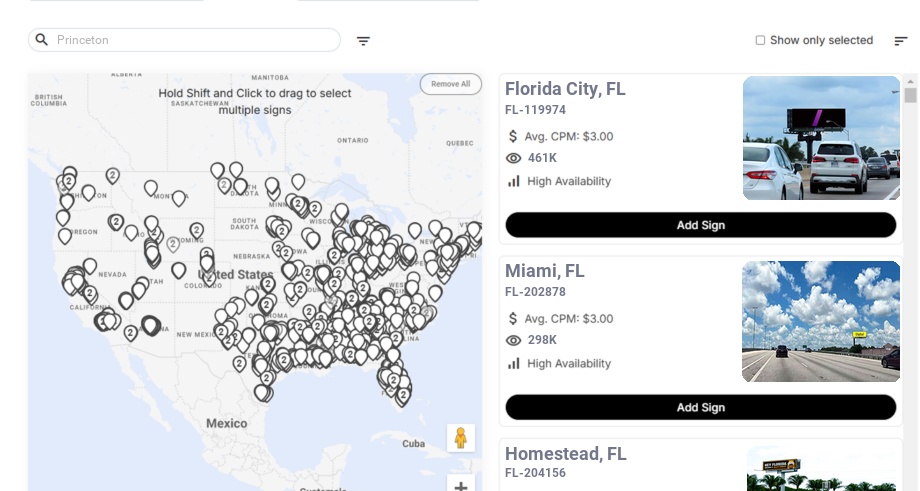
Our 9 digital billboards serving the Princeton area are concentrated in and around Homestead, about 5 miles south. These locations function effectively as Princeton billboards because they sit on the exact routes Princeton residents and visitors most often use. They focus on U.S. 1, Florida’s Turnpike corridors and interchanges, and commercial strips in Homestead near big-box retail, auto dealers, restaurants, and service businesses.
What kind of people do Princeton, Florida billboards reach?
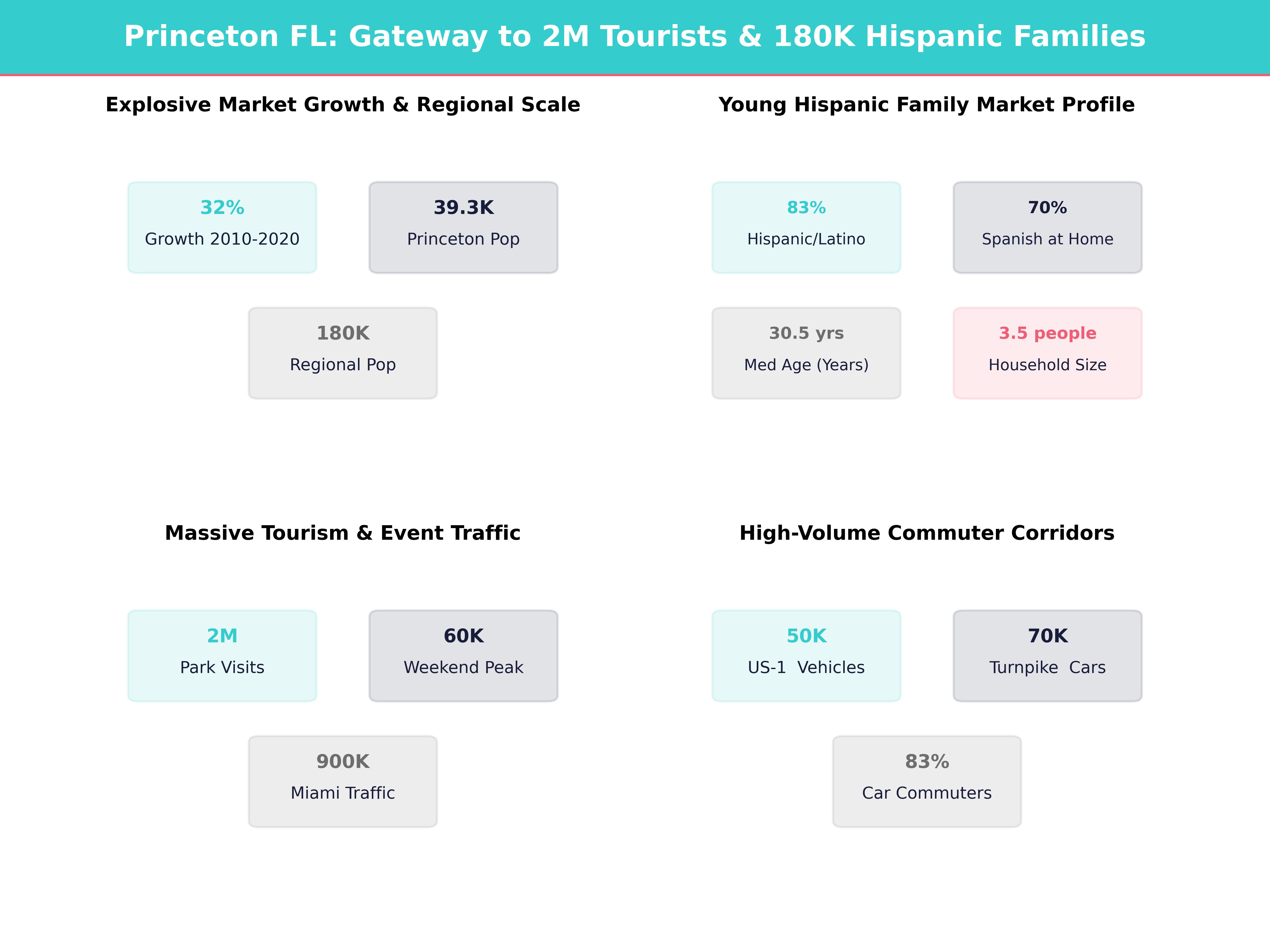
The Princeton area is a fast-growing community in southern Miami-Dade with about 39,300 residents in 2020, and the broader south Miami-Dade region is home to over 180,000 residents. The area has a median age around 30–31, a high share of families, and about 80–85% of residents identify as Hispanic/Latino. In many neighborhoods, 70%+ of households speak Spanish at home, so bilingual or Spanish-first creative often performs best.
When is the best time to run Blip billboards in Princeton, Florida?
For local services, the best drive times are 6:30–9:30 a.m. and 3:30–7:30 p.m., when commuters are leaving and returning to the neighborhood. For tourism and attractions, Friday afternoon through Sunday evening is especially strong, with daytime hours capturing travelers deciding what to do and where to stop. Seasonal demand also rises from December to April during peak tourism and snowbird season.
What traffic makes Princeton, Florida billboard advertising effective?
The Princeton area sits at a crossroads between suburban Miami-Dade neighborhoods, the Florida Keys, and nearby parks, which creates strong commuter and visitor traffic. U.S. 1 in the Homestead–Princeton stretch commonly ranges from 40,000 to 60,000 vehicles per day, while Florida’s Turnpike near Homestead regularly carries 70,000+ vehicles per day. Nearby Everglades and Biscayne National Parks also bring millions of annual visits that pass through or near the corridor.
Do I need a contract to advertise with Blip near Princeton?
No, Blip has no long-term contracts or minimum commitments. You can start, pause, or stop your campaign at any time.
How fast can I launch a billboard campaign with Blip near Princeton?
You can have your campaign live in minutes. Create a free account, select your locations, set your budget, upload your design, and start running once approved.
Where can I advertise with Blip near Princeton?
Blip has digital billboards near Princeton. You can browse available locations on a map, choose the ones that fit your audience, and start advertising right away.
Still have questions? Launch a campaign in minutes — no contracts, no commitments.
Start Your CampaignPrinceton Billboard Advertising Guide
The Princeton, Florida area sits at a powerful crossroads between suburban Miami-Dade neighborhoods, gateway national parks, intensive agriculture, and regional tourism. With 9 digital billboards near the Princeton area—primarily in nearby Homestead, about 5 miles south—we can reach commuters, families, military-affiliated residents, and visitors moving between Miami, Everglades National Park, Biscayne National Park, and the Florida Keys. This guide outlines how to use those boards strategically for high-impact digital billboard campaigns serving the Princeton area, including how to plan, buy, and optimize billboard advertising near Princeton.
Understanding the Princeton Area Market
The Princeton area is an unincorporated community in southern Miami-Dade County, just north of Homestead along U.S. 1 and Florida’s Turnpike. For advertisers, this makes Princeton billboards a natural way to intercept drivers heading between neighborhood streets and these major regional routes.
Key demographic and economic context:
- Population density: The Princeton CDP had about 39,300 residents in 2020, up roughly 30–35% from 2010, making it one of the faster-growing communities in southern Miami-Dade. The broader south Miami-Dade region (including Princeton, Homestead, Naranja, and Leisure City) is home to over 180,000 residents, with new subdivisions continuing to fill in along SW 248th–280th Streets.
- Household structure: Average household size in the Princeton–Homestead area is around 3.4–3.6 people, noticeably higher than the U.S. average of about 2.5, reflecting a high concentration of families and multigenerational homes.
- Age profile: The median age in the Princeton area is around 30–31 years, compared with about 39 statewide. Nearly 30% of residents are under 18, and roughly 60% are under 35, creating strong demand for family, youth, education, and entry-level employment messaging.
- Income & housing: Median household income is in the $55,000–$62,000 range, with a substantial share of households in the working- and lower-middle-income brackets. Roughly 40–45% of households rent, and 55–60% own their homes, which supports both move-up housing and renter-focused services like finance, insurance, and auto.
-
Employment base: In the southern Miami-Dade corridor, roughly:
- 15–20% of workers are in construction and related trades,
- 15–20% in retail and hospitality,
- 10–15% in healthcare and social assistance, and
- 10–15% in logistics, warehousing, and transportation.
- Cultural makeup: Princeton and Homestead are predominantly Hispanic/Latino—around 80–85% of residents identify as Hispanic/Latino, and in many neighborhoods 70%+ of households speak Spanish at home. Bilingual or Spanish-first messages consistently outperform English-only creative for broad consumer campaigns.
Local anchors and traffic generators that matter to advertisers:
- Homestead-Miami Speedway draws tens of thousands of visitors for NASCAR and other major events each year. A single major race weekend can attract 50,000–70,000 attendees, with hotel occupancy in south Miami-Dade regularly exceeding 80–90%. Homestead-Miami Speedway events cause measurable surges in regional traffic.
-
National parks nearby:
- Everglades National Park typically sees around 1.1–1.2 million recreational visits per year.
- Biscayne National Park adds roughly 700,000–900,000 annual visitors, many of whom pass through the U.S. 1 and Turnpike corridors near Princeton and Homestead.
Together, they drive around 2 million park visits annually, with strong spillover for tours, dining, fuel, and lodging.
- Local government & services: Residents rely on services and resources from Miami-Dade County, the City of Homestead, the Miami-Dade Transportation & Public Works Homestead Air Reserve Base thousands of military and civilian personnel and regular contractor traffic.
- Tourism gateways: The Princeton area functions as a staging point for day trips to Zoo Miami, which draws an estimated 800,000–1,000,000 visitors per year, the Redland agricultural district Florida Keys via U.S. 1. The broader Greater Miami area welcomed over 26 million overnight and day visitors in a recent pre-pandemic year, many of whom travel through or near south Miami-Dade on their way to the parks and Keys, according to Miami and Beaches.
This mix of local families, blue-collar workers, national park visitors, and Keys-bound tourists makes the Princeton area a versatile and valuable digital billboard market, and it explains why demand for billboards near Princeton continues to grow.
Where Our Billboards Reach Near Princeton
Our 9 digital billboards serving the Princeton area are concentrated in and around Homestead, about 5 miles south. These locations function effectively as Princeton billboards because they sit on the exact routes Princeton residents and visitors most often use.
These locations focus on:
- U.S. 1 (South Dixie Highway): The main surface artery connecting southern Miami-Dade to central Miami and the Florida Keys. In the Homestead–Princeton stretch, average annual daily traffic (AADT) commonly ranges from 40,000 to 60,000 vehicles per day, according to studies by the Florida Department of Transportation District Six
- Florida’s Turnpike corridors and interchanges: Florida’s Turnpike near Homestead regularly carries 70,000+ vehicles per day, mixing daily commuters with long-distance travelers heading to and from central and north Florida.
- Commercial strips in Homestead: Near big-box retail, auto dealers, restaurants, and service businesses that Princeton-area residents frequent, such as the retail corridors around Campbell Drive, SW 152nd Avenue, and US-1. Major shopping centers in the area can draw 15,000–25,000 visits on a busy weekend day.
Why this matters for campaign planning:
- In Miami-Dade County, about 80–85% of workers commute by car, and average one-way commute times are around 32–33 minutes—among the longest in Florida. Princeton-area residents often commute north toward Kendall and central Miami for work and south toward Homestead for shopping, schools, and services. Placing messages on Homestead boards captures these habitual, daily trips and makes billboard rental near Princeton highly efficient.
-
Many visitors heading to the Everglades, Biscayne Bay, and the Keys pass through or very near these boards. U.S. 1 is the only road into the Keys, and Monroe County (the Florida Keys) typically hosts more than 5 million visitors annually, a large portion of whom travel through southern Miami-Dade. Visitor traffic is heavily directional:
- Southbound mornings/late mornings toward the parks/Keys
- Northbound late afternoons/evenings returning toward Miami
With Blip, we can selectively buy “blips” (individual ad plays) at specific times, days, and locations, so advertisers can align impressions with the flows of Princeton-area commuters and visitors and get more value out of billboard advertising near Princeton.
Traffic Patterns and Optimal Timing Near Princeton
To make digital billboards work hard for you, it helps to understand when and how people move through the Princeton–Homestead area.
Weekday Commuter Flows
Southern Miami-Dade is highly commuter-oriented:
- In many south Miami-Dade communities, more than 65–70% of employed residents work outside their immediate area, and large shares travel north along U.S. 1 or the Turnpike toward Kendall, Dadeland, and central Miami.
- Morning peak: roughly 6:30–9:00 a.m., when volumes on both U.S. 1 and the Turnpike near Homestead can exceed 5,000–6,000 vehicles per hour in each direction.
- Afternoon/evening peak: roughly 4:00–7:00 p.m., with pronounced northbound congestion on weekdays, as reflected in traffic reports from outlets like WPLG Local 10 and NBC 6 South Florida.
Recommended timing for common objectives:
-
Local services (clinics, childcare, auto repair, grocery, restaurants):
Focus on drive times in and out of the Princeton area:- 6:30–9:30 a.m. (commuters leaving the neighborhoods)
- 3:30–7:30 p.m. (commuters returning / school pickup times)
- Employment and hiring campaigns:
Heavier rotation very early morning (5:30–7:30 a.m.) and late evening (7:00–10:00 p.m.), when shift workers in manufacturing, agriculture, logistics, and hospitality are heading to/from work. In industries like logistics and warehousing, 20–30% of workers may be on nontraditional or overnight shifts, making these windows disproportionately valuable.
Weekend and Visitor Traffic
Weekends bring a different pattern:
- Park visitors: Flows to Everglades and Biscayne National Parks increase Friday–Sunday, particularly 9:00 a.m.–2:00 p.m. southbound and 3:00–7:00 p.m. northbound. On peak-season Saturdays, main Everglades entrances can see 2,000–3,500 vehicle arrivals per day, much of it passing near the Princeton–Homestead corridor.
- Retail & dining: Major shopping areas in Homestead see heavier midday and early evening traffic on Saturday and Sunday, with some centers reporting 20–30% higher foot traffic on weekends versus weekdays.
Advertisers targeting:
-
Tourism & attractions (airboat tours, fishing charters, Keys hotels, Redland experiences, Zoo Miami, Schnebly Redland’s Winery & Brewery) should bid more aggressively:
- Friday afternoon–Sunday evening
- Daytime hours when travelers are on the road deciding what to do and where to stop. Tourism research in Greater Miami shows that over 40% of visitors make at least some activity decisions same-day, making roadside messaging highly influential.
- Faith-based organizations and weekend events:
Concentrate on Thursday–Sunday, with heavy plays Thursday evening and Friday to influence weekend planning. Many local congregations report 60–70% of weekly attendance on Sunday services, plus Friday/Saturday youth and family events.
Seasonal Considerations
Southern Miami-Dade experiences clear seasonal shifts:
-
Peak tourism & “snowbird” season: roughly December–April
- South Florida hotel occupancy can rise to 80–90% in this period, and visitor volume to Miami and the Keys can be 30–40% higher than off-season.
- Excellent window for hotels, attractions, restaurants, and high-ticket services such as elective healthcare, real estate, and large home projects.
-
Hurricane season (June–November):
- Heightened consumer attention to home improvement, insurance, auto maintenance, and emergency preparedness. In years with active storms, local media such as the Miami Herald – Homestead South Dade News Leader see sustained surges in weather-related coverage and search interest.
-
Agricultural cycles in the Redland area:
- Winter and early spring are peak seasons for farm tours, u-pick operations, and food festivals. The Redland region includes hundreds of farms and nurseries; major events can draw 5,000–20,000 visitors over a weekend, depending on the festival.
With Blip, we can ramp up budgets during peak tourist or event seasons and scale back during slower periods—all without long-term contracts—so advertisers only pay more when the market is busiest and keep their billboard rental near Princeton closely aligned with demand.
Crafting Billboard Creative for the Princeton Area
The Princeton area’s audience is highly visual, bilingual, and often viewing boards at driving speeds of 35–65 mph. Strong creative is critical for maximizing results from Princeton billboards.
Language and Cultural Relevance
- A large majority of residents in the Princeton–Homestead corridor are Hispanic/Latino; 8 out of 10 or more identify as Hispanic/Latino, and Spanish is used daily at home and at work.
- Across studies of South Florida media habits, 60–70% of Hispanic adults report consuming at least some content primarily in Spanish.
-
We strongly recommend:
- Bilingual creative (English + Spanish) for broad consumer campaigns.
- Spanish-first creative when targeting local families for schools, healthcare, retail, finance, or faith-based services.
Examples of effective bilingual structure:
-
Headline in Spanish, subline in English:
- “Ahorra en tu seguro de auto” / “Save on your car insurance”
- Or vice versa, depending on your core audience.
Design Principles for High-Speed Readability
Given typical speeds on U.S. 1 and Turnpike corridors, drivers have 3–6 seconds to absorb your message. Independent out-of-home (OOH) research shows that simple, bold designs can increase ad recall by 20–40% versus cluttered creative.
We recommend:
- 6–8 words or fewer in the main headline.
-
Font sizes large enough to be read from 400–600 feet, with high contrast:
- Light text on a dark background or vice versa.
-
One clear call to action:
- Phone number (easy digits), short URL, or simple search cue (“Search: ‘Princeton HVAC’”).
- Limit to 1–2 key visual elements (logo + one photo or icon).
- Avoid cluttered price grids or long lists; pick the single strongest offer. Testing shows that focusing on one primary benefit can lift response rates by 15–25%.
For tourism-targeted boards (Keys, parks, Zoo Miami):
- Use big, bold imagery: beaches, wildlife, family fun, or food. Visuals can account for up to 70% of what viewers remember from an OOH ad.
- Emphasize distance/time to your location: “Just 10 min off U.S. 1” or “Next Turnpike Exit.” Simple directional cues can increase visitation from passersby by 10–20% compared with generic branding.
For local Princeton-area services:
- Include local cues: “Serving Princeton & Homestead,” references to nearby schools or neighborhoods, or local landmarks like Homestead Station Homestead Hospital
- Locally anchored phrases help build trust; in surveys of local shoppers, over 60% say they are more likely to patronize a business that clearly identifies as local. This is especially true when they see that the business is investing in billboard advertising near Princeton rather than only in more distant areas.
Aligning Message with Audience Segments
The Princeton area spans several distinct buyer segments; tailoring your creative to them boosts performance.
Families and Young Households
With a median age around 30 and nearly 1 in 3 residents under age 18, family outreach is a top opportunity.
-
Best-fit advertisers:
- Pediatric and family clinics
- Daycares and after-school programs
- K–12 schools, charter schools, and tutoring (including programs in Miami-Dade County Public Schools)
- Quick-service restaurants and family dining
- Recreational activities, sports leagues, and entertainment
-
Message tips:
- Emphasize convenience (“near U.S. 1,” “easy parking”), affordability (“plans desde $29/mes”), and safety.
- Promote time-bound offers around back-to-school, holidays, and summer break. In Miami-Dade, school calendars create noticeable spikes in spending; back-to-school periods can drive 10–20% increases in retail categories like clothing, healthcare checkups, and tutoring.
Blue-Collar and Service-Sector Workers
A significant number of Princeton-area residents work in construction, trades, agriculture, logistics, hospitality, and retail. In some nearby ZIP codes, 25–30% of jobs are in blue-collar or service roles.
-
Best-fit advertisers:
- Trade schools and certification programs
- Staffing agencies and employers hiring for skilled trades and logistics
- Tool, equipment, and automotive services
-
Message tips:
- Feature wage info (“Start at $20/hr”), shift schedules, or benefits in large, clear type. Transparent pay ranges can increase application rates by 15–30%.
- Run heavier during early morning and late night windows to catch shift patterns when workers are most alert to “new job” messaging.
Park Visitors and Keys-Bound Travelers
This mobile, experience-seeking audience is often making decisions on the road:
-
Best-fit advertisers:
- Attractions in the Redland and Homestead areas
- Airboat tours, fishing charters, guided Everglades trips
- Hotels, motels, RV parks, and campgrounds
- Restaurants and bars on the way to/from the Keys
-
Message tips:
- Play up scarcity and urgency: “Last stop before the Keys,” “Turn now for fresh seafood.” Limited-time and “last chance” language can lift response by up to 30% in tourism categories.
- Use simple exit instructions or landmark directions instead of complex addresses—tourists are often unfamiliar with local street grids and are relying on GPS plus quick roadside cues.
Using Blip’s Tools Strategically Near Princeton
Blip’s flexible buying model is especially powerful in a market like the Princeton area, where traffic patterns and audience compositions shift by time of day, day of week, and season. It gives even small advertisers access to Princeton billboards without the typical long-term contracts.
Dayparting: Only Show When It Matters
With dayparting, we set your ads to play only during certain hours:
- Breakfast and coffee shops: Target 5:30–10:00 a.m. when commuters leave the Princeton area. In commuter corridors, 30–40% of coffee and quick breakfast sales happen before 10 a.m.
- Dinner and nightlife: 4:30–10:00 p.m., focusing Thursday–Sunday, when restaurant revenue can be 50–60% higher than early-week evenings.
- Weekend attractions: Late morning to late afternoon Friday–Sunday for family outings and tourist excursions, capturing the peak 9:00 a.m.–4:00 p.m. drive window.
By avoiding low-value hours for your business, we stretch your budget and raise your effective impressions. Advertisers who use dayparting effectively often see 15–25% more outcomes (calls, visits, sign-ups) per dollar spent compared with always-on schedules.
Budget Control and Bidding
Blip charges based on the value of each “blip” (ad play); prices fluctuate by board, time, and demand.
For the Princeton area:
-
Boards along major commuter routes near Homestead may be more competitive during weekday rush hours.
Strategy:- Bid higher if these windows are crucial, or
- Shift spend to slightly off-peak windows (e.g., 9:30–11:30 a.m., 7:30–9:30 p.m.) where impressions are still strong but more affordable.
-
During major events at Homestead-Miami Speedway, bids may rise. You can:
- Temporarily increase budgets to ride the surge, or
- Focus on pre- and post-event weeks when attention is still elevated but competition may be lower.
In practice, advertisers that actively adjust bids around big events and seasons often achieve 10–20% lower cost per thousand impressions (CPM) than those leaving bids static, making their billboard rental near Princeton more cost-effective.
A/B Testing Multiple Creatives
Because digital billboards can rotate multiple designs, we encourage:
- Testing versions with English-only vs. bilingual headlines to see which yields higher web/phone engagement. In many South Florida tests, bilingual creative has produced 10–25% higher recall among Hispanic audiences.
-
Experimenting with price-led vs. benefit-led creative:
- “Oil Change $39.99” vs. “Fast Oil Change While You Wait.”
- In automotive categories, clear price points can increase response by up to 20%, while benefit-led creative is often better for premium services.
-
Rotating seasonal and event-specific creatives:
- “Beat Hurricane Season – Roof Inspections” (June–October)
- “Back-to-School Checkups in Princeton Area” (July–September)
Monitor response using:
- Website analytics (spikes during campaign windows)
- Unique URLs or phone numbers
- Offer codes (“Mention PRINCBLIP for 10% off”) to attribute foot traffic.
Even simple A/B tests can reveal 15–30% performance differences between creatives; using Blip’s flexibility lets you quickly shift more budget to winners.
Leveraging Local Events and Calendars
Tying campaigns to local events in areas near Princeton creates urgency and relevance.
Some key event-driven opportunities:
-
Homestead-Miami Speedway events:
Race weekends bring tens of thousands of extra visitors—NASCAR Cup Series events alone can attract 50,000+ attendees. Perfect for:- Hotels, restaurants, bars, and convenience stores
- Auto services, performance shops, and motorsports retailers
Use high-energy visuals and run heavier rotations 1–2 weeks before and during event weekends.
Check schedules at homesteadmiamispeedway.com
-
Redland agricultural and food festivals:
The Redland area hosts fairs and food festivals that attract both locals and visitors—signature events can draw 5,000–15,000 visitors over a weekend; many are listed through the City of Homestead and local tourism sites like Miami and Beaches.
Ideal for:- Wineries, breweries, farm stands, craft vendors, and local artisans.
-
Local government and community events:
Miami-Dade County and the City of Homestead promote vaccination drives, emergency preparedness events, and community resource fairs—good tie-ins for:- Healthcare providers
- Insurance agents
- Nonprofit services
Community health events can serve hundreds to a few thousand residents in a single day, creating strong need for awareness in the immediate weeks beforehand.
- School and youth sports calendars:
With more than 330,000 students in Miami-Dade County Public Schools, back-to-school, testing seasons, and graduation periods are major life moments. Local youth sports leagues and school athletics in Homestead and Princeton also bring hundreds of families to fields every weekend—prime time to promote family dining, healthcare, and tutoring.
You can also keep an eye on local news outlets such as the Miami Herald’s Homestead section ( miamiherald.com – Homestead WPLG Local 10 (local10.com), NBC 6 South Florida (nbcmiami.com), and South Dade News Leader (southdadenewsleader.com) for upcoming events that may boost regional traffic and increase the impact of billboard advertising near Princeton.
Industry-Specific Strategies for the Princeton Area
Below are some tailored approaches by industry to make the most of digital billboards serving the Princeton area.
Auto Dealers, Repair, and Services
The Princeton–Homestead corridor has heavy reliance on personal vehicles:
- In Miami-Dade, over 90% of households have access to at least one vehicle, and in many south-county neighborhoods, 70%+ of workers drive alone to work.
- Focus messages on low down payments, fast approvals, and bilingual service.
-
Time campaigns to:
- Paydays (1st–5th and 15th–20th of each month), when consumer spending on auto and big-ticket items can increase 15–25%.
- Weekends for test drives and service appointments.
- Use directional copy if your lot is close to major intersections or ramps:
“Turn Right at Campbell Dr – Huge Used Car Sale.” - Consider service promotions such as “Oil Change $39.99 – No Appointment” or “Free A/C Check Before Summer,” which often deliver higher response rates than generic brand messages.
Healthcare, Dental, and Clinics
With many young families and working adults:
-
Highlight:
- Walk-in availability, evening/weekend hours, bilingual staff.
- Affordable pricing, Medicaid/Medicare acceptance if applicable. In Miami-Dade, over 18% of residents are uninsured, so clear affordability messages are important.
-
Promote preventive and seasonal services:
- “Back-to-School Vaccines – Walk In Today”
- “Same-Day Urgent Care in the Princeton Area”
- Health systems in South Florida report that urgent care and walk-in centers can see 20–30% increases in daily volume when awareness campaigns run across OOH and digital channels simultaneously.
Education and Training
There’s strong demand for upward mobility and skills training:
- Roughly 25–30% of adults in parts of southern Miami-Dade have some college or an associate degree, leaving a large pool for training programs and certifications.
-
For trade schools, community colleges, and language schools:
- Focus on completion timelines (“Become a Medical Assistant in 9 Months”).
- Show tuition assistance and job placement in concise statements; job placement rates of 70–80% stand out when presented clearly.
-
Run heavier campaigns:
- Late summer (school-year planning)
- January/February (New Year’s resolution mindset), when interest in education and training often spikes by 15–20% in search and inquiry data.
Tourism, Hospitality, and Attractions
For businesses benefiting from Everglades, Biscayne, Zoo Miami, or Keys traffic:
-
Use simple, exit-based directions:
- “Exit 2 – Airboat Tours – 10 Minutes from Here.”
-
Highlight what makes you unique vs. generic options in Miami or the Keys:
- “Only Winery in the Redland” (for places like Schnebly Redland’s Winery).
- Consider multilingual creative (English + Spanish, and possibly Portuguese or French) if you target international visitors; in Greater Miami, over 25% of visitors come from international markets in many years.
- Tourism research shows that travelers exposed to at least one OOH ad are 15–30% more likely to visit an attraction compared with those who are not, especially when the ad is within 15–20 miles of the destination.
Measuring and Optimizing Campaign Success
Digital billboards in the Princeton area must tie back to results. We recommend:
- Dedicated landing pages (e.g., yoursite.com/princeton) to track visits from the region. A clear, campaign-specific page can improve conversion rates by 10–20% versus sending traffic to a generic homepage.
-
Promo codes unique to billboard campaigns:
- “Use code PRINCETEN for 10% off” to attribute sales or bookings.
-
Google Analytics and call tracking:
- Monitor traffic spikes during campaign windows and adjust budgets accordingly.
- Businesses that implement call tracking on OOH campaigns often find 10–40% of new inbound calls can be directly tied to billboard exposure windows.
Combine these metrics with what you know about your own peak business times to refine:
- Which boards perform best (Homestead vs other nearby corridors)
- Which dayparts generate meaningful response
- Which creative messages drive calls, visits, or form fills
Because Blip allows you to adjust campaigns in near real-time, you can quickly pivot from underperforming variations and double down on the winners, turning even modest budgets into consistent, measurable lifts in awareness and sales.
By leveraging the 9 digital billboards serving the Princeton area and applying a data-driven approach to timing, message, language, and audience segments, advertisers can turn the Princeton–Homestead corridor into a powerful engine for awareness, foot traffic, and sales. With flexible budgeting, precise dayparting, and rapid creative testing, we can help you reach residents, workers, and visitors moving near Princeton with the right message at the right moment and make billboard advertising near Princeton a measurable, dependable part of your marketing mix.