Billboards near Keystone, FL
No Minimum Spend. No Long-Term Contracts. Just Results.
Trusted by Leading Brands


Billboard advertising
near Keystone has never been easier



How much is a billboard near Keystone?
Why Choose Blip for Billboard Advertising near Keystone
Blip lets Keystone brands launch fast on US-19, SR 54, and Veterans Expressway traffic—no media buyer needed.
Use flexible budgets in Keystone to reach affluent lake-home families and Tampa commuters only when it matters.
Daypart your Keystone ads for 6:30-9 a.m. and 4-7 p.m. to catch rush-hour traffic home to the lakes.
No contracts means Keystone businesses can test short bursts for beach season, back-to-school, or holiday peaks.
Track Keystone campaign results in real time and shift spend toward Palm Harbor and East Lake routes that convert.
Blip's creative tools help Keystone ads stay bold and readable for fast-moving drivers on US-19 and Alt US-19.
Frequently Asked Questions About Billboard Advertising near Keystone
How much does a billboard cost near Keystone, Florida with Blip?
With Blip, you can advertise on Keystone billboards in the Keystone area on virtually any budget, because you pay only for the individual “blips” your ad receives. Each blip is a short 7.5 to 10-second display on digital billboards near Keystone, Florida, and you set a daily budget that Blip automatically follows. The cost per blip changes based on your chosen times, locations serving the Keystone area, and real-time advertiser demand, so you’re always paying a fair, flexible rate.
Where can I advertise with Blip near Keystone, Florida?
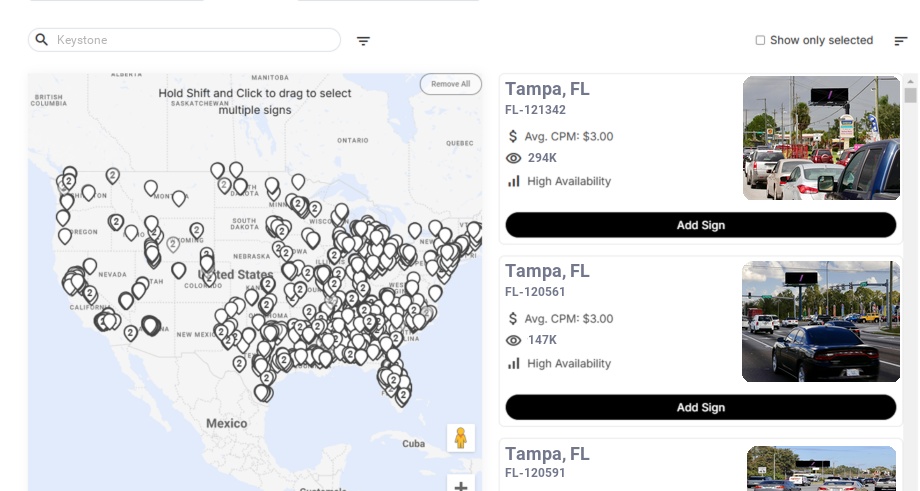
Our 26 digital billboards serving the Keystone area are within about 10 miles, focused around Palm Harbor (roughly 9.7 miles away). These Keystone billboards are strategically positioned along high-volume roads that Keystone-area residents frequently use, including US‑19 near Palm Harbor, Alt US‑19 / Palm Harbor Road corridors, and feeders from SR 54 and East Lake Road. That makes nearby corridors around Palm Harbor and North Pinellas ideal places to intercept Keystone-area households as they drive to work, school, shopping, and recreation.
What kind of people do Keystone, Florida billboards reach?
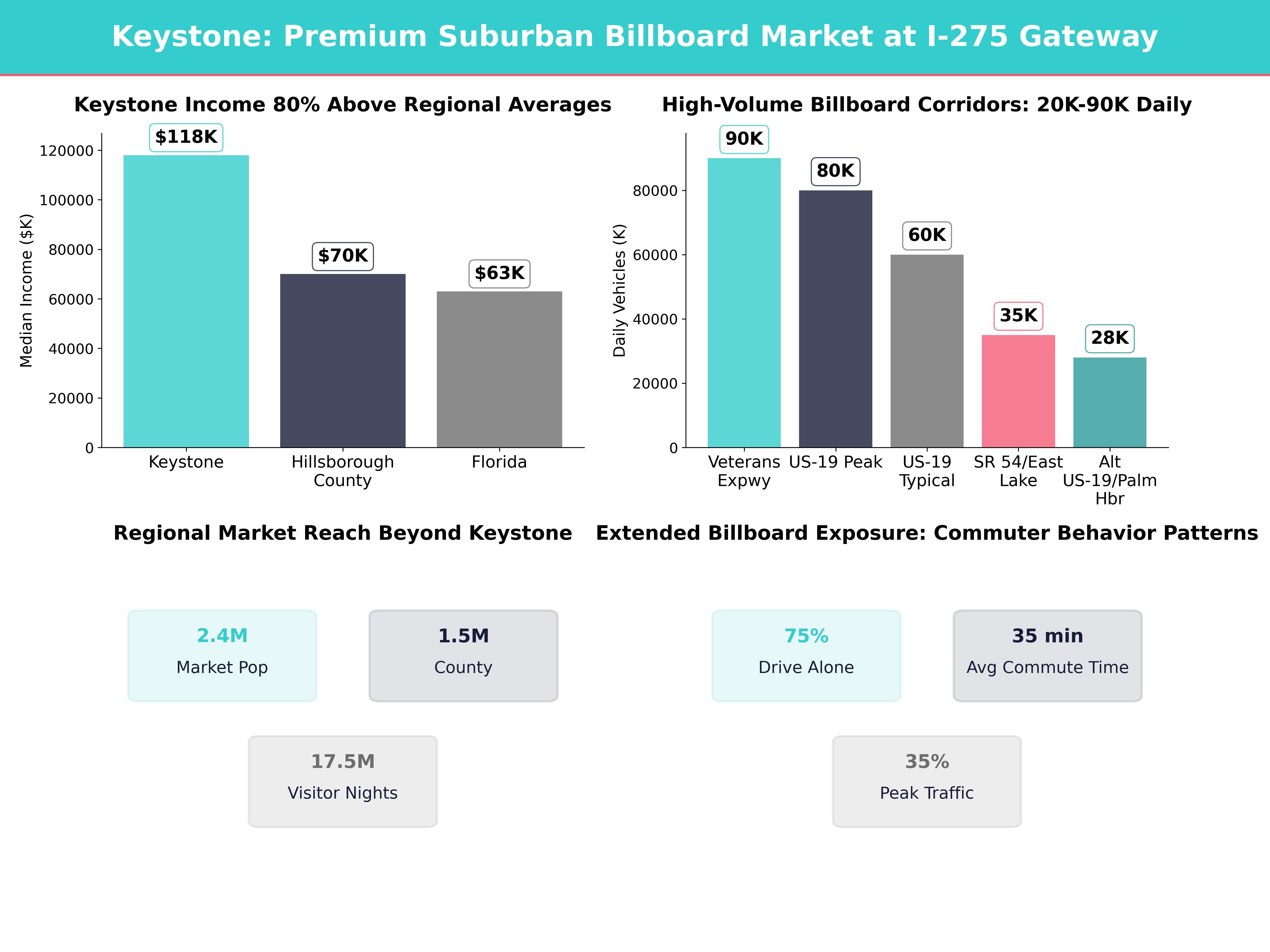
The Keystone area is characterized by large residential lots, equestrian properties, and dozens of lakes, and it skews family-oriented and middle-aged. Median household income in the Keystone area is around $115,000–$120,000, and owner-occupancy in nearby northwestern Hillsborough communities typically exceeds 75–80%. The area also has a substantial share of residents between 35 and 64, plus many school-age children and teens.
When is the best time to run Blip ads in Keystone, Florida?
For commuter-focused or B2B campaigns, the page recommends heavier Blip scheduling in weekday rush hours, concentrating on the 6:30–9:00 a.m. and 4:00–7:00 p.m. blocks. Morning traffic moves south and east toward Tampa job centers, Westchase office parks, and Pinellas commercial areas, while evening traffic reverses back toward Keystone-area neighborhoods. The page also notes that weekend daytime and seasonal periods like back-to-school, winter visitor season, and holiday breaks can create strong opportunities.
What traffic patterns make billboards near Keystone, Florida effective?
Many Keystone-area residents commute toward Tampa, Westchase, and the Pinellas beaches via major routes like Gunn Highway, the Veterans Expressway (SR 589), SR 54, and US‑19. US‑19 near Palm Harbor carries about 50,000–70,000 vehicles per day, with some segments approaching or surpassing 80,000 daily vehicles during seasonal peaks. The Veterans Expressway and US‑19 corridors also record strong weekday peaks, with expressway segments handling 90,000+ vehicles per day in some stretches.
Do I need a contract to advertise with Blip near Keystone?
No, Blip has no long-term contracts or minimum commitments. You can start, pause, or stop your campaign at any time.
How fast can I launch a billboard campaign with Blip near Keystone?
You can have your campaign live in minutes. Create a free account, select your locations, set your budget, upload your design, and start running once approved.
Where can I advertise with Blip near Keystone?
Blip has digital billboards near Keystone. You can browse available locations on a map, choose the ones that fit your audience, and start advertising right away.
Still have questions? Launch a campaign in minutes — no contracts, no commitments.
Start Your CampaignKeystone Billboard Advertising Guide
The Keystone, Florida area offers a rare mix of affluent lake communities, commuter traffic to Tampa, and proximity to Gulf Coast beaches—all within easy reach of our 26 digital billboards near Keystone, primarily in nearby Palm Harbor
Understanding the Keystone Area Market
Keystone is an unincorporated community in northwestern Hillsborough County, characterized by large residential lots, equestrian properties, and dozens of lakes. That “exurban” feel has big implications for billboard advertising:
- Population: The Keystone area (Keystone CDP) has roughly 24,000–25,000 residents based on 2020 era local planning estimates, with population growth in northwestern Hillsborough remaining positive over the last decade.
- Households & density: With an average of about 2.7–3.0 persons per household and relatively low residential density (often fewer than 1,000 residents per square mile in many neighborhoods), advertising skewed toward single‑family homeowners performs especially well.
- Income: Median household income in the Keystone area is around $115,000–$120,000, well above both the Florida median (about $63,000) and Hillsborough County median (around $70,000). Roughly 40–45% of households in similar northwestern Hillsborough tracts report incomes above $100,000, supporting premium products and larger ticket purchases.
- Housing & ownership: Owner‑occupancy in nearby northwestern Hillsborough communities typically exceeds 75–80%, and median home values are often 30–50% higher than the Hillsborough County average, which strengthens demand for home improvement, outdoor living, and professional services.
- Age: The area skews family-oriented and middle-aged, with a substantial share of residents between 35 and 64 and a significant population of school-age children and teens. Hillsborough County Public Schools enrolls about 220,000+ students districtwide, and neighborhoods feeding into schools in northwest Hillsborough are among the more stable, higher‑income zones.
- Commute: Many Keystone-area residents commute toward Tampa, Westchase, and the Pinellas beaches via major routes like Gunn Highway, the Veterans Expressway (SR 589), SR 54, and US‑19. Regional transportation and planning agencies such as Plan Hillsborough and TBARTA
These patterns make nearby corridors—especially those around Palm Harbor and North Pinellas—ideal places to intercept Keystone-area households as they drive to work, school, shopping, and recreation with billboard advertising near Keystone that feels constant but not overwhelming.
For macro context, Hillsborough County now has more than 1.5 million residents, according to county summaries, and Pinellas County adds another ~960,000 residents—making it one of the most densely populated counties in Florida. You’re advertising on arteries that connect the Keystone area to a combined regional market of well over 2.4 million people, plus millions of annual visitors.
You can explore local planning and demographic context via:
- Hillsborough County Government
- Pinellas County Government
- Regional transportation and development agencies like Plan Hillsborough and Forward Pinellas
- Regional tourism boards like Visit Tampa Bay and Visit St. Pete/Clearwater
Who You Reach with Billboards Serving the Keystone Area
Our 26 digital billboards serving the Keystone area are within about 10 miles, focused around Palm Harbor (roughly 9.7 miles away). These Keystone billboards and nearby faces are strategically positioned along high-volume roads that Keystone-area residents frequently use:
- US‑19 near Palm Harbor: One of Florida’s busiest north-south surface corridors; FDOT District Seven 50,000–70,000 vehicles per day, with some segments approaching or surpassing 80,000 daily vehicles when seasonal peaks are included.
- Alt US‑19 / Palm Harbor Road corridors: Carry a mix of local residents, beach-bound tourists, and daily commuters. On many Pinellas arterials of this type, FDOT reports 20,000–35,000 vehicles per day, offering strong frequency for brand-building campaigns.
- Feeders from SR 54 and East Lake Road: Heavily used by Keystone-area residents making east‑west connections to shopping, schools, and recreation. In north Pinellas and south Pasco, typical daily volumes on major east‑west routes fall in the 25,000–45,000 vehicles per day range, depending on the specific segment.
What this means practically:
- Across our core Keystone‑serving boards, you’re aligning your message with corridors that can easily generate hundreds of thousands of weekly impressions when combining all exposed faces and dayparts.
- You can reach Keystone-area households not only when they’re close to home, but also when they’re in a “buying mindset”—shopping in Palm Harbor, heading to Clearwater beaches, or going out for dining and entertainment.
- You also gain spillover reach into affluent neighboring communities like East Lake, Odessa, Westchase, and parts of Tarpon Springs, many of which record median household incomes of $90,000+ and above‑average home values—without paying for separate, scattered campaigns.
Because Blip lets us buy digital billboard time in small increments, we can focus your budget on the specific boards and travel directions that align with the Keystone-area trips that matter to you most, rather than spreading spend across lower‑value impressions. This keeps your billboard rental near Keystone tightly aligned with the audiences most likely to convert.
Traffic Patterns and High-Impact Dayparts
To maximize your spend near Keystone, we want to align your schedule with real-world driving behavior.
Commuter Flows
Hillsborough and Pinellas counties are highly car-dependent:
- Countywide, more than 75% of workers commute by driving alone, and another 8–10% carpool, according to regional transportation planning summaries.
- Average commute times for Hillsborough workers hover around 27–30 minutes, with many northwest residents spending 30–40 minutes traveling toward Tampa’s core job centers or westward to Pinellas.
- The Veterans Expressway/Suncoast Parkway and US‑19 corridors record strong weekday peaks, with expressway segments handling 90,000+ vehicles per day in some stretches.
For many Keystone-area households:
- Morning commute (6:30–9:00 a.m.): Traffic moves south and east—toward Tampa job centers, Westchase office parks, and Pinellas commercial areas. In typical commuter windows, 30–40% of daily traffic can pass within these few hours.
- Evening commute (4:00–7:00 p.m.): Flows reverse—drivers head back toward the lakes and neighborhoods around Keystone and Odessa, often picking up kids, running errands, or stopping for dinner. PM peaks often run slightly higher than AM peaks, especially on Fridays.
For commuter-focused or B2B campaigns, we typically recommend:
- Heavier Blip scheduling in weekday rush hours, concentrating on the 6:30–9:00 a.m. and 4:00–7:00 p.m. blocks when traffic volumes can be 30–60% higher than mid‑day troughs.
-
Directional emphasis:
- Promotions for breakfast, coffee, or morning services when traffic is leaving the Keystone area.
- Promotions for restaurants, childcare, medical, and local services when traffic is returning toward Keystone-area neighborhoods.
Shopping and Errand Patterns
Major retail, grocery, and dining hubs for Keystone-area residents often lie along US‑19, SR 54, and near key intersections in Palm Harbor and East Lake. According to county economic development and planning reports, these commercial nodes can account for:
- Hundreds of thousands of square feet of retail and dining space in individual centers, drawing customers from a 10–15 mile radius.
- Strong lunchtime activity (11:00 a.m.–2:00 p.m.) from local workers and remote employees leaving home offices.
- Heavy weekend traffic, particularly Saturdays between 10:00 a.m. and 6:00 p.m., as families shop, dine, and head to beaches or sports activities. Retail corridors often see 20–30% more traffic on Saturdays versus typical weekdays in these time windows.
For local retailers and service providers, we often:
- Increase Blip bids or share-of-voice during Saturday and Sunday daytime when families are most likely to act on impulse purchases and errands.
- Run “errand‑oriented” creative (oil changes, pet care, groceries, home improvement) from late morning through early evening, when parking lots and arterial volumes are peaking.
Seasonal Trends: Snowbirds, Tourists, and Local Events
The Keystone area sits just inland from some of Florida’s strongest tourism and seasonal inflows.
Snowbird and Winter Visitor Season
Pinellas County, according to Visit St. Pete/Clearwater millions of overnight visitors annually. In strong years, the broader St. Pete–Clearwater area has reported:
- Roughly 15–20 million total annual visitor nights (combining domestic and international stays).
- Peak occupancy and room rates from January through April, when seasonal “snowbird” residents escape colder states.
- Visitor spending that reaches into the billions of dollars annually across lodging, dining, retail, and entertainment.
Even though Keystone itself is more residential, many of its residents’ regular routes intersect with:
- Beach-bound tourists using US‑19 and Alt US‑19, particularly on Fridays, weekends, and holidays.
- Seasonal residents staying in areas like Palm Harbor, Dunedin, and Clearwater, who may travel US‑19 multiple times per week for shopping, healthcare, and entertainment.
Winter campaigns can leverage:
- Higher impressions on weekends and afternoons as seasonal visitors explore—traffic on beach access corridors and US‑19 often rises 10–25% in prime visitor months.
- Messaging that targets both locals and visitors (e.g., “Trusted by Keystone families, loved by Tampa Bay visitors”), maximizing the value of each impression when out‑of‑state spending is highest.
Spring & Fall Sports and School Calendars
Keystone-area families are heavily involved in youth sports, after-school programs, and extracurriculars. Hillsborough County Public Schools, via its district calendar, highlights key periods:
- Back-to-school: Early August through September, when more than 220,000 students return to classrooms and traffic near school zones increases noticeably.
- Holiday breaks: Thanksgiving, winter break in late December, and spring break (often March), which influence both travel and local retail patterns.
- Testing and graduation periods in late spring, which often drive demand for tutoring, celebrations, and family events.
These times drive predictable spikes in:
- Shopping for apparel, electronics, and school supplies in the 2–3 weeks before school starts.
- Childcare, tutoring, and extracurricular program searches in early fall and late winter.
- Family dining out and entertainment during long weekends and breaks, when parents look for nearby options that don’t require long drives.
We often recommend:
- Intensifying Blip schedules 2–3 weeks before back‑to‑school and around spring registration windows for camps and activities.
- Running targeted, time‑limited promotions around holiday breaks, such as “winter break camps,” “back‑to‑school checkups,” or “holiday home services.”
Events & Local Culture
Nearby Pinellas and Hillsborough communities host numerous festivals, sporting events, and cultural happenings, frequently covered by outlets like the Tampa Bay Times:
- Spring training baseball in the broader Tampa Bay area, which can attract hundreds of thousands of attendees across the season.
- Beach festivals, food and wine events, and holiday parades in Clearwater, Dunedin, and Palm Harbor that bring thousands to tens of thousands of visitors to the coast on event weekends.
- Local markets, equestrian events, and community fairs that draw Keystone-area residents and visitors to regional parks and event venues.
You can schedule short, high‑impact Blip bursts leading up to event weekends to drive awareness and attendance, especially on corridors feeding from Keystone toward Palm Harbor, Dunedin, and Clearwater, taking full advantage of billboard advertising near Keystone during these high-interest periods.
Creative Strategies for Reaching Keystone Area Drivers
Because Keystone-area drivers spend significant time on divided highways and multi‑lane arterials, your creative has to be legible at speed and instantly relevant.
Design for Fast, High-Income Commuters
Given the Keystone area’s higher household income and professional makeup:
-
Focus on clear, premium positioning:
- “Concierge pediatric care minutes from the Keystone area”
- “Custom pool design for Keystone-area lake homes”
- Limit text to 7 words or fewer; at 55–65 mph, drivers typically have only 5–7 seconds to absorb your message.
- Use large, high-contrast fonts and bold colors that stand out against greenery and suburban backdrops; industry readability studies suggest letter heights of at least 18–24 inches on digital billboards for quick recognition.
-
Include a simple, memorable call to action:
- Short URL or brand name.
- Easy phrase to search (“Google: Keystone Orthodontics”).
- Phone numbers only if truly short and easy; most drivers will remember a name or URL more easily than a 10‑digit number.
Lean Into Local Identity
Keystone-area residents tend to value space, nature, and community:
- Use imagery featuring lakes, horses, trails, and family life, reflecting the area’s many lakes and equestrian properties.
-
Reference local landmarks and nearby destinations:
- “On your way back to the Keystone area?”
- “Serving families from Keystone to Palm Harbor.”
-
Emphasize trust, longevity, and local ownership:
- “Family-owned in the Tampa Bay area since 1998.”
- “Proud to serve Keystone-area homeowners.”
- Consider referencing local hubs and amenities promoted by organizations such as Visit Tampa Bay or Visit St. Pete/Clearwater
Seasonal and Weather-Responsive Messaging Ideas
While Blip does not automatically change creatives by weather, you can upload multiple creatives and schedule them by time or date:
-
Summer heat (highs often 90°F+; humidity high on 60–70% of summer days):
- A/C services, pools, water parks, indoor entertainment, and hydration‑focused messaging.
-
Hurricane season (June–November):
- Home preparation, insurance, generators, tree services, roofing, and emergency supplies. In active storm years, regional data show home‑improvement spending and insurance inquiries rising 10–30% after major events.
-
Holiday periods:
- Gift cards, local events, charity drives, religious services, and end‑of‑year sales. Many retailers report that 30–40% of annual sales can cluster in the November–December period.
By rotating creatives seasonally, you keep your message fresh and contextually relevant for Keystone-area drivers who travel these routes multiple times per week.
Using Blip Tools to Target the Keystone Area
Digital billboards serving the Keystone area give us precise control over when, where, and how often your ads appear, making billboard rental near Keystone flexible and efficient for a wide range of budgets.
Geographic Focus
With 26 boards within approximately 10 miles of Keystone, primarily around Palm Harbor, we can:
-
Prioritize boards that align with your customers’ likely routes:
- Keystone → US‑19 → Clearwater/Pinellas Park.
- Keystone → SR 54 / East Lake Road → Palm Harbor shopping.
- Exclude boards that don’t fit your geography or audience, conserving budget and improving effective CPM.
-
Use directionality (where available) to focus on:
- Inbound traffic to Keystone-area neighborhoods for “on your way home” messages.
- Outbound traffic for “start your day here” calls to action.
This type of geographic refinement can concentrate your impressions on the 20–40% of daily trips most relevant to your business rather than the entire traffic mix, so your billboards near Keystone are seen most often by the people you care about.
Daypart Scheduling
Blip’s scheduling capabilities allow you to run:
- Rush-hour only campaigns if you’re targeting commuters.
- Midday and early afternoon slots if you’re after retirees, stay‑at‑home parents, or remote workers—groups that typically make more discretionary trips between 10:00 a.m. and 3:00 p.m..
- Weekend‑only bursts for events, open houses, or promotions when leisure and shopping trips spike.
Example patterns:
-
A Keystone-area dental practice:
- Heavier Blips 7:00–9:00 a.m. & 4:00–7:00 p.m. to reach working adults, with lighter mid‑day coverage for stay‑at‑home parents.
-
A Palm Harbor restaurant serving Keystone-area families:
- Focus 4:00–9:00 p.m. on Fridays and Saturdays, when dinner and entertainment trips can be 50%+ higher than early‑week evenings.
-
A home contractor:
- Strong presence Saturday mornings and weekday late afternoons when homeowners are planning projects and making calls.
Budget Control
Because Blip operates on a flexible, per‑“blip” model:
- You can start with modest daily budgets (e.g., $10–$25 per day) and scale up as you see results.
- Increase bids during competitive periods (e.g., winter tourist season, back‑to‑school, major local festivals) when more advertisers are vying for the same impressions.
- Run short “test flights” (for example, 7–14 days) on specific boards and time slots, then expand what works and pause what does not.
For many local businesses, this approach leads to a testing phase where 10–20% of the monthly budget is reserved for experimentation, and 80–90% is allocated to proven placements and dayparts.
Sample Strategies by Business Type
To make this concrete, here are some Keystone-area specific approaches.
Local Home Services (Landscaping, Pool, HVAC, Roofing)
Audience: Keystone-area homeowners with higher property values and large lots.
Tactics:
- Focus on boards along US‑19 and east‑west connectors that Keystone residents travel to big-box home stores and garden centers.
- Run heavier schedules March–June (project planning and pre‑summer home upgrades) and September–November (storm prep and fall maintenance). In Florida, home‑improvement and landscaping activity commonly peaks in these months due to weather and school calendars.
-
Creative:
- “Keystone-area lakefront? We keep it pristine.”
- “New roof before hurricane season? Call [Brand].”
- Use strong before/after visuals, but keep layout simple so key benefits can be understood in 3–5 seconds.
Healthcare & Wellness (Pediatrics, Dental, Orthodontics, Fitness)
Audience: Families and working professionals.
Tactics:
- Schedule Blips around morning commute, after school (3–6 p.m.), and weekend mid-morning. School dismissal and practice times can generate heavy traffic near major corridors that families use to reach youth sports fields and medical offices.
-
Emphasize convenience and trust:
- “Minutes from the Keystone area, open late.”
- “Same‑day sick visits for Keystone-area families.”
-
For fitness studios or gyms, highlight:
- “On your way home from US‑19? Stop in for a 30‑minute workout.”
- Consider referencing local health and wellness resources coordinated with county initiatives shared via Hillsborough County or local hospital systems to align with community health campaigns.
Restaurants & Entertainment
Audience: Keystone-area families heading to or from Palm Harbor, Dunedin, or Clearwater.
Tactics:
- Focus on Thursday–Sunday, especially 4:00–9:00 p.m., when dining and entertainment trips surge.
-
Time‑sensitive messages:
- “Tonight only: Kids eat free.”
- “Happy hour on your way back to the Keystone area.”
-
Consider rotating creatives:
- Lunch specials vs. dinner offers vs. weekend brunch.
- When major events are promoted by regional tourism sites like Visit Tampa Bay or local news outlets such as the Tampa Bay Times, run short bursts targeting pre‑ and post‑event traffic.
Real Estate & New Developments
Audience: Move‑up buyers and relocators.
Tactics:
- Run continuous, low‑frequency presence near high-traffic, higher‑income corridors to build familiarity—especially along routes that affluent buyers from Tampa or Pinellas use when exploring northwest Hillsborough.
- Increase frequency during spring and early summer, historically active home‑buying seasons when transaction volumes can rise 20–30% compared with winter months.
-
Creative:
- “Acreage near Keystone. Private tours this weekend.”
- “Thinking of selling your Keystone-area home? Free valuation.”
- Highlight data points such as “homes in our area spending fewer days on market” or “average sale prices up X% year‑over‑year,” using figures from local real estate boards or market reports to underscore urgency.
Measuring and Improving Campaign Performance
To get the most from your Keystone-area campaign, we recommend treating it as an iterative process.
Baseline: Tie to a Clear Goal
Define what success looks like:
- Branding: Higher name recognition in the Keystone area—measured via simple brand‑recall questions, social mentions, or direct feedback.
- Response: More calls, website visits, bookings, or in‑store traffic. Many local advertisers see 5–20% lifts in branded search or direct website visits during sustained billboard flights.
- Events: Attendance at an open house, seminar, festival, or sale.
Create simple, trackable elements:
- A short URL unique to your billboard creative.
- “Mention this billboard near Keystone for 10% off.”
- A dedicated phone number or extension.
- QR codes sized appropriately for slower segments or near traffic signals, if the selected board and roadway context allow safe scanning.
Use Local Data and Feedback Loops
Leverage local sources:
- News and trend coverage from outlets like the Tampa Bay Times.
- County planning and economic development updates via Hillsborough County and Pinellas County.
- Transportation and congestion reports from FDOT District Seven Plan Hillsborough.
- Business and events listings from organizations like the Palm Harbor Chamber of Commerce
Watch for:
- Seasonal spikes (tourism, school calendar, holidays) and adapt your scheduling—visitor and retail data often show double‑digit percentage swings between low and high seasons.
- Which offers or messages customers mention most often when they call or visit.
- Web analytics: traffic from the Keystone area and nearby ZIP codes after your Blip flights, watching for week‑over‑week or month‑over‑month increases that correlate with your campaigns.
Test, Refine, and Scale
We encourage advertisers near Keystone to:
- Start focused: Select a limited set of boards nearest the Keystone area and run 1–2 strong creatives for 2–4 weeks, long enough to accumulate meaningful impressions.
- Compare variants: Test different headlines, images, or calls to action. Even small tweaks—such as simplifying a headline from 10 words to 6—can improve recall.
- Adjust timing: Shift budget toward the time blocks that correlate with more inquiries or sales; many advertisers find that 20–30% of time slots produce a disproportionate share of results.
- Expand winners: Once a message and schedule prove effective, increase your daily budget or extend your geographic coverage outward through Palm Harbor and surrounding corridors, capturing more of the 2.4+ million‑person regional market and its steady stream of visitors.
By combining the Keystone area’s affluent, family-oriented population with the heavy traffic and regional draw of nearby Palm Harbor and US‑19, we can build digital billboard campaigns that punch above their weight. With precise scheduling, data-informed creative, and ongoing optimization, advertisers can turn the roads serving the Keystone area into a powerful, flexible marketing channel and make the most of billboard advertising near Keystone for long-term growth.