Billboards in Daytona Beach Shores, FL
No Minimum Spend. No Long-Term Contracts. Just Results.
Trusted by Leading Brands


Billboard advertising
in Daytona Beach Shores has never been easier



How much is a billboard in Daytona Beach Shores?
Why Choose Blip for Billboard Advertising in Daytona Beach Shores
Blip makes Daytona Beach Shores ads self-serve, so you can launch fast on A1A or Dunlawton without buying through a long sales cycle.
Set flexible budgets in Daytona Beach Shores and pay only when your ad blips live—ideal for testing beach and bridge traffic without contracts.
Use dayparting in Daytona Beach Shores to hit A1A diners, SR 421 commuters, or Bike Week crowds when they’re on the road.
Real-time Blip analytics help you track Daytona Beach Shores performance and shift spend toward the strongest beachside or I-95 reach.
Create and swap artwork for Daytona Beach Shores in minutes, matching race weeks, spring break, or condo-owner services with the right message.
Frequently Asked Questions About Billboard Advertising in Daytona Beach Shores
How much does a billboard cost in Daytona Beach Shores with Blip?
With Blip, billboard advertising in Daytona Beach Shores can be surprisingly affordable because you only pay when your ad actually displays. Each 7.5-to-10-second “blip” starts at just $0.01, and your daily budget is used by Blip’s algorithm to bid for open ad slots on rotating digital billboards. Since pricing is dynamic, the cost per blip can change based on time of day, location, and advertiser demand, helping maximize your reach for what you spend.
Where can I advertise with Blip in Daytona Beach Shores?
Through Daytona Beach Shores, South Atlantic Avenue is the local spine, and recent Florida Department of Transportation traffic counts commonly place A1A segments through the barrier-island strip in the 15,000 to 25,000 AADT range, depending on location and season. State Road 421, better known locally as Dunlawton Avenue, is the most important east-west connector at the south end of Daytona Beach Shores and generally falls in the 35,000 to 45,000 AADT range. I-95 in the Daytona Beach area and US 92, or International Speedway Boulevard, also provide stronger regional reach.
Is Daytona Beach Shores a good market for Blip billboard ads?
Daytona Beach Shores is a small city with just over 5,000 residents, but it sits inside Volusia County's 553,543-person market and one of Florida’s most recognizable beach tourism corridors. For advertisers, that combination of local affluence, commuter dependence, and visitor volume makes Daytona Beach Shores far bigger than its city-limit population suggests. Car dependence is central to how we should think about reach, since nearly 9 in 10 workers commute by car, truck, or van.
When is the best time to run billboard ads in Daytona Beach Shores with Blip?
From January through April, we usually see the richest blend of audiences, with seasonal residents returning, tourism climbing, and the event calendar becoming unusually dense. Winter and early spring are an ideal period for hotels, attractions, restaurants, nightlife, transportation services, retail, and healthcare messaging aimed at visitors who need nearby options. Fall also matters because Biketoberfest is a 4-day October event and the shoulder season remains active for restaurants, bars, live entertainment, and lodging.
What kinds of people can Blip reach in Daytona Beach Shores?
The best billboard strategy in this market comes from recognizing that several very different audiences overlap. Daytona Beach Shores itself is a concentrated population of condo residents, retirees, second-home owners, and seasonal visitors, and the area also has daily commuters, tourists, event visitors, students, faculty, and healthcare and hospitality workers. That gives us a strong audience for apartments, fast casual dining, furniture, wireless, banking, healthcare, tutoring, part-time jobs, and entertainment.
Do I need a contract to advertise with Blip in Daytona Beach Shores?
No, Blip has no long-term contracts or minimum commitments. You can start, pause, or stop your campaign at any time.
How fast can I launch a billboard campaign with Blip in Daytona Beach Shores?
You can have your campaign live in minutes. Create a free account, select your locations, set your budget, upload your design, and start running once approved.
Where can I advertise with Blip in Daytona Beach Shores?
Blip has digital billboards in Daytona Beach Shores. You can browse available locations on a map, choose the ones that fit your audience, and start advertising right away.
Still have questions? Launch a campaign in minutes — no contracts, no commitments.
Start Your CampaignDaytona Beach Shores Billboard Advertising Guide
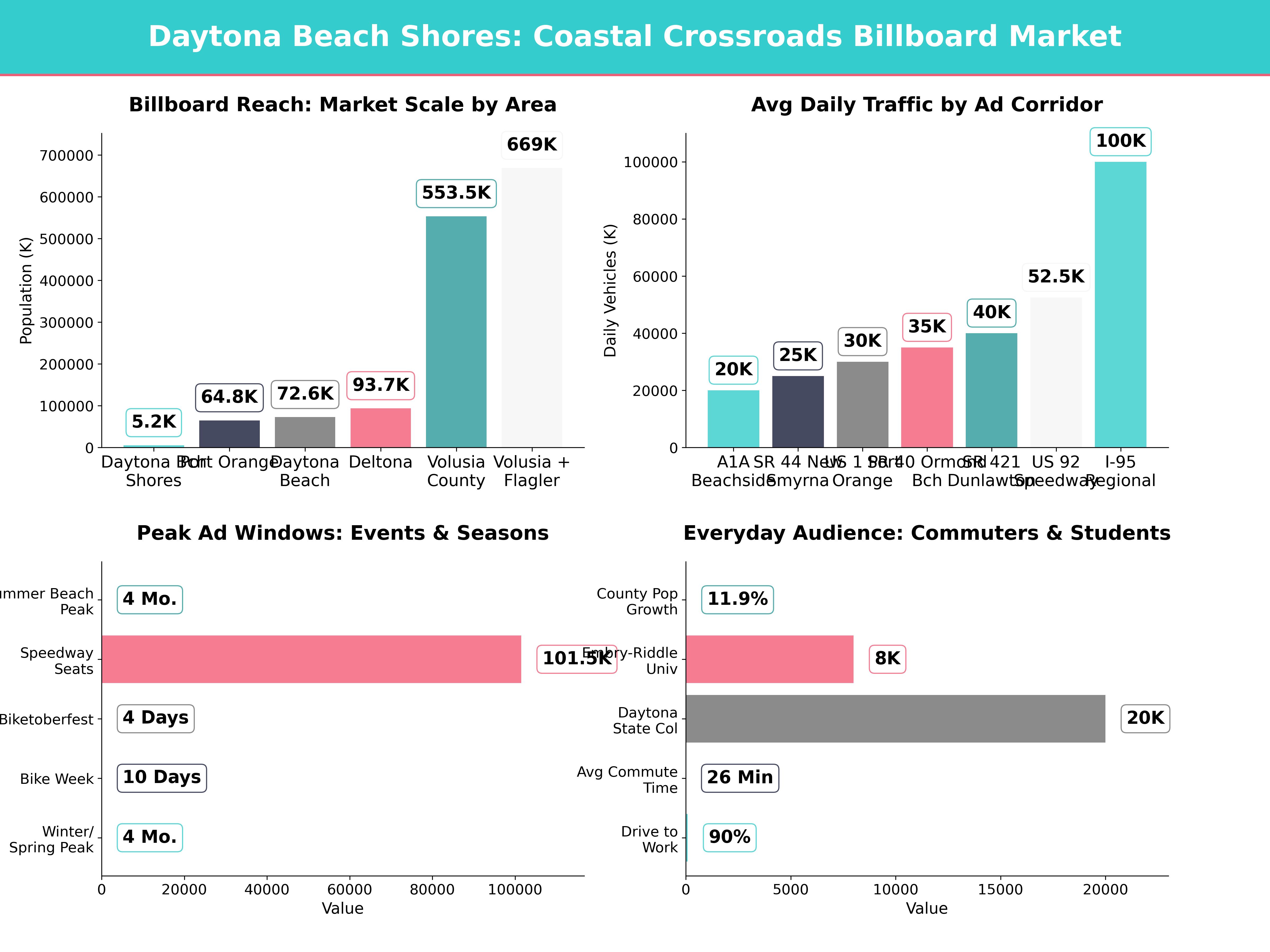
Daytona Beach Shores 5,000 residents (5,179 in the 2020 census), but it sits inside Volusia County's 553,543-person market and one of Florida’s most recognizable beach tourism corridors. Because the city stretches along State Road A1A on a narrow barrier island, much of its audience arrives by car through a limited number of bridges and arterial routes, which makes out-of-home placement especially efficient. We also benefit from the pull of the greater Daytona Beach area, with roughly 669,000 residents across Volusia and Flagler County
Daytona Beach Shores Market Overview
When we plan billboard campaigns in Daytona Beach Shores, we need to think beyond the city boundary. The immediate trade area includes Daytona Beach 72,647 residents, Port Orange, with 64,842, Ormond Beach 43,080, and New Smyrna Beach 30,142. To the west, Deltona 93,692 residents to the broader feeder market.
Growth has been meaningful. Volusia County increased from 494,593 residents in 2010 to 553,543 in 2020, which is an 11.9% gain. That growth matters for billboard advertisers because it translates into more households, more service demand, and more routine road traffic across the county’s core corridors.
Car dependence is central to how we should think about reach. In Volusia County, nearly 9 in 10 workers commute by car, truck, or van, and the average one-way commute is about 26 minutes. Votran provides transit service, but most high-frequency audience exposure still comes from roads, bridges, and major arterials.
Tourism expands the market beyond local population counts. The Daytona Beach Area Convention and Visitors Bureau promotes 23 miles of beach in the core destination area, and Volusia County has 47 miles of Atlantic coastline. The region also has major destination anchors, including Daytona International Speedway 101,500, and the Ocean Center, which offers 205,000 square feet of meeting space.
The local economy is more diversified than many beach markets. Tourism drives a lot of visibility, but Daytona Beach International Airport, Embry-Riddle Aeronautical University, Daytona State College, Halifax Health, and AdventHealth Daytona Beach help keep traffic and purchasing activity steady outside of peak visitor weekends. That balance gives us room to run both evergreen campaigns and short event-driven bursts.
Key Traffic Corridors for Daytona Beach Shores Billboards
Daytona Beach Shores has an unusually clear roadway hierarchy. That is good news for advertisers because a small number of corridors control a large share of movement.
South Atlantic Avenue and State Road A1A
Through Daytona Beach Shores, South Atlantic Avenue is the local spine. Recent Florida Department of Transportation traffic counts commonly place A1A segments through the barrier-island strip in the 15,000 to 25,000 AADT range, depending on location and season.
This corridor is especially effective for advertisers that need beachside relevance rather than countywide scale. We usually like A1A for:
- Restaurants and nightlife, because we can reach visitors deciding where to eat after arriving on the island.
- Hotels, resorts, and vacation rentals, because we can reinforce brand recall near the point of stay.
- Real estate, property management, and home services, because the city has a strong condo and second-home profile.
- Urgent care, dental, and wellness brands, because beachside convenience matters when residents and visitors want nearby options.
A1A is also valuable because many barrier-island trips repeat. Residents head north for dining and services, visitors cruise the shoreline, and event traffic often uses the same road multiple times over a stay.
State Road 421 and Dunlawton Avenue
SR 421, better known locally as Dunlawton Avenue, is the most important east-west connector at the south end of Daytona Beach Shores. FDOT counts on the bridge-area corridor generally fall in the 35,000 to 45,000 AADT range.
For many advertisers, this is the smartest “everyday demand” corridor in the market. It connects beachside households with inland shopping and services in Port Orange, and it captures residents, workers, and visitors crossing the Halifax River. We often prioritize Dunlawton for grocery, pharmacy, medical, automotive, banking, furniture, home improvement, and quick-service dining because it reaches people when they are actively moving between home, errands, work, and the beach.
Bridge approaches also create a useful bottleneck effect. In a market where people have limited crossing points, a good location on or near SR 421 can deliver repeated exposure without needing a huge footprint.
Interstate 95 in the Daytona Beach Area
I-95 is the regional power corridor. Through the Daytona Beach area, core segments commonly run between 90,000 and 110,000 AADT, with some of the strongest volumes clustering near the I-4 and US 92 interchanges.
We use I-95 when we want to reach beyond Daytona Beach Shores itself. This corridor is ideal for:
- Regional healthcare systems, because patients travel from across the county.
- Legal, insurance, and financial advertisers, because broad awareness matters.
- Tourism, attractions, and lodging, because the interstate captures drive-market visitors.
- Colleges and training programs, because it reaches both local prospects and visiting families.
- Large retailers and auto dealers, because shoppers often compare options across city lines.
I-95 also matters because Daytona Beach Shores pulls visitors from Orlando, Jacksonville, and the wider Southeast. If our goal is destination awareness before travelers choose an exit or finalize plans, I-95 is often the highest-scale option.
US 92 and International Speedway Boulevard
US 92, which runs locally as International Speedway Boulevard, is one of the area’s most commercially intense routes. Key sections commonly carry 45,000 to 60,000 AADT. The corridor links I-95, the speedway district, the airport, ONE DAYTONA Tanger Outlets Daytona Beach, Embry-Riddle Aeronautical University, and the beachside bridge toward the oceanfront.
This is where we go for event-oriented messaging and destination retail. During race weeks, convention periods, and leisure-heavy weekends, US 92 becomes one of the best places to reach people who are actively spending. It is especially strong for entertainment, bars, chain restaurants, special events, ticketed attractions, hotels, and anything that benefits from “right now” decision-making.
US 1, Granada Boulevard, and State Road 44
US 1 through South Daytona and Port Orange typically runs in the 25,000 to 35,000 AADT range on major commercial stretches. SR 40, or Granada Boulevard, in Ormond Beach often reaches 30,000 to 40,000 AADT, and SR 44 toward New Smyrna Beach commonly lands between 20,000 and 30,000 AADT.
These roads matter when we want to stretch a Daytona Beach Shores campaign across the larger county without relying only on interstate inventory. US 1 is excellent for family retail, healthcare, and recurring local services. Granada helps us pick up affluent north-county households and beach traffic in Ormond Beach. SR 44 is useful when our campaign needs south-county leisure traffic, especially around New Smyrna Beach Southeast Volusia Chamber of Commerce business corridor.
Audience Segments We Can Reach in Daytona Beach Shores
The best billboard strategy in this market comes from recognizing that several very different audiences overlap.
Barrier-island residents, condo owners, and seasonal households
Daytona Beach Shores itself is not a mass-market city, but it is a high-value local audience. We are speaking to a concentrated population of condo residents, retirees, second-home owners, and seasonal visitors who often spend on healthcare, dining, personal services, home improvement, real estate, and financial planning. Because the city is linear and access is limited, repeat exposure can be strong even when the local population is modest.
Daily commuters and errand traffic
The county’s travel habits strongly favor billboards. With nearly 9 in 10 workers commuting by vehicle and average trips around 26 minutes, we can build useful frequency on bridge approaches, US 1, I-95, and US 92. This audience is especially valuable for dentists, urgent care, auto repair, grocery, insurance, gyms, banks, and restaurants.
Tourists and event visitors
Tourism is one of the biggest reasons Daytona Beach Shores billboard campaigns can outperform the city’s small resident base. The destination area markets 23 miles of beach, Daytona International Speedway 101,500, the Ocean Center has 205,000 square feet of meeting space, and the Peabody Auditorium seats 2,521. That combination creates a constant stream of race fans, convention attendees, beach vacationers, and event-goers.
Several recurring events are especially important. Bike Week runs for 10 days, and Biketoberfest 4 days. Jeep Beach also brings a major spring influx. For hospitality, bars, restaurants, attractions, vehicle services, and entertainment brands, these events can justify short, aggressive billboard flights.
Students, faculty, and education-adjacent audiences
The college audience is real in this market. Embry-Riddle Aeronautical University enrolls more than 8,000 students at its Daytona Beach campus, and Daytona State College serves more than 20,000 students. Bethune-Cookman University adds another important student and faculty population, and Volusia County Schools serves more than 60,000 students districtwide.
That gives us a strong audience for apartments, fast casual dining, furniture, wireless, banking, healthcare, tutoring, part-time jobs, and entertainment. It also means that campaign timing around move-in, graduation, and the start of the school year can be very effective.
Healthcare, hospitality, and service-sector workers
The area’s employment base includes large hospitals, hotels, restaurants, retail centers, schools, and airport-related operations. Workers in those sectors are often on the road early, mid-day, and late, which makes dayparting useful. Healthcare recruiting, trade schools, payroll services, uniforms, foodservice vendors, and B2B local services can all perform well when we place messages on commuter-oriented corridors rather than purely leisure routes.
Seasonal and Timing Opportunities in Daytona Beach Shores
Timing matters in Daytona Beach Shores because the same board can speak to very different audiences in different months.
Winter and early spring in Daytona Beach Shores
From January through April, we usually see the richest blend of audiences. Seasonal residents return, tourism climbs, and the event calendar becomes unusually dense. Speedweeks Daytona 500 Bike Week runs for 10 days in March, and spring break adds another leisure layer.
This is an ideal period for hotels, attractions, restaurants, nightlife, transportation services, retail, and healthcare messaging aimed at visitors who need nearby options. It is also a smart time for legal, insurance, and auto-service brands because road volume and trip complexity both increase.
Late spring and summer in Daytona Beach Shores
From Memorial Day through August, beach and family travel become the main story. We usually shift creative toward family dining, water recreation, urgent care, ice cream, casual apparel, and impulse-friendly attractions. A1A and the bridge approaches become especially important because people are making shorter, more local decisions after they arrive.
Summer is also when weather-sensitive planning matters most. Afternoon rain can suppress some dayparts, but evening traffic often rebounds quickly once conditions improve.
Back-to-school and fall event timing
Volusia County Schools generally restart in August, which creates a dependable shift from visitor-heavy messages to family and routine-service advertising. Dental groups, pediatric care, tutoring, after-school programs, gyms, auto service, and grocery-oriented brands often benefit from a late-summer reset.
Fall should not be overlooked. Biketoberfest 4-day October event, and the shoulder season remains active for restaurants, bars, live entertainment, and lodging. This is also a good time for home services, financial planning, and healthcare because local households are back in more normal routines after the summer travel peak.
Weather, storms, and rapid-response scheduling
Florida’s hurricane season runs from June through November, and coastal weather can change our audience mix quickly. In this market, flexibility is a strategic advantage. We can pause leisure-heavy messages during severe weather windows, switch to reopening or recovery offers after storms, and increase spending quickly when a clear weekend brings traffic back to the beach.
Daytona Beach Shores Billboard Design Tips
Local creative should reflect how people actually experience the area. Generic Florida imagery is not enough.
Design for two driving speeds in Daytona Beach Shores
We should design one way for A1A and another way for I-95. On I-95, where traffic can move at 70 mph, we should keep copy extremely short, usually 6 to 8 words, with one bold image and one clear call to action. On A1A, US 1, and bridge corridors, where drivers have more stop-and-go conditions, we can support a little more detail, such as a location cue like “Dunlawton,” “Beachside,” or “Near the Speedway.”
Use imagery that feels coastal and local
Daytona Beach Shores is not inland suburbia, and it is not South Beach. We usually get stronger resonance when we use imagery tied to the local environment, including oceanfront views, sunrise colors, bridge silhouettes, motorcycles during rally periods, and clean, upscale condo or resort visuals. For family-focused offers, beach-day imagery and easy parking cues tend to work better than generic nightlife themes.
Match tone to the audience segment
For retirees, condo owners, and seasonal residents, we usually lead with trust, convenience, proximity, and quality. For race fans and rally visitors, we can use more urgency and energy, especially around words such as “today,” “tonight,” “oceanfront,” and “live music.” For student and young-adult audiences, affordability and immediacy matter more than prestige.
Favor high contrast over pastel softness
Bright sun, salt air, and reflective coastal light can reduce readability. We usually recommend strong contrast combinations such as navy and white, black and yellow, deep teal and white, or coral against a dark field. Pastel-on-pastel designs may look attractive on a laptop, but they often lose punch on the road.
Keep destination cues practical
This is a geography where local names carry real navigational value. “A1A,” “Dunlawton,” “US 1,” “near the beach,” “by the speedway,” and “Port Orange” do useful work. We should also avoid tiny QR codes or fine print because much of this audience is driving, crossing bridges, or scanning the road quickly.
Regional Strategies Around Daytona Beach Shores
A smart campaign here usually blends several submarkets rather than treating the area as one uniform zone.
Daytona Beach Shores and Ponce Inlet
Daytona Beach Shores Ponce Inlet
Port Orange and South Daytona
Port Orange, with 64,842 residents, and South Daytona are the practical-service core for many Daytona Beach Shores households. This is where we emphasize grocery, pharmacy, furniture, urgent care, auto repair, banks, and family dining. If our goal is routine weekly demand, the SR 421 bridge approach and US 1 often outperform purely tourist-facing locations.
Daytona Beach core, the Speedway district, and the airport zone
Daytona Beach 72,647 residents, gives us the broadest mix of visitors, students, and local households. The speedway district is especially strong because it clusters Daytona International Speedway ONE DAYTONA Tanger Outlets Daytona Beach, Daytona Beach International Airport, and Embry-Riddle Aeronautical University. We use this area when we want volume, event visibility, and spending-oriented traffic.
Ormond Beach, New Smyrna Beach, and west-side feeders
Ormond Beach 43,080 residents, and New Smyrna Beach 30,142, expand a campaign north and south along I-95 and A1A. West Volusia adds more scale, especially Deltona 93,692 residents. We use these areas when we need countywide awareness, healthcare market coverage, or a broader retail trade area rather than a strictly beachside focus.
Using Blip Tools in Daytona Beach Shores
Blip works particularly well in Daytona Beach Shores because the market changes quickly by corridor, season, and event calendar.
We can daypart around bridge, commuter, and dining behavior
Morning and late-afternoon windows are often strongest on SR 421, US 1, and commuter-led routes because they align with work and errand trips. Midday and early evening can be stronger on A1A and beachside placements because that is when visitors are choosing food, entertainment, and activities. Dayparting lets us match spend to actual roadway behavior instead of treating every hour the same.
We can scale budgets up for event spikes without rebuilding the whole campaign
This market has clear spikes around the Daytona 500 Bike Week, Jeep Beach, convention periods at the Ocean Center, and Biketoberfest 10-day and 4-day event windows that matter most.
We can tailor creative by corridor
The same advertiser may need one message for beach visitors, another for Port Orange families, and another for I-95 pass-through traffic. Blip’s creative flexibility makes that practical. We can run location-specific offers, event-specific language, or alternate visuals without having to lock the entire market into one static design.
We can use analytics to learn faster in a weather-sensitive market
In Daytona Beach Shores, timing is not theoretical. Rain, storms, race weekends, and school calendars all shift road behavior. Real-time reporting helps us see which boards are producing the most efficient exposure so we can move budget toward the best corridors instead of guessing.
Getting Started with Billboard Rental in Daytona Beach Shores
Renting billboard space in this market is easiest when we start with geography and business goals instead of starting with inventory alone.
We should define the campaign objective first
If we need local foot traffic, beachside restaurant awareness, or condo-owner services, we should focus on A1A and the bridge approaches. If we need regional brand awareness, we should include I-95 or US 92. If we need a mix of both, we should layer a local island-facing board with a broader regional corridor.
We should evaluate locations based on trip stage
In Daytona Beach Shores, trip stage matters as much as total traffic. A board before the SR 421 bridge can catch residents heading inland for errands. A board on A1A can influence same-day dining or attraction choices. A board on I-95 can shape decisions before travelers even enter the beach district.
We should test several corridors, not just one
We often learn more from a 2- to 4-week test across 2 or 3 corridors than from one long undifferentiated buy. In this market, a bridge-facing board, a beachside board, and a regional feeder board often serve very different purposes. Testing helps us see where awareness, visits, or inquiry volume actually responds.
We should compare flexibility against traditional buying
Traditional billboard buying can be cumbersome in a market with short but intense demand windows. Daytona Beach Shores has meaningful bursts around a 10-day Bike Week, a 4-day Biketoberfest, race weekends, and weather-driven tourism swings. Flexible digital buying is simply better suited to that reality because we can start, stop, and adjust without planning months around fixed contracts.
We should judge success by the right local metric
For a restaurant, success may mean more evening covers after a beachside campaign. For a healthcare provider, success may mean more appointments from Port Orange and South Daytona commuters. For a hotel, success may mean stronger event-week occupancy. The best Daytona Beach Shores billboard plan is the one that aligns the corridor, the audience, the season, and the creative with the action we want people to take.
If we approach Daytona Beach Shores with that level of local precision, we can turn a small beach city into a highly efficient billboard market. The roads are concentrated, the tourism brand is powerful, and the surrounding Volusia County population gives us much more scale than the city alone would suggest.