Billboards in Key Largo, FL
No Minimum Spend. No Long-Term Contracts. Just Results.
Trusted by Leading Brands


Billboard advertising
in Key Largo has never been easier



How much is a billboard in Key Largo?
Why Choose Blip for Billboard Advertising in Key Largo
Blip lets you launch Key Largo billboards yourself in minutes, perfect for U.S. 1 traffic that has no other route on or off the Keys.
Use Blip to time Key Largo ads for winter snowbirds and holiday surges, then scale back in hurricane season without being locked in.
Set a flexible budget in Key Largo and stay in control while reaching commuters, tourists, and mainland workers on the Overseas Highway.
Blip-optimized campaigns can auto-place Key Largo ads when U.S. 1 slows near bridges and traffic lights, maximizing captive views.
Track Key Largo performance in real time, then shift spend toward lunch, sunset, or weekend arrival windows that fit your audience.
Frequently Asked Questions About Billboard Advertising in Key Largo
How much does a billboard cost in Key Largo, Florida with Blip?
With Blip, you set your own daily budget for Key Largo billboards, and our system automatically keeps your campaign within that limit, so you’re always in control. Each “blip” is a 7.5–10 second ad on digital billboards in Key Largo, Florida, and you pay only for the blips you receive. Pricing for each blip varies based on when and where your ad runs and current advertiser demand, making it easy to match your spend to your goals.
Where can I advertise with Blip in Key Largo, Florida?
With U.S. 1 as the only road on and off the islands, digital Key Largo billboards can reach travelers in a uniquely captive way. A presence here functions like a “toll gate” for attention, letting you influence plans for the rest of a visitor’s stay across the entire island chain. Blip campaigns can also be split between local community messages and tourism-driven purchase decisions.
Who sees Key Largo billboards on Blip, and what kind of audience is there?
Key Largo sits at the gateway to the Florida Keys, pulling in a powerful mix of daily commuters, high-spending tourists, and seasonal residents. Visitor studies often show 60–70% of overnight guests arrive by car, directly exposing them to roadside media like billboards in Key Largo. Visitor age clusters in the 35–64 range, along with families and couples seeking nature and water activities.
When is the best time to run Blip billboards in Key Largo, Florida?
Key Largo and the wider Keys are strongly seasonal, with high season roughly from December to April. Holiday weekends and spring break weeks produce sharp surges in drive-in visitors, often pushing traffic volumes 20–30% above off-peak averages. Blip’s real-time scheduling lets you ramp budgets specifically for these dates while scaling back between them.
What should I put on a billboard in Key Largo, Florida with Blip?
Direction and mile-marker messaging are especially effective because visitors quickly learn to navigate by them. The page recommends keeping messages bold and simple, with 6–8 words plus a logo or icon wherever possible. It also suggests using high-contrast colors and clear calls to action like “Walk-ins welcome” or “Next left after the traffic light.”
Do I need a contract to advertise with Blip in Key Largo?
No, Blip has no long-term contracts or minimum commitments. You can start, pause, or stop your campaign at any time.
How fast can I launch a billboard campaign with Blip in Key Largo?
You can have your campaign live in minutes. Create a free account, select your locations, set your budget, upload your design, and start running once approved.
Where can I advertise with Blip in Key Largo?
Blip has digital billboards in Key Largo. You can browse available locations on a map, choose the ones that fit your audience, and start advertising right away.
Still have questions? Launch a campaign in minutes — no contracts, no commitments.
Start Your CampaignKey Largo Billboard Advertising Guide
Key Largo sits at the gateway to the Florida Keys, pulling in a powerful mix of daily commuters, high-spending tourists, and seasonal residents. With U.S. 1 as the only road on and off the islands, digital Key Largo billboards can reach travelers in a uniquely captive way. Below, we explore how we can use Key Largo’s traffic, tourism cycles, and demographics to build smart, data‑driven digital Key Largo billboard advertising campaigns with Blip.
Understanding the Key Largo Market
Key Largo is the northernmost island of the Keys and the first major stop after leaving mainland Florida. It’s part of Monroe County 82,000–83,000 residents around 2020–2023, while the Key Largo Census Designated Place itself has roughly 12,000–13,000 year‑round residents according to county profiles referenced by the Monroe County government
Key Largo’s influence, however, goes far beyond its resident base:
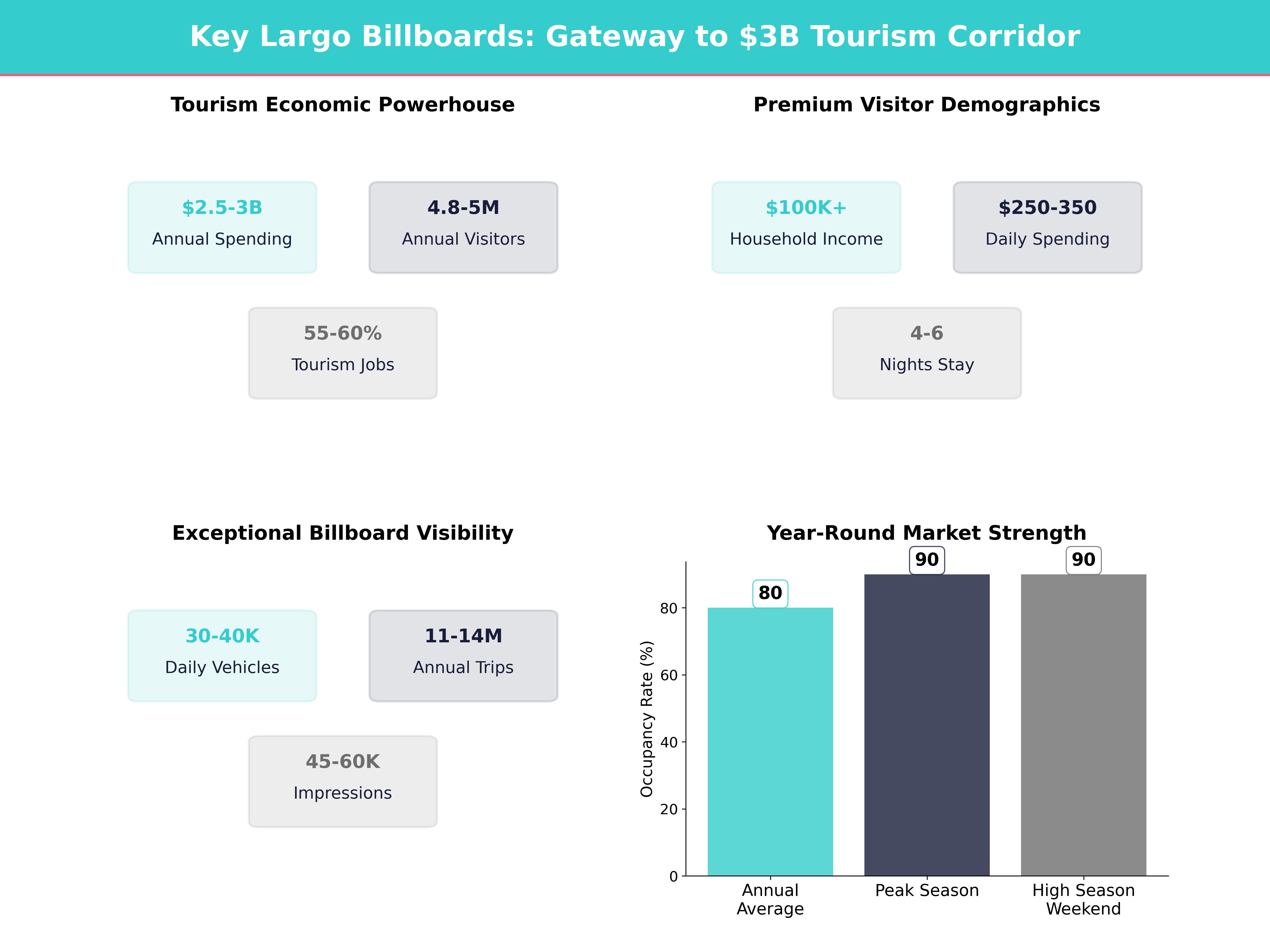
- The Florida Keys overall attract around 4.8–5.2 million visitors per year, with visitor spending in Monroe County exceeding $2.5–3.2 billion annually, according to the Monroe County Tourist Development Council Florida Keys tourism.
- Tourism accounts for roughly 55–60% of all jobs in Monroe County, with more than 25,000 tourism‑related positions supported by visitors each year.
- Lodging performance is strong: hotel and short‑term rental occupancy in the Keys frequently runs in the 75–85% range on an annual basis, climbing to 90%+ on peak winter and holiday weeks.
- Average daily room rates (ADR) in the Keys are among the highest in Florida, commonly exceeding $275–350 per night in many Key Largo and Upper Keys properties during high season, based on lodging data summarized in local tourism reports.
- The Keys draw a particularly affluent visitor: typical overnight tourists often report household incomes in the $100,000+ range, and spending per party per day frequently exceeds $250–350 when lodging, dining, and recreation are included, per Florida Keys tourism research regularly shared by fla-keys.com.
- Average length of stay in the Keys often falls in the 4–6 night range, meaning a booking or on‑the‑road decision influenced in Key Largo can translate to multiple days of spending across the island chain.
What this means for billboard advertisers:
- We should treat Key Largo as both a local community market and a high‑value tourism funnel where well‑placed Key Largo billboards and digital signs can guide much of that spending.
- Campaigns can be split between messages aimed at local life (service businesses, medical, auto, home services) and tourism‑driven purchase decisions (restaurants, attractions, water sports, lodging, retail, events).
- Because almost every visitor traveling by car must pass through Key Largo via U.S. 1, a presence here functions like a “toll gate” for attention: we can influence plans for the rest of a visitor’s stay across the entire island chain, from Key Largo down to Islamorada Key West
Who You’re Reaching: Demographics and Visitor Profiles
Monroe County and Key Largo have some distinctive demographic characteristics, documented by local government and tourism agencies:
- Median age in Monroe County is in the 48–49 range, significantly higher than the U.S. average in the late 30s, reflecting both retirees and older professionals choosing Keys living.
- The population skews white and Hispanic, with non‑Hispanic white residents making up roughly 60–65% of the county and Hispanic/Latino residents around 20–25%, alongside smaller Black and multiracial communities.
- Educational attainment is relatively high, with around 30–35% of adults holding a bachelor’s degree or higher.
- Household incomes are polarized: Monroe County’s median household income is typically reported in the $75,000–80,000 range, but a substantial share of households earn $100,000+, while many service‑sector workers fall under $50,000, according to economic profiles reported by the Monroe County government
- Housing costs are among the highest in Florida: median home values in many Upper Keys communities are well above $600,000, and long‑term rental rates frequently exceed $2,500–3,000 per month, driving a large commuting workforce from mainland areas.
Tourism segmentation compiled by Florida Keys & Key West tourism and local hospitality data often highlights:
- Strong representation of visitors from South Florida (Miami‑Fort Lauderdale‑West Palm Beach metro), the broader Southeast, and the Northeast U.S., plus a sizable share from Europe and Canada.
- In many visitor studies, 60–70% of overnight guests arrive by car, directly exposing them to roadside media like billboards in Key Largo.
- Visitor age clusters in the 35–64 range, along with families and couples seeking nature and water activities. Retiree and “snowbird” segments are especially prominent from December through April.
- High interest in diving, snorkeling, fishing, boating, eco‑tourism, and dining, with local icons such as John Pennekamp Coral Reef State Park Dagny Johnson Key Largo Hammock Botanical State Park
- Per‑party trip spending for many Keys visitors totals $1,500–3,000+ over the course of a stay once lodging, food, entertainment, fuel, and activities are included.
Implications for creative strategy:
- We can use clear, lifestyle‑driven imagery—boats, reefs, sunsets, waterfront dining—to tap into visitor motivations and make Key Largo billboard advertising feel aspirational and relevant.
- Messaging should be legible and relevant to a broad age range: 30s through retirement age, plus families with kids.
- Consider bilingual or simple Spanish support for ads targeting the service workforce or bilingual local population, especially for employment, housing, or essential services. In some Upper Keys census tracts, 25–35% of residents speak Spanish at home, underscoring the value of bilingual creative.
Traffic Patterns: Why U.S. 1 Is Your Primary Stage
Key Largo’s billboard opportunity is defined by U.S. 1 (Overseas Highway), the only continuous road connecting mainland Florida to Key West.
According to traffic counts shared through the Florida Department of Transportation District 6 Monroe County MPO
- Average Annual Daily Traffic (AADT) on U.S. 1 in the Key Largo area is often in the 30,000–40,000 vehicles per day range, depending on the specific segment.
- At Jewfish Creek Bridge, just north of Key Largo, and around major intersections in the island itself, volumes routinely exceed 30,000 vehicles per day in peak seasons and can approach or surpass 40,000 on some holiday weekends.
- Over the course of a typical year, that translates to roughly 11–14 million vehicle trips passing through the Upper Keys, a large share of which either begin or end outside Monroe County.
- On major holiday weekends and during winter high season, daily volumes can surge well above these averages, with heavy congestion creating stop‑and‑go conditions and long dwell times, especially near traffic lights and bridges.
Practical takeaways:
- U.S. 1 placements in Key Largo deliver high‑frequency, captive exposure. Traffic slowdowns mean drivers and passengers have longer viewing windows, so bold, simple creatives on billboards in Key Largo perform especially well.
- Because travelers can’t “choose another route,” frequency builds quickly; we can rely on repetition to imprint directions and offers for the rest of the Keys.
- Directional messaging is powerful: “2 miles ahead on the right,” “Turn at MM 99,” or “Next left after the traffic light” aligns directly with how people navigate U.S. 1 and makes your Key Largo billboard advertising feel immediately useful.
- With daily traffic in the tens of thousands, even a conservative assumption of 1.5 occupants per vehicle suggests 45,000–60,000 potential daily impressions for well‑located boards.
With Blip’s bidding and scheduling, we can concentrate impressions on:
- Northbound traffic (leaving the Keys): great for “stop before you leave” offers, souvenir sales, fuel, dining, and reminders to book again.
- Southbound traffic (entering the Keys): best for “plan your stay” messages for lodging, attractions, tours, and restaurants located further down the island chain.
Seasonality: Timing Your Campaign with the Keys’ Tourism Cycles
Key Largo and the wider Keys are strongly seasonal. Tourism, weather, and school calendars all shape when people are on the road, which directly affects how you approach billboard rental in Key Largo.
Insights from Florida Keys tourism and coverage in local media such as the Keys Weekly and Key West Citizen / KeysNews highlight:
-
High Season (roughly December–April)
- Driven by “snowbird” visitors escaping northern winters and international guests.
- Many accommodations report occupancy in the 85–95% range on weekends and holiday periods.
- Average daily room rates can climb 20–40% higher than summer lows.
- U.S. 1 sees consistently heavy southbound traffic on weekends and around holidays, often with multi‑mile backups at bottlenecks.
- High-value window for hotel, tour, dining, and luxury retail campaigns that rely heavily on Key Largo billboards to catch travelers as they arrive.
-
Shoulder Seasons (May–early June, late October–November)
- Still strong visitation, often with slightly lower room rates and more availability.
- Some properties offer 10–25% discounts compared with winter highs to stimulate demand.
- Great time for value‑oriented messaging and locals’ specials to fill gaps.
- Ideal for testing new offers with flexible Blip budgets, since competition for attention is softer than in peak months.
-
Hurricane Season and Late Summer (June–October, especially August–September)
- Tourist volumes can dip, particularly during peak storm months, with some weeks experiencing double‑digit percentage declines compared to winter peaks.
- Local audiences (residents and workers) make up a larger share of the impressions.
- Strong period for local services, recruiting, education, and essential retail that benefit from consistent billboard rental in Key Largo even when visitor traffic is lighter.
- Also useful for last‑minute deals and “Florida resident” promotions, a strategy frequently highlighted by the Monroe County Tourist Development Council
-
Holiday Peaks
- Long weekends (Memorial Day, July 4, Labor Day), Christmas–New Year’s, and spring break weeks produce sharp surges in drive‑in visitors, often pushing traffic volumes 20–30% above off‑peak averages.
- Key events and festivals publicized by the Key Largo Chamber of Commerce and Upper Keys associations add additional spikes.
- Blip’s real‑time scheduling lets us ramp budgets specifically for these dates while scaling back between them.
How to apply this with Blip:
- Use seasonal campaigns: for example, a dive shop can run “Book your winter dive now” from November–January, then “Late summer locals’ discount – 20% off” from August–September.
- Adjust bids and budgets based on demand: higher during winter and holiday peaks; more efficient, experimental flights in shoulder and off‑peak periods.
- Build advance‑booking campaigns: advertise winter stays as early as late summer and fall, catching planners when they’re researching trips and using billboards in Key Largo to anchor your brand in their minds.
Dayparting: Matching Your Message to the Time of Day
Key Largo’s daily rhythm is predictable: early departures for fishing and diving, mid‑day leisure, and strong evening dining traffic. Local observations and coverage by outlets like the Keys Weekly and Key Largo Chamber of Commerce confirm this pattern.
While exact volumes vary, many local corridors see:
- Noticeable morning peaks around 7–9 a.m., when workers commute and charter boats depart.
- Mid‑day steadiness from about 10 a.m.–3 p.m. as tourists move between parks, marinas, and restaurants.
- A second late afternoon/evening bump around 4–7 p.m. driven by shift changes and dinner traffic.
When we map that to Blip’s dayparting capabilities, a few time windows stand out:
-
Early Morning (6 a.m.–9 a.m.)
- Charter fishing, dive boats, and snorkel tours often depart early from Key Largo and nearby marinas.
- Promote: breakfast cafés, coffee, bait and tackle, marinas, tours with same‑day openings, weather‑dependent last‑minute offers.
- Use simple, direct calls to action like “Walk‑ins welcome at 7:00 a.m.” or “Need coffee before your charter? Next right.”
-
Late Morning to Afternoon (9 a.m.–3 p.m.)
- Sightseeing, shopping, family activities, and late check‑ins. Parks like John Pennekamp Coral Reef State Park Dagny Johnson Key Largo Hammock Botanical State Park
- Promote: attractions, water sports rentals, state parks, souvenir shops, lunch spots, spa services.
- This is also an ideal time to reach locals on service shifts or workers commuting mid‑day.
-
Late Afternoon to Evening (3 p.m.–8 p.m.)
- Peak for dining, sunset cruises, bars, and entertainment. Many waterfront restaurants time happy hours to sunsets, which vary around 5:30–8:30 p.m. seasonally.
- Promote: happy hour specials, dinner reservations, live music, sunset tours.
- Use countdown‑style creatives: “Sunset cruise at 6:30 – Book now at MM 100” or “Happy hour ’til 6 – 10 minutes ahead.”
-
Night (8 p.m.–midnight)
- Ideal for bars, nightlife, late‑night food, and lodging decisions for travelers still driving through.
- Also good for brand building among residents and seasonal workers commuting home, especially those working late shifts in hospitality.
With Blip, we can:
- Create separate creatives for different dayparts, highlighting breakfasts in the morning and dinner or live music in the evening.
- Increase bids in time windows where conversions are most likely. A waterfront restaurant might prioritize 3–8 p.m., while a café focuses on 6–10 a.m.
- Target tourists in transit by focusing on Friday evening and Saturday morning windows, when weekend visitors frequently arrive and U.S. 1 volumes spike, making effective billboard rental in Key Largo especially valuable.
Weather and Environment: Designing for Sun, Rain, and Glare
Key Largo’s tropical climate shapes how people perceive billboards:
- The Florida Keys experience more than 250–260 sunny days per year, with strong sunlight, reflections off the water, and high humidity.
- Average high temperatures range from about 75–77°F in winter to 88–90°F in summer, with humidity often above 70%.
- Afternoon thunderstorms and tropical weather are common in summer and early fall; in a typical wet season, the Keys can receive 30+ inches of rain, with many days seeing short, intense downpours.
- During storms and heavy rain, traffic often slows considerably on U.S. 1, increasing dwell time near signs but also reducing visibility.
Creative implications:
- Use high‑contrast color combinations (e.g., white/yellow on dark blue, bright cyan on black, deep navy backgrounds) to cut through intense glare on Key Largo billboards.
- Avoid overly thin fonts or intricate details; focus on bold sans‑serif fonts and minimal text.
- Because of humidity and glare on windshields, readability distance can be reduced; limit your message to 6–8 words plus a logo or icon wherever possible.
-
Weather‑linked messaging can be powerful:
- On hot days: “Cool off – AC & cold drinks at MM 102.”
- On rainy days: “Rain change your plans? Visit our indoor attraction at MM 99.”
Blip’s ability to rotate multiple creatives makes it simple to test:
- One set of creatives emphasizing bright, colorful, sunny imagery.
- An alternate set with “rainy day” messaging and offers, scheduled more heavily in typical afternoon storm windows or during extended rainy periods.
- For businesses influenced by offshore conditions (fishing, diving), creatives can acknowledge weather realities and redirect: “Offshore too rough? Try our mangrove eco‑tour instead.”
Targeting Tourists vs. Locals: Two Parallel Strategies
Key Largo’s audiences fall into two broad groups: transient tourists and embedded locals/seasonal workers. We should design campaigns with clarity on which group we’re targeting.
Local economic reports show that Monroe County’s workforce includes roughly 35,000–40,000 jobs, with more than half tied directly or indirectly to tourism and hospitality. A notable portion of these workers commute from the mainland, particularly Homestead and Florida City, increasing daily exposure to U.S. 1 messaging and to Key Largo billboard advertising along the corridor.
Tourist‑focused strategy:
- Primary goals: bookings, foot traffic, on‑trip purchases, and upsells.
- Best verticals: lodging, tours, attractions, water sports, fishing/diving charters, restaurants, bars, souvenir and boutique retail, spas, marinas.
-
Tactics:
- Emphasize distance and direction: “At MM 98 on bayside,” “Next light, left turn,” etc. Mile marker references are especially effective because visitors quickly learn to navigate by them.
- Use FOMO and scarcity: “Limited spots today,” “Only 6 seats left for tonight’s sunset cruise,” or “Last chance for lobster season specials.”
- Drive phone and walk‑in actions rather than long URLs: “Call now,” “Walk‑ins welcome,” “Text ‘DIVE’ to [short code].”
- Highlight activity durations (“2‑hour snorkel,” “Half‑day charter”) so travelers can plan around drive times further down the Keys.
Local and workforce‑focused strategy:
- Primary goals: repeat visits, brand familiarity, hiring, and community engagement.
- Best verticals: health care, dental, auto repair, construction and trades, real estate, schools, local retail, employment/recruitment, professional services, and government services like the Monroe County Tax Collector Monroe County School District.
-
Tactics:
- Emphasize convenience and relationship: “Trusted by Keys families since 1995,” “Local care, no mainland drive needed.”
- Promote residents’ deals: “Monroe County resident discount,” “Locals eat for less on Tuesdays.”
- Use recurring schedules: e.g., always show hiring messages around shift changes (early morning and late evening).
- Support community identity with references to local institutions, from Coral Shores High School Key Largo Chamber of Commerce.
Because Blip allows flexible budgeting and multiple campaigns, we can run parallel tourist and local campaigns:
- One campaign heavy on weekends and holidays for tourists.
- Another steady, lower‑budget campaign throughout the week and year targeting locals.
Mile Markers: Using the Keys’ Native Navigation System
The Keys rely heavily on mile markers (MM) along U.S. 1. Local tourism sites like Florida Keys tourism’s Key Largo section and the Key Largo Chamber of Commerce routinely describe businesses by MM.
We should mirror this in our creatives:
-
Replace complex addresses with short mile‑marker directions:
- “MM 99 oceanside – Dive Shop & Rentals”
- “Family restaurant at MM 100 bayside – Next left”
-
For businesses farther down the island chain (Islamorada, Marathon, Key West), use Key Largo billboards to pre‑frame the trip:
- “Book your Key West sunset sail now – MM 0, call ###‑####.”
- “Islamorada resort at MM 84 – Reserve tonight’s room before you pass Key Largo.”
- Keep in mind that U.S. 1 runs from roughly MM 106 in North Key Largo down to MM 0 in Key West, so mile markers double as both marketing shorthand and real navigation tools.
Design tips:
- Display the MM as a large, bold element, ideally in a familiar green road‑sign style.
- If space allows, mention “bayside” vs. “oceanside,” key directional cues visitors quickly learn.
- Combine MM references with time cues: “5 minutes ahead at MM 102” helps drivers gauge whether they should stop now or later.
Category‑Specific Ideas for Key Largo Campaigns
Below are practical approaches for some of the most common advertiser categories making use of billboards in Key Largo.
Hotels, Resorts, and Vacation Rentals
- Highlight distance to check‑in: “Stay tonight – Only 20 minutes ahead in Key Largo.”
- Promote off‑peak and weekday deals during slower seasons to smooth demand; even a 10–15% discount at high‑ADR properties can be compelling given typical nightly rates above $250.
-
Rotate creatives for:
- Families (“Kids stay free this weekend”)
- Couples (“Romantic waterfront suites – limited availability”)
- Divers/fishermen (“Dock your boat, rinse your gear on site”)
-
Use Blip to burst ads on:
- Friday afternoons/evenings (arrivals)
- Sunday mornings (upsell one more night: “Stay one more night and save 20%”)
- Consider highlighting amenities popular in Keys visitor surveys—free parking, pet‑friendly rooms, dockage, included breakfast, or partnerships with local operators like dive shops or charters.
Restaurants and Bars
- Focus on meal‑time clusters: run heavier from 11 a.m.–2 p.m. for lunch, 4–8 p.m. for dinner. Operators often see 30–40% of daily revenue concentrated in these windows.
- Promote signature items: “Fresh grouper sandwiches,” “Key lime pie from scratch,” or “Live music & sunset views.”
-
Use promotions strategically on traditionally slower days:
- “Local night Tuesday – 15% off with Monroe County ID.”
- Emphasize quick decisions for drivers: “Turn at MM 100 bayside – Free parking, no wait.”
-
Consider alternating creatives that show:
- One powerful food image.
- One text‑heavy special or event message.
Then use Blip’s reporting plus POS data to see which draws better engagement (measured by spikes in calls, web traffic, or walk‑ins shortly after ad windows).
Charters, Water Sports, and Attractions
- Emphasize unique experiences and local icons: “Dive the Spiegel Grove,” “Swim with dolphins,” “Eco‑kayak the mangroves.”
- Use early morning slots to catch day‑of bookings: “Open spots on today’s 9 a.m. charter – call now.”
- Promote “bad weather backups” if applicable, for when offshore conditions are rough but inshore or indoor activities are still available.
- Reference safety and credentials where relevant—e.g., “USCG‑licensed captains,” “PADI‑certified instructors”—to reassure higher‑spending visitors who may be investing $100–200+ per person in a single excursion.
- Highlight capacity and group options: “Groups up to 6,” “Private charters available,” matching common party sizes reported in visitor surveys (often 2–4 people).
Local Services and Professional Practices
-
For doctors, dentists, lawyers, and trades, target:
- Commuter peaks (6–9 a.m., 4–7 p.m.) year‑round.
- Times around paydays (1st and 15th of the month, or biweekly Fridays) for retail and elective services.
-
Stress proximity vs. mainland alternatives:
- “No need to drive to Homestead – get your auto repair at MM 101.”
-
For real estate, use:
- Lifestyle images (waterfront living, boating, Keys sunsets).
- Positioning as “Your Keys expert since [year].”
- Statistics such as “Keys median home values above $600,000” to underline the need for specialized local expertise.
- For medical and dental practices, emphasize capacity and access: “Same‑week appointments,” “Accepting new patients in Key Largo,” which matter in a county where year‑round residents are outnumbered by visitors in peak months.
Hiring and Workforce Campaigns
With a hospitality‑heavy economy, nearly every season brings worker shortages:
- Hospitality, food service, and retail employers in Monroe County often report persistent vacancy rates and turnover above 20–30% annually, creating ongoing hiring needs.
- Advertise housing support, benefits, and transportation clearly: “Staff housing available,” “Ride‑share from Homestead daily.”
- Target early morning and late evening hours to capture commuting workers, many of whom travel from the mainland or other Keys communities.
- Keep creatives simple: “Line cooks – $X/hr + tips – Apply MM 100.”
- Link to local resources when appropriate, such as job fairs or training programs shared through the CareerSource South Florida – Monroe County Key Largo Chamber of Commerce.
Measuring and Optimizing in a Small but High‑Value Market
Because Key Largo is relatively small in population but large in visitor volume, smart measurement is crucial for any ongoing billboard rental in Key Largo.
We can:
- Use vanity URLs and trackable phone numbers on creatives to watch traffic spikes during ad windows. Even a 10–20% increase in calls or site visits during specific Blip time blocks is a strong optimization signal.
-
Run A/B tests with two or three versions of creative:
- Version A: strong image + short headline.
- Version B: more text, specific offer or discount.
- Version C: different language or focus (e.g., families vs. couples).
Then adjust Blip budgets toward the versions that drive more calls or web visits.
-
Coordinate billboard flights with local coverage and events:
- If your business is mentioned in a story in the Keys Weekly or another local outlet, support it with a short burst of billboard impressions for brand reinforcement.
- Align with community events, tournaments, festivals, and charity happenings listed by the Key Largo Chamber of Commerce for sponsorship or co‑branding opportunities.
- For multi‑location businesses (e.g., a chain with outlets in Homestead and Key Largo), compare performance between markets during identical campaigns to quantify the incremental value of Keys traffic and the specific lift driven by Key Largo billboards.
Putting It All Together for a Key Largo Blip Campaign
To maximize impact in Key Largo, we can combine these insights into a structured plan:
-
Define your primary audience
- Tourists, locals, or workforce?
- Match the tone, offer, and language accordingly.
-
Align with season and demand
- Ramp up around winter high season and key holidays.
- Use shoulder and off‑peak seasons to win locals and experiment.
-
Use U.S. 1 and mile markers intelligently
- Always provide clear navigation instructions.
- Consider both northbound and southbound travelers separately.
-
Leverage dayparting
- Match ad times to the behaviors you’re targeting—mornings for charters and breakfast, evenings for dinners and sunset cruises.
-
Design for the environment
- High contrast, bold fonts, short messages suited to bright tropical conditions and slow, but sometimes stressful, highway drives.
-
Measure, refine, and rotate
- Continuously test creatives and offers, track responses, and shift Blip budgets to what clearly works.
By grounding our Key Largo billboard advertising strategy in the area’s real traffic patterns, tourism cycles, and local culture—supported by data from agencies such as the Monroe County government Florida Keys tourism, and local news outlets—we can turn every impression into a focused opportunity, whether it’s inspiring a traveler’s next adventure, filling tonight’s tables, or building a lasting relationship with the local community.