Billboards in Naples, FL
No Minimum Spend. No Long-Term Contracts. Just Results.
Trusted by Leading Brands


Billboard advertising
in Naples has never been easier



How much is a billboard in Naples?
Why Choose Blip for Billboard Advertising in Naples
Choose Blip in Naples to launch self-serve on I-75, U.S. 41, or Collier Blvd in minutes—no broker needed.
Blip-optimized campaigns in Naples can auto-shift budget to high-traffic winter corridors from Nov-Apr, when visitor demand peaks.
Set flexible daily budgets in Naples and pay only when your ad plays, so you can test U.S. 41 or Marco Island routes without waste.
Use Blip dayparting in Naples to hit commuter peaks on I-75, then switch to midday shoppers and dinner traffic on U.S. 41.
No contracts in Naples means you can pause for hurricane season, then restart fast as tourism and local traffic rebound.
Track Naples results in real time and use Blip creative tools to tailor ads for healthcare, real estate, and luxury shoppers on local corridors.
Frequently Asked Questions About Billboard Advertising in Naples
How much does a billboard cost in Naples with Blip?
Pricing starts at just $0.01 per display. You only pay when your ad actually appears, and your daily budget helps Blip’s algorithm bid for open ad slots. Cost per blip changes based on time of day, location, and advertiser demand, so you can control your total cost while staying visible in Naples.
Where can I advertise with Blip in Naples?
Naples traffic is concentrated on a relatively small group of major corridors, which helps a modest number of smart placements still produce meaningful market coverage. The key Naples-area routes include Interstate 75, U.S. 41, Collier Boulevard, Pine Ridge Road, and Immokalee Road. For a smaller budget, even 1 to 3 highly relevant boards can still produce useful learning if the geography is tight.
What kind of audience can billboards reach in Naples?
Naples is not a one-audience market, and we can reach affluent retirees, seasonal residents, working families, hospitality employees, healthcare workers, and visitors all within the same county. Collier County’s median age is just over 52, and roughly 28% of residents identify as Hispanic or Latino. More than 1 in 3 residents are 65 or older, which is one reason healthcare, financial services, senior living, elective medicine, and home services are especially visible categories here.
When is the best time for Blip billboard advertising in Naples?
Naples’ prime visitor season generally runs from November through April, with especially strong visibility in January, February, and March. That is the best window for campaigns tied to luxury retail, high-end dining, arts programming, medical specialists, plastic surgery, golf, home furnishings, and real estate. Summer in Naples shifts from seasonal visitors to resident routines, so campaigns often perform best when they emphasize convenience, indoor comfort, urgent needs, and family activities.
Why is Naples a strong billboard market for Blip?
Naples is a strong billboard market because the audience extends far beyond the City of Naples itself. Collier County grew from 321,520 residents in 2010 to 375,752 in 2020, and the Naples-Marco Island metro is effectively that full county footprint. Add in seasonal tourism, affluent households, and year-round demand for healthcare, home services, dining, and real estate, and Naples becomes a market where digital billboards can work with both precision and scale.
Do I need a contract to advertise with Blip in Naples?
No, Blip has no long-term contracts or minimum commitments. You can start, pause, or stop your campaign at any time.
How fast can I launch a billboard campaign with Blip in Naples?
You can have your campaign live in minutes. Create a free account, select your locations, set your budget, upload your design, and start running once approved.
Where can I advertise with Blip in Naples?
Blip has digital billboards in Naples. You can browse available locations on a map, choose the ones that fit your audience, and start advertising right away.
Still have questions? Launch a campaign in minutes — no contracts, no commitments.
Start Your CampaignNaples Billboard Advertising Guide
Naples City of Naples 19,115 residents in the 2020 census, Collier County had 375,752 residents, and the Naples-Marco Island metro is effectively that full county footprint. We also benefit from an unusually car-oriented travel pattern, with most daily movement concentrated on a limited set of high-visibility roads, and seasonal tourism that peaks from November through April. Add in seasonal tourism, affluent households, and year-round demand for healthcare, home services, dining, and real estate, and Naples becomes a market where digital billboards can work with both precision and scale.
Naples Market Overview
Population, growth, and the true advertising footprint in Naples
When we plan billboard advertising in Naples, we should think countywide instead of city-only. The Naples-Marco Island metropolitan area is a single-county metro, so one well-built campaign can cover most of the market without the sprawl we see in larger Florida metros.
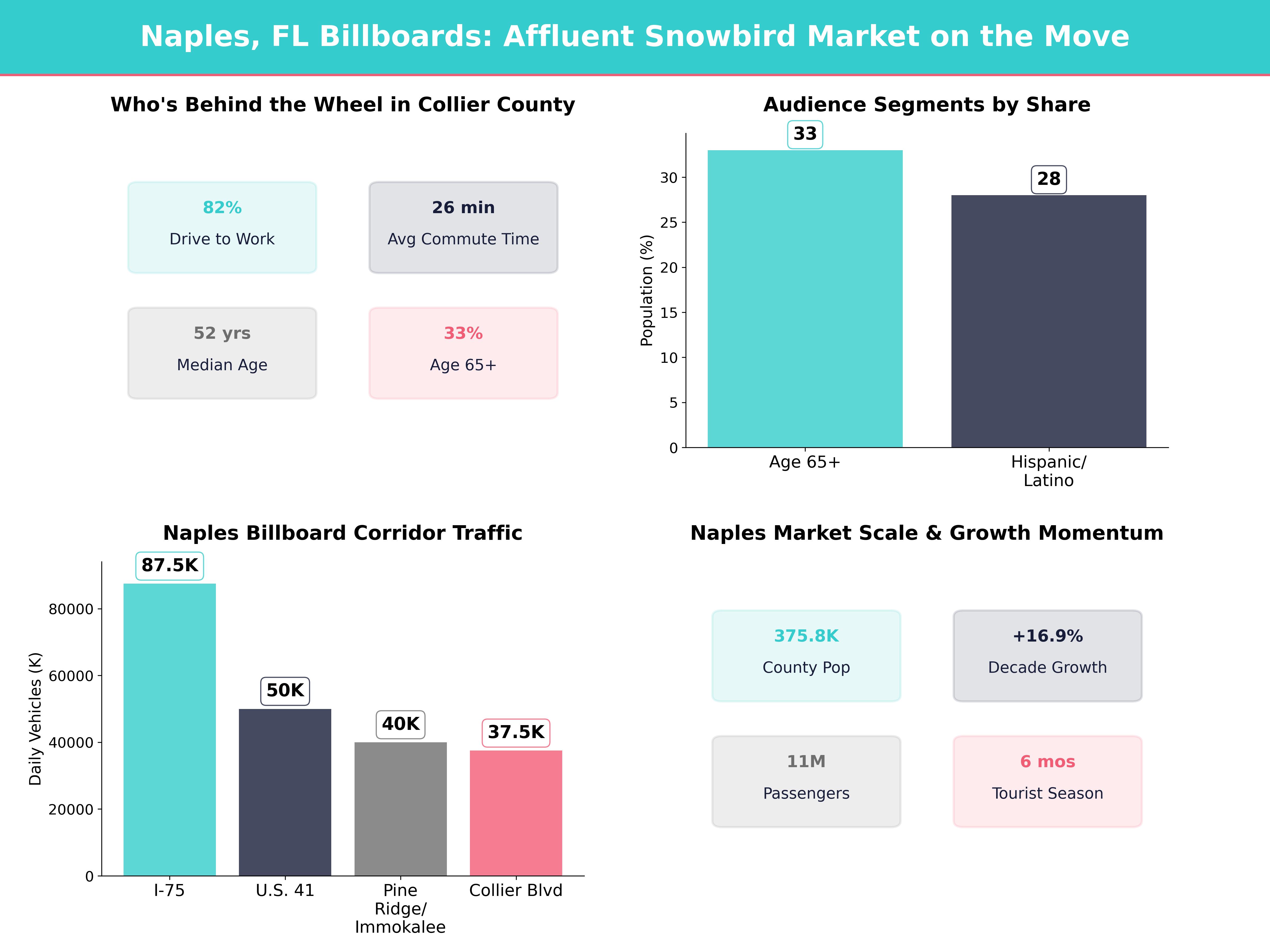
The headline numbers support that approach. Collier County grew from 321,520 residents in 2010 to 375,752 in 2020, which was an increase of 54,232 people, or 16.9%. The city of Naples remained much smaller at 19,115 residents in 2020, while nearby Marco Island had 15,760 residents. That means billboard reach depends less on one dense downtown and more on connecting the county’s residential, retail, medical, and visitor corridors.
Demographics and travel behavior that favor billboards in Naples
Naples is not a one-audience market. We can reach affluent retirees, seasonal residents, working families, hospitality employees, healthcare workers, and visitors all within the same county. Recent demographic estimates show Collier County’s median age is just over 52, and roughly 28% of residents identify as Hispanic or Latino. More than 1 in 3 residents are 65 or older, which is one reason healthcare, financial services, senior living, elective medicine, and home services are especially visible categories here.
Travel behavior is equally important. About 82% of workers in Collier County commute by car, truck, or van, and the average commute is about 26 minutes. In practical terms, that gives us repeated exposure on the same arterials, day after day, especially on Interstate 75, U.S. 41, Collier Boulevard, and the east-west connectors that feed them.
Economic drivers and what they mean for advertisers in Naples
Naples advertising works best when we remember how diverse the spending base is. The market is supported by tourism through Naples, Marco Island, Everglades CVB, healthcare anchors like NCH Healthcare System and Physicians Regional Healthcare System, major employers like Arthrex, retail districts like Mercato Fifth Avenue South
We also need to account for inbound travel. Southwest Florida International Airport 11 million passengers in 2023, and a meaningful share of those travelers continue south into Collier County. For billboard advertisers, that combination of local repeat traffic and visitor inflow creates room for both always-on branding and highly seasonal promotional pushes.
Key Traffic Corridors for Naples Billboards
Florida Department of Transportation and the Collier Metropolitan Planning Organization
Interstate 75 in Naples and Collier County
I-75 is the region’s top corridor for broad reach. FDOT count maps commonly show Collier County segments in the roughly 80,000 to 95,000 AADT range, especially on the north-county stretches connecting Naples with Bonita Springs Fort Myers
This highway is especially useful when we want scale rather than hyperlocal targeting. It works well for:
- Healthcare systems, because patients travel countywide for specialists, surgery, imaging, and urgent care.
- Auto dealers, because shoppers compare options across multiple cities and counties.
- Home services, because broad service areas are common in Southwest Florida.
- Tourism and hospitality, because visitors arriving from Southwest Florida International Airport
The key Naples-area interchanges are also helpful planning markers. Exit 101 serves Collier Boulevard, exit 105 serves Golden Gate Parkway, exit 107 serves Pine Ridge Road, and exit 111 serves Immokalee Road. When we want to blend regional reach with local relevance, those interchange zones are often the best starting point.
U.S. 41, or Tamiami Trail, through Naples
U.S. 41, also called Tamiami Trail, is Naples’ everyday visibility corridor. FDOT traffic volumes on central Naples segments often fall in the 40,000 to 60,000 AADT range, depending on the exact stretch. Unlike I-75, this route gives us stronger access to shoppers, diners, medical patients, and local errand traffic.
This is the corridor we should prioritize for advertisers that need proximity and repeated frequency. It is particularly effective for restaurants, legal services, dental groups, med spas, luxury retail, home furnishings, and arts venues like Artis—Naples
Collier Boulevard and the Marco Island gateway
Collier Boulevard, or SR 951, is a critical north-south route for East Naples, the Golden Gate area, and traffic headed to Marco Island. Depending on the segment, FDOT counts generally land around 30,000 to 45,000 AADT. That is lower than the biggest I-75 segments, but the audience is often highly intentional.
We like this corridor for advertisers that benefit from trip purpose. Travelers on Collier Boulevard are often going somewhere specific, including homes, grocery centers, medical offices, boat access points, pickleball venues, or Marco Island resorts. That makes the route especially useful for marine services, family dining, urgent care, attractions, local retail, and hotels trying to intercept leisure traffic before it reaches the island.
Pine Ridge Road, Immokalee Road, and Naples’ east-west arterials
Naples’ east-west roads matter because they feed both I-75 and U.S. 41. Pine Ridge Road, Immokalee Road, and Golden Gate Parkway routinely carry heavy suburban traffic, with many major segments in roughly the 35,000 to 45,000 AADT range. In North Naples, some Immokalee Road segments also approach the low-to-mid 40,000s.
These roads are ideal for neighborhood-focused advertisers. We typically use them for childcare, schools, grocery, healthcare, insurance, HVAC, plumbing, fitness, and local entertainment. They are also valuable because they capture residents close to decision points, including shopping centers, school zones, medical campuses, and freeway ramps.
Audience Segments We Can Reach in Naples
Naples commuters and local service buyers
Because about 82% of workers commute by car, truck, or van, Naples remains a classic out-of-home market. We can reliably reach drivers on recurring weekly patterns, especially on I-75, U.S. 41, Airport-Pulling Road, Collier Boulevard, Pine Ridge Road, and Immokalee Road. The average commute of about 26 minutes gives us enough time to build familiarity with service providers, healthcare brands, and retailers that depend on repeated exposure rather than one-time impressions.
This is why categories like personal injury law, dentistry, orthopedics, urgent care, pest control, pool service, roofing, and home remodeling tend to fit Naples well. The audience is mobile, route-based, and often making practical household decisions close to home.
Affluent retirees and seasonal residents in Naples
Collier County’s median age of just over 52 and its large 65-plus population give Naples an unusually strong older-adult audience. We should not think of that audience as passive. In this market, retirees and seasonal residents are major consumers of healthcare, dining, cultural events, luxury goods, home management services, financial planning, and real estate.
This segment is especially visible in North Naples, Park Shore, Pelican Bay, Old Naples, and the resort corridors tied to The Ritz-Carlton, Naples Artis—Naples Mercato
Tourists, resort guests, and event travelers in Naples
Tourism is not just a side audience in Naples. It is one of the reasons the market overperforms relative to its year-round population, especially during the roughly 6-month November-through-April high season. Visitors come for beaches, golf, dining, arts, boating, and nature, with destination support from Paradise Coast, Naples Botanical Garden, Naples Zoo, Tin City Fifth Avenue South Marco Island.
Airport access helps sustain that flow. Southwest Florida International Airport 40 miles north of downtown Naples, and Naples Airport is only about 4 miles from downtown. That combination gives us two visitor streams, including commercial air passengers arriving via Fort Myers and private aviation traffic arriving directly in Naples.
Families, students, and workforce communities across Collier County
Naples is older than many Florida markets, but it is not only a retiree market. Collier County Public Schools serves more than 47,000 students, which signals a substantial family base. We can also reach college and workforce audiences through Florida SouthWestern State College in Naples, Ave Maria University, and the broader employment corridors tied to hospitality, healthcare, construction, education, and agriculture.
This is also where neighborhood targeting matters. Golden Gate, East Naples, and Immokalee often respond well to straightforward value messaging, local credibility, and in some cases bilingual creative. Because roughly 28% of Collier County residents are Hispanic or Latino, Spanish-language or dual-language testing can be worthwhile on the right routes and for the right categories.
Seasonal and Timing Opportunities in Naples
Winter high season in Naples
Naples’ prime visitor season generally runs from November through April, with especially strong visibility in January, February, and March. Average highs in January are around 75°F, which is exactly why seasonal residents, golfers, arts patrons, and vacationers increase local traffic during the winter months.
This is the best window for campaigns tied to luxury retail, high-end dining, arts programming, medical specialists, plastic surgery, golf, home furnishings, and real estate. It is also when events like the Naples Winter Wine Festival January, the Everglades Seafood Festival February, and the Collier Fair in March create natural timing anchors.
Spring events and shoulder-season opportunities in Naples
Spring stays active even as winter visitors begin to thin out. The US Open Pickleball Championships in East Naples typically lands in late April or early May, which is especially relevant in a market that already over-indexes for active older adults, rec sports, and wellness spending.
This shoulder season is useful for advertisers that want to remain visible while competition softens slightly. We often like this period for healthcare, fitness, legal services, local restaurants, attractions, and retail that serves both visitors and year-round residents.
Summer local focus in Naples
Summer in Naples shifts from seasonal visitors to resident routines. Average highs in July and August are around 91°F, and the wet season generally runs from June through September. That means summer boards often perform best when we emphasize convenience, indoor comfort, urgent needs, and family activities.
This is a strong period for HVAC, roofing, plumbing, pest control, indoor entertainment, urgent care, camps, grocery, and back-to-school promotions. Because Collier County Public Schools returns in August, late summer is a practical moment for orthodontics, youth sports, tutoring, after-school programs, and family healthcare.
Storm season and rapid-response campaigns in Naples
Hurricane season runs from June 1 through November 30, and that timing matters in Southwest Florida. In Naples, rapid-turn outdoor messaging can be especially effective for insurance agencies, restoration companies, roofers, generator installers, shutter providers, tree services, and home watch companies.
This is one of the clearest cases for using flexible digital scheduling. We can run preparedness messages before a storm, pause if needed, and then shift quickly to cleanup, reopening, staffing, or community support messaging after conditions change.
Billboard Design Tips for the Naples Market
Design for Naples’ affluent coastal image
Creative in Naples should match the market’s visual expectations. For campaigns aimed at downtown Naples, North Naples, and resort-oriented traffic, we usually do better with clean layouts, restrained color palettes, and premium photography than with loud discount-style creative. Colors that echo the local environment, including navy, white, sand, teal, and golf-course green, often feel more native to the market than harsh neons.
This is especially true for luxury real estate, elective healthcare, fine dining, financial services, and home design. References to recognizable local destinations, including Fifth Avenue South Mercato Marco Island, can also increase relevance when the location genuinely serves those areas.
Design for older drivers and faster Naples roads
Naples is a market where readability matters. The median age is just over 52, more than 1 in 3 residents are 65-plus, many major arterials run 45 to 55 mph, and I-75 traffic moves at up to 70 mph. We should respond with larger type, strong contrast, shorter headlines, and a clear single takeaway.
In practical terms, that usually means one offer, one brand, and one action. We should avoid clutter, tiny legal copy, complicated URLs, or multiple phone numbers. If the advertiser is local and established, trust markers such as “Serving Naples Since 2008” or “North Naples Location” can work better than a generic slogan.
Design for families and bilingual neighborhoods in Naples
Golden Gate, East Naples, and Immokalee often reward direct, useful messaging. We generally want practical offers, obvious service categories, and clear local cues. If a clinic, grocery, school, telecom provider, bank, or employer actively serves Spanish-speaking households, it is worth testing Spanish or bilingual creative in those zones.
Because roughly 28% of county residents are Hispanic or Latino, we should not assume one-language creative is always the best fit. In some parts of the market, parallel English and Spanish versions can improve comprehension without changing the core brand look.
Design for tourism and event-driven traffic in Naples
Visitor-oriented creative should be directional and immediate. Travelers do not always know the street network, so phrases like “On the Way to Marco,” “Near 5th Avenue,” or “Next Right on U.S. 41” can be more effective than neighborhood shorthand. Tourism creative should also sell the feeling of the destination, whether that means dining, sunset views, boating, art, or family attractions.
Weather matters visually too. Bright Southwest Florida sun and summer storms both reduce the effectiveness of weak contrast. We should favor bold separation between background and text, especially on boards facing glare-heavy afternoon traffic.
Regional Strategies Across Naples and Collier County
Downtown Naples and the U.S. 41 core
Downtown Naples is the right strategy when we want high-income residents, arts patrons, diners, and visitors already in spending mode. Boards around the U.S. 41 core are well suited for luxury retail, restaurants, med spas, galleries, law firms, and event venues tied to Artis—Naples Tin City Fifth Avenue South
In this zone, creative should be elegant and specific. We should talk less like a countywide service provider and more like a brand that belongs in Naples.
North Naples and the I-75 interchange cluster
North Naples is where regional reach and affluent households overlap. The I-75 interchanges at exits 107 and 111, plus the surrounding Pine Ridge and Immokalee corridors, are strong for medical groups, destination retail, home improvement, financial services, and recruiting. This area also benefits from the pull of Mercato Arthrex, NCH Healthcare System, and nearby resort traffic.
When we want scale with quality, this is usually the first submarket we test. It captures both local buying power and pass-through movement from Lee County.
East Naples and the Marco Island gateway
East Naples and the Marco Island approach work best for leisure, marine, dining, and activity-driven brands. The US Open Pickleball Championships have made East Naples even more visible for sports and wellness audiences, while the Marco route adds hotels, vacation rentals, charter boating, family dining, and attraction traffic.
This submarket is ideal for ads that benefit from trip intent. People here are often headed to a beach, a restaurant, a marina, a vacation rental, or a recreational event, which makes message timing especially important.
Golden Gate, Immokalee, and eastern Collier County
If our goal is local frequency, workforce reach, or value-driven response, eastern Collier deserves its own strategy. Golden Gate and Immokalee are important for healthcare access, education, grocery, employment, telecom, financial services, and community-based outreach. Farther east, Ave Maria and Ave Maria University add another pocket of student, family, and residential growth.
This is also where we should think carefully about language, practicality, and service radius. Recruiting, school enrollment, urgent care, and essential retail can perform very well when the creative feels local rather than generic.
Using Blip Tools Effectively in Naples
Match dayparts to Naples traffic patterns
In Naples, timing often matters as much as placement. Morning schedules tend to fit commuter-oriented messages on I-75 and the east-west feeders. Midday and early afternoon are stronger for medical, retail, and errand traffic on U.S. 41 and major arterial roads. Late afternoon into evening can be especially effective for restaurants, entertainment, and service businesses that want to catch people on the way home.
We can use Blip’s dayparting tools to reflect those local rhythms instead of buying one flat schedule across the entire day. That is especially helpful in a market where commuter, shopper, and tourist traffic often peak at different times.
Use different Naples submarkets for different campaign goals
Naples is a good fit for both manual and Blip-optimized approaches. If we know we want only the Marco gateway, the downtown core, or a specific I-75 interchange, manual selection makes sense. If we want countywide awareness across multiple audience types, Blip’s optimization tools can help distribute budget across high-volume commuter boards and more targeted local placements.
We should also use different creative versions by submarket. A polished luxury message may fit North Naples and downtown, while a more direct service message may perform better in Golden Gate or Immokalee. Blip makes that kind of creative variation practical without turning the campaign into a long traditional media negotiation.
Let Naples seasonality guide optimization
Naples changes materially between January and August, so our billboard plan should change too. Real-time analytics help us see which boards and times are carrying the campaign during winter visitor season, spring event season, summer local season, and storm-response periods.
That flexibility matters in Naples more than in many markets. We can shift budget toward tourist corridors in winter, then lean back into local service routes in summer, and then pivot again during hurricane preparation or recovery windows.
Getting Started With Billboard Rental in Naples
Start with the goal, not just the map
Before we rent a billboard in Naples, we should decide whether the real goal is broad awareness, local store visits, event attendance, recruiting, lead generation, or seasonal bookings. The answer changes the right location. An I-75 board may be ideal for countywide awareness, while a U.S. 41 or Collier Boulevard placement may be better for driving near-term action.
This is one of the biggest differences between a strong campaign and a pretty one. In Naples, prestige locations matter, but route intent matters more.
Evaluate Naples billboard locations with local context
When we compare Naples billboards, we should look at the approach direction, surrounding land use, nearby intersections, and whether the board sits before or after the decision point. A board near an interchange can be excellent if the advertiser serves a broad area. A board closer to retail, dining, or medical clusters is often better if we want immediate action.
We should also think in terms of clusters. For many local advertisers, a test across 3 to 5 boards in one submarket is more informative than one isolated premium location. For a smaller budget, even 1 to 3 highly relevant boards can still produce useful learning if the geography is tight.
Use Blip to launch faster and learn before expanding in Naples
Traditional billboard buying in a market like Naples often pushes advertisers toward fixed packages, long commitments, and slow creative changes. That can be frustrating in a place where seasonality, weather, and tourism patterns move quickly. Blip simplifies the process because we can launch online, adjust timing, swap art, pause spending, and test locations without committing to a rigid long-term structure.
A practical Naples approach is to start with a 2 to 4 week test, learn which corridor and daypart produce the best traction, and then expand from there. If we stay focused on the audience, the route, and the season, Naples gives us one of Florida’s most efficient billboard markets for combining local relevance with premium visibility.