Billboards near Naranja, FL
No Minimum Spend. No Long-Term Contracts. Just Results.
Trusted by Leading Brands


Billboard advertising
near Naranja has never been easier



How much is a billboard near Naranja?
Why Choose Blip for Billboard Advertising near Naranja
Blip lets you launch Naranja billboards in minutes, reaching US-1 and Turnpike commuters without traditional ad-buying barriers.
Set a flexible budget in Naranja and stay on track automatically—ideal for South Dade families, farm workers, and shoppers.
Daypart your Naranja ads for morning Turnpike rush or evening southbound traffic to match when drivers are most active.
No contracts mean you can test Naranja messaging for Keys visitors, Speedway events, or Redland agriculture traffic, then pivot fast.
Blip's real-time analytics help you tune Naranja campaigns as traffic shifts along US-1, Krome Avenue, and Campbell Drive.
Use Blip's creative tools to build bilingual Naranja billboards for Miami-Dade's Spanish-speaking audience and fast-moving drivers.
Frequently Asked Questions About Billboard Advertising near Naranja
How much does a billboard cost near Naranja, Florida with Blip?
With Blip, you control exactly what you spend on Naranja billboards by setting a daily budget that works for you, and Blip automatically keeps your campaign within that amount. Each ad plays for 7.5 to 10 seconds on digital billboards near Naranja, Florida, and you only pay for the individual “blips” you receive. Costs vary based on when and where your ad runs and current advertiser demand, but you can start with any budget and adjust it at any time.
Where can I advertise with Blip near Naranja, Florida?
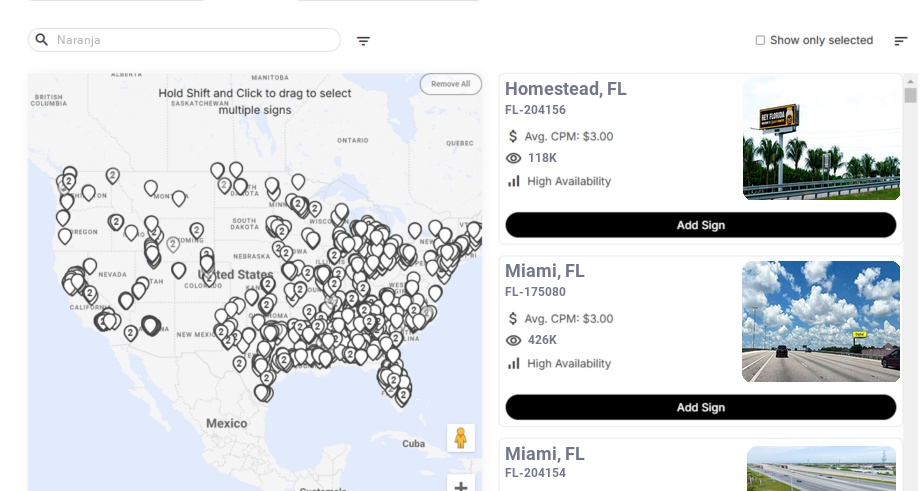
With our digital billboards located nearby in Homestead, we can help advertisers reach daily commuters, local families, farm and construction workers, and visitors headed toward the Florida Keys, Everglades National Park, and Biscayne National Park. For brands specifically looking for billboards near Naranja, this cluster of locations provides efficient coverage of both local and through-traffic. Because our 9 nearby digital billboards are clustered in Homestead, advertisers can tap into this broader South Dade flow.
What kind of audience can I reach with Blip billboards in Naranja, Florida?
The southern Miami-Dade region is predominantly Hispanic/Latino, often in the 65–75% range in communities like Naranja and Homestead, compared with roughly 70% countywide. The Naranja area skews younger than the national average, and many South Dade census areas report 3.0–3.5 people per household, with 30–40% of households including children under 18. South Dade’s economy mixes agriculture, construction, logistics, and service jobs, plus growing retail and hospitality along US-1 and the Florida Turnpike.
When is the best time to run a billboard campaign in Naranja, Florida?
Regional transportation studies from the Miami-Dade TPO show clearly defined peak periods, including weekday morning rush, midday shopping and errands, and evening southbound traffic as workers return home. Tourist & festival season roughly runs from November to April, bringing higher visitation to Everglades and Biscayne National Parks and more race and event activity at Homestead-Miami Speedway. Summer and hurricane/back-to-school season also create strong opportunities for campaigns tied to local needs and seasonal promotions.
How do Blip billboards near Naranja, Florida fit the local traffic patterns?
The Naranja area is functionally part of the South Dade transportation funnel connecting greater Miami to the Keys and the national parks. US-1 / Dixie Highway, Florida’s Turnpike, Campbell Drive, and Krome Avenue all generate heavy traffic, with US-1 often at 40,000–60,000 vehicles per day and the Turnpike commonly exceeding 80,000–90,000 vehicles per day near Homestead. Our 9 digital billboards positioned in Homestead are strategically located to intercept these flows, ensuring repeated visibility to commuters, visitors, and local residents.
Do I need a contract to advertise with Blip near Naranja?
No, Blip has no long-term contracts or minimum commitments. You can start, pause, or stop your campaign at any time.
How fast can I launch a billboard campaign with Blip near Naranja?
You can have your campaign live in minutes. Create a free account, select your locations, set your budget, upload your design, and start running once approved.
Where can I advertise with Blip near Naranja?
Blip has digital billboards near Naranja. You can browse available locations on a map, choose the ones that fit your audience, and start advertising right away.
Still have questions? Launch a campaign in minutes — no contracts, no commitments.
Start Your CampaignNaranja Billboard Advertising Guide
The Naranja area sits at the crossroads of suburban Miami, agriculture, and eco‑tourism, making it a uniquely diverse market for digital billboard advertising. With our digital billboards located nearby in Homestead, we can help advertisers reach daily commuters, local families, farm and construction workers, and visitors headed toward the Florida Keys, Everglades National Park, and Biscayne National Park—all within a roughly 10‑mile radius of Naranja. For brands specifically looking for billboards near Naranja, this cluster of locations provides efficient coverage of both local and through‑traffic.
Understanding the Naranja Area Market
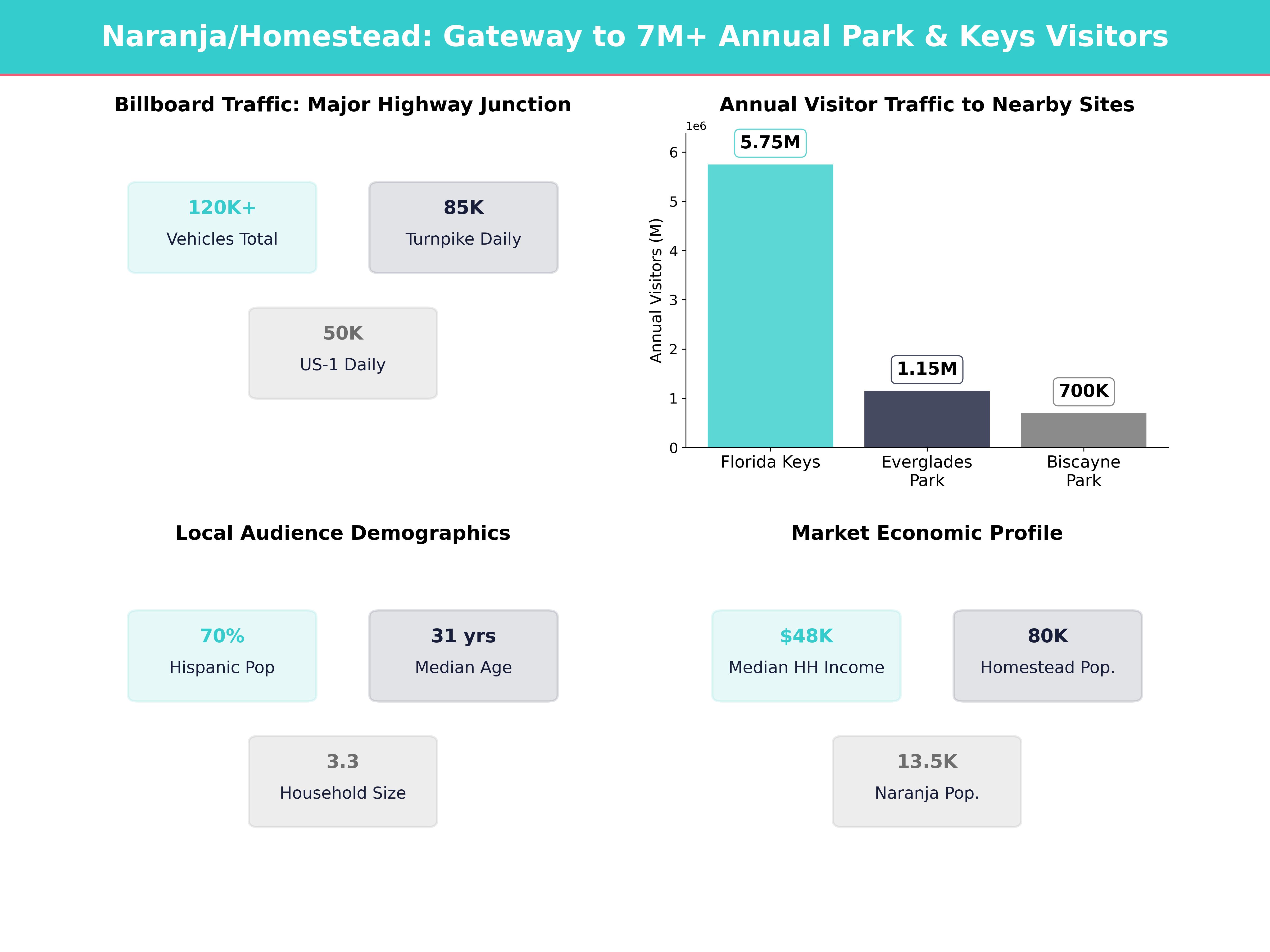
Naranja is an unincorporated community in south Miami‑Dade County, just north of Homestead and Florida City. While the Naranja census‑designated place has a relatively small residential base—around 13,000–14,000 residents (the 2020 count was roughly 13,500)—its true advertising reach is much larger because it sits within the fast‑growing South Dade corridor and pulls from nearby Homestead, Leisure City, Princeton, Goulds, and Florida City. This makes Naranja billboards an efficient way to connect with a broader trade area than the local population alone might suggest.
Key regional facts that affect billboard strategy:
-
Miami‑Dade County has an estimated population of about 2.7 million residents, making it the most populous county in Florida and larger than the entire population of 15+ U.S. states.
- County overview, planning data, and mobility reports are available from Miami‑Dade County and the Miami‑Dade Transportation Planning Organization.
- Homestead, only about 3 miles from Naranja, has grown to roughly 80,000 residents, with city reports showing double‑digit population growth over the last decade and thousands of new housing units under construction or in the pipeline. See city information at the City of Homestead and its Community Redevelopment Agency.
- South Dade is one of Miami‑Dade’s fastest‑growing residential sub‑markets; county building reports show thousands of new single‑family homes and townhomes permitted annually in the southern ZIP codes alone, pushing more commuters onto US‑1 and the Florida Turnpike and increasing the value of billboard advertising near Naranja.
-
The Naranja area lies along major southbound routes from greater Miami toward Everglades National Park, Biscayne National Park, and the Florida Keys, all of which generate high visitor traffic:
- Everglades National Park regularly reports around 1.1–1.2 million recreational visits annually (about 1,150,000 in a recent year). More info: Everglades National Park.
- Biscayne National Park typically sees 650,000–750,000 visits per year (about 700,000 in a recent year). More info: Biscayne National Park.
- The broader Florida Keys region records roughly 5.5–6.0 million visitors per year, with tourism agencies reporting visitor spending in excess of $5 billion annually; much of this traffic funnels through the Homestead–Florida City gateway. Visitor information is available from The Florida Keys & Key West.
- The Greater Miami and Miami Beach tourism market attracts around 26–28 million overnight visitors in a typical year, generating more than $20 billion in direct visitor spending—much of it moving along the same north–south corridors that serve Naranja. See visitor stats at Greater Miami & Miami Beach and Miami‑Dade County Tourism
South Dade’s economy mixes agriculture, construction, logistics, and service jobs, plus growing retail and hospitality along US‑1 and the Florida Turnpike. South Miami‑Dade is one of Florida’s top agricultural regions, with county data attributing tens of thousands of acres to crops like tropical fruit, ornamental plants, and winter vegetables centered around the Redland agricultural area
Because our 9 nearby digital billboards are clustered in Homestead (about 2.9 miles from Naranja), advertisers can tap into this broader South Dade flow, repeatedly reaching people who live, work, shop, and drive through the Naranja area. For marketers evaluating billboard rental near Naranja, this Homestead cluster effectively acts as a Naranja‑area network. A single board on a high‑volume arterial can generate hundreds of thousands of weekly impressions, and a 9‑board network compounds that reach across multiple routes and dayparts.
Who You’re Reaching: Demographics & Audience Segments
The Naranja area and surrounding South Dade have a demographic profile that is distinct from many other parts of Miami‑Dade, and that should shape your billboard messaging. Understanding who lives and works here helps ensure your Naranja billboards speak directly to the right audience.
Ethnic and language mix
- The southern Miami‑Dade region is predominantly Hispanic/Latino, often in the 65–75% range in communities like Naranja and Homestead, compared with roughly 70% countywide.
- In some nearby ZIP codes, more than 70% of residents report speaking a language other than English at home, with Spanish being the dominant language.
- There are also sizable Black/African American and Caribbean communities; in South Dade areas, Black residents often make up 20–30% of the population, with significant Haitian and Jamaican communities contributing to Haitian Creole and other language usage.
- County educational data show that in South Dade public schools, more than 45–50% of students are classified as English Language Learners at some point, underscoring the importance of bilingual communication. More information is available from Miami‑Dade County Public Schools.
Implications for creatives:
- Consider bilingual English–Spanish designs, or Spanish‑first campaigns where your audience skews local and family‑oriented.
- Keep Spanish copy concise and high‑contrast so it reads quickly at highway speeds.
- For brands with multicultural positioning (banks, grocery chains, wireless carriers, healthcare, political campaigns), emphasize community, family, and value—strong motivators in this market that align with larger household sizes and multi‑earner families.
Age and household composition
- The Naranja area skews younger than the national average; median ages in South Dade neighborhoods often fall around 30–33 years, versus a U.S. median of about 39 years.
-
Household sizes above the national norm are common:
- The U.S. average household size is about 2.5 people, while many South Dade census areas report 3.0–3.5 people per household, with 30–40% of households including children under 18.
- Local school‑age populations are robust: Miami‑Dade County Public Schools, the fourth‑largest school district in the U.S., serves more than 335,000 students, with several large high schools and K–8 centers located in or near Homestead and Naranja. School listings and boundary maps are available at Miami‑Dade County Public Schools.
Implications for creatives:
- Feature family‑oriented messaging (education, healthcare, family dining, entertainment, discount retail, financial services).
- Use strong call‑to‑actions like “Tonight,” “This Weekend in Homestead,” or “Enroll Before [Date]” to speak to active, busy households that are making frequent last‑minute decisions.
Income and employment profile
- South Dade median household incomes typically fall below the countywide median (around $60,000–65,000), with many neighborhoods in the $40,000–55,000 range.
-
A significant share of workers are employed in construction, transportation/warehousing, agriculture, hospitality, and retail, sectors that rely heavily on drive‑time exposure:
- Miami‑Dade employment data show that trade, transportation, and utilities account for roughly 18–20% of jobs,
- Leisure and hospitality about 10–12%, and
- Construction around 5–6%—all strongly represented in South Dade. County labor stats are summarized by Miami‑Dade County Regulatory & Economic Resources.
Implications for creatives:
- Emphasize value pricing, financing options, discounts, and “$0 down” or “low monthly payment” messages.
- Recruitment ads for logistics, construction, agriculture, and retail can perform well because so many workers in these sectors commute through the area daily.
Key audience segments we can reach near Naranja
-
Daily commuters
- Thousands of residents travel to jobs in Kendall, Cutler Bay, Doral, or central Miami via US‑1 or the Florida Turnpike.
- County commuting data show that more than 75% of Miami‑Dade workers drive alone or carpool, and over 40% have one‑way commutes longer than 30 minutes, keeping them on the road (and in front of billboards) for extended periods. Properly placed billboards near Naranja can capture these commuters multiple times per week.
-
Local workers
- Employees in agriculture, warehouses, construction, and local retail scattered through South Dade industrial and farming zones.
- South Dade’s agricultural belt supports thousands of seasonal and year‑round jobs, with daily truck and equipment movement on Krome Avenue, US‑1, and side roads.
-
Shoppers & errand‑runners
- Families and individuals traveling to shopping centers and services in Homestead and along US‑1.
- Major anchors like Homestead Pavilion dozens of national brands (big‑box retailers, supermarkets, QSR chains), drawing thousands of vehicle trips per day.
-
Tourists & day‑trippers
- Visitors heading to Everglades National Park, Biscayne National Park, the Florida Keys, and Homestead‑Miami Speedway events (see Homestead‑Miami Speedway
- Race weekends and major events at Homestead‑Miami Speedway can draw 40,000+ spectators over an event period, significantly increasing traffic volumes on approach routes.
- The nearby Zoo Miami—about 20–25 minutes north—welcomes 700,000–800,000 visitors annually, many of whom travel through or near the South Dade corridor.
Designing your campaigns to resonate with these clusters will increase relevance and response and help you get more from your billboard advertising near Naranja.
Traffic Patterns & Where Our Billboards Fit In
The Naranja area is functionally part of the South Dade transportation funnel connecting greater Miami to the Keys and the national parks. That funnel is what makes digital billboards near the Naranja area especially powerful.
Key roadways influencing impressions
-
US‑1 / Dixie Highway:
- Runs north–south through the Naranja and Homestead corridor, serving as the main surface route for South Dade residents and tourists.
- Florida Department of Transportation (FDOT) traffic counts near Homestead typically show 40,000–60,000 vehicles per day on US‑1 in this section, with some specific segments recording annual average daily traffic (AADT) in the 45,000–55,000 range. More detailed stats are accessible via FDOT and regional summaries from the Miami‑Dade Transportation Planning Organization
- Carries both local residents and long‑haul visitors toward Florida City and the Overseas Highway; during peak holiday and spring‑break periods, weekend volumes can spike well above weekday averages.
-
Florida’s Turnpike (Homestead Extension):
- A major north–south toll facility serving commuters and freight.
- FDOT annual average daily traffic volumes near Homestead commonly exceed 80,000–90,000 vehicles per day, with some sections of the Homestead Extension approaching or surpassing 100,000 vehicles per day as growth continues.
- Many Naranja‑area residents use the Turnpike to commute north to employment centers in Kendall, Doral, and the Airport West area, giving advertisers consistent, repeat exposure to the same drivers through Naranja billboards and nearby digital locations.
-
Campbell Drive, Krome Avenue, and local arterials:
- Campbell Drive (SW 312th St) links the Turnpike, US‑1, and central Homestead, supporting tens of thousands of vehicle trips per day to shopping, schools, and medical facilities such as Baptist Health Homestead Hospital
- Krome Avenue (SR‑997) is a crucial north–south route for agricultural traffic and park access, with AADT counts in nearby segments often in the 20,000–30,000 vehicles‑per‑day range.
- These roads generate high local circulation, especially during peak school hours, agricultural seasons, and event days.
Our 9 digital billboards positioned in Homestead are strategically located to intercept these flows, ensuring repeated visibility to:
- Northbound commuters returning to the Naranja area in the evening.
- Southbound visitors headed toward Florida City and the Keys.
- Local residents moving between neighborhoods, retail centers, and workplaces.
- Event and race attendees traveling to and from Homestead‑Miami Speedway and other venues.
Industry research from organizations like the Out of Home Advertising Association of America (OAAA) and Nielsen has found that 60–70% of drivers notice roadside digital billboards, and around 60% of viewers report taking some form of action after seeing an out‑of‑home ad (such as visiting a website, searching online, or visiting a store). When combined with verified traffic counts from FDOT and local planning agencies, these statistics help translate board placements into realistic impression estimates and ROI expectations for billboard advertising near Naranja.
With digital inventory, we can adjust your campaign by time of day, day of week, and specific boards to prioritize either commuter traffic, local shoppers, or visitors.
Timing Your Campaign: When Impressions Matter Most
In the Naranja area, how people move changes dramatically by time of day and season. Blip’s flexible buying model lets us align your ads with those movement patterns, making your billboards near Naranja work hardest when traffic is heaviest.
Daily patterns
Regional transportation studies from the Miami‑Dade TPO show clearly defined peak periods:
-
Weekday morning peak (6:30–9:00 a.m.)
- High northbound flows on both the Turnpike and US‑1, with many corridors operating at 80–100% of capacity during the height of the rush.
- Best for: job recruitment, quick‑serve breakfast, gas stations, financial services, political name recognition, traffic‑dependent apps (rideshare, navigation, etc.).
-
Midday (10:00 a.m.–3:00 p.m.)
- Strong local traffic associated with shopping, school‑related trips, and service appointments.
- For many big‑box and grocery‑anchored centers, a significant share (often 40–50%) of daily customer visits occur during this window.
- Best for: grocery stores, medical and dental offices, government services, auto repair, small businesses targeting local residents.
-
Evening peak (4:00–7:00 p.m.)
- Southbound traffic builds as workers return to the Naranja, Homestead, and Florida City neighborhoods.
- Turnpike and US‑1 volumes can rival or exceed the morning peak during this period.
- Best for: restaurants, retail, gyms, entertainment venues, family activities, and church or community events.
-
Late evening & night
- Overall volumes decrease, but research suggests that fewer competing visuals can boost ad recall; some studies report 10–20% higher recall for illuminated digital boards at night versus daytime.
- Best for: bars and nightlife, streaming apps, QSR drive‑thru, 24‑hour services, and campaigns that benefit from repeated exposure at lower cost.
Seasonal patterns
-
Tourist & festival season (roughly November–April)
- Cooler, drier months bring higher visitation to Everglades and Biscayne National Parks and more race and event activity at Homestead‑Miami Speedway.
- South Florida’s peak tourist season overlaps with winter in northern states; visitor data show that domestic overnight visitors to Greater Miami and the Keys increase noticeably during these months.
- Snowbird travel adds to US‑1 and Turnpike volumes, with RV and long‑distance vehicle trips heading toward the Keys.
- Consider heavier spend or more creatives highlighting events, tourism packages, and seasonal promotions during this window. Event calendars are frequently updated by sites such as Greater Miami & Miami Beach and local outlets like the Miami Herald
-
Hurricane and back‑to‑school season (August–October)
- Residents focus on preparedness, home improvement, insurance, and school shopping.
- Florida’s hurricane season officially runs from June 1 to November 30, but South Florida historically sees heightened storm activity in August–October, driving spikes in searches and purchases for storm shutters, generators, roofing, and insurance.
- Excellent time for campaigns from insurance carriers, home improvement stores, healthcare providers, and educational institutions.
-
Summer (June–August)
- Strong local traffic with kids out of school and families seeking close‑to‑home activities, especially on weekends.
- Attractions like Zoo Miami, Deering Estate, and local farms and u‑pick operations in the Redland area promote summer programs and events that increase weekend traffic through South Dade.
- Great for parks, attractions, movie theaters, quick‑service restaurants, summer sales, and youth programs.
With Blip, you can set budgets and schedules so that your ads appear more frequently during your most valuable windows, and throttle down during lower‑priority times—maximizing ROI rather than paying a flat, locked‑in rate for your billboard rental near Naranja.
Crafting Effective Creative for Drivers Near the Naranja Area
Traffic near the Naranja area is a mix of highway speeds, arterial stop‑and‑go, and tourist drivers unfamiliar with local roads. Your creative should cut through this mix in under 5–7 seconds, which is roughly how long a passing driver has your board in view.
Industry best‑practice studies from organizations like the OAAA and Nielsen consistently show that simple creatives with fewer than 10 words and a single focal image outperform cluttered designs in terms of recall and comprehension.
Design fundamentals for this market
- Minimal text: Aim for 6–8 words max, plus your logo or short URL/phone.
- Big, bold fonts: Sans‑serif, high contrast (e.g., white or yellow text on dark backgrounds).
- One main idea per creative: “$4.99 Tacos in Homestead,” “Same‑Day Braces Near Naranja,” “New Apartments – Move‑In Specials.”
- Ensure your logo and call‑to‑action occupy at least 15–20% of the total design area to remain legible at distance.
Content that resonates locally
- Family‑oriented visuals: Parents with kids, multigenerational households, school themes, and community gatherings reflect the fact that over one‑third of households in the area include children.
-
Bilingual messaging:
- Example: “Auto Insurance You Can Afford / Seguro de auto a tu alcance”.
- Keep both languages concise; avoid dense paragraphs. Studies of bilingual OOH ads indicate that keeping total word counts below 12–14 across both languages significantly improves comprehension.
-
Local landmarks and references:
- Mention proximity to known roads or destinations: “Just off US‑1,” “Near Homestead‑Miami Speedway,” “5 minutes from the Turnpike.”
- Reference familiar shopping areas or institutions like “Across from Homestead Pavilion” or “Next to Homestead Hospital” to increase mental mapping.
- Use phrases like “serving the Naranja area” so viewers immediately understand relevance, especially when they are searching for billboards near Naranja for neighborhood‑focused promotions.
Examples of strong concepts
-
Healthcare:
- “Walk‑In Clinic – 7 Days a Week – Near Naranja”
- Visual: Friendly doctor, clear icon for “7 Days”.
- Reinforce with services that are top‑of‑mind locally (urgent care, pediatrics, sports physicals).
-
Restaurants/QSR:
- “2 for $5 Breakfast – Exit at Campbell Dr”
- Visual: High‑quality food photo, simple price bubble.
- Considering that over 35% of adults report visiting a quick‑serve restaurant on a typical day, frequent rotation during commute hours can drive real volume.
-
Education & training:
- “Trade Programs that Lead to Jobs – Enroll This Month”
- Visual: Young adult in a skilled trade (HVAC, automotive, nursing), bilingual call‑to‑action.
- Tie to local institutions such as Miami Dade College campuses or private training centers in Homestead.
-
Home services:
- “AC Not Cooling? Call 305‑XXX‑XXXX – 24/7”
- Visual: Large phone icon and simple temperature graphic.
- Given South Florida’s climate—average summer highs around 90°F with humidity frequently above 70%—air‑conditioning and hurricane‑readiness services are perennial needs.
Use Blip’s ability to upload multiple creatives so we can test different offers or languages (e.g., English‑dominant during AM commute, Spanish‑dominant evenings and weekends) and see which creative mix generates the best response from billboard advertising near Naranja.
Leveraging Multiple Creatives and Localization
One of the key advantages of digital billboards near the Naranja area is the ability to rotate creatives dynamically and segment your messaging by time, audience, or even direction of travel.
Daypart‑specific creative
-
Morning commute:
- Focus: urgency and daily needs.
- Example: “Need a New Job? Hiring Today in Homestead – Apply Online.”
- Recruitment campaigns are well‑suited here, especially in sectors like logistics and construction where South Dade employers regularly advertise starting pay rates (e.g., “From $18/hr”).
-
Midday shoppers and workers:
- Focus: errands and services.
- Example: “Oil Change in 15 Minutes – Turn Right on US‑1.”
- Position routine services when workers are on lunch breaks or parents are running midday errands.
-
Evening family traffic:
- Focus: dinner, entertainment, retail.
- Example: “Kids Eat Free Tuesdays – Family Restaurant Near Naranja.”
- Retail sales data often show late‑afternoon and early‑evening peaks for grocery and casual dining, aligning with this commute window.
Language variations
- Run Spanish‑first creatives during times when local residents are most active (evenings, weekends), when a higher share of traffic is neighborhood‑based and heavily Hispanic.
- Use English‑dominant messages during morning commuter hours and event‑heavy times that draw more out‑of‑area visitors from across the U.S. and abroad.
- Where possible, test A/B variants with different language mixes and measure downstream response (web visits, calls, coupon use) to quantify which balance drives better results in your category.
Location‑aware ads
-
Because our boards are positioned in Homestead, we can tailor call‑to‑actions to match realistic drive times:
- “5 minutes from this exit”
- “Next light, turn left”
- “Only 3 miles ahead”
- GPS and smartphone data in national OOH studies show that location‑specific directions can lift store visitation by 10–20% compared with generic branding messages.
- This micro‑localization helps convert impressions into store visits or website traffic, especially for impulse‑driven categories like food, fuel, and entertainment, and it maximizes the effectiveness of your billboard rental near Naranja.
Industry‑Specific Opportunities in the Naranja Area
Certain categories can perform especially well near the Naranja area given its economic and geographic profile. When you use Naranja billboards and nearby Homestead inventory strategically, these verticals can see particularly strong results.
Automotive & transportation
-
High daily volumes on US‑1 and the Turnpike—often totaling more than 120,000 vehicles per day across key nearby segments—mean strong prospects for:
- Car dealerships
- Auto repair and tire shops
- Car washes
- Insurance providers
- Research from automotive marketers indicates that 70–80% of car buyers research online but still purchase in person; roadside OOH is effective at steering in‑market shoppers to specific lots.
-
Use price‑driven and time‑sensitive offers:
- “Brakes from $99 – Same‑Day Service”
- “Full Detail $39 – Today Only”
- Highlight proximity: “On Campbell Dr – 2 minutes from Turnpike Exit” resonates with commuters who know exactly where that is and are influenced by billboard advertising near Naranja on their daily route.
Home improvement & services
-
Rapid residential growth and older housing stock in parts of South Dade create steady demand for:
- Roofing, HVAC, plumbing, and electrical
- Landscaping and pest control
- Solar installations and hurricane shutters
- Miami‑Dade’s building code and frequent storm activity make resilience a hot topic; after major storms, local news outlets like Local 10 News and the Miami Herald
-
Highlight reliability and local presence:
- “Trusted in South Dade for 20+ Years”
- “Free Roof Inspections Before Hurricane Season”
- Remind viewers of timing: “Beat Peak Season – Book Before June 1” leverages the official start of hurricane season.
Healthcare & wellness
-
Large family households and working‑class demographics benefit from:
- Urgent care and walk‑in clinics
- Pediatric and dental offices
- Vision and hearing centers
- South Dade’s higher rates of uninsured or under‑insured residents relative to more affluent Miami neighborhoods make affordability and access key selling points.
-
Emphasize accessibility:
- “Walk‑Ins Welcome – Open Late”
- “Se habla español – Most insurance accepted”
- Connect to recognized providers such as Baptist Health Homestead Hospital
Education, training, and recruitment
-
Workforce‑focused schools and employers can reach a young, diverse labor pool:
- Trade and vocational programs
- Community college extensions
- Employers hiring for logistics, construction, healthcare, and retail
- In Miami‑Dade, more than 60% of adults have less than a bachelor’s degree, creating strong demand for short‑term credentials and certifications offered by institutions like Miami Dade College and private academies.
-
Include a clean, memorable URL or short code:
- “Text ‘JOB’ to 55555 – Hiring in Homestead”
- “Apply at SchoolName.edu/Naranja”
- Recruitment campaigns can reference wage ranges (e.g., “Up to $20/hr”) to stand out in a competitive labor market and to make the most of billboard rental near Naranja as a recruiting channel.
Tourism, entertainment, and events
-
Proximity to Homestead‑Miami Speedway, national parks, and seasonal festivals means:
- Promoting race weekends, concerts, and festivals is highly impactful.
- Restaurants, hotels, and attractions can capture visitor spend on the way to and from events.
- Homestead hosts events such as the Redland Heritage Festival and seasonal farm tours; during these events, local roads may see thousands of additional daily trips.
-
Hotels, vacation rentals, and attractions can tie their campaigns to high‑visibility event calendars:
- Local news outlets like the Miami Herald and Local 10 News often feature event calendars.
- Tourism and park sites such as Everglades National Park, Biscayne National Park, and The Florida Keys & Key West publish detailed schedules.
- Syncing your campaign with these well‑publicized dates can amplify response and drive incremental visits, especially when you include clear travel‑time cues: “Stop Here Before the Speedway” or “Stay Tonight in Homestead – 30 Minutes from Key Largo.”
Measuring, Optimizing, and Integrating Your Campaign
To get the most from digital billboards serving the Naranja area, we encourage tying your Blip campaign to measurable actions.
Trackable call‑to‑actions
- Use unique URLs or landing pages for billboard traffic (e.g.,
brand.com/naranja). - Add promo codes specific to the campaign (“Show this code: NARANJA10”).
- Track phone calls from a number used only on your billboard creative; call‑tracking providers can attribute which campaigns generate the highest volume and longest call durations.
- National advertiser case studies show that campaigns using unique URLs or promo codes can attribute 10–30% of incremental sales directly to OOH exposure when tracked carefully.
Align with digital and local media
-
Coordinate messaging across:
- Social platforms targeting South Dade ZIP codes such as 33032, 33033, 33034, 33035, and 33039.
- Local news and community sites like the City of Homestead, Miami‑Dade County, and neighborhood‑focused outlets such as Community Newspapers
- Google Business Profiles and map listings near the Naranja area, where consistent use of keywords like “Naranja,” “Homestead,” and “South Dade” can improve local search visibility and support discovery for users who search for billboards near Naranja.
- Keep core offers and visuals consistent so viewers recognize your message when they see it online and on the road. Nielsen OOH studies have found that combining out‑of‑home with digital can increase reach by up to 30–40% compared with digital alone.
Iterative testing with Blip
- Start with 2–4 variations of creative.
-
Monitor performance indicators on your end:
- Changes in store traffic or call volume
- Web sessions from South Dade ZIP codes
- Use of billboard‑specific promo codes
-
Replace the lowest‑performing creatives with new variations focusing on:
- Different price points
- Stronger images
- Adjusted language balance (more Spanish vs. more English)
- Advertisers that actively test and optimize OOH creative typically report double‑digit lifts in response (e.g., 10–25% improvements) over static, untested campaigns.
Digital flexibility means we can refine your campaign over time rather than being locked into a single static design for months, giving you more control over how your billboard advertising near Naranja performs.
Regulatory and Community Considerations
The Naranja area falls under Miami‑Dade County regulations, and our boards are in nearby Homestead, which has its own sign and zoning rules. We ensure our inventory complies with local ordinances so you can advertise with confidence.
- Miami‑Dade’s sign regulations and right‑of‑way rules are administered by departments listed on Miami‑Dade County.
- The City of Homestead provides zoning and permitting information that governs signage within city limits.
Best practices for staying aligned with community expectations:
- Avoid content that may be perceived as unsafe or overly distracting to drivers, especially near school zones and residential neighborhoods.
- Be sensitive with imagery and claims around immigration, healthcare, and politics, which can be hot‑button topics in South Dade.
- For political and issue campaigns, monitor local coverage from outlets like the Miami Herald Local 10 News to keep messaging accurate and timely, and ensure compliance with applicable disclosure and sponsorship rules.
- When referencing local landmarks (schools, hospitals, parks), confirm current naming and branding via official sites (e.g., Miami‑Dade Parks, Recreation and Open Spaces) to avoid confusion.
We focus on creative that is clear, honest, and beneficial to viewers—from promoting essential services to highlighting local events—which tends to deliver the strongest long‑term results and positive brand perceptions for advertisers using Naranja billboards and nearby Homestead inventory.
By understanding the unique demographics, traffic flows, and economic drivers of the Naranja area—and leveraging our 9 nearby digital billboards in Homestead—we can build campaigns that reach the right people at the right times with messages that truly resonate. Using Blip’s flexible scheduling, budget control, and creative rotation, advertisers of any size can participate in high‑impact outdoor advertising near Naranja and turn local traffic into real business results with efficient billboard rental near Naranja.