Billboards near Goldenrod, FL
No Minimum Spend. No Long-Term Contracts. Just Results.
Trusted by Leading Brands


Billboard advertising
near Goldenrod has never been easier



How much is a billboard near Goldenrod?
Why Choose Blip for Billboard Advertising near Goldenrod
Blip lets Goldenrod brands launch fast on SR 50, SR 417, and I-4 commuter routes with self-serve control.
Set flexible budgets for Goldenrod and reach UCF students, families, and Orlando commuters without long commitments.
Daypart Goldenrod ads for 7-9 a.m. school runs, 4-7 p.m. commutes, or UCF game-day surges.
Track Goldenrod billboard results in real time and shift spend toward Azalea Park, Sanford, or Winter Park traffic.
Use Blip creative tools to test bold, local messages for Goldenrod—like “Near UCF” or “Exit at Semoran” — fast.
Frequently Asked Questions About Billboard Advertising near Goldenrod
How much does a billboard cost near Goldenrod, Florida with Blip?
With Blip, you control exactly what you spend on Goldenrod billboards by setting your own daily budget, so you can start with just a few dollars and scale up whenever you’re ready. Each ad play, or “blip,” is a brief 7.5 to 10-second display on digital billboards near Goldenrod, Florida, and you only pay for the blips you receive. Pricing for each blip adjusts automatically based on when and where you choose to advertise in the Goldenrod area and on current advertiser demand.
Where can I advertise with Blip near Goldenrod, Florida?
Our 36 digital billboards serving the Goldenrod area are placed in nearby communities that funnel traffic past Goldenrod’s residents throughout the day. Key nearby locations include Azalea Park, Orlando, Longwood, and Sanford, giving advertisers practical options for billboard rental near Goldenrod without having to commit to a single location. These boards can help you reach East Orlando commuters, I-4 travelers, and audiences near Orlando.
What kind of audience do Goldenrod billboards with Blip reach?
Goldenrod, Florida may feel like a quiet, unincorporated pocket between Orlando and Winter Park, but it sits in the path of intense commuter, campus, and family traffic. Nearby UCF enrolls more than 69,000 students and brings a large 18–34 audience into and around the Goldenrod area daily. Goldenrod is also surrounded by established single-family neighborhoods, apartments, and townhomes, creating a mix of students, families, and professionals.
When is the best time to run billboards near Goldenrod, Florida?
Expect strongest roadway volumes on weekday 7–9 a.m. and 4–7 p.m., as well as weekend middays 11 a.m.–3 p.m. on roads serving the Goldenrod area. On major UCF home game days, traffic can spike 20–30% above typical volumes on roads around campus and the Research Park area. With Blip’s flexible scheduling, you can concentrate impressions on weekday rush hours, shift to midday and evening, or boost weekend schedules depending on your campaign goals.
Do I need a contract to advertise with Blip near Goldenrod?
No, Blip has no long-term contracts or minimum commitments. You can start, pause, or stop your campaign at any time.
How fast can I launch a billboard campaign with Blip near Goldenrod?
You can have your campaign live in minutes. Create a free account, select your locations, set your budget, upload your design, and start running once approved.
Where can I advertise with Blip near Goldenrod?
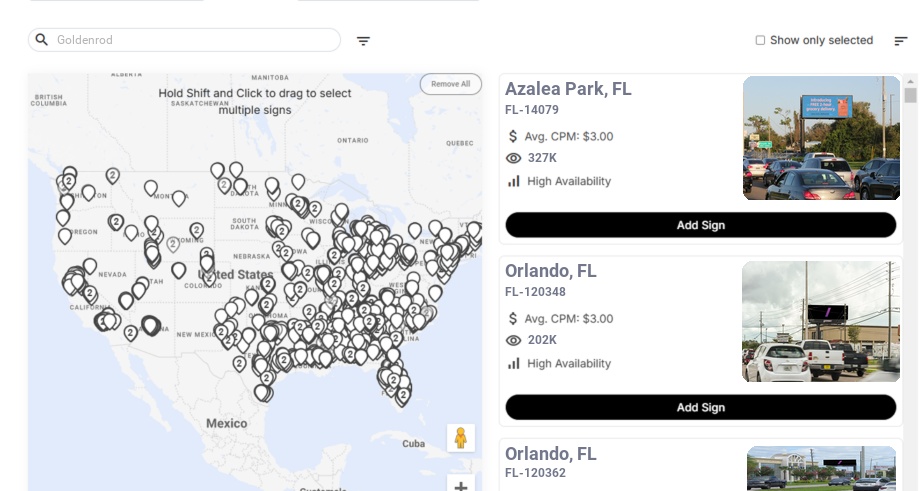
Blip has digital billboards near Goldenrod. You can browse available locations on a map, choose the ones that fit your audience, and start advertising right away.
Still have questions? Launch a campaign in minutes — no contracts, no commitments.
Start Your CampaignGoldenrod Billboard Advertising Guide
Goldenrod, Florida may feel like a quiet, unincorporated pocket between Orlando and Winter Park, but it sits in the path of intense commuter, campus, and family traffic. With 36 digital billboards serving the Goldenrod area from nearby Azalea Park, Longwood, Sanford, and Orlando, we can tap directly into daily routines connecting bedroom neighborhoods, major employers, and world-famous attractions. Below, we outline how to use these Goldenrod billboards strategically to reach residents, students, and visitors moving through the Goldenrod area.
Understanding the Goldenrod Area Market
Goldenrod sits in both Orange and Seminole counties, surrounded by key employment, education, and entertainment hubs:
-
Population context:
- Orange County’s population is estimated at over 1.5 million residents, while Seminole County has around 480,000 residents, according to county planning and economic development reporting from Orange County Government and Seminole County Government.
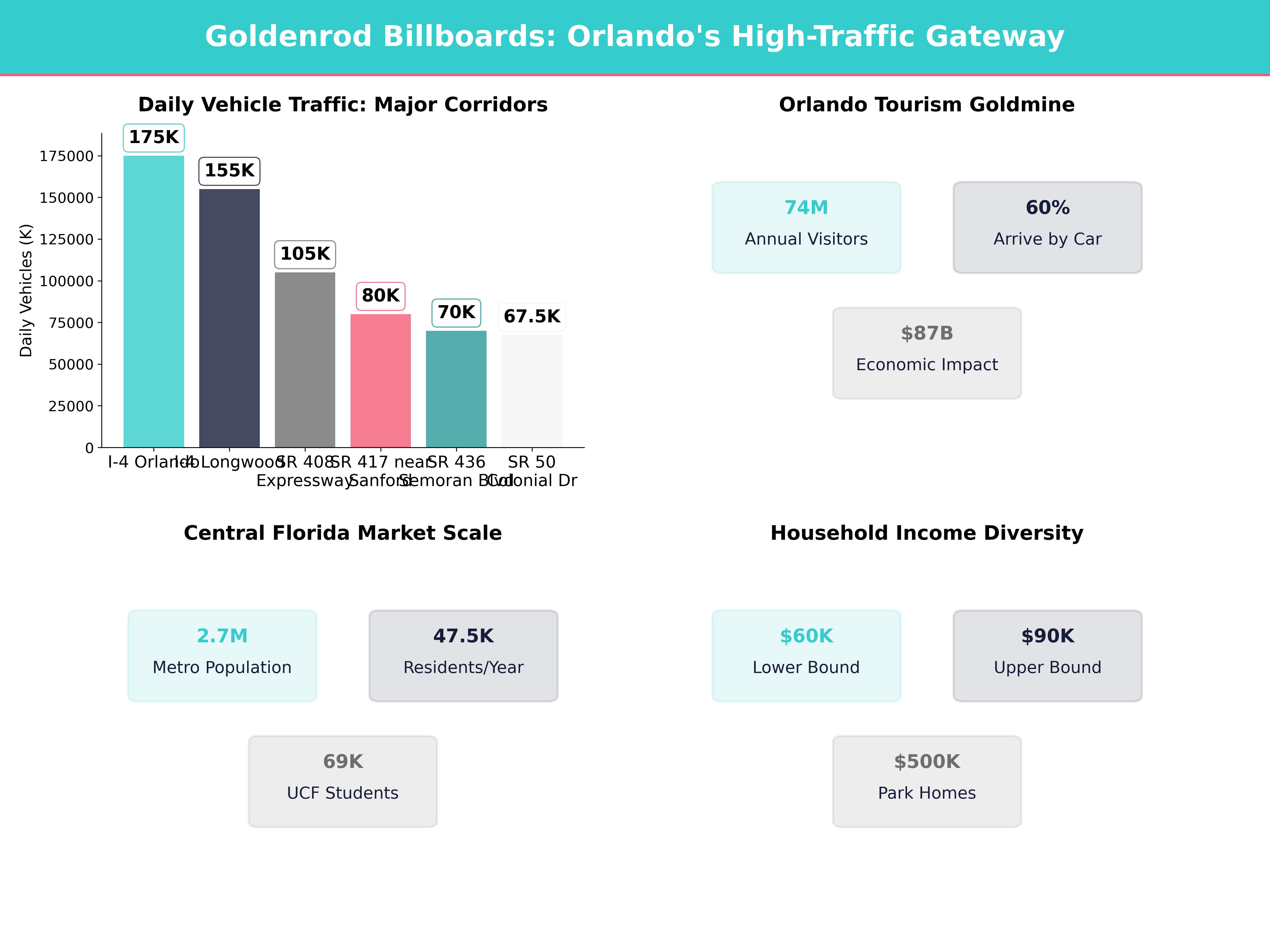
- The broader Orlando–Kissimmee–Sanford metro has grown to roughly 2.7 million residents, adding 40,000–55,000 new residents per year in recent years, based on regional economic development summaries from the Orlando Economic Partnership and coverage in the Orlando Sentinel.
- Orange County has consistently been among Florida’s fastest‑growing counties, with annual growth rates often in the 1.5–2.5% range over the last decade.
- Age and lifestyle mix: Nearby University of Central Florida (UCF) enrolls more than 69,000 students, making it one of the largest universities in the country, per UCF’s official data. That brings a large 18–34 audience, plus 13,000+ faculty and staff, into and around the Goldenrod area daily. Regional profiles frequently show that over 25% of residents in East Orlando and adjacent ZIP codes fall into the 18–34 age bracket, creating a strong base for youth‑oriented brands that use billboard advertising near Goldenrod to stay top of mind.
- Household profile: Goldenrod is surrounded by established single‑family neighborhoods, apartments, and townhomes. Orange and Seminole counties both report homeownership rates above 55–60%, with many neighborhoods near Goldenrod exceeding 65% ownership, according to local housing reports published by Orange County Government and Seminole County. Median household incomes in nearby East Orlando and Winter Park ZIP codes often range from $60,000 to over $90,000, creating a mix of value‑seeking and affluent households—ideal for family services, healthcare, education, and home services advertisers that want billboards near Goldenrod to reach decision‑makers close to home.
This mix of students, families, and professionals means campaigns near the Goldenrod area can perform well for:
- Higher education and trade schools
- Home services (HVAC, roofing, lawn, pest control, solar)
- Healthcare (urgent care, dental, pediatrics, vision)
- Dining and quick‑service restaurants
- Auto dealers, repair, and insurance
- Local attractions, events, and entertainment
Where Our Billboards Serve the Goldenrod Area
Our 36 digital billboards serving the Goldenrod area are placed in nearby communities that funnel traffic past Goldenrod’s residents throughout the day, giving you practical options for billboard rental near Goldenrod without having to commit to a single location:
- Azalea Park (≈3.5 miles from Goldenrod): Dense, working‑class and middle‑income neighborhoods east of Orlando, with heavy traffic along SR 50 (Colonial Drive) and SR 551 (Goldenrod Road). Florida Department of Transportation (FDOT) counts on nearby segments of SR 50 often exceed 60,000–75,000 vehicles per day, and Goldenrod Road segments in East Orlando routinely carry 25,000–35,000 vehicles per day, according to District 5 volume data shared through FDOT District 5
- Orlando (≈9.8 miles): As the economic core, Orlando sees massive daily peaks on SR 408, I‑4, Semoran Boulevard (SR 436), and Colonial Drive (SR 50). FDOT volume maps show many stretches of I‑4 through Orlando carrying 150,000–200,000+ vehicles per day, SR 408 segments carrying 90,000–120,000 vehicles per day, and SR 436 (Semoran) frequently in the 60,000–80,000 vehicles per day range. These corridors carry many Goldenrod residents traveling to work, school, and entertainment and give your Goldenrod billboards access to both local and regional audiences. See the city’s transportation initiatives at the City of Orlando.
- Longwood (≈7.4 miles): A key Seminole County suburb northwest of Goldenrod, near I‑4 and CR 427, with significant commuter flows between Seminole County and the UCF/Research Park/East Orlando area. Segments of I‑4 around Longwood and Altamonte Springs often see 140,000–170,000 vehicles per day, giving advertisers broad regional reach, per FDOT District 5 traffic summaries.
- Sanford (≈9.6 miles): A major gateway for I‑4 and SR 417, plus the Orlando Sanford International Airport, as noted by the City of Sanford. The airport alone serves 3–4 million passengers annually, and adjacent segments of SR 417 commonly carry 70,000–90,000 vehicles per day. Sanford brings regional travelers, day visitors, and airport passengers past our boards, expanding the impact of billboard advertising near Goldenrod beyond just nearby neighborhoods.
By using Blip’s location and budget controls, we can cluster impressions on specific boards that best match your audience—whether that’s East Orlando commuters from Azalea Park, I‑4 travelers through Longwood and Sanford, or urban professionals and tourists near Orlando—while still focusing your spend on Goldenrod billboards that matter most to your business.
Traffic Patterns and When to Run Your Ads
To time your campaign effectively, it helps to understand how people move around the Goldenrod area and how they encounter billboards near Goldenrod during their daily routines:
-
Commuting:
- The Orlando metro has some of the longest average commutes in Florida, frequently in the 28–32 minute range according to regional transportation studies referenced by MetroPlan Orlando. Many workers commuting between Seminole and Orange counties spend 45+ minutes per day on the road.
- Major routes relevant to Goldenrod include Goldenrod Road (SR 551), University Boulevard, Aloma Avenue (SR 426), Colonial Drive (SR 50), and expressways like SR 417 and SR 408. FDOT reports show key links like SR 417 near University Blvd and SR 408 near SR 436 regularly exceed 70,000–100,000 daily vehicle trips, placing billboards in front of tens of thousands of drivers each day.
-
Tourism pressure:
- Visit Orlando reports over 74 million visitors to the Orlando area annually, according to Visit Orlando. That total has rebounded to pre‑pandemic levels, with domestic visitors making up more than 90% of the volume and international visitors accounting for tens of millions of room nights.
- Visitor spending in the region is estimated at tens of billions of dollars annually—Visit Orlando has cited tourism’s annual economic impact at roughly $87 billion, supporting more than 450,000 jobs across Central Florida. While many visitors stay near theme parks, they spread across the region for shopping, dining, and lodging—fueling traffic through Orlando and nearby corridors that your Goldenrod billboards can tap into.
-
Peak periods: Expect strongest roadway volumes:
- Weekday 7–9 a.m. (commuters and students headed toward UCF, downtown Orlando, and Winter Park)
- Weekday 4–7 p.m. (evening commute, after‑school activities, errands)
- Weekend middays 11 a.m.–3 p.m. (shopping, dining, and family outings)
- On major UCF home game days, MetroPlan Orlando and local news outlets such as WESH 2 News often warn of traffic spikes of 20–30% above typical volumes on roads around campus and the Research Park area.
With Blip’s flexible scheduling, we can:
- Concentrate impressions on weekday rush hours to reach office workers and service employees.
- Shift to midday and evening for family‑oriented campaigns (restaurants, healthcare, retail).
- Boost weekend schedules for entertainment, events, and attractions.
For instance, a home services company might run heaviest from 6–9 a.m. and 4–8 p.m. Monday–Friday, while an event at UCF could spike ads Thursday–Saturday evenings on boards along SR 50 and near campus‑bound routes, using focused billboard advertising near Goldenrod to drive last‑minute awareness.
Leveraging Nearby Anchors: UCF, Winter Park, and East Orlando
Goldenrod sits near several powerful audience magnets:
-
University of Central Florida (UCF):
- Over 69,000 students and more than 13,000 employees, according to UCF. That’s a daily campus population comparable to a mid‑sized city.
- UCF and the nearby Central Florida Research Park house over 120 companies in defense, simulation, software, and advanced tech, supporting 10,000+ employees and contractors. This creates high‑value B2B and B2C audiences with strong demand for housing, dining, transportation, and professional services.
- Winter Park: Upscale retail, dining, and cultural venues along Park Avenue, plus Rollins College. The City of Winter Park 30,000 residents live within city limits, with thousands more commuting in daily to work and shop, and Park Avenue’s central business district draws hundreds of thousands of visitors annually, highlighted at cityofwinterpark.org $500,000, making it one of the more affluent pockets in Metro Orlando.
- East Orlando retail and medical clusters: Large shopping centers, medical offices, and big‑box retail along Colonial Drive and Semoran Boulevard include major anchors like regional hospitals, superstores, and high‑traffic plazas. Local economic reports from the City of Orlando and coverage from Spectrum News 13 often highlight East Orlando as one of the city’s busiest retail and medical corridors, with daily traffic volumes commonly above 50,000 vehicles on several key segments.
For advertisers:
- Student‑focused campaigns (food delivery, apartments, tutoring, nightlife, fitness) should target boards on routes connecting UCF ↔ Goldenrod ↔ Orlando/Azalea Park, with heavier schedules during the academic year (late August–early May) and around semester starts. UCF’s fall and spring semesters each bring back tens of thousands of students within a 1–2 week window, creating a short, high‑impact period to advertise move‑in specials and student offers on billboards near Goldenrod and near campus.
- Affluent consumer brands and healthcare can benefit from boards intercepting Winter Park and Research Park traffic, using aspirational, design‑forward creative. With local household incomes often 20–40% above the metro median in these zones, high‑end healthcare, financial services, and luxury retail tend to perform well, especially when supported by premium Goldenrod billboards that speak to nearby homeowners and professionals.
- B2B and hiring campaigns (tech, logistics, healthcare staffing) should focus on weekday rush hours near Longwood and Sanford to reach commuting professionals. Seminole County alone has more than 240,000 workers, many of whom travel daily toward Orlando’s employment centers, according to summaries posted by Seminole County Economic Development. Strategically placed billboard rental near Goldenrod and these commuter routes can keep your hiring message visible throughout the workweek.
Seasonal Trends: When Goldenrod‑Area Campaigns Hit Hardest
The Orlando area has clear seasonal patterns:
-
Tourism peaks:
- March–April (Spring Break / Easter): Strong influx of families and college students. Visitor tallies routinely spike by 10–20% versus slower winter months, as reported by Visit Orlando and local outlets like WKMG News 6.
- June–August (summer vacation): High family traffic; heavy use of attractions and dining, per Visit Orlando. Summer months account for a substantial share of annual visitation, with hotel occupancy often climbing into the 70–80% range across the region.
- November–December (holidays): Elevated shopping and event traffic. Retail centers around Orlando and Winter Park often report double‑digit percentage increases in foot traffic and sales compared with off‑peak months, as covered by the Orlando Sentinel and Orlando Business Journal
-
Local calendar drivers:
- UCF’s academic year and football season draw tens of thousands of extra trips on game days and during major campus events. Spectrum Stadium and the UCF campus can see 40,000+ attendees for major games, creating significant surges on University Blvd, Alafaya Trail, and SR 50.
- Local festivals and arts events in Winter Park and downtown Orlando, promoted by outlets such as Bungalower Orlando Sentinel, draw regional visitors through key corridors. Large events like Winter Park’s arts festivals, the Winter Park Sidewalk Art Festival, and downtown Orlando parades can bring tens of thousands of attendees in a single weekend.
How to adapt:
- Tourism‑oriented businesses (hotels, short‑term rentals, attractions, restaurants) should increase frequency ahead of and during peak tourism months, focusing on Orlando and Sanford boards that catch visitors arriving via I‑4, SR 417, and major arterials. Even a modest presence during these months can put your brand in front of hundreds of thousands of incremental out‑of‑town drivers and reinforce awareness on Goldenrod billboards as those visitors explore further east.
-
Local service businesses can shift budgets:
- Spring and summer for home improvement (roofing, landscaping, pool services), when Central Florida’s rainy and storm seasons drive demand. Local insurance and roofing news reports in outlets like WFTV 9 often cite thousands of storm‑related claims in particularly active years.
- Late summer and January for education and tutoring (back‑to‑school, new semester) as Orange and Seminole County Public Schools—together educating more than 250,000 students, according to Orange County Public Schools and Seminole County Public Schools—ramp up.
- Q4 for retail and healthcare (holiday sales, open enrollment, urgent care), when retail sales and healthcare appointments spike. Local hospital systems frequently report double‑digit percentage increases in urgent care visits around cold and flu season, as covered by Orlando Health news releases and local TV outlets.
Blip’s ability to adjust budgets in real time lets us ramp up ad frequency only when it matters most for your category, so your billboard advertising near Goldenrod stays efficient while still taking advantage of seasonal surges.
Crafting Creative That Works in the Goldenrod Area
Drivers in the Goldenrod area move quickly on multilane roads and expressways, so creative must be instantly legible and locally relevant.
Key guidelines:
- Keep text short: Aim for 7 words or fewer as a general rule. For example, “New Urgent Care – 5 Min Ahead” or “Apartments Near UCF – Now Leasing.” Studies cited by outdoor advertising industry groups and summarized in local business coverage show that concise creatives can improve recall by 20–40% compared with crowded designs.
-
Use bold, high‑contrast colors:
- Bright colors stand out well against Florida’s strong sun, but avoid overly busy backgrounds.
- Dark text on a bright background or vice versa works best, especially on high‑speed roads like SR 417 and SR 408 where drivers may only have 3–6 seconds to absorb your message.
-
Call out local landmarks:
- Phrases like “Just off Semoran & Colonial,” “Near UCF Campus,” or “Minutes from Winter Park” help drivers immediately understand relevance.
- For Goldenrod‑area streets, referencing Goldenrod Road, University Blvd, or Aloma Ave can improve response by clearly signaling proximity to where the audience lives and drives, and makes your billboards near Goldenrod feel hyper‑local.
-
Directional and distance cues:
- “Next Right,” “2 Miles Ahead,” or “Exit Now on SR 417” can be very effective for location‑based businesses, especially tourists who may not know the area well. Local tourism research shared by Visit Orlando notes that a large share of visitors—often 40–50%—travel by car within the region, making directional messaging particularly powerful.
-
Tailor messaging by board cluster:
- On boards near Azalea Park/or Eastern Orlando, emphasize value and convenience—these corridors mix students, service workers, and families.
- On boards serving Longwood and Sanford commuters, stress reliability, professionalism, and family orientation (e.g., healthcare, insurance, home services), aligning with higher rates of homeownership and longer‑distance commuters.
-
Use multiple creatives with Blip:
- Run one message for morning (“Grab Breakfast On Your Way”) and another for evening (“Dinner Tonight? Kids Eat Free”).
- Test different offers—“$0 Down,” “Free Consultation,” “Same‑Day Service”—and monitor which align best with your other metrics (calls, form fills, redemptions). A/B testing even 2–3 creative variations over a 4–8 week period can reveal meaningful lift in responses.
Reaching Specific Audiences in the Goldenrod Area
Because our boards serving the Goldenrod area sit at the crossroads of several audience segments, we can design campaigns to match:
Families and Homeowners
- Where they travel: Goldenrod Road, University Blvd, Aloma Ave, SR 436, SR 417, SR 408. These roads collectively account for hundreds of thousands of daily vehicle trips, according to FDOT District 5 counts, giving broad coverage of school runs and errands and steady exposure to Goldenrod billboards.
- When to advertise: Weekday mornings (school runs) and late afternoons/evenings, plus weekend mid‑days. Orange and Seminole County school days typically run 180 days per year, creating a long, predictable window for family‑focused impressions.
-
What to say: Home repair, medical, education, and family dining. Highlight trust, reviews, and time‑saving benefits:
- “Trusted Pediatric Dentist – 10 Min from Goldenrod”
- “AC Not Working? Same‑Day Repairs in Your Area”
Students and Young Professionals
- Where they travel: UCF area corridors, SR 50, Semoran Blvd, Colonial Drive, routes into downtown Orlando. UCF’s main commuting shed covers tens of thousands of off‑campus students, and local news stories from outlets like FOX 35 Orlando often highlight heavy traffic on Alafaya Trail and SR 50 during peak class times.
- When to advertise: Late mornings, afternoons, and evenings; Thursday–Saturday late nights for nightlife. Student‑heavy periods can see activity on and around campus extending well past midnight, especially during football season and major events.
-
What to say: Affordability, convenience, lifestyle:
- “$5 Late‑Night Bites – Near UCF”
- “Fast Internet for Goldenrod Apartments”
Tourists and Day Visitors
- Where they travel: I‑4 near Longwood/Sanford, SR 417 and SR 408 into Orlando, major arterials to attractions and shopping. Regional tourism articles in the Orlando Sentinel note that a substantial share of visitors—often more than 60%—arrive by car or rental car, driving between the airport, hotels, and attractions.
- When to advertise: All day, with emphasis on afternoon and evening when visitors are heading to dinner, shopping, and shows.
-
What to say: Proximity, unique experiences, and package deals:
- “Rainy Day? Explore Our Indoor Attraction – 15 Minutes Away”
- “Outlet Shopping Near You – Exit at Semoran”
Using Data to Optimize Your Campaign
While digital billboards are a top‑of‑funnel medium, we can still use data and local context to refine performance:
-
Follow traffic and event calendars:
- Monitor UCF’s academic and events schedule via ucf.edu and local event hubs like Visit Orlando to increase impressions around home games, graduation weekends, and large festivals. A single commencement weekend can bring tens of thousands of visitors onto local roads around Goldenrod and East Orlando.
- Check road construction and detour updates from Orange County Transportation Planning Seminole County Public Works to anticipate shifts in traffic. Major projects on I‑4, SR 417, or SR 408 can divert thousands of daily drivers onto alternate arterials, temporarily increasing exposure on some boards.
-
Align with business metrics: Track changes in:
- Website direct traffic and brand‑search volume from Goldenrod‑area zip codes. Even a 5–15% lift in branded search during flighted weeks can signal strong billboard impact.
- Call volumes and form submissions during specific dayparts you’re buying.
- Coupon code or landing‑page usage promoted only on your billboards. Simple billboard‑only promo codes can help you attribute a portion of response to out‑of‑home.
-
Iterate creative:
- Start with 2–3 versions of creative.
- After 2–4 weeks, retire the least effective variant (based on downstream metrics) and introduce a new test creative.
- Keep seasonal creative fresh every 60–90 days. Many Orlando‑area businesses see 20–30% swings in demand between seasons; aligning your creative and offers with those cycles can significantly improve ROI.
Because Blip allows you to adjust bids, select specific boards, and update artwork without large production costs, you can treat your Goldenrod‑area campaign as an ongoing optimization effort instead of a one‑shot media buy, and scale or refine your billboard rental near Goldenrod as performance data comes in.
Practical Campaign Frameworks for the Goldenrod Area
Here are a few starting frameworks we often see work well near Goldenrod:
Local Service Business (HVAC, Roofing, Plumbing)
- Target boards: Azalea Park & Orlando boards along Colonial, Semoran, and Goldenrod‑bound routes; some Longwood boards for north–south commuters. These corridors collectively reach tens of thousands to over 100,000 daily drivers, per FDOT counts and are some of the highest‑impact locations for billboards near Goldenrod.
- Dayparts: Heaviest 6–9 a.m. and 4–8 p.m., 7 days/week during peak season (e.g., summer for AC, rainy season for roofing). Central Florida can experience 90+ days per year with temperatures above 90°F, increasing emergency HVAC demand.
-
Creative mix:
- Ad 1: “AC Out? 24/7 Service – Goldenrod Area”
- Ad 2: “New System $0 Down – Call Today”
- Ad 3: “Free Second Opinion – Local Techs Near You”
Medical or Dental Practice
- Target boards: Routes from Goldenrod to Winter Park and Orlando medical corridors; boards in Longwood/Sanford for regional reach. Orlando’s healthcare hubs include major systems like Orlando Health and AdventHealth, which collectively serve millions of patient visits annually, as highlighted in their newsrooms and local media.
- Dayparts: Weekday mornings and afternoons; lighter evening/weekend awareness. Many practices report that 70–80% of appointments fall between 8 a.m. and 5 p.m., making daytime impressions especially valuable.
-
Creative mix:
- Ad 1: “New Patients Welcome – Family Dentist Near Goldenrod”
- Ad 2: “Same‑Day Appointments – Most Insurance Accepted”
- Ad 3: “Emergency Care – Call Now, Walk‑Ins Welcome”
Restaurant or QSR Near UCF/Goldenrod
- Target boards: East Orlando, Azalea Park, and Orlando boards on SR 50, University Blvd, and Semoran. These roads serve heavy lunch and dinner traffic from UCF and surrounding office parks and are natural fits for billboard advertising near Goldenrod that promotes quick, local options.
-
Dayparts:
- Breakfast campaigns: 6–10 a.m.
- Lunch: 10:30 a.m.–2 p.m.
- Dinner and late‑night: 4–10 p.m., with late‑night up to 1–2 a.m. on key student nights.
-
Creative mix:
- Ad 1 (AM): “Breakfast Burritos – 5 Min from Goldenrod”
- Ad 2 (Lunch): “Lunch Combos Under $10 – Exit at [Street]”
- Ad 3 (Evening): “Late‑Night Eats Near UCF – Open ‘Til 2 A.M.”
Bringing It All Together
The Goldenrod area sits at a strategic junction of suburban neighborhoods, one of the nation’s largest universities, and a world‑class tourism economy. With 36 digital billboards serving the Goldenrod area from nearby Azalea Park, Longwood, Sanford, and Orlando, we can intersect these audiences at multiple touchpoints throughout their daily journeys with highly targeted billboard advertising near Goldenrod.
By:
- Targeting the right corridors that Goldenrod residents use,
- Scheduling ads around real traffic patterns and local calendars,
- Crafting concise, locally aware creative, and
- Iterating based on your own performance data,
we can build digital billboard campaigns that consistently reach and influence the people who matter most to your business in the Goldenrod area, while making the most of every dollar you invest in Goldenrod billboards and billboard rental near Goldenrod.