Billboards in Homosassa, FL
No Minimum Spend. No Long-Term Contracts. Just Results.
Trusted by Leading Brands


Billboard advertising
in Homosassa has never been easier
How much is a billboard in Homosassa?
Why Choose Blip for Billboard Advertising in Homosassa
Blip lets Homosassa brands launch fast on US 19/98, reaching drivers on the county's main coastal spine without traditional buying hassles.
Use Homosassa's winter manatee season to daypart ads for weekends and midday trips, then shift spend when traffic changes.
No contracts means Homosassa advertisers can test coastal vs inland routes near Lecanto and Inverness, then keep what works.
Track real-time results in Homosassa and optimize for tourists, retirees, and commuters on the Suncoast Parkway 2-fed travel pattern.
Blip's creative tools help Homosassa ads stay bold and readable for 45-55 mph roads, from river tours to healthcare and home services.
Frequently Asked Questions About Billboard Advertising in Homosassa
How much does a billboard cost in Homosassa with Blip?
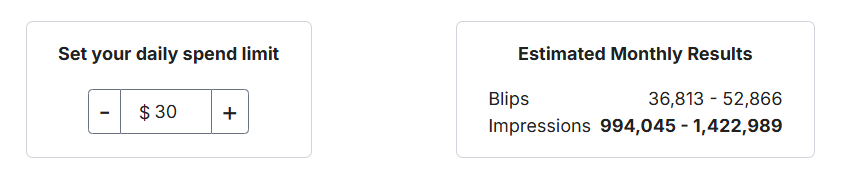
With Blip, billboard advertising in Homosassa can be surprisingly affordable because you only pay when your ad actually appears. Pricing starts at just $0.01 per display, and each “blip” is a 7.5-to-10-second display on a rotating digital billboard. You choose a daily budget, and Blip’s algorithm uses it to bid for open ad slots, helping maximize your reach while keeping costs in check.
Where can I advertise with Blip in Homosassa to reach local drivers?
The main coastal spine through Homosassa is US 19 and US 98, locally known as Suncoast Boulevard. On FDOT traffic maps, segments of this corridor in the Homosassa Springs area generally land in the mid-20,000s to mid-30,000s AADT range, and busier commercial stretches farther north toward Crystal River can exceed 40,000 AADT. SR 44 and US 41 also expand Homosassa reach beyond the coast and carry meaningful local traffic.
When is the best time to run Blip ads in Homosassa for tourism?
If we only choose one season to emphasize in Homosassa, winter is usually the winner. From roughly November through March, we see the strongest overlap of snowbirds, manatee tourism, holiday visitors, and cool-weather outdoor recreation. During these months, midday and weekend placements can be just as important as weekday commute windows because many visitors are in leisure mode rather than work mode.
What kind of people does billboard advertising in Homosassa reach?
Recent demographic estimates show Citrus County has a median age of roughly 57 years, with about 39% of residents age 65 or older. Roughly 83% of occupied homes in Citrus County are owner-occupied, which supports billboard campaigns for roofing, HVAC, flooring, windows, solar, insurance, pest control, remodeling, and lawn care. More than 84% of workers commute by driving alone, so roadway frequency is strong for local advertising.
Can I use Blip to change Homosassa billboard ads by season?
Yes, the content says Homosassa is a market where timing matters, so flexibility matters too. With Blip, we can test winter tourism messaging on US 19, switch to scallop-season creative in July, and then pivot to storm-prep or healthcare messaging in late summer without rebuilding a traditional long-term media buy. Because campaigns run on a pay-per-play basis, it is easier to stay disciplined with budgets while adjusting to the market's rhythms.
Do I need a contract to advertise with Blip in Homosassa?
No, Blip has no long-term contracts or minimum commitments. You can start, pause, or stop your campaign at any time.
How fast can I launch a billboard campaign with Blip in Homosassa?
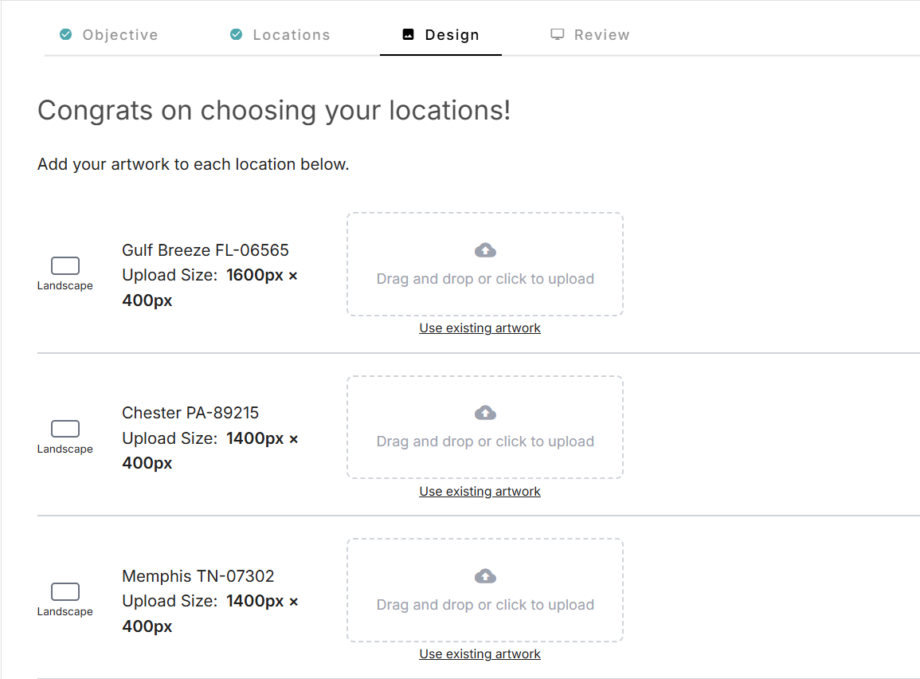
You can have your campaign live in minutes. Create a free account, select your locations, set your budget, upload your design, and start running once approved.
Where can I advertise with Blip in Homosassa?
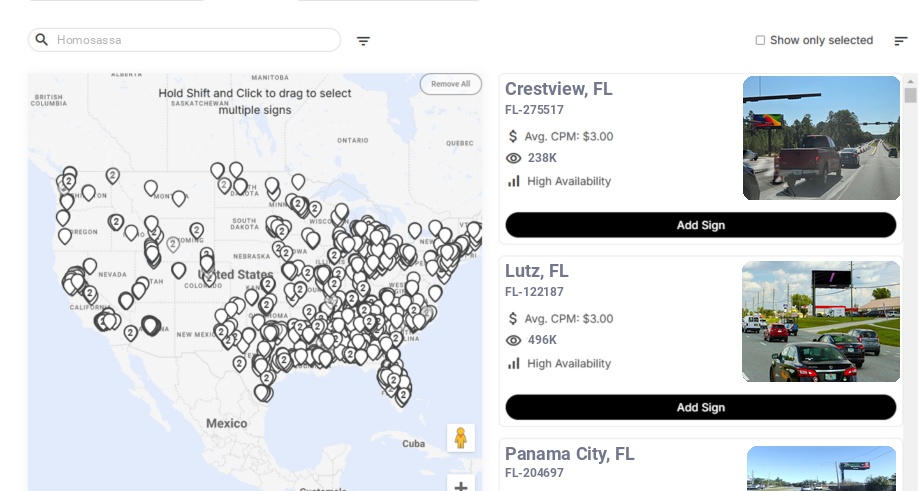
Blip has digital billboards in Homosassa. You can browse available locations on a map, choose the ones that fit your audience, and start advertising right away.
Still have questions? Launch a campaign in minutes — no contracts, no commitments.
Start Your CampaignHomosassa Billboard Advertising Guide
Homosassa is a strong billboard market because we are not buying visibility for a single tiny crossroads. We are buying into the larger west Citrus County travel pattern that funnels residents, retirees, service workers, and visitors onto a limited set of roads.
Homosassa Market Overview
Homosassa advertising works at a countywide scale
When we plan for Homosassa, we should think beyond the census-designated place and focus on the broader trade area that includes Homosassa Springs, southern Crystal River Inverness 2 incorporated cities, Crystal River Inverness
That matters because billboards in Homosassa are not niche neighborhood media. They are regional media that can influence restaurant choices, medical appointments, home-service calls, attraction visits, and destination retail trips across a wide portion of the county.
The Homosassa customer base is older, established, and highly vehicle-oriented
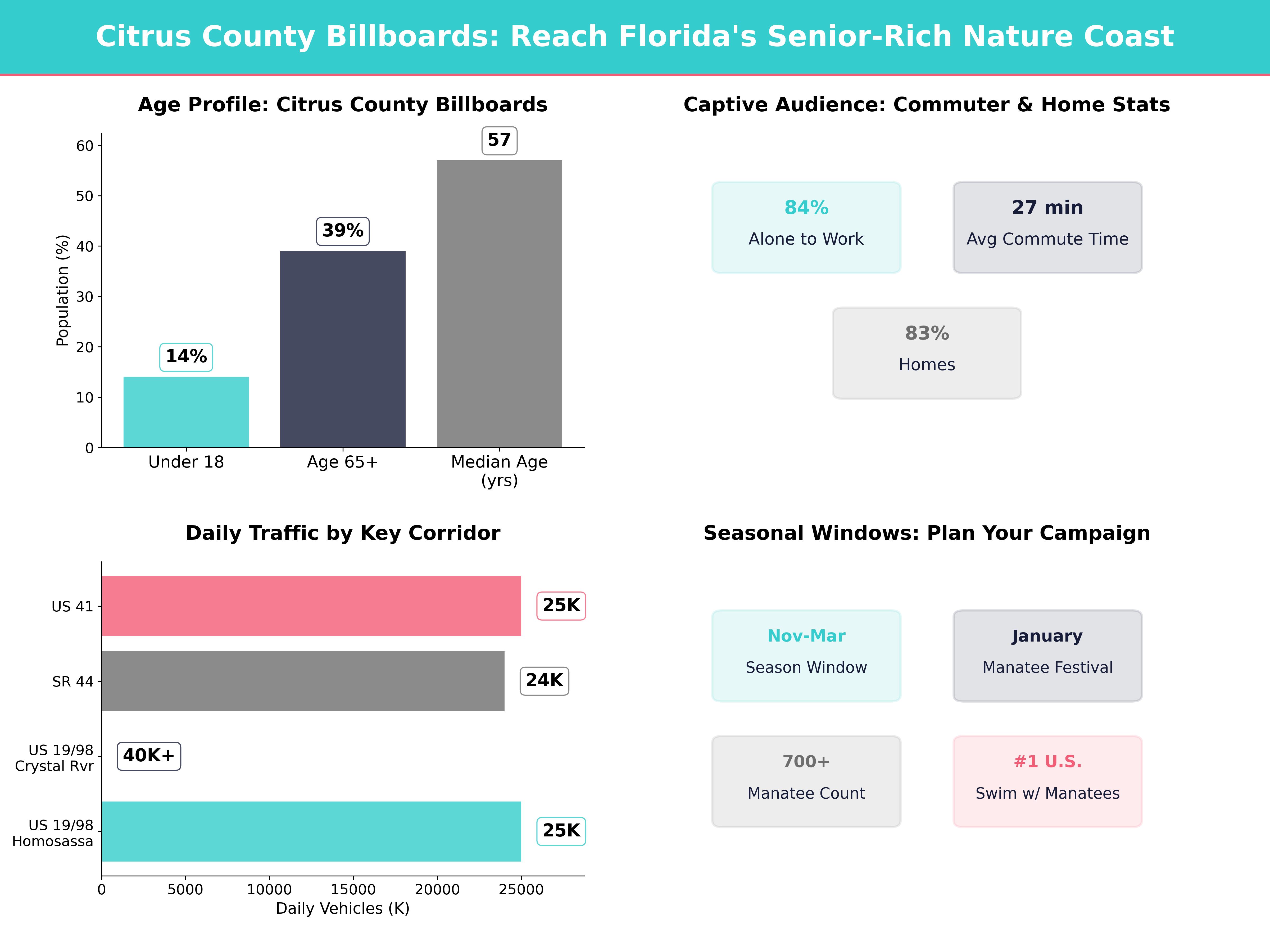
Recent demographic estimates show Citrus County has a median age of roughly 57 years, with about 39% of residents age 65 or older. At the same time, only about 14% of residents is under age 18.
That age profile is unusually favorable for advertisers in healthcare, hearing, dental, vision, legal services, financial planning, home improvement, mobility products, and destination dining. Housing data also point toward strong demand for homeowner-driven categories.
Roughly 83% of occupied homes in Citrus County are owner-occupied, which supports billboard campaigns for roofing, HVAC, flooring, windows, solar, insurance, pest control, remodeling, and lawn care. We are speaking to a market where many households are settled, own property, and make recurring local purchasing decisions.
Commuting patterns reinforce the billboard case. More than 84% of workers commute by driving alone, and the average commute is about 27 minutes.
Even though Citrus County is less dense than major metros, those commute patterns create reliable roadway frequency because most errands, work trips, medical visits, and recreational outings happen by car.
Homosassa sits inside a practical healthcare and services economy
Citrus County’s local economy is supported by healthcare, construction, hospitality, retail, and small business services. Two anchor healthcare institutions alone illustrate the scale of everyday local demand.
HCA Florida Citrus Hospital in Inverness is a 204-bed acute-care hospital, and Tampa General Hospital Crystal River 128-bed hospital serving the coastal side of the county.
For advertisers, that means Homosassa boards can do more than drive tourist traffic. We can also reach people making high-intent decisions about urgent care, specialists, imaging, elective procedures, pharmacies, legal needs, and home services.
The local business ecosystem promoted by the Citrus County Chamber of Commerce and Citrus County Economic Development
Key Traffic Corridors for Homosassa Billboards
US 19 and US 98 are the backbone of Homosassa visibility
The main coastal spine through Homosassa is US 19 and US 98, locally known as Suncoast Boulevard. This is the road that ties Homosassa to Homosassa Springs, Crystal River
On Florida Department of Transportation traffic maps, segments of this corridor in the Homosassa Springs area generally land in the mid-20,000s to mid-30,000s AADT range, and busier commercial stretches farther north toward Crystal River can exceed 40,000 AADT. That volume matters because US 19 and US 98 serve both local and visitor traffic.
We can use this corridor effectively for several categories. Restaurants, quick-service brands, and attractions perform well here because drivers are often making same-day stop decisions.
Healthcare, pharmacies, and urgent care providers benefit because this road is a habitual route for routine local errands and medical trips. Auto dealers, repair shops, and tire stores fit naturally because vehicle needs are top-of-mind during longer county drives.
Hotels, marinas, manatee tours, and fishing charters gain value because tourists encounter these messages before they choose where to stop. Road speeds on much of the corridor are typically in the 45 to 55 mph range, so simple, large-format creative is especially important.
Suncoast Parkway access has changed Homosassa’s strategic value
A major shift for the market came when Florida’s Turnpike Enterprise opened the 13-mile Suncoast Parkway 2 extension in 2022. That project extended expressway access farther north into Citrus County and strengthened the county’s connection to the Tampa Bay region.
Even if a given billboard is not directly on the toll road, the extension still matters to Homosassa advertisers because it changes trip planning. More drivers can now move between southern Citrus County and the Tampa metro more efficiently, and that makes the Homosassa area more attractive for destination businesses, healthcare providers, homebuilders, and regional service brands.
For us, parkway-oriented campaigns work best when we focus on planned purchases rather than pure impulse buys. Good fits include scheduled medical care, senior living, legal services, furniture, flooring, home improvement, financial services, and larger-ticket retail.
SR 44 and US 41 expand Homosassa reach beyond the coast
If we want broader county coverage, we should pay close attention to SR 44 and US 41. SR 44 is the main east-west connector between Crystal River, Lecanto, and the Suncoast Parkway approach, while US 41 is the inland spine running through Lecanto, Hernando, and Inverness
FDOT traffic counts on SR 44 commonly reach the high teens to upper-20,000s AADT on busier segments, and inland portions of US 41 regularly fall into the 20,000 to 30,000 AADT range. Those are meaningful numbers in a county this size, especially because these roads carry school traffic, county-government traffic, healthcare trips, and shopping trips.
This inland network is especially effective when we want to reach: Residents visiting the College of Central Florida Citrus Campus and nearby education services; Patients and families traveling to HCA Florida Citrus Hospital, Tampa General Hospital Crystal River
Local tourism feeders matter even when they carry less volume
Smaller connectors around Homosassa also deserve strategic attention, especially for tourism and marine businesses. Roads leading toward the Ellie Schiller Homosassa Springs Wildlife State Park
When we advertise on or near these feeders, we should use directional copy, distance markers, and immediate offers. A message that says “Manatee Tours Ahead,” “Fresh Seafood on the River,” or “Boat Rentals Next Right” is often more effective here than a broad brand statement because the audience is already in exploration mode.
Audience Segments We Can Reach in Homosassa
Homosassa reaches retirees, homeowners, and healthcare consumers
The strongest year-round audience in the Homosassa market is the established local resident. With a median age of about 57, and nearly 39% of the county age 65+, we can justify billboard campaigns for primary care, specialists, elective procedures, hearing aids, physical therapy, assisted living, estate planning, wealth management, and insurance.
This same audience also supports home-service categories because homeownership sits around 83%. That is one reason roofing, windows, HVAC, generators, gutters, landscaping, and pest control can perform well with repeated roadside exposure.
These residents may not be searching every day, but when a need appears, familiar brands usually have the advantage.
Homosassa also reaches one of Florida’s most distinctive tourist audiences
Tourism in this market is not generic beach traffic. It is highly specific, seasonal, and experience-driven.
Discover Crystal River Florida promotes the area as the only place in the United States where we can legally swim with manatees in the wild, which gives the region a nationally distinctive draw. Winter is especially important.
The springs in the area stay near 72°F year-round, and the Crystal River system can host 700+ manatees during peak cold-weather periods. The core manatee season typically runs from November 15 through March 31, which creates ideal timing for tour operators, hotels, restaurants, outfitters, and family attractions.
Beyond manatees, the area also attracts anglers, paddlers, RV travelers, golfers, and day-trippers. Cabot Citrus Farms has 57 holes of golf, and the Withlacoochee State Trail 46 miles, which helps broaden the visitor mix beyond just wildlife tourism.
That gives us opportunities for hospitality, recreation, apparel, local retail, breweries, and premium dining.
Families, students, and workforce households still matter in Homosassa
Even in an older market, we should not ignore families and working adults. The Citrus County School District operates 3 traditional public high schools, and College of Central Florida adds a steady education audience in Lecanto.
School traffic, extracurriculars, dual-enrollment activity, youth sports, and parent errands all contribute to weekday roadway repetition. This segment is useful for advertisers in childcare, tutoring, family dining, orthodontics, urgent care, auto service, telecom, and value retail.
Because more than 84% of workers drive alone, commuter-oriented copy still matters even in a county with a large retiree base.
Seasonal and Timing Opportunities in Homosassa
Winter is Homosassa’s most obvious billboard season
If we only choose one season to emphasize in Homosassa, winter is usually the winner. From roughly November through March, we see the strongest overlap of snowbirds, manatee tourism, holiday visitors, and cool-weather outdoor recreation.
This is when we should prioritize campaigns for tours, hotels, vacation rentals, waterfront dining, warm-weather escape offers, and local attractions. The Florida Manatee Festival in nearby Crystal River, typically held in January, creates another seasonal visibility spike.
During these months, midday and weekend placements can be just as important as weekday commute windows because many visitors are in leisure mode rather than work mode.
Spring and summer create a different kind of Homosassa demand
Spring shifts the message. The Citrus County Fair usually lands in late March or early April, schools move toward testing and graduation, and locals spend more time outside.
This is a good window for home improvement, healthcare checkups, family entertainment, seasonal retail, and restaurant advertising. Summer brings a strong outdoor recreation audience.
Under rules set by the Florida Fish and Wildlife Conservation Commission, bay scallop season in Citrus County usually opens in early July and runs into September. That is prime time for marinas, bait and tackle, boat rentals, seafood restaurants, lodging, gas stations, coolers, marine repair, and waterfront bars.
Summer heat also shifts dayparting strategy. Morning ads can catch boaters and outfitters early, while late-afternoon ads can catch returning recreational traffic that is deciding where to eat, refuel, or book the next outing.
Weather and school calendars shape timing more than many advertisers expect
Florida’s Atlantic hurricane season runs from June 1 through November 30, and even on the Gulf side of Citrus County, weather awareness matters. That creates short-term opportunities for storm prep, generators, roofing, shutters, cleanup services, insurance, and hardware retailers.
It also makes digital billboards especially useful because we can rotate in timely creative without replacing printed vinyl. Back-to-school campaigns usually belong in August, while graduation, summer registration, and student-housing messages belong in May and early June.
In Homosassa, a smart calendar often looks like this: We use January through March for tourism, dining, and winter visitor offers; We use April through June for home services, healthcare, graduation, and warm-weather local spending; We use July through September for scalloping, boating, restaurants, and marine retail; We use October through December for holiday shopping, seasonal healthcare, snowbird return messaging, and pre-winter tourism.
Billboard Design Tips for the Homosassa Market
Homosassa creative should feel like the Nature Coast, not generic Florida
The best billboard design in Homosassa usually reflects the area we are actually advertising in. Nature Coast imagery works because it feels native to the market.
Clear spring water, manatees, boats, fishing, marsh grass, golf, seafood, and riverfront dining all connect better than generic neon beach visuals that feel more like Miami or Daytona. Color choices should support readability first, but local resonance helps.
Deep blue, sea green, teal, sand, white, and high-contrast black often fit the market well. If we are promoting healthcare or home services, those same palettes can feel clean and trustworthy rather than loud.
Homosassa boards need larger type and simpler messages
Because many roadway speeds are in the 45 to 55 mph range, and because the local audience skews older, we should prioritize readability. Large type, strong contrast, and one clear offer almost always beat busy layouts.
We should also avoid QR-code-only calls to action. A short web address, a memorable brand name, or a simple “Next Right” instruction usually works better at speed.
Directional copy is especially effective in this market. Visitors heading toward the river or state park respond well to messages that reduce uncertainty, such as distance, turn cues, and same-day availability.
Local residents respond well to credibility cues, including years in business, same-day service, locally owned positioning, and insurance or licensing language where appropriate.
Homosassa-specific offers should match local motivations
Local creative should reflect what people are actually doing in the area. If we are targeting winter visitors, we should mention manatees, warm-weather escapes, river tours, or waterfront dining.
If we are targeting homeowners, we should mention roofs, air conditioning, windows, generators, or pest issues that matter in Florida’s climate. If we are targeting retirees, we should emphasize trust, convenience, appointments, and specialized care.
If we are targeting recreation seekers, we should highlight golf, fishing, scalloping, paddling, and marina access.
Regional Strategies Around Homosassa
Homosassa and Homosassa Springs should focus on immediate action
The core Homosassa and Homosassa Springs area is best for attractions, restaurants, marinas, rentals, guide services, seafood, convenience retail, and healthcare brands with nearby locations. This is where we want messages that trigger a same-day decision.
Proximity matters here, so “today,” “open now,” “next light,” and “5 minutes away” are strong framing devices. The Ellie Schiller Homosassa Springs Wildlife State Park
Visitors may arrive for wildlife and then choose where to eat, shop, fuel up, or extend their stay.
Crystal River should be part of most Homosassa strategies
Even when our business is based in Homosassa, we should think about northbound and southbound movement between Homosassa and Crystal River
Campaigns in this zone work well for hotels, charter services, attractions, specialty retail, healthcare, and higher-end hospitality such as Plantation Resort on Crystal River.
Lecanto and Inverness give Homosassa campaigns countywide depth
If our goal is not only tourists but also year-round county residents, we should pair coastal boards with inland exposure near Lecanto and Inverness
For many categories, the best regional strategy is not choosing coastal or inland. It is using both.
A coastal board can build awareness, and an inland board can reinforce frequency among everyday residents.
Southbound commuter and Tampa-facing strategies are growing in value
As the Suncoast Parkway network improves access, southern Citrus County becomes more connected to the broader Tampa Bay economic orbit. That makes Homosassa useful for brands that want to intercept planned regional travel.
We should consider this angle for homebuilders, medical specialists, furniture stores, legal firms, senior living providers, and destination retail that benefits from a wider trade area.
Using Blip Tools in Homosassa
We can match Homosassa’s rhythms without overcommitting
Homosassa is a market where timing matters, so flexibility matters too. We can test winter tourism messaging on US 19, switch to scallop-season creative in July, and then pivot to storm-prep or healthcare messaging in late summer without rebuilding a traditional long-term media buy.
Blip’s map-based selection is especially useful here because location choice is everything. We can compare coastal boards against inland boards, test northbound versus southbound visibility, and decide whether we want tourist intent, commuter repetition, or both.
Because campaigns run on a pay-per-play basis, with displays starting at $0.01 and each blip lasting about 7.5 to 10 seconds, we can also stay disciplined with budgets while still building frequency in a smaller market.
Dayparting and real-time optimization fit Homosassa exceptionally well
Homosassa is not a one-pattern market. Morning traffic can skew local and work-related.
Midday traffic can skew tourist and errand-driven. Weekends can shift heavily toward recreation, and with Blip, we can daypart around those behaviors instead of buying every hour the same way.
We can also use analytics to refine quickly. If a healthcare message is performing best on weekday mornings, we can lean into that.
If a restaurant or tour offer gains traction on Friday through Sunday, we can concentrate budget there. For a seasonal market like Homosassa, that kind of agility is more valuable than simply buying the same board all year with the same creative.
Getting Started with Billboard Rental in Homosassa
We should start by choosing the real objective in Homosassa
Before we rent a billboard in Homosassa, we should decide whether we want to reach locals, tourists, or a blend of both. That one decision shapes almost everything else, including location, timing, direction of travel, and creative style.
A useful evaluation checklist includes a few practical questions. We should ask whether the board faces a road people use every week, or a road they use mainly during leisure trips.
We should ask whether the audience is making a planned decision, such as choosing a doctor, or an impulse decision, such as picking lunch. We should ask whether the board appears before the decision point, not after it.
We should ask whether the message matches the season, such as manatees in winter, scalloping in summer, or storm prep in late summer and fall.
Blip simplifies Homosassa billboard rental compared with traditional buying
Traditional billboard buying often forces us into fixed terms, heavier commitments, slower creative changes, and less transparent testing. In a market like Homosassa, where seasonality and route selection matter so much, that can be limiting.
Blip simplifies the process by letting us choose boards on a map, set a budget that matches our goals, upload artwork, and adjust campaign timing as the market shifts. That matters if we want to start with a narrow winter test on US 19, add inland support near Lecanto later, or pause after a short seasonal push.
The smartest way to begin is usually to launch with a focused set of placements, monitor performance, and then expand into the corridors and dayparts that prove they can deliver. In Homosassa, the winning campaign is rarely the one that buys the most inventory first. It is the one that matches the county’s actual travel patterns, seasonal demand, and local motivations with clear creative and disciplined placement choices.