Billboards in South Pasadena, FL
No Minimum Spend. No Long-Term Contracts. Just Results.
Trusted by Leading Brands


Billboard advertising
in South Pasadena has never been easier



How much is a billboard in South Pasadena?
Why Choose Blip for Billboard Advertising in South Pasadena
Blip’s self-serve platform lets South Pasadena advertisers launch fast on Pasadena Ave South or Corey Causeway without the usual hassle.
Use Blip to target South Pasadena beach traffic on Gulf Blvd and time ads for midday or evening return trips.
No contracts or minimums in South Pasadena mean you can start small, then shift budget toward I-275 or SR 693 as needed.
Blip-optimized campaigns help South Pasadena brands auto-bid on the right billboards and times for commuters, condo residents, and visitors.
Track South Pasadena performance in real time and adjust creative for healthcare, dining, or storm-season offers as traffic patterns change.
Frequently Asked Questions About Billboard Advertising in South Pasadena
How much does a billboard cost in South Pasadena with Blip?
With Blip, billboard advertising in South Pasadena can be surprisingly affordable because you only pay when your ad actually appears. Each “blip” is a 7.5-to-10-second display on a rotating digital billboard, with prices starting at just $0.01 per display. You set a daily budget, and Blip’s algorithm uses it to bid on open ad slots, helping maximize your reach based on when and where people are most likely to see it.
Where can I advertise with Blip in South Pasadena?
For South Pasadena itself, the SR 693 corridor, including Pasadena Avenue South and the Corey Causeway approach, generally lands in the 30,000 to 35,000 AADT range. Gulf Boulevard carries a tourism-heavy stream that often falls in the 15,000 to 25,000 AADT range, depending on the specific segment and season. If our goal is broader metropolitan reach, I-275 is the heavyweight route and many segments through St. Petersburg exceed 120,000 AADT.
What kind of audience can South Pasadena billboard ads with Blip reach?
South Pasadena sits on the everyday path between St. Petersburg, the Gulf beaches, and the broader Pinellas County consumer base, so the audience includes commuters, condo residents, healthcare decision-makers, and year-round visitors. Pinellas County overall has a median age of about 49, and South Pasadena skews older still, with many condo buildings, seasonal residents, and households making decisions around healthcare, mobility, insurance, estate planning, and home maintenance. The wider trade area also includes dense family neighborhoods and student movement tied to local schools and colleges.
When is the best time to run South Pasadena Blip billboard ads?
From January through April, we typically see the strongest mix of snowbird activity, spring leisure travel, and local event traffic. From Memorial Day through Labor Day, the market shifts toward families, day-trippers, and in-state leisure traffic. Late summer also matters because Pinellas County Schools returns in August, and the Atlantic hurricane season runs from June 1 through November 30.
What roads in South Pasadena are best for Blip billboards?
The county’s peninsula geography compresses traffic onto a limited number of arterials, bridges, and north-south spines, which is exactly what we want in an out-of-home market. SR 693, Gulf Boulevard, I-275, US 19, 66th Street, and the Pinellas Bayway all serve different audiences and travel intents. This makes South Pasadena a strong market for campaigns that want to match creative to the actual route people are taking.
Do I need a contract to advertise with Blip in South Pasadena?
No, Blip has no long-term contracts or minimum commitments. You can start, pause, or stop your campaign at any time.
How fast can I launch a billboard campaign with Blip in South Pasadena?
You can have your campaign live in minutes. Create a free account, select your locations, set your budget, upload your design, and start running once approved.
Where can I advertise with Blip in South Pasadena?
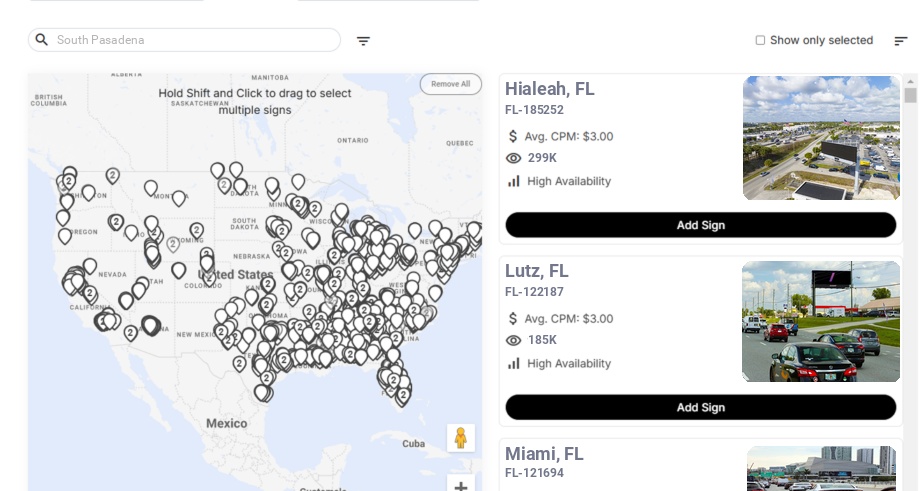
Blip has digital billboards in South Pasadena. You can browse available locations on a map, choose the ones that fit your audience, and start advertising right away.
Still have questions? Launch a campaign in minutes — no contracts, no commitments.
Start Your CampaignSouth Pasadena Billboard Advertising Guide
South Pasadena is a small Florida city with an unusually strong billboard position because it sits on the everyday path between St. Petersburg, the Gulf beaches, and the broader Pinellas County consumer base. We are not advertising into an isolated town of just over 5,000 residents. We are advertising at the edge of a dense county of 959,107 people, where private vehicles dominate daily movement and beach traffic layers on top of resident demand. That combination gives us access to commuters, condo residents, healthcare decision-makers, and year-round visitors moving through a compact road network again and again.
South Pasadena Market Overview
South Pasadena is small, but its trade area is large
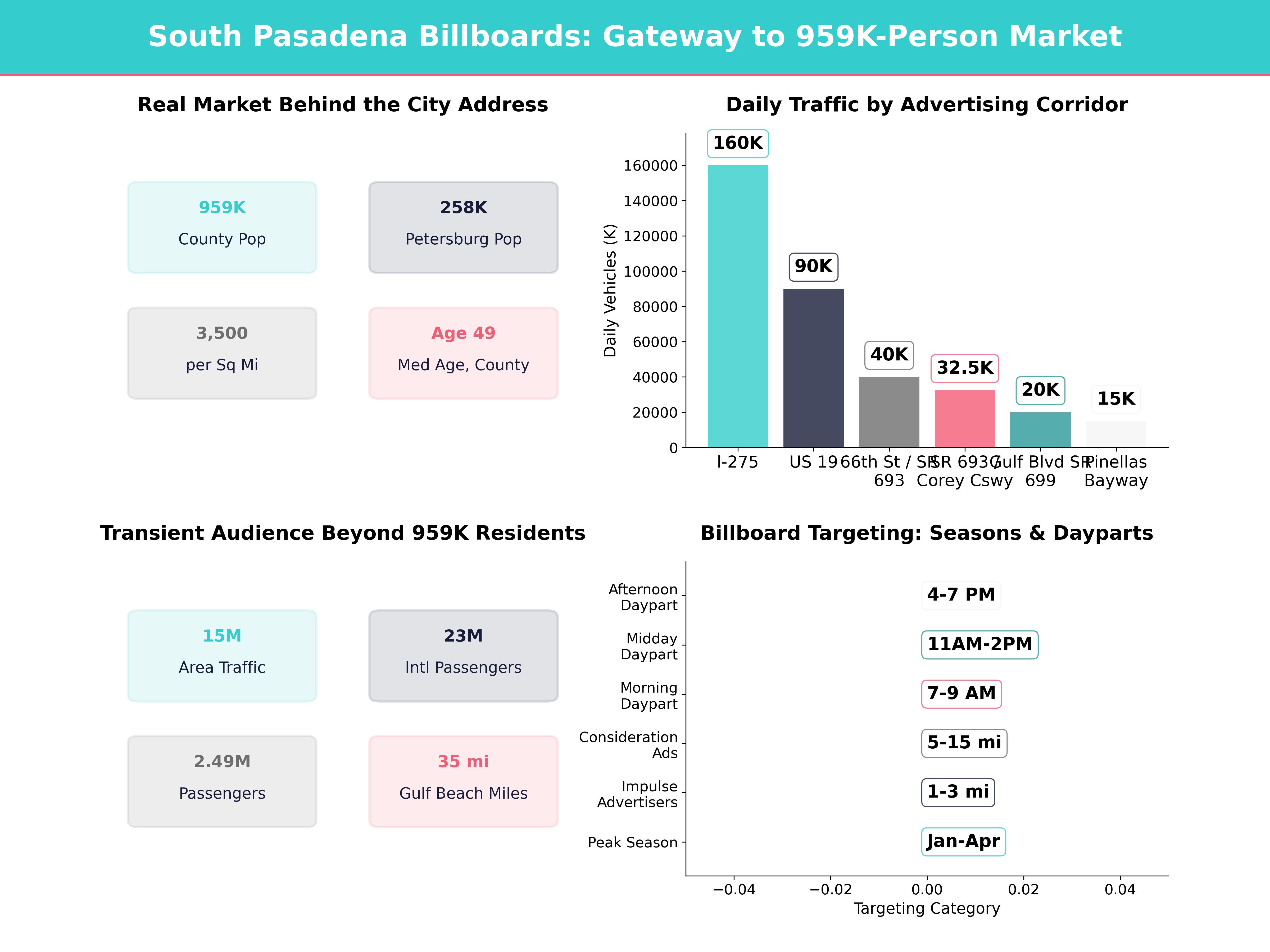
When we plan a billboard campaign in South Pasadena, we need to think beyond the city limits. Pinellas County had 959,107 residents in 2020, and the county fits onto only 274 square miles of land. That works out to roughly 3,500 residents per square mile, which makes the county one of the most densely populated in Florida and helps outdoor advertising generate repeat exposure.
South Pasadena itself is a compact, primarily residential city with just over 5,000 residents, but it sits next to much larger demand centers. St. Petersburg had 258,308 residents in 2020, and nearby communities such as Gulfport, St. Pete Beach Treasure Island, and Seminole expand the practical audience for any well-placed campaign.
Growth in this market has been steady rather than explosive, which is helpful for billboards. Pinellas County grew about 4.6% from 2010 to 2020, which means established arterials still matter because consumer movement has not been scattered across distant exurbs. We can keep investing in the same proven corridors instead of chasing growth to entirely new parts of the metro every year.
Travel behavior also supports out-of-home advertising. In county and regional planning profiles used by Forward Pinellas and the Florida Department of Transportation, private vehicles account for well over 80% of commute trips, and average commute times are about 25 minutes. Those are not extreme Sun Belt commute lengths, but they are more than long enough for drivers to see the same digital boards with useful frequency.
South Pasadena benefits from a diverse local economy
We can also lean on the breadth of the local economy. Pinellas County Economic Development supports a mix of healthcare, professional services, marine activity, hospitality, real estate, home services, education, and retail. That diversity matters because it keeps demand on the roads during weekdays, weekends, tourist seasons, and relocation cycles.
Tourism is especially important around South Pasadena. Visit St. Pete-Clearwater 35 miles of Gulf beaches and roughly 15 million annual visitors, and South Pasadena sits on one of the most practical approach routes to that shoreline. For many advertisers, that means we can reach both locals and visitors with the same campaign, especially when the message is tied to dining, entertainment, medical services, attractions, or nearby shopping.
Air access reinforces that visitor base. St. Pete-Clearwater International Airport handled about 2.49 million passengers in 2023, and nearby Tampa International Airport 23 million passengers in 2023. Not every one of those travelers comes through South Pasadena, but a meaningful share heads into the beaches, downtown St. Petersburg, or short-term lodging in the surrounding coastal area.
Education and healthcare add dependable year-round movement. Pinellas County Schools serves more than 91,000 students, while St. Petersburg College, USF St. Petersburg Eckerd College keep students, faculty, and families circulating across the west side of the county. Healthcare is equally important for this market, with providers such as HCA Florida Pasadena Hospital, BayCare, and Johns Hopkins All Children's Hospital
Key Traffic Corridors for South Pasadena Billboards
South Pasadena advertising works best when we map campaigns to the way people actually move through lower Pinellas. The county’s peninsula geography compresses traffic onto a limited number of arterials, bridges, and north-south spines, which is exactly what we want in an out-of-home market.
Pasadena Avenue South and Corey Causeway on SR 693
For South Pasadena itself, FDOT counts on the SR 693 corridor, including Pasadena Avenue South and the Corey Causeway approach, generally land in the 30,000 to 35,000 AADT range. That is a strong number for a local arterial because the corridor combines resident errands, beach access, service traffic, and visitor circulation.
This corridor is ideal when we want immediate action. The advertisers that usually fit best include the following categories:
- Restaurants, coffee shops, and convenience retail work well here because drivers are often only minutes from a turn decision.
- Urgent care, pharmacies, dental offices, and hospitals benefit because the route serves dense residential towers and an older local population.
- Real estate, senior services, legal services, and wealth management perform well because South Pasadena and nearby condo markets contain many homeowners, retirees, and seasonal residents.
Gulf Boulevard on SR 699
Once traffic crosses toward the barrier islands, Gulf Boulevard 15,000 to 25,000 AADT range, depending on the specific segment and season. The raw counts are lower than on inland highways, but the intent level is high.
These drivers are going somewhere leisure-oriented, and many are actively deciding where to eat, shop, stay, or stop. We should favor this corridor for the following campaign types:
- Hotels, vacation rentals, beach bars, and seafood restaurants can intercept visitors before they settle on an option.
- Attractions, museums, boat rentals, and event promotions can benefit because leisure travelers are more open to spontaneous plans.
- Apparel, souvenirs, sunscreen, groceries, and beach essentials can convert quickly because need-based purchases often happen after arrival.
I-275 through St. Petersburg and the bridge approaches
If our goal is broader metropolitan reach, I-275 is the heavyweight route. Through St. Petersburg, many segments exceed 120,000 AADT, and the busiest bridge approaches toward Tampa run above 200,000 vehicles per day. That kind of volume is valuable when we need efficient frequency across a large audience instead of only beach-bound traffic.
I-275 is especially useful for the following advertisers:
- Regional healthcare systems, colleges, and legal brands can build broad familiarity across multiple ZIP codes.
- Auto dealers, insurance, financial services, and home improvement companies can reach countywide and cross-bay shoppers.
- Concerts, sports, festivals, and major attractions can promote dates and ticket calls-to-action to a large commuter audience.
US 19 and north-county commercial spines
For campaigns that need suburban household reach beyond South Pasadena, US 19 remains one of the most important commercial corridors in Pinellas. Major segments commonly run in the 80,000 to 100,000+ AADT range. That gives us access to shoppers, trade workers, and households moving between Pinellas Park Clearwater, and northern retail districts.
US 19 tends to reward advertisers with a broader consideration cycle, including the following categories:
- Furniture, mattresses, roofing, HVAC, and remodeling fit because consumers often compare options before acting.
- Medical specialists, imaging centers, and elective care providers benefit because patients may travel farther for appointments.
- Regional retail chains and family attractions can build awareness before a planned weekend trip.
66th Street and the Tyrone retail district
The 66th Street spine, which is also part of SR 693 farther north, typically carries around 35,000 to 45,000 AADT on major Pinellas segments. Near Tyrone Square
This is a strong fit for campaigns focused on local household demand. We can use it effectively for grocery-anchored retail, family dining, cell phone providers, urgent care, auto service, and home services that need repeated exposure close to purchase locations.
Pinellas Bayway on SR 682
For specialty leisure audiences, the Pinellas Bayway is worth watching. Traffic is lower than the county’s major spines, often around 10,000 to 20,000 AADT, but the route serves destination-minded travelers headed toward marinas, waterfront recreation, and Fort De Soto Park. We should use this corridor when we want to reach boaters, anglers, park visitors, and high-intent recreation traffic.
Audience Segments We Can Reach Around South Pasadena
The strength of South Pasadena billboard advertising is not just traffic volume. It is the mix of audiences layered into a relatively tight geography.
Daily commuters and local service professionals
Even in a tourism market, locals still form the backbone of repeat frequency. Because more than 80% of work trips in the county are made by car, truck, or van, digital billboards can reliably reach office workers, healthcare employees, service contractors, retail staff, and managers moving between home and work.
For this audience, we should emphasize convenience, trust, and location. A clear message such as “Next Right,” “Open Late,” or “Same-Day Appointments” often fits better than abstract brand copy because many trips around South Pasadena are short and practical.
Beach visitors and leisure traffic
This audience is one of the area’s biggest advantages. Visit St. Pete-Clearwater 35 miles of beaches, and South Pasadena sits at a natural handoff point between inland neighborhoods and the shoreline. We can reach tourists coming from airports, hotels, downtown St. Petersburg, and surrounding residential areas.
Transit adds another layer to this segment. The SunRunner from PSTA connects downtown St. Petersburg to St. Pete Beach along a 10.3-mile route, and it surpassed 1 million rides in its first year. Even though billboard advertising primarily targets drivers, that ridership confirms how strong the downtown-to-beach movement pattern is.
If people are filling buses at that scale, the roads in the same corridor matter even more.
Retirees, condo residents, and healthcare decision-makers
South Pasadena is one of the older communities in lower Pinellas, with Pinellas County overall having a median age of about 49, and that shapes what resonates. Pinellas County overall has a median age of about 49, which is already older than many U.S. markets. South Pasadena skews older still, with many condo buildings, seasonal residents, and households making decisions around healthcare, mobility, insurance, estate planning, and home maintenance.
That means we can effectively reach the following groups:
- Older adults managing routine care for cardiology, orthopedics, vision, hearing, and primary care.
- Adult children and caregivers who help with appointments, legal planning, and housing decisions.
- Affluent condo households that need remodeling, financial advice, moving services, and premium local dining.
Families, students, and year-round households
South Pasadena is not only a retiree market. The wider trade area includes dense family neighborhoods and student movement tied to Pinellas County Schools, which serves more than 91,000 students. College audiences from St. Petersburg College, USF St. Petersburg Eckerd College add younger adults with different spending patterns.
We should think about this audience when promoting back-to-school retail, quick-service dining, entertainment, fitness, mobile services, and events that appeal to younger professionals in St. Petersburg’s urban core.
Seasonal and Timing Opportunities for South Pasadena Campaigns
South Pasadena campaigns perform best when we treat the year as several distinct advertising seasons rather than one static market.
Winter and spring in South Pasadena
From January through April, we typically see the strongest mix of snowbird activity, spring leisure travel, and local event traffic. This is a prime period for restaurants, healthcare providers, home services, real estate, arts organizations, and beach-oriented retail.
March is especially valuable because it overlaps with spring break travel and large regional events such as the Firestone Grand Prix of St. Petersburg. Once baseball season begins, Tropicana Field adds 81 regular-season home dates to the downtown traffic calendar, which supports restaurants, bars, entertainment venues, and parking-related services.
Summer in South Pasadena
From Memorial Day through Labor Day, the market shifts toward families, day-trippers, and in-state leisure traffic. Beaches remain the headline draw, but our creative should become more immediate and action-oriented because summer travelers often make same-day decisions.
For summer campaigns, we usually see strong logic in three dayparts:
- 7 a.m. to 9 a.m. works for coffee, breakfast, healthcare, and commute-led service messages.
- 11 a.m. to 2 p.m. works for beach dining, attractions, retail, and spur-of-the-moment stops.
- 4 p.m. to 7 p.m. works for dinner, happy hour, grocery, and return-trip reminders.
Late summer and fall in South Pasadena
Late summer gives us a different kind of demand. Pinellas County Schools returns in August, which makes this a smart window for family services, tutoring, after-school programs, pediatric care, and household retail.
We also need to acknowledge Florida storm season. The Atlantic hurricane season runs from June 1 through November 30, and the Florida Division of Emergency Management keeps preparedness top of mind through much of that period. Roofing, generators, shutters, insurance, legal recovery services, and restoration companies can all benefit from timely, credible messaging before and after major weather events.
Holiday timing around South Pasadena
From November through December, we should shift toward gifting, dining, local events, charitable campaigns, and service offers tied to visiting family. South Pasadena’s older resident base and nearby beach lodging also create an opportunity for healthcare checkups, estate and tax planning, and local hospitality messaging aimed at visiting relatives.
South Pasadena Billboard Design Tips
South Pasadena creative should feel local, legible, and useful. The audience is diverse, but the environment is consistent: bright coastal light, frequent return traffic, and a mix of older residents and leisure travelers.
Design for bright coastal light and older viewers
Because this market includes many retirees and condo residents, we should design for readability first. High-contrast color combinations, large type, and a single obvious call to action usually outperform clever but cluttered layouts.
We can simplify our approach by matching text length to road speed. On high-speed routes like I-275, we should usually stay near 6 words of core message. On slower local routes like SR 693 or Gulf Boulevard, we can often stretch to 8 to 10 words if the message is still clean and the benefit is immediate.
We should also avoid washed-out pastel palettes that disappear in coastal glare. Blues, teals, coral accents, white, navy, and bold black can feel local without becoming hard to read.
Use local references that feel authentic in South Pasadena
Local specificity helps this market. Generic “Florida fun” creative is easy to ignore, but a headline that mentions St. Pete, the beaches, Gulfport, marina access, or a nearby district can feel more relevant right away.
The best references are practical, not forced. “Minutes from St. Pete Beach,” “Pasadena Ave Next Right,” or “Near Tyrone” gives drivers orientation and confidence. That is especially helpful for visitors who know the destination area but not every street name.
Match the message to the trip purpose
South Pasadena drivers are not all in the same mindset, so we should tailor creative to the corridor.
- On Pasadena Avenue South, we should favor utility-driven offers such as urgent care, takeout, grocery, pharmacy, and nearby services.
- On Gulf Boulevard, we should favor leisure cues such as seafood, sunset dining, live music, rentals, and attractions.
- On I-275, we should favor broader brand messages, memorable offers, and clean URLs because the audience is larger and moving faster.
- On US 19 and 66th Street, we should favor household solutions such as furniture, auto service, remodeling, and retail promotions.
Regional Strategies for South Pasadena Campaigns
A South Pasadena campaign is stronger when we build it as a regional plan instead of treating every board as interchangeable.
The South Pasadena core
In the immediate South Pasadena area, we should prioritize boards that influence short-decision trips. This is where restaurants, medical providers, pharmacies, legal services, and neighborhood retail can capture action within 1 to 3 miles of the business.
This core is ideal for frequency. If our audience passes the same route several times a week, repeated digital exposure can do a lot of work even with a modest budget.
South Pasadena beach gateways
The westbound approach toward St. Pete Beach Treasure Island is our beach gateway strategy. Here we can reach visitors before they arrive and locals before they settle on a beach, restaurant, or activity.
This sub-area is best for hospitality, attractions, entertainment, dining, fuel, beach retail, and time-sensitive promotions. We should also remember the reverse flow. Eastbound boards can catch people leaving the beach and deciding where to eat, shop, or stop on the way back.
South Pasadena to downtown St. Petersburg
If we need larger-scale awareness, we should extend into St. Petersburg and the I-275 network. Downtown and interstate placements are valuable for colleges, hospitals, law firms, events, and consumer brands that want the full lower-Pinellas audience, not only beach traffic.
This strategy is especially useful when our product is not impulse-driven. A hospital campaign, event series, or home improvement brand may benefit more from countywide repetition than from a single local corridor.
South Pasadena to Seminole, Tyrone, and north-county retail
For household demand, we should add the western St. Petersburg, Seminole, Pinellas Park
Campaigns in this submarket often work well for the following businesses:
- Home services can reach homeowners with aging properties and ongoing maintenance needs.
- Medical specialists can attract patients willing to drive 5 to 15 miles for the right provider.
- Retail and furniture brands can build familiarity before a planned shopping trip.
Using Blip Tools for South Pasadena Campaigns
Blip works especially well in South Pasadena because the market has distinct corridors, clear dayparts, and very different audiences depending on season and direction of travel.
We can schedule around South Pasadena traffic waves
Instead of running the same intensity all day, we can align our budget to the moments that matter most. Morning commute windows, midday beach movement, and late-afternoon return traffic often deserve different emphasis.
For example, we might weight healthcare and professional services toward 7 a.m. to 9 a.m., shift restaurants and attractions toward 11 a.m. to 2 p.m., and bring dining, grocery, and entertainment back up from 4 p.m. to 7 p.m. That is a simple way to make South Pasadena traffic patterns work harder for us.
We can localize creative by corridor
South Pasadena is a strong market for message variation. We can run one version that speaks to residents on Pasadena Avenue South, another that targets leisure travelers on the beach approach, and another that builds metro awareness on I-275.
That matters because “same-day appointments,” “beach lunch specials,” and “book online” are not interchangeable messages. If we give each corridor its own purpose, the campaign usually feels more relevant and performs better.
We can adapt quickly to seasonality in South Pasadena
This market changes meaningfully from winter visitor season to summer beach traffic to late-summer storm preparation. With Blip, we can shift artwork, timing, and location emphasis without rebuilding our entire marketing plan around a long fixed buy.
That flexibility is useful when we want to do any of the following moves:
- Increase beach-oriented creative from May through August.
- Rotate storm-prep or recovery messaging between June and November.
- Push healthcare, financial, or senior-focused offers during the winter resident season.
- Promote event-driven creative around the Grand Prix, baseball season, or holiday periods.
We can use performance data to refine the South Pasadena mix
Because South Pasadena includes both local and destination traffic, results can vary a lot by board group. Real-time analytics help us compare weekday versus weekend performance, beach-gateway inventory versus commuter inventory, and local-service creative versus broader awareness creative.
That lets us learn quickly. If one corridor drives stronger direct response, we can add weight there. If another corridor is better for frequency and recall, we can keep it in the mix for branding while shifting action-focused creative elsewhere.
Getting Started with Billboard Rental in South Pasadena
Renting a billboard in South Pasadena works best when we start with a practical plan, not just a pin on a map. The market is compact, but the audience mix is wide, so clarity at the beginning saves money later.
Start with the South Pasadena outcome we want
Before we choose boards, we should define whether we want walk-in traffic, booked appointments, calls, website visits, or broader local awareness. A restaurant near the beaches needs a different location strategy than a specialist medical practice or a countywide home services brand.
If our goal is impulse action, we should stay close to the business and the turn decision. If our goal is consideration over time, we should widen the map and build frequency across multiple routes.
Choose South Pasadena billboard locations by decision distance
In this market, distance to action matters.
- For restaurants, urgent care, fuel, grocery, and quick retail, we should usually focus within 1 to 3 miles of the location.
- For healthcare specialists, senior services, legal services, and home improvement, a 5 to 15 mile catchment often makes more sense.
- For events, colleges, attractions, and regional brands, countywide reach can be the better objective.
Evaluate each South Pasadena board with four questions
When we compare locations, we should ask four practical questions.
- Is the board on the correct approach side for the action we want? A board after the turn rarely works as well as one before it.
- Is the driver in the right mindset there? Commuters, beach visitors, and shoppers respond to different messages.
- Is the road fast or slow? Fast roads need simpler copy, while slower roads can carry a bit more detail.
- Is the location building frequency or triggering action? Both goals are valuable, but we should know which one each board serves.
South Pasadena billboard rental is easier when we test first
Traditional billboard buying often pushes us toward fixed packages, long lead times, and more inventory than we actually need to prove a concept. Blip makes the process simpler because we can launch with a focused test, watch performance, and expand only where the geography proves itself.
For South Pasadena, that usually means we start with one or two corridor strategies, measure how the audience responds, and then scale the winning pattern. In a market this route-driven, a smart test can tell us a lot very quickly.