Billboards in Immokalee, FL
No Minimum Spend. No Long-Term Contracts. Just Results.
Trusted by Leading Brands


Billboard advertising
in Immokalee has never been easier
How much is a billboard in Immokalee?
Why Choose Blip for Billboard Advertising in Immokalee
Blip lets you launch in Immokalee fast, with self-serve access for SR 29 and Immokalee Road traffic without sales delays.
Set flexible daily budgets in Immokalee and reach car-heavy commuters, shift workers, and family errands along the town’s core routes.
Use Blip’s dayparting in Immokalee to hit early farm shifts, school pickup, and evening casino traffic on the right schedule.
No contracts in Immokalee means you can test bilingual creative for a Hispanic-majority audience and pause anytime.
Track real-time analytics in Immokalee to see whether SR 29 frequency or I-75 reach is driving better response.
Blip’s creative tools make it easy to refresh Immokalee ads for harvest season, the Collier County Fair, or storm prep.
Frequently Asked Questions About Billboard Advertising in Immokalee
How much does a billboard cost in Immokalee with Blip?
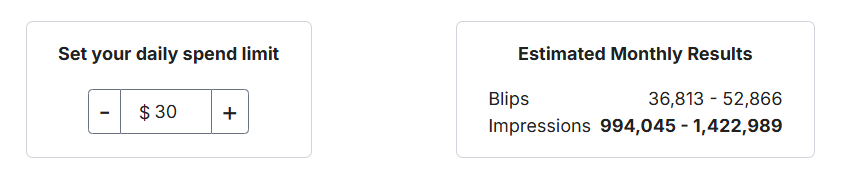
With Blip, billboard advertising in Immokalee can fit a range of budgets because you only pay when your ad actually displays. Each “blip” is a 7.5-to-10-second spot on a rotating digital billboard, and pricing starts at $0.01 per display. Your daily budget tells Blip’s algorithm how to bid for open ad slots, so your spend is guided toward the best available opportunities.
Where can I advertise with Blip in Immokalee to reach local and regional drivers?
State Road 29 through central Immokalee generally places traffic in the 15,000 to 20,000 AADT range, making it a strong choice for dependable local frequency. Immokalee Road connects to Ave Maria, Interstate 75, and North Naples, and nearby I-75 segments are commonly above 100,000 vehicles per day. These corridors let advertisers reach both local residents and regional travelers.
Who can I reach with Blip billboard ads in Immokalee?
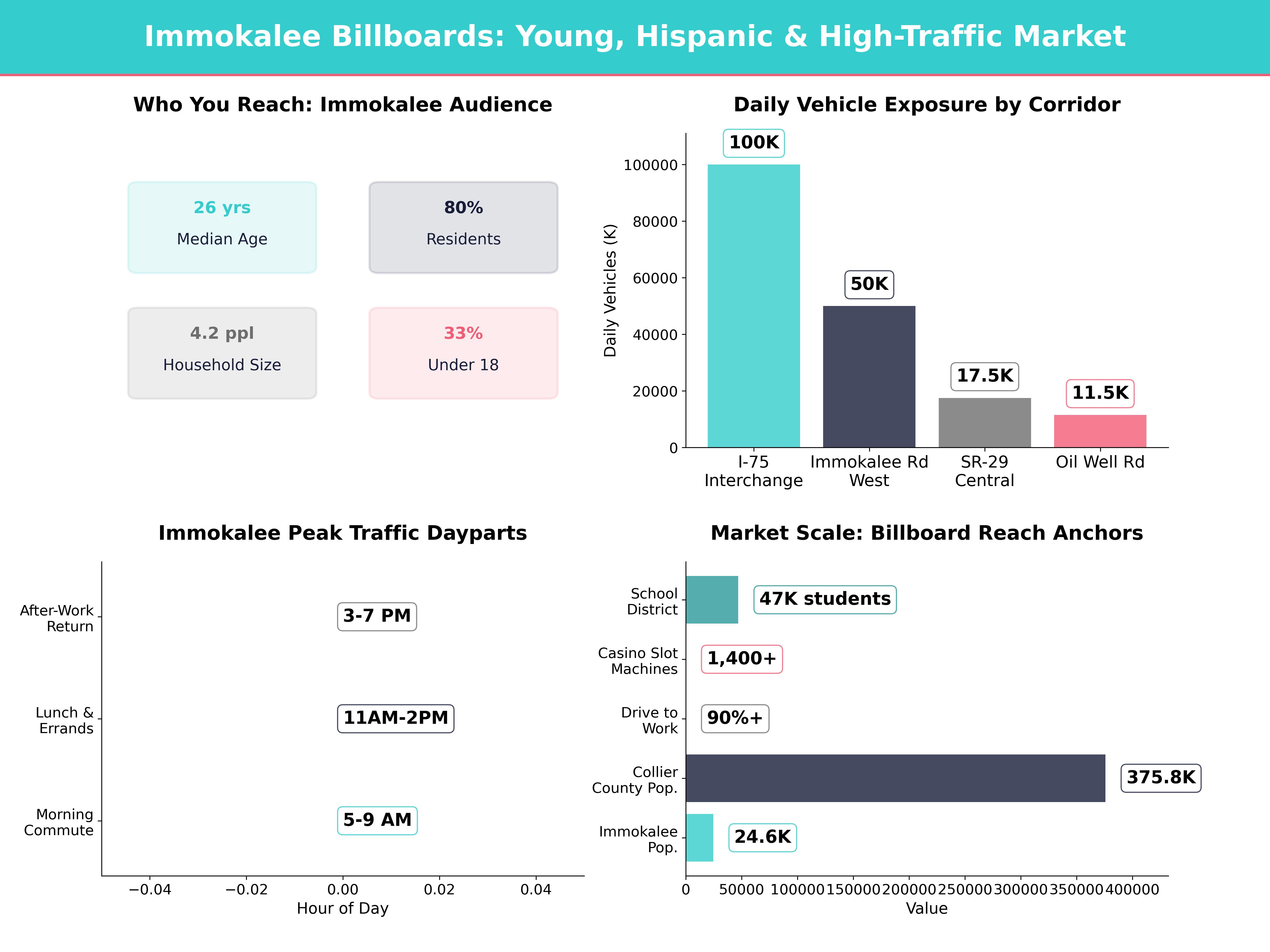
Immokalee is a family-oriented market with roughly 1 in 3 residents under 18, a median age of about 26, and average household size above 4. Roughly 4 in 5 residents identify as Hispanic or Latino, so language choice and visual tone matter. The market also includes workers, shoppers, students, visitors, and entertainment traffic from across Southwest Florida.
When is the best time to run billboard ads in Immokalee with Blip?
Morning messaging often performs best from about 5:00 to 9:00 a.m., and afternoon return traffic often performs best from about 3:00 to 7:00 p.m. Late fall through spring is especially important in Immokalee’s farm economy, and a practical campaign window is November through April. Southwest Florida’s strongest visitor window generally runs from January through April.
Why is Immokalee a good market for Blip digital billboards?
Immokalee gives us a rare Southwest Florida advertising mix: a resident population of 24,557 people, a broad agricultural trade area, and steady regional traffic flowing between inland communities and coastal Collier County. More than 90% of workers in Collier County commute by personal vehicle when driving alone and carpooling are combined, so billboards build frequency very quickly. The market is active outside the standard office day, which makes scheduling especially useful.
Do I need a contract to advertise with Blip in Immokalee?
No, Blip has no long-term contracts or minimum commitments. You can start, pause, or stop your campaign at any time.
How fast can I launch a billboard campaign with Blip in Immokalee?
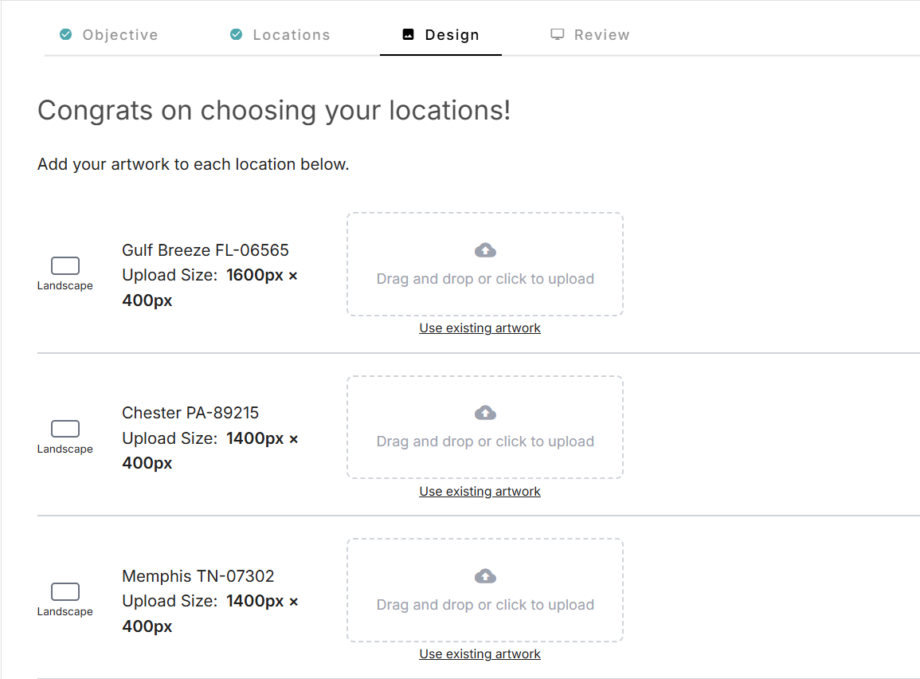
You can have your campaign live in minutes. Create a free account, select your locations, set your budget, upload your design, and start running once approved.
Where can I advertise with Blip in Immokalee?
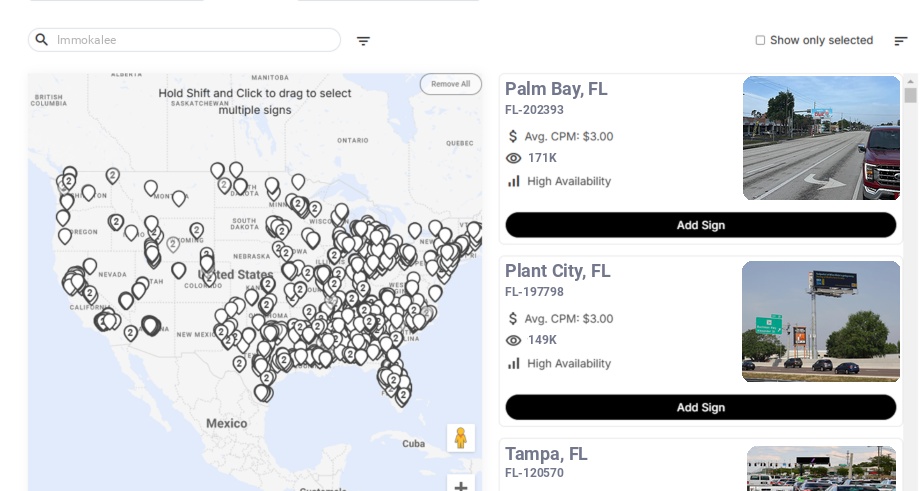
Blip has digital billboards in Immokalee. You can browse available locations on a map, choose the ones that fit your audience, and start advertising right away.
Still have questions? Launch a campaign in minutes — no contracts, no commitments.
Start Your CampaignImmokalee Billboard Advertising Guide
Immokalee gives us a rare Southwest Florida advertising mix: a resident population of 24,557 people, a broad agricultural trade area, and steady regional traffic flowing between inland communities and coastal Collier County. While the community itself is smaller than nearby Naples 321,520 residents in 2010 to 375,752 in 2020, which is a gain of 16.9%. Daily life here is highly car-oriented, and the main travel patterns are concentrated on a limited number of roads, which makes billboard advertising unusually efficient. We also benefit from year-round local demand, seasonal farm activity, casino traffic, and visitors moving through eastern Collier County toward inland destinations.
Immokalee Market Overview
Immokalee is an unincorporated community, but it functions like a regional hub for eastern Collier County and parts of neighboring Hendry County. When we advertise here, we are not speaking only to the town itself. We are also reaching workers, shoppers, students, and visitors who use Immokalee as a service center.
Demographics and Growth in Immokalee
Immokalee’s population increased from 24,154 in 2010 to 24,557 in 2020, which is modest growth of about 1.7%. That slower local growth does not make the market weak. It actually means we should think of Immokalee as a stable core inside a faster-growing region, because the surrounding county expanded much more quickly over the same decade.
The community is notably family-oriented. Local demographic profiles indicate that roughly 1 in 3 residents is under 18, median age is about 26, and average household size is above 4, at roughly 4.2 people per household. For advertisers, that supports strong demand for grocery, wireless, healthcare, dental, school services, discount retail, auto repair, and family dining.
Immokalee is also culturally distinct from coastal Collier County. Roughly 4 in 5 residents identify as Hispanic or Latino, which means language choice and visual tone matter. We usually get better traction here when we plan English and Spanish creative from the start, rather than treating Spanish as an afterthought.
Economy, Employment, and Mobility Around Immokalee
The local economy is anchored by agriculture, food packing, logistics, education, healthcare, gaming, and community services. Organizations such as the Coalition of Immokalee Workers, The Immokalee Foundation, Healthcare Network, Collier County Public Schools, and the Seminole Tribe of Florida all reflect how important Immokalee is as both a workforce center and a community center.
Mobility patterns strongly favor outdoor advertising. Local planning data used by the Collier Metropolitan Planning Organization 90% of workers in Collier County commute by personal vehicle when we combine driving alone and carpooling. In a place where most errands, school trips, and work trips happen on a few repetitive routes, billboards build frequency very quickly.
We should also remember that the market is active outside the standard office day. Agricultural and service shifts often start before 6:00 a.m., school and family traffic builds again in the afternoon, and casino activity extends into the evening. That broader daily window makes scheduling especially useful in Immokalee.
Key Traffic Corridors for Immokalee
Immokalee’s travel pattern is simple in the best possible way. Instead of dozens of interchangeable roads, we can focus on a handful of corridors that repeatedly capture the same audiences.
State Road 29 Through Immokalee
Florida Department of Transportation traffic counts through central Immokalee generally place State Road 29 in the 15,000 to 20,000 AADT range, depending on the segment. For a rural inland market, that is meaningful volume with excellent repetition.
This is the road we should prioritize when we want dependable local frequency. State Road 29 works especially well for the following advertiser categories.
- Quick-service restaurants, c-stores, and grocers perform well here because drivers are making habitual daily trips and can act quickly.
- Healthcare, urgent care, dental, vision, and pharmacy brands perform well here because families repeatedly pass the same service clusters.
- Staffing firms, legal services, tax preparation, insurance, and wireless providers perform well here because the corridor carries core working-age residents.
Because SR 29 cuts through the center of local life, it is usually better for practical offers than for abstract branding alone. We tend to get stronger results when we show a clear benefit, a price point, or a direct call to visit.
County Road 846, Immokalee Road, and the Westbound Funnel
Immokalee Road is the east-west spine that links Immokalee to Ave Maria, Interstate 75, and the larger consumer base in North Naples. On busier western segments closer to I-75 and coastal development, FDOT counts rise into the 40,000 to 50,000+ AADT range.
That matters because Immokalee Road does two jobs at once. It serves local residents traveling into town, and it also carries destination traffic between inland Collier County and wealthier coastal areas. When we want to pull customers from outside Immokalee itself, this corridor is usually our best option.
Immokalee Road is especially strong for the following use cases.
- Destination retail and healthcare benefit because the road connects inland households to major service centers, including providers tied to NCH Healthcare System and other regional medical networks.
- Automotive, home services, and furniture benefit because drivers are often making longer planned trips and are willing to travel for value.
- Education, events, and attractions benefit because the corridor reaches both residents and visitors moving between communities.
Interstate 75 and Exit 111 for Regional Reach
The Immokalee Road interchange at Exit 111 gives us access to one of Southwest Florida’s highest-volume routes. FDOT counts on nearby I-75 segments are commonly above 100,000 vehicles per day. That is a very different advertising environment from in-town Immokalee, because here we are reaching regional travelers rather than only local repeat commuters.
This corridor is ideal when we want reach beyond the community itself. We can use it to pull traffic from Naples Lee County, and the larger Paradise Coast visitor market.
The best fits here usually include the following categories.
- Casinos, hotels, and entertainment benefit because they can intercept discretionary travelers before plans are finalized.
- Large healthcare systems, colleges, and regional employers benefit because the audience extends well beyond one town.
- Attractions, events, and tourism brands benefit because I-75 carries weekend and seasonal visitors who may be open to detours.
Oil Well Road, Ave Maria Connections, and Airport Approaches
Secondary regional routes matter in Immokalee because they deliver highly targeted audiences, even when total traffic is lower. Corridors such as Oil Well Road and approaches tied to Immokalee Regional Airport 8,000 to 15,000 AADT range rather than I-75 scale volumes, but they reach audiences with clear intent.
The Collier County Airport Authority 5,000 feet and a secondary runway of 4,000 feet. That makes the airport area relevant for aviation services, industrial suppliers, logistics, training, and business travel messaging.
When we use these lower-volume corridors, we should lean into specificity. A narrower audience with a strong need is often more valuable than a broader audience with weak intent.
Audience Segments We Can Reach in Immokalee
Immokalee works best when we stop thinking in terms of one generic “local consumer.” The market is made up of several overlapping audiences, and each responds to a different message.
Commuters, Shift Workers, and the Everyday Driving Audience
Because more than 90% of county commuters rely on cars, trucks, or carpools, commuter-facing billboard inventory stays relevant all year. In Immokalee, many workdays begin early. Morning messaging often performs best from about 5:00 to 9:00 a.m., and afternoon return traffic often performs best from about 3:00 to 7:00 p.m.
This audience responds well to utility. We usually do best with messages about breakfast, fuel, banking, mobile service, same-day healthcare, discount retail, and after-work errands. Long explanations are less useful than short promises.
Families, Students, and Household Decision-Makers
Immokalee’s family profile is one of its biggest advertising advantages. With about 1 in 3 residents under 18 and household size above 4, one purchase decision often influences several people at once.
The broader Collier County Public Schools district serves about 47,000 students, which reinforces how important the school calendar is to campaign timing. Family-focused advertisers should think about enrollment periods, sports seasons, teacher workdays, report card periods, and back-to-school shopping windows.
This segment is a strong fit for the following categories.
- Pediatric, dental, vision, and family healthcare brands benefit because repeat family needs create year-round demand.
- Wireless, grocery, discount retail, and fast casual dining brands benefit because household purchases are frequent and visible.
- Tutoring, college recruiting, trade schools, and financial services brands benefit because parents and students are both part of the decision cycle.
Nearby institutions such as Florida SouthWestern State College and Ave Maria University also add educational traffic to the regional mix, especially along the east-west routes.
Visitors, Entertainment Seekers, and Recreation Travelers
Immokalee’s visitor audience is larger than many advertisers expect. Seminole Casino Hotel Immokalee 1,400 slot machines, which gives the area a steady flow of entertainment traffic from across Southwest Florida. That audience is especially valuable for restaurants, hotels, nightlife, events, and premium services.
Nature and recreation also matter. Corkscrew Swamp Sanctuary is home to a 2.25-mile boardwalk across about 13,000 acres of protected wetlands, and the wider Naples, Marco Island, Everglades Convention and Visitors Bureau market continually promotes the region’s outdoor identity. We can use billboard placements on regional approaches to capture ecotourists, day-trippers, and winter visitors looking for something beyond the beach.
Civic, Healthcare, and Community-Service Audiences
Immokalee is a place where trusted institutions carry weight. Campaigns from community-facing organizations, hospitals, clinics, education providers, churches, nonprofits, and legal services often work well because they address immediate needs and high-frequency concerns.
When we advertise in a market with strong organizations such as Healthcare Network, The Immokalee Foundation, the Greater Naples Chamber, and Collier County, credibility matters. The creative should feel useful and local, not distant and overly polished.
Seasonal and Timing Opportunities in Immokalee
Immokalee is active year-round, but our timing should still follow the rhythms of agriculture, schools, tourism, and weather.
Harvest Season and Agricultural Timing in Immokalee
Late fall through spring is especially important in Immokalee’s farm economy. A practical campaign window is November through April, when field, packing, transport, and related service activity tends to be strongest.
For advertisers selling workwear, food service, legal services, banking, trucks, tires, wireless plans, or healthcare access, this is often the best sustained period for consistent billboard activity. Early morning and late afternoon dayparts are usually the most relevant.
Winter Visitor Season and Regional Travel
Southwest Florida’s strongest visitor window generally runs from January through April, when seasonal residents and tourists swell demand across the region. Even though many visitors stay closer to the coast, Immokalee benefits from spillover traffic related to gaming, day trips, events, and inland attractions.
This is when we should lean harder into casino entertainment, weekend dining, events, ecotourism, and destination retail. If our business can draw from Naples or regional visitor traffic, winter is usually the time to push.
School Calendar, Local Events, and Family Demand
The school year creates predictable buying moments. We should plan around back-to-school in August, holiday programming in November and December, and family activity spikes during spring events such as the Collier County Fair, which is typically held in March.
Retailers, medical providers, youth programs, and community organizations usually benefit from flighting campaigns around those moments rather than running the exact same message all year.
Weather Patterns and Storm-Related Messaging
Southwest Florida weather also shapes billboard strategy. The Atlantic hurricane season runs from June 1 through November 30, and the wetter summer pattern often creates urgency for roofing, restoration, flood mitigation, tire shops, urgent care, and generator-related services.
In the rainy season, we should simplify creative even more. Stormy conditions reduce reading time, so short headlines and strong contrast become even more important.
Billboard Design Tips for the Immokalee Market
Good billboard design in Immokalee is not just about legibility. It is about cultural fit, route fit, and audience fit.
Use Language That Matches the Community
Because roughly 4 in 5 residents are Hispanic or Latino, Spanish-language or bilingual creative often feels more natural than English-only messaging. In some cases, Haitian Creole versions can also be useful for specific service categories and placements.
We usually recommend testing at least two versions of the same campaign. One version should lead with English and support with Spanish. One version should lead with Spanish and support with English.
This approach helps us learn whether language order changes response without changing the offer itself.
Prioritize Utility Over Abstraction
Immokalee responds well to practical value. Messages like “same-day appointments,” “walk-ins welcome,” “open late,” “cash for phones,” “free estimate,” or “2 miles ahead” usually outperform vague brand slogans.
That does not mean the creative should look cheap. It means the message should solve a real problem quickly. On roads where drivers are moving at highway speed, a headline of about 6 words or fewer is usually the safest choice.
Match the Visual Style to the Corridor
We should not use the exact same visual tone on every route. On SR 29, everyday local imagery often works best. Family scenes, food, healthcare, work gear, and straightforward pricing fit the context.
On Immokalee Road westbound toward Naples, slightly more polished creative can work because the audience includes destination shoppers and higher-income coastal traffic. On casino and evening-oriented routes, darker palettes, gold accents, nightlife imagery, and event-driven urgency can be effective.
Design for Bright Sun, Rain, and Distance
Immokalee drivers often encounter billboards in intense sunlight, summer haze, and sudden rain. We should use high-contrast color combinations, bold sans-serif type, and one dominant visual. Deep green, orange, yellow, white, red, and black all tend to read well in this environment when used cleanly.
If a location is meant to drive immediate action, we should include one clear instruction, such as a turn direction, a distance marker, or a short URL. Route-based guidance is especially powerful in a market where many trips are intentional and repeatable.
Regional Strategies Around Immokalee
The smartest Immokalee campaigns treat the area as a set of sub-markets rather than one uniform zone.
Immokalee Town Core and SR 29 Strategy
In the town core, we should focus on frequency and familiarity. These placements are ideal for brands that want to become part of everyday routines, including grocery, telecom, healthcare, local retail, legal services, banks, and quick-service restaurants.
If our goal is weekly repetition, the town core is often better than chasing only the biggest traffic number.
Westbound Immokalee Road Toward I-75 and Naples
This is the strategy we should use when we need to draw from a wider radius. The westbound corridor helps us reach residents heading toward Naples I-75, and consumers with more destination-oriented shopping behavior.
This area is especially effective for the following objectives.
- Regional healthcare recruitment and patient acquisition can work well here.
- Furniture, home improvement, automotive, and higher-ticket retail can work well here.
- Events, attractions, and casino promotions can work well here.
Ave Maria, Airport, and Eastern Growth Pocket
The eastern side of the market deserves its own plan. Ave Maria, Ave Maria University, and airport-related traffic create a different audience profile than central Immokalee. We should think more about education, healthcare, dining, housing, home services, faith-based organizations, and business services here.
This is also a good area for niche campaigns that would be wasted on a broad coastal buy.
Cross-County Reach Into Hendry and Lee
Immokalee’s trade area extends beyond Collier County lines. Consumers move between Immokalee, LaBelle, parts of Hendry County, and inland sections connected to Lee County. For some advertisers, especially healthcare, legal services, staffing, and auto categories, that cross-county audience is part of the opportunity.
When we build these campaigns, we should use messaging that feels regionally relevant rather than hyperlocal to one neighborhood.
Using Blip Tools to Win in Immokalee
Immokalee is a strong match for Blip because the market rewards timing, testing, and route-specific creative more than massive fixed commitments.
Dayparting for Real Immokalee Travel Patterns
We can align schedules with how the community actually moves. We can emphasize 5:00 to 9:00 a.m. for work-bound traffic. We can emphasize 11:00 a.m. to 2:00 p.m. for lunch, errands, and service visits.
We can emphasize 3:00 to 7:00 p.m. for after-school and after-work trips. We can emphasize Friday and Saturday evenings for casino, dining, and entertainment demand.
That level of timing control is useful in a market where commute, shift, and leisure windows are very different from one another.
Flexible Testing Across Corridors
Instead of guessing which route will carry the best audience, we can test central Immokalee, westbound Immokalee Road, and I-75-oriented inventory separately. Real-time reporting helps us see whether a campaign is winning because of local frequency or regional reach.
In a place like Immokalee, that matters. A local service provider may learn that SR 29 performs best, while an event promoter may learn that I-75 traffic is worth the premium.
Fast Creative Rotation for Language and Season
Blip also makes it easy for us to rotate English and Spanish versions, swap seasonal offers, or refresh creative around school registration, harvest peaks, the Collier County Fair, or casino event calendars. We do not need to lock one message in place for months just because the market is smaller.
Getting Started with Billboard Rental in Immokalee
Renting a billboard in Immokalee starts with a simple question: are we trying to reach local repeat drivers, regional travelers, or both? Once we answer that, the map becomes much easier to read.
What to Expect in the Immokalee Market
Immokalee is not a market with endless interchangeable billboard options. Inventory tends to matter most on the core commuter and gateway roads, which is actually an advantage. A few well-chosen locations can do a lot of work when the audience uses the same routes every day.
We should expect digital inventory to be concentrated where traffic is concentrated, especially near the town core, the major east-west approaches, and regional connectors.
How We Should Evaluate Locations
We should judge each location on five factors. We should ask whether the board reaches local frequency or regional reach. We should confirm the direction of travel and whether it matches our customers’ route.
We should consider whether the audience is moving at town speed or highway speed. We should check whether the location is close enough to act on, especially if our goal is store visits. We should match the board to the right daypart instead of assuming every hour is equally valuable.
For directional campaigns, the best billboard is often the last clean reminder within 1 to 5 miles of the destination. For awareness campaigns, the best billboard is often the one with the steadiest repeated exposure.
A Practical Way to Launch
For many advertisers, a smart starting plan is to launch on 2 or 3 boards for 2 to 4 weeks, split across one local corridor and one regional corridor. That gives us enough data to compare message, timing, and route performance without overcommitting.
From there, we can optimize quickly. If local traffic is converting, we can weight toward SR 29 or town-core inventory. If broader reach is producing stronger results, we can add westbound Immokalee Road or I-75-facing exposure.
Why Blip Simplifies Immokalee Billboard Buying
Traditional outdoor buying can be slow, rigid, and hard to test in a market like this. Blip makes Immokalee easier because we can review locations on a map, choose the times that fit our audience, update creative when seasons change, and keep budgets aligned with actual performance.
That flexibility is valuable here because Immokalee is not a one-note market. It is a family market, a worker market, a regional pass-through market, and an entertainment market all at once. When we use the roads, seasons, and audience segments correctly, billboards in Immokalee can be both efficient and surprisingly versatile.