Billboards near Key Biscayne, FL
No Minimum Spend. No Long-Term Contracts. Just Results.
Trusted by Leading Brands


Billboard advertising
near Key Biscayne has never been easier




How much is a billboard near Key Biscayne?
Why Choose Blip for Billboard Advertising near Key Biscayne
Blip lets you launch fast in Key Biscayne and reach Rickenbacker Causeway commuters without long contracts.
Set flexible budgets in Key Biscayne, Florida and focus spend on I-95, I-395, and MacArthur Causeway rush hours.
Use Blip dayparting in Key Biscayne to catch weekday pros, weekend beachgoers, and winter tourists.
Track real-time results on Key Biscayne campaigns and shift bids as traffic changes between Brickell and Miami Beach.
Blip creative tools help you tailor Key Biscayne ads for affluent, bilingual audiences heading to Crandon Park or Bill Baggs.
Frequently Asked Questions About Billboard Advertising near Key Biscayne
How much does a billboard cost near Key Biscayne, Florida with Blip?
With Blip, you choose your own daily budget and pay only for the individual 7.5–10 second blips your ad receives on digital Key Biscayne billboards serving the Key Biscayne area. The price of billboards near Key Biscayne, Florida changes based on the time of day, location, and advertiser demand, but you’ll never pay more than your daily limit. That makes it easy to start small, test what works, and then scale up.
Where can I advertise near Key Biscayne, Florida with Blip?
There are 27 digital billboards near Key Biscayne, located in Miami and Miami Beach within about 10 miles. The best strategy is to dominate the paths people take to and from the island with billboards near Key Biscayne that sit on the highest-volume approach routes. Major corridors like I-95, I-395, and feeder routes into Brickell and downtown Miami are especially important.
What kind of audience do Key Biscayne, Florida billboards reach?
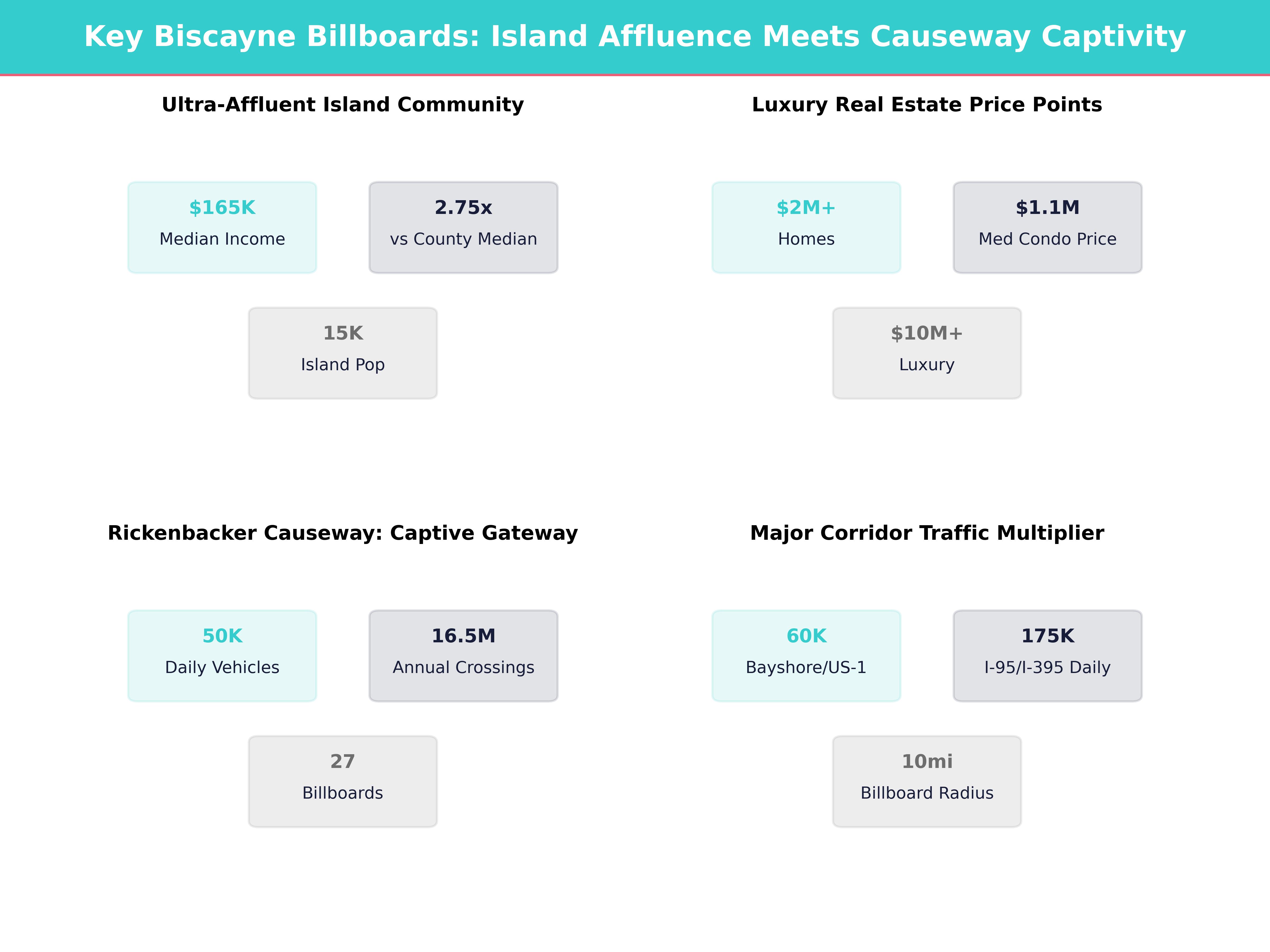
The Key Biscayne area offers advertisers a rare mix of affluent residents, international visitors, and daily commuters. The village has a resident population of roughly 15,000 people and a very high median household income around $160,000–$170,000. A strong Hispanic/Latino presence and a large international expat population also shape the audience.
When should I run billboard ads near Key Biscayne, Florida with Blip?
Digital buys near Key Biscayne work best when they align with local rhythms, and Blip lets you set time windows for when ads run. Weekday peaks include the morning commute, the school and activities window, and the evening leisure window. Weekend daytime and holiday peaks are also strong because of recreation traffic, tourism, and seasonal visitors.
Do I need a contract to advertise with Blip near Key Biscayne?
No, Blip has no long-term contracts or minimum commitments. You can start, pause, or stop your campaign at any time.
How fast can I launch a billboard campaign with Blip near Key Biscayne?
You can have your campaign live in minutes. Create a free account, select your locations, set your budget, upload your design, and start running once approved.
Where can I advertise with Blip near Key Biscayne?
Blip has digital billboards near Key Biscayne. You can browse available locations on a map, choose the ones that fit your audience, and start advertising right away.
Still have questions? Launch a campaign in minutes — no contracts, no commitments.
Start Your CampaignKey Biscayne Billboard Advertising Guide
Surrounded by water, parks, and some of South Florida’s most luxurious neighborhoods, the Key Biscayne area offers advertisers a rare mix of affluent residents, international visitors, and daily commuters. With 27 digital billboards near Key Biscayne—located in Miami and Miami Beach within about 10 miles—we can help brands reach this concentrated, high-value audience with flexible, data-driven campaigns. For brands comparing different Key Biscayne billboards and approaches, this network makes it easy to scale up or down without sacrificing reach.
Understanding the Key Biscayne Area Market
Key Biscayne is a barrier-island community southeast of downtown Miami, connected to the mainland by the Rickenbacker Causeway. According to the Village of Key Biscayne and recent demographic estimates, the village has:
- A resident population of roughly 15,000 people, with official village estimates typically in the 14,500–15,000 range.
- A very high median household income around $160,000–$170,000, more than 2.5–3 times higher than the Miami-Dade County median, placing the village among the highest-income communities in South Florida.
- A strong Hispanic/Latino presence (around two-thirds, or 65–70% of residents), alongside a large international expat population—with many residents originating from countries such as Brazil, Venezuela, Argentina, Colombia, and various European nations.
Real estate and cost-of-living indicators underscore the area’s spending power:
- Typical single-family home values on Key Biscayne often exceed $2 million, and luxury waterfront properties can surpass $10 million, while median condo prices generally hover in the $900,000–$1.3 million range, according to recent South Florida real estate market reports frequently covered by the Miami Herald Local 10 News.
- Homeownership rates in the village are close to 70–75%, significantly above many nearby Miami neighborhoods, indicating a stable, invested residential base.
Key Biscayne is also heavily influenced by regional factors from nearby Miami:
- Miami-Dade County's population exceeds 2.7 million residents, with more than 6 million in the broader South Florida metro area.
- The Greater Miami and Miami Beach tourism market hosted roughly 26–27 million visitors in a recent year, including more than 15 million overnight visitors and over 10 million day visitors, generating an estimated $20–21 billion in direct visitor spending and supporting well over 150,000 tourism-related jobs (Greater Miami Convention & Visitors Bureau).
- Tourism and hospitality contribute more than $1 billion annually in local taxes, which helps fund infrastructure and parks that attract even more visitors to the Key Biscayne area.
- Major employment centers in downtown Miami, Brickell, Coral Gables, and Miami Beach—where office vacancy rates, new construction, and professional services growth are consistently tracked by local outlets like the Miami Herald—drive intense daily traffic flows that include many Key Biscayne area residents and visitors.
For advertisers, this means that well-placed digital billboards near Key Biscayne can reach:
- High-income island residents with above-average disposable income for categories like luxury retail, real estate, private education, and healthcare.
- Families and athletes heading to Crandon Park and Bill Baggs Cape Florida State Park, which together attract hundreds of thousands of annual visitors and recreation users ( Crandon Park – Miami‑Dade Parks Bill Baggs Cape Florida State Park – Florida State Parks
- Tourists staying in Brickell, downtown Miami, and Miami Beach who visit Key Biscayne’s beaches, parks, and resorts—part of a regional lodging market that often exceeds 75–80% average hotel occupancy during peak winter and event seasons, according to reports highlighted by the Greater Miami Convention & Visitors Bureau and local business media such as the South Florida Business Journal
- Professionals commuting between the island and major business districts, with local transportation data showing that a majority of Key Biscayne residents—often 70% or more—use personal vehicles for daily commuting, making roadside media and billboard advertising near Key Biscayne particularly effective.
By leveraging our 27 digital billboards serving the Key Biscayne area, we can tap into these overlapping audiences with precise geographic and time-of-day controls, aligning spend with the tens of thousands of daily impressions moving between the island and the mainland.
Traffic Patterns and Where to Focus Impressions
There are no billboards on Key Biscayne itself, so the strategy is to dominate the paths people take to and from the island with billboards near Key Biscayne that sit on the highest-volume approach routes.
Key Connection: Rickenbacker Causeway
The Rickenbacker Causeway is the only road link to the island, funneling virtually all vehicle traffic. Florida Department of Transportation (FDOT) traffic counts along the causeway typically show around 45,000–55,000 vehicles per day on key segments, with weekday traffic driven by commuters, school runs, and service trips, and weekend traffic surging with beach- and park-goers. Over the course of a month, this equates to roughly 1.3–1.6 million vehicle trips, and well over 15–18 million annual crossings. You can explore regional traffic data through FDOT District Six Miami‑Dade Transportation Planning Organization.
We recommend focusing impressions on nearby corridors that feed causeway traffic:
- South Bayshore Drive / US-1 access points near Coconut Grove and Brickell, which can see 50,000–70,000 vehicles per day on adjoining segments of US‑1.
- I-95, I-395, and MacArthur Causeway corridors that connect downtown, Brickell, and Miami Beach, where key sections routinely carry 150,000–200,000+ vehicles daily, according to FDOT and county traffic monitoring summaries from agencies such as the Miami-Dade Department of Transportation and Public Works.
- Major arterials in Miami and Miami Beach within 8–10 miles of Key Biscayne where our boards are located, many of which individually deliver tens of thousands of daily impressions each.
These locations let us intercept:
- Residents leaving the island for work or shopping—often multiple trips per day per household, given that Key Biscayne’s average household size is close to 2.6–2.8 people.
- Visitors coming from hotels in Brickell, downtown Miami, and Miami Beach—areas that collectively host more than 55,000–60,000 hotel rooms.
- Locals choosing between different beach and recreation options, including Key Biscayne, Miami Beach, Virginia Key, and local marinas, where well-placed Key Biscayne billboards can influence last-minute decisions.
By adjusting bids and budgets in Blip, brands can prioritize billboards closest to causeway feeder routes during key travel periods, maximizing exposure during windows that routinely account for 40–50% of daily traffic volumes.
When to Run: Dayparting Around Island Routines
Digital buys near Key Biscayne work best when they align with local rhythms. Because we can set time windows for when ads run, we can align your spend with high-value viewing moments.
Local traffic and mobility studies in Miami-Dade County routinely show clear AM and PM peaks, with roughly 60–65% of weekday trips concentrated in morning and late-afternoon/evening windows. The Key Biscayne corridor behaves similarly, with pronounced spikes linked to office hours, school schedules, and recreation.
Weekday Patterns
-
Morning commute (6:30–9:30 a.m.)
- Many Key Biscayne area residents are professionals commuting to Brickell, downtown Miami, or Coral Gables—districts that together host hundreds of thousands of jobs in finance, law, healthcare, and tech.
- In many Miami core corridors, 30–35% of daily vehicle volume passes during the AM peak.
- This is prime time for financial services, B2B, education, healthcare, and luxury auto campaigns.
-
School and activities window (2:00–5:00 p.m.)
- Families traveling to schools, tutoring, sports, and after-school programs both on and off the island. Local private and charter schools in the broader urban core enroll tens of thousands of students, and traffic around dismissal can spike 10–20% above mid-day baselines on nearby arterials.
- Ideal for family-oriented services, enrichment, kids’ healthcare, and local retail.
-
Evening leisure window (5:00–8:30 p.m.)
- Residents heading back over the causeway, plus those going out in Brickell, Wynwood, or Miami Beach. Evening peaks often account for 30–40% of daily traffic on key expressways like I‑95 and I‑395.
- Perfect for restaurants, entertainment, fitness, and e-commerce retargeting messages (“Seen us online? Visit tonight.”).
Weekend and Seasonal Spikes
-
Weekend daytime (9:00 a.m.–5:00 p.m.)
- Heavy recreation traffic to Crandon Park, Bill Baggs Cape Florida State Park, beaches, marinas, and cycling routes. Key Biscayne’s park and beach assets are consistently listed among Miami-Dade’s most-visited coastal parks, with peak-season weekends drawing thousands of cars per day into parking areas alone (Miami‑Dade Parks, Recreation and Open Spaces).
- Strong use cases: tourism attractions, food delivery, beachwear, boating, real estate, and high-end consumer goods that can benefit from highly visible billboard advertising near Key Biscayne.
-
Holiday peaks
- Long weekends (Memorial Day, Labor Day, 4th of July), winter high season (December–March), and spring break bring surges of domestic and international visitors, especially from Latin America and Europe. During marquee periods like New Year’s, Miami hotel occupancy can exceed 90%, and passenger volumes at Miami International Airport regularly surpass 120,000–140,000 travelers per day, according to the Miami‑Dade Aviation Department.
- We can increase bids or budgets for these windows, then scale back during shoulder seasons, something that’s simple to manage with Blip.
-
Weather-responsive messaging
- Miami’s summer rainy season typically runs from May through October, when afternoon thunderstorms are frequent and average monthly rainfall can exceed 7–9 inches. Winter months tend to be drier, with many days of clear skies and temperatures in the 70s°F (low 20s°C).
- For example, run creative like “Rainy afternoon? Order in instead” on summer storm-prone afternoons, or “Perfect beach day—visit us before you hit the sand” during clear weekend mornings, leveraging weather triggers or simple calendar-based rules.
Audience Insights: Who You Reach Near Key Biscayne
The Key Biscayne area skews affluent, international, and family-oriented:
- Median age hovers around the low 40s (roughly 41–43), with a mix of young families and established professionals.
- Median home values are typically well above $1 million, with many estimates placing the median around $1.2–$1.4 million, reflecting a high disposable income audience.
- A large share of residents are foreign-born—often 50% or more—with strong ties to Latin America and Europe and frequent international travel via Miami International Airport.
- Spanish is widely used alongside English in daily life and business; in many Miami-Dade communities, over 70% of residents speak a language other than English at home, and the Key Biscayne area reflects this bilingual norm.
Implications for your campaign:
- Bilingual messaging is powerful. Consider English + Spanish creative, or alternate between language versions via multiple Blips. In practice, campaigns that local media and agencies report as bilingual in South Florida often achieve higher recall and engagement among Hispanic segments than English-only messaging.
- Premium positioning. Focus on goods and services with higher margins—luxury retail, private schools, specialty healthcare, financial services, real estate, marine services, and high-end hospitality—categories that historically capture a large share of discretionary spending in affluent coastal communities.
- International brand recognition. Many residents and visitors are familiar with global brands. Use brand assets and taglines consistent with Latin American and European campaigns where appropriate, particularly during peak international visitation months (often November–April).
Local media such as the Miami Herald and WLRN public media regularly profile South Florida’s economic trends, real estate, and tourism. Reviewing their coverage—as well as reporting from outlets like NBC 6 South Florida and WSVN 7 News—can help refine which audience segments we target and when to emphasize certain products or services.
Crafting Effective Creative for the Key Biscayne Area
Because our boards serving the Key Biscayne area are on busy Miami and Miami Beach corridors, ads must stand out amid heavy visual competition. Many of these corridors carry 100,000+ vehicles per day, meaning a single well-designed digital execution can generate hundreds of thousands to millions of weekly impressions depending on rotation and budget. This makes them ideal placements when you want Key Biscayne billboards that consistently reach both residents and visitors.
Visual and Message Strategy
-
Lead with imagery that matches the lifestyle.
- Beaches, marinas, sailing, tennis, golf, cycling, and waterfront dining. Key Biscayne’s coastline provides over 5 miles of beaches and shoreline, and nearby marinas host hundreds of boat slips, reinforcing a boating and outdoor lifestyle.
- Clean, upscale visuals signal that your brand belongs in this environment.
-
Prioritize ultra-clear hierarchy.
- 1 main message, 1 visual, 1 strong call to action.
- Use large, high-contrast fonts; avoid more than 7–10 words total when possible to account for 3–6 seconds of typical roadside viewing time at urban driving speeds.
-
Local relevance hook.
-
Examples:
- “Minutes from the Rickenbacker Causeway”
- “Your Key Biscayne neighbor for luxury auto care”
- “Brickell location—on your way to the island”
- Local references can increase perceived relevance, which industry studies often associate with double-digit lifts in ad recall compared to generic copy.
-
Examples:
-
Use Spanish selectively but strategically.
- Run variant creatives: English during work commute windows, Spanish-heavy creatives during weekends or evening leisure periods, reflecting Miami’s 60%+ Hispanic/Latino population.
- Or alternate languages on the same board across different Blips to see which gets better response (measured via web traffic, promo codes, or inquiry volume).
-
High-end aesthetics.
- Understated color palettes, sophisticated typefaces, and elegant photography align with local expectations for premium brands, particularly in markets where median household incomes exceed $150,000.
Tailoring Creative to Time and Audience
-
Morning (professionals):
- “Private banking for your global lifestyle. Brickell & Key Biscayne area.”
- “Concierge healthcare with same-day appointments. Call before 10 a.m. for today.”
- Align these creatives to the 6:30–9:30 a.m. window when commuter volumes can be 30%+ higher than mid-day baselines.
-
Afternoon (families):
- “After-school tutoring 10 minutes from the causeway.”
- “Enroll at [School Name]—top-rated programs for K–12 near the Key Biscayne area.”
- Target 2:00–5:00 p.m. when school dismissals and youth programs boost short-trip traffic.
-
Weekend (visitors & leisure):
- “Boat rental today? Reserve your slip before you reach the island.”
- “Brunch with an ocean view—free valet this weekend.”
- Emphasize availability, reservations, and offers during 9:00 a.m.–2:00 p.m. on Saturdays and Sundays when leisure trips dominate.
By loading multiple creatives into your Blip campaign, we can rotate messages based on time-of-day and day-of-week, maximizing relevance without increasing production costs and turning a single board into several context-specific messages throughout the week.
Using Blip’s Flexibility for the Key Biscayne Area
Blip’s platform is especially well-suited to a market like the Key Biscayne area because we can adjust where, when, and how much you advertise with a high level of precision. This creates a flexible alternative to traditional billboard rental near Key Biscayne, which often requires long, fixed contracts on a single face.
Geographic Targeting
- Target our 27 digital billboards located within about 10 miles of Key Biscayne, in Miami and Miami Beach, to intercept residents and visitors on their way to and from the island.
- Emphasize boards on major corridors like I-95, I-395, and feeder routes into Brickell and downtown Miami to catch Key Biscayne commuters; these roads together handle hundreds of thousands of daily trips, making them some of the busiest in Florida.
- Test separate “clusters” of boards—e.g., Brickell/downtown vs. Miami Beach—and compare results via tracked URLs or offer codes. For example, assign unique promo codes by cluster and monitor which areas deliver higher conversion rates or average ticket sizes.
Budget and Bidding
- Start with a modest daily budget to establish baseline performance (for example, a daily budget aligned to 200–500 Blips per day during peak windows), then optimize based on which locations and time blocks deliver the best response.
- Increase your maximum bid during high-value periods (weekday rush hours, weekend beach traffic) and lower it during lower-priority times. In many campaigns, concentrating 60–70% of impressions into the top 30–40% of hours by value can materially improve ROI.
-
Take advantage of seasonality:
- High winter tourism season (roughly December–March): allocate a higher share of your budget to boards heavily trafficked by visitors, particularly near downtown Miami, Miami Beach, and the Brickell waterfront, where hotel occupancy and restaurant spending are at their peak.
- Summer and early fall: focus on local residents and back-to-school promotions, when visitor volumes may soften but resident-driven spending on education, services, and home-related purchases rises.
Testing and Optimization
- Run A/B creative tests for different language mixes, offers, or visuals. For example, test “10% off with code KEY10” vs. “Free valet with this message,” then track which incentive generates more redemptions per 1,000 impressions.
- Adjust schedules based on which time blocks generate more website visits, store traffic, or calls. Use web analytics and call tracking to correlate spikes in activity with specific dayparts or days of the week.
- Use short-run “bursts” for key events (e.g., 3–7 day heavy schedules around a product launch, holiday, or local festival), then lower-level “always-on” presence for brand reinforcement the rest of the month.
Industry-Specific Opportunities Near Key Biscayne
Because the Key Biscayne area is relatively small but affluent and connected to the broader Miami market, specific verticals can benefit disproportionately from targeted digital billboard campaigns.
Real Estate and Luxury Services
- High-end condo and single-family listings, waterfront property, and investment opportunities are a natural fit. Local coverage frequently highlights multi-million-dollar sales; luxury condo units often close in the $2–5 million range, with trophy properties well above that.
- Emphasize scarcity (“Only 10 residences available”), views, and proximity (“5 minutes from the causeway”). Scarcity messaging is especially effective in markets with low inventory; South Florida’s months-of-supply in high-end coastal neighborhoods often runs below 6 months for desirable product.
- Connect with current coverage on South Florida real estate from outlets like the Miami Herald and Local 10 News to time campaigns around market buzz—such as reports of record-breaking sales, new development launches, or changes in mortgage conditions.
Tourism, Hospitality, and Dining
- Resorts, boutique hotels, marinas, charter boats, and destination restaurants can all leverage the tourist and leisure traffic. Visitors to Greater Miami spend billions annually on lodging and food & beverage; in a typical year, dining and nightlife alone can represent 20–30% of total visitor spend, according to tourism industry breakdowns from the Greater Miami Convention & Visitors Bureau.
- Run campaigns timed to coincide with major events in Miami and Miami Beach—such as Art Basel Miami Beach Discover Boating Miami International Boat Show Miami Open tennis tournament—when high-spend visitors are abundant and hotel rates, ADR, and occupancy surge. These events can bring tens of thousands of additional visitors over a few days, greatly increasing potential impressions.
- Highlight unique experiences: “VIP yacht charter from the Key Biscayne area” or “Fine dining with skyline views before your island sunset.” Experiences with clear proximity cues (“5 minutes from Brickell Key,” “Just off the Rickenbacker”) help convert both tourists and locals who are already planning coastal outings and paying attention to billboard advertising near Key Biscayne.
Education and Youth Programs
- Private schools, language academies, sports academies, and after-school programs can reach families commuting between the island and mainland schools. In the greater Miami area, private school enrollment numbers in the tens of thousands, and many Key Biscayne families opt for private or specialty programs in Brickell, Coconut Grove, and Coral Gables.
- Back-to-school campaigns (July–September) and enrollment periods are key windows to intensify impressions. During these months, search interest and inquiry volumes for education services typically climb 20–40% over off-peak periods, making timely billboard exposure especially valuable.
Healthcare and Wellness
- Concierge medicine, pediatric clinics, dental practices, orthopedics, and cosmetic medicine all align with the area’s demographics. South Florida is a major hub for medical tourism, particularly in cosmetic and elective procedures, with local providers often serving both residents and international visitors.
- Emphasize convenience (“Same-day appointments”), personalization (“Dedicated care team”), and bilingual staff (“Atendemos en español”). Many high-end practices in Miami report that 50% or more of their clientele is bilingual or Spanish-speaking, so clearly signaling language capabilities can improve response rates.
Local Regulations, Community Sensitivities, and Brand Fit
While Blip and our billboard partners handle compliance with all local sign and content regulations, brands still benefit from being aware of the local context.
- The Village of Key Biscayne places a strong emphasis on quality of life, environmental protection, and community character (keybiscayne.fl.gov). The village has long invested in shoreline protection, park maintenance, and resilience planning, committing millions of dollars to infrastructure and environmental initiatives.
- Messages that show respect for the natural environment, traffic safety, and community values resonate better than aggressive or controversial messaging. Family-oriented, wellness-focused, and sustainability-related themes tend to align well with local priorities.
- Family-friendly creative works particularly well because of the strong presence of children and youth activities on the island, with numerous sports programs, camps, and recreation offerings supported by the Key Biscayne Community Center
Consider weaving in subtle nods to local landmarks—Cape Florida Lighthouse, Crandon Park beaches, or the Miami skyline—as part of your visual storytelling, while maintaining a clean, premium look. Referencing these icons can make your creative feel more “of the place,” which often improves resonance with both residents and repeat visitors.
Putting It All Together
To reach the unique audience near Key Biscayne effectively, we recommend:
- Target corridors feeding the Rickenbacker Causeway, especially in Miami and Miami Beach, using our network of 27 digital billboards within about 10 miles. Focus on high-volume routes like I‑95, I‑395, and US‑1, where daily traffic often exceeds 100,000 vehicles and where billboards near Key Biscayne naturally capture both inbound and outbound flows.
- Align your flights with local movement patterns—weekday commutes, weekend beach traffic, holiday tourism, and major Miami events—so that the majority of your impressions coincide with the 60–70% of trips that occur during peak travel hours and seasons.
- Use premium, bilingual-optional creative that reflects the area’s affluent, international, and family-oriented character, leveraging concise copy (under 10 words), luxury imagery, and clear proximity cues to Key Biscayne and Brickell.
- Leverage Blip’s flexibility to test different dayparts, creatives, language mixes, and board clusters, then double down on what works, using metrics like website visits, calls, inquiries, and in-store traffic per 1,000 impressions as your guide.
- Maintain a brand presence during high-impact seasons like winter tourism and major events, while sustaining lower-level awareness the rest of the year to support long consideration cycles—especially for high-ticket categories like real estate, education, and healthcare, where ongoing billboard rental near Key Biscayne can keep your brand top of mind.
By combining thoughtful local insights with Blip’s on-demand, data-driven buying model, advertisers can build campaigns that capture the full value of the Key Biscayne area—its residents, commuters, and visitors—without committing to rigid, long-term static buys, and with the power to adjust in real time as traffic, tourism, and demand patterns evolve.