Billboards near West Little River, FL
No Minimum Spend. No Long-Term Contracts. Just Results.
Trusted by Leading Brands


Billboard advertising
near West Little River has never been easier
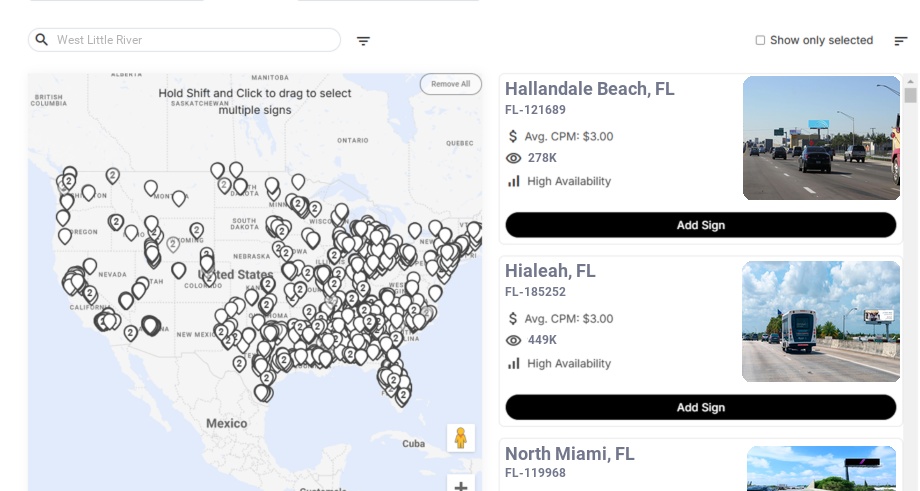



How much is a billboard near West Little River?
Why Choose Blip for Billboard Advertising near West Little River
Blip lets West Little River brands launch fast and target I-95, Palmetto, and Gratigny commuters without traditional buying friction.
Set flexible daily budgets for West Little River and reach dense, price-sensitive households across Hialeah, North Miami, and Miami Gardens.
Daypart your West Little River ads for morning rush, school release, or evening drive times on NW 27th Ave and 125th St.
No contracts mean West Little River campaigns can pivot quickly for hurricane season, back-to-school, or Miami Gardens game days.
Track West Little River results in real time and shift spend toward the corridors driving the most clicks, calls, and visits.
Use Blip's creative tools to test bilingual West Little River billboards that speak to Spanish and Haitian Creole audiences.
Frequently Asked Questions About Billboard Advertising near West Little River
How much does a billboard cost near West Little River, Florida with Blip?
With Blip, you control exactly what you spend on West Little River billboards by setting a daily budget that can be adjusted anytime, so your message can appear in the West Little River area on nearly any budget. Each “blip” is a brief 7.5–10 second display, and you only pay for the blips you receive, making billboards near West Little River, Florida accessible for small and growing businesses. It depends on when and where your ad runs and on advertiser demand, but you’ll always see your costs add up in real time as each blip is purchased, giving you full transparency and flexibility while reaching your ideal local audience.
Where can I advertise near West Little River, Florida with Blip?
Digital billboards serving the West Little River area give us direct access to one of Miami-Dade County’s most dynamic, diverse, and densely populated communities—plus the massive traffic corridors that surround it. With 90 digital billboards within about 10 miles, concentrated in nearby cities like North Miami, Hialeah, Opa-locka, Miami Gardens, Medley, North Miami Beach, and Miami, we can build extremely targeted campaigns that reach residents, commuters, and visitors moving through the West Little River area all day long. For brands looking specifically for billboards near West Little River, this surrounding network offers the closest, most efficient coverage.
What kind of audience is in the West Little River, Florida area for billboard ads?
West Little River is an urban, residential community in unincorporated Miami-Dade County, bordered by major employment and retail hubs in Hialeah, North Miami, and Miami. Population near West Little River (CDP) is about 34,700 residents, with surrounding zip codes and adjacent neighborhoods pushing the immediate trade area well above 110,000–130,000 people within a roughly 10–15 minute drive. This makes West Little River billboards—both within nearby municipalities and along the major corridors that residents use—especially valuable for neighborhood-focused campaigns.
What roads do people in West Little River, Florida drive on most for billboard exposure?
Residents and commuters regularly use I-95, SR 826 / Palmetto Expressway, SR 924 / Gratigny Parkway, and major arterial streets near the West Little River area. I-95 through Miami and North Miami is one of the busiest interstates in Florida, with average annual daily traffic on central Miami-Dade segments often in the 230,000–260,000 vehicles per day range. SR 826 / Palmetto Expressway serves both commuters and heavy truck traffic to industrial and logistics hubs, while SR 924 / Gratigny Parkway is a key east–west commuter route with busy stretches frequently registering 90,000–110,000 vehicles per day.
When is the best time to run Blip ads for West Little River, Florida commuters?
Morning (6–10 a.m.) brings heavy commuter traffic on I-95, the Palmetto, Gratigny, and major arterials, and in many corridors 30–40% of daily traffic occurs during morning and late-afternoon peaks. Midday can still represent 25–30% of daily traffic, but with less congestion and often lower digital billboard bid prices. Evening (4–8 p.m.) is ideal for return commute plus shopping, gym, and dining traffic, and Blip lets us bid differently by hour so we can invest heavily in the most valuable drive times.
Do I need a contract to advertise with Blip near West Little River?
No, Blip has no long-term contracts or minimum commitments. You can start, pause, or stop your campaign at any time.
How fast can I launch a billboard campaign with Blip near West Little River?
You can have your campaign live in minutes. Create a free account, select your locations, set your budget, upload your design, and start running once approved.
Where can I advertise with Blip near West Little River?
Blip has digital billboards near West Little River. You can browse available locations on a map, choose the ones that fit your audience, and start advertising right away.
Still have questions? Launch a campaign in minutes — no contracts, no commitments.
Start Your CampaignWest Little River Billboard Advertising Guide
Digital billboards serving the West Little River area give us direct access to one of Miami-Dade County’s most dynamic, diverse, and densely populated communities—plus the massive traffic corridors that surround it. With 90 digital billboards within about 10 miles, concentrated in nearby cities like North Miami Hialeah, Opa-locka Miami Gardens Medley, North Miami Beach, and Miami, we can build extremely targeted campaigns that reach residents, commuters, and visitors moving through the West Little River area all day long. For brands looking specifically for billboards near West Little River, this surrounding network offers the closest, most efficient coverage.
Understanding the West Little River Area Market
West Little River is an urban, residential community in unincorporated Miami-Dade County, bordered by major employment and retail hubs in Hialeah, North Miami, and Miami. This makes West Little River billboards—both within nearby municipalities and along the major corridors that residents use—especially valuable for neighborhood-focused campaigns.
Key facts about the West Little River area and broader Miami-Dade market:
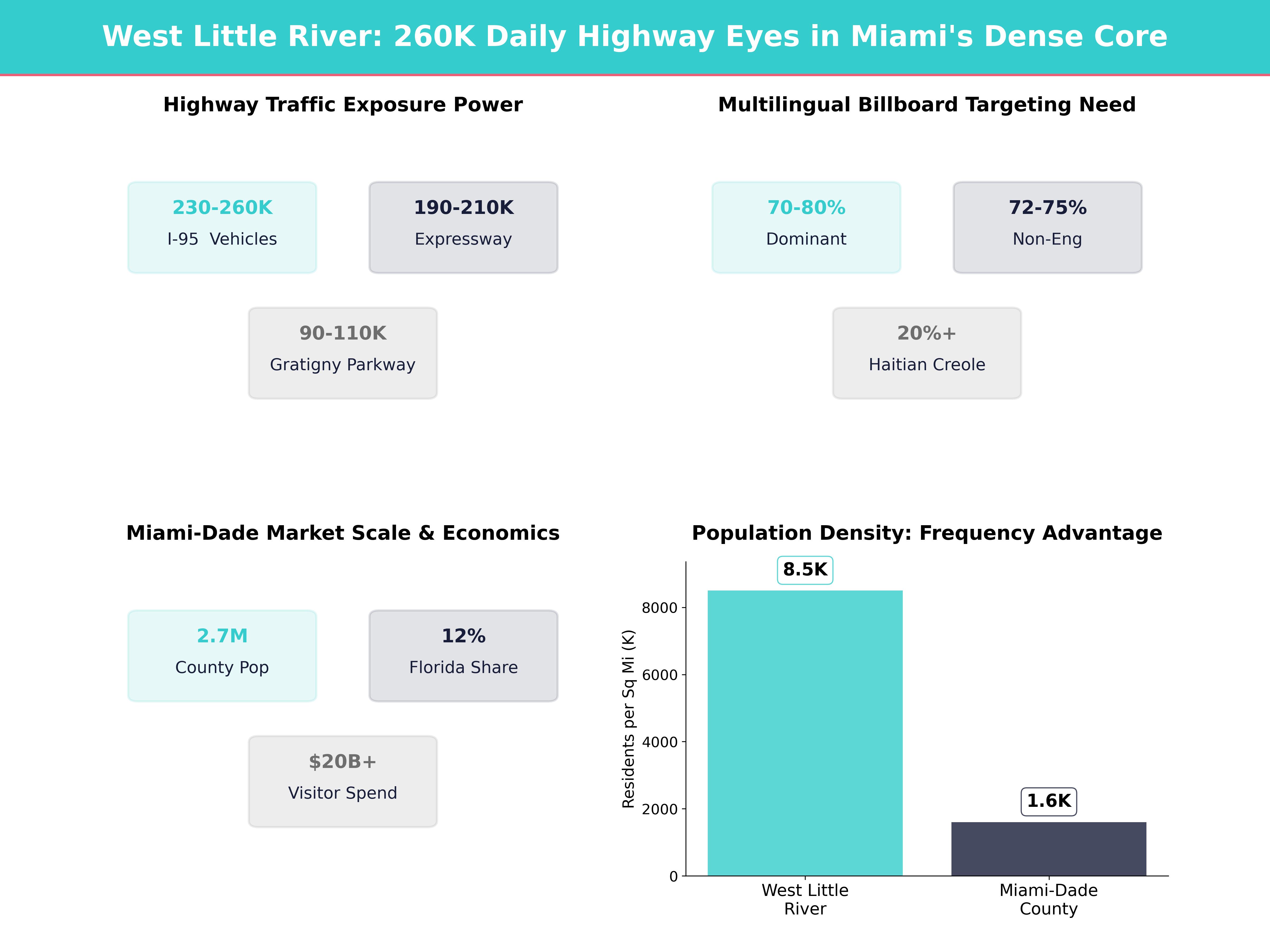
- Population near West Little River (CDP): about 34,700 residents (2020), with surrounding zip codes and adjacent neighborhoods pushing the immediate trade area well above 110,000–130,000 people within a roughly 10–15 minute drive.
- Miami-Dade County population: roughly 2.7 million residents, ranking among the top 10 most populous counties in the U.S. and accounting for almost 12% of Florida’s total population.
- Density: West Little River’s residential density is in the range of 8,000–9,000 residents per square mile, compared with a countywide density of about 1,500–1,700 residents per square mile, making out-of-home coverage and billboard advertising near West Little River especially efficient.
-
Language and culture:
- A large share of residents in the West Little River area speak Spanish at home, and a substantial Haitian community speaks Haitian Creole. In many nearby tracts, 70–80% of households are non–English dominant.
- In Miami-Dade overall, about 72–75% of residents speak a language other than English at home, and roughly 69–70% identify as Hispanic or Latino.
- Haitian and Afro-Caribbean communities are significant—countywide, more than 90,000 Haitian-born residents and over 300,000 residents of Caribbean origin contribute to the cultural mix.
-
Age and household composition:
- Median age in the West Little River area is in the mid-30s (around 35–36 years), slightly younger than the national median, indicating a strong mix of working-age adults, young families, and school-aged children.
- In this part of North-Central Miami-Dade, roughly 25–27% of residents are under 18, and about 60–62% are between 18 and 64.
- Households are often multigenerational; in many nearby tracts, 15–20% of households have three or more generations under one roof, affecting purchasing patterns for groceries, healthcare, financial services, and education.
-
Income:
- Median household income in the West Little River area is estimated in the $37,000–$40,000 range, versus a Miami-Dade median closer to $55,000–$60,000.
- Roughly 20–25% of residents in and around West Little River live below the federal poverty line, compared with about 16–18% for Miami-Dade overall.
- This makes value messaging, promotions, and clear price points especially powerful for everything from groceries and telecommunications to banking and auto services.
Local governments and institutions help shape daily life here. For regulatory, planning, or community context, we can reference resources like Miami-Dade County, the City of Miami, and nearby municipalities such as North Miami, Hialeah, and Miami Gardens. For additional neighborhood-level insights and local initiatives affecting mobility and land use, advertisers can also consult the Miami-Dade Transportation Planning Organization and Miami-Dade Public Schools, which serves more than 330,000 students countywide.
For advertisers, this all adds up to a dense, highly mobile audience that lives locally but moves frequently among neighboring cities—perfect for a network of digital billboards positioned near, but not directly inside, the West Little River area. Businesses that want West Little River billboards in practice are usually best served by placing creative on this nearby ring of signs.
How People Move Around the West Little River Area
To design effective out-of-home campaigns, we need to think like a driver in the West Little River area.
Residents and commuters regularly use:
- I-95 (through Miami and North Miami – one of the busiest interstates in Florida, with average annual daily traffic (AADT) on central Miami-Dade segments often in the 230,000–260,000 vehicles per day range. In peak hours, that can mean 8,000–10,000 vehicles per lane, per direction.
- SR 826 / Palmetto Expressway (through Hialeah, Hialeah Gardens 190,000–210,000 vehicles daily, serving both commuters and heavy truck traffic to industrial and logistics hubs.
- SR 924 / Gratigny Parkway (near Opa-locka and Hialeah) – a key east–west commuter route, with busy stretches frequently registering 90,000–110,000 vehicles per day, concentrating a large number of daily impressions on relatively short segments.
-
Major arterial streets near the West Little River area, including:
- NW 27th Ave (SR 9), which in some segments handles 30,000–40,000 vehicles per day
- NW 103rd St / 125th St corridors, key east–west routes connecting to I-95 and the Palmetto
- NW 79th St and NW 95th St, which link West Little River area residents to job centers in Miami and Hialeah
We can review traffic and corridor data through the Florida Department of Transportation (FDOT) District Six Miami-Dade Transportation & Public Works department, which oversees more than 700,000 daily transit boardings (bus, Metrorail, Metromover) and maintains detailed traffic count maps.
Blip’s digital billboards located in:
- North Miami & North Miami Beach intercept residents going to coastal jobs, colleges, and shopping. North Miami, for example, has over 60,000 residents, while North Miami Beach adds another 43,000+, creating strong local reach in addition to through-traffic for anyone seeking billboards near West Little River along north–south travel routes.
- Hialeah & Hialeah Gardens catch heavy working-class commuter flows and industrial/warehouse traffic. Hialeah alone has more than 220,000 residents and one of the highest population densities in the country—over 10,000 residents per square mile.
- Opa-locka & Miami Gardens reach drivers near industrial parks, airports, and major sports/entertainment venues. Miami Gardens, home to Hard Rock Stadium 111,000 residents and draws tens of thousands of visitors per NFL game or major concert.
- Miami & Miami Beach extend our reach to central business districts, tourism corridors, and beaches—common work and leisure destinations for West Little River area residents. Downtown and Brickell office markets host 200,000+ daytime workers, and Miami Beach welcomes millions of visitors annually.
Because most Miami-Dade workers drive, and average commute times hover around 30–32 minutes one-way (several minutes above the U.S. average), repeated exposures on these corridors can build strong frequency with a relatively small set of locations. Countywide, roughly 85–90% of workers commute by car (alone or carpool), which is why out-of-home remains one of the most reliable ways to reach employed adults and why billboard advertising near West Little River works so well for service-driven businesses.
Strategic Placement: How to Use the 90 Nearby Billboards
With 90 digital billboards serving the West Little River area, we can think in terms of coverage patterns rather than isolated signs. This is essentially a ready-made network for billboard rental near West Little River, with inventory spread across the places residents drive most. A few strategic approaches:
1. “Home-to-Work” Ring Strategy
- Use Hialeah, Opa-locka, and Medley boards to catch outbound morning commuters who live near the West Little River area and work in industrial parks, logistics hubs, and businesses west and northwest of the neighborhood. Industrial employment in Hialeah and Medley alone runs in the tens of thousands of jobs, especially in transportation, warehousing, and manufacturing.
- Use Miami, North Miami, and Miami Beach boards for commuters heading to downtown, Brickell, hospitals, universities, and hotels, where combined employment centers count well over 300,000 jobs within a relatively tight urban core.
- In the evening, reverse the pattern to reach those same people heading home through the West Little River area. If a typical five-day commuter makes 20 one-way trips per week, even 10–15 impressions per week on key corridors can produce meaningful recall.
2. “Living Local, Shopping Everywhere” Strategy
Residents often shop and play outside their immediate neighborhood:
- Aventura and North Miami Beach: high-income shoppers, Aventura Mall, and upscale retail attract residents on weekends. Aventura Mall is one of the largest malls in the U.S., with over 300 retailers and an estimated 28–30 million visitors annually; placing lifestyle, automotive, and retail ads here increases perceived brand status back in the West Little River area. The City of Aventura
- North Bay Village and Miami Beach: leisure, nightlife, and dining destinations—prime for restaurants, entertainment, rideshare, and hospitality campaigns. North Bay Village and Miami Beach together offer about 7–8 miles of beaches and support over 20,000 hotel rooms, driving year-round night and weekend traffic.
- West Park and Miami Gardens: good for reaching residents attending sporting events, concerts, and regional festivals. The City of West Park 60,000–65,000 attendees per game or concert, greatly multiplying impressions on surrounding corridors.
3. Hyperlocal Frequency Strategy
If our objective is awareness in the West Little River area specifically (e.g., a local clinic, charter school, or grocery store):
- Concentrate spend on a tighter cluster of boards in North Miami, Hialeah, Opa-locka, and Miami Gardens that align with the most common commute paths and shopping routes used by area residents. By concentrating on 10–20 billboards instead of all 90, we can significantly increase frequency—often moving from 1–3 weekly views per person to 5–10+ among target commuters. This approach effectively simulates having several West Little River billboards even when the signs themselves sit just outside the neighborhood boundary.
- Use Blip’s flexible budgeting to run high-frequency, short-radius exposure bursts around store openings or enrollment deadlines. For example, a 2–3 week burst at higher bids leading up to a grand opening can generate tens of thousands of additional impressions compared with always-on, low-intensity buys.
Demographics and Messaging: What Works in the West Little River Area
Because the West Little River area is culturally rich and multilingual, billboard creative should reflect the community:
Language Strategy
- Consider bilingual English–Spanish creative for most mass-market campaigns. In broader Miami-Dade, about 60–65% of residents speak Spanish at home; in many West Little River–adjacent neighborhoods, that share is even higher, making bilingual boards feel inclusive and familiar.
- For campaigns targeting specific neighborhoods, healthcare, community services, or Haitian-owned businesses, English–Haitian Creole messaging can stand out strongly and generate trust. Miami-Dade’s Haitian community is one of the largest in the U.S., and in some nearby census tracts, 20% or more of residents report Haitian or other French Creole as the primary language at home.
- If testing multiple language versions, we can rotate creatives on the same billboard through Blip and compare response by time of day or location—e.g., Spanish-dominant creative during morning commutes on corridors with higher Hispanic density, and more English or Creole in specific pockets known for Haitian and African-American populations.
Cultural Relevance
- Family-oriented imagery resonates: in the wider area, 30–35% of households include children under 18, and multigenerational living is common. Show multi-generational families, children, and shared meals.
- Messaging that emphasizes value, savings, and reliability (e.g., “$39 clinic visits,” “Same-day auto repair,” “No annual fee”) aligns with many residents’ price-sensitive decision making and the local income mix.
- For aspirational brands (banks, education, automotive), highlight mobility and progress: “Build your credit,” “Finish your degree,” “Drive the car you deserve.” In a county where car ownership is a key economic marker—over 90% of households have access to at least one vehicle in many nearby areas—automotive and financial mobility cues are especially powerful.
Visual Style
- Use high-contrast colors that pop against South Florida’s bright daylight—deep blues, reds, and dark backgrounds with bold white or yellow text are easier to read, especially given typical travel speeds of 45–60 mph on major arterials.
- Limit text to 6–8 words; drivers often have only 5–7 seconds to absorb your message as they pass a board at highway speeds.
- Show faces that reflect local diversity—Afro-Caribbean, Afro-Latino, and Hispanic representation will immediately feel more “native” to the West Little River area and surrounding neighborhoods.
Timing and Dayparting: When to Run Your Blips
The West Little River area and surrounding corridors have distinct traffic and lifestyle patterns we can leverage with Blip’s scheduling tools:
Morning (6–10 a.m.)
- Heavy commuter traffic on I-95, the Palmetto, Gratigny, and major arterials. In many corridors, 30–40% of daily traffic occurs during morning and late-afternoon peaks.
-
Best for:
- Coffee, breakfast, and QSR promotions
- Transit and rideshare services
- Education (schools, colleges) and healthcare reminders
- Financial services and employment opportunities
Midday (10 a.m.–3 p.m.)
- Mix of shift workers, parents, and seniors running errands. Midday flows can still represent 25–30% of daily traffic, but with less congestion and, often, lower digital billboard bid prices.
-
Strong placement for:
- Grocery and discount retail
- Clinics and pharmacies
- Government and community services messaging
- Because CPMs can be lower mid-day, this is an efficient time to build additional frequency in the West Little River area, especially for value-driven brands.
Afternoon School Release (2–5 p.m.)
- Parents, school buses, and after-school traffic. The Miami-Dade Public Schools system operates hundreds of schools, with dismissal times that create short but intense traffic surges on local arterials.
-
Great for:
- Tutoring centers and education programs
- Children’s activities, sports leagues, and enrichment programs
- Quick-service restaurants and snack brands
Evening (4–8 p.m.)
- Return commute plus shopping, gym, and dining traffic. Many corridors reach peak hourly volumes in this window, particularly around large shopping centers and intersections.
-
Ideal for:
- Restaurants, bars, and nightlife (especially on boards in Miami, North Miami, North Bay Village, and Miami Beach)
- Retail events and weekend promotions
- Streaming, entertainment, and sports marketing (tie in with events at nearby venues in Miami Gardens or downtown Miami)
Late Night (8 p.m.–2 a.m.)
- Lower volume overall, but high-value audiences on certain corridors (hospital workers, hospitality staff, late-night service workers). In entertainment and hospitality districts, late-night traffic can account for 10–15% of daily flows.
-
Efficient for:
- Staffing and recruitment ads
- Nightlife and delivery services
- Branding campaigns that benefit from 24/7 presence
Blip lets us bid differently by hour, so we can invest heavily in morning and evening drive times on corridors most used by West Little River area residents, while using lower-cost off-peak hours to sustain awareness.
Tourism and Regional Reach: Leveraging Greater Miami Foot Traffic
Even if your core customer lives in the West Little River area, tourists and regional visitors spending time in Miami can be an important secondary audience—especially if your business serves hospitality workers, transportation, or tourism-adjacent services.
According to local tourism officials like the Greater Miami Convention & Visitors Bureau:
- Greater Miami and Miami Beach attract roughly 25–27 million overnight visitors per year, plus millions more day visitors from elsewhere in Florida.
- Visitor spending in Miami-Dade reaches more than $20 billion annually, supporting tens of thousands of jobs across hotels, restaurants, retail, arts, nightlife, and transportation.
- Hotel occupancy in peak periods often exceeds 80%, with average daily rates (ADR) in prime Miami Beach and downtown markets frequently above $250–$300.
Many West Little River area residents work in these industries, commuting daily to:
- Hotels and restaurants in Miami Beach, North Miami Beach, Aventura, and downtown Miami
- Cruise and port operations near PortMiami, operated by PortMiami, one of the world’s busiest cruise ports, hosting 6–7 million cruise passengers annually
- Retail centers like Aventura Mall or Dolphin Mall tens of millions of shoppers per year
By advertising near these employment zones, we not only reach tourists but also reinforce messaging to the same workers who return every night to the West Little River area. A campaign for a local credit union, for example, might:
- Run aspirational financial messaging on downtown Miami and Miami Beach boards (targeting workers as they arrive to work).
- Run practical, product-focused messaging on Hialeah and North Miami boards as those same workers drive home, emphasizing branch proximity, extended hours, or remittance services frequently used by immigrant households.
Campaign Ideas by Business Type
Here are concrete ways businesses can use our 90 digital billboards serving the West Little River area:
Healthcare & Clinics
- Focus on boards in Hialeah, North Miami, and Miami Gardens—close to the residential catchment areas. Across Miami-Dade, residents make millions of outpatient visits annually, and local urgent care facilities can see hundreds of patients per week, so proximity messaging matters when using billboards near West Little River.
-
Message examples:
- “Walk-in Clinic Near the West Little River Area – $49 Visits”
- “Free Kids’ Vaccines – Saturday 9–3 – [Clinic Name].”
- Run heavier schedules in late afternoon and early evening when parents are handling family errands; this lines up with typical urgent-care peak volumes between 4–8 p.m.
Schools, Colleges, and Training Programs
-
Charter schools, private schools, and technical colleges can run enrollment campaigns:
- Use bilingual English–Spanish creative, plus Creole where relevant. In nearby neighborhoods, households with school-age children may be 70%+ Hispanic and 10–15% Haitian/Caribbean, so multilingual creative significantly broadens reach.
- Emphasize transportation convenience: “On bus routes from the West Little River area.” Many families rely on Miami-Dade Transportation & Public Works bus routes and Metrorail, which together serve tens of thousands of student trips each weekday.
- Target morning and late afternoon around corridors where school families travel, such as NW 27th Ave and the 103rd/125th Street corridors.
Grocery, Discount, and Retail
- Use price-forward designs: specific prices, “3 for $5,” “Weekly specials.” In price-sensitive trade areas where median incomes sit in the $35,000–$45,000 range, ads with clear offers can outperform generic branding.
- Focus on weekends and late afternoons; Saturday and Sunday can account for 30–40% of weekly retail trips for many households.
- Place boards near Hialeah, Opa-locka, and North Miami where shopping trips often originate or pass by, especially around major centers, strip malls, and discount retailers.
Local Restaurants and Food Delivery
- If you serve the West Little River area but your physical location is in a neighboring city, highlight proximity: “5 minutes from the West Little River area – Exit at NW XX St.”
- Use boards in North Miami, Miami Gardens, and Hialeah to catch dine-in and takeout traffic. In Greater Miami, dining out and takeout account for a substantial share of household food spending—often 45–50% of total food dollars.
- Run heavier Thursday–Sunday, with emphasis on evening hours when restaurant transactions spike; many QSR and casual-dining locations see 50%+ of daily sales after 4 p.m.
Financial Services & Auto Dealers
- Promote “no credit” or “low down payment” offers to match local financial realities. In lower-income tracts, rates of unbanked or underbanked households can approach 15–20%, and many residents rely on alternative financial services.
-
Use a mix of:
- Boards on Palmetto and I-95 (for broad commute reach), and
- Boards closer to your dealership or branch (for last-mile decision influence).
- Consider separate creatives for Spanish and English with rotation to test performance. Even a 10–15% lift in response from better language targeting can be significant across thousands of impressions.
Community Organizations & Public Agencies
- Use highly legible, simple, bilingual messaging.
-
Drive awareness of:
- Job fairs and training programs in partnership with Miami-Dade County or local municipalities
- Health screenings and vaccination events supported by county health partners
- Emergency preparedness and hurricane season reminders (hurricane season runs June 1–November 30, and Florida has experienced multiple multi-billion-dollar storms in recent decades)
- Coordinate messaging windows with key local news cycles and weather events, leveraging outlets like the Miami Herald WPLG Local 10, NBC 6 South Florida, and CBS News Miami to align your billboard messaging with media coverage.
Creative Best Practices for the West Little River Area
To maximize the impact of every “blip” we buy:
-
Keep it ultra-simple
- 1 main idea, 1 call to action.
- 6–8 words max; 1–2 short lines of copy.
- In traffic moving at 40–60 mph, complex messages simply won’t be processed.
-
High contrast and bold fonts
- Sans-serif fonts (e.g., bold, thick lettering).
- Avoid thin scripts, especially over photos, which can become unreadable at distance or in bright sun.
-
Use local references
- Mention nearby landmarks or corridors: “Just off the Palmetto,” “Near NW 27th Ave,” “Serving the West Little River area.”
- Avoid saying “in West Little River” unless your location is actually there; focus instead on “near” or “serving the West Little River area” to set clear expectations and reduce confusion. This is particularly important for advertisers using billboard rental near West Little River to attract customers from surrounding neighborhoods.
-
Clear, trackable calls to action
-
Short URLs, recognizable phone numbers, or unique promo codes:
- “Text RIVER to 12345”
- “Use code WEST20”
- This makes it easier to measure which creatives and locations are working, especially when combined with website analytics and point-of-sale tracking.
-
Short URLs, recognizable phone numbers, or unique promo codes:
Measuring and Optimizing Your Campaign
With Blip’s flexibility, we can continuously improve performance of campaigns serving the West Little River area:
-
Rotate multiple creatives across the same set of boards:
- Test different languages, promotions, or images.
- Pause underperforming creative and reallocate impressions quickly.
- Even a 5–10% improvement in response rate can translate into significant incremental revenue when scaled across thousands of daily impressions.
-
Compare performance by location cluster:
- For example, split your budget 50/50 between a “North cluster” (North Miami, North Miami Beach, Aventura) and a “West cluster” (Hialeah, Hialeah Gardens, Opa-locka, Medley).
- Use store traffic, website visits, calls, or form fills from specific zip codes to infer which cluster is more effective. If one cluster delivers 20–30% more conversions at the same spend, you can rapidly shift budget toward those locations.
-
Align with local events and news cycles:
- During major events (sports games in Miami Gardens, festivals in Miami, or county-wide initiatives advertised by Miami-Dade County), temporarily increase bids on nearby boards to ride the surge in traffic and attention.
- For example, a sold-out game at Hard Rock Stadium with 65,000 attendees can dramatically spike impressions on adjacent boards over just a few hours.
-
Seasonal adjustments:
- Hurricane season, back-to-school, holiday shopping, and tax season all influence what residents in the West Little River area care about and purchase. Back-to-school alone affects more than 300,000 students and families in Miami-Dade Public Schools.
- Use Blip to update creative quickly—no printing or installation delays—so you can pivot from hurricane prep to holiday promotions to tax-refund offers within days, not weeks.
Bringing It All Together
Advertising on digital billboards near the West Little River area gives us a rare combination of:
- Dense, diverse residential audiences numbering in the tens of thousands within a short drive
- Heavy daily commuter flows across multiple expressways and arterials, with key corridors carrying 200,000+ vehicles per day
- Proximity to major employment, shopping, and tourism hubs in Miami-Dade that collectively attract tens of millions of visitors and shoppers each year
For brands actively searching for billboards near West Little River, this integrated network delivers the functional equivalent of West Little River billboards by surrounding the neighborhood on every side and capturing its daily traffic patterns.
By using our 90 digital billboards strategically—concentrating impressions on the most relevant corridors, timing campaigns to daily and weekly rhythms, and tailoring creative to local languages and culture—we can build campaigns that feel truly “of the neighborhood” while leveraging the broader power of Greater Miami’s out-of-home network. Whether your goal is always-on billboard advertising near West Little River or a short-term billboard rental near West Little River to support a specific promotion, the same principles of placement, timing, and creative simplicity apply.
With Blip, we’re not locked into static, one-size-fits-all buys. We can fine-tune messaging for the West Little River area, adjust spend in real time, and continuously optimize so every dollar works harder on the roads your customers actually travel.