Billboards in Treasure Island, FL
No Minimum Spend. No Long-Term Contracts. Just Results.
Trusted by Leading Brands


Billboard advertising
in Treasure Island has never been easier



How much is a billboard in Treasure Island?
Why Choose Blip for Billboard Advertising in Treasure Island
Blip lets you launch fast in Treasure Island and target bridge approaches, Gulf Boulevard, and Pasadena Avenue without contracts or hassle.
Use Blip-optimized campaigns in Treasure Island to auto-balance reach on I-275 and beach corridors by your goals, budget, and timing.
Treasure Island budgets flex with Blip, so you can ramp up for winter snowbirds, spring break, or Sanding Ovations, then pause anytime.
Daypart Treasure Island ads for commuter mornings, beach afternoons, or sunset dining; Blip helps your message hit when traffic is most ready.
Track Treasure Island performance in real time and shift spend as visitor traffic changes from airport arrivals to Gulf Boulevard beach trips.
Blip's creative tools make it easy to tailor Treasure Island billboards for older residents, tourists, and storm-season service needs.
Frequently Asked Questions About Billboard Advertising in Treasure Island
How much does a billboard cost in Treasure Island with Blip?
With Blip, billboard advertising in Treasure Island can fit a wide range of budgets because you only pay when your ad actually appears. Each “blip” is a 7.5-to-10-second display on a rotating digital billboard, with pricing starting at just $0.01 per display. You set a daily budget, and Blip’s algorithm uses it to bid for open ad slots, helping maximize your reach based on time of day, location, and advertiser demand.
Where can I advertise with Blip in Treasure Island, Florida?
Treasure Island's travel patterns concentrate around a few regional corridors and beach access routes, including I-275, US 19, SR 688, Pasadena Avenue South, the Treasure Island Causeway, and Gulf Boulevard. This corridor network is ideal for reaching commuters, tourists, and beachbound traffic. Most beachbound traffic enters through just 3 bridge approaches, which makes gateway strategy especially valuable.
Why is Treasure Island a good market for Blip billboard ads?
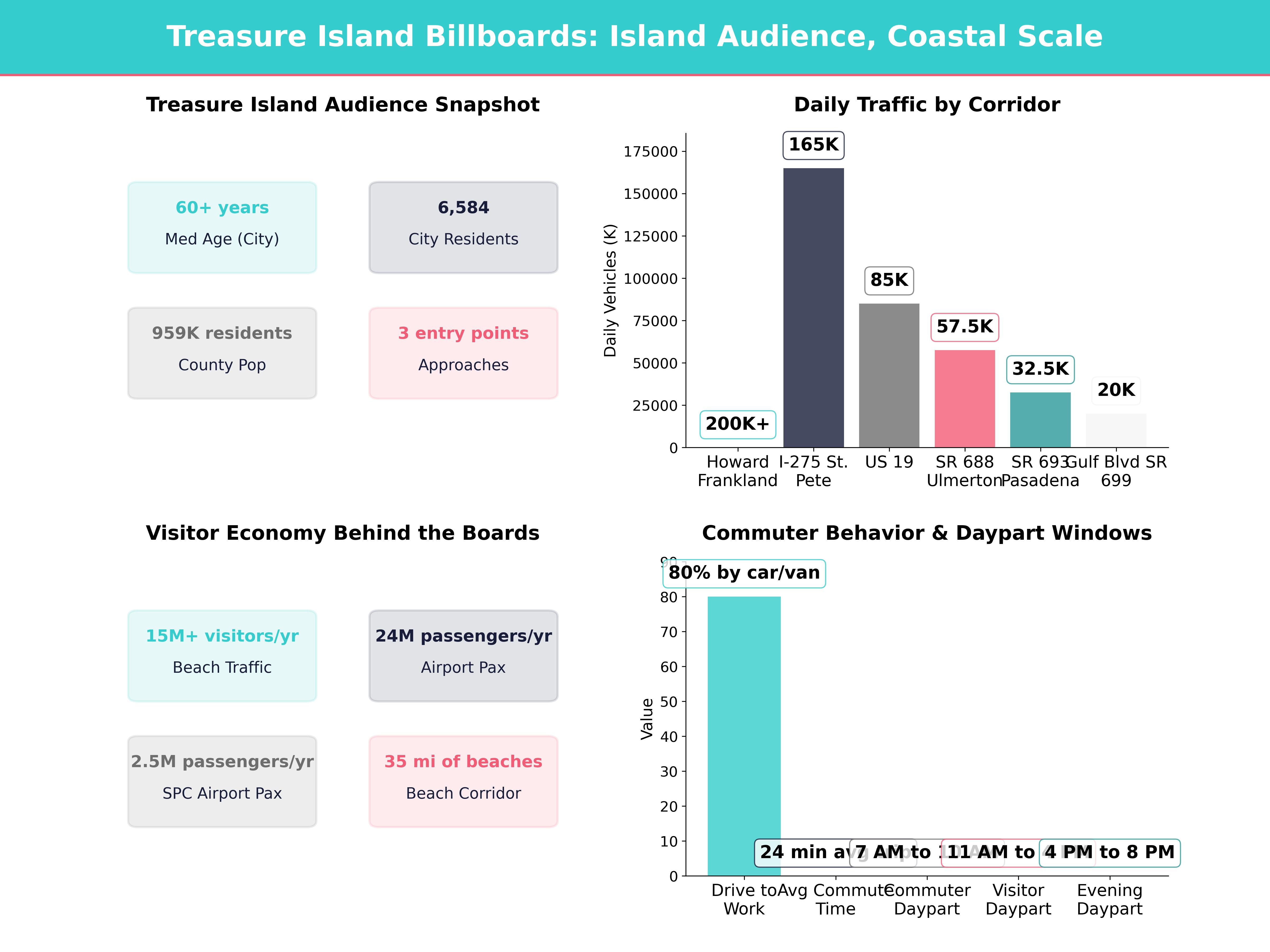
Treasure Island gives us a rare mix of small-city intimacy and regional-scale exposure. The city had 6,584 residents in 2020, but it sits inside Pinellas County with about 959,000 residents and just west of St. Petersburg with 258,308 residents. Add more than 15 million annual visitors and 35 miles of beaches, and we get an audience that is far larger than the city's year-round population suggests.
What kind of people does Blip reach in Treasure Island?
Treasure Island is not a one-audience market, and our strongest campaigns usually work because they speak to the right sub-audience at the right point in the trip. The area reaches commuters and bridge travelers, tourists and day-trippers, students and parents, and retirees, condo owners, and service buyers. Pinellas County's car commute rate of about 80% and the city's median age over 60 both shape the types of messaging that work best.
When is the best time to run Blip ads in Treasure Island?
Treasure Island is highly seasonal, but not in a simple summer-only way. From January through March, the area benefits from snowbird traffic, strong weather, and a fuller calendar of regional events, while March through August is the strongest stretch for restaurants, attractions, convenience goods, and urgent care. Florida's hurricane season runs from June 1 through November 30, which also makes weather-responsive campaigns especially useful here.
Do I need a contract to advertise with Blip in Treasure Island?
No, Blip has no long-term contracts or minimum commitments. You can start, pause, or stop your campaign at any time.
How fast can I launch a billboard campaign with Blip in Treasure Island?
You can have your campaign live in minutes. Create a free account, select your locations, set your budget, upload your design, and start running once approved.
Where can I advertise with Blip in Treasure Island?
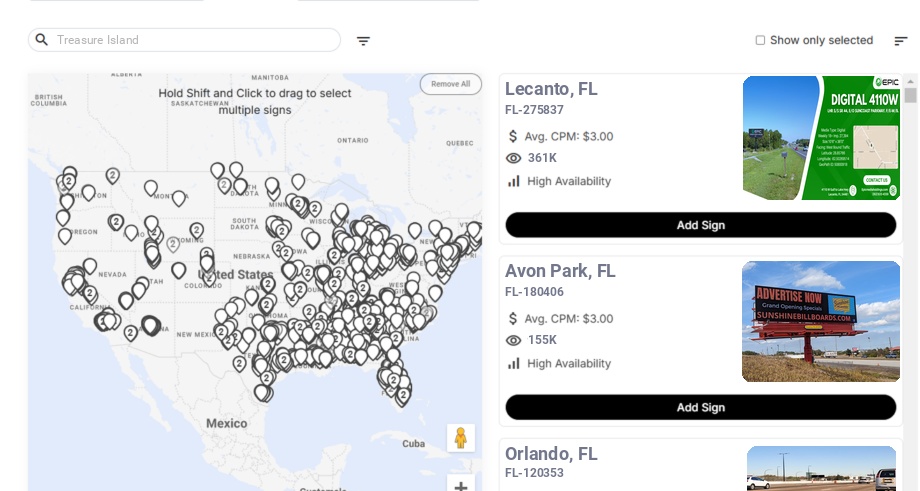
Blip has digital billboards in Treasure Island. You can browse available locations on a map, choose the ones that fit your audience, and start advertising right away.
Still have questions? Launch a campaign in minutes — no contracts, no commitments.
Start Your CampaignTreasure Island Billboard Advertising Guide
Treasure Island, Florida, gives us a rare mix of small-city intimacy and regional-scale exposure. The City of Treasure Island had 6,584 residents in 2020, but it sits inside Pinellas County with about 959,000 residents and just west of St. Petersburg with 258,308 residents. Add Visit St. Pete-Clearwater 35 miles of beaches and more than 15 million annual visitors, and we get an audience that is far larger than the city's year-round population suggests. Because most trips to Treasure Island happen by car over a small set of beach access roads, bridges, and regional highways, including 3 primary bridge approaches, billboards can reach both repeat local traffic and high-intent visitor traffic.
Treasure Island Market Overview
Treasure Island is a mature barrier-island market, which means our advertising strategy should focus less on new-subdivision growth and more on traffic flow, tourism, and regional reach. The city's population was 6,705 in 2010 and 6,584 in 2020, a decline of about 1.8%, which tells us the local market is relatively built out. That is not a weakness for billboard advertising. It simply means the best opportunities come from capturing movement into, out of, and around the beach corridor rather than waiting for sprawl to create new routes.
The broader market is much larger and still growing. Pinellas County grew from 916,542 residents in 2010 to 959,107 in 2020 (+4.6%), while St. Petersburg grew from 244,769 to 258,308 over the same period (+5.5%). Pinellas packs that population into roughly 280 square miles of land, making it Florida's most densely populated county at about 3,400 to 3,500 residents per square mile. For us, that density matters because billboard campaigns can build frequency quickly without needing enormous geographic spread.
Treasure Island also skews older than many Florida markets. The city's median age is over 60, which has direct creative implications. We generally do better here with larger type, simpler layouts, stronger contrast, and offers that emphasize convenience, trust, and immediate value.
Travel habits strongly support outdoor advertising. In Pinellas County, about 80% of workers commute by car, truck, or van, and the average trip to work is roughly 24 minutes. That combination gives us a dependable base of daily impressions from commuters, service workers, healthcare employees, and retail staff moving between the beaches, the mainland, and job centers across the county.
The economic picture is also stronger than Treasure Island's resident count alone would suggest. Visit St. Pete-Clearwater 15 million annual visitors to the county's beach destination. St. Pete-Clearwater International Airport handles about 2.5 million passengers a year, and Tampa International Airport 24 million annual passengers. That constant visitor churn supports hospitality, restaurants, entertainment, retail, healthcare, transportation, and home services, which are all strong billboard categories in this market.
What the Treasure Island numbers mean for advertisers
When we put those numbers together, Treasure Island behaves like three markets at once.
- We reach a small but affluent and service-heavy beach-resident base.
- We reach a dense mainland population in west and central Pinellas.
- We reach a very large stream of tourists, second-home owners, and day-trippers moving through the beach gateways.
That is why Treasure Island works especially well for advertisers that need both frequency and intent, including restaurants, attractions, urgent care, roofing, legal services, insurance, real estate, grocery, and destination retail.
Key Traffic Corridors for Treasure Island Billboards
Treasure Island's travel patterns concentrate around a few regional corridors and beach access routes. That concentration is good news for us because it limits waste. Instead of spraying impressions across dozens of low-value roads, we can focus on the routes that practically everyone uses to reach the beaches.
I-275 and the St. Petersburg gateway to Treasure Island
According to FDOT traffic maps, major I-275 segments through St. Petersburg commonly run in the 150,000 to 180,000 AADT range, while the Howard Frankland Bridge approach carries 200,000+ vehicles per day. This is the corridor that pulls traffic from Tampa, airport routes, north Pinellas connections, and the urban core into southern Pinellas.
For Treasure Island advertisers, I-275 is our broadest awareness corridor. It is especially useful when we want to influence the trip before drivers choose their beach, their hotel, their dinner stop, or their errand run.
- Hospitals, urgent care brands, and healthcare systems benefit here because commuters and visitors make repeated weekday and weekend trips through the corridor.
- Attractions, museums, and entertainment venues benefit here because they can catch visitors before they commit to a full beach day.
- Legal, insurance, and financial services benefit here because I-275 delivers consistent repetition with local adults over many weeks.
US 19 and SR 688 as the Treasure Island feeder network
US 19 is one of Pinellas County's highest-volume commercial corridors, with many segments running roughly 70,000 to 100,000+ AADT. SR 688, better known as Ulmerton Road, commonly runs around 50,000 to 65,000 AADT on busy segments near airport and interchange areas. These roads matter because they gather traffic from north county, business districts, shopping centers, and airport-related travel before those drivers move toward the beaches.
This network is ideal when we want scale without paying only for downtown exposure. It works particularly well for:
- Home services, because homeowners from Largo, Seminole, Pinellas Park Clearwater, and St. Petersburg all move through these routes.
- Retail and automotive brands, because the corridor already functions as a shopping and errand spine.
- Airport-adjacent hospitality and transportation advertisers, because St. Pete-Clearwater International Airport sits directly inside this movement pattern.
Pasadena Avenue South and the Treasure Island Causeway
For advertisers that want true Treasure Island intent, the Treasure Island Causeway and Pasadena Avenue South matter more than any regional highway. FDOT counts on Pasadena Avenue South, part of SR 693, typically land in the 30,000 to 35,000 AADT range on busy mainland segments. Westbound traffic then compresses as vehicles funnel toward the Causeway and onto the island.
This corridor is where our messaging can become more directional and more immediate. Drivers here are not vaguely considering the beach. They are already on the way.
- Restaurants, bars, and dessert shops benefit because "next right," "open until sunset," and parking-focused messages feel timely.
- Grocery, pharmacy, and convenience brands benefit because both residents and renters often make a last stop before crossing to the island.
- Hotels, vacation rentals, and same-day activities benefit because this is one of the last decision windows before arrival.
Treasure Island is also a constrained-access geography. In practical terms, most beachbound traffic enters through just 3 bridge approaches: the Treasure Island Causeway, the John's Pass Bridge, and the Blind Pass connection to St. Pete Beach
Gulf Boulevard, SR 699, and the beach chain
Gulf Boulevard and SR 699 carry the local beach chain from Madeira Beach, through Treasure Island, and down to St. Pete Beach 15,000 to 25,000 AADT range, with meaningful seasonal swings. Those numbers are lower than interstate counts, but the audience quality is exceptionally high because speed is slower, wayfinding is active, and many riders are in decision mode.
This is our strongest corridor for close-in, place-based messaging.
- Hospitality and dining brands benefit because visitors are actively deciding where to eat, shop, and stop.
- Medical, urgent care, and pharmacy advertisers benefit because beach visitors often need immediate options rather than general awareness.
- Water activities, charter boats, and family attractions benefit because same-day purchases are common on the beach strip.
One local advantage is dwell time. Traffic on Gulf Boulevard often slows enough that well-designed creative has more time to register than it would on a fast-moving freeway.
Treasure Island Audience Segments
Treasure Island is not a one-audience market. Our strongest campaigns usually work because they speak to the right sub-audience at the right point in the trip.
Treasure Island commuters and bridge travelers
Even in a tourism-heavy beach city, a large share of impressions still come from routine mobility. Pinellas County's car commute rate of about 80% and average commute of roughly 24 minutes support weekday campaigns for healthcare, legal services, banking, automotive, and home services. These audiences include residents of South Pasadena, Seminole, west St. Petersburg, and other nearby communities who cross between the mainland and the beaches regularly.
Treasure Island tourists and day-trippers
This is the audience that makes Treasure Island special. Visit St. Pete-Clearwater 35 miles of beach communities and reports more than 15 million annual visitors. John's Pass Village & Boardwalk alone features 100+ merchants, which tells us how concentrated visitor commerce is just north of Treasure Island.
Airport access strengthens that visitor audience. St. Pete-Clearwater International Airport handles about 2.5 million annual passengers, and Tampa International Airport 24 million. For us, that means Treasure Island campaigns can target not only beachgoers already on the island, but also inbound travelers on their way from the airport to the coast.
Treasure Island students, parents, and young adults
Treasure Island is not a classic college town, but the regional student audience is large enough to matter. Pinellas County Schools serves more than 90,000 students. St. Petersburg College serves more than 45,000 students annually across its system. USF St. Petersburg 4,000 students, and Eckerd College enrolls about 2,000.
That audience supports campaigns for quick-service dining, apartments, retail, entertainment, career training, and events. It also makes late-summer and back-to-school timing especially useful on mainland approaches and in St. Petersburg.
Treasure Island retirees, condo owners, and service buyers
Treasure Island's median age over 60 means we should not underestimate service-driven local demand. Older adults, second-home owners, and condo residents are strong prospects for healthcare, elective medical services, insurance, legal help, financial planning, remodeling, pest control, HVAC, and restoration. Nearby providers such as BayCare and HCA Florida Pasadena Hospital illustrate the healthcare gravity in the surrounding area.
Seasonal and Timing Opportunities in Treasure Island
Treasure Island is highly seasonal, but not in a simple "summer only" way. The best timing depends on whether we want tourists, local residents, students, or storm-response buyers.
Winter and early spring in Treasure Island
From January through March, Treasure Island benefits from snowbird traffic, strong weather, and a fuller calendar of regional events. This is a prime season for hospitality, dining, attractions, elective healthcare, and real estate messaging. Regional events such as the Firestone Grand Prix of St. Petersburg, the John's Pass Seafood Festival, and spring training activity from the New York Yankees, and the Philadelphia Phillies create extra visitor movement through Pinellas County.
For many categories, winter is also when discretionary spending is strongest. Visitors are out earlier in the day, sunsets still drive dinner traffic, and beach weather supports same-day decisions.
Spring break and summer beach season in Treasure Island
From March through August, beach traffic broadens from snowbirds to families, vacationers, students, and local day-trippers. This is the strongest stretch for restaurants, ice cream, water recreation, attractions, convenience goods, beachwear, and urgent care. We generally want heavier afternoon and early evening coverage here because people are already on the move and more likely to make immediate stops.
Back-to-school and fall in Treasure Island
Pinellas County Schools and local colleges reset traffic patterns in August, which creates a shift away from pure visitor messaging and back toward routine local needs. This is when healthcare, fitness, tutoring, after-school programs, home services, and everyday retail become stronger bets.
Fall also brings events that can drive strong local and visitor visibility, including Sanding Ovations in November. That event-oriented window is a good fit for restaurants, lodging, entertainment, and branded awareness campaigns that want a cultural tie-in without competing with midsummer clutter.
Hurricane season and weather-responsive Treasure Island campaigns
Florida's hurricane season runs from June 1 through November 30. For Treasure Island, that matters operationally as much as creatively. Roofing, restoration, flood mitigation, insurance, generators, cleanup, and emergency services all have legitimate reasons to increase visibility around major weather events. At the same time, tourism campaigns often need the flexibility to pause, shift inland, or restart quickly as conditions change.
Billboard Design Tips for the Treasure Island Market
Treasure Island rewards local specificity. Generic Florida creative can work, but it usually underperforms compared with ads that clearly understand the beach audience, the driving environment, and the island's mix of residents and visitors.
Design for bright light, glare, and beach driving in Treasure Island
Beach markets are visually busy. We compete with sun glare, water reflection, palm canopies, hotel facades, and vacation distraction. We usually do best with very high contrast, a single dominant visual, and short copy. In this market, 6 to 8 words is often a stronger choice than trying to squeeze in a full sentence.
We should also think about speed. On I-275, the message has to land almost instantly. On Gulf Boulevard, slower traffic allows a slightly more directional approach, such as a nearby turn cue, a time-based offer, or a same-day CTA.
Use Treasure Island cues instead of generic coastal imagery
Treasure Island creative works best when it feels anchored in the local trip. Phrases like "Before John's Pass," "On the way to Treasure Island," "Dinner before sunset," and "Beach parking available" tend to fit the mindset better than abstract branding alone. Visuals that suggest Gulf sunsets, white sand, marina life, and casual beach attire usually feel more authentic than generic tropical stock photography.
Build for an older Treasure Island resident base
Because Treasure Island's median age is over 60, we should favor larger type, clean spacing, fewer decorative fonts, and direct value propositions. Service advertisers should lead with trust markers, speed, and clarity. "Licensed and insured," "Same-day appointments," and "Call today" usually fit this market better than slang-heavy copy.
Split resident and visitor creative in Treasure Island
Resident-oriented creative should feel dependable and practical. Visitor-oriented creative should feel immediate and easy. That difference matters.
- A resident-facing home-services ad should emphasize trust, response time, and local service area.
- A visitor-facing restaurant or attraction ad should emphasize proximity, convenience, and what can happen today.
If we run both audiences at once, we should consider separate creative sets for mainland commuter boards and beach-approach boards.
Prepare weather-ready versions for Treasure Island
Because hurricane season spans 6 months, weather-responsive creative is especially useful here. Roofing, remediation, HVAC, and insurance brands should have storm-season artwork ready before they need it. Tourism advertisers should also keep alternate creative prepared for post-storm reopening and "back to the beach" messaging.
Regional Strategies Around Treasure Island
Treasure Island campaigns usually perform best when we treat the area as a set of connected sub-markets rather than one uniform zone.
Treasure Island and Gulf Boulevard core
This is our immediate-conversion zone. We should use it for restaurants, bars, beach shops, convenience, watersports, short-term lodging, and local events. Messaging should be highly specific, with distance cues, turn directions, and same-day offers.
Madeira Beach and John's Pass north of Treasure Island
The Madeira Beach and John's Pass Village & Boardwalk area is one of the strongest visitor clusters in the region. With 100+ merchants concentrated there, northbound and southbound messaging can work well for tourism, dining, shopping, charters, and family attractions. This area is especially useful when we want to reach active leisure travelers rather than only overnight hotel guests.
South Pasadena, Tyrone, Seminole, and the mainland retail belt
The mainland just east of Treasure Island often gives us the best balance of volume and local intent. This is where residents handle errands, shopping, healthcare, and services before or after crossing to the beach. For home improvement, grocery, pharmacy, medical groups, legal services, and financial brands, these inland approaches can outperform on-island placements because the audience is less distracted and more local.
Downtown St. Petersburg and the regional arrival market
Downtown St. Petersburg, Downtown St. Pete, and the I-275 spine are our best options for broader regional awareness. They are ideal when we want to reach convention visitors, event attendees, urban residents, and airport traffic before the trip shifts west. The PSTA SunRunner also creates a recognizable 10-mile downtown-to-beach corridor, which reinforces the value of nearby digital placements even when the final destination is Treasure Island rather than St. Pete Beach.
Using Blip Tools in Treasure Island
Blip's value in Treasure Island is not just flexibility in theory. It is practical flexibility in a market where traffic changes by hour, by season, and by weather.
Daypart Treasure Island by travel pattern
We can shape schedules around how people actually use the market.
- 7 a.m. to 10 a.m. is useful for commuter, healthcare, legal, and service messaging.
- 11 a.m. to 4 p.m. is useful for visitor, attraction, retail, and hospitality messaging.
- 4 p.m. to 8 p.m. is especially strong for sunset dining, entertainment, and last-stop convenience.
A manual campaign works well when we know the exact corridors we want, while a Blip-optimized campaign works well when we want the platform to balance reach across Pinellas and beach gateways.
Test different Treasure Island messages by corridor
Treasure Island is a good market for creative testing because the audience changes so clearly by road. We can run one version on I-275 that builds broad awareness, another on Pasadena Avenue that emphasizes proximity, and another on Gulf Boulevard that focuses on immediate action. Real-time analytics help us see which route and message combination deserves more budget.
Stay flexible around Treasure Island events and weather
Because the market shifts around festivals, weekends, and storm activity, we should not lock ourselves into one rigid flight. Treasure Island advertisers often benefit from adding weight ahead of Sanding Ovations, spring events, and holiday weekends, then scaling back when demand cools or weather interrupts beach traffic.
Use artwork tools to localize Treasure Island creative quickly
Treasure Island campaigns often need fast swaps. A restaurant may want a sunset special, a hotel may want an occupancy push, and a restoration company may need storm-response creative on short notice. Blip's artwork tools make that easier, which matters in a market where timing can change from one weekend to the next.
Getting Started with Billboard Rental in Treasure Island
Renting a billboard for Treasure Island starts with geography. The beach itself is small, access is constrained, and some of the most effective digital inventory sits on the mainland approaches rather than directly on the sand. When we understand that, the market becomes much easier to plan.
Start with the Treasure Island objective
We should decide first whether the goal is broad awareness, local foot traffic, seasonal tourism, or service calls. That decision shapes everything else.
- If we want brand awareness, we should start with I-275 and major St. Petersburg approaches.
- If we want beachbound traffic, we should focus on Pasadena Avenue, the Causeway approach, and Gulf Boulevard-adjacent inventory.
- If we want local service leads, we should prioritize mainland Pinellas corridors where residents are driving routine routes.
Expect Treasure Island gateway boards to matter more than city-limit boards
Treasure Island and neighboring beach cities are tightly managed environments, so advertisers should not assume the best option will always sit inside Treasure Island city limits. In many cases, a stronger strategy is to intercept the audience before it reaches the island, when people are still deciding where to stop, what to buy, or who to call.
That is one of the biggest differences between a smart Treasure Island plan and a generic beach plan. We do not just buy "near the beach." We buy the right decision points on the way to the beach.
Evaluate Treasure Island locations with five practical filters
When we compare billboard options, we should look at more than raw traffic.
- We should check whether the board is on the westbound or eastbound side of the trip.
- We should check whether the location sits before a decision point, such as a bridge approach or major turn.
- We should check whether traffic is moving fast or slowly, because dwell time changes creative effectiveness.
- We should check whether the audience is primarily local, visitor, student, or commuter.
- We should check whether the route performs the same way in summer, winter, and storm season.
Use Blip to simplify Treasure Island billboard rental
Traditional billboard buying in beach markets can be slow, inventory-specific, and hard to adjust once a campaign starts. Blip makes Treasure Island simpler because we can launch quickly, test multiple corridors, adjust timing, refresh creative, and scale what works without the usual friction of a long traditional buying cycle.
A practical starting plan is to begin with a small test across 2 to 4 strategic boards or one optimized regional campaign, run long enough to cover both weekdays and weekends, and then let the performance data guide expansion. In Treasure Island, the winning campaign is often the one that matches the trip stage most precisely, not the one that simply buys the biggest traffic number.