Billboards in North Bay Village, FL
No Minimum Spend. No Long-Term Contracts. Just Results.
Trusted by Leading Brands


Billboard advertising
in North Bay Village has never been easier



How much is a billboard in North Bay Village?
Why Choose Blip for Billboard Advertising in North Bay Village
Blip lets you launch fast on North Bay Village’s JFK Causeway to reach Miami-to-Miami Beach commuters without long-term contracts.
Set flexible budgets in North Bay Village and focus spend on peak 7–9:30 a.m. and 4–7:30 p.m. traffic for maximum visibility.
Daypart your North Bay Village ads for tourists, diners, and nightlife on the causeway—then pause when traffic thins.
Blip’s real-time analytics help North Bay Village campaigns adapt to winter visitor surges, Art Basel, and weekend beach traffic.
Use Blip’s creative tools to test bold bilingual messages for North Bay Village, where Spanish-speaking locals and Miami Beach visitors both pass by.
Frequently Asked Questions About Billboard Advertising in North Bay Village
How much does a billboard cost in North Bay Village, Florida with Blip?
With Blip, you decide what you want to spend each day, and our self-serve platform automatically keeps your campaign within that budget. Because you pay per “blip” (a 7.5 to 10-second ad display), advertising on North Bay Village billboards can work for almost any budget, whether you want to start small or scale up. The price of each blip changes based on when and where your ad runs and current advertiser demand, so every campaign is tailored to your goals.
Where can I advertise with Blip in North Bay Village, Florida?
North Bay Village sits on the John F. Kennedy Causeway (SR 934), a strategic commuter corridor between Miami and Miami Beach. The causeway is a core east-west connector for the region, so billboards here reach local island residents, commuters traveling between Miami and Miami Beach, and tourists headed to beaches, nightlife, and cruise terminals. That makes billboards in North Bay Village disproportionately powerful compared with the city’s small footprint.
What kind of traffic do North Bay Village, Florida billboards get on the Kennedy Causeway?
According to traffic volume data, the John F. Kennedy Causeway sees about 50,000–65,000 vehicles per day. Recent counts on comparable east-west corridors north of Downtown Miami show around 61,000 vehicles per day near the junction of SR 934 and Biscayne Boulevard, and between 45,000 and 55,000 vehicles per day on similar cross-bay connectors serving Miami Beach. The causeway functions as one of only a handful of direct cross-bay routes north of the MacArthur and Julia Tuttle Causeways.
When should I run Blip ads in North Bay Village, Florida to reach commuters and nightlife traffic?
Peak commuter windows are eastbound from 7:00–9:30 a.m. and westbound from 4:00–7:30 p.m., which align with countywide commuting patterns. From about 7:00–11:30 p.m., traffic includes diners, bar and nightclub patrons, event-goers, and tourists. Weekend volumes often remain within 85–95% of weekday levels, but shift later in the day.
What local audience should North Bay Village, Florida billboard ads with Blip target?
In practice, a billboard in North Bay Village reaches local island residents and nearby neighborhoods such as Normandy Isles, Shorecrest, and Little River. It also reaches commuters traveling between Miami and Miami Beach, plus domestic and international tourists headed to beaches, nightlife, and cruise terminals like PortMiami. Campaigns should speak to all three audiences, with flexible creative and scheduling that shift with time of day and season.
Do I need a contract to advertise with Blip in North Bay Village?
No, Blip has no long-term contracts or minimum commitments. You can start, pause, or stop your campaign at any time.
How fast can I launch a billboard campaign with Blip in North Bay Village?
You can have your campaign live in minutes. Create a free account, select your locations, set your budget, upload your design, and start running once approved.
Where can I advertise with Blip in North Bay Village?
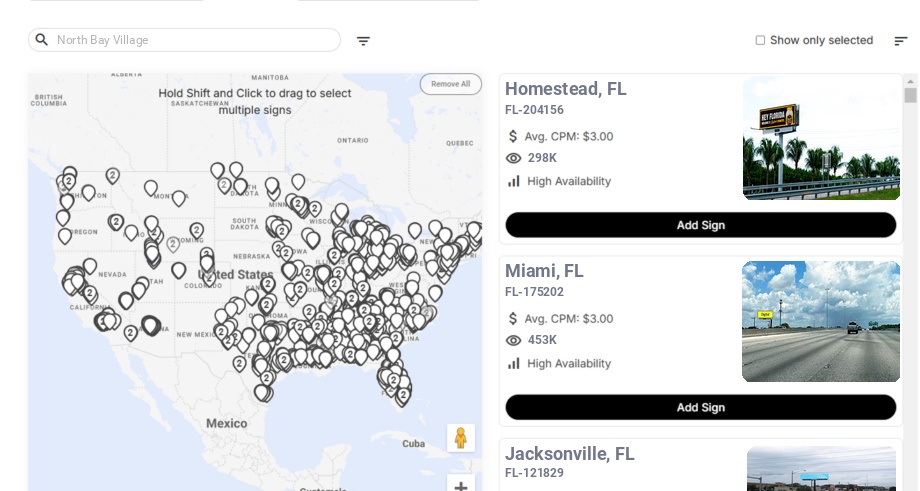
Blip has digital billboards in North Bay Village. You can browse available locations on a map, choose the ones that fit your audience, and start advertising right away.
Still have questions? Launch a campaign in minutes — no contracts, no commitments.
Start Your CampaignNorth Bay Village Billboard Advertising Guide
North Bay Village, Florida, may be small in land area, but it sits on one of the most strategic commuter corridors in Miami-Dade County. As a bridge city between Miami and Miami Beach, it gives us access to tens of thousands of daily drivers, a constant flow of tourists, and a dense local population in just a few blocks. When we use digital North Bay Village billboards with Blip’s flexible tools, we can combine hyper-local relevance with regional reach across the broader Miami metro.
Understanding the North Bay Village Market
North Bay Village is a three-island municipality in Biscayne Bay—Harbor Island, Treasure Island, and North Bay Island—connected by the John F. Kennedy Causeway (SR 934). According to the City of North Bay Village, the city’s population is just over 8,000 residents, but its exposure is far larger because the causeway is a core east–west connector for the region. That makes billboards in North Bay Village disproportionately powerful compared with the city’s small footprint.
Within just a few miles of North Bay Village, the market expands rapidly:
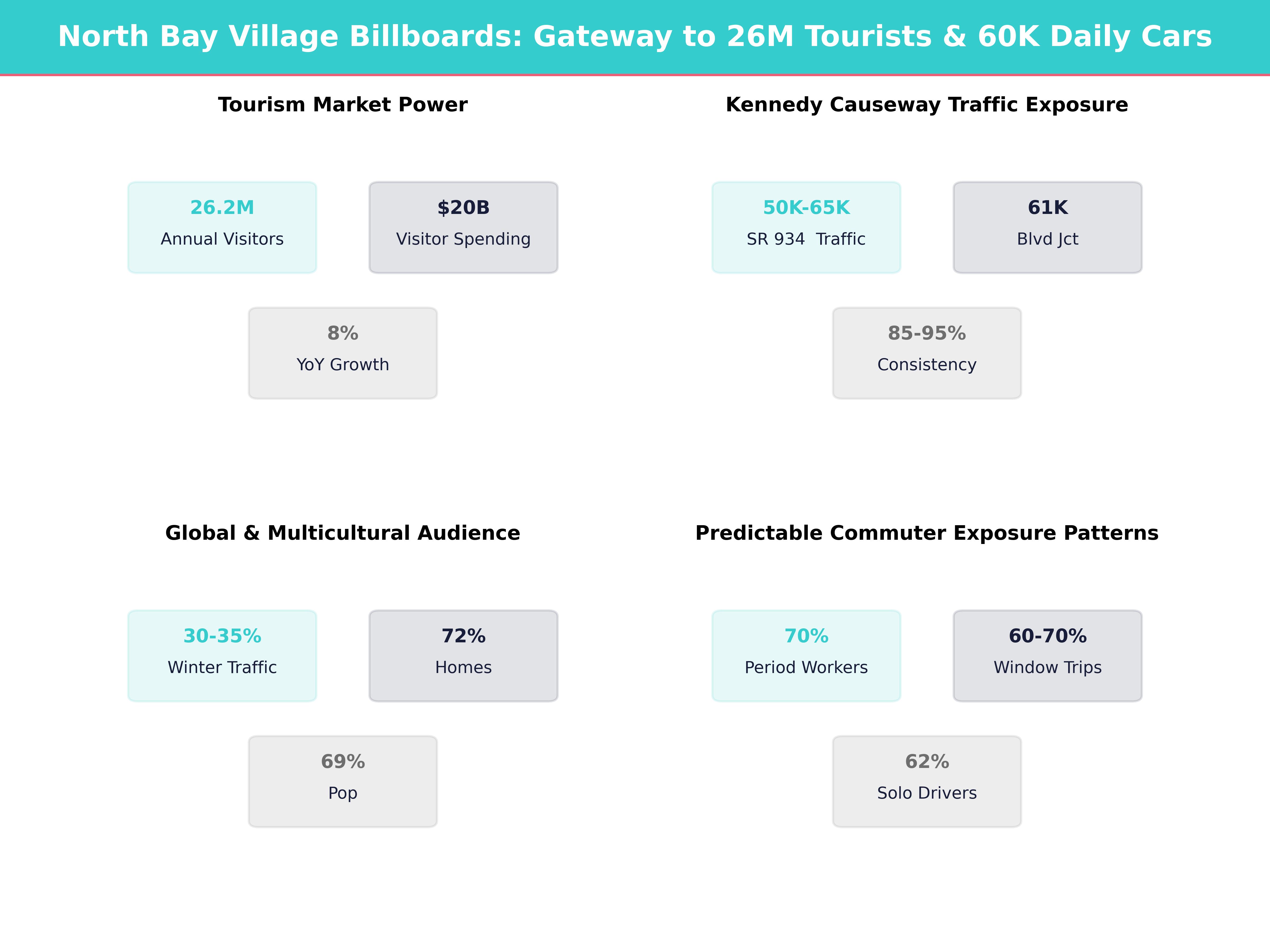
- According to Miami-Dade County, the county has over 2.7 million residents and more than 1.4 million non‑farm jobs, with about 62% of workers commuting by car alone, creating heavy daily flows across the bay.
- The Greater Miami Convention & Visitors Bureau 26.2 million visitors in 2023, up from 24.2 million in 2022—an increase of roughly 8% year over year. Of these, more than 17 million were overnight visitors who tend to generate more impressions per trip.
- Visitor spending in Greater Miami reached over $20 billion annually in recent years, with roughly 40–45% of that spend tied to lodging and food & beverage—categories that are highly responsive to billboard messaging.
- Hotel performance in Miami Beach and Miami is consistently strong; the GMCVB’s lodging data show peak winter occupancy often in the 75–80% range, with average daily room rates frequently exceeding $300 per night in top periods. That concentration of high‑spending visitors translates into dense tourist traffic on all cross‑bay routes, including the Kennedy Causeway that passes directly through North Bay Village.
In practice, this means a billboard in North Bay Village reaches:
- Local island residents and nearby neighborhoods such as Normandy Isles, Shorecrest, and Little River.
- Commuters traveling between Miami and Miami Beach.
- Domestic and international tourists headed to beaches, nightlife, and cruise terminals like PortMiami
Our North Bay Village billboard advertising campaigns should speak to all three audiences, with flexible creative and scheduling that shift with time of day and season.
Traffic Flows and Commuter Patterns on the Kennedy Causeway
The lifeline of North Bay Village is the John F. Kennedy Causeway (also known as 79th Street Causeway / SR 934). It links Miami on the west to North Beach / Miami Beach on the east, running straight across all three North Bay Village islands.
According to traffic volume data published by the Miami-Dade Transportation Planning Organization Florida Department of Transportation District Six 50,000–65,000 vehicles per day (Average Annual Daily Traffic). Recent counts on comparable east–west corridors north of Downtown Miami show:
- Around 61,000 vehicles per day near the junction of SR 934 and Biscayne Boulevard (US‑1).
- Between 45,000 and 55,000 vehicles per day on similar cross‑bay connectors serving Miami Beach.
The Kennedy Causeway itself functions as one of only a handful of direct cross-bay routes north of the MacArthur and Julia Tuttle Causeways, so we can safely treat it as a high‑volume commuter and leisure corridor where a single digital face can reach hundreds of thousands of weekly impressions. This is exactly why North Bay Village billboards are so valuable for brands that need both local and regional exposure.
How this should influence our Blip strategy:
-
Peak commuter windows:
- Eastbound: 7:00–9:30 a.m. (Miami to Miami Beach workplaces, hotels, and hospitality venues).
- Westbound: 4:00–7:30 p.m. (Miami Beach hotels, restaurants, and service workers returning to Miami and beyond).
These align with countywide commuting patterns where roughly 70% of workers travel during traditional peak periods. On Blip, we can daypart to these windows to maximize impressions among working professionals and service employees.
-
Leisure and nightlife traffic:
From about 7:00–11:30 p.m., traffic includes diners, bar and nightclub patrons, event‑goers, and tourists. Miami Beach’s restaurant and nightlife sector accounts for tens of thousands of jobs, and a large share of these employees and patrons cross the bay nightly. This is prime time for restaurants, nightlife, rideshare, delivery apps, and entertainment campaigns. -
Weekend patterns:
Weekend volumes on popular coastal corridors often remain within 85–95% of weekday levels, but shift later in the day. Saturdays and Sundays show more midday traffic for beachgoing, shopping, and brunch. This is when lifestyle brands, real estate open houses, and local services can win attention. With Blip, we can increase weekend bids while lowering or pausing midweek day slots if they are less critical.
Because Blip bills per “blip” (ad play) rather than per month, we can concentrate spend into the precise hours when this causeway is most congested and average speeds drop—often into the 15–25 mph range during peak conditions—giving drivers more time to absorb our message.
Seasonality: Leveraging Miami’s Tourism and Event Calendar
North Bay Village’s visibility is tightly connected to Miami’s tourism and events cycle. The city itself highlights its central location and views on its official site, and effectively, we are advertising in the middle of a major international tourist destination. Seasonally adjusting billboard rental in North Bay Village helps us ride the waves of this visitor demand.
Key seasonal dynamics from the Greater Miami CVB
-
Winter peak (December–March):
- This is Miami’s high season, when hotel occupancy in key beach and downtown submarkets often pushes into the 78–82% range, with some New Year’s and holiday periods selling out entirely.
- Visitor mix skews affluent, with strong influx from colder U.S. states, Europe, and Canada. International visitors can represent 30–35% of total arrivals in some winter months.
- Major events like Art Basel Miami Beach 79,000+ attendees in a typical year) and the South Beach Wine & Food Festival 60,000 attendees) drive high‑spend traffic.
-
Spring (March–May):
- Spring break crowds and major music events, including spin‑off activities tied to festivals like Ultra Music Festival in nearby Downtown Miami (drawing roughly 165,000 attendees over three days).
- Visitors skew younger, with higher demand for nightlife, entertainment, and experiences, and heavier evening and late‑night traffic patterns.
-
Summer (June–August):
- Strong family travel, cruise passengers, and Latin American tourism. PortMiami over 7 million cruise passengers annually in recent years, many of whom overnight in Greater Miami before or after cruises.
- Visitor volume remains high, but average daily room rates typically soften from winter peaks, bringing in a more price‑sensitive but still very active audience.
-
Fall (September–November):
- Slightly softer on pure leisure tourism but stronger for conventions, business travel, and local residents reclaiming the city.
- The Miami Beach Convention Center tens of thousands of delegates, many commuting across the bay.
How we can adapt campaigns with Blip:
- Run tourist-focused creative (beachwear, excursions, tours, attractions, restaurants) heavily from November through April, when visitor counts and average spend per visitor are highest.
- Switch to local and back‑to‑school messaging in late August and September, when Miami-Dade’s 330,000+ public school students and their families are in planning mode via Miami-Dade County Public Schools.
- Time event-specific campaigns (festivals, galas, concerts, sports) 7–21 days before major happenings, increasing bids during event weekends.
- Use short, high‑intensity flights around big dates (Art Basel, New Year’s, Memorial Day Weekend, Ultra, Spring Break peaks) rather than always‑on spend.
Blip’s flexibility lets us run micro‑campaigns that map to each high‑impact weekend or week, especially when hotel occupancy, restaurant covers, and visitor spending are at their highest.
Demographics and Language: Crafting Culturally Fluent Creative
Miami-Dade County is one of the most diverse and bilingual regions in the U.S. According to county‑level profiles and local data referenced by Miami-Dade County Government, more than 72% of residents speak a language other than English at home, with Spanish dominating, and nearly 69% of residents identify as Hispanic or Latino.
Within that context:
- In many neighborhoods surrounding North Bay Village—including North Beach, Little River, and Upper Eastside—household Spanish usage can exceed 70–80%.
- County data and local surveys indicate that over half of residents report speaking English “less than very well,” reinforcing the value of clear bilingual messaging.
- Median ages in Miami‑Dade hover in the 40–42 range, but coastal and nightlife areas skew younger in foot and vehicle traffic, with strong representation from the 25–44 demographic—prime spenders on dining, entertainment, and real estate.
Implications for billboard creative in and around North Bay Village:
-
Bilingual messaging:
When possible, we should consider English + Spanish in the same design, or alternate English and Spanish creatives using Blip’s rotation. For short messages, a single Spanish headline can be very effective with local residents and workers, while English supports tourists and business visitors. -
Cultural references:
- Integrate Latin flavors, colors, and references for local campaigns, mirroring the visual energy people see in neighborhoods like Wynwood and Ocean Drive.
- For tourist‑centric creative, use clear, universal imagery (beach, skyline, dining, nightlife) that resonates regardless of native language.
-
Tone and style:
Miami’s visual culture is bold: think neon, Art Deco, tropical gradients, and high contrast. Simple, bright visuals cut through the visual clutter of the skyline and bay views.
Practical tips:
- Keep to 7–10 words or fewer in your main headline, especially since drivers are moving at 35–45 mph across the causeway under posted speed limits.
- Use large, sans‑serif fonts and high contrast (dark text on light background or vice versa).
-
For bilingual, try stacked or split messaging:
- Top: “Brunch Today?”
- Bottom: “¿Listo para el brunch?”
with a clear call to action and straightforward location.
Creative Strategy: What Works Visually on the Causeway
Billboards in North Bay Village compete with water views, high‑rise facades, and the open horizon. Our designs must be instantly legible and visually strong.
We should emphasize:
-
Big, bold location cues
- “5 MINUTES AHEAD ON MIAMI BEACH”
- “NEXT EXIT TO MIAMI”
- “JUST OFF THE 79TH ST CAUSEWAY”
Drivers crossing the bay use a mental map (Miami vs. Miami Beach vs. North Beach). Make it clear where we are relative to that. For context, the drive from North Bay Village to central Miami Beach via Collins Avenue is typically about 10 minutes, and to Downtown Miami via Biscayne Boulevard can be 10–15 minutes in normal traffic.
-
Short, directional calls to action
- “TURN RIGHT AT THE NEXT LIGHT”
- “EXIT BEFORE THE BRIDGE”
- “DELIVERY IN UNDER 30 MINUTES – ORDER NOW”
Messages with a clear time benefit (“in 10 minutes,” “tonight,” “this weekend”) tend to perform better for on‑the‑go audiences.
-
Visual storytelling
Use one primary image: a dish, a property exterior, a smiling customer, or a product in use. Avoid photo collages; tests across out‑of‑home campaigns show that single‑image layouts are significantly more memorable and can boost recall by 10–20 percentage points compared with cluttered designs. -
Digital flexibility
With Blip, we can upload multiple creatives and rotate them:- Day vs. night creative (coffee in the morning, cocktails at night).
- Weekday commuter vs. weekend leisure versions.
- English‑dominant vs. Spanish‑dominant versions, then watch which yields better response.
Think of each creative as a single, powerful statement rather than a mini brochure; at typical billboard distances of 400–600 feet, drivers only have 3–6 seconds to process your message.
Dayparting: Matching Messages to Mindsets
North Bay Village’s causeway traffic changes by the hour. Blip’s scheduling tools let us align messaging to what people are likely doing or feeling at that time, ensuring North Bay Village billboard advertising stays relevant throughout the day.
Suggested daypart strategy:
-
Early Morning (6:00–9:30 a.m.)
- Audience: Commuters heading into Miami Beach hotels, restaurants, service jobs; some professionals going from beach to mainland. County employment data show that hospitality, retail, and health services together employ over 500,000 people in Miami‑Dade, many working shifts that start before 9 a.m.
- Best for: Coffee shops, breakfast spots, transit apps, employment recruiting, business services.
- Messaging: “Need Coffee Before Work?”, “Now Hiring – Start This Week.”
-
Midday (10:00 a.m.–3:00 p.m.)
- Audience: Tourists, remote workers, errand‑runners, lunch crowd. In hotel submarkets near Miami Beach and Downtown, weekday occupancy around midday remains high, which helps sustain daytime leisure traffic.
- Best for: Attractions, lunch restaurants, spas, retail, tours, medical and dental practices.
- Messaging: “Lunch on the Water Today”, “Walk‑In Clinic – No Appointment Needed.”
-
Evening Commute (4:00–7:30 p.m.)
- Audience: Workers heading home, parents picking up kids, hospitality leaving late afternoon shifts. Roughly 60–70% of daily vehicle trips on major arterials in Miami-Dade occur during morning and evening commute windows.
- Best for: Family services, fitness, streaming services, home improvement, quick dinner options.
- Messaging: “Skip Cooking Tonight”, “Join the 7 p.m. Class.”
-
Night (7:30–11:59 p.m.)
- Audience: Nightlife, dining, and entertainment traffic; tourists exploring. Miami Beach alone licenses hundreds of bars and restaurants, many operating until midnight or later.
- Best for: Restaurants, bars, lounges, live music, late‑night delivery, rideshare codes.
- Messaging: “Cocktails With a Bay View”, “Late‑Night Delivery Until 2 A.M.”
By using Blip’s controls, we can shift a larger portion of our budget into the two or three dayparts where our target audience is most active, instead of spreading spend across low‑value hours such as midafternoon or late night for daytime‑only businesses.
Local Targeting: Who Can Win Big in North Bay Village
Because North Bay Village sits between two major destinations, many categories can see strong performance from digital billboards here. This makes billboard rental in North Bay Village appealing for both small local operators and larger brands seeking cross‑bay visibility.
Some high‑potential verticals:
-
Restaurants and Bars (North Bay Village, Miami, and Miami Beach)
- Miami-Dade has more than 12,000 food and drinking establishments, and the Greater Miami CVB highlights dining as one of the top reasons visitors come to the region.
- Use causeway billboards to capture “Where should we eat?” decisions as people drive across the bay.
- Feature one hero dish or drink, a clear location cue (“10 minutes ahead on Collins Ave”), and possibly valet or free parking mentions.
- Run heavier in the 4:30–10:30 p.m. window and weekends, aligning with dinner peaks when restaurant revenues can be 2–3 times lunch volumes.
-
Real Estate (condos, rentals, pre‑construction)
- Miami’s condo market is highly visual and aspirational, and North Bay Village is itself undergoing redevelopment, with the city’s planning documents highlighting new mixed‑use and residential projects.
- Use billboards to promote open houses or new developments with short, time‑bound campaigns (“Open House This Weekend”).
- Highlight bay views, walking times to beach, or “Only 5 minutes from Miami Beach.” Coastal units often command premiums of 20–40% per square foot compared with inland submarkets, making even a modest lift in qualified leads valuable.
-
Tourism and Attractions
- Boat tours, water sports, cultural attractions, museums, and shows can all benefit from reaching visitors crossing the bay. Greater Miami’s arts and culture sector attracts millions of visits annually, with venues like the Pérez Art Museum Miami Phillip and Patricia Frost Museum of Science, and local theaters heavily promoted by MiamiandBeaches.com.
- Emphasize online booking and promo codes that guests can remember easily (“Use code BAY10”). Even a 2–5% redemption rate from billboard viewers can yield strong ROI for high‑margin experiences.
-
Healthcare and Wellness
- Miami-Dade is a regional hub for healthcare and medical tourism, with major systems and specialists drawing patients from Latin America and the Caribbean.
- Urgent care, dental, cosmetic procedures, and fitness studios can target both residents and workers commuting through North Bay Village.
- Focus on convenience: “Same‑Day Appointments”, “Walk In After Work.” For local practices, converting even 5–10 additional patients per month from billboard exposure can cover campaign costs.
-
Local Services (auto, legal, financial, education)
- Many service decisions are made based on perceived proximity and trust. The dense residential clusters within a 3‑mile radius of North Bay Village include portions of Miami Beach, North Miami, and Miami’s Upper Eastside, representing well over 100,000 residents.
- Use simple, trust‑building messages and a strong, easy‑to‑remember URL or phone number.
Because Blip is budget‑flexible, even small businesses based in or near North Bay Village can afford to show alongside regional brands by running focused, time‑bounded campaigns with daily budgets as modest as a few dollars.
Budgeting and Bidding: Making Every Blip Count
Blip allows us to set daily or campaign‑level budgets and maximum bids per blip, then adjust based on performance. For the North Bay Village area, where vehicular traffic is dense but inventory is limited by geography, a disciplined approach helps us stretch spend and get more from North Bay Village billboards.
Practical budgeting recommendations:
-
Start with a test flight of 7–14 days.
Run multiple creatives and at least two or three dayparts so we can see what works best before committing more budget. In a corridor that can reach 50,000+ daily vehicles, even a short test can generate hundreds of thousands of impressions. -
Use higher bids during premium hours.
Allocate higher bids to:- 7–9:30 a.m. and 4–7:30 p.m. on weekdays if you’re business‑ or commuter‑oriented.
- 6–10 p.m. on Thursdays–Saturdays if you’re nightlife or dining.
Premium hours may cost more per blip, but often deliver 30–50% higher likelihood of immediate action (phone calls, map searches, walk‑ins) because they align with decision windows.
-
Adjust in real time.
If you notice (via web analytics, calls, or store traffic) that response spikes at certain times, re‑weight your budget into those windows. For example, if your restaurant sees 20% more walk‑ins on nights when you run 6–9 p.m. blips compared with all‑day scheduling, concentrate spend there.
Because we pay only when our creative actually displays, and we can pause or change bids at any time, we can actively manage campaigns around holidays, weather, and special events—essential in a coastal city where storm systems and festival calendars can dramatically influence behavior and traffic on any given day.
Measuring Impact in a Tourist‑Heavy Corridor
While billboards are a top‑of‑funnel medium, there are several ways to quantify performance around North Bay Village:
- Branded search and direct traffic:
Watch for increases in searches for your brand name, and direct type‑ins to your URL, during and after your campaign period. In many local campaigns, advertisers see branded search lift in the 10–30% range while billboards are active. - Promo codes and vanity URLs:
Use simple, billboard‑specific codes like “BAY10” or URLs likeYourBrandMiami.comto track redemptions or visits. Even if just 1–3% of exposed viewers respond, the volume along a 50,000‑vehicle‑per‑day corridor can add up quickly. - Call volume and text inquiries:
Track calls or SMS to billboard‑specific phone numbers. Short, numeric phone numbers or click‑to‑call numbers in Google Business Profiles often show noticeable spikes during campaigns. - In‑store attribution:
Train staff to ask “How did you hear about us?” and log “Billboard / North Bay Village” responses. If 5–10% of new customers mention billboards, that can validate and refine ongoing investment.
Pairing these metrics with your Blip campaign data (impressions by hour and day, creative rotation, etc.) allows us to refine message, timing, and bidding on subsequent flights.
Creative and Compliance Considerations
North Bay Village, like all municipalities in Miami-Dade, operates under local and county regulations for outdoor advertising. Before launching, we should be aware of:
- Content standards:
While digital billboards are typically operated under strict guidelines, we should always avoid overly explicit or misleading claims. Staying clear, family‑friendly, and truthful helps maintain long‑term brand equity and aligns with community expectations in a city where families, tourists, and workers share the same corridor. - Municipal and county rules:
The City of North Bay Village and Miami‑Dade County provide zoning, sign, and right‑of‑way information that can affect billboard placement and content. While Blip and its partners manage permitting for existing faces, advertisers should remain aware of any industry‑specific restrictions (for example, healthcare disclosures or legal advertising rules). - Emergency and weather events:
In hurricane season (June–November), there may be times when storm or emergency messaging takes precedence. Local authorities and outlets such as Miami-Dade County Emergency Management and news organizations like the Miami Herald NBC 6 South Florida become key information sources. We can align creative to show community support (e.g., reopening notices, safety messages) after major weather events.
For the latest ordinances and local context, consult the City of North Bay Village and Miami‑Dade’s regulatory information as needed.
Putting It All Together
A high‑performing Blip campaign in North Bay Village typically combines:
- Strategic location choice along the Kennedy Causeway to capture cross‑bay commuters and tourists—tapping into 50,000+ vehicles per day and Greater Miami’s 26.2 million annual visitors with well‑placed billboards in North Bay Village.
- Bold, simple, bilingual‑friendly creative that fits Miami’s bright visual culture and is legible at speed, with 7–10‑word headlines and strong contrast.
- Smart dayparting that aligns with commuter, tourist, and nightlife patterns, shifting budget into the 2–3 highest‑value windows each day.
- Seasonal and event‑based flights that ride the wave of Miami’s visitor and festival calendar, especially winter high season and marquee events like Art Basel and SOBEWFF.
- Data‑driven optimization using promo codes, analytics, call tracking, and in‑store surveys to steadily improve response and ROI.
By understanding how this small island city functions as a gateway between Miami and Miami Beach, we can use Blip’s flexible, pay‑per‑play model for North Bay Village billboard advertising to show up at precisely the right moments—turning North Bay Village’s constant flow of cars and visitors into sustained brand growth.