Billboards in Doral, FL
No Minimum Spend. No Long-Term Contracts. Just Results.
Trusted by Leading Brands


Billboard advertising
in Doral has never been easier
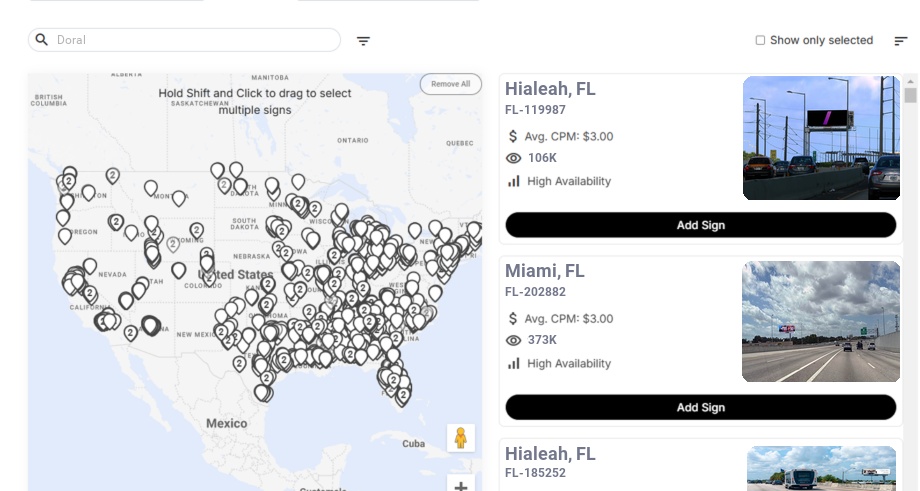



How much is a billboard in Doral?
Why Choose Blip for Billboard Advertising in Doral
Blip lets you launch Doral ads fast on a self-serve platform, reaching SR 826 and SR 836 commuters without waiting on an agency.
Set a flexible daily budget for Doral and stay in control while you test bilingual creative near MIA, hotel, and retail traffic.
No contracts with Blip means you can run Doral campaigns for winter travelers or back-to-school rushes, then pause anytime.
Use dayparting in Doral to hit warehouse workers at dawn, lunch crowds midday, and evening commuters on Palmetto and Dolphin.
Track Doral performance in real time and shift spend toward boards that work best for airport routes, logistics zones, or shopping trips.
Blip's creative tools make it easy to build bold Doral billboards with clear Spanish-English messaging for a bilingual, high-growth audience.
Frequently Asked Questions About Billboard Advertising in Doral
How much does a billboard cost near Doral, Florida with Blip?
With Blip, you can advertise on Doral billboards on any budget by setting a daily amount that works for you, and Blip automatically keeps your campaign within that limit. Each “blip” is a 7.5 to 10-second ad display on digital billboards near Doral, Florida, and you only pay for the blips you receive. Costs vary based on when you choose to run your ads, where they show in the Doral area, and overall advertiser demand.
Where can I advertise with Blip near Doral, Florida?
Blip has 48 digital billboards serving the Doral area from nearby Medley, Hialeah Gardens, Hialeah, and Miami, all within about 7 miles. While the structures may be outside city boundaries, they efficiently reach people who live, work, or shop near Doral. The area also includes major corridors like SR 826, SR 836, NW 36th Street, and NW 25th Street.
What kind of audience can Blip reach on Doral billboards in Florida?
The Doral area sits at the crossroads of international commerce, logistics, and affluent suburban life in northwest Miami-Dade County. Advertisers can use nearby digital billboards to reach decision-makers, commuters, shoppers, and travelers moving through this high-growth market. The area is also heavily Hispanic, bilingual, and relatively affluent, with a strong daytime workforce and proximity to Miami International Airport.
When is the best time to run Doral, Florida billboard ads with Blip?
The Doral area experiences relatively stable year-round traffic due to its business base, with heavy morning, midday, and evening traffic patterns. Morning commute, midday lunch and errands, and evening commute all create strong opportunities depending on your message. Winter is also especially useful because tourism and international visitors increase during the December to March high season.
What traffic patterns make Doral, Florida billboards effective?
Segments of SR 826 and SR 836 near Doral carry well over 150,000 vehicles per day, with some sections exceeding 200,000 Average Annual Daily Traffic. Secondary arterials such as NW 36th Street and NW 25th Street often see 40,000 to 70,000 vehicles per day. Nearby Miami International Airport also drives a constant mix of business travelers, tourists, freight, and commuter traffic through the area.
Do I need a contract to advertise with Blip in Doral?
No, Blip has no long-term contracts or minimum commitments. You can start, pause, or stop your campaign at any time.
How fast can I launch a billboard campaign with Blip in Doral?
You can have your campaign live in minutes. Create a free account, select your locations, set your budget, upload your design, and start running once approved.
Where can I advertise with Blip in Doral?
Blip has digital billboards in Doral. You can browse available locations on a map, choose the ones that fit your audience, and start advertising right away.
Still have questions? Launch a campaign in minutes — no contracts, no commitments.
Start Your CampaignDoral Billboard Advertising Guide
The Doral area sits at the crossroads of international commerce, logistics, and affluent suburban life in northwest Miami-Dade County. With strong Latin American ties, a booming daytime workforce, and proximity to Miami International Airport, advertisers can use nearby digital billboards to efficiently reach decision-makers, commuters, shoppers, and travelers moving through this high-growth market. For brands looking specifically for billboards near Doral, this concentration of audiences makes the area especially attractive for targeted campaigns.
Understanding the Doral Area Market
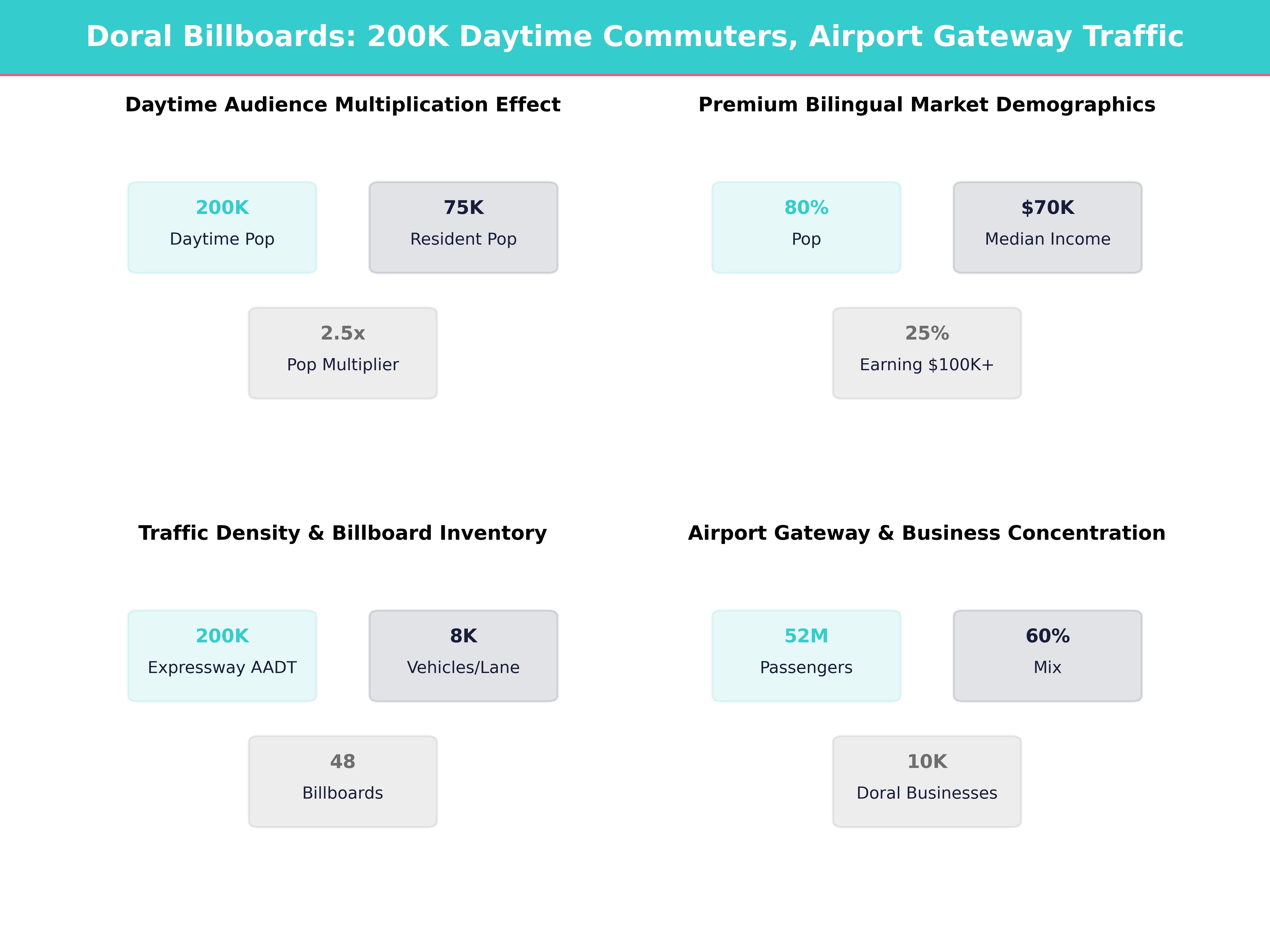
The City of Doral, according to recent city and county estimates, has roughly 75,000–80,000 residents, but the impact of the market is far larger:
- Miami-Dade County as a whole has about 2.7 million residents, and more than 1 in 5 county jobs are located in or immediately around the Airport/Doral/Medley industrial triangle, according to Miami-Dade County economic reports.
- Doral’s daytime population is estimated by local planning studies to exceed 200,000 people on a typical weekday once commuters, students, and visitors are included—roughly 2.5–3 times its residential base.
- The City of Doral reports more than 10,000 businesses operating in the city, including regional and Latin American headquarters for multinational brands, logistics firms, and tech companies. The city lists over 1,000 logistics and freight-related firms alone in its business registry.
- Nearby Miami International Airport (MIA), directly east of Doral, handled over 52 million passengers in 2023 and more than 250,000 aircraft movements. MIA is also ranked among the top U.S. airports for international freight, moving over 2.7 million tons of cargo annually, a major driver of trucking flows through Doral and Medley via SR 826 (Palmetto Expressway), NW 25th Street, and NW 36th Street.
With 48 digital billboards serving the Doral area from nearby Medley, Hialeah Gardens Hialeah, and Miami (all within about 7 miles), we can precisely reach:
- Residents of Doral’s dense condo communities and single-family neighborhoods, where average household sizes are around 3.0–3.2 people.
- Warehouse and distribution workers in Medley and along the Dolphin and Palmetto corridors, where industrial vacancy rates have hovered near historic lows (often below 4–5%) in recent years, indicating intense business activity.
- Corporate professionals and international business travelers using MIA and surrounding hotels; the Airport District and Doral together host dozens of branded hotels, with several thousand rooms catering to both business and leisure visitors.
- Shoppers visiting regional malls and big-box retail clusters near the Turnpike and SR 826, including centers like Miami International Mall Dolphin Mall
The combination of residential affluence, B2B activity, and heavy traffic makes the Doral area ideal for both consumer and business-focused billboard campaigns, especially for advertisers comparing Doral billboards to other Miami submarkets.
Key Demographics and What They Mean for Your Message
Doral sits at the heart of a heavily Hispanic, bilingual, and relatively affluent market.
Based on recent demographic and economic estimates for the Doral area and northwest Miami-Dade from county planning profiles and City of Doral data:
- Hispanic/Latino residents comprise roughly 80–90% of the local population in Doral and adjacent communities, compared with about 69–70% across Miami-Dade County overall.
- The foreign-born share of the population is above 70% in Doral, significantly higher than the roughly 54–55% countywide average, with large communities from Venezuela, Colombia, Brazil, Argentina, Cuba, and other Latin American countries.
- Median age is in the mid-30s (about 35–37 years), skewing slightly younger than the U.S. average, with a large number of working-age adults and families. Nearly two-thirds of residents are between 18 and 64, a prime consumer and professional audience.
- Household incomes in the Doral area trend above the national median. Recent estimates place Doral’s median household income in the $70,000–$80,000 range, with a sizable share of households—often 25–30% or more—earning above $100,000 annually, creating strong middle and upper-middle income segments.
- Educational attainment is high: in Doral, more than 40% of adults 25+ hold at least a bachelor’s degree, supporting demand for professional services, private education, and specialized healthcare.
- Homeownership rates in Doral are typically in the 45–55% range, with a large condo market and steady in-migration of young families and professionals.
How to use this information in your billboard strategy:
- Language choice: Consider fully bilingual creatives (English + Spanish) or Spanish-first campaigns if your product is already widely recognized in the community. Use clear, neutral Spanish that can be understood by diverse Latin American audiences.
- Cultural cues: Visuals that reflect Latin American culture, family life, and small business ownership often resonate. Think family-oriented imagery, entrepreneurial success stories, or regional flavors in food and lifestyle campaigns.
- Professional tone for B2B: With more than 10,000 businesses near Doral and industrial and office vacancy rates frequently under 10%, B2B campaigns benefit from clean, corporate visuals and concise benefit statements (“Cut Shipping Time 30%,” “Save 20% on Commercial Insurance”).
- Family and lifestyle orientation: For B2C brands, emphasize family safety, education, home improvement, finance, and wellness—key priorities for Doral area households where children under 18 often make up 20–25% of residents.
Local media such as the Doral Family Journal Miami Herald Local 10 WPLG, and Telemundo 51 reflect and shape local interests; exploring their coverage can help refine tone and topics for your message and align them with your billboard advertising near Doral.
Traffic Patterns and Where Your Audience Moves
Our 48 digital billboards serving the Doral area are placed along major arteries that channel commuters, freight, and shoppers around northwest Miami-Dade. While structures may be in Medley, Hialeah Gardens, Hialeah, or Miami, they efficiently reach people who live, work, or shop near Doral, giving advertisers the impact of Doral billboards without being limited to city boundaries.
Key traffic dynamics to consider:
-
Expressways:
- SR 826 (Palmetto Expressway) and SR 836 (Dolphin Expressway) connect Doral to Miami, Miami Beach, Kendall, and the Airport District.
- Segments of SR 826 and SR 836 near Doral carry well over 150,000 vehicles per day, with some sections exceeding 200,000 Average Annual Daily Traffic (AADT), according to the Miami-Dade Transportation Planning Organization and FDOT District 6
- Even secondary arterials such as NW 36th Street and NW 25th Street often see 40,000–70,000 vehicles per day, providing strong visibility for surface-street billboards.
-
Industrial & logistics zones:
- Medley, just 3 miles northwest of Doral, is a major warehouse and trucking hub, with industrial space measured in tens of millions of square feet and some of the highest truck volumes in the county.
- Billboard placements near Medley and Hialeah Gardens capture daily truck traffic, shift workers, and logistics professionals traveling to and from MIA and the urban core.
-
Retail and commercial nodes:
- High-traffic retail areas around malls and big-box centers near the Palmetto and Turnpike corridors attract regional shoppers throughout the week and spike on weekends.
- Regional shopping centers in the Doral/Airport area can see weekend visitor surges of 20–30% above weekday baselines, based on local retail foot-traffic analytics cited by area property managers.
-
Airport and hotel traffic:
- Travelers and employees going to and from Miami International Airport stream through adjacent corridors that also serve the Doral area, especially along NW 36th Street and the Dolphin Expressway.
- With more than 52 million passengers per year and roughly 60% of them international, MIA generates a constant mix of high-spend business travelers and tourists, many staying in Doral or nearby hotels listed by the Greater Miami Convention & Visitors Bureau.
How to translate traffic patterns into campaign tactics:
- Use boards along expressways and main arterials to introduce your brand or high-level offers to broad commuter audiences; a single high-traffic board can generate hundreds of thousands of daily impressions and function like multiple billboards near Doral at once.
- Focus industrial-adjacent billboards (near Medley and Hialeah Gardens) on B2B services, staffing, logistics tech, equipment, or commercial real estate, especially during weekday morning and afternoon peaks.
- Prioritize boards near retail clusters for same-day and weekend purchase decisions (restaurants, furniture, auto sales, electronics, big-box retail).
- If your audience includes travelers or hospitality clients, schedule impressions on boards aligned with airport access routes and near hotel clusters tracked by the Greater Miami & Miami Beach tourism team.
When to Advertise: Dayparting and Seasonality in the Doral Area
The Doral area experiences relatively stable year-round traffic due to its business base, with additional seasonal layers driven by tourism and events.
Daily patterns to consider:
- Morning commute (6:30–9:30 a.m.): Heavy inbound traffic toward offices, warehouses, and the Airport District. In some segments of SR 826 and SR 836, peak-hour volumes can reach 8,000–10,000 vehicles per lane per direction.
- Midday (11 a.m.–2 p.m.): Significant movement for lunch, deliveries, and errands; great for restaurants, quick-service food, medical visits, and local retail. Many Doral office and warehouse workers have 30–60 minute lunch windows that keep nearby arterials busy.
- Evening commute (4–7 p.m.): Strong outbound traffic as workers leave Doral-area job centers for western suburbs and central Miami. Congestion frequently pushes speeds down, effectively increasing the time drivers spend in view of each board.
- Late evening (after 8 p.m.): Useful for nightlife, entertainment, streaming, and fast-food campaigns, though overall volumes are lower than peak commute times; this can also mean lower cost per impression in some buying strategies.
Seasonal patterns:
-
Winter (December–March):
- Greater Miami & Miami Beach reports that the region hosts millions of visitors each year, with hotel occupancy and room rates typically peaking in winter high season.
- International visitors—especially from Latin America—are more concentrated in this period, aligning well with Doral’s bilingual and foreign-born profile.
- Hospitality, tourism experiences, retail, and events should increase frequency near the Doral area during these months to catch both residents and visitors.
-
Spring and Fall:
- Strong for real estate, education, after-school programs, and healthcare enrollment campaigns, as families adjust housing, schooling, and insurance before and after summer.
- Local event calendars from the City of Doral and Miami-Dade County often feature cultural festivals, art events, and sports, creating additional promotional hooks that can be amplified with billboard advertising near Doral.
-
Summer (June–August):
- Good for family activities, shopping, and back-to-school campaigns; traffic on industrial corridors remains steady due to logistics and business operations, even if tourism patterns shift.
- Back-to-school shopping in Miami-Dade typically spikes in late July and early August, and Florida’s tax-free holidays amplify demand for apparel, electronics, and school supplies.
Using Blip’s flexibility, you can adjust your schedule in real time:
- Concentrate your budget on peak commuter hours if you need maximum impressions in a short window.
- Run lunch-focused campaigns (e.g., restaurant specials) only between 11 a.m. and 2 p.m. on weekdays.
- Boost evening and weekend delivery, entertainment, or ministry campaigns when people are planning leisure activities.
Crafting Effective Creative for the Doral Area
Creative that works near Doral must be bold, instantly readable, and culturally tuned.
Best practices:
-
Bilingual and simple
-
Consider short, dual-language lines:
- “Auto Insurance You Can Trust / Seguro de Auto en el que Confías”
- “Enroll Today / Inscríbete Hoy”
- Limit text to 7–10 words total. Drivers at 55–65 mph have only 5–7 seconds—and sometimes just 400–600 feet of viewing distance—to read your message.
-
Consider short, dual-language lines:
-
High-contrast design
- Use strong contrast (dark text on light backgrounds or vice versa) so messages remain legible in bright South Florida sunlight and at night.
- Avoid thin fonts and cluttered layouts; one main image, one headline, and one clear logo is ideal.
- Remember that in peak hours, stop-and-go traffic on SR 826 and SR 836 can boost dwell time by 20–40% compared with free-flowing conditions, making clear visuals even more valuable.
-
Highlight numbers and proof
-
This market is business-savvy; quantifiable benefits work well:
- “Save Up to 30% on Freight”
- “From $0 Down / Desde $0 de Enganche”
- “24/7 Emergency Care in the Doral Area”
- Limited-time offers and discounts can trigger quick action, especially when tied to widely recognized shopping seasons (holiday sales, tax refunds, back-to-school).
-
This market is business-savvy; quantifiable benefits work well:
-
Use local cues
- References to “Doral area,” “near the Palmetto,” or “minutes from Miami International Airport” help people locate your business and connect your offer to recognizable Doral billboards they pass daily.
- If you are in or near Doral, include a simple locator: “Exit NW 36th St,” “Next to Miami International Mall,” etc.
- Mentioning local landmarks—such as “by CityPlace Doral” or “near Dolphin Mall”—can improve recall among residents familiar with those destinations.
-
Rotate creatives for testing
-
With digital boards, you can run multiple creative variations:
- English-only vs. bilingual
- Price-focused vs. value-focused
- Different lifestyle images (family vs. professionals)
- Track response (calls, web visits, promo codes) by creative to learn what resonates most. Swapping underperforming creatives can boost response rates by 10–30% over time, based on typical digital out-of-home optimization results shared by industry case studies.
-
With digital boards, you can run multiple creative variations:
Strategic Use Cases by Industry
Different sectors can tap into the Doral area’s unique mix of residents, professionals, and travelers. When you plan billboard rental near Doral, align your strategy with how each of these audiences moves through the market.
B2B and Logistics
Doral and nearby Medley are logistics and warehouse powerhouses. The Airport West submarket—including Doral, Medley, and surrounding areas—contains tens of millions of square feet of industrial space and regularly posts some of the lowest industrial vacancy rates in South Florida.
Use billboards near industrial corridors to reach:
- Import/export firms, freight forwarders, and customs brokers tied to MIA’s 2.7 million metric tons of annual air cargo.
- Warehouse operators and distribution centers serving both local and Latin American markets.
- Corporate decision-makers at regional headquarters located in Doral’s office parks.
Messaging ideas:
- “Cut Your Warehouse Costs 20% – Ask Us How”
- “Faster Freight from MIA to Latin America”
- “Secure Commercial Insurance for Your Fleet”
Consider running heavier frequency on weekdays during commute times, when managers and operators are on the road between sites or heading to/from offices, and when SR 826 and SR 836 are at their highest traffic volumes.
Retail, Auto, and Services
With high household incomes and dense housing, Doral-area residents are prime targets for:
- Auto sales and leasing, including luxury and SUV segments that perform well in suburban Miami-Dade.
- Furniture, appliances, and electronics tied to the area’s active condo and home-renovation market.
- Banking, insurance, and financial advisory services for a population where a significant share of households earn above $75,000.
- Gyms, beauty, and wellness services in a wellness-conscious region where local surveys often show fitness and appearance among top household spending priorities.
Tactics:
- Time big promotions (holiday sales, tax-season offers, back-to-school sales) with weekend-heavy schedules. Retail footfall in major centers around Doral can rise 20–40% on key holiday weekends.
- Use directional cues from major corridors: “Next Exit,” “2 Miles Ahead off Palmetto,” etc., especially near complex interchanges like SR 826/SR 836.
- Combine brand-building creatives (logo + slogan) with offer-specific creatives to both build awareness and drive immediate visits. Tracking promo codes can help you see whether offer-focused boards deliver higher conversion, particularly when used on highly visible billboard advertising near Doral’s busiest shopping routes.
Real Estate and Home Services
The Doral area has seen substantial residential growth and condo development over the last decade, with thousands of housing units added and steady absorption.
Advertisers can:
- Promote new developments, pre-sales, and leasing targeting both local renters and international buyers who often fly through MIA.
- Market mortgage, title, and home-inspection services to a financially stable audience with rising home values.
- Advertise renovation, HVAC, landscaping, and security systems in a climate where A/C usage is nearly year-round and storm preparedness is a recurring concern.
Sample approaches:
- “New Luxury Condos in the Doral Area – From the $400s”
- “Need More Space? Call Our Doral Area Agents Today”
- “24/7 A/C Repair – Rapid Response in the Doral Area”
Align these with weekdays (commutes) for workers contemplating moves and weekends for active home shoppers who may already be touring open houses listed with local brokers and on regional MLS feeds.
Healthcare and Education
The Doral area’s family-centric profile creates strong demand for:
- Clinics, urgent care, and specialty practices; local urgent care centers frequently report peak visits in evenings and weekends, making off-peak billboard inventory valuable for these messages.
- Dental, orthodontic, and pediatric services for households where children and teens account for roughly 20–25% of residents.
- Private schools, language schools, and after-school programs, important in a community with high educational aspirations and significant foreign-born populations looking for bilingual or English-enrichment options.
Ideas:
- “Urgent Care Near the Doral Area – Open 7 Days”
- “Bilingual Preschool Enrollment Now Open”
- “Improve Your English / Mejora Tu Inglés – Classes Near Doral”
Use Blip’s dayparting to emphasize school-related and family messages in early mornings and late afternoons, when parents are commuting with children and when school-drop-off traffic often spikes local volumes by 10–20%.
Events, Hospitality, and Tourism
Proximity to MIA, hotels, and entertainment venues offers opportunities for:
- Concerts, festivals, sports, and cultural events promoted across Greater Miami & Miami Beach, including events listed by the Greater Miami Convention & Visitors Bureau.
- Attractions and museums marketed to Doral-area residents and airport-area visitors looking for same-day activities.
- Hotels and resorts capturing both business and leisure travelers, including those staying in Doral’s many select-service and extended-stay properties.
You can coordinate campaign timing with the event calendar from entities like the Greater Miami Convention & Visitors Bureau and the City of Doral Parks & Recreation
- Push event promotions heavily in the 1–3 weeks before the event, when online search and ticket sales usually ramp up.
- Use countdown-style creatives (“This Weekend Only,” “3 Days Left”) to create urgency and help drive last-minute decisions.
- Highlight parking, easy access from major roads, and limited-time pricing. For large events expected to draw thousands of attendees, directional and parking-focused messaging can reduce friction and increase satisfaction, especially when featured prominently on Doral billboards drivers see as they approach venues.
Leveraging Blip’s Flexibility for the Doral Area
Digital billboards serving the Doral area via Medley, Hialeah Gardens, Hialeah, and Miami give you fine control over who you reach and when. This flexible footprint makes it easy to assemble a mix of billboards near Doral that match your budget and audience goals.
Key capabilities to use strategically:
-
Location targeting:
- Choose boards that align with your audience: industrial zones for B2B, retail corridors for consumer offers, airport-adjacent for travelers, and commuter-heavy expressways for broad brand exposure.
- Use publicly available traffic maps from the Miami-Dade Transportation Planning Organization and FDOT District 6 to prioritize locations with the highest AADT near your target neighborhoods.
-
Budget control:
- Start with modest daily budgets to test creatives and locations; increase spending on the best-performing combinations.
- Reallocate budget toward corridors where your target demographic density is highest—for example, more Spanish-heavy boards in corridors with strong Hispanic commuter flows and more mixed-language boards near MIA and hotel clusters.
-
Dayparting:
-
Run different messages by time of day:
- Morning: professional services, B2B, financial services
- Midday: QSR, casual dining, retail
- Evening: entertainment, family activities, streaming services, restaurants
- Align healthcare, education, and family-oriented messaging with school and work commute peaks shown in local traffic studies.
-
Run different messages by time of day:
-
Multiple creatives:
- Tailor language or offers by route: for example, more Spanish on routes heavily used by workers coming from Hialeah and Hialeah Gardens, and more bilingual mix near airport and hotel corridors.
- Use A/B testing across 2–3 creative versions; even small design tweaks (headline, color, or hero image) can lead to double-digit percentage improvements in response rates.
-
Rapid updates:
- Quickly push new promotions, respond to competitor moves, or adjust for weather and events (e.g., storm prep, holiday sales, game-day specials).
- During hurricane season (June–November), consider timely messages tied to preparedness products or services when local news outlets such as NBC 6 South Florida and WSVN 7 increase storm coverage.
Whether you are testing billboard rental near Doral for the first time or scaling an established out-of-home plan, these tools allow you to refine your approach continuously.
Measuring Results and Optimizing Over Time
To get the most from your investment in digital billboards serving the Doral area, build a simple measurement and optimization loop:
-
Define a clear goal
- Calls, website visits, app downloads, store visits, event registrations, or quote requests.
- For context, digital out-of-home campaigns often see web and search activity lift in the range of 10–30% in exposed markets, according to industry benchmarks, so set realistic targets based on your baseline traffic.
-
Use trackable elements
- Unique URLs or QR codes for billboard viewers; many brands see QR code scan-through rates in the 0.1–0.5% range of exposed audiences, depending on offer and context.
- Billboard-specific phone numbers or extensions to track call volume from different corridors.
- Promo codes like “DORAL20” for discounts so you can assign redemptions directly to billboard impressions.
-
Align with time and place
- If you run different creatives in different corridors or dayparts, tie tracking to those variables (e.g., QR code A on weekday morning creatives, QR code B on weekend creatives).
- Compare performance near residential, industrial, and airport-heavy corridors to see where your message resonates best; then bias future spend toward the top 20–30% of placements.
-
Refine based on data
- Shift your budget toward boards and time windows generating the strongest response, whether that’s higher call volume, more website sessions from the Doral area, or increased in-store traffic.
- Retire underperforming creative variations and replace them with new tests; aim to refresh or test at least quarterly, and more often for fast-moving categories like QSR or retail.
- Coordinate with other channels (search, social, local news ads on sites like Miami Herald and Local 10 WPLG) to amplify campaigns and create consistent messaging across screens.
By understanding the unique characteristics of the Doral area—its bilingual, business-heavy, and family-focused population—and leveraging precise control over where and when your ads appear, we can use nearby digital billboards to build powerful, efficient campaigns that reach the right people at the right moments and maximize the value of billboard advertising near Doral.