Billboards in Casselberry, FL
No Minimum Spend. No Long-Term Contracts. Just Results.
Trusted by Leading Brands


Billboard advertising
in Casselberry has never been easier



How much is a billboard in Casselberry?
Why Choose Blip for Billboard Advertising in Casselberry
Blip lets Casselberry advertisers launch fast on SR-436 and US-17/92 commuter routes—no agency bottlenecks, just self-serve control.
Set a flexible daily budget in Casselberry and scale as I-4, SR-417, and SR-408 traffic shifts with peak commute and tourism waves.
No contracts with Blip means Casselberry businesses can test ads near Longwood, Sanford, and Azalea Park, then adjust as results come in.
Use real-time analytics to see which Casselberry corridor drives response, from morning I-4 commuters to lunch traffic on SR-436.
Blip's creative tools make it easy to build bilingual Casselberry ads for a diverse audience and keep your message clear for fast-moving drivers.
Frequently Asked Questions About Billboard Advertising in Casselberry
How much does a billboard cost near Casselberry, Florida with Blip?
With Blip, you can run eye-catching ads on digital Casselberry billboards on any budget, because you set a daily budget that Blip automatically stays within and you can adjust it anytime. Each ad display, or “blip,” is a 7.5 to 10-second spot on rotating billboards near Casselberry, Florida, and you only pay per blip, similar to pay-per-click online ads. The price of each blip changes based on the time of day, location, and advertiser demand in the Casselberry area, so you control when and where your message appears.
Where can I advertise with Blip near Casselberry, Florida?
Our 30 digital billboards serving the Casselberry area are located in Longwood, Sanford, and Azalea Park. These placements function as billboards near Casselberry that line up with several of the most important travel routes used by Casselberry-area residents. Taken together, this approach lets you build billboard advertising near Casselberry that blankets the full commuter shed while still prioritizing the exact stretches of roadway that matter most to your business.
What kind of people do Casselberry, Florida billboards reach?
The Casselberry area is a dense, middle-income suburban hub in eastern Seminole County, with a population of roughly 30,000 residents in just 7 square miles. The median age in Casselberry is around 39, and the area includes families with children, working-age professionals, and retirees. The Casselberry area is significantly diverse by Florida suburban standards, with Hispanic/Latino residents accounting for roughly 30–35%.
When should I run Blip ads in Casselberry, Florida to reach commuters?
Seminole County’s roads tell us a lot about when our ads should run: morning peak is around 6:30–9:00 a.m., and evening peak is around 4:00–6:30 p.m. Lunchtime traffic sees a bump around retail corridors and near office/commercial zones, especially along SR-436 and US-17/92 near major shopping centers. With Blip’s scheduling tools, we can concentrate budgets into peak hours for awareness campaigns and target midday and weekend slots for categories like shopping centers, restaurants, entertainment, and local events.
What roads and traffic numbers matter most for Casselberry, Florida billboards with Blip?
Key Casselberry-area segments along SR-436 commonly report 40,000–55,000 vehicles per day, while US-17/92 between Casselberry and Winter Park can reach the 45,000–60,000 range in busy commercial sections. I-4 through Seminole County typically runs between 130,000 and 170,000 vehicles per day, depending on the segment. SR-417 and SR-408 near Azalea Park routinely carry 80,000–110,000 vehicles per day on busy stretches connecting the airport, UCF, and eastern suburbs.
Do I need a contract to advertise with Blip in Casselberry?
No, Blip has no long-term contracts or minimum commitments. You can start, pause, or stop your campaign at any time.
How fast can I launch a billboard campaign with Blip in Casselberry?
You can have your campaign live in minutes. Create a free account, select your locations, set your budget, upload your design, and start running once approved.
Where can I advertise with Blip in Casselberry?
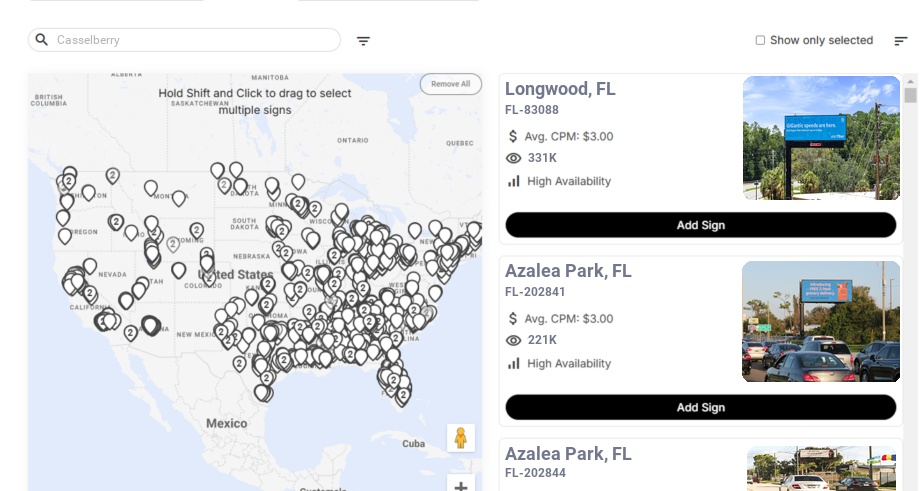
Blip has digital billboards in Casselberry. You can browse available locations on a map, choose the ones that fit your audience, and start advertising right away.
Still have questions? Launch a campaign in minutes — no contracts, no commitments.
Start Your CampaignCasselberry Billboard Advertising Guide
Casselberry sits at the heart of a busy, commuter-heavy pocket of the Orlando metro, with major corridors funneling residents, workers, and visitors between Seminole County suburbs and downtown Orlando Longwood, Sanford, and Azalea Park, we can reach this audience with flexible, data-driven campaigns that match how people really move through the region. For advertisers searching for billboards near Casselberry or exploring billboard rental near Casselberry as part of a broader Orlando strategy, this network offers both coverage and precision.
Understanding the Casselberry Area Market
The Casselberry area is a dense, middle‑income suburban hub in eastern Seminole County:
-
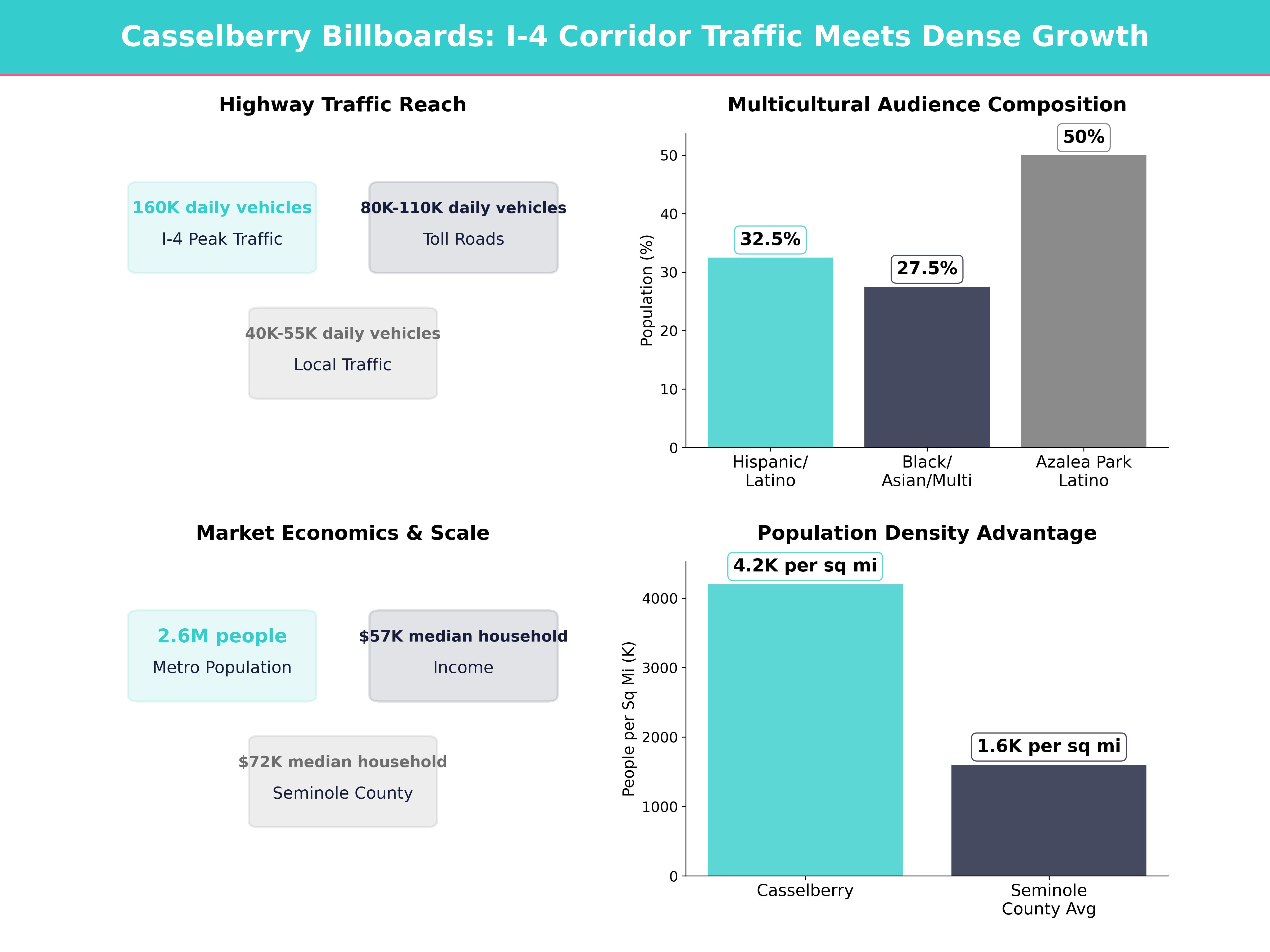
The City of Casselberry reports a population of roughly 30,000 residents in just 7 square miles, for a density of about 4,200+ people per square mile—considerably denser than the Seminole County average of about 1,600 per square mile.
- Source: City of Casselberry and Seminole County.
- Seminole County’s total population is around 480,000, and the broader Orlando–Kissimmee–Sanford metro exceeds 2.6 million people, with the metro adding roughly 25,000–35,000 new residents per year over the last several years according to regional planning and economic‑development reports.
- Seminole County continues to be one of Central Florida’s more affluent suburban counties, with an estimated 200,000+ housing units and an owner‑occupancy rate in many neighborhoods above 60–65%, helping stabilize local consumer spending.
Economically, the Casselberry area is solidly middle class:
- Median household income in Casselberry is in the $55,000–$60,000 range, compared with roughly $72,000 for Seminole County and about $65,000–$70,000 for the Orlando metro overall.
- About 45–50% of Casselberry households are renter‑occupied versus roughly 35–40% countywide, creating a strong base of long‑term renters alongside homeowners.
- Local labor‑force participation in Seminole County is typically around 63–65%, with unemployment often tracking 1–2 percentage points lower than the statewide average according to county economic briefings.
- Housing is predominantly occupied by residents (homeowners and long‑term renters), making the area attractive for campaigns targeting recurring local spend—auto service, healthcare, retail, financial services, and restaurants.
From an advertiser’s perspective, this means:
- A large, stable base of local households you can reach repeatedly—roughly 12,000–13,000 households within Casselberry city limits alone, all accessible through well‑placed Casselberry billboards on nearby commuter routes.
- Easy spillover into higher‑income communities nearby (Longwood, Lake Mary, Winter Springs, Oviedo) using the same network of digital billboards, where median household incomes frequently exceed $80,000–$90,000.
- A daytime population that swells as workers and shoppers move through retail and office corridors along SR‑436 and US‑17/92, where some shopping centers report daily customer counts in the low thousands.
Where Our Billboards Reach: Longwood, Sanford, and Azalea Park
Our 30 digital billboards serving the Casselberry area are located in:
- Longwood (~3.7 miles from Casselberry)
- Sanford (~6.3 miles)
- Azalea Park (~7.1 miles, on the east side of Orlando)
These placements function as billboards near Casselberry that line up with several of the most important travel routes used by Casselberry‑area residents:
-
I‑4 near Longwood and Lake Mary:
- FDOT counts for I‑4 through Seminole County typically run between 130,000 and 170,000 vehicles per day, depending on the segment. Peak segments between Altamonte Springs and Lake Mary frequently exceed 160,000 AADT (average annual daily traffic).
- Source: FDOT District 5 traffic data
-
SR‑417 (Central Florida GreeneWay) and SR‑408 (East–West Expressway) near Azalea Park:
- These toll roads routinely carry 80,000–110,000 vehicles per day on busy stretches connecting the airport, UCF, and eastern suburbs, with weekday peak‑hour traffic sometimes accounting for 10–12% of all daily volume.
- US‑17/92 and SR‑436 (Semoran Blvd), the main surface corridors serving the Casselberry area, feed directly into the Longwood and Azalea Park billboard zones. Key Casselberry‑area segments along SR‑436 commonly report 40,000–55,000 vehicles per day, while US‑17/92 between Casselberry and Winter Park can reach the 45,000–60,000 range in busy commercial sections.
Because Blip lets us buy exposure one “blip” at a time and target specific boards, we can:
- Focus heavier spend on boards hugging commuter paths from the Casselberry area to downtown Orlando or to job centers in Lake Mary and Sanford, where employment hubs along the I‑4 corridor host tens of thousands of office and tech jobs.
- Layer in coverage near the airport‑feeder corridors around Azalea Park to catch visitors and transient traffic tied to Orlando International Airport, which handled 57.7 million passengers in 2023, and Orlando Sanford International Airport 3–4 million passengers annually.
- Build billboard advertising near Casselberry that follows real travel behavior, ensuring your messages appear where local residents, commuters, and visitors are already driving every day.
Who You’re Reaching: Key Demographics and Lifestyles
Knowing who lives and works in the Casselberry area helps shape effective creative and scheduling for Casselberry billboards and nearby placements.
Age & Household Structure
- The median age in Casselberry is around 39, nearly identical to Florida’s statewide median.
- Roughly 25–30% of residents are under 20, and about 15% are 65 or older, producing a broad, multi‑generational audience that includes families with children, working‑age professionals, and retirees.
- Household sizes average around 2.5–2.6 people, typical for a family‑oriented suburb, with an estimated 30–35% of households including children under 18.
- In Seminole County, over 90% of residents have at least a high school diploma, and around 35–40% hold a bachelor’s degree or higher, supporting demand for professional services, financial products, and education‑related offers.
Implications for advertisers:
- Family‑focused messaging (schools, pediatric care, family restaurants, activities) resonates strongly, especially around school calendar milestones.
- Products and services that bridge generations—insurance, healthcare, financial planning, home improvement—fit the demographic profile well and benefit from repeat exposure on daily commute routes.
- Education, tutoring, and extracurricular‑activity campaigns can speak directly to the large cohort of school‑age children and teens.
Diversity
The Casselberry area is significantly diverse by Florida suburban standards:
- Non‑Hispanic White residents make up a bare majority.
- Hispanic/Latino residents account for roughly 30–35%.
- Black, Asian, and multi‑racial populations make up the balance, together representing about 25–30% of the community.
- In nearby east‑Orlando neighborhoods like Azalea Park, the Hispanic/Latino share can exceed 50%, amplifying the value of Spanish or bilingual messaging.
In practice, this means:
- Bilingual (English/Spanish) billboards can noticeably increase engagement, especially for consumer services and retail; regional campaigns that have tested bilingual creative often report double‑digit percentage lifts in call or click volumes from heavily Hispanic ZIP codes.
- Inclusive imagery—families and professionals of different backgrounds—helps your brand feel local and relatable rather than generic, particularly when paired with neighborhood‑specific references.
Income & Commuting
- A major share of working adults commute to jobs in Orlando, Lake Mary, and Sanford, with Seminole County sending tens of thousands of daily commuters into Orange and Volusia counties.
- Average commute times in the Casselberry area run around 26–29 minutes, aligning with regional norms, and many I‑4 and SR‑417 commuters experience 45‑minute or longer trips during peak congestion.
- In Seminole County, roughly 70–75% of workers drive alone, 8–10% carpool, and a smaller share use transit, cycling, or walking, underscoring the importance of roadway‑based media.
- Only a small minority of households are car‑free—private vehicle access usually exceeds 90% of households in most suburbs—reinforcing the reach value of roadside digital billboards.
For campaigns, this suggests:
- Strong opportunities for commuter‑time messaging on Longwood and Sanford boards tied to daily routines—coffee and breakfast on the way in, dinner and errands on the way home.
- Products that alleviate stress, time pressure, or cost of living (maintenance services, meal deals, telehealth, subscription services) are compelling for this audience.
- Service businesses within a 10–20‑minute drive radius of Casselberry can comfortably brand themselves as “local,” since that time window aligns with how far many residents already travel for work, school, and errands.
Traffic Patterns: When and How People Travel
Seminole County’s roads tell us a lot about when our ads should run:
- Morning peak: ~6:30–9:00 a.m.
- Evening peak: ~4:00–6:30 p.m.
- Lunchtime traffic sees a bump around retail corridors and near office/commercial zones, especially along SR‑436 and US‑17/92 near major shopping centers where parking‑lot counts often spike by 20–30% between 11 a.m. and 2 p.m.
FDOT and local planning data show:
- I‑4 through Longwood/Sanford and SR‑417 experience some of the highest congestion in the region during peak commute hours, with travel speeds on I‑4 sometimes dropping below 25 mph in heavy traffic.
- US‑17/92 and SR‑436 serving the Casselberry area regularly carry 40,000–60,000+ vehicles per day on key segments, with weekday traffic volumes often 10–15% higher than typical Sunday averages.
- The Orlando metro’s overall vehicle miles traveled have steadily increased over the last decade, with Central Florida regional reports noting year‑over‑year VMT growth in the 2–4% range during many pre‑pandemic years, and recent totals rebounding to or exceeding prior highs.
With Blip’s scheduling tools, we can:
- Concentrate budgets into peak hours for awareness campaigns (e.g., new brand launch, political campaign, healthcare clinic opening).
- Target midday and weekend slots for categories like shopping centers, restaurants, entertainment, and local events when audiences are more open to discretionary trips.
- Use lighter overnight schedules for categories such as streaming services, night‑life, or late‑night restaurants that benefit from repetition at lower cost per impression.
For more detailed traffic insights that can guide board selection and timing, advertisers can reference regional planning resources from MetroPlan Orlando and Seminole County’s Public Works and Engineering pages.
Seasonality: Weather, Tourism, and Local Events
Central Florida’s seasonality isn’t just about snowbirds—it’s about tourism, weather, and school calendars.
Tourism
-
Orlando welcomed over 74 million visitors in 2022, recovering strongly from the pandemic, with similar levels reported into 2023.
- Source: Visit Orlando.
- Visit Orlando and regional tourism agencies report that international visitation, especially from Latin America and the U.K., continues to rebound, helping keep hotel occupancy and rental demand strong across the metro.
- Many visitors stay north and east of the main theme‑park corridor to save on lodging costs, which means more out‑of‑town drivers using I‑4, SR‑417, and SR‑408 near our billboards serving the Casselberry area.
- Seminole County markets itself as “Orlando North” through Orlando North, Seminole County Tourism
Opportunities:
- Hospitality, vacation rentals, attractions, and dining can capture tourists passing through Longwood, Sanford (including those heading to the Orlando Sanford International Airport), and Azalea Park.
- Campaigns can spike in spring break (March–April), summer (June–August), and winter holiday periods (late November–early January), when Orlando‑area hotel occupancy and theme‑park attendance routinely climb by 10–30% compared with slower shoulder seasons.
- Sports tournaments, regattas on Lake Monroe, and special events promoted by City of Sanford and City of Longwood draw thousands of regional visitors on select weekends.
Weather and Lifestyle
- The Orlando region experiences hot, humid summers with afternoon storms from roughly May through September, when average high temperatures often sit in the 90–93°F range and daily rain chances commonly exceed 40–60%.
- Outdoor activities peak in October–April, when average highs drop into the 70s and low 80s°F, humidity is lower, and local parks, trails, and lakes see higher use.
- Central Florida’s hurricane season runs from June 1 to November 30, with preparedness messaging often intensifying from August through October when storm activity typically peaks.
Use this seasonality to your advantage:
- Promote indoor activities and stay‑cool products heavily in summer (gyms, indoor playgrounds, HVAC, water parks, movie theaters).
- Emphasize outdoor recreation, festivals, and home improvement in the October–April window, when residents are more willing to tackle projects and attend events.
- For storm‑related services (roofing, tree care, insurance, generators), ramp up messaging during hurricane season and immediately after major weather events covered by outlets like Spectrum News 13 and WFTV Channel 9.
Local Events and School Calendar
The Casselberry area is influenced by:
-
Seminole County Public Schools, considered one of the stronger districts in Florida, regularly serving 60,000+ students across the county.
- School calendars and events listed at Seminole County Public Schools.
- Local city events like Casselberry’s concerts, art festivals, and community gatherings, promoted via the City of Casselberry events page. Signature events can draw anywhere from a few hundred to several thousand attendees on a weekend.
- Nearby city calendars, including City of Orlando, City of Longwood, and City of Sanford, which feature parades, food & wine events, markets, and cultural festivals that attract both residents and visitors.
Timing suggestions:
- Back‑to‑school campaigns (clothing, tutoring, healthcare, tech) in late July–August, when local families are preparing for a new academic year and SCPS enrollment events and open houses are in full swing.
- Event‑based campaigns 1–3 weeks prior to festivals, performances, or city events hosted in the Casselberry area or nearby cities.
- Tax‑season messaging from February–April, when financial services and big‑ticket purchases (appliances, furniture, vehicles) often see a lift tied to refunds.
Creative Best Practices for the Casselberry Area
Because our billboards serving the Casselberry area sit on high‑speed roads and commuter corridors, simplicity and clarity win. Whether you are planning billboard advertising near Casselberry for a single promotion or a long‑term brand presence, these creative guidelines help maximize impact.
Design for Quick Readability
- Use 7 words or fewer for the main headline; studies of roadside readability suggest that keeping copy under 8–10 words significantly improves recall at highway speeds.
- Keep total visual elements to 3–4 key components: logo, short message, call‑to‑action, and maybe one image.
- Favor high‑contrast color combinations (e.g., dark text on light background or vice versa); avoid blue text on green backgrounds or low‑contrast gradients.
- Aim for 1.0–1.5 seconds of reading time per 10 mph of speed—for a 45 mph road, your message should be digestible in 5–7 seconds.
Localize Your Message
Residents of the Casselberry area respond to messaging that feels anchored in their daily life:
- Use local references: “Serving the Casselberry area since 2008” or “Minutes from SR‑436 & 17‑92.”
- Mention nearby landmarks or corridors, not just Orlando (e.g., “Near Lake Howell,” “Off 17‑92 by the Home Depot,” etc.).
- For boards closer to Sanford and Longwood, reference local touchpoints like Historic Downtown Sanford, Lake Mary Blvd, or Longwood’s Historic District—places featured on tourism and community pages from Orlando North, Seminole County Tourism
- When appropriate, include estimated travel times (“Only 7 minutes from this exit”) that reflect typical off‑peak driving conditions.
Use Bilingual and Inclusive Messaging Where Appropriate
With a sizable Hispanic population nearby:
- Consider a split campaign: some creatives in English, others in Spanish, or mixed bilingual lines (e.g., “Auto Repair You Can Trust – Servicio de Confianza”).
- In corridors like SR‑436 and the Azalea Park area, where Spanish‑speaking households can represent 40%+ of residents in some ZIP codes, Spanish‑forward messaging can materially improve response rates.
- Feature diverse families and professionals in imagery to mirror the local community.
Highlight Clear Calls‑to‑Action
For the Casselberry area’s on‑the‑go audience:
-
Use short URLs or brand names that are easy to recall (ideally 12 characters or fewer if possible), or:
- Emphasize “Search: [Brand Name] Casselberry” or “Exit at [road name]” to reduce mental load.
- If your goal is direct response, tie the CTA to something time‑bound: “This Week Only,” “Today’s Special,” “Enroll by Friday.”
- For boards near slower arterial roads (30–40 mph), limited use of QR codes can work; aim for codes at least 10–12 inches tall on screen for reliable scanning at distance.
Using Blip’s Scheduling & Targeting to Match Local Behavior
Blip’s flexibility is particularly powerful for advertisers focusing on the Casselberry area and comparing different Casselberry billboards by route, time of day, and audience.
Dayparting by Objective
-
Morning commute (6–9 a.m.)
Ideal for:- Coffee shops and breakfast spots
- Fitness centers and healthcare reminders (“Don’t ignore that back pain”)
- Traffic‑sensitive offers (“Skip I‑4 traffic—try telehealth today”)
- School‑related services as parents drive children to Seminole County Public Schools campuses
-
Midday (11 a.m.–2 p.m.)
Ideal for:- Lunch specials
- Retail and service businesses that see same‑day visits (oil changes, salons, urgent care)
- B2B messaging aimed at local decision‑makers out on errands
- Tourism‑oriented messages for visitors exploring Orlando North attractions listed on Orlando North, Seminole County Tourism
-
Evening commute (4–7 p.m.)
Ideal for:- Restaurants and grocery stores (“What’s for dinner?”)
- Family activities and entertainment
- Home services booked after work (plumbing, HVAC, lawn care)
- Promotions tied to local sports leagues, school events, or concerts happening that night
-
Late evening & weekends
Ideal for:- Nightlife, events, streaming services, and e‑commerce
- Big‑ticket items where consumers research at home (cars, real estate, solar)
- Event promotion timed to weekend festivals in Casselberry, Longwood, Orlando, or Sanford
Geographic Targeting Strategy
With billboards in Longwood, Sanford, and Azalea Park serving the Casselberry area:
-
Use Longwood boards to focus on:
- Casselberry‑area residents commuting to I‑4 corridor jobs in Altamonte Springs, Lake Mary, and downtown Orlando.
- High‑income neighbors in Longwood/Lake Mary visiting Casselberry‑area businesses; Lake Mary’s median household income often exceeds $90,000, making it an attractive audience for premium services.
-
Use Sanford boards to:
- Reach travelers to/from Orlando Sanford International Airport, which sees millions of passengers per year plus accompanying friends and family.
- Tap into regional visitors attending events in downtown Sanford or at Lake Monroe, where weekend festivals can attract 5,000–10,000+ attendees depending on the event.
- Connect with residents of northern Seminole County and Volusia County driving south toward Casselberry and Orlando.
-
Use Azalea Park boards to:
- Capture east‑Orlando commuters crossing SR‑408 and SR‑417 between residential areas and job hubs, including downtown Orlando and the UCF/Research Park corridor.
- Reach students and staff traveling toward University of Central Florida and nearby campuses, a combined population of 70,000+ students when considering the main university plus surrounding colleges.
- Connect tourism traffic moving between the airport, International Drive, and the northern suburbs.
Taken together, this approach lets you build billboard advertising near Casselberry that blankets the full commuter shed while still prioritizing the exact stretches of roadway that matter most to your business.
Budgeting and Scaling With Blip
Because Blip sells digital billboard exposure one impression at a time (“blips”), we can align spend closely with your goals:
-
Start with focused tests:
- Pick 3–5 boards most relevant to the Casselberry area and run targeted dayparts for 2–4 weeks.
- Plan for a minimum reach where your typical commuter might see your message 15–25 times across the test period, which research often associates with meaningful lift in brand recall.
- Allocate more budget to commute windows if awareness is your main KPI.
-
Scale what works:
- Increase frequency on high‑performing boards and add nearby boards for broader coverage.
- Expand from weekdays only to weekend coverage for categories like retail, restaurants, and entertainment, when Seminole County shopping and dining districts can see 20–40% higher traffic compared with weekdays.
- Layer in seasonal bursts (e.g., tax season, back‑to‑school, holiday shopping) with 2–3x your baseline daily spend for short windows.
Example frameworks:
-
Local service business (e.g., dental office)
- Budget: modest daily cap focused on a few thousand impressions per day across select boards.
- Strategy: Heavier blips Monday–Friday during morning and evening commute on boards serving the Casselberry area, especially in Longwood, with creative rotating between preventive care, emergency availability, and family plans. This kind of focused billboard rental near Casselberry makes it easy to dominate the specific corridors your patients use most.
-
Regional brand (e.g., multi‑location retailer)
- Budget: medium to large, supporting tens of thousands of impressions per week.
- Strategy: Continuous coverage with peaks during holiday seasons and big promotions, using all three zones (Longwood, Sanford, Azalea Park) and varying creative by time of day and proximity to store locations.
-
Event organizer (festival, concert, sports tournament)
- Budget: concentrated 2–3 week burst.
- Strategy: Ramp from low awareness two weeks out to high frequency the final 3–5 days before the event, with boards near primary access routes and parking locations highlighted on city or venue pages.
Industry‑Specific Ideas for the Casselberry Area
Healthcare & Wellness
The Casselberry area’s family‑oriented demographics make healthcare a strong fit:
- Promote primary care, pediatrics, dental, chiropractic, and urgent care—services that a large share of the 12,000+ local households will need multiple times per year.
- Many Central Florida urgent care centers report that 40–60% of visits occur outside traditional 9–5 hours, so evening and weekend billboard visibility is important.
-
Rotate creatives:
- Morning: “Same‑day Appointments Before Work – Book Online.”
- Evening: “Walk‑In Urgent Care until 9 P.M. near the Casselberry area.”
- Seasonal: “Flu Shots Available Now” in fall and winter; “Sports Physicals This Week” around school sports seasons.
Restaurants and Food Service
With commuter traffic and family households:
- Use lunchtime creatives on boards near office parks and commercial strips; lunch‑focused offers can tap into the 11 a.m.–2 p.m. mini‑rush when many restaurants see 25–35% of their weekday transactions.
- Drive evening visits with “Kids Eat Free,” “Happy Hour,” or “Online Ordering” messaging; dinner tends to capture another 35–45% of daily volume for many family and casual dining spots.
- Align special pushes with paydays (1st & 15th) or weekends, when discretionary spending often increases 10–20%.
- Highlight proximity to well‑known crossroads or plazas listed on city or tourism maps so drivers can quickly understand how to reach you.
Auto Dealers and Services
The average Floridian drives over 14,000 miles per year, one of the highest rates in the U.S., and Seminole County is particularly car‑dependent.
- Use boards along I‑4 and SR‑417 to raise awareness of dealerships or repair shops within a 10–15 minute drive of the Casselberry area.
-
Emphasize:
- “Free Loaner Car,” “Same‑Day Service,” “No Appointment Oil Change.”
- Local reassurance: “Serving the Casselberry area and Seminole County drivers.”
- Seasonal hooks like “Hurricane‑Ready Vehicle Check” or “Back‑to‑School Brake Specials.”
- Auto dealers often see a measurable uptick in website visits—sometimes 10–30%—during major campaign windows that include consistent billboard exposure.
Real Estate and Home Services
With many long‑term residents and ongoing in‑migration to the Orlando region:
- Realtors can promote listings, new developments, or their brand presence: “Buying or Selling in the Casselberry area?” Seminole County home sales regularly number in the hundreds per month, giving ample churn for lead generation.
- Median home prices in Seminole County are often 10–20% higher than the statewide median, supporting campaigns for higher‑end renovations, landscaping, and design services.
-
Home services—roofing, HVAC, landscaping, pest control—should:
- Run heavier in storm season (roughly June–November for hurricanes).
- Emphasize reliability and local longevity: “Trusted by Casselberry‑area homeowners since 1995.”
- Use service‑area language (“We serve all of Seminole County”) to capture nearby cities like Longwood, Winter Springs, and Oviedo.
These categories are especially well‑suited to billboard rental near Casselberry because they draw from both local residents and neighboring communities who regularly travel past our key corridors.
Working Within Local Rules and Best Practices
While digital billboards are regulated primarily by state and county agencies:
-
FDOT provides guidelines and permitting oversight for state‑road‑adjacent boards.
- Reference: FDOT District 5
- Local municipalities like Longwood, Sanford, and Orlando have additional sign ordinances. Their websites provide context:
- Seminole County also addresses sign standards and land‑use issues through its Development Services and planning pages, which can be useful for businesses coordinating on‑premise signs with off‑premise billboard campaigns.
As advertisers, we should:
- Avoid prohibited content (e.g., obscenity, certain political misrepresentations).
- Keep brightness and animation within allowed limits; Blip’s platform already adheres to these constraints, including typical standards like no rapid flashing and minimum dwell times per creative.
- Be mindful of safety considerations near school zones, transit stops, and complex intersections as highlighted by MetroPlan Orlando and local Vision Zero safety initiatives.
Measuring Success in the Casselberry Area
To know whether your campaign is working:
-
Define a Clear Goal Upfront
- Web traffic lift from the Casselberry area (via Google Analytics geo‑reports); a successful awareness campaign might aim for a 10–25% increase in local sessions during the flight.
- In‑store visits or coupon redemptions; track billboard‑specific offers.
- Call volume or form fills during and immediately after your run.
-
Time‑Box Your Campaign
- Run for at least 2–4 weeks to allow for repeated exposures along regular commuter routes; many outdoor advertisers target 20–30 impressions per person over a campaign to cement recall.
- Align with a specific promotion or season (e.g., back‑to‑school, hurricane prep, holiday shopping) documented on local calendars like City of Casselberry, Seminole County Public Schools, or Orlando North, Seminole County Tourism
-
Use Simple Tracking Techniques
- Unique URLs or landing pages mentioned only on billboards.
- QR codes for slower road segments or boards near retail zones (avoid on high‑speed highways).
- “Mention this billboard for ___” offers, then tally how many redemptions you see in a 2–6 week window.
-
Monitor Local Media and Community Response
- Watch local outlets like the Orlando Sentinel, Spectrum News 13, and WFTV Channel 9 for broader regional trends that could impact your categories. You can also keep an eye on other local news sources such as WKMG News 6 and FOX 35 Orlando.
- Check online reviews and social media for mentions of seeing your billboard serving the Casselberry area.
- Compare your results to periods when you were advertising only through digital or print; outdoor often pairs well with search and social, contributing to multi‑channel lift that shows up across several metrics at once.
By aligning creative, timing, and board selection with how people in the Casselberry area actually live, commute, and spend money, we can use Blip’s digital billboard network in Longwood, Sanford, and Azalea Park to build efficient, high‑impact campaigns. For any business evaluating billboard advertising near Casselberry, this combination of flexible scheduling, granular geographic control, and scalable billboard rental near Casselberry makes it possible to consistently reach this growing Seminole County market with messages that feel timely, local, and relevant.