Billboards in Pembroke Pines, FL
No Minimum Spend. No Long-Term Contracts. Just Results.
Turn heads in the Pembroke Pines area with eye-catching Pembroke Pines billboards powered by Blip. Our 33 digital billboards near Pembroke Pines, Florida let you launch flexible, budget-friendly campaigns in minutes, so your message shines bright exactly when and where you want it.
Billboard advertising
in Pembroke Pines has
never been easier
HERE'S HOW IT WORKS
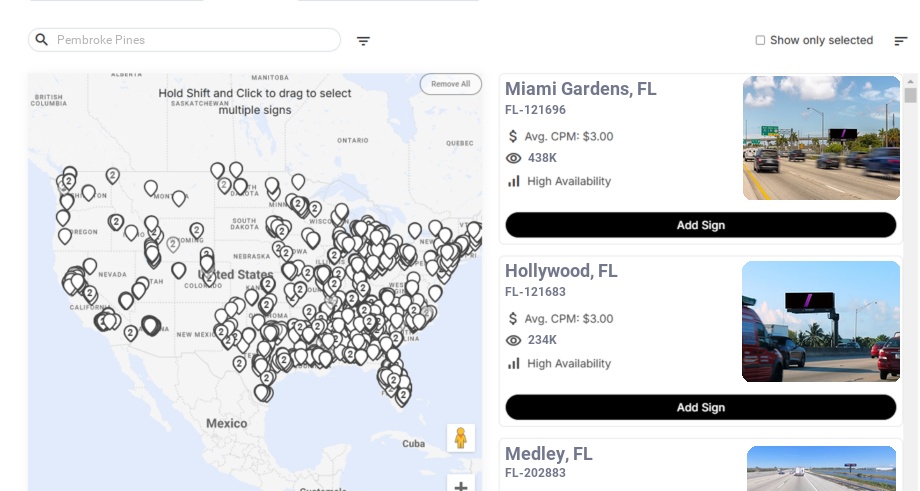
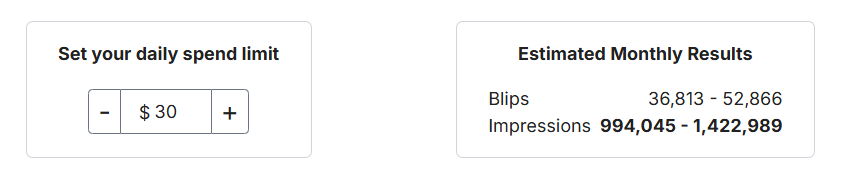
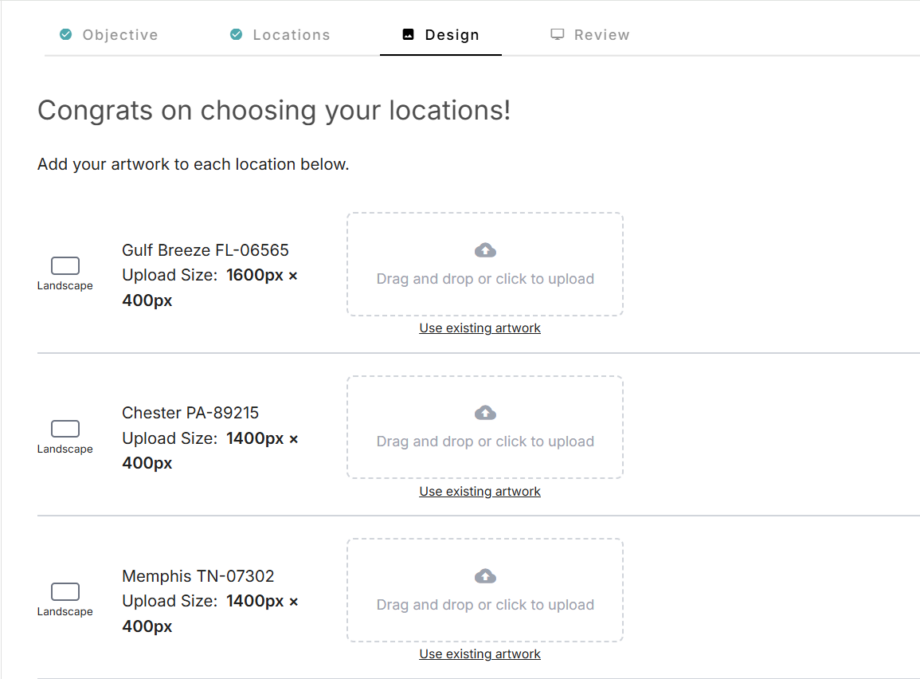
How much is a billboard in Pembroke Pines?
Billboards in other Florida cities
Pembroke Pines Billboard Advertising Guide
Pembroke Pines sits at the heart of one of South Florida’s most dynamic suburban corridors. With 33 digital billboards serving the Pembroke Pines area from nearby Miramar, Miami Gardens, Opa-locka, West Park Sunrise Hialeah Gardens
Understanding the Pembroke Pines Area Market
Pembroke Pines is one of Florida’s largest cities and a key part of the Miami–Fort Lauderdale metro:
- The City of Pembroke Pines reports a population of roughly 170,000–175,000 residents, making it one of the top 10 largest cities in Florida and consistently one of the largest in Broward County.
- The broader Miami–Fort Lauderdale–West Palm Beach metro has grown to roughly 6.2–6.3 million residents, according to regional planning and tourism agencies, creating a vast regional audience moving through nearby corridors every day.
- The median age in Pembroke Pines is around 40–41 years, and more than 72–74% of residents are 18 or older, which means a strong core of working-age adults and families.
- Household incomes in the area are relatively strong, with median household income around $75,000–$80,000 in Pembroke Pines and nearby suburbs, and significant shares of households earning $100,000+, supporting discretionary spending on dining, travel, health, and retail.
The market is also highly diverse:
- In Pembroke Pines and nearby communities in Broward and Miami-Dade counties, Hispanic/Latino residents often make up 45–60% of the population, with some nearby cities such as Hialeah Gardens Opa-locka skewing even higher.
- A large share of residents is foreign-born—commonly 35–45% across many neighborhoods—and more than 50–60% speak a language other than English at home, predominantly Spanish, along with Haitian Creole and Portuguese in parts of the region.
- Regional education levels are strong: in many west Broward communities, 30–40% of adults 25+ hold at least a bachelor’s degree, which supports demand for financial, professional, and healthcare services.
For billboard advertisers, this means:
- Broad-based consumer products, services, and entertainment offerings can do very well with clear, family-friendly messaging that speaks to a middle- and upper-middle–income audience.
- Bilingual or Spanish-first creative can significantly expand reach and relevance. In some nearby Miami-Dade neighborhoods, 70%+ of residents speak Spanish at home, making Spanish-language messaging especially effective.
- The market supports both value-focused and premium-brand positioning; you’ll find room for discount retail and service offers, as well as higher-end real estate, medical, legal, and financial campaigns that can all benefit from Pembroke Pines billboards and surrounding inventory.
For additional local context on demographics, parks, and community programs you can tie into your messaging, explore the City of Pembroke Pines and Broward County websites.
Where the Audience Moves: Key Roads and Traffic Patterns
Digital billboards serving the Pembroke Pines area are positioned along some of South Florida’s busiest roadways in nearby cities like Miramar, Miami Gardens, West Park Sunrise Opa-locka, and Hialeah Gardens
Major regional highways and corridors
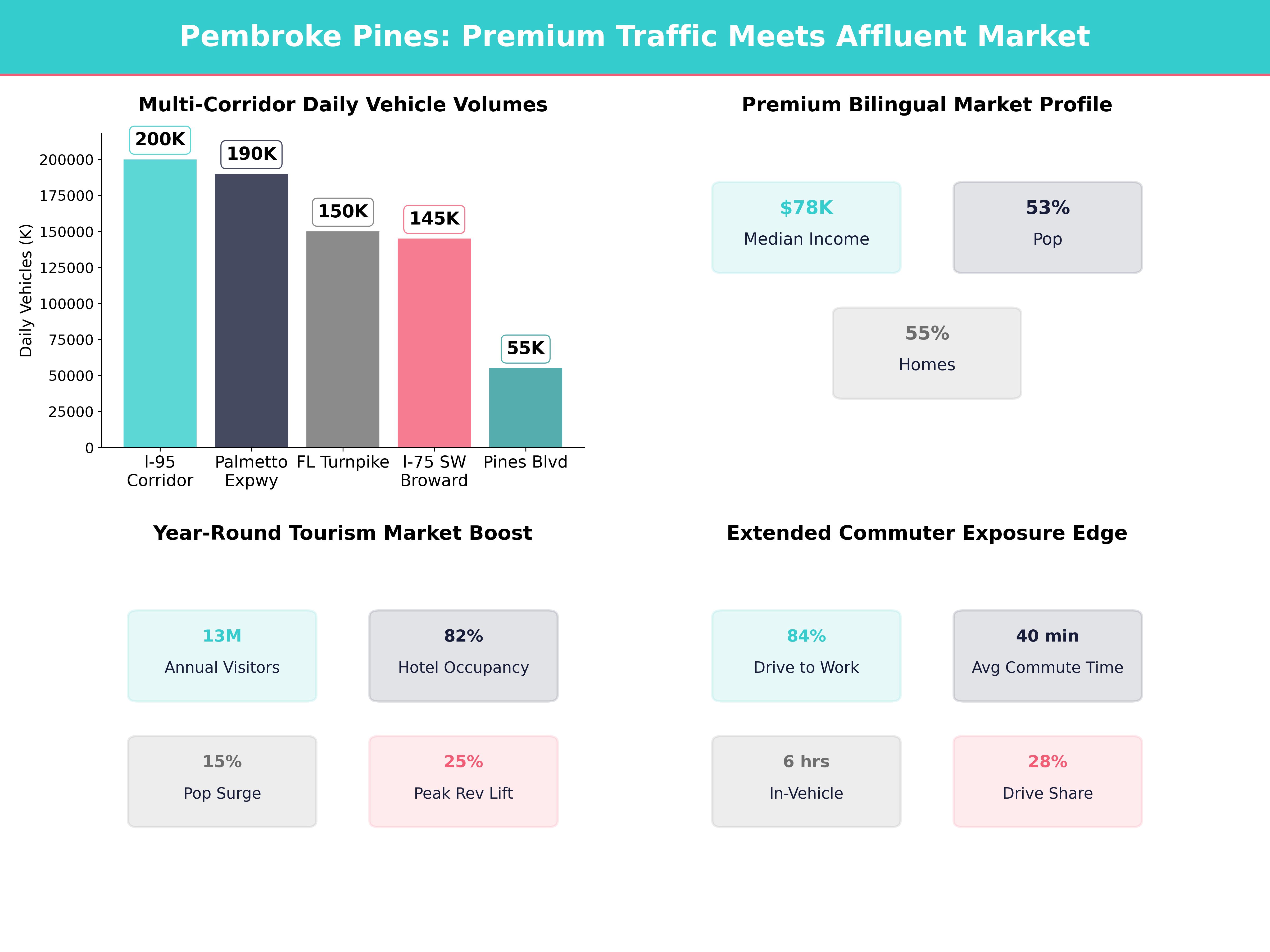
- I‑75 (west of Pembroke Pines): Florida Department of Transportation (FDOT) traffic counts on I‑75 in southwest Broward often exceed 140,000–150,000 vehicles per day, with some segments trending even higher during peak season. Morning and evening rush hours can see speeds drop below 35 mph, increasing dwell time for your ads.
- Florida’s Turnpike (east of Pembroke Pines): Segments near Miramar and Hollywood typically carry 140,000–160,000 vehicles per day, linking Broward County with Miami-Dade and serving daily flows of workers headed toward Miami Gardens, Opa-locka, and central Miami.
- I‑95 (further east but still influential): In Broward and northern Miami-Dade, I‑95 routinely exceeds 200,000 vehicles per day. Regional transportation agencies estimate that more than 2 million vehicle trips occur on I‑95 in South Florida every week, feeding traffic toward cross-county routes serving the Pembroke Pines area.
- Palmetto Expressway (SR 826) near Miami Gardens: Near Hard Rock Stadium 180,000–200,000 vehicles, a key corridor for commuters from the Pembroke Pines area heading into Miami-Dade.
Local and regional arterials important to Pembroke Pines residents
- Pines Boulevard (SR 820): The City of Pembroke Pines identifies Pines Boulevard as one of its primary east–west arteries connecting I‑75 to Florida’s Turnpike and beyond. Local transportation data often shows 50,000–60,000+ vehicles per day along major stretches, lined with dense retail, dining, and medical uses that draw residents daily.
- University Drive, Flamingo Road, and Sheridan Street also move significant volumes of local traffic, with many segments carrying 30,000–45,000 vehicles per day and feeding vehicles onto the expressways where our nearby billboards are located.
By placing digital billboards along the expressways and arterials in Miramar, Miami Gardens, Opa-locka, West Park, Sunrise, and Hialeah Gardens, we efficiently reach:
- Daily commuters from the Pembroke Pines area traveling toward Miami, Fort Lauderdale, Port Everglades, and major industrial zones in west Broward and north Miami-Dade.
- Shoppers and families traveling to regional malls and centers such as Pembroke Lakes Mall, Sawgrass Mills
- Visitors moving between major airports—Fort Lauderdale-Hollywood International Airport and Miami International Airport—beach destinations, and suburban hotels who will frequently pass billboards near Pembroke Pines during their stay.
Using Blip, we can fine-tune which boards along these routes run your ads and at what times, so you appear exactly where and when Pembroke Pines–area audiences are most likely to see you, maximizing impressions from the region’s hundreds of thousands of daily vehicle trips.
Seasonality: When to Turn Up (or Dial Back) Your Campaign
The Pembroke Pines area follows South Florida’s broader seasonality patterns, with distinct peaks in traffic, tourism, and spending:
Tourism and “snowbird” season
- Greater Fort Lauderdale tourism data from Visit Lauderdale shows that Broward County welcomes roughly 13 million+ visitors annually, with peak hotel occupancy often running 78–85% from December through April.
- The Greater Miami Convention & Visitors Bureau reports that Miami-Dade County attracts around 25–27 million overnight and day visitors annually, with strong winter and spring peaks and hotel occupancy regularly climbing above 80% in prime months.
- Seasonal “snowbird” residents significantly increase population in South Florida’s winter months; in some communities, local planners estimate effective population increases of 10–20% when part-time residents are counted.
- Many of these visitors stay, shop, and eat in the suburbs—including west Broward—using the same highways and arterials that serve Pembroke Pines and the surrounding billboard network.
What this means for advertisers
- December–April: Ideal for hospitality, attractions, events, luxury retail, auto, and real estate. During these months, hotel revenues and visitor spending in Broward and Miami-Dade can run 20–30% higher than off-peak. Consider increasing your average daily budget and bidding more aggressively during morning and evening drive times when visitors and locals are on the move, especially if you rely on billboard advertising near Pembroke Pines to drive tourist traffic.
- Summer (June–August): Local families and students dominate. Public school districts such as Broward County Public Schools and Miami-Dade County Public Schools serve hundreds of thousands of students, and back‑to‑school periods generate strong demand for retail, healthcare, and education services. Back‑to‑school spending per household regularly exceeds $600–$800 nationwide, a trend that’s clearly visible in South Florida’s retail corridors.
- Hurricane season (June–November): The Atlantic hurricane season shapes local media and consumer behavior. Insurance, roofing, impact windows, generators, and urgent care services often see spikes in inquiries during active storm periods. Messaging around preparedness and rapid response can resonate, and our ability to quickly swap creatives allows you to pivot around storm threats or after major weather events highlighted by outlets like Local 10 (WPLG) and NBC 6 South Florida.
- Weekends year-round: The region’s sports, dining, and nightlife continue regardless of season. Major weekend events at Hard Rock Stadium FLA Live Arena tens of thousands of trips on top of baseline traffic.
With Blip’s flexible scheduling, we can increase your presence around key local dates—such as major concert weekends, sports events at Hard Rock Stadium, back‑to‑school periods on the Broward County and Miami-Dade County calendars, or city festivities promoted by the City of Pembroke Pines.
Connecting with Commuters and Event Traffic
A large share of Pembroke Pines–area residents commute by car, often across county lines. Heavy congestion means long dwell times and repeated exposures for billboard campaigns:
- Regional transportation and labor data show that roughly 82–86% of workers in the Miami–Fort Lauderdale metro commute by car, truck, or van (driving alone or carpooling), far above national transit and walking shares.
- Average one-way commute times in South Florida often exceed 30 minutes, with many cross‑county commuters traveling 35–45 minutes each way. Over a five‑day week, a typical driver may spend 5–7 hours in the car, creating substantial opportunity for repeated impressions.
Key event and commute drivers to consider:
- Hard Rock Stadium (Miami Gardens): Home to the Miami Dolphins, University of Miami football, major concerts, the Formula 1 Crypto.com Miami Grand Prix 65,000 seats, and multi‑day events like F1 have drawn 240,000+ attendees over a single weekend, many traveling via I‑75, the Turnpike, and SR 826 from west Broward communities including Pembroke Pines.
- Regional employment hubs along the I‑75 and Turnpike corridors in Miramar, Miami Gardens, and Hialeah Gardens thousands of workers. Many of these employees live in Pembroke Pines, western Miramar, and other west Broward neighborhoods.
- Airports and seaports: Fort Lauderdale-Hollywood International Airport and Miami International Airport together handle 70–80 million passengers per year, while Port Everglades and PortMiami process millions of cruise passengers annually. A significant share of these travelers pass along the same highway network your billboards will occupy.
Strategically, we can:
- Run heavier rotations on boards near Miami Gardens and Hialeah Gardens during weekday morning (6–9 a.m.) and evening (4–7 p.m.) commutes, matching regional peak congestion windows reported by FDOT.
- Use event-focused dayparts on Fridays, Saturdays, and Sundays around stadium events, concerts, and festivals, pointing attendees toward restaurants, nightlife, hotels, and services convenient to the Pembroke Pines area.
- Consider directional messaging (e.g., “Exit toward Pembroke Pines – 15 minutes ahead” or “Next 2 Exits – Pembroke Pines Area”) to capture travelers heading back into the suburbs after events or work and to get more visibility from billboards near Pembroke Pines just as drivers are making routing decisions.
Crafting Creative That Works in the Pembroke Pines Area
Because digital billboards near Pembroke Pines must capture attention at highway speeds, our creative strategy focuses on clarity, cultural relevance, and immediate value:
Keep it bold and bilingual (when it makes sense)
- Use 5–7 words max of main copy, with a large, legible font. At prevailing highway speeds, drivers typically have 2–3 seconds to absorb the message, and eye‑tracking studies show recall rates drop sharply once you exceed 8–10 words.
-
For campaigns aimed at shoppers, families, and local services, consider bilingual English/Spanish creative or alternating English and Spanish creatives:
- Example A (English): “Urgent Care in 10 Minutes – Pembroke Pines Area”
- Example B (Spanish): “Atención Médica Rápida a 10 Minutos – Área de Pembroke Pines”
- If your core audience skews Spanish-dominant (which can be 60–70% of households in parts of Miami-Dade and southern Broward), test a Spanish-first line with a smaller English support line.
Anchor your message to familiar landmarks
Residents orient themselves using familiar locations and corridors. Use short references like:
- “Just off Pines Blvd”
- “Near Pembroke Lakes Mall”
- “Minutes from I‑75 / Pines Blvd exit”
- “Serving the Pembroke Pines area since 2005”
These simple cues make it easier for drivers to understand where you are and can measurably increase response rates. Location‑anchored messages often outperform generic ones in local campaigns by 10–30% in terms of calls, clicks, or walk‑ins, based on advertiser case studies.
Highlight offers and urgency
The Pembroke Pines area is dense with retail competition. Strong offers are key:
- Use numbers and timeframes: “$0 Down Dental Implants”, “3 Months Free Storage”, “Same-Day AC Repair”. Clear numerical offers are generally remembered 30–40% more often than generic branding messages.
- Pair urgency with proximity: “Walk-ins Today – 2 Miles Ahead”, “Call Now – Book for Tonight”.
- For service businesses, repeat your phone number or short URL in large type; for larger brands, drive to a simple branded URL that is easy to remember at a glance.
Because our digital boards can rotate multiple creatives, we can:
- Test A/B variations (different offers, languages, or visuals) and then direct more budget to the top performer after a few weeks.
- Run time-based offers (“Today Only – Free Appetizer 4–7 p.m.”) during select dayparts using Blip’s scheduling tools, allowing you to align your creative with peak traffic and store hours.
Using Data-Driven Scheduling with Blip
Blip’s platform lets us buy space in small increments (“blips”) and apply precise scheduling to reach Pembroke Pines–area audiences efficiently. We can tailor your campaign based on:
Time of day
- Morning drive (6–9 a.m.)
Great for coffee, breakfast, childcare, gyms, and service reminders (“Call for same-day AC repair”). In South Florida, these hours regularly account for 25–30% of weekday vehicle trips on major corridors. - Midday (10 a.m.–3 p.m.)
Ideal for retail, medical appointments, home services, and senior-focused offers when traffic is steadier and decision windows are longer. Many medical offices report 40–50% of their weekday appointments fall in this window. - Evening drive (4–7 p.m.)
Strong for restaurants, grocery, entertainment, and promotions that benefit from post-work visits. On key roads like I‑75 and the Turnpike, PM peak volumes can be as high or higher than the morning rush. - Late evening (8–11 p.m.)
Good for streaming, nightlife, delivery services, and branding campaigns targeting younger and entertainment-focused audiences; in entertainment districts, weekend late‑evening traffic can run 10–20% above typical weekday levels.
Day of week
- Monday–Thursday: Emphasize routine services—healthcare, education, banking, home services, recurring weekly offers. Many service businesses see 60–70% of their weekly appointments on these days.
- Friday–Sunday: Focus on dining, entertainment, weekend sales, automotive, and event-driven messaging, especially around Miami Gardens and Sunrise boards. Retail centers typically see 30–40% of weekly sales between Friday and Sunday.
Board selection by direction and context
With 33 boards serving the Pembroke Pines area, we can mix:
- Boards in Miramar and West Park to capture east–west movements between Pembroke Pines, Hollywood, and Miami-Dade, aligned with traffic along Pines Boulevard and Miramar Parkway.
- Boards in Miami Gardens and Opa-locka to catch Pembroke Pines–area commuters heading to/from Miami, Hard Rock Stadium, and nearby employment centers.
- Boards in Sunrise to reach residents venturing north for work at corporate campuses, shopping at Sawgrass Mills FLA Live Arena
We can start broad, then refine by concentrating spend on the boards and time slots delivering the best results, guided by your web analytics, call volumes, or in-store traffic patterns and cross‑checked with traffic data from agencies such as the Broward Metropolitan Planning Organization and Miami-Dade Transportation Planning Organization. This approach turns a broad cluster of Pembroke Pines billboards and nearby locations into a tightly tuned, high-performing campaign.
Local Sectors That Perform Well Near Pembroke Pines
Given the demographics, commuting habits, and road network, several categories tend to benefit especially from digital billboards serving the Pembroke Pines area:
1. Healthcare and wellness
- Primary care, pediatric practices, urgent care centers, dental offices, and specialists draw from a wide catchment area of hundreds of thousands of residents within a 15–20 minute drive.
- Healthcare spending is one of the largest household expense categories in South Florida, with local per‑capita health expenditures commonly running 5–10% above national averages in high‑cost metro areas.
-
Use billboards to:
- Emphasize convenience (“Walk-ins welcome until 8 p.m.”).
- Highlight insurance acceptance (“Most major plans accepted”).
- Provide simple location cues and a prominent phone number; campaigns with clear “exit now” or “2 miles ahead” language often see higher call and visit rates than generic branding.
2. Education and childcare
The Pembroke Pines area is known for excellent schools and family-oriented neighborhoods:
- Broward County Public Schools is one of the largest school districts in the U.S., serving more than 250,000 students, and west Broward communities have particularly high concentrations of school‑age children.
- The city and surrounding areas host numerous charter schools, private schools, preschools, and tutoring centers, competing for thousands of families each enrollment cycle.
- Promote private schools, charter schools, after-school programs, and tutoring.
- Focus on enrollment windows, open house dates, and test-prep seasons (for example, SAT/ACT periods in spring and fall).
- Use board locations near morning and afternoon commute routes and time slots like 7–9 a.m. and 2–6 p.m., which align with school drop‑off and pick‑up peaks.
3. Real estate, home services, and finance
A strong homeowner base with middle-to-upper incomes supports:
- Real estate brokerages, apartment communities, new developments, mortgage lenders, and remodelers. In many west Broward communities, homeownership rates often sit in the 60–70% range.
- The Miami–Fort Lauderdale region has seen substantial residential appreciation over the past decade, with some submarkets experiencing 40–60%+ price growth, boosting demand for mortgage refinancing, home equity products, and remodeling.
- Messaging that references local neighborhoods (“Serving Silver Lakes & Chapel Trail”, “West Pines & Southwest Ranches”) or widely known corridors tends to resonate and can increase lead quality.
4. Retail, dining, and entertainment
With regional malls, plazas, and a robust restaurant scene across Broward and Miami-Dade:
- Large shopping destinations like Pembroke Lakes Mall, Sawgrass Mills tens of thousands of visits each week, especially on weekends and during holiday seasons.
- Restaurants can drive traffic with clear offers (“Kids Eat Free Tues”, “Happy Hour 4–7 p.m.”). Studies of quick-service and casual dining campaigns routinely show double‑digit lifts in visits when strong offer-based billboard messaging is used near key corridors.
- Retailers can highlight limited-time sales and direct people to stores near I‑75 or Pines Boulevard, particularly during high‑spend periods such as back‑to‑school, Black Friday, and the December holidays.
- Entertainment venues and events—especially those promoted by Visit Lauderdale or covered by outlets like the Sun Sentinel and Miami Herald
5. Automotive
South Florida is heavily auto-oriented:
- Vehicle ownership rates in suburban Broward and Miami-Dade commonly exceed 1.7–2.0 vehicles per household, and the vast majority of residents rely on cars for daily errands and commuting.
- Dealers, auto repair shops, tire centers, and car washes can capitalize on congested roadways near Miramar, Sunrise, and Miami Gardens to reach drivers at the exact moment they’re thinking about their vehicles.
- Use price points and limited-time incentives (“$0 Down”, “Oil Change $29.99 This Week Only”), and align your dayparts with commute times. Auto advertisers often see noticeable lifts in call and web inquiry volume when campaigns are concentrated in the 7–9 a.m. and 4–7 p.m. windows.
Measuring and Optimizing Your Campaign
Digital billboards are a top-of-funnel medium, but we can still be methodical about tracking and improving performance:
Set clear, trackable goals
- For calls: Use a trackable phone number unique to your billboard campaign. Many local advertisers see 20–40% of their inbound calls attributed to billboard-visible numbers when they track sources carefully.
- For web traffic: Create a custom landing page or URL (e.g.,
YourBrand.com/Pines) and monitor its traffic using analytics tools. Look for traffic spikes that align with your scheduled impressions. - For in-store: Train staff to ask, “How did you hear about us?” and log responses. Even if just 10–20% of customers answer, patterns emerge quickly.
Align schedules with response data
-
Compare incoming calls, form fills, or store visits against your Blip schedule:
- If calls spike after morning rotations, consider shifting more budget earlier in the day.
- If weekend sales outperform weekdays, increase Friday–Sunday impressions and test stronger weekend-specific offers.
- If you see higher conversion from certain ZIP codes, we can emphasize boards that best serve those neighborhoods.
Test creatives systematically
-
Run at least two creatives simultaneously:
- One focused on a strong offer (e.g., “$500 Off Braces”).
- Another focused on trust and credibility (“20+ Years Serving the Pembroke Pines Area”, “Rated 4.9★ by Local Patients”).
- After several weeks and at least tens of thousands of impressions per creative, continue the top performer and refine or replace the weaker one.
- Over time, many advertisers see 15–30% improvements in response metrics by iteratively testing and optimizing billboard creative.
Leverage local context
Use coverage from local outlets like Local 10 (WPLG) or NBC 6 South Florida and community announcements from the City of Pembroke Pines to inspire topical creatives—for example:
- Promoting storm-prep services as hurricane season stories dominate local news.
- Aligning with back-to-school timing highlighted by Broward County Public Schools or Miami-Dade County Public Schools.
- Celebrating local sports teams and events such as Miami Dolphins home games or major concerts at Hard Rock Stadium
Bringing It All Together for the Pembroke Pines Area
By combining rich local knowledge with Blip’s flexible digital billboard platform, we can:
- Reach residents, commuters, and visitors traveling on high-traffic routes in nearby Miramar, Miami Gardens, Opa-locka, West Park, Sunrise, and Hialeah Gardens, tapping into hundreds of thousands of daily vehicle trips across I‑75, Florida’s Turnpike, I‑95, and SR 826 through a coordinated set of billboards near Pembroke Pines.
- Tailor messaging to the Pembroke Pines area’s family-oriented, diverse, and car-dependent population—more than 170,000 local residents within city limits and millions more within a short drive.
- Use data—traffic patterns, seasonality, event calendars, and your own response metrics—to schedule campaigns when and where they’ll perform best, turning simple billboard rental near Pembroke Pines into a measurable, ROI-focused channel.
- Continually test, measure, and refine creative to turn impressions into real-world results, improving performance by double digits over time through optimization.
With 33 digital billboards serving the Pembroke Pines area and full control over your budget, timing, and creatives, we’re able to build campaigns that not only look great on the highway, but also make a measurable impact on your business in one of South Florida’s most active suburban markets.