Billboards in Pinellas Park, FL
No Minimum Spend. No Long-Term Contracts. Just Results.
Turn heads with Pinellas Park billboards the easy way. Blip lets you launch flexible campaigns on digital billboards near Pinellas Park, Florida, serving the Pinellas Park area with real-time control, any budget, and creative options that make your brand pop.
Billboard advertising
in Pinellas Park has
never been easier
HERE'S HOW IT WORKS
How much is a billboard in Pinellas Park?
Billboards in other Florida cities
Pinellas Park Billboard Advertising Guide
Pinellas Park sits in the heart of one of Florida’s most active coastal metros, surrounded by major commuter corridors, beach traffic, and year‑round tourism. With six digital billboards serving the Pinellas Park area from nearby Seminole, St. Petersburg, and Clearwater, we can help advertisers tap into a dense, diverse audience that moves constantly between neighborhoods, beaches, workplaces, and entertainment districts. For businesses specifically looking for billboards near Pinellas Park, these locations provide flexible options to reach both local and regional drivers.
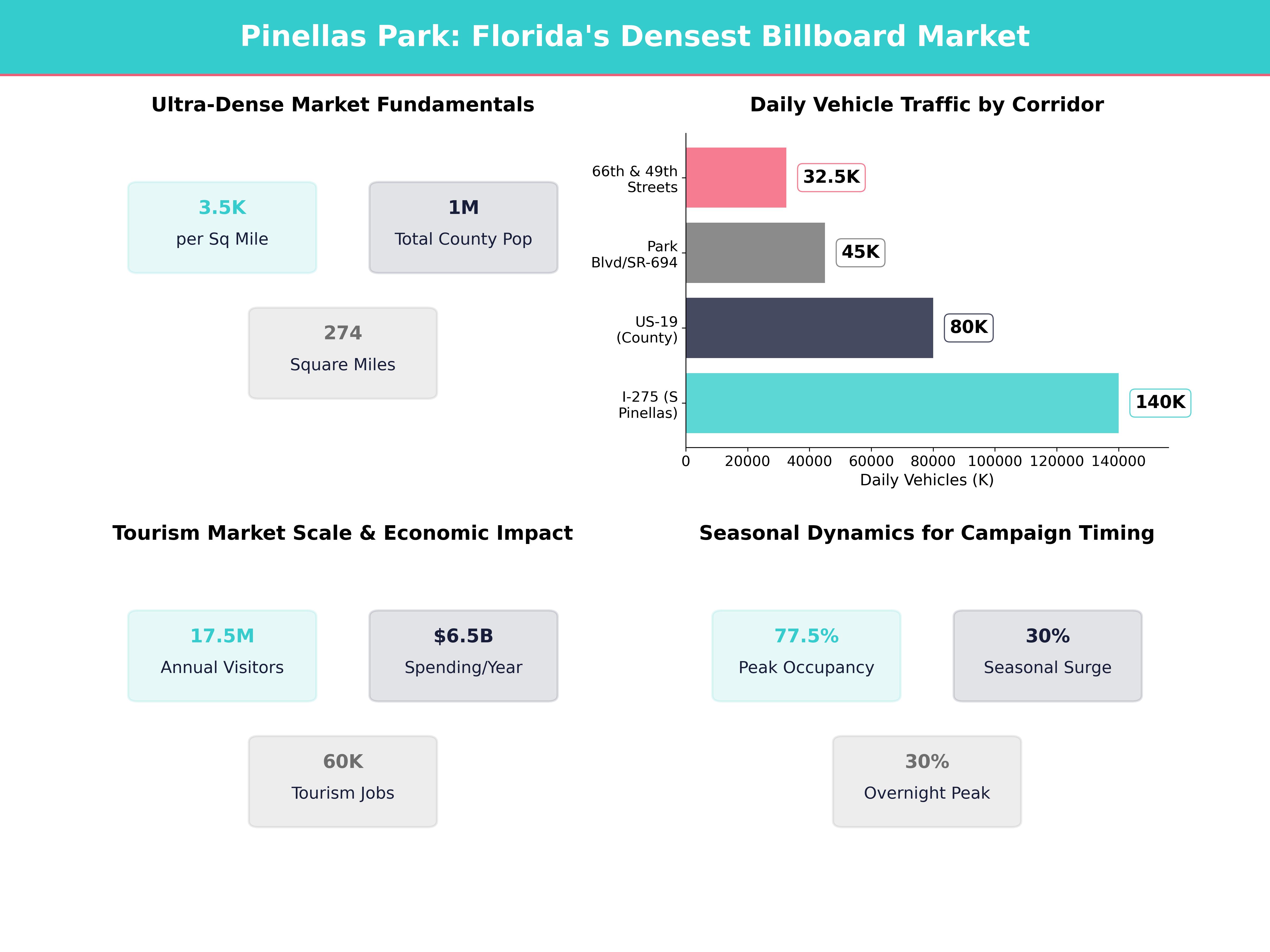
According to Pinellas County, the county spans only about 274 square miles of land yet supports close to 1 million residents, making it one of the most densely populated counties in Florida with over 3,500 residents per square mile. That density, combined with steady tourism, keeps local roadways active from early morning through late evening almost every day of the year.
Understanding the Pinellas Park Area Audience
Pinellas Park is centrally located in Pinellas County, one of Florida’s most urbanized counties. A few key stats to frame the opportunity for billboard advertising near Pinellas Park:
- Pinellas Park has an estimated population of roughly 55,000–60,000 residents, while Pinellas County as a whole is just under 1 million residents. Neighboring cities like St. Petersburg, Clearwater, Largo, and Seminole all sit within a roughly 20–25 minute drive.
- The median age in Pinellas County is around 48 years, several years older than the U.S. median, which means a strong mix of retirees, “snowbirds,” and working‑age adults. In many west‑central Pinellas ZIP codes, adults 45+ make up 45–55% of residents.
- Household economics are solid for many local consumers. Countywide, median household incomes in central and coastal Pinellas typically range from the $55,000–$75,000 band, with pockets near the beaches and in north county significantly higher, supporting discretionary spending on dining, healthcare, automotive, and home services.
- The City of Pinellas Park notes its central location and strong industrial base, with multiple business parks and light manufacturing, bringing in daily commuter traffic from surrounding cities (City of Pinellas Park). The city’s industrial zones host hundreds of businesses across manufacturing, logistics, and services.
- Nearby St. Petersburg has about 260,000+ residents, Clearwater about 115,000+, and Seminole around 19,000+, all feeding traffic through the area. Across the broader Tampa Bay metro, more than 3.2 million people live within commuting distance of Pinellas County.
This regional population is layered on top of robust visitor activity. According to Visit St. Pete/Clearwater 15–20 million visitors annually, with direct visitor spending in recent years surpassing $6–7 billion per year and supporting well over 60,000 tourism‑related jobs. That means advertisers in the Pinellas Park area are not just speaking to locals, but also to a constantly refreshing pool of travelers who can be reached efficiently with digital Pinellas Park billboards.
Demographically, Pinellas Park area audiences include:
- Families in residential neighborhoods around 66th St, 49th St, and Park Blvd, where single‑family homes and townhomes make up a large share of the housing stock and owner‑occupancy in many tracts exceeds 55–60%.
- Industrial and logistics workers commuting to industrial parks along Bryan Dairy Rd and 49th St; county employment data through Pinellas County Economic Development show that manufacturing, logistics, and professional services together account for tens of thousands of jobs in central Pinellas alone.
- Service and hospitality workers traveling toward St. Petersburg, Clearwater, and the beaches, where hotels, restaurants, and attractions drive strong demand for hourly and shift‑based employment.
- Retirees and seasonal residents (especially October–April), when visitor counts and temporary residency in Pinellas County jump significantly—many condo communities west of US‑19 report seasonal occupancy increases of 20–40%.
- Tourists heading to Indian Shores, Madeira Beach, and Clearwater Beach—three of the Gulf beaches that routinely appear in national “best beaches” rankings, drawing daily beach traffic that can exceed 30,000–40,000 visitors on peak weekends across the barrier islands.
This mix supports campaigns across many verticals: healthcare, automotive, restaurants, attractions, home services, financial services, and more. For example, local hospital systems, urgent cares, and specialists serving Pinellas County collectively handle hundreds of thousands of outpatient visits per year, while automotive dealers along US‑19 represent one of the highest‑density auto corridors in the region—ideal audiences for well‑placed billboard advertising near Pinellas Park.
Where Our Billboards Reach Drivers Near Pinellas Park
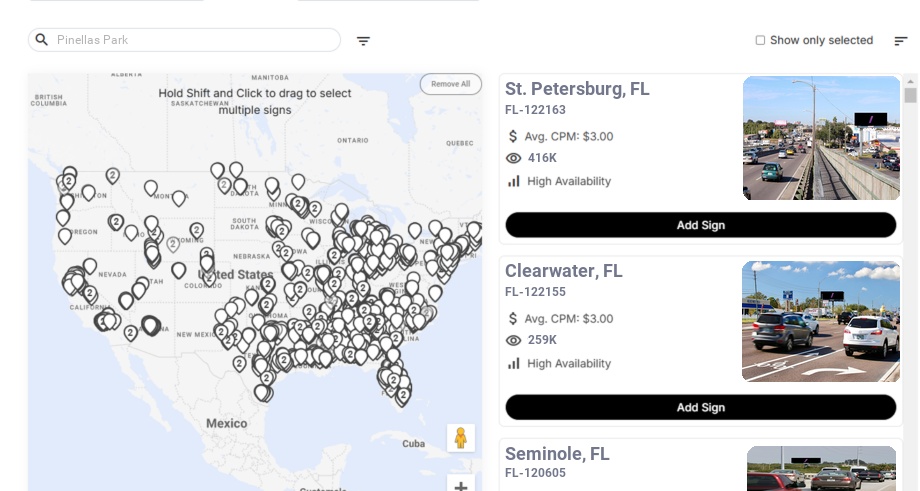
We have six digital billboards serving the Pinellas Park area, strategically positioned in:
- Seminole (about 4.5 miles from Pinellas Park)
- St. Petersburg (about 5.3 miles from Pinellas Park)
- Clearwater (about 9.0 miles from Pinellas Park)
These locations allow you to intercept traffic on key routes that residents and visitors use daily to reach or pass near Pinellas Park. For advertisers seeking flexible billboard rental near Pinellas Park, this spread of inventory makes it easy to match coverage to your preferred trade area:
- Park Boulevard / SR‑694 – A major east‑west corridor linking Pinellas Park with Seminole and the Gulf beaches, often carrying 40,000–50,000 vehicles per day on many segments, according to regional traffic counts cited by Forward Pinellas. This corridor picks up both local shoppers and beach‑bound visitors using the Park Blvd bridge.
- US‑19 – A primary north‑south arterial through Pinellas County with segments in the county regularly exceeding 70,000–90,000 vehicles per day. Drivers from Clearwater, Largo, and St. Petersburg use US‑19 to access the Pinellas Park area; it is one of the county’s key high‑capacity corridors for commuters and commercial traffic.
- 66th Street / CR‑693 and 49th Street – High‑volume corridors channeling local and commuter traffic between Pinellas Park, St. Petersburg, and Seminole. Several segments along 66th Street and 49th Street typically see 25,000–40,000 vehicles per day, providing strong frequency for campaigns that rely on repeat local exposure.
- I‑275 near St. Petersburg – Portions of I‑275 in south Pinellas typically carry 130,000–150,000 vehicles per day, funneling regional traffic that often exits toward Pinellas Park, downtown St. Petersburg, or the beaches. According to FDOT District 7
By selecting specific boards through Blip, you can choose whether to concentrate impressions closer to Seminole and the beaches, toward downtown St. Petersburg, or closer to Clearwater, depending on which audiences are most valuable to you. For many advertisers, combining two or three locations can easily yield hundreds of thousands of weekly impressions when scheduled across peak times, effectively creating a network of billboards near Pinellas Park that follow your customers’ daily routes.
Key Traffic Patterns and When to Run Your Blips
The Pinellas Park area has distinct traffic flows that we can align with your digital billboard schedule:
Weekday commuter peaks
- Morning inbound movement (approx. 7–9 a.m.) from Seminole and north Pinellas toward employment centers in Pinellas Park, St. Petersburg, and across the bay. In many parts of Pinellas, more than 60% of workers commute by car alone, leading to consistent drive‑time congestion.
- Afternoon outbound and cross‑county traffic (approx. 4–7 p.m.) as workers head back toward Seminole, Largo, Clearwater, and residential areas. Travel time reports from Tampa Bay Next and local media like WTSP 10 Tampa Bay routinely highlight heavier delays on these corridors during weekday peaks.
With Blip’s dayparting controls, we can:
- Emphasize rush‑hour blips for B2B, staffing, and professional services that benefit from worker and commuter visibility. For many advertisers, concentrating 40–60% of impressions into these windows can significantly improve visibility to employed adults.
- Use midday scheduling (11 a.m.–2 p.m.) to drive lunch traffic for restaurants, quick‑service concepts, and retail in and around Pinellas Park, when restaurant traffic can spike by 20–30% compared with shoulder times.
Beach and tourism patterns
Tourism and beach traffic introduce additional peaks:
- Heavy late morning traffic (10 a.m.–noon) heading west toward the beaches on weekends, holidays, and during spring break. Spring and summer weekends often see parking at popular beaches reach capacity by late morning, reflecting strong roadway volumes leading west from Pinellas Park and Seminole.
- Evening return flows (5–9 p.m.) from beach areas through Seminole and north–south corridors back toward lodging, downtown St. Petersburg, and Pinellas Park. During clear‑weather weekends in spring and summer, these return flows can push travel times up by 25–50% versus normal weekdays.
If you operate a restaurant, entertainment venue, or attraction in the Pinellas Park area:
- Concentrate blips on Friday–Sunday, especially during spring (March–April) and summer (June–August), when visitor counts to the beaches and to downtown St. Petersburg are highest.
- Target boards closer to Seminole and Clearwater to catch beach‑bound travelers making dining and activity decisions. Surveys highlighted by Visit St. Pete/Clearwater 30–40%—make dining and entertainment decisions on the same day, making real‑time billboard messaging especially valuable.
Seasonality: Planning Around Snowbirds and Events
The Pinellas Park area experiences significant seasonal variations:
- Snowbird / high visitor season: roughly November–April, with peaks around holidays and spring training. Some coastal communities report hotel occupancy rates consistently above 75–80% during this window, compared with much lower midweek occupancy in shoulder seasons.
- Spring training and early spring: Clearwater and the broader area host MLB spring training, drawing thousands of visitors each March. For example, the Philadelphia Phillies’ spring training games at BayCare Ballpark 6,000–8,000 fans per game, according to coverage from the Tampa Bay Times.
- Summer family tourism: June–August sees strong beach travel and family trips centered around the Gulf Coast. Tourism agencies report that summer months can account for 30%+ of annual visitor overnights in coastal Pinellas.
Major regional events to consider timing around include:
- Firestone Grand Prix of St. Petersburg (March): Brings tens of thousands of attendees downtown—recent editions have reported 100,000+ fans over race weekend, boosting traffic through St. Petersburg and surrounding corridors. See updates via the City of St. Petersburg or local coverage from the Tampa Bay Times.
- St. Pete Pride (June): One of the largest Pride celebrations in the Southeast, dramatically increasing regional travel to and from downtown St. Petersburg. Organizers and local news outlets such as Bay News 9 have cited annual attendance figures in the hundreds of thousands, especially for parade and festival days.
- Seasonal festivals and parades in Pinellas Park itself, shown on the City of Pinellas Park events calendar. Annual events like the Country in the Park festival, holiday parades, and cultural celebrations can draw several thousand attendees each, boosting local traffic around Park Blvd and 49th St and increasing the value of nearby Pinellas Park billboards.
We recommend:
- Increasing your daily budget and bid amounts on Blip during these peak windows to win more impressions. Many advertisers see 20–50% higher impression delivery when they proactively raise bids ahead of major events and holidays.
- Running event‑specific creatives (e.g., “Welcome race fans – 10 minutes north in Pinellas Park”) in the weeks around major events.
- Scheduling awareness flights 2–3 weeks before key tourism surges, then tactical offers (discounts, limited‑time deals) during the peak weeks. This mirrors best practices used by regional attractions and venues that rely heavily on visitor traffic.
Matching Creative to Pinellas Park Area Audiences
To stand out on digital billboards near the Pinellas Park area, creative needs to be designed for drivers making split‑second decisions at 45–55 mph. We usually recommend:
1. Ultra‑simple copy
- Aim for 6–10 words total, with a clear focal message. Studies of roadside ad recall generally show significant drop‑offs beyond 7–10 words for moving drivers.
- Use a single main idea: “Same‑Day Urgent Care – 49th & Park” or “$0 Down Auto – US‑19 Near Pinellas Park.”
- Because the region is car‑centric (car commute mode share typically over 75%), including directional cues such as “Next Right,” “2 Miles Ahead,” or “5 Min from Pinellas Park” performs well.
2. Localized references
Pinellas Park area audiences respond strongly to local references. Consider:
- Mentioning nearby landmarks or corridors: “Off Park Blvd by the Shoppes,” “Near 66th St & Bryan Dairy.”
- Referencing beach proximity for visitors: “Fuel Up Before the Beach – Exit for Pinellas Park.”
- Calling out the Pinellas Park area explicitly: “Serving the Pinellas Park Area Since 1998” to make it clear your message is tied to billboards near Pinellas Park that drivers see every day.
3. Color and contrast for sunny Gulf days
With high sun and frequent glare:
- Use high‑contrast color combinations (dark backgrounds with bright text, or vice versa). Visibility studies for digital out‑of‑home suggest high‑contrast creative can improve legibility distances by 20–30%.
- Avoid thin fonts and overly detailed imagery that can wash out.
- Use bold icons: a tooth for dentists, a car for auto repair, a fork and knife for restaurants, etc.
4. Visuals for key sectors
- Healthcare: Pinellas County’s older median age supports strong response to urgent care, primary care, eye care, and specialty clinics. Emphasize ease and access: “Walk‑In Urgent Care – Open 7 Days – Near Pinellas Park.” Local health systems and urgent care centers collectively handle millions of patient encounters annually across the Tampa Bay region, making awareness and top‑of‑mind recall critical.
- Home services: With a large homeowner base and aging housing stock—many homes in central Pinellas were built 30–50+ years ago—highlight fast response and service area: “A/C Out? We Serve the Pinellas Park Area – Call Today.”
- Automotive sales and service: Use price anchors and guarantees: “Oil Change $39 – 10 Min from Pinellas Park on US‑19.” The US‑19 corridor hosts dozens of auto dealers and service centers, and vehicle registrations in Pinellas County are in the hundreds of thousands, creating consistent demand.
- Restaurants and entertainment: Focus on time‑sensitive calls to action: “Kids Eat Free Tonight – Park Blvd, 5 Minutes East.” With millions of annual visitors and a large local population, even capturing a tiny share of nightly diners or weekend entertainment seekers can translate into significant revenue.
Using Blip’s Flexibility for Hyper‑Local Targeting
Digital billboards near the Pinellas Park area allow you to act more like a digital marketer than a traditional out‑of‑home buyer. With Blip, we can:
Target by specific boards
- Choose boards closest to Seminole to reach beach‑bound travelers and residents west of Pinellas Park.
- Emphasize St. Petersburg boards to reach commuters headed downtown, healthcare workers near major hospitals, and entertainment seekers around the waterfront, Tropicana Field, and arts districts.
- Use Clearwater‑area boards to access north county residents and visitors who may drive through or near Pinellas Park for dining, shopping, or services. This lets you build a custom footprint of billboard advertising near Pinellas Park that follows your customers’ paths.
Adjust by time of day and day of week
- Weekday rush hours: B2B, employment, and commuter‑focused offers.
- Midday and evening: restaurants, shopping centers, healthcare, and entertainment.
- Weekends: tourism, attractions, beach‑related services, and family activities.
Because you pay per “blip” (a brief spot on the digital rotation), you can:
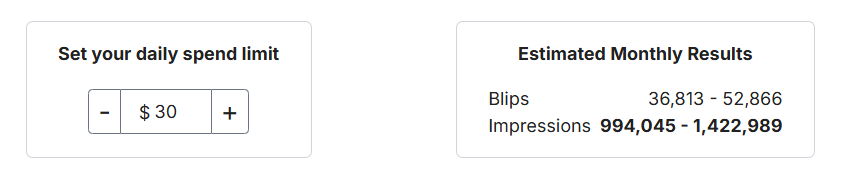
- Start with small, test budgets—for example, $10–$20 per day per board—to identify the highest‑performing times and locations.
- Increase spend on the best‑performing combinations (for example, Saturday daytime near Seminole and Clearwater during spring break) once you see which pairings drive more calls, web visits, or in‑store traffic.
- Pause or scale back quickly during off‑peak periods or between promotions, similar to how you might adjust bids on search or social campaigns. This flexibility makes digital billboard rental near Pinellas Park accessible even for smaller, neighborhood‑focused businesses.
Crafting Campaign Strategies by Business Type
Here are some sample strategies tailored to common advertiser categories in the Pinellas Park area:
Local retail and shopping centers
- Focus on boards along Park Blvd and corridors feeding into the Pinellas Park area, where daily traffic volumes typically exceed 30,000–40,000 vehicles on key segments.
- Use creatives like: “Outlet Prices – 2 Lights East of 66th – Pinellas Park Area.”
- Daypart for late afternoon and weekends when shopping trips spike; retail data often show weekend sales volumes 20–40% higher than weekday averages.
- Run short, intensive flights during back‑to‑school, Black Friday, and holiday seasons when consumer spending in Florida historically rises by 20–30% versus off‑season months.
Restaurants and bars
- Target commuters and beach traffic returning through Seminole and St. Petersburg.
- Use time‑sensitive messaging: “Happy Hour 4–7 – 10 Min from This Sign.”
- Increase bids on Thursday–Sunday evenings and during major local sports events (Bucs, Lightning, Rays games) when people are looking for places to gather. Local ratings data reported by outlets like WFLA News Channel 8 Bay News 9 show strong viewership spikes for big games, which correlate with higher bar and restaurant traffic.
- During peak visitor months, consider creative in multiple languages (e.g., English and Spanish) to reach a broader audience.
Healthcare and wellness
- Highlight accessibility for nearby neighborhoods: “Serving the Pinellas Park Area – Same‑Day Appointments.”
- Run consistent, year‑round presence with a modest daily budget to build trust and recall; healthcare decisions often have long consideration cycles, and repeated exposure can improve brand recognition by 20–30% or more over several months.
- Dial up spend seasonally (e.g., flu season, Medicare enrollment periods, or back‑to‑school physicals), when search and appointment volumes typically rise.
Home improvement and contractors
- Many homeowners in Pinellas County live in older homes requiring ongoing maintenance, and the area faces an annual hurricane season from June 1 to November 30.
-
Use billboards to build brand awareness during priority seasons:
- Roofing and hurricane prep: late spring to early fall, ahead of the most active storm months.
- A/C and HVAC: late spring through summer, when high temperatures and humidity push demand; energy‑use data in Florida often show cooling accounting for 40–50% of household electricity consumption in the warmest months.
- Landscaping and exterior work: spring and fall, when weather is more favorable for outdoor projects.
- Rotate creatives: “Roof Leaks? Call Before the Next Storm,” then shift seasonally to “Hurricane Season is Here – Protect Your Roof.”
Measuring Impact and Refining Your Campaign
Even though billboards are a top‑of‑funnel medium, we can still track real‑world results from campaigns near the Pinellas Park area:
- Promo codes and URLs: Use location‑specific or time‑specific promo codes (“PARK10”) or short URLs to measure which creative and schedule convert best. When implemented consistently, promo codes can help attribute 5–15% of responding customers directly to out‑of‑home exposure.
- Search lift: Monitor branded search volume and direct traffic while your campaigns are live; local media like the Tampa Bay Times and Bay News 9 often report regional events that also drive traffic surges you can align with.
- Call tracking numbers: Use a dedicated phone number for billboard campaigns to quantify calls from your billboard presence. Many local advertisers discover that 10–30% of inbound calls during a flight can be tied to unique billboard numbers.
- Geographic sales patterns: Compare sales or foot‑traffic changes in the Pinellas Park area during flights vs. before and after. Even a 5–10% lift during a focused campaign window can represent a strong return on a tightly targeted local budget.
With Blip’s reporting, we can show:
- How many impressions your campaign is estimated to have delivered; depending on your bids and schedules, this can range from tens of thousands to several hundred thousand impressions per week across multiple boards.
- Which boards and time blocks received the most blips.
- How shifts in your bid and budget affect your share of voice at different locations.
From there, we refine: turning up spend where performance is strong, updating creatives that underperform, and adjusting schedules to match actual traffic behavior. This continuous optimization mirrors the test‑and‑learn approach used in digital channels, but applied to high‑impact roadside inventory.
Bringing It All Together for the Pinellas Park Area
The Pinellas Park area benefits from a unique combination of dense local population, high commuter volume, and powerful tourism dynamics centered around the Gulf beaches and nearby cities. With six digital billboards located in Seminole, St. Petersburg, and Clearwater serving the Pinellas Park area, we can help you:
- Reach residents, workers, and visitors moving between neighborhoods, industrial parks, beaches, and downtown cores.
- Tailor messaging to specific corridors and dayparts using flexible Blip bidding and scheduling.
- Adapt creatives and budgets quickly around seasonal surges, local events, and promotions.
By combining smart data‑driven planning with locally relevant creative, advertisers can use digital billboards near the Pinellas Park area to build brand recognition, drive response, and stay visible in one of Florida’s most active coastal markets. Whether your goal is ongoing billboard advertising near Pinellas Park or a short‑term billboard rental near Pinellas Park tied to a specific promotion, this market offers the volume and variety of audiences needed to make your campaign perform.