Billboards in Moorestown Lenola, NJ
No Minimum Spend. No Long-Term Contracts. Just Results.
Turn heads in the Moorestown-Lenola area with Blip’s flexible digital ads. Launch eye-catching Moorestown-Lenola billboards on any budget and control everything online. With billboards near Moorestown-Lenola, New Jersey, you can test ideas, tweak schedules, and watch your results in real time.
Billboard advertising
in Moorestown Lenola has
never been easier
HERE'S HOW IT WORKS
How much is a billboard in Moorestown Lenola?
Billboards in other New-jersey cities
Moorestown Lenola Billboard Advertising Guide
Moorestown-Lenola sits at the heart of one of South Jersey’s most desirable suburban markets—high-income, commuter-heavy, and tightly connected to Philadelphia
Understanding the Moorestown-Lenola Area Market
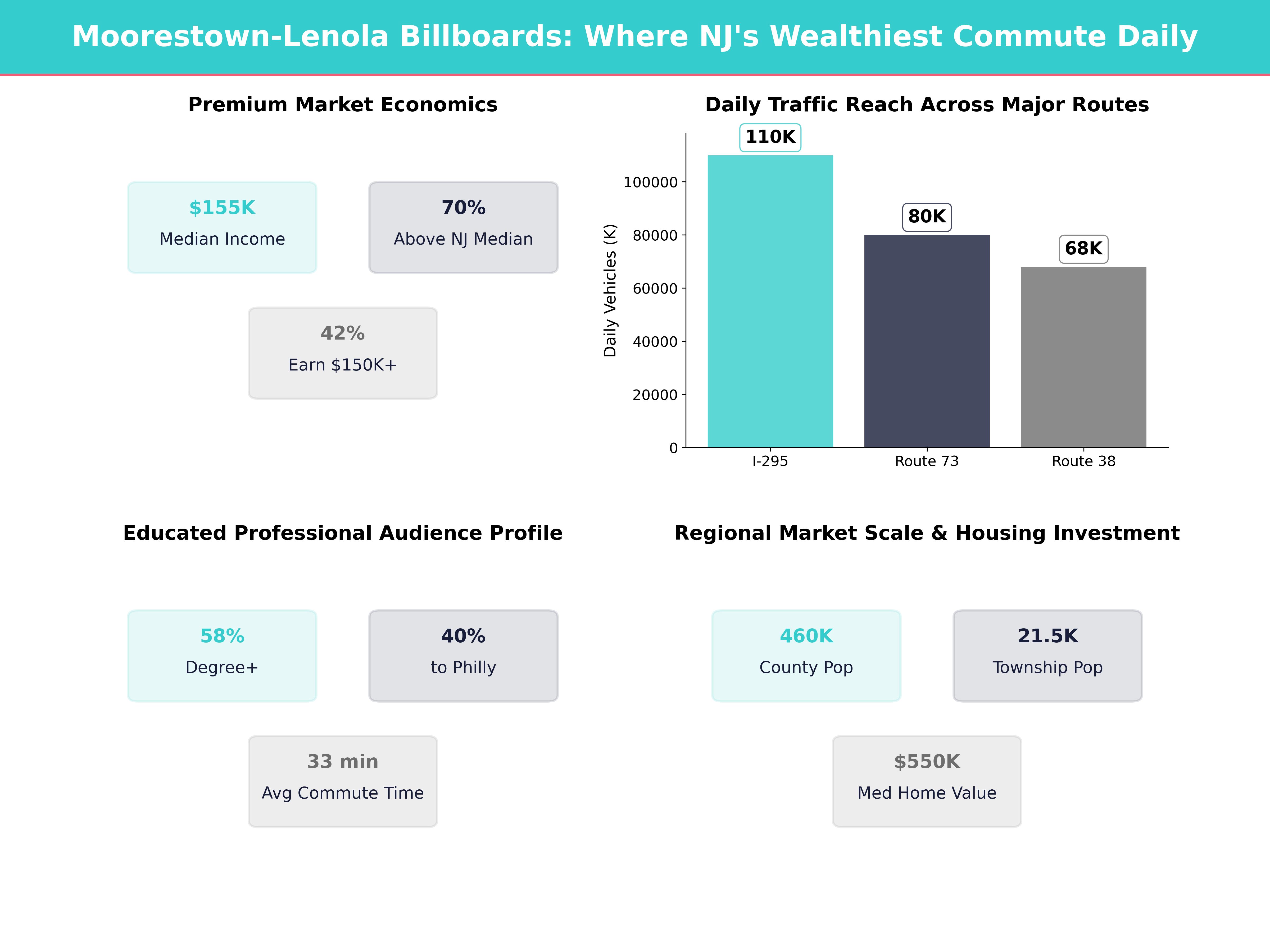
Moorestown-Lenola is part of Moorestown Township in Burlington County, an affluent, education-focused community that punches above its weight for purchasing power:
- The Moorestown-Lenola CDP has roughly 15,000 residents (2020 data), while Moorestown Township as a whole has about 21,000–22,000 residents, spread across roughly 15 square miles, for a population density of around 1,400–1,500 residents per square mile.
- Median household income in Moorestown Township is well into six figures (around $150,000–$160,000), which is roughly 65–75% higher than the New Jersey median and nearly double the national median. More than 40–45% of households earn $150,000+ annually.
- Burlington County, overseen by the County of Burlington, has about 460,000 residents across 40 municipalities, with a median household income in the $90,000+ range and an owner-occupied housing rate around 70%. That provides a large regional audience that regularly travels through and near Moorestown-Lenola.
- Homeownership in the Moorestown area is high (around 75–80% of occupied housing units), with median home values commonly in the $500,000–$600,000+ range—well above state and national averages.
- Educational attainment is strong: roughly 55–60% of adults hold a bachelor’s degree or higher, and Moorestown public schools, highlighted by Moorestown Township Public Schools
- Moorestown is routinely recognized by regional outlets like NJ.com and Philadelphia Magazine as a top place to live in New Jersey, which supports strong real estate values and a consumer base willing to spend on quality retail, dining, healthcare, and education.
What this means for advertisers:
- You are speaking to a high-disposable-income audience, with a large share of dual-income professional households that value quality, education, safety, and family-oriented activities.
- Message strategies that emphasize premium, trusted, family-friendly, and community-focused positioning will resonate strongly; nearly 30–35% of households include children under 18, and local school and youth activities are major decision drivers.
- The “suburban decision maker” is crucial here—parents, professionals, and homeowners who choose where the family spends money and who typically control the majority of household discretionary spending, often estimated at $30,000–40,000+ per year in similar-income suburbs. Well-placed Moorestown-Lenola billboards can influence these decisions repeatedly along their everyday routes.
Where Our Billboards Are and How They Serve the Moorestown-Lenola Area
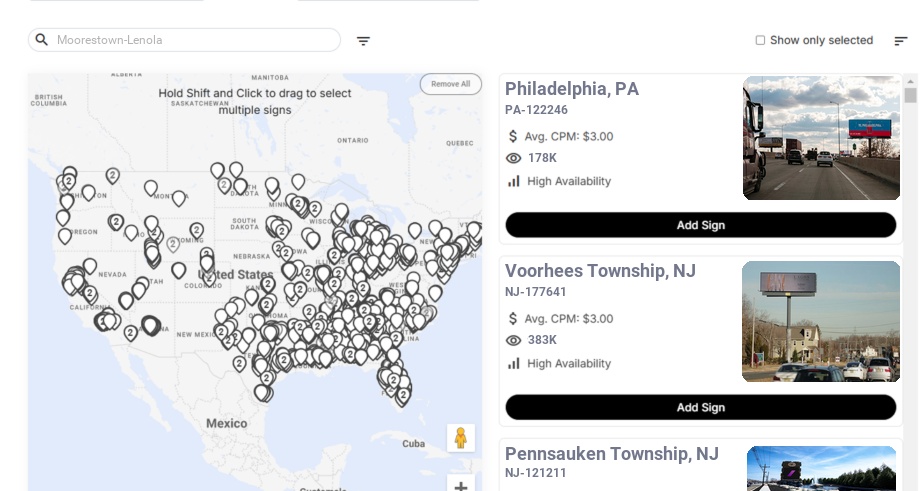
We have 22 digital billboards serving the Moorestown-Lenola area, all within about 10 miles, in:
- Pennsauken Township (≈5.7 miles) – Pennsauken Township
- Voorhees Township (≈7.9 miles) – Voorhees Township
- Burlington (≈8.0 miles) – City of Burlington
- Camden (≈8.5 miles) – City of Camden
- Gloucester City (≈9.4 miles) – Gloucester City
- Philadelphia, PA (≈9.4 miles) – City of Philadelphia
- Bensalem, PA (≈9.6 miles) – Bensalem Township
These boards sit on high-traffic corridors feeding in and out of Moorestown-Lenola, including routes that connect to:
- Route 38 and Route 73 (primary retail and commute routes to Moorestown Mall and East Gate Square
- I-295 and NJ Turnpike, operated by the New Jersey Turnpike Authority
- Bridges and feeder roads into Philadelphia and Camden
According to New Jersey Department of Transportation counts, nearby major routes such as:
- Route 38 between Moorestown and Cherry Hill carries roughly 60,000–75,000 vehicles per day on busy segments.
- Route 73 through Maple Shade and Mount Laurel is typically in the 70,000–90,000 vehicles per day range.
- I-295 through Burlington and Camden County 100,000–120,000 vehicles per day on key stretches.
The Ben Franklin, Walt Whitman, Betsy Ross, and Tacony-Palmyra Bridges, operated by agencies such as the Delaware River Port Authority, collectively carry well over 300,000 vehicles per average weekday, much of it South Jersey–Philadelphia commuter flow that passes near our inventory.
That daily volume allows advertisers to reach both local Moorestown-Lenola residents and broader South Jersey and Philadelphia commuters. With Blip, you can target specific boards in those surrounding cities and time your blips so that your message intercepts Moorestown-Lenola–area residents on their actual commute and shopping paths. This makes our billboards near Moorestown-Lenola a powerful extension of your in-town presence, even though the structures themselves are just outside the CDP.
Key Audience & Travel Patterns to Leverage
Moorestown-Lenola’s value as an advertising market is rooted in how and where its residents move each day:
- Commuters to Philadelphia and Camden: Regional labor data show that in many Burlington County suburbs, 35–45% of employed residents commute to jobs in Philadelphia, Camden, or other Camden County and Center City employment hubs. Many professionals living in the Moorestown-Lenola area commute west on Route 38, Route 70, or Route 73 toward Camden and over the Ben Franklin, Walt Whitman, Betsy Ross, or Tacony-Palmyra bridges into Philadelphia. Boards in Pennsauken, Camden, Gloucester City, and Philadelphia are ideal for intercepting this flow.
- Transit-assisted commutes: Nearby park-and-ride lots feeding PATCO Speedline stations and NJ TRANSIT bus routes support thousands of weekday boardings in the region, meaning your boards near those approaches can influence both drivers and passengers.
- Regional shopping trips: Moorestown Mall, managed by PREIT, totals roughly 1 million square feet of retail space and, together with surrounding centers like East Gate Square, can see tens of thousands of visits on peak weekends. These destinations pull traffic from Cherry Hill, Mount Laurel, and Cinnaminson. Many shoppers use I-295, Route 73, or Route 38—routes served by boards in Pennsauken, Voorhees, and Burlington.
-
Weekend leisure patterns: Residents often head toward:
- Philadelphia attractions (via Visit Philly 40,000–70,000 attendees on single game or event days.
- Local South Jersey destinations featured by Visit South Jersey—breweries, wineries, historic downtowns, and outdoor recreation that collectively draw millions of visits annually across the region.
- School and sports traffic: The Moorestown Township Public Schools district enrolls roughly 3,800–4,000 students, generating predictable morning and afternoon traffic. Youth sports, clubs, and activities can mean multiple car trips per day per household, typically along the same main roads and regional retail corridors.
What this implies for your campaign:
- Use westbound morning and eastbound evening dayparts near Camden and Philadelphia to surround commuters from the Moorestown-Lenola area, who often spend 25–40 minutes each way on the road.
- Add weekend-focused blips on boards close to major bridges and shopping corridors to capture leisure and shopping trips, when regional foot traffic at malls and town centers can spike by 20–40% versus weekdays.
- Consider reverse-commute messaging (e.g., for employers, colleges, medical centers) shown on boards facing inbound traffic toward Moorestown-Lenola–adjacent routes in the afternoon and evening, when inbound contractors, service providers, and visitors are entering the township.
Local Economic & Media Landscape
Understanding the broader context helps you align messaging and timing:
- Retail & Dining: Moorestown-Lenola is anchored by Moorestown Mall and surrounding centers on Route 38, with 100+ stores and restaurants within a short drive. Retail vacancy in prime Moorestown corridors tends to run lower than in many South Jersey peers, which keeps competition for consumer attention and prime storefronts high—billboards help you stand out before shoppers even arrive.
- Professional Services & Healthcare: Burlington County’s strong insurance coverage and above-average incomes translate into robust demand for professional and medical services. In affluent South Jersey suburbs, it’s common for 20–25% of local employment to be in healthcare, professional, and technical services. This makes brand trust and perceived expertise critical in categories like financial advising, dentistry, specialty healthcare, and legal services.
- Education & Youth Activities: With a high share of school-age children, spending on private schools, tutoring, camps, and extracurriculars can average several thousand dollars per child per year. Local families often enroll children in multiple concurrent activities (sports, arts, academic programs), creating repeated exposure opportunities along the same travel routes.
-
Media consumption: Local news and information flows heavily through:
- The Philadelphia Inquirer, which reaches hundreds of thousands of readers across the region each week.
- Courier-Post, serving South Jersey communities including Burlington and Camden Counties.
- Local township channels like Moorestown Township, which maintains municipal updates, recreation information, and community news.
- Additional regional outlets such as Burlington County Times and NJ Spotlight News that regularly cover Burlington County developments.
Digital billboards near the Moorestown-Lenola area allow you to extend the reach of online and local media campaigns by reinforcing messages in the physical spaces people travel every day, creating a one-two punch of screen plus street impressions.
Timing Your Campaign: Seasonality and Dayparting
With Blip, you can turn your boards on and off by time of day, day of week, and budget. In the Moorestown-Lenola area, smart advertisers align this flexibility with local rhythms:
Seasonal patterns
-
Back-to-school (August–September):
- Parents are making big-ticket decisions—tuition, tutoring, sports leagues, after-school programs, and tech purchases—which can easily total $500–$1,500+ per child in upfront seasonal spending.
- Emphasize boards on commute routes to and from schools and offices, especially along Route 38 and I-295, when school-year traffic volumes typically rise 5–10% versus summer.
-
Holiday retail (November–December):
- Moorestown Mall and nearby centers see heavy traffic; retail analysts often note 20–30% of annual sales can occur in this period for some categories. According to regional retail trends reported in outlets like the Inquirer, the Philadelphia-South Jersey region typically experiences double-digit percentage boosts in foot traffic during peak holiday weekends, with some centers seeing 30–40% more visits than non-holiday weekends.
- Increase frequency on nearby boards, especially late afternoon, evening, and weekend dayparts, when shoppers make multi-stop trips that can last 2–3 hours.
-
Spring home & services (March–May):
- High-income homeowners plan renovations, landscaping, solar, and real estate moves. In many Northeast suburbs, 40–50% of annual home improvement project starts cluster in spring. Average project tickets can range from $5,000–$20,000+, making even modest conversion lifts extremely valuable.
- Use consistent weekday morning and early evening schedules to catch commuters when they are mentally planning projects and checking contractor websites.
-
Summer leisure (June–August):
- Families travel toward Philadelphia events, South Jersey shore routes, and regional attractions. Shore-bound traffic on key weekends can surge 20–50% along major corridors.
- Target weekends and pre-holiday periods (Memorial Day, July 4th, Labor Day) on boards in Pennsauken, Camden, Gloucester City, and Bensalem—key connectors toward major bridges and highways.
Dayparting strategies
- Morning drive (6–9 a.m.): Ideal for commuting professionals—financial services, healthcare, higher education, employment recruiting, and B2B categories. In many commuter corridors, 30–35% of daily traffic occurs in this window.
- Midday (10 a.m.–3 p.m.): Best for local retail, senior services, moms with young children, and flexible workers. Midday drivers may spend more time in shopping areas; in lifestyle centers, weekday lunchtime periods can represent 15–20% of daily sales for quick-service dining.
- Evening drive (3–7 p.m.): Perfect for restaurants, entertainment, fitness, and after-work services. This window often captures another 30–35% of daily traffic, including school pickups, practices, and errands.
- Weekends: Increase frequency for family activities, retail promotions, religious organizations, events, and attractions. Weekend leisure and shopping trips often have higher basket sizes, as households combine multiple purchases into a single outing.
Crafting Creative That Resonates in the Moorestown-Lenola Area
The Moorestown-Lenola audience is sophisticated, time-pressed, and brand-conscious. Your creative should reflect that:
Visual style
- Use clean, premium design: Simple color palettes, strong contrast, and 1–2 primary elements work best at highway speeds. Drivers typically have 3–6 seconds to process your message.
-
Include local visual cues that connect to the area without suggesting the board is physically in Moorestown-Lenola—for example:
- “Minutes from Moorestown Mall”
- “Serving Moorestown families since 19XX”
- “Proud to Serve Burlington County”
-
Feature lifestyle imagery that reflects:
- Families with children and teens (a key demo in Moorestown’s school-focused community)
- Professionals and business attire, reflecting the high share of white-collar employment
- Upscale dining, fitness, and home design that matches local spending patterns
Copy guidelines
- Aim for 6–8 words or fewer. At 55–65 mph, drivers can typically read no more than 2–3 short lines.
-
Highlight key value propositions for this market:
- “Trusted Care for Moorestown Families”
- “Premium Kitchens, Priced for Burlington County Homes”
- “Top-Rated Tutoring Near Moorestown”
- Emphasize quality, trust, and convenience over deep discounting. In affluent suburbs, messages focused on expertise, outcomes, and time savings consistently outperform “cheapest” offers. Phrases like “Top-Rated,” “Award-Winning,” and “Board-Certified” can increase perceived value.
-
Include a simple call to action:
- “Exit 4 off 295”
- “Book Today – BrandName.com”
- “Call Now: 856-XXX-XXXX”
- “Scan for Offer” (for boards and placements where including a QR code is appropriate)
Versioning for Blip
Because you can upload multiple creatives and rotate them:
- Run A/B tests with different benefit-focused lines (“Closer,” “Trusted,” “Award-Winning”) and favor the versions that align with click or call spikes in your digital analytics. Even a 10–20% lift in response rate can translate into substantial revenue when your average customer value is high.
-
Use time-specific creatives:
- Morning: “Call Before Work for Same-Day Appointments”
- Evening: “Dinner Tonight Near Moorestown”
- Weekend: “This Weekend Only – Save in Moorestown”
- Rotate seasonal messages—for example, back-to-school versus holiday themes—to align with the spending patterns noted above.
Geographic Targeting: Matching Boards to Your Objective
With 22 digital billboards in nearby cities serving the Moorestown-Lenola area, you can create precise coverage patterns:
Brand awareness in the Moorestown-Lenola area
- Mix boards in Pennsauken, Burlington, Voorhees, and Bensalem to ring the area from multiple directions, ensuring you touch the majority of common commute and shopping paths used by Moorestown-area residents.
- Show your brand consistently at lower frequency but across multiple boards, so residents encounter you on different routes over the course of a week. In many campaigns, achieving 5–10 impressions per person per month in your core trade area significantly improves recall. This kind of always-on billboard advertising near Moorestown-Lenola keeps your name top of mind even when customers aren’t yet ready to buy.
Drive-to-location campaigns
-
If your business is:
- North or northwest of Moorestown-Lenola (e.g., along Route 130 or near the Tacony-Palmyra Bridge), lean into boards in Pennsauken and Burlington to intercept both local shoppers and through traffic headed toward Philadelphia and the river bridges.
- West (toward Philadelphia or Camden), lean into Camden, Gloucester City, and Philadelphia boards to intercept inbound and outbound traffic, especially during weekday rush hours and event days at Philadelphia stadiums.
- South or southeast (near Voorhees, Cherry Hill, or Berlin), choose boards in Voorhees and adjacent corridors to capture shoppers coming from and through Moorestown’s retail spine.
- Always include distance-based CTAs when you are reasonably close: “Just 8 minutes from Moorestown Mall” or “Exit X off Route 73.” Studies on roadside advertising response consistently show that adding a clear location cue can increase in-store visit intent by 10–30%.
Event-based campaigns
- If you’re promoting events in or near the Moorestown-Lenola area (fairs, school events, grand openings), concentrate impressions in the 7–10 days leading up to the event, when awareness-building is most critical.
- Use boards closest to major approach routes and malls, then taper off immediately after the event to conserve budget. For recurring events (e.g., weekly markets or concert series), consider maintaining lower-level ongoing presence to keep the series top of mind.
Sample Strategies by Business Type
Here are some practical ways different advertisers can win near the Moorestown-Lenola area:
Local retailers & restaurants
- Target evening and weekend dayparts on boards in Pennsauken, Voorhees, and Burlington, when dining and shopping trips peak. Restaurants often see 30–40% of weekly sales on Friday–Sunday.
-
Run 2–3 rotating creatives:
- One brand-focused (“Upscale Dining Near Moorestown”)
- One offer-focused (“Kids Eat Free Tuesdays”)
- One seasonal (“Holiday Parties – Book Now”)
- Tie in with social posts and local coverage from outlets like the Courier-Post, Inquirer, and Burlington County Times to build multi-channel frequency and leverage local food and lifestyle features.
Medical, dental, and specialty healthcare
- Focus on boards along main commute routes toward Camden and Philadelphia, where many healthcare workers and patients travel daily.
- Prioritize weekday mornings and early evenings, when appointment scheduling calls and online booking activity are highest.
-
Messaging examples:
- “Same-Day Pediatric Appointments for Moorestown Families”
- “Top-Rated Orthodontics – 10 Minutes from Moorestown”
- In suburbs with similar demographics, healthcare practices often report that 20–30% of new patients first learned of them from outdoor signage or word of mouth—billboards amplify both.
Home services (contractors, solar, HVAC, landscaping)
- Peak activity: spring and early fall, when weather and school schedules drive home project planning; many contractors see 40–60% of annual revenue in these windows.
-
Use simple problem-solution creatives:
- “Basement Flooding? Call Moorestown’s Local Experts”
- “Cut Energy Bills – Solar for Burlington County Homes”
- Combine boards in Burlington, Pennsauken, and Voorhees to cover a broad ring of likely homeowners who shop and commute near Moorestown-Lenola, many of whom live in houses built in the 1960s–2000s and now require upgrades.
Schools, tutors, and youth programs
-
Heavy up around:
- Late July–September (back to school)
- April–June (camp sign-ups and summer prep)
-
Speak to parents’ priorities: safety, results, and convenience:
- “SAT Scores Up. Stress Down. Near Moorestown.”
- “STEM Summer Camps for Burlington County Kids.”
- In high-achieving school districts, participation in paid extracurriculars can exceed 70–80% of students, translating into continuous demand for academic, arts, and sports programming.
Regional attractions & entertainment
- Leverage boards in Philadelphia, Camden, and Bensalem to catch Moorestown-Lenola–area trips into the city and beyond. Venues such as the Camden Waterfront thousands to tens of thousands of visitors on event days.
-
Emphasize timing and proximity:
- “This Weekend Only – Family Fun Just Across the Bridge”
- “Free Parking – 15 Minutes from Moorestown.”
- Coordinate with tourism partners like Visit South Jersey and Visit Philly
Using Blip’s Flexibility to Manage Budget and Performance
Blip’s model—paying per “blip” (a single play of your ad)—lets you right-size your investment to the market, making billboard rental near Moorestown-Lenola accessible for both small businesses and regional brands:
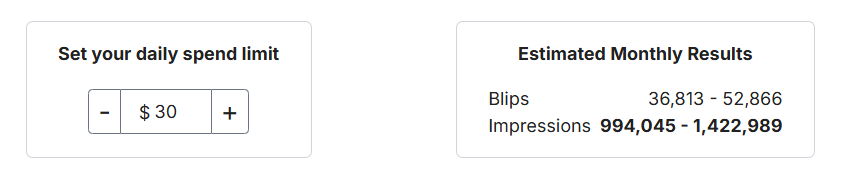
- Set a daily budget: Start with a modest daily cap, monitor how often your ad plays on different boards, and scale up where you see results. Many small and midsize businesses begin with $10–$50 per day and then increase spend on the highest-performing routes and dayparts.
-
Bid by board and time of day:
- Bid more aggressively for premium commute hours on key approach routes, where competition for impressions is higher but so is potential impact.
- Bid lower for midday or late-night slots if you want cost-efficient reach for brand awareness; CPMs (cost per thousand impressions) in off-peak periods are often significantly lower.
-
Rotate creative and test:
- Upload multiple designs and review which periods correlate with more website visits, calls, or in-store traffic.
- Use Google Analytics or call-tracking to connect peaks in activity with your billboard schedule; even with rough attribution, you can spot 10–20% swings tied to certain messages or time windows.
Because you can adjust your campaign in real time, you can react to:
- Weather (e.g., push HVAC or roofing before and after storms; in the Mid-Atlantic, severe weather events can spike service demand by 2–3x in the following week).
- Local news cycles (e.g., feature special messaging when Moorestown-Lenola is highlighted in local media or on Moorestown Township).
- Inventory trends (e.g., car dealers advertising surplus inventory at month-end, retailers promoting clearance events when stock levels are high).
Measuring Success in the Moorestown-Lenola Area
While you can’t “click” a billboard, you can still track impact in the Moorestown-Lenola area with clear metrics:
- Branded search lift: Watch for increases in searches for your brand or “near Moorestown” variants during your campaign. Many advertisers see 10–25% lifts in branded search volume when outdoor is layered on top of digital.
- Website traffic by geography: Look for traffic increases from Moorestown, Mount Laurel, Maple Shade, Cinnaminson, and nearby ZIP codes when your blips are running. A sustained 5–15% increase from target ZIPs during flight weeks is a strong signal of impact.
- Call and lead volume: Track phone, form fills, and appointments day by day, comparing periods with and without active billboard runs. Service businesses often see call spikes aligned with peak billboard dayparts (e.g., morning and early evening).
- Coupon or code usage: Use simple, memorable offers (“Mention MOORESTOWN BOARD”) to tie in-store or phone redemptions to your billboard creative. Even if only 5–10% of customers use the specific code, the pattern over time helps validate performance.
- Survey and anecdotal feedback: Ask customers, “How did you hear about us?”—in affluent, tight-knit communities like the Moorestown-Lenola area, word of mouth and billboard recall often go hand in hand. It’s common for 20–30% of respondents in outdoor-heavy campaigns to mention seeing a sign or billboard.
By combining our 22 digital Moorestown-Lenola billboards serving the Moorestown-Lenola area with data-driven scheduling and locally tuned creative, we can help you consistently reach high-value, decision-making households on the roads they use every day. With Blip’s flexible billboard rental near Moorestown-Lenola, you can start small, test what works, and scale into a powerful always-on presence around one of South Jersey’s most influential suburban communities.