Billboards in Edison, NJ
No Minimum Spend. No Long-Term Contracts. Just Results.
Trusted by Leading Brands


Billboard advertising
in Edison has never been easier
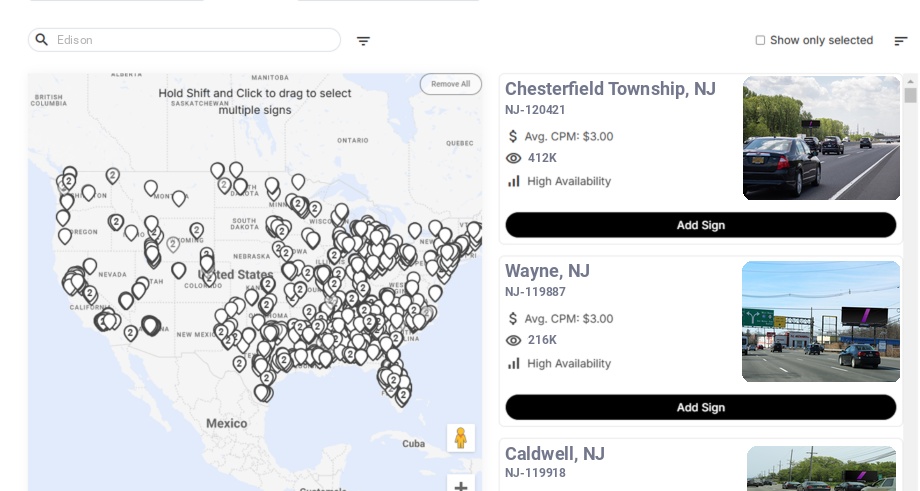
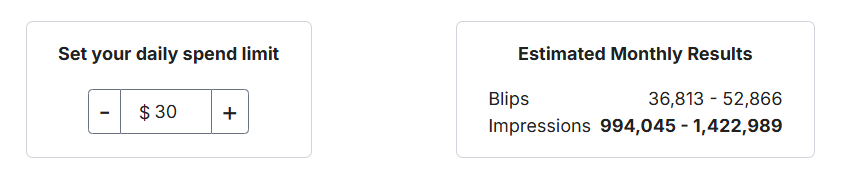
How much is a billboard in Edison?
Why Choose Blip for Billboard Advertising in Edison
-
Blip lets you launch Edison ads fast on Route 1 and I‑287, reaching daily commuters without the hassle of traditional buys.
-
Set flexible budgets in Edison and stay in control as traffic shifts from Metropark rush hour to Menlo Park Mall weekends.
-
Use dayparting in Edison to hit Oak Tree Road shoppers, weekday professionals, or NJ Turnpike drivers when they’re most active.
-
No contracts means Edison brands can test flights around Diwali, Rutgers events, or Shore season and pivot quickly.
-
Track Edison campaign results in real time and refine your message for Raritan Center, Route 27, or local school traffic.
-
Blip’s creative tools make it easy to build crisp Edison billboard ads that stand out for fast-moving drivers on busy corridors.
Frequently Asked Questions About Billboard Advertising in Edison
How much does a billboard cost in Edison, New Jersey with Blip?
With Blip, there’s no flat fee; you pay per “blip,” a 7.5 to 10-second ad display on digital billboards in Edison, New Jersey. The price of each blip depends on when and where you choose to show your ad, as well as advertiser demand. Your total cost over time is simply the sum of the blips you receive, and you can adjust your budget at any time.
Where can I advertise with Blip on Edison billboards?
Edison is ringed by major highways: I-287, Route 1, Route 27, and is minutes from the New Jersey Turnpike (I-95) and the Garden State Parkway. Route 1 in Edison typically carries 95,000–115,000 vehicles per day on many segments, and I-287 near Edison often exceeds 130,000–150,000 vehicles per day. Local arterials like Route 27, Woodbridge Ave, and Amboy Ave also connect residential neighborhoods, local schools, downtown areas, and strip centers.
Why are Edison, New Jersey billboards a good choice with Blip?
Edison sits at the heart of central New Jersey’s transportation web, connecting dense residential neighborhoods, major corporate campuses, logistics hubs, and regional shopping destinations. Edison is one of New Jersey’s largest townships, with roughly 105,000–110,000 residents and a daytime population that can swell by 15–25% due to commuting workers, shoppers, and visitors. This combination means a single digital unit on the right corridor can realistically deliver 700,000–1.2 million weekly impressions, depending on share-of-voice and scheduling.
When is the best time to run Blip ads in Edison, New Jersey?
Rush hours from 6:30–9:30 a.m. and 4:00–7:00 p.m. are heavy on I-287, Route 1, and arterial roads feeding Metropark and park-and-ride lots. Midday brings more local errands, shopping, medical appointments, school pickups, and lunch traffic, while evenings and weekends are busier near Menlo Park Mall, theaters, restaurants, and event venues. Blip also lets you run separate creatives by time of day, so you can tailor messages to commuters in the morning and families in the evening.
What kinds of businesses work best for Edison, New Jersey billboard advertising with Blip?
Retail, healthcare, education, real estate, restaurants, and B2B services are all strong fits in Edison. The area has affluent, spending-ready households, a highly educated professional audience, and major destinations like Raritan Center, Metropark Station, Menlo Park Mall, and the New Jersey Convention & Exposition Center. Local and regional brands can reach residents, shoppers, commuters, and decision-makers within the same geographic footprint.
Do I need a contract to advertise with Blip in Edison?
No, Blip has no long-term contracts or minimum commitments. You can start, pause, or stop your campaign at any time.
How fast can I launch a billboard campaign with Blip in Edison?
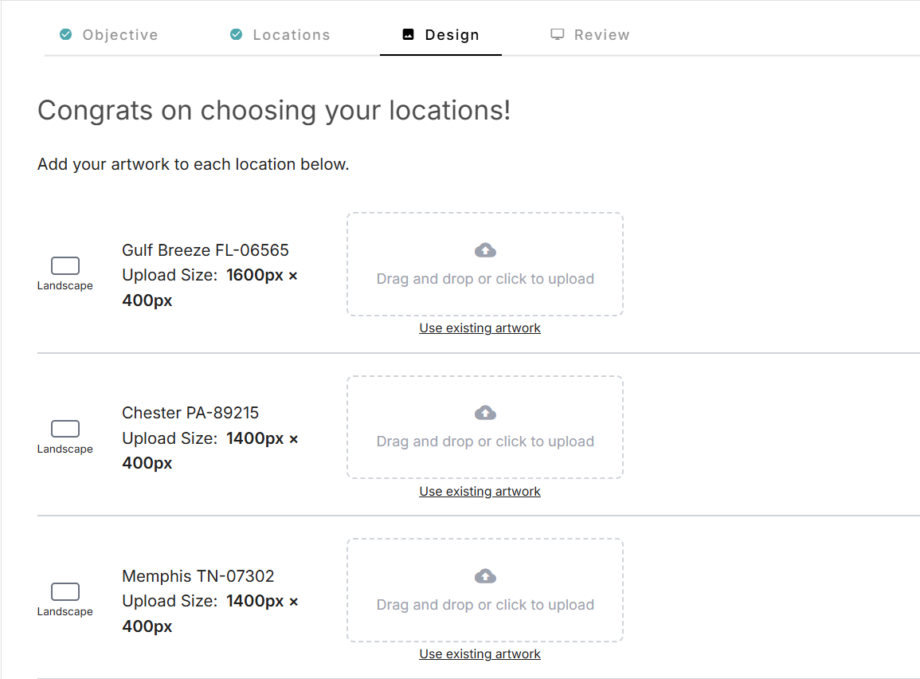
You can have your campaign live in minutes. Create a free account, select your locations, set your budget, upload your design, and start running once approved.
Where can I advertise with Blip in Edison?
Blip has digital billboards in Edison. You can browse available locations on a map, choose the ones that fit your audience, and start advertising right away.
Still have questions? Launch a campaign in minutes — no contracts, no commitments.
Start Your CampaignEdison Billboard Advertising Guide
In this guide, we explore how to use Edison, New Jersey’s unique transportation web and demographics to maximize our digital billboard campaigns and drive measurable results for local and regional brands.
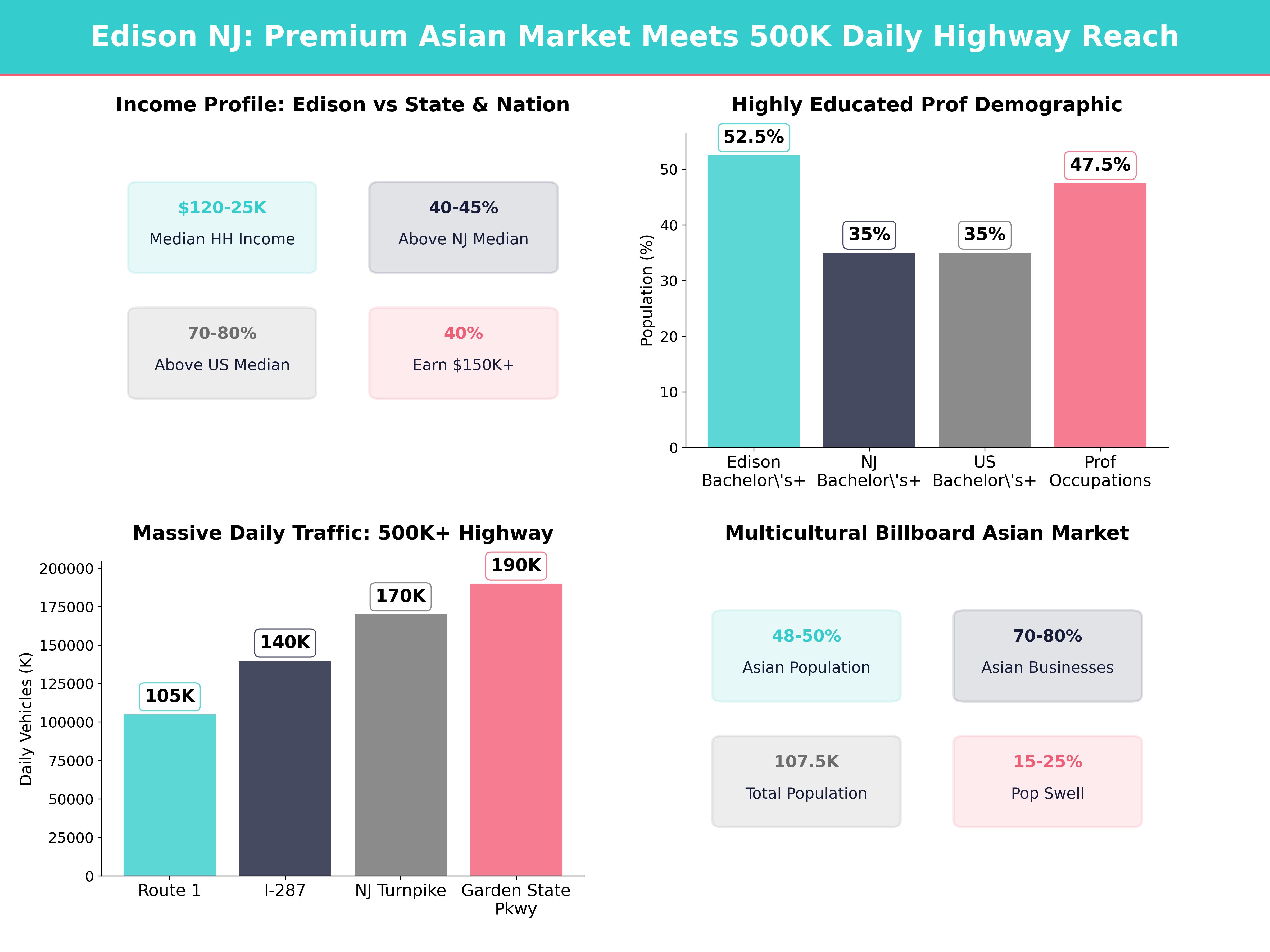
Edison, New Jersey sits at the heart of central New Jersey’s transportation web, connecting dense residential neighborhoods, major corporate campuses, logistics hubs, and regional shopping destinations. When we use digital Edison billboards strategically here, we tap into tens of thousands of daily commuters on corridors like Route 1 and I‑287, high-income suburban households, and one of the most diverse communities in the state—all within 30–40 minutes of both New York City and the Jersey Shore.
Why Edison Is a High-Impact Market for Digital Billboards
Edison is one of New Jersey’s largest townships, with roughly 105,000–110,000 residents and a daytime population that can swell by 15–25% due to commuting workers, shoppers, and visitors. According to township and county planning reports from Edison Township and Middlesex County
-
Affluent, spending-ready audience
- Edison’s median household income is around $120,000–$125,000, which is roughly 40–45% higher than New Jersey’s statewide median and almost 70–80% above U.S. national household income levels.
- More than 40% of households earn over $150,000 per year, supporting robust demand for higher-end retail, home services, and financial products that can be effectively promoted through billboards in Edison.
- Nearby Middlesex County, with a population of about 860,000 residents, consistently ranks among New Jersey’s higher-income counties and generates $40+ billion in annual consumer spending across retail, dining, healthcare, education, and professional services (per county economic development summaries on the Middlesex County
-
Regional connectivity and heavy traffic flows
- Edison is ringed by major highways: I‑287, Route 1, Route 27, and is minutes from the New Jersey Turnpike (I‑95) and the Garden State Parkway, which together carry well over 500,000 vehicles per day in the broader Middlesex corridor.
-
New Jersey Department of Transportation traffic count data for Middlesex County corridors indicate:
- Route 1 in Edison typically carries 95,000–115,000 vehicles per day on many segments.
- I‑287 near Edison often exceeds 130,000–150,000 vehicles per day, depending on the exact milepost.
- Nearby Garden State Parkway segments in Woodbridge/Clark typically register 180,000–200,000+ vehicles per day, and NJ Turnpike segments around Exit 10/11 frequently reach 160,000–180,000 vehicles per day (see traffic resources via NJDOT).
- This means a single digital unit on the right corridor can realistically deliver 700,000–1.2 million weekly impressions, depending on share-of-voice and scheduling, making billboard rental in Edison particularly efficient for reach.
-
Commuter rail and job centers
- Two major NJ TRANSIT Northeast Corridor stations—Metropark and Edison—serve substantial rail traffic. Pre-pandemic, Metropark Station averaged roughly 7,000–9,000 weekday boardings, and current ridership has been recovering steadily (see station details on Metropark Station).
- The broader Northeast Corridor line is one of NJ TRANSIT’s busiest, with more than 90,000 average weekday riders across the line, many of whom pass through or park in the Edison–Iselin area.
- The nearby Raritan Center Business Park 100 companies across roughly 12–14 million square feet of industrial and office space, supporting an estimated 8,000–10,000 employees on a typical weekday—an attractive B2B audience for Edison billboards along industrial corridors.
-
Proximity to powerful anchors
- Menlo Park Mall 150 stores and restaurants and total trade-area visitation well into the millions of shopper trips annually.
- Rutgers University–New Brunswick, just across the Raritan River, enrolls more than 50,000 students and employs over 10,000 staff and faculty. Rutgers reports an annual economic impact in New Jersey of more than $5 billion, much of it concentrated in Middlesex County.
- The New Jersey Convention & Exposition Center in Edison hosts more than 150 events annually, attracting 200,000–400,000 visitors each year between trade shows, festivals, and consumer expos.
For advertisers, this combination means we can reach local residents, regional shoppers, and B2B decision-makers all within the same geographic footprint—simply by choosing our billboards in Edison and scheduling intelligently.
Understanding Edison’s Audience and Demographics
To design artwork and messaging that truly connects, we need to account for who lives and works in Edison and the surrounding area, using demographic profiles assembled by Edison Township, Middlesex County
-
Highly educated and professional
- Over 50–55% of Edison adults hold at least a bachelor’s degree, compared with roughly 35% statewide and under 35% nationally. Graduate and professional degrees are common in neighborhoods near major employers and transit.
- An estimated 45–50% of employed residents work in management, business, science, and arts occupations, with strong concentrations in technology, healthcare, pharmaceuticals, finance, and professional services linked to regional hubs like New Brunswick, Newark, Jersey City, and Manhattan.
- Middlesex County overall supports more than 430,000 jobs, with over 60,000 jobs in professional and technical services and 50,000+ in healthcare and social assistance, which heavily draw on Edison’s workforce (per county economic profiles on Middlesex County
-
Exceptionally diverse, especially South Asian communities
- Roughly 48–50% of Edison’s population is Asian, and local data and community organizations indicate Indian-American residents constitute one of the largest Indian communities in the United States.
- In some corridors—especially around Oak Tree Road and the Edison/Iselin border—South Asian businesses can account for 70–80% of street-facing retail, with dense clusters of restaurants, grocery stores, jewelry shops, travel services, and medical practices.
- Cultural and religious events such as Diwali, Navratri, and Eid drive noticeable spikes in discretionary spending. Local merchants on Oak Tree Road often report double or triple their typical weekly sales during peak Diwali weeks, according to coverage in outlets like MyCentralJersey and TAPinto Edison
-
Family-oriented suburbs
- Edison’s median age is in the mid‑30s to early‑40s, reflecting a strong concentration of families with school-age children. Roughly 25–30% of residents are under age 18.
- Edison Public Schools enroll approximately 16,000–17,000 students across more than 18–19 schools, including several nationally recognized high schools and magnet programs.
- Residents strongly value education, safety, and convenience, and local surveys frequently show high interest in tutoring, enrichment, STEM programs, and college-prep services.
What this means for creative and messaging:
- Emphasize quality, trust, and expertise—this audience responds well to professional, clean design and clear value propositions, particularly in healthcare, education, and financial categories.
-
For certain campaigns, consider subtle cultural cues:
- Recognizable local festivals (“Celebrate Diwali with 20% off gold jewelry this week”)
- Imagery that reflects multicultural families and professionals
- Keep copy short and sophisticated. With average commute speeds of 25–40 mph on local arterials and 55–65 mph on highways, drivers often have 2–3 seconds to absorb your key message on Edison billboards.
- If you’re a local or regional brand with roots in Edison or Middlesex County, highlight that (“Serving Edison families since 1998”)—local pride is strong, and more than 60% of households have lived in the county for 10+ years, according to county planning summaries.
Mapping High-Value Corridors and Placement Strategy
While we can’t control exactly where every digital board is located, we can choose which panels we buy on and how we use them. In Edison, we want to align messaging with major corridors and nearby destinations mapped by Edison Township and Middlesex County
1. Route 1 Corridor
-
Why it matters:
- Connects Edison to North Brunswick, Woodbridge, and beyond; multiple interchanges, shopping centers, auto dealers, and quick-service restaurants line the route.
- AADT (average annual daily traffic) is typically 90,000–110,000 vehicles on Edison segments, making it one of the most heavily traveled commercial corridors in central New Jersey (NJDOT).
-
Best for:
- Retail sales (especially if you’re along or just off Route 1).
- Auto dealers, service centers, quick-service and fast-casual restaurants.
- “Next exit” or “2 miles ahead” directional messages that leverage high-visibility billboards in Edison.
-
Strategy tip:
- Use distance and exit numbers in your copy: “Exit now for Route 1 car deals,” “Next right – Free Estimate Today.”
- Consider reinforcing in-store foot traffic metrics—Route 1-facing businesses often see 30–50% of new walk-ins citing “saw your sign” or “saw you on Route 1” in local merchant surveys.
2. I‑287 and NJ Turnpike Access
-
Why it matters:
- Carries heavy commuter, logistics, and regional traffic between Somerset, Middlesex, Union, and Bergen counties, plus long-haul trucking.
- I‑287 AADT near Edison often exceeds 130,000–150,000 vehicles; nearby NJ Turnpike segments (Exits 9–11) can reach 170,000–180,000+ vehicles per day, including high percentages of commercial vehicles ( NJ Turnpike Authority
-
Best for:
- B2B offerings, logistics, warehousing, staffing agencies, insurance, and financial services.
- Regional brands targeting both central and northern New Jersey commuters.
-
Strategy tip:
- Emphasize time savings, reliability, and scale (“Same-day freight in NJ/NY/PA,” “Staff your warehouse this week”).
- Consider weekday, rush-hour-heavy scheduling, as peak weekday volumes can be 30–40% higher than typical weekend flows.
3. Local Arterials: Route 27, Woodbridge Ave, Amboy Ave
-
Why they matter:
- These roads connect residential neighborhoods, local schools, downtown areas, and strip centers, often carrying 15,000–30,000 vehicles per day each, according to municipal traffic studies.
- Traffic volumes are lower than Route 1 but maintain high local relevance and slower average speeds, which allow for slightly more detailed creative.
-
Best for:
- Local clinics, dentists, restaurants, tutoring centers, home services, and community organizations.
-
Strategy tip:
- Include neighborhood references (“Near Clara Barton,” “Minutes from North Edison High,” “In Raritan Center”) to build local affinity and increase recall in household surveys. These details help distinguish your creative within the broader mix of Edison billboard advertising.
4. Proximity to Transit Hubs (Metropark & Edison Stations)
-
Why they matter:
- Metropark Station is one of NJ TRANSIT’s busiest suburban stations, with several thousand weekday boardings and a park-and-ride lot that often reaches 80–90% capacity on weekdays (NJ TRANSIT).
- The Edison Station also serves daily commuters heading to Newark, Jersey City, and New York Penn Station, with ridership that spikes during peak commuting hours and major events.
- Commuters are often mid- to high-income white-collar professionals—household incomes of $100,000+ are common among frequent rail users in this corridor.
-
Best for:
- Professional services, financial advisors, healthcare specialists, higher education, and real estate.
-
Strategy tip:
- Target early-morning and late-day commute windows with messaging like “Call on your lunch break” or “Tour this weekend.”
- Emphasize time-limited offers (“Book by Friday,” “Enroll by 30th”) to capitalize on the repetitive daily exposure commuters get.
Timing Your Blip Campaign Around Local Traffic Patterns
Edison’s road network has distinct peaks based on commuting, shopping, and school schedules. Blip’s dayparting and budgeting flexibility let us focus spending when impressions are most valuable, using insights from township traffic studies and NJDOT counts. Timing is especially important when you’re investing in digital Edison billboards, where you pay only for the blips you run.
Rush Hours (6:30–9:30 a.m. and 4:00–7:00 p.m.)
- Heavy on I‑287, Route 1, and arterial roads feeding Metropark and park-and-ride lots. In these windows, volumes can be 25–40% higher than midday baselines.
- Audience skew: professionals commuting to corporate hubs and NYC, with above-average household incomes and higher education levels.
-
Ideal for:
- B2B services, staffing, technology, financial services, healthcare, and premium retail.
-
Creative tips:
- Use problem/solution framing: “Hate your commute? Work closer to home—Now hiring in Edison.”
- Keep messages highly legible in 2 seconds or less—no more than 7–8 words and bold typography.
Midday (10:00 a.m.–3:00 p.m.)
- More local errands: shopping, medical appointments, school pickups, and lunch traffic. Traffic volumes are typically 15–25% lower than peak rush hours but skew more heavily toward household decision-makers.
- Audience skew: stay-at-home parents, retirees, flexible workers, small-business owners, and gig workers.
-
Ideal for:
- Local restaurants, clinics, urgent care, tutoring centers, and service businesses.
-
Creative tips:
- Promote same-day or walk-in options: “Walk-in urgent care – Route 1 & Plainfield Ave,” “Lunch specials today – Exit now.”
- Include phone numbers or URLs—drivers in midday traffic are more likely to have time to snap a photo or remember a simple web address.
Evenings (7:00–10:00 p.m.) and Weekends
- Heavier traffic near Menlo Park Mall, theaters, restaurants, and event venues, especially Friday evenings, Saturdays, and pre-holiday weekends. Retail districts can see 20–30% higher volumes in December versus typical months, per mall and county data.
- Audience skew: families, couples, teens, and young adults.
-
Ideal for:
- Entertainment, dining, shopping events, gyms, and churches/faith communities.
-
Creative tips:
- Use event and weekend-specific messaging: “Live music Friday,” “Sunday brunch reservations.”
- Highlight easy-to-remember offers like “Kids eat free Sunday” or “This weekend only.”
With Blip, we can run separate creatives by time of day—for example, one ad for commuting professionals in the morning and a different one for families in the early evening—without needing long-term commitments to a single message.
Seasonal and Event-Based Opportunities in Edison
Seasonality in Edison is influenced by schools, weather, cultural festivals, and regional events. Planning around these cycles can significantly increase response and media efficiency, especially when coordinating flight dates with your overall Edison billboard advertising calendar.
School Calendar & University Cycles
- Edison Public Schools and nearby districts follow a traditional September–June calendar; back-to-school retail typically surges in late July through early September, with some categories (backpacks, electronics, clothing) seeing 20–30% sales lifts over annual monthly averages.
- Rutgers University–New Brunswick move-in and orientation in late August/early September bring tens of thousands of students and families through Edison-area highways; the university reports more than 10,000 new students entering each fall across undergraduate and graduate programs.
-
Opportunities:
- Back-to-school clothing, electronics, tutoring, activities, and healthcare.
- Apartment rentals, storage, furniture, and student services.
-
Strategy:
- Start campaigns 4–6 weeks before the school year and intensify two weeks prior to move-in dates.
- Consider separate creatives for K–12 families and college students/parents, each with tailored calls to action.
Holiday Shopping and Cultural Festivals
-
November–December: Peak general holiday shopping. Menlo Park Mall and local plazas become major traffic magnets, with some retailers reporting 30–40% of annual sales in this period.
- Diwali (often October–November): Extremely important for Edison’s Indian community—jewelry, clothing, home décor, and sweets see major spikes; local Indian gold and jewelry retailers often double typical weekly sales during Diwali weeks, as reported by regional news outlets like NJ.com Middlesex
- Eid and Ramadan, Christmas, and New Year’s also drive category-specific surges in catering, gifts, and travel.
-
Opportunities:
- Gold and jewelry stores, ethnic grocery markets, banquet halls, caterers, and event planners.
-
Strategy:
-
Use culturally relevant language or imagery while keeping copy inclusive and simple:
- “Diwali Gold Offers – Menlo Park”
- “Eid Catering – Book Today – Edison”
- Time Blip flights to start 2–3 weeks before festival dates for awareness, then ramp 5–7 days before for last-minute shoppers.
-
Use culturally relevant language or imagery while keeping copy inclusive and simple:
Local and Regional Events
- The New Jersey Convention & Exposition Center in Raritan Center hosts trade shows, consumer expos, and festivals year-round, attracting hundreds of thousands of visitors annually, many of whom drive via I‑287 and local arterials.
- Rutgers football games, graduations, and large events at Jersey Mike’s Arena 10–20% on event weekends, according to coverage from MyCentralJersey and NJ.com Middlesex
- Edison and Middlesex County list community events on Edison Township’s website and Middlesex County’s site MyCentralJersey, NJ.com Middlesex
-
Strategy:
- Align short, intense Blip flights 1–2 weeks before major events to capture attendees as they plan travel and activities.
- Use simple, event-tied language: “In town for the Expo? Dinner 2 miles ahead.”
Weather and “Jersey Shore” Season
- Summer weekends see heavy southbound traffic as residents head to the Jersey Shore beaches (promoted via VisitNJ.org). Shore towns such as Point Pleasant Beach Seaside Heights tens of thousands, much of it originating from central New Jersey counties like Middlesex.
- On peak Friday and Sunday periods from late May through early September, southbound and northbound highway volumes can increase 20–35% over non-summer levels.
-
This benefits:
- Hotels, beach rentals, outdoor gear, restaurants, and auto service (pre-trip maintenance).
-
Strategy:
- Launch highly visible weekend-focused creatives in late spring and early summer, highlighting “Before you hit the Shore…” offers.
- Emphasize safety and preparedness angles such as “Free AC check before your Shore trip.”
Creative Strategies That Resonate Locally
Digital billboards in Edison work best when we combine clean design with local relevance and a data-informed understanding of driver behavior.
1. Keep Copy Short and Directional
- Aim for 7–10 words maximum and no more than 2–3 key visual elements. Studies of roadside readability consistently show recall drops sharply beyond that threshold at 55–65 mph.
-
Emphasize what, where, and why now:
- “Urgent Care – Route 1 – Walk-In Today”
- “New Luxury Apartments – 5 Min from Metropark”
2. Reflect Edison’s Diversity Without Overcomplicating
- Use imagery that includes multicultural families and professionals, aligning with Edison’s roughly 50% Asian, 20–25% White, and 15–20% Hispanic and Black population mix (as reported in township demographics).
- Sprinkle in occasional, simple phrases that resonate with South Asian audiences (e.g., “Diwali Offers,” “Navratri Nights”), but keep the main message in clear English to reach all drivers.
- For Oak Tree Road–oriented campaigns, small touches like colorful backgrounds or festive motifs can lift engagement without alienating non-South Asian audiences.
3. Tie Into Landmarks and Local Identity
-
Reference:
- Menlo Park Mall
- Raritan Center
- Metropark Station
- Oak Tree Road (a major Indian retail/dining corridor, just over the Edison/Iselin line)
- Local high schools and neighborhoods such as JP Stevens, Edison High, Clara Barton, and North Edison
- Example: “Oak Tree Rd Sweets – Diwali Specials This Week.”
- Local research and chamber of commerce surveys (see Edison Chamber of Commerce) show that including a recognizable local landmark or neighborhood in creative can boost ad recall by 10–20 percentage points versus generic messaging.
4. Use Rotating Creatives Intelligently
Because Blip allows multiple creatives in rotation, we can:
- Test two different headlines (“Same-Day Braces Consultations” vs. “Braces from $89/mo”) and see which correlates with more web visits or calls during the same time window.
- Run bilingual variations (e.g., one English-only creative, another with a short Hindi or Gujarati phrase) in South Asian-heavy corridors and compare results. Local businesses on Oak Tree Road often estimate that 50–70% of their in-store customer base is comfortable with South Asian languages, so modest bilingual elements can build affinity.
- Adjust creative seasonally—one set for back-to-school, another for holiday shopping, another for Shore season—without redesigning everything from scratch.
Using Blip Tools to Target, Test, and Optimize in Edison
We can leverage Blip’s flexibility to make Edison campaigns more precise and cost-effective, especially when combined with local insights from Edison Township and county economic data. Whether you are testing Edison billboard advertising for the first time or scaling ongoing flights, these tools help refine your spend.
-
Location-based selection:
- Prioritize boards closest to your physical location or primary trade area—within 3–5 miles for local services; within 10–20 miles for regional brands drawing from the entire Middlesex–Union–Somerset region.
- For B2B or industrial offerings, emphasize boards near Raritan Center, I‑287, and NJ Turnpike feeders, where a high share of vehicles are commercial or employee commuters.
-
Dayparting and Budget Concentration:
- If you serve primarily working professionals (e.g., high-end dental, financial advising), allocate 60–70% of impressions to weekday rush hours on major commuter corridors, when the concentration of white-collar workers is highest.
- Restaurants and entertainment venues might push 50–60% of impressions to evening and weekend slots near mall and retail clusters, where leisure trips dominate.
- Healthcare and urgent care often benefit from a balanced mix (e.g., 40% rush hour, 40% midday, 20% evening).
-
Micro-campaigns by Message:
- Launch short, 7–14 day flights for sales, holiday events, or new openings, especially around key retail periods like Diwali or Black Friday.
- Maintain a lower baseline presence year-round for brand awareness, then surge spending during peak seasons (e.g., back-to-school, Diwali, holiday shopping, Shore season).
- Local advertisers often see 20–30% higher conversion rates when tying billboard flights to clear, time-bound promotions.
-
A/B Testing:
-
Rotate two or three variations of your creative and track changes in:
- Direct website visits
- Unique URLs or promo codes used
- Call volume and form fills
- Google Business Profile direction requests
- After a few weeks, pause the underperforming creatives and reallocate impressions to the top performer. Even small optimizations (e.g., a stronger call to action) can improve response rates by 10–25%.
-
Rotate two or three variations of your creative and track changes in:
Industry-Specific Tips for Edison Advertisers
Retail & Shopping Centers
- Focus on Route 1, Menlo Park Mall area, and Oak Tree Road vicinity. These zones collectively reach tens of thousands of daily shoppers and passersby, according to mall and township data.
- Use headlines like “Next Right,” “Across from Menlo Park Mall,” or time-limited offers (“This Weekend Only”).
- Schedule heavier weekend and late-afternoon impressions, when shopping traffic is strongest and mall parking lots approach 80–100% occupancy on peak days. For retailers considering billboard rental in Edison, these placements often generate the fastest visibility and measurable lift.
Healthcare & Wellness
- Edison and surrounding Middlesex County have high demand for specialist care, urgent care, dental, pediatric, and wellness services, with regional hospital and clinic systems serving hundreds of thousands of patient visits annually.
-
Target:
- Commuter corridors in morning and evening to capture professionals choosing providers closer to home.
- Local arterials midday to reach parents, retirees, and flexible workers.
- Highlight convenience and trust: “Same-Day Appointments,” “Open Until 9 p.m.,” “Board-Certified Cardiology in Edison.”
- Consider featuring metrics like average wait times (“Most visits under 30 minutes”) or evening/weekend hours, which are particularly valued among dual-income households.
Education & Tutoring
- With high academic expectations and a large youth population, tutoring centers, test-prep, and enrichment programs can thrive. In many Edison neighborhoods, high school graduation and college attendance rates exceed 90%, and participation in SAT/ACT prep is well above state averages.
- Run campaigns ahead of report card periods, exam seasons, and summer camps—for example, January–March for spring test prep and April–June for summer programs.
- Use simple calls to action: “SAT Prep – Enrolling Now – North Edison,” “STEM Camp – Ages 8–14.”
- Highlight measurable outcomes where possible (“Average score increase 150+ points,” “95% of students improve one letter grade”).
Restaurants & Food Service
- Edison is known for its diverse dining, from Indian to Korean to Italian, and local coverage in TAPinto Edison MyCentralJersey frequently features new openings.
- Focus on evening and weekend impressions; feature appetizing imagery, not just logos.
- For South Asian cuisine, align campaigns with Diwali, Eid, Navratri, and wedding seasons; highlight catering and banquet services, which can account for 30–50% of annual revenue for some restaurants and banquet halls.
- Use proximity-based copy: “1 Minute from Oak Tree Rd,” “Across from Menlo Park Mall Food Court.”
Real Estate & Home Services
-
High median incomes and stable homeownership—owner-occupied housing rates in many Edison neighborhoods are in the 60–70% range—make Edison a good market for:
- Realtors, mortgage brokers
- Contractors, roofers, HVAC, solar
- Use geographic targeting: “Serving Edison & North Brunswick,” “Free Estimate in 24 Hours.”
- Concentrate impressions during spring and early summer, when buying, selling, and renovation activity peaks; national and regional data typically show 30–40% of annual home sales closing from April to July.
- Consider using statistics such as “Over 50 homes sold in Edison last month” (aligned with local MLS reports) to create urgency.
B2B, Logistics, and Industrial Services
- Raritan Center and nearby industrial parks host distribution centers, manufacturers, and logistics companies; Middlesex County tens of thousands of jobs in the county.
- Use boards along I‑287, NJ Turnpike approaches, and Raritan Center access routes to reach decision-makers and fleet drivers.
- Emphasize efficiency and scale: “Warehouse Staffing in 48 Hours,” “3PL Solutions – Same-Day Quotes.”
- Highlight quantitative claims: “98% on-time delivery,” “Over 1M sq ft managed in NJ/NY,” which resonate strongly with operations managers.
Measuring Success and Iterating in Edison
To get the most from Edison billboard campaigns, we should pair Blip’s flexibility with clear metrics and local feedback loops. Treat each round of billboard rental in Edison as both a branding investment and a test you can learn from.
Trackable Elements
- Vanity URLs: e.g.,
YourBrand.com/Edisonor/Route1, which can easily be monitored in analytics tools. - Promo codes: e.g., “Mention EDISON20 for 20% off.”
- Call tracking numbers dedicated to billboard campaigns—local businesses often find that 20–40% of new inbound calls over a campaign window can be attributed to billboard-specific numbers.
- Google Analytics: watch for spikes in direct and branded search volume during your campaign windows; in many cases, brands see 10–30% uplifts in direct traffic when billboards are live.
Time-Based Analysis
-
Compare performance before, during, and after Blip flights. Look for changes in:
- Web sessions
- Phone inquiries
- Appointment or reservation volume
- Look at day-of-week and time-of-day trends—if calls or site visits spike after morning rush hour impressions, lean into those windows in your next flight.
Local Feedback Loops
- Ask customers, “How did you hear about us?” and log responses; many Edison-area businesses report 15–25% of new customers mentioning “saw your sign” when they consistently advertise on major corridors.
- Monitor local media and community calendars—if coverage on MyCentralJersey, NJ.com Middlesex
- Stay in touch with local business groups like the Edison Chamber of Commerce and regional organizations such as the Middlesex County Regional Chamber of Commerce
By combining local insight—traffic patterns, cultural rhythms, income levels, and commuting behavior—with Blip’s on-demand digital billboard platform, we can create Edison billboard advertising campaigns that are not only visible, but also timely, targeted, and measurably effective for brands across retail, services, B2B, and community sectors.