Billboards in Berlin, NJ
No Minimum Spend. No Long-Term Contracts. Just Results.
Trusted by Leading Brands


Billboard advertising
in Berlin has never been easier
How much is a billboard in Berlin?
Why Choose Blip for Billboard Advertising in Berlin
-
Choose Blip in Berlin to launch fast on White Horse Pike or Route 73 with self-serve control and no contracts.
-
Berlin budgets flex by daypart on Blip, so you can hit weekday commuters and Friday Shore traffic when it matters most.
-
Track Berlin plays in real time and shift spend from local errands to Expressway-bound weekend traffic as results change.
-
Blip’s no-minimum model helps Berlin advertisers test suburban family audiences, then scale what works without long commitments.
-
Use Blip creative tools to tailor Berlin ads for White Horse Pike, Route 73, or summer Shore trips in seconds.
Frequently Asked Questions About Billboard Advertising in Berlin
How much does a billboard cost in Berlin, New Jersey with Blip?
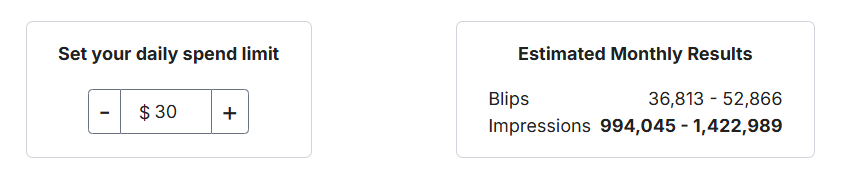
With Blip, you choose a daily budget, and Blip’s pay-per-play model means you only pay when your ad actually appears. Each “blip” is a 7.5-to-10-second spot on a rotating digital billboard, with pricing that can start at just $0.01 per display. Since costs change based on time of day, location, and advertiser demand, Blip’s algorithm works to stretch your budget and maximize your reach.
Where can I advertise with Blip in Berlin, New Jersey?
U.S. 30 is Berlin’s defining corridor, and NJDOT traffic-count segments through the Berlin-Atco area commonly land in the low-20,000s to low-30,000s AADT. Route 73 gives Berlin advertisers access to one of South Jersey’s strongest retail and family-entertainment spines, with nearby segments often running from the mid-30,000s to above 50,000 AADT. The Atlantic City Expressway and Route 42/I-295 also shape Berlin advertising by feeding regional commuter and Shore-bound traffic.
Why is Berlin, New Jersey a strong market for Blip billboard advertising?
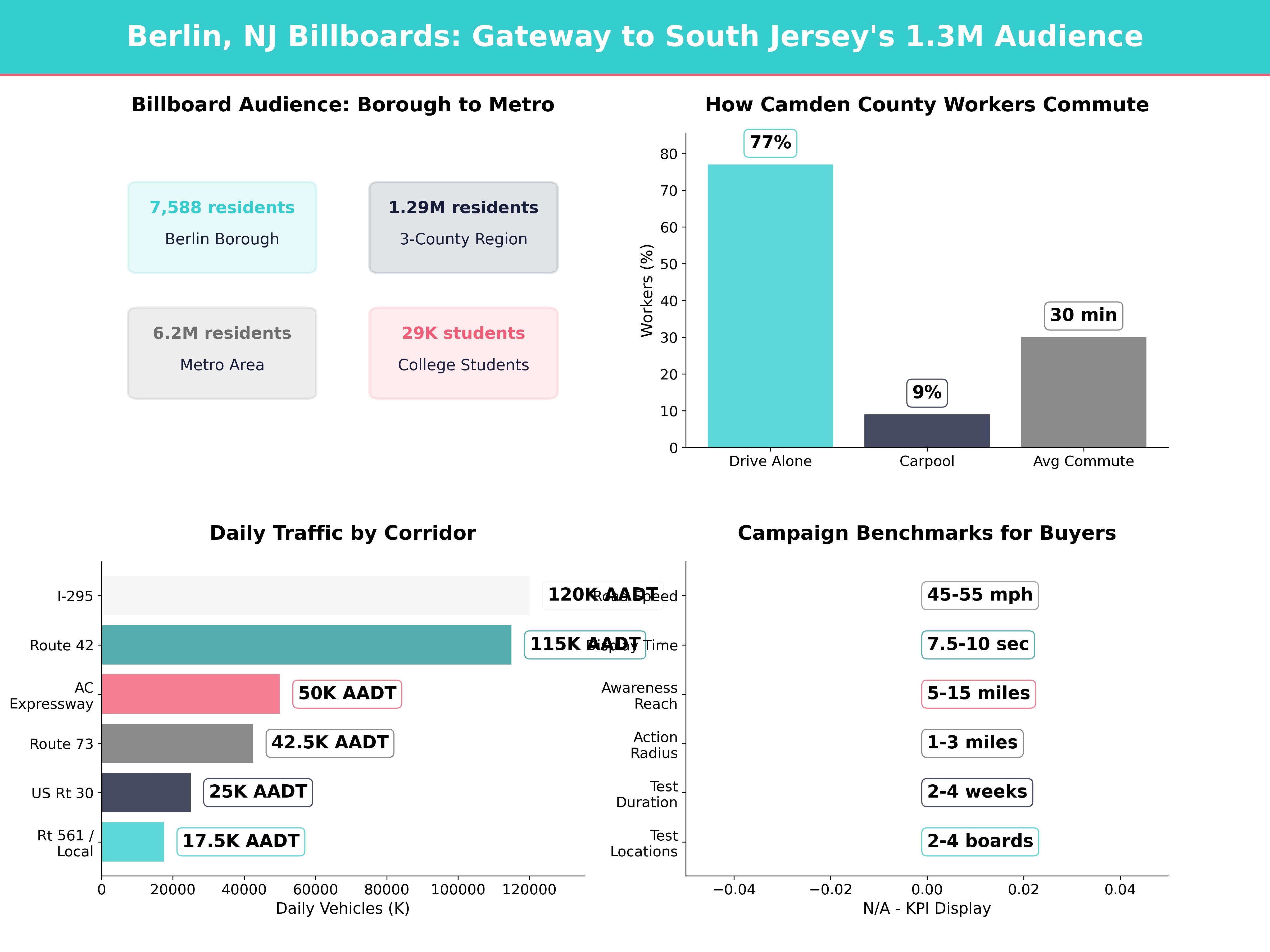
Berlin Borough is a strong billboard market because it sits where everyday South Jersey driving patterns overlap with regional travel. The borough itself has roughly 7,588 residents, but it pulls from a much larger base in Camden County and from a three-county ring of about 1.29 million people when Burlington County and Gloucester County are included. That combination creates reliable weekday frequency and valuable seasonal spikes.
When is the best time to run billboard ads in Berlin, New Jersey?
From Memorial Day to Labor Day, Berlin sits in the path of South Jersey’s leisure traffic, and eastbound movement intensifies as travelers head toward Atlantic City, the Shore, and summer attractions. Back-to-school season from late July through September is also a strong window because daily school traffic, sports travel, and parent scheduling return. By December, sunset arrives before 5:00 p.m., often around 4:30 p.m., making afternoon and early evening visibility especially important.
What kinds of businesses work well for billboard ads in Berlin, New Jersey with Blip?
Berlin is a good fit for healthcare, education, family entertainment, retail, and home service advertisers. The local economy supports campaigns for brands such as healthcare systems, universities, and family destinations because commuters, families, students, and tourists all move through the market. Berlin is not a one-note market; it is a stable suburban audience with enough commuter density and leisure flow to support both awareness campaigns and immediate-response offers.
Do I need a contract to advertise with Blip in Berlin?
No, Blip has no long-term contracts or minimum commitments. You can start, pause, or stop your campaign at any time.
How fast can I launch a billboard campaign with Blip in Berlin?
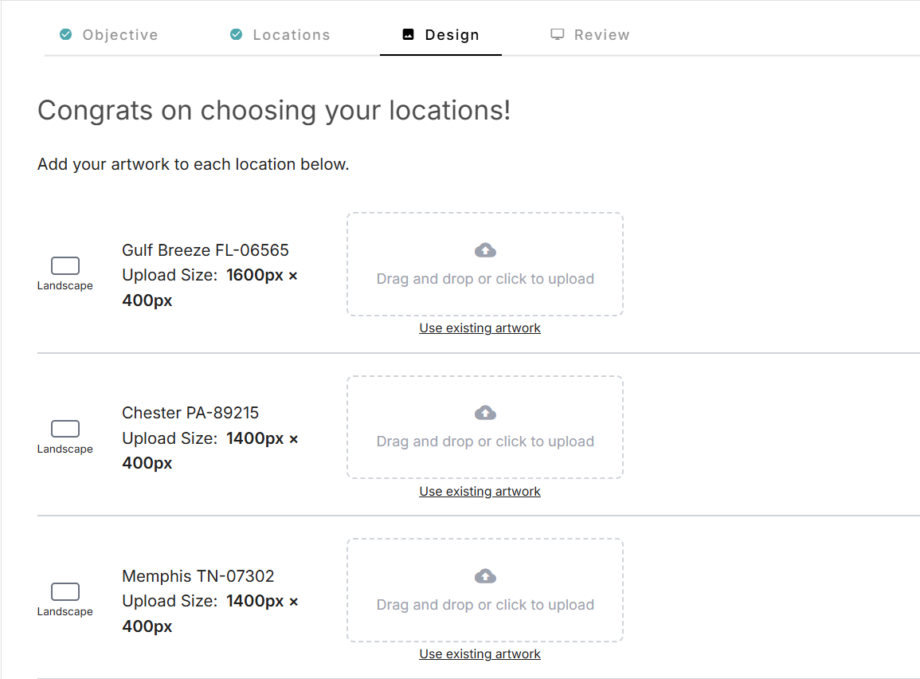
You can have your campaign live in minutes. Create a free account, select your locations, set your budget, upload your design, and start running once approved.
Where can I advertise with Blip in Berlin?
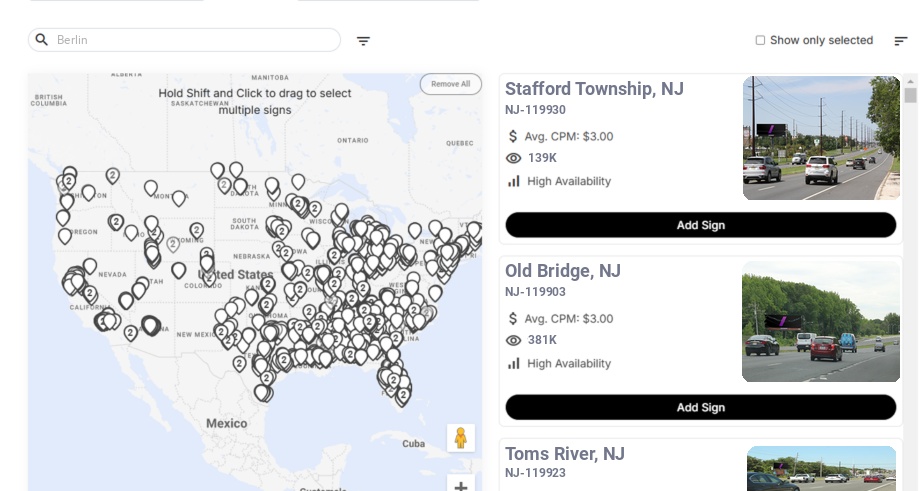
Blip has digital billboards in Berlin. You can browse available locations on a map, choose the ones that fit your audience, and start advertising right away.
Still have questions? Launch a campaign in minutes — no contracts, no commitments.
Start Your CampaignBerlin Billboard Advertising Guide
Berlin Borough is a strong billboard market because it sits where everyday South Jersey driving patterns overlap with regional travel. The borough itself has roughly 7,588 residents, but it pulls from a much larger base in Camden County 523,485 residents in 2020, and from a three-county ring of about 1.29 million people when we include Burlington County Gloucester County
Berlin, New Jersey Market Overview
Berlin works best when we think of it as both a local borough and a gateway market. Many campaigns that start in Berlin are really reaching the borough, Berlin Township Voorhees Township Winslow Township Gloucester Township Evesham Township. That matters because local consumers do not shop or commute by municipal boundary. They follow roads, routines, and destination clusters.
Berlin is small, but its real audience is regional
In 2020, Camden County counted 523,485 residents. Burlington County added 461,860 residents, and Gloucester County added 302,294 residents. Together, those three counties total 1,287,639 people, which gives Berlin advertisers a much larger practical audience than the borough population alone suggests.
That regional base also grew over the last decade. From 2010 to 2020, those three counties added nearly 37,100 residents combined, or roughly 3% overall growth. Berlin benefits from that steady expansion because it sits between established neighborhoods and newer suburban growth farther south and east.
Berlin also sits inside the broader Philadelphia-Camden-Wilmington metro, which has more than 6.2 million residents. The borough is roughly 20 miles from Philadelphia 40 miles from Atlantic City. That geography gives us two useful billboard dynamics at once. We get dependable local repetition from South Jersey residents, and we get regional pass-through exposure from commuters and leisure travelers.
What Berlin’s commuting and economy mean for advertisers
South Jersey is a driving market first. Based on recent American Community Survey estimates, roughly 77% of Camden County workers drive alone to work, and nearly 9% carpool. The average commute is just under 30 minutes, which is long enough for outdoor advertising to matter and frequent enough for recall to build.
Berlin especially benefits from that pattern because it is surrounded by suburban land use, shopping centers, school trips, healthcare visits, and family errand travel. Even with regional options from NJ Transit and PATCO, most local decisions still happen in cars. That reality makes billboard exposure practical for advertisers that need repeated, location-based awareness.
The local economy is also diversified in ways that help outdoor advertising. New Jersey Department of Labor and Workforce Development data consistently shows South Jersey employment strength in health care, education, retail, logistics, and services. Around Berlin, that means campaigns can work for:
- Healthcare brands, because systems such as Virtua Health, Cooper University Health Care Jefferson Health New Jersey
- Education brands, because Rowan University enrolls more than 23,000 students, Rutgers University–Camden enrolls more than 6,000, and Camden County College operates 3 campuses in the county.
- Family entertainment and retail brands, because nearby destinations such as Diggerland USA Big Kahuna’s Water Park Clementon Park & Splash World, and the Berlin Farmers Market create recurring weekend traffic.
For advertisers, Berlin is not a one-note market. It is a stable suburban audience with enough commuter density and leisure flow to support both awareness campaigns and immediate-response offers.
Key Traffic Corridors for Berlin, New Jersey Campaigns
When we plan Berlin billboard coverage, traffic corridors matter more than municipal borders. The best placements usually align with routes drivers already trust. Where available, we can use New Jersey Department of Transportation traffic-count ranges expressed as AADT, or annual average daily traffic, to understand likely reach.
U.S. Route 30, the White Horse Pike
U.S. 30 is Berlin’s defining corridor. NJDOT traffic-count segments through the Berlin-Atco area commonly land in the low-20,000s to low-30,000s AADT, making the White Horse Pike one of the most dependable local impression generators in the market. It is not only a commuter road. It is also a shopping road, a dining road, and a Shore approach road.
This corridor works especially well for advertisers that benefit from routine exposure.
- Restaurants, convenience retail, and fuel-related brands perform well here because drivers are often already in decision mode.
- Healthcare, urgent care, dental, and vision providers benefit because the White Horse Pike is part of recurring family and appointment traffic.
- Home services such as HVAC, plumbing, roofing, and restoration fit the corridor because homeowners use this road repeatedly throughout the week.
For many local advertisers, U.S. 30 is the place to build frequency first.
Route 73 and the West Berlin commercial cluster
Route 73 gives Berlin advertisers access to one of South Jersey’s strongest retail and family-entertainment spines. NJDOT counts on nearby Route 73 segments in West Berlin, Voorhees, and Marlton often run from the mid-30,000s to above 50,000 AADT. That is valuable because this corridor attracts both habitual locals and destination traffic.
Route 73 is a strong fit for:
- Family entertainment and recreation, because West Berlin destinations already condition drivers to expect places to stop.
- Retail, furniture, fitness, and service brands, because Route 73 traffic often includes planned shopping trips.
- Medical specialists, legal services, and financial brands, because the corridor connects denser suburban households to office and care centers farther north.
If we want Berlin exposure that reaches beyond the borough and into higher-volume suburban decision-making, Route 73 is usually near the top of the list.
The Atlantic City Expressway and Shore-bound movement
The South Jersey Transportation Authority 44-mile Atlantic City Expressway, and that road shapes Berlin advertising even when a board is not directly on the expressway itself. Nearby western segments commonly carry traffic in the mid-40,000s to mid-60,000s AADT range, with strong directional swings during summer weekends and holiday travel periods.
For Berlin advertisers, the expressway matters in two ways. First, it creates feeder traffic on roads near Berlin as drivers position for eastbound or westbound travel. Second, it introduces a leisure mindset that is very different from weekday commuting.
This corridor is especially useful for:
- Hotels, casinos, tourism brands, and attractions that want eastbound visibility.
- Quick-service restaurants, convenience stores, and gas stations that need timely, en-route decisions.
- Regional brands that want to intercept South Jersey residents before they commit to a longer trip.
Friday afternoons, summer weekends, and holiday travel windows can be particularly valuable here.
Route 42 and I-295 for regional commuter scale
Berlin advertisers that need reach beyond the immediate trade area should also think about the corridor system feeding toward Philadelphia 90,000 to 140,000 AADT range, while busy I-295 segments often run around 100,000 to 140,000 AADT. Those are not Berlin streets, but they are part of Berlin’s regional audience flow.
This broader network is ideal for:
- Hospitals, universities, and major healthcare systems that serve multi-county populations.
- Employment and staffing campaigns aimed at broad labor pools.
- Insurance, legal, home improvement, and financial brands that need repeated visibility across a wide geography.
If our goal is regional awareness rather than only local foot traffic, these corridors extend Berlin campaigns into the larger South Jersey commute pattern.
County Route 561, Cross Keys Road, and local feeder roads
Not every effective Berlin campaign needs a major highway. County Route 561 and other local feeders such as Cross Keys Road often carry volumes in the mid-teens to mid-20,000s AADT range on relevant segments, which can be extremely useful for community-level targeting. These roads capture school runs, grocery trips, youth sports movement, and neighborhood errand traffic.
We usually like these corridors for:
- Local restaurants and independent retailers that win on familiarity.
- Community banks, churches, schools, and events that need relevance more than raw scale.
- Service businesses that want to stay top of mind inside a smaller service radius.
In Berlin, a balanced billboard plan often uses one high-volume regional route and one or two highly local feeders.
Audience Segments We Can Reach Around Berlin
Berlin’s value comes from audience overlap. We are not choosing between commuters, families, and visitors. We can often reach all three with the right mix of placements and timing.
Commuters and everyday errand traffic
Commuters are Berlin’s most reliable audience. With roughly 77% of Camden County workers driving alone and nearly 9% carpooling, the car remains the default medium. That gives us weekday repetition on morning and evening trips, plus midday exposure from errands, appointments, and school pickups.
This audience is ideal for healthcare, legal, banking, restaurants, automotive, and home services. These categories all benefit when a brand becomes familiar before the moment of need.
Families across the three-county ring
Families are a major reason Berlin billboards work so well. The combined population of Camden, Burlington, and Gloucester counties is 1,287,639, and much of that base lives in suburban households that make frequent car trips. Berlin and West Berlin already serve family-oriented destinations, and local calendars revolve around schools, sports, shopping, and weekend recreation.
That audience is a strong fit for pediatric care, orthodontics, tutoring, youth activities, family dining, grocery, entertainment, and seasonal events. Nearby attractions such as Diggerland USA Big Kahuna’s Water Park Clementon Park & Splash World, and the Berlin Farmers Market reinforce that family traffic is already part of the market.
Students, faculty, and young adults
Berlin is not a college town, but it sits within a useful education catchment. Rowan University and Rutgers University–Camden together account for more than 29,000 students, and Camden County College adds a 3-campus community-college presence. Student, faculty, and staff travel influences housing, dining, healthcare, apparel, and technology spending across the region.
This audience is especially relevant for affordable dining, apartments, telecom, auto services, urgent care, and career-oriented education brands.
Tourists, weekenders, and leisure travelers
Berlin is also influenced by New Jersey tourism. According to Visit New Jersey, the state welcomed 120.5 million visitors in 2023, who generated $50.6 billion in spending. Berlin does not need to be a beach town to benefit from that. It sits on approach routes and decision paths for Shore travel, day trips, and family recreation.
Tourism-driven billboard campaigns can work for:
- Attractions and entertainment brands that need awareness before arrival.
- Hospitality and dining brands that capture travelers en route.
- Retailers and service brands that want to convert weekend discretionary spending.
Healthcare workers, tradespeople, and shift-based audiences
South Jersey’s labor base also includes hospital workers, logistics workers, tradespeople, and other shift-based audiences. Healthcare systems such as Virtua Health, Cooper University Health Care Jefferson Health New Jersey 24/7, and service industries around Berlin do not keep a simple 9-to-5 schedule.
That makes Berlin useful for job recruiting, tool and supply brands, auto repair, workwear, quick meals, and off-hour healthcare messaging. Dayparting can be especially powerful with these audiences.
Seasonal and Timing Opportunities in Berlin
Berlin is a year-round market, but the strongest campaigns usually respect the local calendar. Timing matters because the same road can carry a very different mindset in July than it does in November.
Summer in Berlin means Shore traffic and family recreation
From Memorial Day to Labor Day, Berlin sits in the path of South Jersey’s leisure traffic. Eastbound movement intensifies as travelers head toward Atlantic City, the Shore, and summer attractions. West Berlin also benefits from warm-weather visitation to Diggerland USA Big Kahuna’s Water Park
During June and July, daylight stretches past 8:00 p.m., which supports longer evening visibility windows. For summer campaigns, we often like:
- Thursday and Friday eastbound messaging for Shore and weekend planning.
- Saturday daytime messaging for family entertainment, dining, and retail.
- Sunday westbound messaging for return-trip offers, convenience, and recovery services.
Back-to-school season resets local routines
From late July through September, Berlin shifts back into structured family driving. Berlin Borough School District, Eastern Regional School District, and nearby colleges bring back daily school traffic, sports travel, and parent scheduling. That creates a strong window for pediatric care, tutoring, orthodontics, youth programs, family restaurants, apparel, and automotive maintenance.
This is also a good season for higher-frequency commuter messaging. Summer leisure traffic softens, and weekday routines become more predictable again. If we want repeat exposure among local households, the back-to-school window is one of the strongest times to buy Berlin.
Fall and holiday campaigns reward relevance
Fall in South Jersey is a practical season. Consumers think about school, heating, home maintenance, local events, and holiday shopping. Berlin advertisers can lean into that with campaigns for HVAC, roofing, insulation, grocery, seasonal dining, retail, and healthcare enrollment periods.
By December, sunset arrives before 5:00 p.m., often around 4:30 p.m., which makes afternoon and early evening billboard visibility especially important. Shorter days also compress shopping and errand behavior into a tighter after-work window. For Berlin campaigns, that means weekday late afternoon inventory can become more valuable in Q4.
Winter and spring favor service, health, and home categories
January through April can be highly effective for categories that solve problems rather than sell entertainment. Tax preparation, fitness, urgent care, primary care, home repair, legal services, and professional services all fit the season well. Spring then opens the door for landscaping, outdoor living, home improvement, allergy care, and early summer booking campaigns.
Berlin’s location near the Pinelands Commission region and wooded suburban corridors gives spring campaigns a particularly local feel. Creative that references renewal, yard projects, and getting back outside can resonate strongly in this market.
Billboard Design Tips for Berlin, New Jersey
Good Berlin creative should feel built for South Jersey roads, not copied from a dense urban campaign. The audience is often driving at suburban arterial speeds, and the visual environment includes trees, lower-rise retail, and longer approach views.
Design for wooded corridors and faster suburban speeds
Many relevant Berlin-area roads run around 45 to 55 mph, which means our message has to land quickly. On Blip’s 7.5- to 10-second digital displays, we usually want one idea, one brand cue, and one action. Berlin creative should be bold enough to read fast and simple enough to remember after the board is gone.
High-contrast palettes tend to work well here. Bright whites, clean blues, vivid reds, and warm yellows usually separate better from the green tree line and mixed roadside signage than muted earth tones do.
Use South Jersey language that feels local
Berlin audiences respond well to practical geography. Instead of vague copy, we can use place-aware lines such as “On White Horse Pike,” “Before the Expressway,” “Minutes Ahead on 73,” or “Serving Berlin and Voorhees.” Those cues feel more trustworthy because they match how local drivers actually think.
We do not need to overdo local slang, but we should sound like we understand the route. In Berlin, specificity often beats polish.
Match the message to the trip type
Commuter creative should be direct and useful. Family or leisure creative can be more inviting and visual.
For example:
- A commuter-facing healthcare ad should emphasize trust, convenience, or same-day access.
- A Route 73 entertainment ad should emphasize fun, kids, weather-proof options, or limited-time offers.
- A Shore-bound message should feel immediate and directional, not generic.
Berlin is a market where the same brand may need 2 or 3 creative versions to match weekday commuters, Saturday families, and summer travelers.
Show proof points that matter to local buyers
Berlin audiences are practical. They respond to proof. That proof might be a price, a local location, a time-saving message, a review cue, or a service-area claim. In many cases, “Free estimate,” “Same-day appointments,” “Open late,” or “5 minutes ahead” will outperform softer brand copy.
We should also favor imagery that feels regionally believable. Family outings, home ownership, healthcare access, school-year structure, and Shore-weekend convenience all fit Berlin better than luxury-only or purely urban creative concepts.
Regional Strategies Around Berlin, New Jersey
Berlin campaigns usually perform best when we treat sub-areas differently. One message and one corridor can work, but segmentation usually works better.
Berlin Borough and the White Horse Pike core
The borough and White Horse Pike corridor are best for local frequency. We like this zone for restaurants, banks, urgent care, dental, home services, storage, community events, and any business that wants repeated exposure among residents who pass the same way several times per week.
If the goal is to drive nearby visits, this is often the first place to start.
West Berlin and the Route 73 cluster
West Berlin, inside Berlin Township
This area is also useful for brands that need broader suburban reach without going all the way into the densest parts of Cherry Hill Township Evesham Township.
Northbound suburbs toward Voorhees, Marlton, and Cherry Hill
Heading north, we move into a denser suburban decision environment with strong healthcare, retail, and professional-service demand. Campaigns for elective medical care, legal services, education, remodeling, and financial services often fit well here because consumers are already used to traveling for higher-value services.
If our budget allows only a few boards, pairing Berlin with one northbound suburban corridor can be a smart way to balance local familiarity with broader household reach.
Eastbound and southbound routes toward Winslow, Hammonton, and the Shore
Toward Winslow Township Hammonton, Berlin becomes more of a gateway. This is where tourism, convenience, fuel, quick dining, auto services, and destination messaging can work especially well. It is also a useful direction for trades, staffing, and value-oriented retail when we want to speak to working households and travel-through audiences at the same time.
Using Blip Tools in Berlin
Blip’s self-serve approach fits Berlin especially well because the market changes by corridor, daypart, and season. We do not need a rigid buy to execute a smart local plan.
Daypart Berlin by trip type
We can use weekday morning and late-afternoon targeting for commuter categories, then shift to midday or weekend windows for family entertainment and local retail. In Berlin, it often makes sense to separate 6:00 to 9:00 a.m. commuting from 3:00 to 7:00 p.m. return traffic, and to treat Friday afternoon eastbound travel differently from Sunday evening westbound travel.
Rotate creative by direction and season
Berlin rewards message rotation. We can run school-year creative in September, holiday offers in November and December, and Shore-oriented copy in summer without rebuilding the whole campaign from scratch. We can also swap creative by direction, which is useful when eastbound drivers and westbound drivers have different intent.
Use analytics to compare corridors, not just impressions
Real-time reporting helps us test whether White Horse Pike, Route 73, or a wider South Jersey corridor is producing the best value for the goal. For Berlin advertisers, that matters because the lowest-friction local sale may come from one route, while the strongest regional awareness may come from another.
Keep production local and fast
Blip’s artwork tools also help us create Berlin-specific variants quickly. We can build one base design and adapt the copy for “White Horse Pike,” “Route 73,” or “Before the Expressway” without slowing down the launch.
Getting Started with Billboard Rental in Berlin, New Jersey
Renting a billboard in Berlin is easiest when we start with the customer journey, not the board itself. A location is only valuable if it matches the audience and the moment.
Start with one clear goal
Before we choose anything, we should decide whether the campaign is meant to drive immediate visits, build awareness across South Jersey, promote a seasonal event, or support a new location. A local restaurant, a healthcare clinic, and a Shore attraction can all advertise in Berlin, but they should not buy the same boards the same way.
Evaluate Berlin billboard locations by intent
When we compare boards, we should ask practical questions.
- If we want near-term action, we should usually prioritize boards within about 1 to 3 miles of the business or the turnoff.
- If we want broad awareness, we can justify boards 5 to 15 miles away if they sit on stronger commuter corridors.
- If the road is mostly routine commuter traffic, we should use trust and reminder messaging.
- If the road is destination or leisure traffic, we should use directional and immediate-offer messaging.
That evaluation process is often more useful than simply chasing the highest traffic count.
Expect more flexibility than traditional outdoor buying
Traditional billboard buying often means long negotiations, fixed terms, and slower creative changes. Berlin advertisers usually do better with flexibility because local traffic patterns change by season and corridor. Blip makes it easier to launch quickly, adjust budgets, swap artwork, and pause underperforming ideas without waiting on a long contracting cycle.
Launch small, learn fast, and scale what works
In Berlin, we often learn more by testing 2 to 4 locations for 2 to 4 weeks than by overcommitting to one guess. We can compare White Horse Pike versus Route 73, commuter windows versus weekend windows, or local-service creative versus family-offer creative. Once we see which combination matches the goal, we can scale the budget into the strongest boards with much more confidence.
For advertisers entering Berlin for the first time, that is the smartest path. We start with the routes real customers already use, build creative that sounds local, and let the market tell us where frequency matters most.