Billboards near Carteret, NJ
No Minimum Spend. No Long-Term Contracts. Just Results.
Trusted by Leading Brands


Billboard advertising
near Carteret has never been easier



How much is a billboard near Carteret?
Why Choose Blip for Billboard Advertising near Carteret
-
Blip lets you launch on Carteret's Turnpike, Route 1/9, and Parkway commuter flow in minutes—no traditional buy-in needed.
-
Set a flexible budget for Carteret and pay only for blips seen by port, warehouse, and shift workers near Port Newark–Elizabeth.
-
Daypart your Carteret ads for 5–9 a.m. and 4–8 p.m. to catch the same drive-alone commuters twice a day.
-
No contracts mean Carteret brands can test bilingual creative for Hispanic and South Asian households, then scale what works.
-
Track Carteret campaign performance in real time and shift spend fast as summer Shore traffic and weekday truck routes change.
-
Use Blip's creative tools to build bold Carteret billboards with simple, readable copy for fast-moving highway traffic.
Frequently Asked Questions About Billboard Advertising near Carteret
How much does a billboard cost near Carteret, New Jersey with Blip?
With Blip, you set your own daily budget and only pay for the individual 7.5–10 second “blips” your ad receives on digital Carteret billboards serving the Carteret area. Because pricing is pay-per-blip, costs change based on when and where your ad appears and on advertiser demand, giving you flexibility whether you’re testing the waters or scaling up. You can adjust your budget anytime, and the total cost over days or weeks is simply the sum of each blip you’ve received.
Where can I advertise near Carteret, New Jersey with Blip billboards?
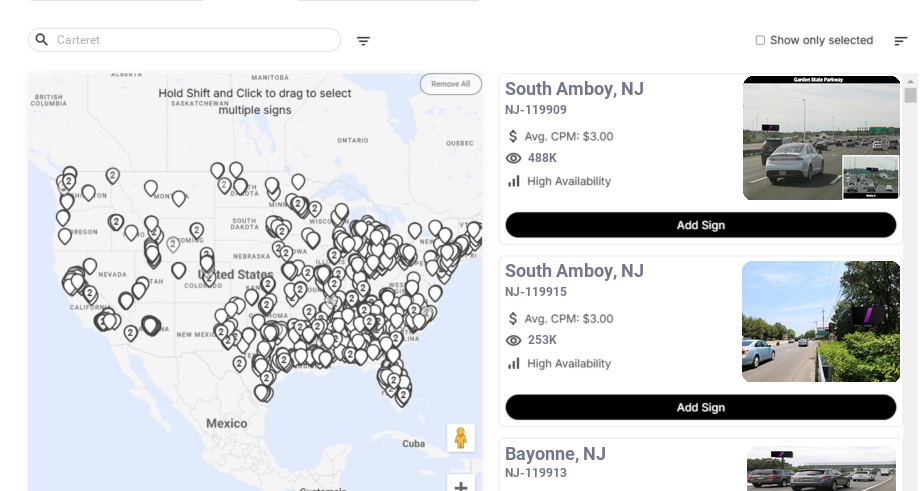
Blip has 27 digital billboards within 10 miles of Carteret, spread across Woodbridge Township, Elizabeth, Bayonne, South Amboy, and Edison. These boards reach residents, workers, and through-traffic moving through the Carteret area at every time of day, giving advertisers reliable access to billboards near Carteret without needing signs inside the borough itself. The network effectively creates a ring of coverage around the Carteret area.
What makes the Carteret, New Jersey area a strong market for billboard advertising with Blip?
The Carteret area sits at the crossroads of major freight, port, and commuter corridors, making it a powerful but often under-estimated market for digital billboard advertisers. Carteret’s population was 25,326 in 2020, and the combined population within a 10-mile radius exceeds 750,000 people. The industrial base also creates a steady weekday audience of shift workers, truck drivers, and contractors.
When is the best time to run Blip ads near Carteret, New Jersey?
Weekday commute times are especially valuable, with morning slots from 5–9 a.m. and evening slots from 4–8 p.m. capturing the same commuters as they travel to and from work. Midday can be more cost-efficient, and late-night hours often offer some of the lowest CPMs on many boards for truck and shift-worker traffic. Weekends can also be strong for shopping, dining, and leisure travel toward the Shore.
Who do Carteret, New Jersey billboards with Blip reach?
Carteret is ethnically diverse, with recent estimates indicating roughly 44–46% Hispanic/Latino, 20–25% Asian, 10–12% Black, and about 20–25% White non-Hispanic residents. Nearly 45–50% of residents are foreign-born, and over 60% speak a language other than English at home, with Spanish, Gujarati, Hindi, Urdu, and Portuguese among the most common. This supports bilingual or multilingual creative for consumer services, retail, and community-focused campaigns.
Do I need a contract to advertise with Blip near Carteret?
No, Blip has no long-term contracts or minimum commitments. You can start, pause, or stop your campaign at any time.
How fast can I launch a billboard campaign with Blip near Carteret?
You can have your campaign live in minutes. Create a free account, select your locations, set your budget, upload your design, and start running once approved.
Where can I advertise with Blip near Carteret?
Blip has digital billboards near Carteret. You can browse available locations on a map, choose the ones that fit your audience, and start advertising right away.
Still have questions? Launch a campaign in minutes — no contracts, no commitments.
Start Your CampaignCarteret Billboard Advertising Guide
The Carteret, New Jersey area sits at the crossroads of major freight, port, and commuter corridors, making it a powerful but often under‑estimated market for digital billboard advertisers. With 27 Blip digital billboards within 10 miles—spread across Woodbridge Township Elizabeth Bayonne, South Amboy, and Edison—we can reach residents, workers, and through‑traffic moving through the Carteret area at every time of day, giving advertisers reliable access to billboards near Carteret without needing signs inside the borough itself.
Understanding the Carteret Area Market
Carteret is a compact borough in Middlesex County New Jersey Turnpike Port Newark–Elizabeth Marine Terminal
Recent census and local planning data help quantify just how strong this market is.
Key stats that matter for advertisers:
-
Population scale
- Carteret’s population in 2020 was 25,326 residents, and recent estimates suggest the borough has held roughly steady or grown slightly since, keeping the local market in the 25,000–26,000 range.
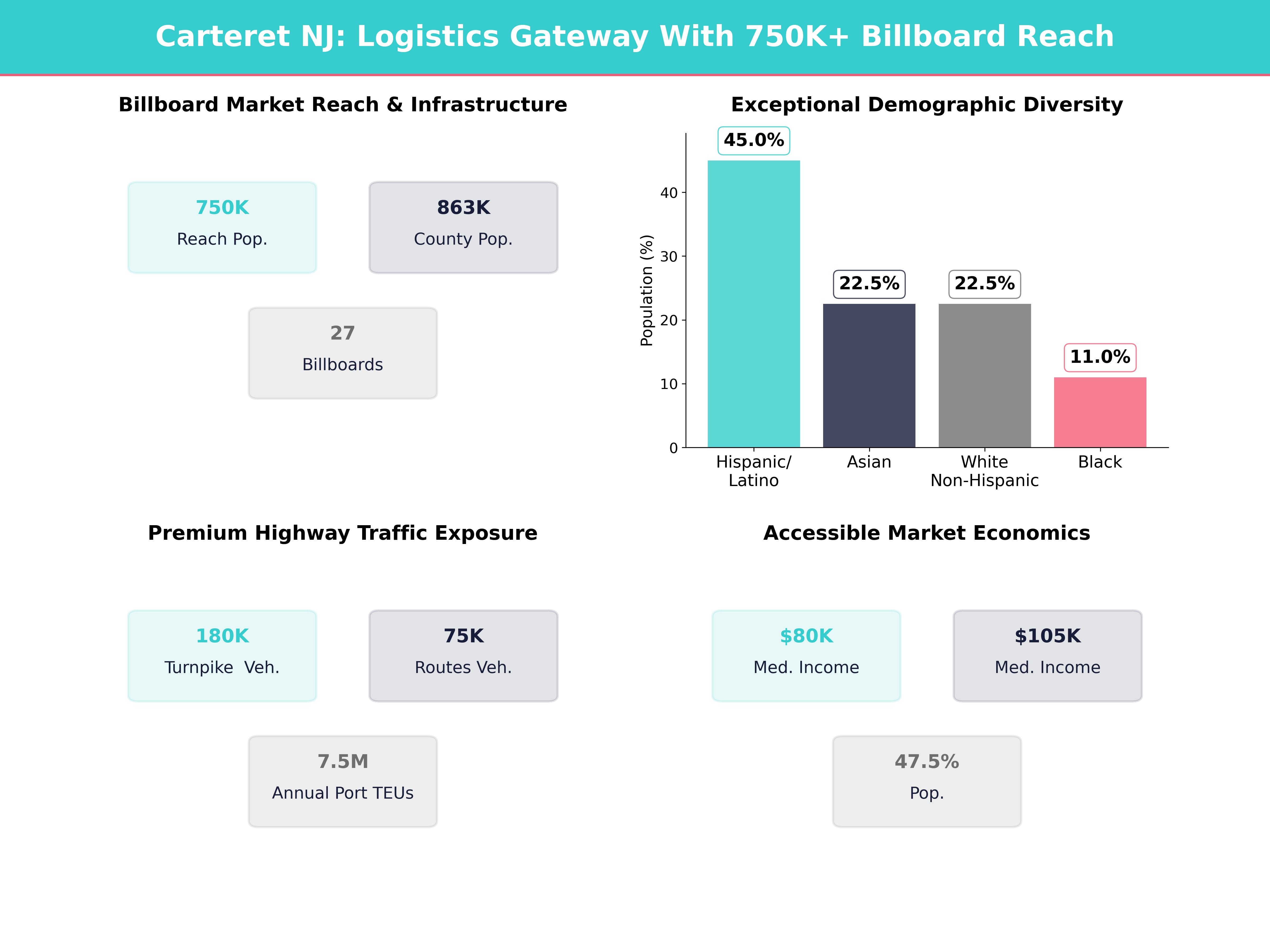
- Middlesex County as a whole has about 863,000 residents, making it New Jersey’s second‑most‑populous county. Carteret‑area campaigns can therefore tap into a wider suburban audience that regularly drives through nearby corridors.
- Within a 10‑mile radius of Carteret (captured by our Woodbridge, Edison, Elizabeth, Bayonne, and South Amboy boards), the combined population easily exceeds 750,000 people, including large segments of neighboring Union and Hudson counties, all of whom can be reached with billboard advertising near Carteret.
-
Diversity and language
- Carteret is ethnically diverse: recent estimates indicate roughly 44–46% Hispanic/Latino, 20–25% Asian, 10–12% Black, and about 20–25% White non‑Hispanic residents.
- Nearly 45–50% of residents are foreign‑born, and over 60% speak a language other than English at home, with Spanish, Gujarati, Hindi, Urdu, and Portuguese among the most common.
- This supports bilingual or multilingual creative (e.g., English/Spanish, English/Hindi) for consumer services, retail, and community‑focused campaigns and helps brands signal cultural awareness.
-
Age profile and households
- The median age in Carteret is around 37–38 years, similar to the New Jersey average, giving advertisers access to a balanced mix of young families, working‑age adults, and older residents.
- Roughly 35–40% of households include children under 18, and Carteret’s average household size is around 3.1–3.2 persons, higher than the U.S. average—an indicator of family and multigenerational living.
- About 60%+ of housing units are owner‑occupied, while the remainder are renter‑occupied, providing opportunities for both home‑ownership‑focused and renter‑focused messaging (home services, insurance, apartments, and financial products).
-
Income and spending power
- Median household income in Carteret is typically estimated around $78,000–$82,000, solidly middle‑class and above the U.S. median.
- Middlesex County’s countywide median is over $105,000, with several nearby communities (Woodbridge, Edison) posting six‑figure median household incomes. This points to significant disposable income flowing along the corridors where our boards are placed.
- Car ownership is common: more than 90% of households have at least one vehicle, and a majority have two or more vehicles, supporting campaigns for automotive, fuel, finance, and commuting‑oriented services.
-
Industrial, port, and logistics economy
- Carteret sits next to major distribution and industrial zones. The borough and nearby port areas collectively support tens of thousands of logistics, warehousing, and manufacturing jobs within a short drive.
- The Port Newark–Elizabeth Marine Terminal, directly north of Carteret, is part of the Port of New York and New Jersey 7–8 million TEUs (twenty‑foot equivalent units) of containerized cargo annually in recent years. Much of that freight activity radiates via truck and rail through corridors close to Carteret.
- The industrial base creates a steady weekday audience of shift workers, truck drivers, and contractors—ideal for workforce recruitment, training, B2B services, and safety campaigns that use billboards near Carteret exits and nearby warehouse clusters.
For more background on local development and demographics, we recommend reviewing the Borough of Carteret official site and Middlesex County’s resources at https://www.middlesexcountynj.gov Discover Middlesex
Where Our Billboards Are and How They Serve the Carteret Area
While our Blip billboards are not placed inside Carteret’s borders, they are strategically located in nearby municipalities that funnel traffic to and from the Carteret area, giving advertisers functional access to Carteret billboards without navigating local sign restrictions:
- Woodbridge Township – approx. 2.6 miles from Carteret
Woodbridge is New Jersey’s most populous township, with around 100,000 residents and major employment centers such as the Woodbridge Center retail district and multiple office/industrial parks. Situated near U.S. 1/9, Route 35, and the Garden State Parkway tens of thousands of vehicles per day. Boards here can intercept Carteret residents heading to big‑box retail, malls, and workplaces, as well as commuters driving past Carteret exits on the Turnpike.
Learn more on the township’s site at https://www.twp.woodbridge.nj.us - Elizabeth – approx. 4.9 miles from Carteret
Elizabeth, with a population of about 137,000, is one of New Jersey’s largest cities and a major regional employment hub. It is adjacent to the New Jersey Turnpike, Port Newark–Elizabeth Marine Terminal, and Newark Liberty International Airport, as well as the Jersey Gardens 170,000–190,000 vehicles per day, including heavy truck traffic. High daily traffic volumes and a strong working‑class population create excellent reach for value‑focused consumer offers and workforce messaging serving the Carteret area.
City information is available at https://www.elizabethnj.org - Bayonne – approx. 7.7 miles from Carteret
Bayonne, home to roughly 71,000 residents, is positioned near the Bayonne Bridge
Visit the city’s site at https://www.bayonnenj.org. - South Amboy – approx. 8.0 miles from Carteret
South Amboy, with about 9,000 residents, sits close to the Garden State Parkway, Route 9, and NJ TRANSIT’s North Jersey Coast Line. These corridors carry both local suburban traffic and longer‑distance travelers headed toward the Jersey Shore. Boards here are ideal for reaching southbound Carteret‑area commuters and suburban families on leisure trips.
Local information is available at http://www.southamboynj.gov. - Edison – approx. 8.8 miles from Carteret
Edison is one of Middlesex County’s largest employment and shopping hubs, with a population of about 108,000. It is intersected by Route 1, Route 27, and I‑287, corridors where daily traffic counts often exceed 60,000–100,000 vehicles per day per segment. Boards here give Carteret‑area advertisers visibility among both local residents and a wider Middlesex audience, especially around regional draws like the Menlo Park and Edison retail districts.
Learn more at https://www.edisonnj.org.
By combining these 27 boards, we can create a “ring” of coverage around the Carteret area, targeting both outbound Carteret residents and inbound visitors, workers, and shoppers moving among these communities. This ring effectively functions as a network of billboards near Carteret that can support everything from one‑time announcements to year‑round branding.
Traffic and Commuter Patterns to Leverage
Carteret is defined by its roads and freight corridors. To get the most from Blip campaigns, we recommend designing strategies around key flows of traffic.
-
Highways and major routes near the Carteret area
- New Jersey Turnpike (I‑95) – One of the busiest interstates in the region. NJDOT count stations on Turnpike segments serving the Carteret area (near Interchanges 11–13A) typically report 170,000–190,000 vehicles per average day, including 15–20% heavy trucks.
- U.S. Routes 1/9, Route 35, Route 440, and the Garden State Parkway – These parallel north–south routes through Woodbridge, Elizabeth, and Bayonne routinely record 40,000–90,000 vehicles per day on key segments, capturing both commuters and regional shoppers.
- Advertisers can use peak‑hour targeting on Blip to prioritize impressions during weekday rush periods when these roadways are heaviest, typically 6–9 a.m. and 4–7 p.m.
-
Commuter rail and transit influences
- NJ TRANSIT lines at nearby Woodbridge, Rahway 1,000–3,000+ average weekday boardings.
- While billboards serve road traffic, boards near station access roads and park‑and‑rides catch drivers as they approach transit hubs—prime audiences for messages about parking, rideshare, coffee, and grab‑and‑go food.
- See NJ TRANSIT system details at https://www.njtransit.com.
-
Port and logistics activity
- The Port Authority of New York and New Jersey reports that the Port of New York and New Jersey has handled roughly 7–9 million TEUs of containers per year in recent years, making it the busiest seaport on the U.S. East Coast. Port Newark–Elizabeth alone generates thousands of truck trips per day as containers move to regional warehouses, several of which are clustered in and around Carteret.
- Trucks accessing warehouses around the Carteret area often route through Elizabeth, Bayonne, and adjacent industrial corridors where several of our boards are positioned, giving employers and B2B brands a direct line to drivers and shift workers.
- For logistics and industrial employers, we can time campaigns around early‑morning shifts (4–8 a.m.), mid‑shift breaks, and afternoon turnover (2–6 p.m.).
-
Local commuting behavior
- Recent survey data for Carteret and surrounding Middlesex communities shows that 70–75% of workers commute by driving alone, another 10–15% carpool, and about 8–10% use public transit, with the remainder working from home or walking.
- Average one‑way commute times fall in the 30–35 minute range, notably longer than many U.S. suburbs, reflecting frequent travel toward Newark, Jersey City, and New York City.
- This extended drive time creates multiple daily touchpoints for billboard impressions near Woodbridge, Edison, South Amboy, and Elizabeth, allowing your message to reach the same commuter twice per day, five days a week.
NJDOT posts traffic counts and roadway information at https://www.nj.gov/transportation, and the Port Authority provides freight and port activity details at https://www.panynj.gov. The New Jersey Turnpike Authority
Audience Segments in the Carteret Area
Using demographic, economic, and commuting data, we can tailor campaigns to specific audiences.
1. Commuter Households
- In Carteret and nearby towns, roughly 85–90% of employed residents work outside their home municipality, with many commuting to Newark, Elizabeth, Jersey City, and New York City via the Turnpike, U.S. 1/9, or the Parkway.
- Key employment sectors among these commuters include healthcare, logistics, warehousing, retail, education, and professional services. Healthcare and social assistance alone often accounts for 15–20% of local jobs, with transportation and warehousing adding another 10–15%.
- Effective messaging: time‑sensitive offers (coffee, food, gas), banking and financial services, insurance, streaming/telecom, and healthcare providers with convenient hours near major exits.
2. Industrial and Logistics Workers
- The Carteret area’s warehouse, trucking, and industrial clusters employ thousands of workers across nearby municipalities. Within a short radius of Carteret and Elizabeth, industrial parks and port facilities contribute a large share of shift‑based jobs with early start times.
- Many workers commute in from Elizabeth, Newark, Bayonne, Perth Amboy
- Effective messaging: job recruitment (“CDL drivers wanted,” “Warehouse positions starting at $20–$25/hr”), safety campaigns, OSHA and CDL training programs, equipment leasing, industrial supplies, and fleet maintenance.
3. Families and Multigenerational Households
-
Carteret‑area household data shows a high share of family households (70%+ of all households) and a notable share of multigenerational homes, common in both Hispanic and South Asian communities.
- Public school enrollment in Carteret and nearby districts numbers in the thousands of students, driving demand for childcare, after‑school programs, tutoring, sports, and healthcare.
- Effective messaging: after‑school programs, pediatric and family healthcare, local dining, grocery, weekend entertainment, youth sports, and education (tutoring, private schools, and community colleges such as Middlesex College
4. Multilingual and Ethnically Diverse Communities
- With large Hispanic and South Asian populations and more than 6 in 10 residents speaking a language other than English at home, messaging that recognizes language and culture tends to perform better.
- Effective messaging: bilingual ads, culturally relevant holidays (Diwali, Eid, Three Kings Day, Hispanic Heritage Month), and creative that features familiar foods, festivals, and family scenes.
- Brands that highlight bilingual staff or multilingual customer service can leverage this by featuring phrases like “Se habla español” or “Hindi and Urdu spoken here.”
Local news outlets such as NJ.com’s Middlesex County section MyCentralJersey CentralJersey.com News 12 New Jersey can also help advertisers stay aligned with local conversations that may influence how Carteret billboards are perceived.
Creative Best Practices for the Carteret Area
Given the fast‑moving traffic and commuter environment near the Carteret area, creative must be simple, direct, and visually bold.
Keep it readable at highway speed
- Aim for 6–8 words of main copy plus a short URL or logo; research from outdoor industry groups consistently finds that recall drops sharply beyond 10–12 total words.
- Use high‑contrast colors (e.g., dark text on a light background or vice versa) to stand out on cloudy days and at dusk, which are frequent commuting conditions in the region.
- Avoid small fonts; main text should be legible from 400–600 feet at highway speeds of 55–65 mph, which generally means using large, thick type and limiting secondary details.
Tailor creative to specific corridors
-
Boards near Woodbridge and Edison
- Emphasize shopping, restaurants, automotive, and service locations Carteret‑area residents can reach after work.
- More than 60% of county residents report making at least one major shopping trip per week, making simple retail calls‑to‑action effective (“Sale this weekend,” “Today only”).
- Phrases like “Minutes from Carteret area exits” or “Just off Exit XX” help anchor location without claiming the board is inside Carteret.
-
Boards near Elizabeth and Bayonne
- Gear messaging toward port workers, truck drivers, and cross‑Harbor traffic. Many port‑related employees work shifts of 8–12 hours, so messages about quick meals, fuel, or nearby rest options resonate.
- Use clear calls to action: “Apply Today,” “Exit XX for [Service],” or “Next Right for [Brand].”
-
Boards near South Amboy
- Reach southbound commuters and weekend travelers headed toward the Jersey Shore. Parkway traffic to shore destinations can spike by 20–40% on summer weekends, amplifying exposure for leisure‑oriented campaigns.
- Promote beach trips, entertainment venues, quick‑service dining, and auto services between the Carteret area and the Jersey Shore.
Use language strategically
- Consider bilingual English/Spanish creative where space and legibility allow; in many Middlesex County corridors, Spanish‑speaking populations make up 25–35% of nearby residents.
- If space is limited, reserve Spanish or another second language for the headline or key call to action to signal inclusivity without cluttering the layout.
Highlight local convenience
- Lean into messages like “Minutes from the Carteret area,” “Serving Carteret and surrounding communities,” and “Your local [service] near Carteret.” These phrases reassure audiences that they are seeing billboard advertising near Carteret that actually connects to convenient nearby locations.
- When using maps or directional icons, show proximity to major exits or landmarks (e.g., “Off Turnpike Exit 12”) rather than relying solely on a street address.
The official New Jersey tourism site VisitNJ.org and the Borough’s site Carteret.net are useful for understanding local attractions, waterfront development, and events your creative can reference. For neighboring communities, tourism and community pages like Woodbridge’s site at https://www.twp.woodbridge.nj.us Discover Middlesex
Timing and Dayparting Strategy with Blip
Blip’s ability to schedule “blips” (short ad plays) at specific times lets us match impressions to real‑world behavior in the Carteret area.
Weekday commute focus
-
Morning (5–9 a.m.) – Capture Carteret‑area residents heading toward employment hubs in Elizabeth, Newark, and beyond. In many New Jersey corridors, 40–45% of weekday traffic volume occurs during morning and evening peaks, so morning slots are high‑value. Perfect for:
- Coffee shops and QSRs on key routes
- Transit‑oriented services (parking apps, rideshare, rail promotions)
- Job recruitment for warehouse/shipping facilities with early shifts starting at 5–7 a.m.
-
Evening (4–8 p.m.) – Reach the same commuters as they return, more receptive to:
- Grocery and dinner offers—household expenditure data show that over half of restaurant spending occurs in the evening hours
- Family entertainment and local events
- Healthcare (urgent care, dental, eye care) with extended hours (e.g., open until 8–9 p.m.)
Midday and off‑peak
- Midday (10 a.m.–3 p.m.) – Traffic volumes drop relative to peak, but this period captures stay‑at‑home parents, retirees, self‑employed drivers, and shift workers. For many boards, CPMs can be 10–30% lower than peak‑hour pricing, improving cost‑efficiency.
-
Late‑night (9 p.m.–2 a.m.) – Late‑night vehicle counts fall sharply, but this is when a significant share of truck and shift‑worker traffic moves through the Turnpike and industrial zones. These hours often offer some of the lowest CPMs on many boards; ideal for campaigns targeting:
- Late‑shift workers and truck drivers
- Streaming services, food delivery, or 24‑hour services (pharmacies, urgent care, towing)
Weekend strategies
- Weekends bring more discretionary trips: shopping, dining, visiting friends and family, and leisure travel toward the Shore. On some Garden State Parkway segments, weekend summer volumes can exceed weekday averages by 20–30%.
-
Increase weekend share of voice for:
- Retail sales, auto dealerships, and big‑box stores
- Events, festivals, local sports, and waterfront activities serving the Carteret area
- Religious services and community organizations, which often see their highest attendance on Friday evenings, Saturdays, and Sundays
Because Blip allows us to adjust budgets by hour and day, we can start with heavier spending during weekday peak periods, then rebalance toward weekend and off‑peak slots as performance data accumulates.
Geographic Targeting and Board Selection
With 27 boards near the Carteret area, selecting the right subset is critical to balancing reach, frequency, and budget. Thoughtful selection effectively becomes your billboard rental near Carteret strategy, determining which audiences you reach most often.
We typically recommend:
-
Core coverage boards
- Prioritize boards in Woodbridge Township and Edison to dominate the main commuting and shopping flows serving the Carteret area. Routes 1 and 27 together carry well over 100,000 vehicles per day across multiple segments in these towns.
- Add boards in Elizabeth for additional reach among port/logistics workers and airport‑linked traffic—especially valuable for job recruitment and travel‑related services.
-
Expansion boards
-
Use Bayonne and South Amboy locations when:
- You want regional exposure beyond the Carteret area (e.g., brand awareness campaigns, regional retail draws).
- You serve customers from Staten Island, Jersey City, or southern Middlesex/Monmouth counties, where weekend and seasonal traffic spikes are common.
-
Use Bayonne and South Amboy locations when:
-
Directional messaging
- For boards north of the Carteret area (Elizabeth, Bayonne), use “Southbound” directional cues: “South of here near the Carteret area,” “Next exit after Carteret area Exit XX,” etc.
- For boards south or southwest (South Amboy, Edison), emphasize “Northbound” travel toward the Carteret area (“Head north to Carteret area,” “Just north of Exit XX”).
By segmenting boards and creative sets in Blip’s tools, we can run A/B tests to discover which corridors yield better click‑through or conversion rates when paired with specific calls to action. For example, you might compare:
- Wage‑focused vs. benefit‑focused headlines for recruitment
- “Minutes away” vs. “Next exit” location framing for QSRs or retail
- Brand‑only vs. offer‑driven creative for awareness campaigns
Campaign Types That Perform Well Near the Carteret Area
Certain verticals are particularly well‑suited to the Carteret area’s mix of commuters, families, and industrial workers, especially when paired with flexible billboard rental near Carteret.
Local Retail and Restaurants
- Shopping centers and big‑box retail around Woodbridge/Edison draw Carteret‑area households, with regional malls attracting thousands of visits per day.
- Promote: weekly sales, limited‑time offers, and new store openings, especially aligned with high‑traffic retail periods (late afternoons, weekends, and holiday seasons).
- Use simple distance cues: “5 minutes from Carteret area,” “Next 2 exits,” or “Across from [known landmark].”
Healthcare and Wellness
- Primary care, urgent care, dental, and optical providers frequently draw patients from multiple towns. In Middlesex County, healthcare and social assistance account for roughly 15–20% of local employment, reflecting strong demand for services.
- Emphasize: same‑day appointments, evening/weekend hours, walk‑in availability, and insurance acceptance.
- Consider running heavier schedules during weekday evenings and weekend mornings, when families are more likely to schedule routine visits.
Education and Training
- Community colleges, vocational schools, truck‑driving academies, and ESL programs can draw from the Carteret area’s working‑age population, where roughly 60%+ of adults are in the 25–64 age range.
- Focus boards near Elizabeth, Edison, and Woodbridge—corridors where many prospective students commute or transfer.
- Align campaigns with enrollment windows, graduation seasons (April–June), and back‑to‑school periods (August–September).
Industrial, Port, and Logistics Recruitment
- With port and warehouse operations nearby, there is constant demand for CDL drivers, warehouse associates, forklift operators, and maintenance technicians. Job postings data consistently show logistics and warehousing among the top hiring sectors along the Turnpike corridor.
- Use bold wage and benefit headlines: “Drivers up to $35/hr,” “$2,000 Sign‑On Bonus,” “Health & 401(k) Day One.”
- Target early morning and late afternoon shifts near Elizabeth, Bayonne, and Woodbridge, with increased frequency on weekdays when staffing managers are actively hiring.
Events and Municipal Initiatives
- Concerts, festivals, waterfront activities, and civic initiatives that attract Carteret‑area residents benefit from quick, high‑frequency reach in the 1–3 weeks preceding an event.
- Coordinate creative with information on Carteret’s official calendar and Middlesex County events pages.
- For tourism and regional attractions, also consult VisitNJ.org and Discover Middlesex
Measuring and Optimizing Campaigns
We can use a combination of Blip analytics and local data sources to refine performance over time and continuously improve billboard advertising near Carteret.
Key metrics to monitor
- Impressions by board and time of day – Identify which corridors deliver the highest reach for your budget. Boards along the Turnpike and Route 1 will usually generate higher impressions per dollar than lower‑traffic local roads.
- Flighting performance – Compare weekday vs. weekend and peak vs. non‑peak schedules. It’s common to see 20–40% variation in cost per thousand impressions (CPM) between different dayparts.
- Engagement proxy metrics – Use campaign‑specific URLs, QR codes (for slower‑speed boards or urban surface streets), unique promo codes, or call‑tracking numbers to trace responses.
Improving results over time
-
Start broad, then narrow
- Begin with a set of boards across Woodbridge, Elizabeth, and Edison to learn which audiences respond best.
- After 2–4 weeks of data, reallocate spend toward the highest‑performing locations and dayparts and pause under‑performing boards.
-
Align with local news and seasonality
- Use local outlets like NJ.com MyCentralJersey
- Shift creative around back‑to‑school, holidays (Memorial Day, July 4, Thanksgiving, year‑end), and summer travel to reflect current local realities and maximize relevance.
-
Refresh creative regularly
- For ongoing campaigns, rotate designs every 4–8 weeks to combat ad fatigue. Industry studies show that recall can drop by 20–30% when the same creative runs too long without variation.
- Test variations in headline, imagery, and call‑to‑action, then expand the best performers across more boards or higher‑traffic dayparts.
Local Compliance, Context, and Best Practices
While Blip handles the technical integration with our digital billboard partners, it is helpful for advertisers to understand regional norms.
-
Content standards
- New Jersey and local municipalities generally prohibit offensive, misleading, or unsafe content on outdoor advertising.
- Avoid creative that could be interpreted as imitating official road signage or emergency alerts, particularly on high‑speed corridors like the Turnpike and Parkway.
-
Safety considerations
- NJDOT emphasizes driver safety; avoid overly complex visuals that may distract drivers traveling 55–65 mph.
- Keep copy minimal and ensure images are easy to interpret in under 3 seconds, which aligns with typical driver glance patterns.
-
Community alignment
- The Carteret area is family‑oriented and culturally diverse. Roughly two‑thirds of residents live in family households, and many participate in local cultural and religious organizations.
- Ensure creative respects cultural differences and avoids stereotypes.
- Partnering with local organizations or featuring real community scenes—parks, waterfront, or local events highlighted on Carteret’s site and Middlesex tourism pages—can build stronger resonance and trust.
By combining Carteret‑specific demographic insights, corridor‑based targeting, and Blip’s flexible scheduling tools, we can design digital billboard campaigns that efficiently reach people who live, work, and travel near the Carteret area. For advertisers looking for billboards near Carteret or exploring billboard rental near Carteret for the first time, this approach ensures your budget is focused on the highest‑value corridors and optimized using real performance data rather than guesswork.