Billboards in Ocean City, NJ
No Minimum Spend. No Long-Term Contracts. Just Results.
Trusted by Leading Brands


Billboard advertising
in Ocean City has never been easier
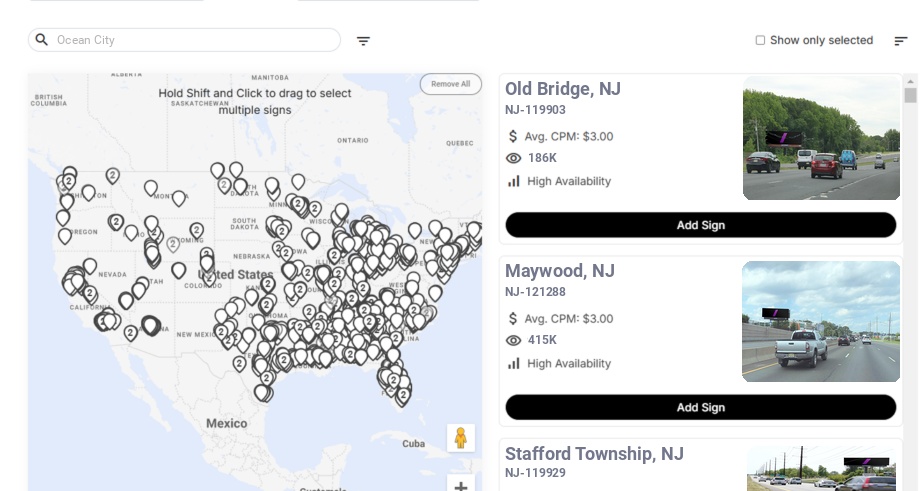



How much is a billboard in Ocean City?
Why Choose Blip for Billboard Advertising in Ocean City
-
Blip lets you launch on Ocean City’s Route 52 and mainland feeders in minutes, reaching beach-bound drivers before they hit the island.
-
No contracts or minimums in Ocean City mean you can test summer shore traffic, then shift budget when Memorial Day to Labor Day demand changes.
-
Use Ocean City dayparting to hit Friday arrivals, midday beachgoers, or evening return trips on Route 52 and Black Horse Pike.
-
Track Ocean City performance in real time and reallocate fast as sunny weekends, storms, and event spikes change traffic patterns.
-
Blip’s creative tools help you build bold, family-friendly ads for Ocean City’s 8-mile beach, Boardwalk, and shore identity.
Frequently Asked Questions About Billboard Advertising in Ocean City
How much does a billboard cost in Ocean City, New Jersey with Blip?
Blip makes billboard advertising in the Ocean City area flexible and accessible by using pay-per-play pricing, so you only pay when your ad actually appears. Each “blip” is a 7.5-to-10-second display on a rotating digital billboard, with pricing starting at just $0.01 per display. Your daily budget is what drives Blip’s algorithm, which bids for open ad slots serving the Ocean City area and helps maximize reach based on time of day, location, and demand.
Where can I advertise with Blip in Ocean City, New Jersey?
We can reach that audience on 4 digital billboards serving the Ocean City area, with locations in nearby Pleasantville and Atlantic City just 9.4 to 9.8 miles from Ocean City. That proximity matters because Ocean City is a barrier-island destination, so a large share of local residents, workers, renters, and vacationers funnels through a relatively small number of mainland roads. For advertisers that want visibility near the shore without the rigidity of a traditional billboard buy, the Ocean City area offers a rare mix of concentrated traffic, strong seasonality, and highly recognizable local identity.
When is the best time to run Blip ads in Ocean City, New Jersey?
The most obvious campaign window runs from Memorial Day through Labor Day, which is roughly 100 days of heightened demand. That is when beach weather, school breaks, rental turnovers, and family travel all align. Spring matters more than many advertisers expect, and fall remains useful in the Ocean City area because weather often stays favorable, weekend visitation continues, and local residents reclaim the market after peak summer congestion.
What kind of traffic and audience does Ocean City, New Jersey have for billboard ads?
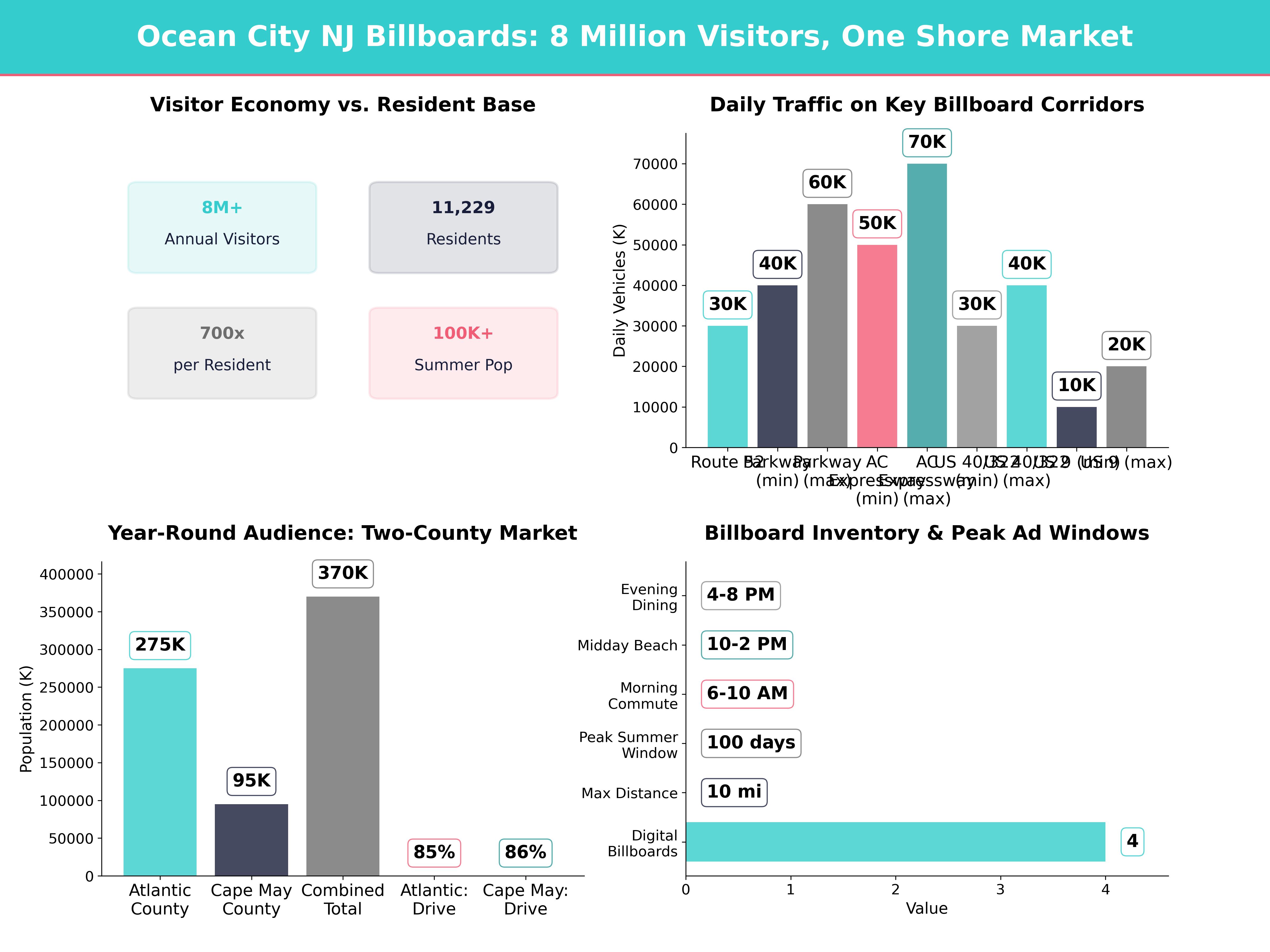
Ocean City’s year-round population was 11,229 in the 2020 count, but the advertising opportunity grows far beyond that number because the destination draws more than 8 million visitors annually and the summer population rises well above 100,000. Road travel dominates how people move through this market, with roughly 85% of workers in Atlantic County and roughly 86% of workers in Cape May County commuting by private vehicle. That is exactly the kind of behavior that makes billboard advertising near Ocean City effective.
What roads should I target for billboard advertising in Ocean City, New Jersey?
The primary gateway is Route 52 between Ocean City and Somers Point, and corridor materials consistently place the approach in the 30,000-plus vehicles per day range, with summer peaks running higher than annual averages. The Garden State Parkway and the Atlantic City Expressway are also major feeders, and Pleasantville’s Black Horse Pike corridor through US 40 and US 322 often carries 30,000 to 40,000-plus vehicles per day. For many businesses serving the Ocean City area, that is the sweet spot between hyperlocal and regional reach.
Do I need a contract to advertise with Blip in Ocean City?
No, Blip has no long-term contracts or minimum commitments. You can start, pause, or stop your campaign at any time.
How fast can I launch a billboard campaign with Blip in Ocean City?
You can have your campaign live in minutes. Create a free account, select your locations, set your budget, upload your design, and start running once approved.
Where can I advertise with Blip in Ocean City?
Blip has digital billboards in Ocean City. You can browse available locations on a map, choose the ones that fit your audience, and start advertising right away.
Still have questions? Launch a campaign in minutes — no contracts, no commitments.
Start Your CampaignOcean City Billboard Advertising Guide
Ocean City Ocean City is one of New Jersey’s most efficient shore markets for billboard advertising because the audience concentrates before it reaches the island. We can reach that audience on 4 digital billboards serving the Ocean City area, with locations in nearby Pleasantville Atlantic City just 9.4 to 9.8 miles from Ocean City. That proximity matters because Ocean City is a barrier-island destination, so a large share of local residents, workers, renters, and vacationers funnels through a relatively small number of mainland roads. For advertisers that want visibility near the shore without the rigidity of a traditional billboard buy, the Ocean City area offers a rare mix of concentrated traffic, strong seasonality, and highly recognizable local identity.
Ocean City area market overview
The Ocean City area combines a small year-round base with a very large visitor economy
Ocean City’s year-round population was 11,229 in the 2020 count, which makes it a small city by resident base. The advertising opportunity grows far beyond that number because the Ocean City Regional Chamber of Commerce promotes the destination as drawing more than 8 million visitors annually, and the summer population rises well above 100,000. That means annual visitor volume exceeds the year-round population by more than 700 times, which is one reason the market behaves very differently in July than it does in January.
The place itself also has exceptionally clear brand cues. Ocean City offers 8 miles of beach and a 2.5-mile Boardwalk, and it has long positioned itself as “America’s Greatest Family Resort” through city and chamber marketing. For advertisers, that gives us a shorthand that many local markets do not have. Family travel, beach weather, day trips, vacation rentals, dining, amusements, healthcare, and home services can all fit naturally into the way people already think about the Ocean City area.
The broader resident market is larger than Ocean City alone. Cape May County 95,263 residents in 2020, and Atlantic County 274,534, for a combined two-county population of 369,797. Nearby mainland cities add scale close to the route network that serves Ocean City, including Pleasantville at 20,629 residents and Atlantic City at 38,497 residents.
The regional economy is diversified enough for year-round campaigns
The Ocean City area is not only a summer tourism story. Ocean City itself is driven by lodging, vacation rentals, restaurants, retail, real estate, and seasonal services, while the mainland adds healthcare, education, logistics, and entertainment. Major regional institutions such as AtlantiCare, Shore Medical Center, Stockton University, and Atlantic Cape Community College keep consumer movement active outside peak beach season.
Atlantic City also expands the regional buying base. The resort city has 9 casino resorts, and the Atlantic City Convention Center offers about 486,600 square feet of exhibit space, which brings in convention attendees, exhibitors, hotel guests, and entertainment traffic that can spill into surrounding shore markets. That matters for brands serving the Ocean City area because many visitors move between Atlantic City, Somers Point
Road travel dominates how people move through this market. Recent survey estimates show roughly 85% of workers in Atlantic County and roughly 86% of workers in Cape May County commute by private vehicle. That is exactly the kind of behavior that makes billboard advertising near Ocean City effective. People here do not just see a road once. They repeat the same approaches for work, errands, beach trips, restaurant runs, and rental turnovers.
Ocean City area key traffic corridors
Ocean City’s barrier-island geography compresses traffic onto a few valuable approaches
When we advertise near Ocean City, we benefit from geography. The city sits on a barrier island, so many trips have to pass through mainland connectors before drivers reach the beaches, neighborhoods, or Boardwalk. That creates a funnel effect that is harder to find in inland markets with dozens of parallel arterial options.
The primary gateway is Route 52 between Ocean City and Somers Point. NJDOT corridor materials and local planning work through the South Jersey Transportation Planning Organization consistently place the Route 52 approach in the 30,000-plus vehicles per day range, with summer peaks running higher than annual averages. For advertisers, that is one of the most important facts in the whole market. If we can influence drivers before or after the causeway decision point, we can shape beach spending, dining decisions, retail stops, and service awareness serving the Ocean City area.
Secondary island access also matters, especially for local repetition. Northern and southern bridge connections tie Ocean City to nearby mainland communities and shore routes, but Route 52 remains the dominant high-volume entry for much of the regional audience. That is why digital inventory in nearby mainland cities can outperform what a simple distance measure might suggest.
Mainland corridors in Pleasantville and Atlantic City help us reach Ocean City-bound drivers before they split
The mainland road network north of Ocean City gives us several strong opportunities. The Garden State Parkway 40,000 to 60,000-plus vehicles per day range, depending on segment. That traffic includes vacationers from North Jersey, South Jersey, and out-of-state feeder markets, along with workers and local residents making regular county-to-county trips.
The Atlantic City Expressway 50,000 to 70,000-plus vehicles per day range. That corridor is especially useful when we want to reach drivers coming from the Philadelphia side of the market, travelers using Atlantic City International Airport
Pleasantville adds local and regional value because of the Black Horse Pike corridor. US 40 and US 322 through Pleasantville and West Atlantic City often carry 30,000 to 40,000-plus vehicles per day, which gives us dense exposure to shoppers, workers, and visitors moving among Egg Harbor Township, Pleasantville, Atlantic City, and Somers Point. For many businesses serving the Ocean City area, that is the sweet spot between hyperlocal and regional reach.
US 9 also plays an important role in repeat exposure. Depending on the segment, mainland US 9 often runs in the 10,000 to 20,000-plus vehicles per day range, which is lower than the big resort feeders but highly valuable for everyday trips. That corridor is useful for healthcare providers, home-service companies, schools, grocery brands, and local retailers that want frequency among residents in Linwood Northfield Absecon, Somers Point
We should also remember that even when visitors use NJ TRANSIT rail or bus service into Atlantic City, many of their purchases in the Ocean City area still involve rented cars, ride shares, or companion vehicles. In practical terms, the region remains a road-first media environment.
Ocean City area audience segments
We can reach residents, commuters, and mainland households that regularly spend in the Ocean City area
A common mistake is assuming the Ocean City area audience is only tourists. The resident base across Atlantic and Cape May counties is nearly 370,000 people, and much of that population uses the same approach corridors repeatedly. That makes billboard advertising near Ocean City effective for year-round categories such as:
- Healthcare, dental, urgent care, vision, and senior services, because the year-round audience includes many older residents and caregivers making frequent mainland trips.
- Home improvement, HVAC, plumbing, roofing, pest control, and insurance, because the area supports a large stock of vacation properties, second homes, and rental units.
- Grocery, banking, legal, automotive, and retail brands, because mainland errands often happen before or after bridge crossings.
- Recruiting and hiring campaigns, because hospitality, healthcare, education, and service employers all need recurring visibility.
Ocean City also has a distinctive family profile. Because the city is known as a dry, family-centered shore destination, ads that feel trustworthy, useful, and easy to act on often fit better than nightlife-heavy messaging. That does not mean we have to be bland. It means we should reflect the local emotional context.
Tourists, students, and event visitors expand the reachable audience dramatically
Tourism is still the headline audience. Ocean City’s 8 miles of beach, 2.5-mile Boardwalk, and 8 million-plus annual visitors create an enormous seasonal impression pool. During peak summer, the area supports beachgoers, weekly renters, day-trippers, grandparents visiting family, youth sports families, and second-home users. That audience is particularly strong for restaurants, attractions, retail, real estate, healthcare, and convenience-focused services.
Students add another layer. Stockton University enrolls nearly 10,000 students, and Atlantic Cape Community College serves several thousand more across its campuses. Those students, along with faculty and staff, create recurring demand for apartments, food, entertainment, healthcare, banking, and part-time employment. They also help stabilize the fall and spring audience after the peak summer rush fades.
Atlantic City event traffic is another useful adjacent audience. The city’s 9 casinos, Boardwalk Hall, and convention business bring in concertgoers, gamblers, meeting attendees, hotel guests, and regional visitors who may also dine, shop, or day-trip in the Ocean City area. For some advertisers, especially entertainment, hospitality, attractions, and premium retail, that crossover can be extremely valuable.
Ocean City area seasonal and timing opportunities
The shore calendar creates natural campaign windows near Ocean City
The most obvious campaign window runs from Memorial Day through Labor Day, which is roughly 100 days of heightened demand. That is when beach weather, school breaks, rental turnovers, and family travel all align. If we are promoting restaurants, amusements, retail, attractions, convenience products, rentals, or local experiences serving the Ocean City area, late May through August is usually the core period.
Spring matters more than many advertisers expect. Ocean City’s event calendar typically ramps up in April and May with seasonal openings, the Doo Dah Parade, and the Spring Block Party. Those events help us reach early planners before the summer crush. Spring is also a smart time for hiring campaigns, because hospitality and service employers need workers in place before June.
Mid-summer has its own rhythm. Weekly rentals make Friday, Saturday, and Sunday especially important. Late July’s Night in Venice and August’s Boardwalk Art Show can further increase attention. If we are serving tourists, we should think about arrival patterns as much as raw seasonality. A Friday afternoon impression can be more actionable than a Tuesday morning impression if the goal is same-day dining or weekend spending.
Shoulder season and year-round timing can be efficient for local advertisers
September and October remain useful in the Ocean City area because weather often stays favorable, weekend visitation continues, and local residents reclaim the market after peak summer congestion. That makes fall a strong period for real estate, home services, healthcare, education, and financial services. The return of school and college routines at Ocean City School District, Stockton University, and Atlantic Cape Community College also creates dependable commuting patterns.
Winter is quieter, but it is not empty. Holiday shopping, healthcare appointments, tax-season messaging, fitness offers, restaurant promotions, and local-service branding can all benefit from reduced clutter. New Year’s events in Ocean City, including First Night and First Day activities, create another short but visible opportunity.
Time of day matters in this market as much as month of year. We generally see three useful patterns:
- 6:00 to 10:00 a.m. is ideal for mainland commuters, healthcare appointments, schools, and recruiting.
- 10:00 a.m. to 2:00 p.m. is strong for beach traffic, lunch, attractions, and convenience retail.
- 4:00 to 8:00 p.m. is valuable for dinner, entertainment, grocery, and return-trip decisions.
Because shore behavior is weather-sensitive, flexible scheduling can be a major advantage. When a sunny weekend appears in the forecast, we can lean into visitor-focused messaging. When rain pushes people off the beach, we can pivot toward indoor attractions, dining, retail, or local services.
Ocean City area billboard design tips
Creative should reflect Ocean City’s family-first shore identity
Ocean City has one of the clearest personalities on the Jersey Shore. When we build creative for the Ocean City area, we should use that to our advantage instead of fighting it. Messages that feel family-friendly, trustworthy, and place-aware usually fit better than ads that feel overly edgy or disconnected from the local setting.
A few design principles tend to work especially well here:
- We should use bold, high-contrast colors such as navy, aqua, white, coral, yellow, and lifeguard red, because summer glare and shore haze can wash out low-contrast palettes.
- We should keep the headline extremely short, ideally 6 to 8 words, because a digital blip appears for only 7.5 to 10 seconds.
- We should feature one main idea, one brand name, and one call to action, because drivers near shore corridors do not have time to decode layered messages.
- We should use imagery that feels local, such as beaches, boardwalk textures, bicycles, umbrellas, family dining, shore homes, or simple route-oriented visuals.
- We should avoid cluttered legal copy, too many logos, or small address text, because readability matters more than completeness at driving speed.
If we are aiming at the Ocean City audience specifically, references to family fun, convenience, reservations, same-day services, and “serving the Ocean City area” often feel more natural than generic metropolitan copy.
Messaging should match the route, the season, and the audience mindset
The best Ocean City-area creative changes with location. A board serving Atlantic City traffic can support entertainment, attractions, upscale dining, or cross-market tourism. A board serving Pleasantville and mainland commuter traffic may work better for healthcare, recruiting, auto, legal, home services, or retail.
We should also adjust for season:
- In spring, we should emphasize openings, hiring, bookings, and preseason planning.
- In summer, we should emphasize simplicity, hours, proximity, parking, reservations, and immediate action.
- In fall, we should emphasize local loyalty, service reliability, real estate, schools, and routine purchases.
- In winter, we should emphasize trust, value, appointments, and repeat local need.
Because Ocean City is a family resort, we should be careful with tone. Humor can work, but it should stay clean and easy to understand. Urgency can work, but it should feel helpful rather than aggressive. If we do use directions or travel times, they should be accurate and easy to process at a glance.
Ocean City area regional strategies
Pleasantville works well for repeat local exposure and practical service categories
Pleasantville is one of the most useful nearby cities for campaigns serving the Ocean City area because it sits close to mainland daily life. Traffic there is not only about vacationers. It is also about commuters, workers, parents, shoppers, and service buyers moving between Egg Harbor Township, Northfield Linwood Somers Point
That makes Pleasantville a strong fit for:
- Healthcare systems, urgent care, dental groups, and specialty practices.
- Auto dealers, repair shops, tire stores, and insurance agencies.
- Home-service brands that want jobs both on the mainland and in shore communities.
- Community colleges, training programs, and hiring campaigns.
- Grocery, banking, and everyday retail offers.
If our ideal customer is likely to make repeated weekly trips rather than a once-a-summer visit, Pleasantville often deserves serious consideration.
Atlantic City helps us tap entertainment, convention, and high-volume visitor traffic
Atlantic City serves a different purpose. Its road network captures regional arrivals, hotel traffic, entertainment travel, and convention movement. Because Atlantic City has 9 casinos and a convention center with about 486,600 square feet of exhibit space, it can produce a broader mix of visitors than Ocean City alone. That is useful when we want to reach people who may be deciding between beach time, dining, shopping, nightlife, shows, and day trips.
Atlantic City-area boards can be especially effective for:
- Attractions and experiences that want regional visitors.
- Restaurants and hospitality brands with multiple shore-area locations.
- Retailers that benefit from vacation spending.
- Events, ticketed experiences, and entertainment venues.
- Premium real estate, luxury services, and destination-style offers.
For brands that straddle family travel and regional tourism, Atlantic City can be an important complement to Pleasantville rather than a substitute for it.
A combined corridor strategy can improve both reach and frequency near Ocean City
Because our 4 digital billboards serving the Ocean City area sit within 10.0 miles of the market, we can think strategically about sequence and repetition. A combined approach can work very well:
- We can use a Pleasantville board for weekday repetition among local residents and commuters.
- We can use an Atlantic City board for higher-volume regional arrivals and visitor traffic.
- We can shift budget toward Friday afternoon, Saturday morning, and Sunday afternoon when weekly shore travel is strongest.
- We can rotate creative by audience, with one version for local households and another for tourists.
This is especially effective when we want to build recall rather than depend on a single impression. In a compact coastal market, seeing the same brand on more than one approach corridor can make a business feel larger, more established, and easier to remember.
Ocean City area campaigns with Blip
Blip’s flexibility is well suited to the Ocean City area’s changing demand
The Ocean City area changes too much by season, weather, and day of week for a rigid buy to be ideal. That is where Blip fits naturally. We can choose the nearby digital boards on a map, set a daily budget, target only the hours that matter, and update creative as local conditions change.
That flexibility matters in a market where a sunny Saturday in July behaves very differently from a rainy Wednesday in October. We can increase presence when the beach forecast looks strong, lean into commuter hours for year-round service categories, or swap creative around local events without waiting on a print cycle.
Testing and optimization are especially important near Ocean City
Because this market has both residents and visitors, testing is valuable. We can run one creative version for families, another for commuters, and another for evening dining or entertainment. We can also compare nearby boards to see which locations produce the strongest awareness for our goal.
Blip’s pay-per-play structure helps us avoid overcommitting before we know what works. Since ads can start at $0.01 per display, we can begin with a manageable test, watch performance, and then push more budget into the best days, times, and locations. In a seasonal market like this, that ability to optimize in real time can be more useful than locking into a fixed traditional package months in advance.
Getting started with billboard rental near Ocean City
We should start by matching the board location to the business goal
The right billboard near Ocean City depends on who we need to reach and when we need to reach them. Before we launch, it helps to answer a few practical questions:
- If we want vacationers and beach families, we should prioritize boards that serve inbound summer traffic and weekend arrival patterns.
- If we want year-round local customers, we should focus more on mainland commuter corridors and repeat daily exposure.
- If we want both groups, we should consider a split strategy using more than one nearby board.
- If our product is time-sensitive, we should favor the hours when decisions happen, not just the season when traffic is high.
We should also evaluate each location by direction of travel, nearby interchanges, surrounding land use, and likely audience mindset. A board that is excellent for restaurant traffic may not be the best fit for a hospital system or a roofing company, even if both are technically serving the Ocean City area.
Blip simplifies billboard rental compared with traditional outdoor buying
Traditional billboard buying often comes with longer commitments, fixed terms, limited flexibility, and more back-and-forth. Blip simplifies that process. We can launch online, choose from the nearby digital inventory serving Ocean City, upload creative, set our budget, and make changes whenever our campaign needs to shift.
That simplicity is valuable in a market where timing is everything. We do not have to overbuy an entire season to test a message. We do not have to commit to a long contract just to learn whether Pleasantville or Atlantic City works better for our audience. We can start small, evaluate results, and scale with confidence.
A practical starting plan for the Ocean City area usually looks like this:
- We define the primary audience, such as commuters, tourists, students, or local households.
- We choose one or two nearby boards based on the routes those people are most likely to travel.
- We write one short, high-contrast message tailored to the local season.
- We run during the days and hours that match actual decision-making behavior.
- We review results and then expand, narrow, or rotate creative based on what performs best.
That process is much closer to smart digital marketing than to old-fashioned outdoor buying. In a concentrated shore market with 4 nearby digital billboards, heavy summer swings, and strong road dependence, that kind of flexibility can make billboard rental near Ocean City much more approachable and much more effective.