Billboards near Edgewater, NJ
No Minimum Spend. No Long-Term Contracts. Just Results.
Trusted by Leading Brands


Billboard advertising
near Edgewater has never been easier
How much is a billboard near Edgewater?
Why Choose Blip for Billboard Advertising near Edgewater
-
Blip lets you launch on Edgewater’s River Road and bridge-tunnel routes in minutes—perfect for Manhattan-bound commuters and waterfront shoppers.
-
Set a flexible budget in Edgewater, then scale up for GW Bridge and Lincoln Tunnel peaks without contracts or wasted spend.
-
Daypart your Edgewater ads for the 6:30–10 a.m. rush or 4:00–7:30 p.m. returns, reaching drivers when tunnel traffic slows most.
-
Track Edgewater performance in real time and shift spend toward Route 1/9, Route 46, and Secaucus flows that deliver the best results.
-
Use Blip creative tools to make Edgewater ads pop for bilingual, high-income waterfront audiences and weekend diners near the Hudson.
Frequently Asked Questions About Billboard Advertising near Edgewater
How much does a billboard cost near Edgewater, New Jersey with Blip?
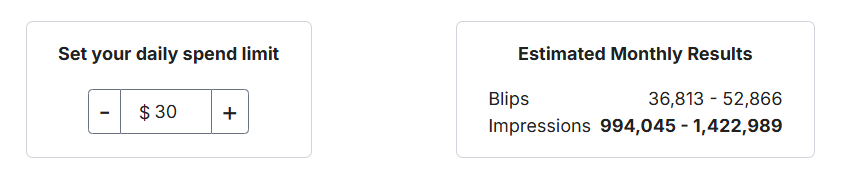
With Blip, you control exactly what you spend to reach drivers on Edgewater billboards by setting a daily budget that fits your needs, whether you’re a local shop or a growing brand. Each ad display, or “blip,” is a brief 7.5 to 10-second appearance on digital billboards near Edgewater, New Jersey, and you only pay for the blips you receive. Pricing for each blip depends on the time of day, location, and advertiser demand, and Blip automatically keeps your campaign within the budget you choose.
Where can I advertise with Blip near Edgewater, New Jersey?
Our 191 digital billboards serving the Edgewater area are concentrated in high-traffic corridors within roughly a 10-mile radius, including Ridgefield, Bogota, Hackensack, North Bergen, Weehawken, Secaucus, Kearny, Jersey City, and New York City. These placements allow your campaign to reach Edgewater area residents heading to and from work, shoppers and diners traveling to the riverfront retail centers and nearby malls, New York City commuters heading west and east, and visitors using the George Washington Bridge, Lincoln Tunnel, and Holland Tunnel.
Who are the main audiences for billboard advertising in Edgewater, New Jersey?
The Edgewater area’s demographics create several high-value segments, including affluent professionals and families, young urban renters and condo owners, multicultural and multilingual communities, regional shoppers and diners, and visitors and reverse commuters from New York City. Many residents commute to finance, tech, media, and professional jobs in Manhattan or Jersey City, and high incomes along the waterfront support higher-priced services, luxury retail, and private education or healthcare. Dense apartments and condos along the Hudson waterfront also create a strong base of 25–44-year-olds.
What are the best times to run Edgewater, New Jersey billboard ads with Blip?
Morning peaks run from 6:30–10:00 a.m., while evening peaks run from 4:00–7:30 p.m., and these windows are especially useful for Manhattan-bound and returning commuter traffic. Midday can capture remote workers, stay-at-home parents, retirees, and service professionals on the move, and weekends are often strong for retail, entertainment, tourism, and local events. With Blip, you can dial your budget up or down at any of these windows rather than paying a flat 24/7 rate.
Why are Edgewater, New Jersey billboards effective for reaching commuters?
The George Washington Bridge handles around 280,000 vehicle crossings per average weekday, the Lincoln Tunnel carries roughly 120,000 vehicles daily, and the Holland Tunnel adds another 80,000+ vehicles daily. Combined, these three crossings often see 480,000–500,000 vehicles per weekday, and a large share of this traffic originates from or passes through Bergen and Hudson counties. Displays in Ridgefield, North Bergen, Weehawken, Jersey City, and Secaucus are strategically suited to intercept these flows.
Do I need a contract to advertise with Blip near Edgewater?
No, Blip has no long-term contracts or minimum commitments. You can start, pause, or stop your campaign at any time.
How fast can I launch a billboard campaign with Blip near Edgewater?
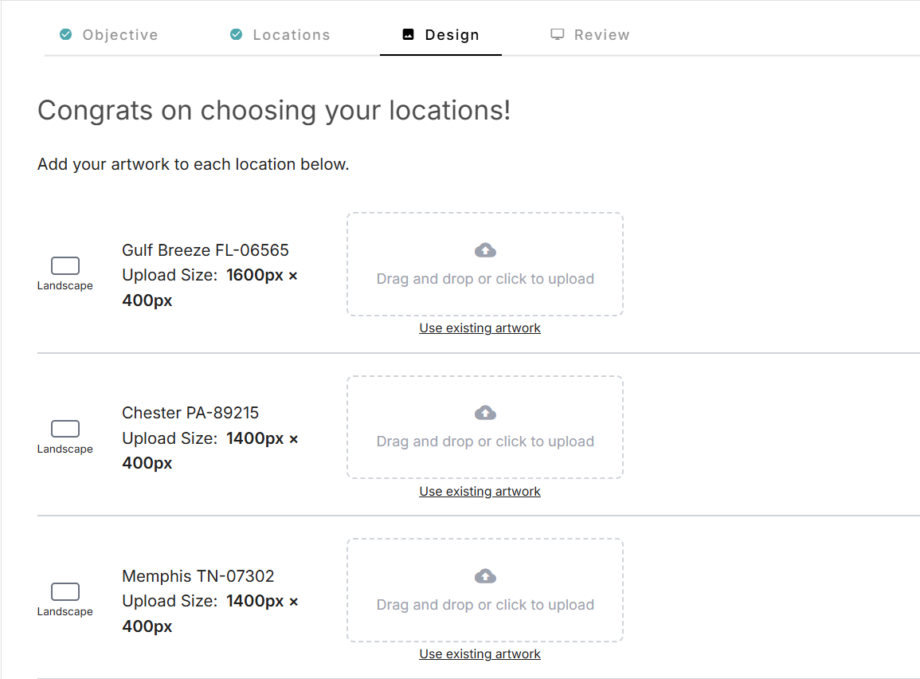
You can have your campaign live in minutes. Create a free account, select your locations, set your budget, upload your design, and start running once approved.
Where can I advertise with Blip near Edgewater?
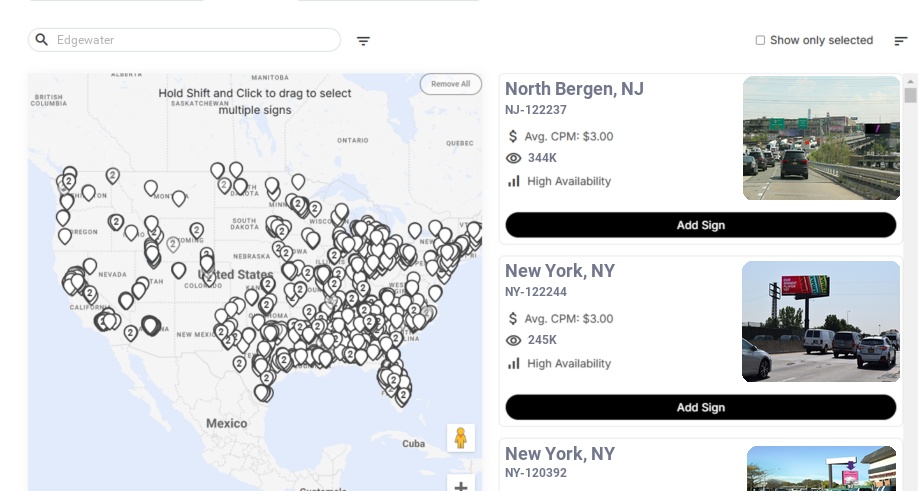
Blip has digital billboards near Edgewater. You can browse available locations on a map, choose the ones that fit your audience, and start advertising right away.
Still have questions? Launch a campaign in minutes — no contracts, no commitments.
Start Your CampaignEdgewater Billboard Advertising Guide
The Edgewater, New Jersey Ridgefield, North Bergen Weehawken Jersey City Secaucus
Understanding the Edgewater Area Market
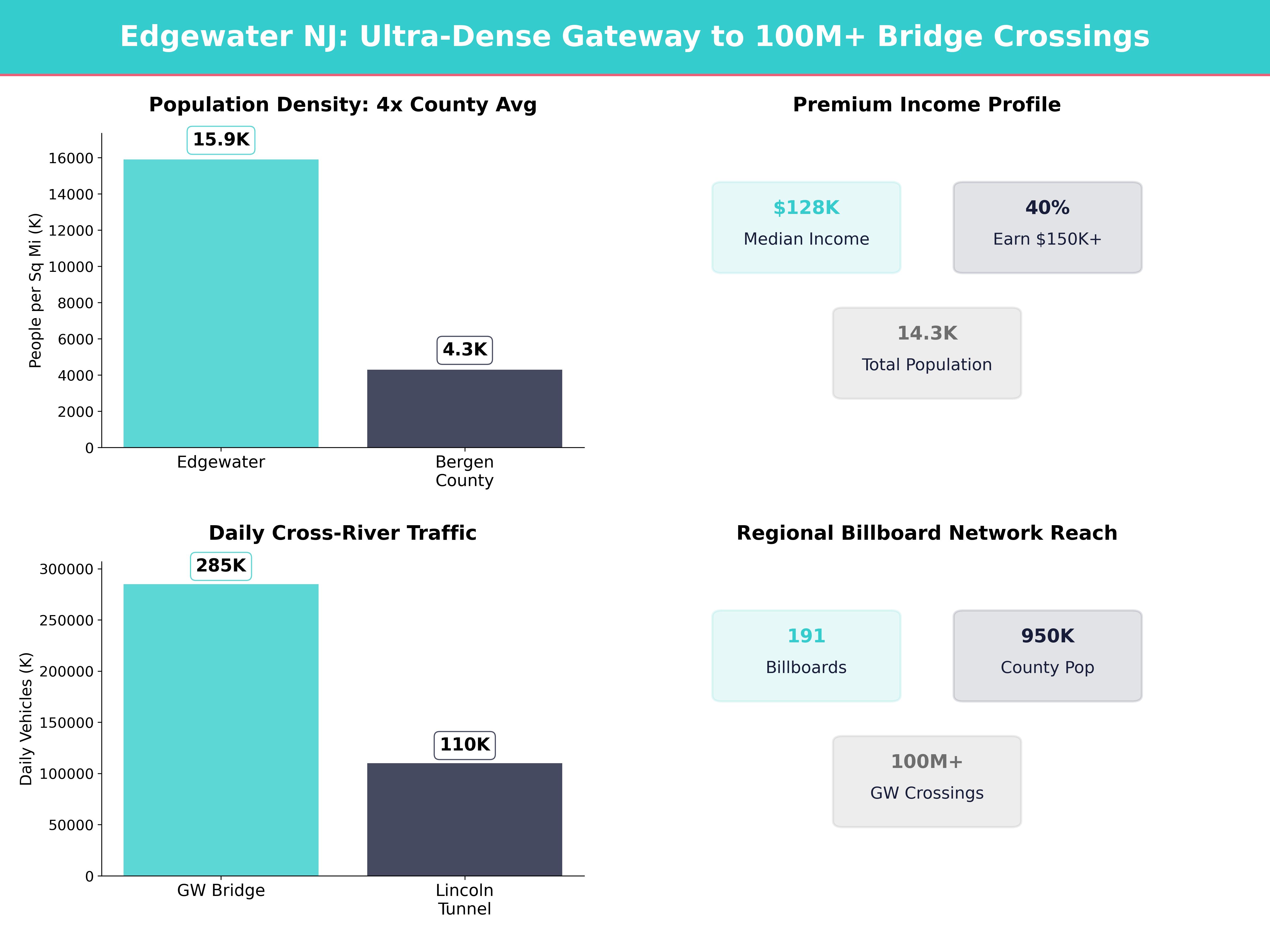
The Edgewater area combines urban density with high household incomes and constant cross-river movement:
- The Borough of Edgewater
- Recent federal and state estimates place Edgewater’s median household income above $135,000, while many Hudson River waterfront tracts in neighboring Fort Lee Cliffside Park are in the $130,000–$160,000 range. Bergen County’s overall median household income is around $115,000, roughly 30–40% higher than the U.S. median, signaling strong disposable income for retail, services, automotive, finance, healthcare, and luxury brands.
- Bergen County overall has more than 950,000 residents, and Hudson County
- According to county housing and planning summaries from Bergen County and Hudson County, over 60% of occupied housing units in many riverfront tracts are renter-occupied, and high-rise buildings frequently exceed 300–500 units each—concentrating thousands of target consumers within a few blocks of major roads.
Key characteristics that matter for billboard strategy:
- High commuter volume: In Bergen and Hudson counties, driver-commuters remain dominant: recent surveys show that about 60–65% of workers drive alone and another 8–12% carpool, meaning roughly 500,000–600,000 residents are in vehicles on a typical weekday. Thousands of residents in the Edgewater area travel daily toward the George Washington Bridge, Lincoln Tunnel, and Midtown Manhattan.
- Dense multifamily housing: River Road and the waterfront are lined with high-rise and mid-rise apartment and condo complexes, many of them luxury or upper-middle-market. Individual developments commonly advertise rents in the $3,000–$5,000 per month range for 1–2 bedroom units, underscoring the area’s high-spend demographic.
- Diverse population: Edgewater, Fort Lee, Palisades Park
- Regional draw for shopping and dining: Bergen County’s retail hubs—including the Paramus Hoboken, pull shoppers from multiple counties and from New York City.
The combination of density, affluence, and highway access makes digital billboards near the Edgewater area an efficient way to reach local residents, daily commuters, and New York City–bound traffic with the same campaign. For brands comparing different options, well-placed billboards near Edgewater can often outperform other local media on a cost-per-thousand basis while still delivering premium audiences.
For tourism- and visitor-oriented campaigns, it’s helpful to note that New Jersey welcomes more than 110 million visitors in a typical year, generating tens of billions in visitor spending according to statewide reports highlighted by VisitNJ. Many of these visitors arrive via the Hudson River crossings and travel through the Edgewater area or adjacent corridors on their way to regional attractions, making Edgewater billboards especially valuable as wayfinding and discovery tools.
Where Our 191 Digital Billboards Reach the Edgewater Area
Our 191 digital billboards serving the Edgewater area are concentrated in high-traffic corridors within roughly a 10‑mile radius, including:
- Ridgefield (≈2.5 miles) – Near Route 1/9 and Route 46, catching traffic moving between the Edgewater area, Fort Lee, and the George Washington Bridge or Lincoln Tunnel approaches. Ridgefield sits at the nexus of several arterials where NJ Department of Transportation (NJDOT) counts show tens of thousands of vehicles per day.
- Bogota Hackensack (≈4–6 miles) – Along routes connecting River Road and the GW Bridge area to central Bergen County (Route 4, Route 17, I‑80). Hackensack alone has more than 46,000 residents and serves as a major employment center with a daytime population significantly higher than its residential base, according to City of Hackensack economic development materials.
- North Bergen & Weehawken (≈5 miles) – Overlooking Tonnelle Avenue, Route 495, and Lincoln Tunnel approaches; prime for Manhattan commuters and reverse commuters. Township of North Bergen notes that the township is over 5 square miles with a population above 60,000—more than 11,000 people per square mile—helping sustain heavy local traffic.
- Secaucus & Kearny (≈5–9 miles) – Around the New Jersey Turnpike, Route 3, and Secaucus Junction, where drivers and transit riders converge en route to both Newark and Manhattan. Town of Secaucus highlights its role as a regional crossroads, with large office parks, outlet retail, and the Secaucus Junction rail hub drawing thousands of workers and shoppers daily.
- Jersey City (≈8 miles) – Near the Holland Tunnel and major arterials attracting Hudson County residents and New York–bound commuters. Jersey City has more than 280,000 residents and is one of the fastest-growing large cities in the region, with substantial daytime inflows to its waterfront financial district.
- New York City & Brooklyn (≈5–10 miles) – Capturing cross-Hudson audiences and visitors heading toward New Jersey, airports, or regional destinations. Manhattan alone has over 1.6 million residents and a daytime population well above 3 million, which means even a modest share of cross-river travelers translates into very large potential impression volumes.
These placements allow your campaign to reach:
- Edgewater area residents heading to and from work
- Shoppers and diners traveling to the riverfront retail centers and nearby malls
- New York City commuters heading west and east
- Visitors using the George Washington Bridge, Lincoln Tunnel, and Holland Tunnel
Because our inventory is digital and sold per “blip,” you can concentrate your budget on the days, times, and roadways that matter most for the Edgewater area. Advertisers often see cost-per-thousand (CPM) efficiencies improve when they focus on a subset of 10–40 boards that align with their heaviest customer flows instead of spreading the same budget thinly across the entire region. This flexible approach makes billboard rental near Edgewater accessible for both small local businesses and larger regional brands.
Traffic, Commuting, and Mobility Patterns to Target
To build an effective schedule, it helps to understand how people actually move around the Edgewater area.
Bridge and tunnel volumes
The Port Authority of New York & New Jersey
- The George Washington Bridge handles around 280,000 vehicle crossings per average weekday (over 100 million crossings annually in recent years).
- The Lincoln Tunnel carries roughly 120,000 vehicles daily, or more than 40 million vehicles per year.
- The Holland Tunnel adds another 80,000+ vehicles daily, or around 30 million vehicles annually.
Combined, these three crossings often see 480,000–500,000 vehicles per weekday, not including buses and trucks counted separately in some statistics. A large share of this traffic originates from or passes through Bergen and Hudson counties—exactly where our Edgewater-area billboards are located. Displays in Ridgefield, North Bergen, Weehawken, Jersey City, and Secaucus are strategically suited to intercept these flows, giving billboard advertising near Edgewater unusually high reach among cross-river travelers.
Major roads influencing the Edgewater area
According to the NJ Department of Transportation, key corridors around the Edgewater area record daily traffic counts in the tens of thousands:
- Route 1/9 and Route 46 (Ridgefield / North Bergen): Many segments see 50,000–80,000+ vehicles per day, with some intersections among the top volume locations in Bergen and Hudson counties.
- I‑95 / New Jersey Turnpike and I‑80 (near Secaucus, Hackensack, Lodi): Numerous segments exceed 100,000 vehicles per day, ranking among the busiest roadway stretches in New Jersey.
- Route 3 and Route 495 (Secaucus / Weehawken): Primary approaches to the Lincoln Tunnel, with heavy peak-hour congestion and long dwell times. During the busiest morning hours, average speeds can drop below 20 mph, which increases the length of time drivers are exposed to your message.
- Local arterials feeding River Road: East–west connectors from towns like Leonia
Although River Road itself has more moderate volumes (often 20,000–30,000+ vehicles per day on busy stretches), many residents and visitors rely on north–south alternates and feeder roads that feed into the larger highways where our boards sit. When you aggregate volumes from multiple corridors within a 5–10 mile radius, it’s common for a single commuter to pass 3–6 of our digital billboards during an average weekday.
Transit and ferries
- NJ TRANSIT operates multiple bus routes serving the Edgewater area and surrounding communities. Systemwide, NJ TRANSIT buses carry well over 400,000 weekday passenger trips in a typical year, with many north–south routes in Bergen and Hudson counties feeding the Port Authority Bus Terminal and George Washington Bridge Bus Station.
- NY Waterway ferries from nearby landings along the Hudson River—such as Port Imperial, Weehawken and Hoboken—carry tens of thousands of passenger trips per weekday across their New Jersey–Manhattan network. During peak periods, ferries on some routes can depart every 10–15 minutes, illustrating the intensity of cross-river commuting.
- Secaucus Junction, less than 10 miles from Edgewater, handles tens of thousands of rail passengers daily, acting as a transfer point between northern New Jersey lines and New York Penn Station.
Even though drivers see your billboards more often than transit riders, transit patterns signal where dense commuter clusters live and travel—which helps us pick ideal billboard locations and time slots to reach those same people on nearby roads.
What this means for your scheduling
- Morning peaks (6:30–10:00 a.m.): In regional commuting surveys, 35–40% of daily trips occur during the morning and evening peak windows; in the Edgewater corridor, a large portion of those are Manhattan-bound. Focus on eastbound routes and Manhattan-bound corridors—good for coffee shops, fast-casual breakfast, transit-linked services, financial services, and local professional services in the Edgewater area.
- Evening peaks (4:00–7:30 p.m.): Evening traffic often has slightly higher leisure and shopping trip shares—ideal for restaurants, grocery, gyms, childcare, home services, and entertainment. Shift weight to westbound boards catching commuters returning toward the Edgewater area and Bergen County.
- Midday (10:00 a.m.–3:00 p.m.): National travel behavior data show that midday periods can account for 30% or more of all trips, dominated by errands, healthcare, and service calls. Capture remote workers, stay-at-home parents, retirees, and service professionals on the move—especially effective for medical offices, retail, auto services, and home improvement.
- Weekends: In many retail and dining categories, 25–40% of weekly sales can occur between Friday evening and Sunday. Retail, entertainment, tourism, and local events often perform best during weekend shopping and leisure trips, particularly along the waterfront and in regional mall corridors like Paramus and Secaucus.
With Blip, you can dial your budget up or down at any of these windows rather than paying a flat 24/7 rate, allowing you to chase the highest-intent impressions instead of simply the highest raw traffic counts.
Key Audience Segments in the Edgewater Area
The Edgewater area’s demographics create several high-value segments:
-
Affluent professionals and families
- Many residents commute to finance, tech, media, and professional jobs in Manhattan or Jersey City. In some waterfront tracts, more than 40% of workers are employed in management, business, science, or arts occupations.
- High incomes (often $130,000+ per household along the waterfront) support higher-priced services, luxury retail, and private education or healthcare. In Bergen County, per‑capita income is roughly $55,000–$60,000, significantly higher than the national figure.
- Auto ownership remains the norm: even in dense riverfront communities, more than 80% of households typically have access to at least one vehicle, and two‑car households are common in family-oriented buildings.
- These consumers are responsive to messages about quality, convenience, and time savings—key advantages you can highlight for services they can access on the way to or from work.
-
Young urban renters and condo owners
- Dense apartments and condos along the Hudson waterfront create a strong base of 25–44-year-olds, often comprising 35–45% of the population in nearby high-rise neighborhoods.
- They favor local dining, nightlife, fitness, delivery services, and subscription products, and they are heavy users of smartphone-based ordering and navigation apps.
- Studies of digital out-of-home (DOOH) show that more than 70% of urban viewers recall seeing a digital billboard in the past month, and over 40% report taking an action (like visiting a website or store) afterward. Because this group is digitally connected, integrating billboard calls-to-action with QR codes, URLs, and social handles can be particularly effective.
-
Multicultural and multilingual communities
- The Edgewater area and neighboring towns like Palisades Park and Fort Lee have some of the highest shares of Korean and other Asian residents in New Jersey; in Palisades Park, for example, a majority of residents identify as Asian, and Korean-language signage dominates major commercial corridors, according to local profiles shared by the borough and regional planners.
- Spanish-speaking and Portuguese-speaking communities are prominent in towns like North Bergen, Union City
- Campaigns that incorporate Korean, Spanish, or other languages—or imagery that reflects these communities—can stand out. Nationally, bilingual DOOH campaigns have been shown to increase message recall among target audiences by double-digit percentages.
- Bi‑lingual messaging is especially valuable on boards in Ridgefield, North Bergen, and Jersey City, where diversity is high.
-
Regional shoppers and diners
- Residents from Hackensack, Lodi, Maywood
- Bergen County’s retail trade sector supports tens of thousands of jobs and generates billions in annual taxable sales, according to county economic development summaries from Bergen County.
- Shoppers also travel in the opposite direction to malls and big-box centers in Paramus, Hackensack, and Secaucus, where individual properties can draw tens of thousands of visitors per weekend day during peak seasons.
-
Visitors and reverse commuters from New York City
- Many New Yorkers come to the Edgewater area for destination grocery stores, waterfront dining, lower sales tax on certain items, and gateway access to northern New Jersey. Weekend traffic counts on River Road and connecting arterials often rise 10–20% compared with typical weekdays during peak leisure seasons.
- Reverse commuting has grown steadily as Jersey City and Bergen County’s office and industrial hubs attract Manhattan residents to New Jersey jobs.
- Billboards in Manhattan, Brooklyn, and Weehawken can nudge this audience toward the Edgewater area for shopping, weekend trips, and services.
When you plan your creative and placement, think about which of these segments you most want to reach—and when and where they’re actually on the road. Matching each audience to specific billboards near Edgewater helps you avoid waste and maximize your budget.
Crafting Billboard Creative for the Edgewater Area
To be effective in this high-traffic but fast-moving environment, your creative needs to be clear, localized, and culturally aware.
-
Hyper-local references
- Use anchors locals recognize:
“Minutes from the Edgewater waterfront,” “Just off River Road,” “Near the George Washington Bridge,” or “5 minutes from the ferry.” - If your store or office is in the Edgewater area, show a simple map snippet or directional arrow (“Next right off River Road”) to convert drivers into visitors immediately.
- Consider referencing well-known local landmarks like the Edgewater Commons shopping center, City Place / The Shops at Riverwalk, or major intersections highlighted by the Borough of Edgewater and neighboring town maps.
- Use anchors locals recognize:
-
Design for speed
Highway drivers have 6–8 seconds or less to absorb your message:- Limit yourself to 7 words or fewer of main text when possible. Industry research shows that recall rates can drop sharply once copy exceeds 10–12 words.
- Use fonts at least 15–18 inches high in the final billboard layout (your designer or printer will manage this, but blocks of large, bold type are best). On a 14′ x 48′ board, that often translates to headline text heights of 24–36 inches.
- Stick to one primary call-to-action: “Exit at [road],” “Order at [short URL],” or “Text EDGE to [shortcode].”
- Keep contrast high—simple color pairings (e.g., white on dark blue, yellow on black) have been shown in DOOH tests to improve legibility at highway speeds by 20–30%.
-
Respect the diverse audience
- Consider running two language versions of your ad (e.g., English and Korean or English and Spanish) in rotation. With digital billboards, you can easily alternate creatives every few seconds without additional printing cost.
- Use imagery that reflects the Edgewater area’s diversity: multi-ethnic families, professionals, and young adults.
- If your brand serves a specific community (e.g., a Korean bakery, Latin American restaurant, or specialty grocer), don’t hide it—celebrate it prominently.
- In neighborhoods where 40% or more of residents speak a language other than English at home, a simple bilingual headline can significantly increase engagement.
-
Connect billboards to digital
- Feature easy URLs such as “BrandEdgewater.com” or “BrandNJ.com”—drivers won’t remember complicated strings.
- Short promo codes like “EDGE20” help track which redemptions come from your Edgewater-area billboards. Even a redemption rate of 0.1–0.3% on tens of thousands of impressions can translate into dozens of incremental customers per month for local businesses.
- Align creative with campaigns you’re running on local news sites such as NorthJersey.com, regional outlets like the Hudson County section of NJ.com Hudson Reporter
-
Use seasonality
- Winter: Promote indoor activities, delivery, home services, tax preparation, and healthcare—driven by shorter days and colder weather. In the Northeast, heating and home service calls can spike 20–40% during cold snaps, creating opportunities for service-oriented advertisers.
- Spring: Home improvement, landscaping, auto services (tires, detailing), and fitness. Many home and garden retailers see double-digit percentage bumps in March–May versus winter months.
- Summer: Waterfront dining, travel services, camps, and tourism; coordinate with regional promotions from VisitNJ and Hudson County tourism resources such as the county’s cultural and tourism office at Hudson County.
- Fall: Back-to-school, tutoring, flu shots, and holiday pre-sales. Local school calendars in Edgewater, Fort Lee, and Bergen County usually cluster major start dates in late August and early September, making August an ideal month for back-to-school messaging.
You can schedule different creatives for different seasons or events without printing new vinyl—just upload revised artwork and adjust your Blip settings.
Strategic Placement Near the Edgewater Area
Because we have 191 digital billboards serving the Edgewater area, you can tailor your campaign footprint rather than blanketing the whole region blindly.
-
Reaching residents of the Edgewater area
Prioritize boards:
- In Ridgefield, North Bergen, and Bogota/Hackensack, where many Edgewater-area residents drive on their way to work, shopping, or schools.
- On east–west connectors (Route 4, Route 3, I‑80) used by local residents heading toward malls, big-box retail, and Jersey City or Manhattan jobs.
Use messaging centered on everyday needs: groceries, gyms, healthcare, childcare, and local services. For example, Bergen County health and recreation data show high participation in youth sports and fitness programs, making sports medicine, pediatric care, and fitness clubs natural billboard categories.
-
Capturing New York City–bound commuters
Focus on:
- Weehawken and Secaucus boards along Route 495 and I‑95/Turnpike spurs.
- Jersey City boards near Holland Tunnel approaches.
These are ideal for:
- Promoting Edgewater-area dining as a “stop on the way home.”
- Advertising financial services, legal firms, or medical specialists based in the wider Bergen–Hudson corridor.
- Positioning your brand as part of the commuter’s daily routine: “Coffee before the tunnel,” “Dinner when you get back to the river,” etc.
Commuter surveys in the region often find that 60–70% of workers make at least one discretionary stop (gas, grocery, coffee, or dining) on their way to or from work each week, which gives roadside advertisers repeated chances to influence choices.
-
Attracting visitors from New York City
Use boards in:
- New York City and Brooklyn, especially near river crossings.
- Jersey City and Weehawken facing eastbound traffic heading back to Manhattan (to encourage a stop in the Edgewater area before crossing).
Messaging examples:
- “Waterfront views, free parking—just across the river.”
- “Skip Midtown crowds. Shop & dine near Edgewater.”
Tourism reports from VisitNJ and county-level tourism offices indicate that day-trippers and overnight visitors contribute billions of dollars annually in spending to North Jersey communities. Even a small redirection of that flow toward your business can produce significant revenue increases over a campaign period, especially when supported by prominent Edgewater billboards on primary approach routes.
-
Retail and event “fencing”
If you operate a retail center, event venue, or restaurant cluster in the Edgewater area:
- Concentrate impressions within a 5–7 mile radius on boards that drivers use just before they make a decision turn.
- Use directional copy: “2 exits ahead,” “Next right after the bridge,” or “Turn at [road name].”
- Increase frequency Friday–Sunday for events, nightlife, and shopping. Retailers commonly see 20–35% higher foot traffic on weekends; matching your impression levels to those days aligns your spend with customer volume.
- For larger events, coordinate timing with municipal calendars from the Borough of Edgewater, Bergen County, and Jersey City to capture attendees as they drive in and out.
Timing and Budget Optimization With Blip
Because Blip allows you to buy individual ad plays (“blips”) instead of a fixed 4‑week contract, you can shape your media buy around how the Edgewater area actually lives and works. This makes billboard rental near Edgewater highly adaptable to changing business needs, seasonal patterns, and promotional calendars.
Daypart strategies
- Early morning (5:30–7:30 a.m.): Target shift workers, hospitality staff, and early commuters. Good for breakfast, coffee, convenience retail, and gyms. In many commuter corridors, traffic between 5:30 and 7:30 a.m. can represent 10–15% of total weekday volume, with relatively little advertising clutter.
- Core commute (7:30–9:30 a.m. and 4:30–6:30 p.m.): Higher bid levels to win more blips when traffic is heaviest, especially on GW Bridge and Lincoln Tunnel approaches. Vehicle counts during these windows can peak at 2–3 times off-peak hourly volumes.
- Late evening (8:00–11:00 p.m.): Often lower competition; great for branding, nightlife, streaming services, and late-night dining in the Edgewater area. Many boards still see thousands of vehicles per hour during early nighttime, but with fewer advertisers bidding, your share of voice can increase at a lower effective cost.
Day-of-week strategies
- Monday–Thursday: Focus on everyday essentials—grocery, pharmacy, healthcare, auto, and quick-service restaurants. Weekday campaigns align with recurring appointments and errands.
- Friday: Shift toward weekend-focused messages—events, dining, entertainment, and travel. Regional visitor data often show Friday evening as one of the highest-volume departure periods for weekend trips.
- Saturday–Sunday: Emphasize family activities, shopping, religious services, and community events. Local parks, waterfront walkways, and malls can attract thousands of additional weekend visits, according to municipal recreation and tourism reports from Bergen County and Hudson County.
You can run multiple creatives with different schedules: for example, a weekday commuter-focused ad plus a weekend family-focused ad, all within the same campaign. Many advertisers find that A/B testing two or three creatives over a 4–8 week period produces measurable lift in response metrics like website visits or promo code redemptions.
Example Campaign Approaches for the Edgewater Area
To make this concrete, here are some practical campaign concepts:
-
Local waterfront restaurant in the Edgewater area
Goal: Increase weekday dinner and weekend brunch traffic.
- Placement: Boards in Weehawken, North Bergen, and Ridgefield facing westbound traffic (evening return flow) and late-morning traffic on weekends.
- Schedule:
– Weekdays 4:00–7:30 p.m. for “Stop here for dinner” messages
– Weekends 10:00 a.m.–3:00 p.m. for brunch and lunch - Creative:
– “Waterfront views. Free parking. 5 min from River Road.”
– Mouthwatering food photography, clear exit directions.
– Add a trackable incentive such as “Show this code: RIVER10” and monitor redemption. Even achieving 1 redemption per 1,000–2,000 impressions can be profitable for higher-ticket dining checks.
-
Healthcare clinic or dental practice serving the Edgewater area
Goal: Book new patients from nearby apartments and commuters.
- Placement: Boards in Hackensack, Bogota, and Ridgefield on routes connecting residential buildings along the Hudson with workplaces and shopping.
- Schedule: Daytime hours 9:00 a.m.–6:00 p.m., especially Monday–Wednesday when people schedule appointments.
- Creative:
– “New patients near Edgewater welcome. Same-week appointments.”
– QR code for online booking.
– Consider highlighting key proof points like “Most insurance accepted” or “Open evenings,” since surveys show that extended hours are a top decision factor for more than 40% of healthcare consumers.
-
Regional e‑commerce or app-based service targeting affluent commuters
Goal: Build brand awareness and drive app downloads.
- Placement: High-traffic boards in Secaucus, Weehawken, and Jersey City along Turnpike and tunnel approaches.
- Schedule: Heavy morning and evening commute focus, some weekend coverage.
- Creative:
– “Save an hour this week. Try [Brand].”
– Short URL or keyword, strong logo emphasis, simple imagery.
– National DOOH studies indicate that app download rates can increase by 15–30% when billboards are synchronized with mobile ads in the same geography; use geo-targeted digital ads around the Edgewater, Weehawken, and Jersey City corridors for maximum effect.
-
Real estate or multifamily development near the Edgewater area
Goal: Lease up new apartments or condos.
- Placement: Boards ringing the Hudson waterfront from Ridgefield to Jersey City, plus select locations in Manhattan and Brooklyn targeting reverse commuters.
- Schedule: Evenings and weekends when prospective renters and buyers are touring or browsing.
- Creative:
– “Luxury riverfront living from $X/month – 10 minutes from the GW Bridge.”
– Photo of skyline or river view, URL and phone.
– Leasing campaigns often track leads per 1,000 impressions; even a conversion rate as low as 0.05–0.1% (1 lead per 1,000–2,000 impressions) can be highly efficient given the lifetime value of a signed lease.
Integrating Local Media and Community Presence
Billboards work best when they’re part of a broader local presence. In the Edgewater area, consider reinforcing your digital billboard campaign with:
- Local news outlets such as NorthJersey.com, which covers Bergen and Passaic counties; the Hudson County section of NJ.com; and community-focused platforms and weeklies that cover waterfront towns from Edgewater down to Jersey City. Local news sites often reach tens of thousands of readers per day in these counties.
- Municipal and county resources, including listings or sponsorship opportunities with the Borough of Edgewater, Bergen County, Hudson County, and nearby municipalities such as North Bergen, Weehawken, and Secaucus. Community calendars, recreation guides, and cultural events can provide natural tie-ins for your messaging.
- Tourism and events sites like VisitNJ, county tourism efforts, and city event pages from Jersey City or waterfront towns if you’re promoting attractions, restaurants, or seasonal events that appeal to visitors traveling through the Edgewater area.
- Cultural and historic organizations, including divisions within Bergen and Hudson counties that promote museums, festivals, and heritage sites. For example, county cultural affairs offices regularly highlight events that draw hundreds or thousands of visitors on a given weekend—ideal opportunities to time your campaigns.
When your billboard creative echoes what people see on these local channels, recall and response rates increase significantly. Cross-channel studies commonly find that pairing DOOH with digital and local media can produce incremental lifts of 20–40% in ad recall and brand consideration compared to using a single channel alone.
Putting It All Together
To reach audiences in the Edgewater, New Jersey area efficiently with digital billboards:
- Define your core audience (commuters, residents, visitors, or a mix) based on the Edgewater area’s unique mix of affluent professionals, families, and multicultural communities. Use available local data—such as median incomes above $130,000 along the waterfront, population densities of 15,000+ per square mile, and high shares of professional occupations—to shape your targeting.
- Choose strategic corridors—Ridgefield, North Bergen, Weehawken, Secaucus, Hackensack, Jersey City, and New York City—to intercept those audiences where they already travel. Focus on roads with 50,000–100,000+ vehicles per day and on approaches to the GW Bridge, Lincoln Tunnel, and Holland Tunnel. This is where well-placed billboards near Edgewater can create repeated, high-quality exposures.
- Schedule around real-world behaviors, leaning into morning and evening peaks, weekday vs. weekend patterns, and seasonal demand. Align impression delivery with the 30–40% of trips that occur in peak hours and the 25–40% of weekly sales that many categories generate on weekends.
- Design concise, localized creative that speaks directly to the Edgewater area, with strong calls-to-action and clear directions, and consider bilingual executions where appropriate to reflect the region’s diversity.
- Use Blip’s flexibility to test, optimize, and scale: adjust bids, rotate creatives, and narrow or expand your footprint as performance data comes in. Track KPIs like promo code use, website visits from target ZIP codes, and store traffic during key dayparts to refine your buy.
With 191 digital billboards serving the Edgewater area and fully flexible, on-demand scheduling, we can help you build a campaign that not only reaches this high-value market—but does so with the precision and efficiency that modern advertisers expect from billboard advertising near Edgewater.