Billboards near Union City, NJ
No Minimum Spend. No Long-Term Contracts. Just Results.
Trusted by Leading Brands


Billboard advertising
near Union City has never been easier
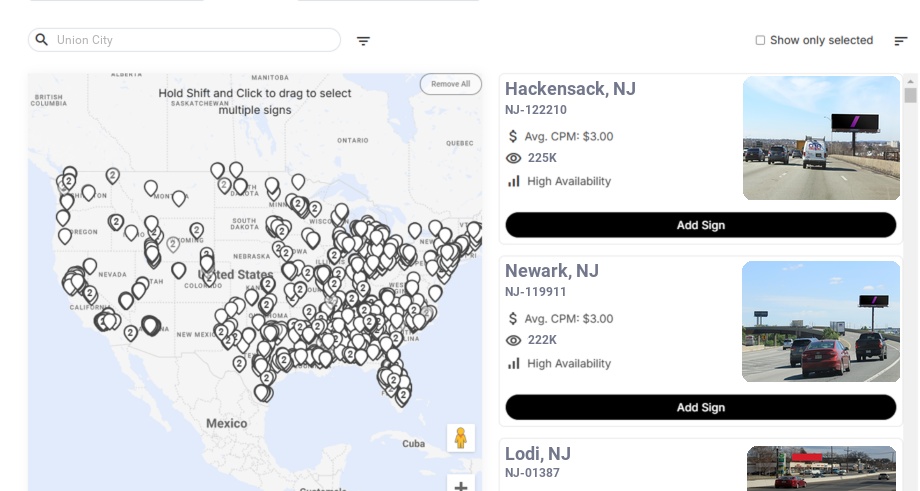



How much is a billboard near Union City?
Why Choose Blip for Billboard Advertising near Union City
-
Blip lets you launch Union City billboards in minutes, reaching Lincoln Tunnel and Route 495 commuters without a long-term commitment.
-
Set flexible budgets on Union City, New Jersey boards and tap dense, bilingual households near Kennedy Boulevard and Bergenline Avenue.
-
Daypart your Blip campaign for Union City rush hours, midday errands, or late-night traffic on Route 3 and Tonnelle Avenue.
-
No contracts means Union City advertisers can test around Hudson County festivals and back-to-school spikes, then shift spend fast.
-
Track Union City performance in real time and optimize by corridor, from Weehawken tunnel approaches to Jersey City waterfront flows.
-
Use Blip creative tools to build bold, bilingual Union City ads that stand out in 3–7 second glances on fast-moving commuter routes.
Frequently Asked Questions About Billboard Advertising near Union City
How much does a billboard cost near Union City, New Jersey with Blip?
With Blip, advertising on Union City billboards is flexible and affordable because you only pay per “blip,” a 7.5–10 second ad display. You set a daily budget for your campaign serving the Union City area, and Blip automatically keeps your campaign within that limit, so you’re always in control of spend. Costs per blip vary based on when and where your ad appears and on advertiser demand, and your total cost is simply the sum of all the blips you receive.
Where can I advertise with Blip in Union City, New Jersey?
With 188 digital billboards serving the Union City area, you can reach audiences in nearby communities like Weehawken, North Bergen, Jersey City, and Secaucus. Key traffic channels include Route 495 and Lincoln Tunnel approaches, the New Jersey Turnpike and Route 3, Hudson River waterfront and Holland Tunnel approaches, and local arterials like Kennedy Boulevard and Tonnelle Avenue.
Who sees Union City, New Jersey billboards the most?
Union City’s population is roughly 65,000 residents packed into about 1.3 square miles, yielding more than 50,000 residents per square mile. The area is predominantly Hispanic or Latino, with well above 75% of residents in some estimates, and many households speak Spanish at home. It also has a strong commuter share, with many workers using public transit, walking, or carpooling.
When should I run Blip ads on Union City, New Jersey billboards?
Because the Union City area is so commuter-heavy and transit-oriented, dayparting your Blip campaign is critical. Morning, midday, evening rush, and late night each reach different audiences, and weekday traffic volumes can be 30–40% higher during peak rush than midday. The page also notes that a well-funded campaign on a single board can generate tens of thousands of plays per day on high-traffic routes.
What kind of billboard creative works best in Union City, New Jersey with Blip?
Strong, simple visuals work best in this dense, fast-moving environment where drivers have 3–7 seconds to absorb a message. Bilingual English/Spanish creatives can reach well over three-quarters of local households, and messaging that reflects immigrant stories, family life, entrepreneurship, and upward mobility will resonate strongly. The page also recommends keeping copy to 7 words or fewer whenever possible and using high-contrast colors.
Do I need a contract to advertise with Blip near Union City?
No, Blip has no long-term contracts or minimum commitments. You can start, pause, or stop your campaign at any time.
How fast can I launch a billboard campaign with Blip near Union City?
You can have your campaign live in minutes. Create a free account, select your locations, set your budget, upload your design, and start running once approved.
Where can I advertise with Blip near Union City?
Blip has digital billboards near Union City. You can browse available locations on a map, choose the ones that fit your audience, and start advertising right away.
Still have questions? Launch a campaign in minutes — no contracts, no commitments.
Start Your CampaignUnion City Billboard Advertising Guide
Union City, New Jersey sits at the heart of one of the busiest, densest, and most diverse urban corridors in the United States. With 188 digital billboards serving the Union City area from nearby communities like Weehawken North Bergen, Jersey City Secaucus
Understanding the Union City Area Audience
Union City is small in land area but massive in density and activity.
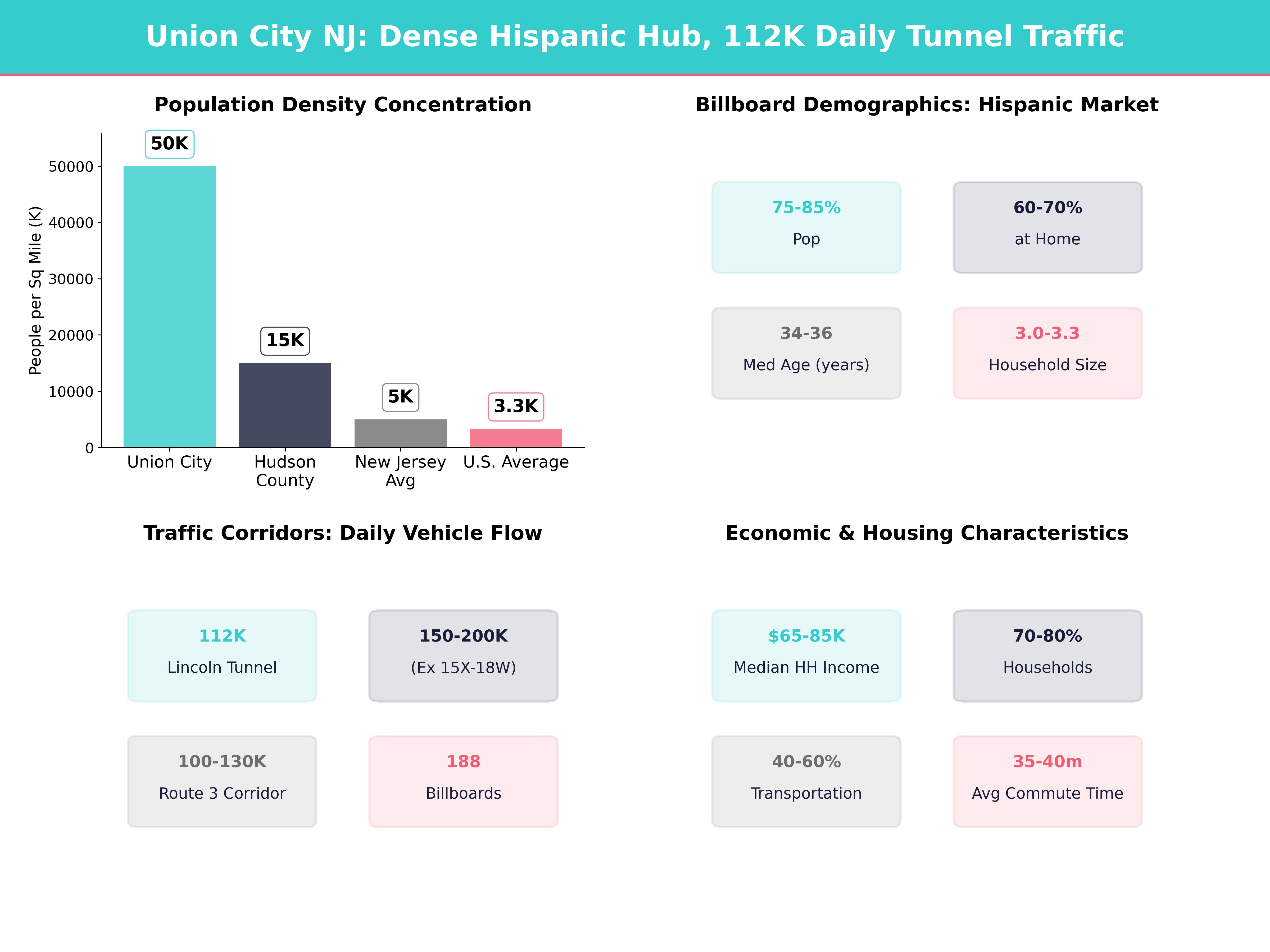
- Population density leader: Union City’s population is roughly 65,000 residents packed into about 1.3 square miles, yielding more than 50,000 residents per square mile. That’s well over 10x denser than New Jersey as a whole and more than 15x denser than the U.S. average, putting it in the top tier of densely populated cities nationwide.
- Hudson County scale: Hudson County overall has about 707,000+ residents in just 46 square miles, which is more than 15,000 residents per square mile according to Hudson County
- Transit-oriented living: In many Hudson County communities, 40–60% of workers commute by public transit, walking, or carpooling, compared with about 10% nationally. NJ Transit’s Hudson–Bergen Light Rail, dense bus networks through Union City, Weehawken, and North Bergen, plus PATH and NY Waterway ferries, shape daily movement patterns. In some neighborhoods, over one-third of households are car-free, making street-level visibility particularly valuable and increasing the impact of Union City billboards and nearby placements.
- Rental, household, and income profile: In the Union City area, it’s common for 70–80% of households to rent rather than own, with average household sizes around 3.0–3.3 people, reflecting multi-generational and family living. Median household incomes across Union City and neighboring Hudson County communities tend to fall in the $65,000–$85,000 range, with significant segments both below $50,000 and above $100,000, supporting a mix of value-focused and premium brands.
Demographically, the Union City area is:
- Predominantly Hispanic/Latino: Union City’s Hispanic or Latino population is commonly reported well above 75% of residents, with some local estimates closer to 80–85%. Large Cuban, Dominican, Central American, and South American communities anchor the culture and drive strong demand for Spanish-language and bilingual messaging.
- Young and working: The broader Hudson County area skews younger than the U.S. average, with around 35–40% of residents in the 25–44 working-age bracket and a median age of roughly 34–36 years. This aligns well with advertisers focused on careers, nightlife, consumer tech, education, and family services.
- Bilingual or multilingual: In some Hudson County cities, 60–70% of residents speak a language other than English at home, primarily Spanish. You’ll also find Portuguese, Arabic, Tagalog, and others—especially across nearby Jersey City
- High commuter share: Average one-way commute times of 35–40 minutes are common for Union City and neighboring communities, several minutes above the national average. This creates extended daily exposure windows on highways and major arterials that benefit any billboard advertising near Union City.
You can monitor neighborhood-level demographics and community initiatives via Hudson County’s Jersey City’s government site Hoboken’s official site.
What this means for your creative:
- Strong, simple visuals work best in such a dense, fast-moving environment where drivers have 3–7 seconds to absorb a message.
- Bilingual English/Spanish creatives can reach well over three-quarters of local households.
- Messaging that reflects immigrant stories, family life, entrepreneurship, and upward mobility will resonate strongly with this audience.
- Value messaging (discounts, flexible payment options) can appeal to price-sensitive households, while premium positioning works in waterfront and commuter corridors with higher-income professionals.
Where Your Impressions Come From: Key Corridors Serving Union City
The 188 digital billboards serving the Union City area are strategically positioned near some of the most heavily traveled arteries on the East Coast. When we activate boards in nearby cities, we’re tapping into routes thousands of Union City residents and visitors use daily, giving you powerful reach with billboards near Union City even when the structures sit just across municipal lines.
Key traffic channels include:
- Route 495 & Lincoln Tunnel approaches (Weehawken / North Bergen / Union City area)
The Lincoln Tunnel, managed by the Port Authority of New York and New Jersey - New Jersey Turnpike & Route 3 (Secaucus, Kearny, Newark)
The New Jersey Turnpike Newark. Route 3, which connects the Turnpike to the Lincoln Tunnel corridor, sees in the range of 100,000–130,000 vehicles per day between Clifton, the Meadowlands, and Secaucus. These corridors feed commuters to Union City, Jersey City, and Hoboken, plus shoppers headed to Secaucus retail centers and the MetLife Stadium - Hudson River waterfront & Holland Tunnel approaches (Jersey City)
The Holland Tunnel carries about 90,000+ vehicles daily, translating to roughly 33 million trips per year across the Hudson. Boards in Jersey City near waterfront office hubs and residential high-rises offer repeated exposure to a growing population—Jersey City’s population has climbed past 280,000 residents, with thousands of new units added along the waterfront in the last decade. Many of these professionals work in Jersey City or Manhattan but live in Union City, North Bergen, and the western Hudson communities, generating two-way daily flows ideal for campaigns that rely on continuous billboard advertising near Union City. - Local arterials & neighborhood connectors (North Bergen, Ridgefield, Hackensack, Bayonne)
Routes like Kennedy Boulevard and Tonnelle Avenue (US 1/9) are the everyday backbone of Hudson County. Segments of Kennedy Boulevard can see 25,000–35,000 vehicles per day, while parts of Tonnelle Avenue carry 40,000–50,000 daily vehicles, including a high share of commercial traffic. Local connectors in North Bergen, Ridgefield, and Bayonne catch residents throughout the day as they shop, pick up kids, and run errands at speeds low enough for detailed offers or QR codes. Nearby communities such as Hackensack - Cross-Hudson connection to NYC and Brooklyn
Billboards in New York City and Brooklyn are within about 6–8 miles of Union City. They reach a massive regional audience—over 8.3 million NYC residents plus regional commuters—including many who travel regularly to the Union City area for family, shopping, or work. Greater New York–New Jersey metro daytime population swells above 20 million people, giving your campaign reach across both sides of the Hudson when paired with billboards near Union City on the New Jersey side.
Use this network to build layered campaigns—for example, reaching Union City residents on their way into Manhattan in Weehawken, and then again on boards in Midtown or Brooklyn later in the day. Corridor-based planning lets you follow the same audience over multiple touchpoints per day, which can significantly lift recall versus single-exposure strategies.
Timing Your Blips Around Daily Life in the Union City Area
Because the Union City area is so commuter-heavy and transit-oriented, dayparting your Blip campaign is critical. Think in terms of the local daily rhythm and the fact that, across the region, weekday traffic volumes can be 30–40% higher during peak rush than midday.
Typical digital billboard spots (“blips”) run 6–10 seconds per play, with signs cycling 8–10 advertisers every minute. That means a well-funded campaign on a single board can generate tens of thousands of plays per day on high-traffic routes.
Morning (6–10 a.m.)
- Focus on Route 495, Route 3, and Turnpike boards serving eastbound and southbound commuters, plus key arterials feeding park-and-ride locations and NJ Transit rail or bus hubs in Secaucus and Jersey City.
- In many commuter corridors, 35–45% of daily vehicle volume occurs before 10 a.m., making this one of the most valuable dayparts.
-
Aim messages at:
- Coffee, breakfast, convenience foods
- Transit and rideshare services
- Financial services, job recruiting, and education
- Use urgent, action-oriented CTAs: “Today only,” “This morning,” “On your way home, stop at…”
Midday (10 a.m.–3 p.m.)
- Target shoppers and service-seekers traveling between Union City, Jersey City, Secaucus, and Newark, including workers on staggered schedules and service industry employees.
- Midday driving often accounts for 30–35% of total daily traffic, with slightly slower speeds on urban arterials—ideal for slightly more detailed value propositions on Union City billboards and nearby placements.
-
Ideal for:
- Retail, healthcare, and legal services
- Restaurants promoting lunch specials
- Local government or non-profit awareness campaigns
- Consider bilingual messaging here, as local errands often involve families and older residents who may prefer Spanish. In some Union City–area schools, Spanish-speaking students account for 80–90% of enrollment, making family-facing messages in Spanish particularly effective.
Evening Rush (3–8 p.m.)
- Westbound traffic out of Manhattan and Jersey City peaks. On many corridors, 35–40% of daily volume flows between 3–8 p.m., with pronounced surges between 4–7 p.m.
- Exposure on Weehawken, Secaucus, Kearny, and Newark-area boards is especially valuable as commuters return to Hudson County, Bergen County, and beyond.
-
Promote:
- Dining, nightlife, fitness, and events
- Streaming services and entertainment
- Grocery and big-box retail for after-work shopping
- Use CTAs tailored to immediate decisions: “Dinner tonight,” “Join us after work,” “Exit 16E—5 minutes away.”
Late Night (8 p.m.–2 a.m.)
- Even though total volumes are lower, late-night audiences in this corridor skew toward nightlife, service workers, hospitality staff, and younger adults out for dining and entertainment.
-
Perfect for:
- Nightlife, bars, clubs, lounges
- Quick-service restaurants and delivery apps
- Casinos and entertainment venues in the broader region
- Highlight lighting, bold color, and very minimal copy to stand out. At posted speeds of 35–60 mph, late-night drivers may only have 2–4 seconds of clear view time.
By adjusting your Blip schedule to these patterns, you can push more impressions into your highest-value dayparts instead of spreading budget thinly across the entire day. Coordinate with transit and traffic updates from agencies like NJ Transit, PATH, and local police or transportation departments listed through municipal portals like Jersey City Hoboken.
Seasonal and Event-Driven Opportunities Near Union City
Hudson County and the surrounding region have strong seasonal patterns that you can harness. Retail and service businesses commonly see 20–40% swings in volume between low and high seasons, and your out-of-home schedule should track those shifts when planning billboard advertising near Union City.
Winter & Early Spring (Jan–Mar)
- Union City area residents often commute through harsh weather. Snow and ice can depress foot traffic by 10–20% on the worst days, while increasing demand for certain services.
-
Highlight:
- Auto repair, car washes, and tire shops (winter-related claims and repairs often spike 15–25% regionally)
- Health services (flu shots, urgent care, telehealth—flu season can peak with 2–3x typical clinic visits)
- Tax preparation and financial planning in the run-up to April deadlines
- Use straightforward visuals with warm colors to contrast gray winter days, and focus on reassurance, safety, and convenience.
Late Spring & Summer (Apr–Aug)
- Warmer months see more activity at parks and waterfronts. Nearby Jersey City Hoboken, and Hudson County events bring visitors in and out of the Union City area.
- The Hudson County tourism sector welcomes hundreds of thousands of visitors each summer, with major festivals and waterfront events often drawing 10,000–50,000 attendees per day.
-
Promote:
- Outdoor events, festivals, concerts, parades
- Summer programs, schools, camps, and youth sports—many camps run at or near capacity, so early registration pushes matter
- Ice cream shops, casual dining, and waterfront attractions
- Consider campaigns that spike around big regional events (Fourth of July fireworks on the Hudson, waterfront festivals, sports events at MetLife Stadium
Back-to-School & Fall (Sep–Nov)
- Families in Union City and neighboring communities focus on school, work, and structured routines. Local districts and charters serve tens of thousands of students across Hudson County.
-
Effective verticals:
- Schools, tutoring, and after-school programs—demand for tutoring often rises 20–30% at the start of each term
- Retail (clothing, electronics, backpacks), as households shift spending from vacations to school needs
- Healthcare, dental, and vision checkups before and shortly after school resumes
- Use countdown-style messages: “3 weeks left for registration” or “Enroll before October 1.” Deadlines and scarcity messaging can improve response rates, particularly among busy working families.
Monitoring local calendars from sources like Hudson County’s tourism site, municipal event pages for Jersey City Hoboken, and Bayonne, or local news such as NJ.com’s Hudson County section Hudson Reporter
Tailoring Creative to a Bilingual, Urban Market
In the Union City area, good creative is not just visually sharp—it’s culturally aware and language-smart. With well over half of households speaking Spanish at home in many neighborhoods, language choice directly affects reach.
- Use bilingual or dual-creative strategies
-
Bilingual copy on a single creative can work if it’s concise:
- Example: “Low-Cost Health Clinic / Clínica de Salud a Bajo Costo”
-
Alternatively, rotate English-only and Spanish-only creatives during your campaign, using Blip to test which mix performs better in different time slots. For instance:
- Run 70–80% Spanish during daytime and early evening on neighborhood arterials.
- Run a 50/50 mix on regional highways that pull audiences from broader North Jersey.
- Campaigns that use Spanish in at least part of their creative can see double-digit percentage lifts in engagement from Hispanic/Latino audiences compared with English-only messaging, especially in heavily bilingual corridors served by Union City billboards.
- Simplify to match drive times
On Lincoln Tunnel approaches, Turnpike segments, and Route 3, drivers have only a few seconds to process your message.
- Limit copy to 7 words or fewer whenever possible; research across the out-of-home industry consistently shows higher recall for short, high-contrast ads.
- Make your brand or offer legible at a glance; avoid long URLs and clutter.
- Use high-contrast color (e.g., dark text on light background or vice versa), which is especially important in winter fog or nighttime conditions. Tests in similar metro markets often show 15–30% higher recall for high-contrast creatives versus low-contrast designs.
- Reflect local culture and everyday life
Union City and neighboring communities celebrate strong cultural identities and family values. Community events like Hispanic heritage parades and neighborhood festivals regularly draw thousands of attendees.
- Highlight family meals, multi-generational households, and small-business pride.
- Show real people that resemble the neighborhood—Latino families, young professionals, and diverse friend groups.
- Include references that locals recognize: mentions of key corridors like “near Kennedy Boulevard,” “minutes from the Lincoln Tunnel,” or landmarks in Jersey City or Secaucus. When viewers can locate you mentally in 1–2 seconds, conversion odds rise significantly.
- Promote proximity clearly
Because the boards are in nearby cities serving the Union City area, explicitly state how close you are:
- “5 minutes off Route 3”
- “Next to the Bergenline Avenue shopping district”
- “Just past the Lincoln Tunnel exit”
Businesses that call out time-to-location (“5 minutes away,” “2 exits ahead”) often see better response than those that only list street addresses, especially in dense urban environments where 60–70% of trips are under 30 minutes. Clear proximity cues are especially important when your billboard rental near Union City sits along fast-moving commuter routes.
Using Geographic Strategy: Local vs. Regional Reach
With 188 digital billboards serving the Union City area, you can calibrate your geographic reach from hyper-local to region-wide. The average Hudson County driver may traverse multiple municipalities per day, meaning even a modest geographic expansion can multiply total impressions.
Hyper-local campaigns (Union City + immediate neighbors)
Focus on boards in:
- Weehawken (0.5 miles from Union City)
- North Bergen (0.8 miles)
- Jersey City (3.0 miles)
- Secaucus (1.4 miles)
These communities collectively represent more than 300,000 residents within a 5–10 minute drive of Union City, plus sizeable daytime worker populations. They are ideal starting points if you are testing your first billboards near Union City and want to confirm response before expanding.
Best for:
- Local businesses (restaurants, clinics, law offices, salons, gyms)
- City agencies and community organizations in the Union City area
- Schools and childcare facilities targeting nearby families, such as programs linked with local districts and vocational schools promoted through Hudson County
Cross-county and regional campaigns
Add locations like:
- Newark (7.6 miles)
- Hackensack (8.6 miles)
- Bayonne (8.7 miles)
- Brooklyn and New York, NY (6–8 miles)
Together, these zones give you access to a combined population topping 3–4 million within a relatively short drive radius, plus millions more in daytime workers, tourists, and event attendees.
Best for:
- Colleges and trade schools recruiting regionally—including programs that draw from both New Jersey and NYC boroughs
- E-commerce brands and apps that ship or serve throughout the metro
- Health systems drawing patients from across North Jersey and NYC
- Regional political or issue-based campaigns aiming for millions of impressions over a 4–8 week cycle
By grouping boards into logical “corridors” (e.g., Lincoln Tunnel approach, Turnpike north of Newark, waterfront Jersey City), you can allocate more of your budget to the clusters that intersect most tightly with Union City residents’ travel patterns, rather than spreading spend evenly. Corridor targeting can reduce wasted impressions and concentrate your exposure among the high-frequency commuters who see your message 20+ times per week.
Budgeting and Testing Strategies for the Union City Area
The Union City area’s density allows even modest budgets to generate meaningful exposure if used wisely. In a zone where many corridors see 100,000+ daily vehicles, incremental increases in share-of-voice can translate to tens of thousands of additional daily impressions.
Start narrow, then scale
- Begin with a small set of boards closest to the Union City area (Weehawken, North Bergen, Jersey City) where you can achieve higher frequency. A focused launch on 5–10 boards can often outperform a thinly spread buy across dozens, especially when you’re just beginning billboard rental near Union City and want clean test results.
-
Run multiple creatives simultaneously:
- English-only
- Spanish-only
- Bilingual
- Track performance indicators such as website direct traffic, call volume, coupon redemptions, or store foot traffic during your flight. Even simple before-and-after comparisons over 2–4 weeks can reveal which language mix or offers are working.
Optimize by time and corridor
Once you see which creatives and time windows perform best:
- Shift more budget into those proven dayparts (e.g., morning for coffee shops; evening for restaurants and gyms). As a rule of thumb, moving 20–30% of impressions from underperforming times into your best slot can produce outsized gains.
- Add additional boards along the same commute path to “follow” commuters—e.g., from Secaucus into Weehawken, then across to Midtown Manhattan.
- Watch for weekly patterns: in many metro areas, Thursday–Saturday traffic to retail and dining corridors can be 10–20% higher than early-week volumes.
Leverage short, intense bursts
In such a high-traffic region, running short, high-frequency campaigns for:
- Grand openings
- Limited-time sales
- Event promotions
can be extremely effective. A 1–2 week burst aligned with a major event or holiday—especially if you’re aiming at times when household spending spikes, such as tax refund season or back-to-school—can deliver millions of impressions with a tight budget. Coordinating that burst with social media and local press (such as the Hudson Reporter NJ.com’s Hudson coverage
Industry Examples That Thrive Near Union City
Based on the area’s demographics, transit use, and density, some industries see particular success on digital billboards near the Union City area:
- Restaurants and food delivery: With so many commuters and dense housing, quick visual reminders about delivery, late-night hours, or weekday specials can drive immediate orders. In dense urban neighborhoods, food and beverage can account for 25–35% of local retail spending. Highlighting proximity (“2 blocks from Bergenline Avenue”) and call-to-action (“Order now”) can convert quickly.
- Healthcare and dental: Many residents rely on local clinics and practices. In communities where 20–30% of residents may be uninsured or underinsured, clear offers (“Free Consultation,” “Low-Cost Clinic”) stand out. Simple “New Patients Welcome / Se Habla Español” creatives on high-traffic corridors are very effective and can feed appointment pipelines for months.
- Legal and financial services: Immigration, personal injury, workers’ comp, and tax services can all benefit from targeted, bilingual messaging across commuting routes. Tax preparation and refund advance services often see peak demand from February to April, while legal services tied to accidents and employment issues see steady, year-round demand amplified by traffic volumes.
- Education and training: ESL classes, GED programs, community colleges, and trade schools can tap into a large working-age population seeking advancement. In Hudson County and neighboring areas, tens of thousands of adults lack a college degree but are of prime working age, making career training and certification programs highly relevant.
- Government and non-profit messaging: Public health information, election awareness, and community services announcements can reach large, diverse audiences cost-effectively. In high-turnout local elections, small shifts in awareness can influence thousands of votes; during public health campaigns, repeated exposure can significantly increase participation in testing, vaccination, or benefit enrollment drives.
Aligning your offer to the realities of life near Union City—long commutes, bilingual households, tight-knit neighborhoods—helps differentiate your message from generic metropolitan advertising. Local references and Spanish-language content signal that you understand and serve the community, and using a mix of Union City billboards and nearby placements keeps your brand visible across daily routines.
Integrating Billboards With Your Broader Marketing
Digital billboards serving the Union City area work best when integrated with your full marketing mix. Multi-channel campaigns typically see higher brand recall and conversion rates than single-channel efforts.
- Pair with mobile and social ads
When someone sees your billboard on Route 495 or the Turnpike and then encounters your ad again on Instagram or a news app, recall increases dramatically—studies in similar urban markets often show 20–40% lifts in aided recall with cross-channel reinforcement. You can reference the boards in your copy: “Saw our message on the Lincoln Tunnel?” or “As seen on Route 3.”
Consider placing mobile geotargeted ads around key hubs such as Journal Square - Use short URLs and QR codes carefully
Short URLs like “BrandNJ.com” can work if they’re large and legible. QR codes work best at lower-speed locations (urban arterials, not high-speed highway segments) and should be high contrast with a clear CTA like “Scan for 20% off.” On roads posted 35 mph or below, drivers and passengers have more time to register a QR code than on 55–65 mph highways. - Coordinate with PR and local media
If you’re sponsoring a community event or making a big announcement, synchronize your billboard campaign with press coverage in outlets like NJ.com’s Hudson coverage Hudson Reporter Union City’s official website and neighboring municipal portals. Businesses that pair outdoor campaigns with earned or local media often see higher search interest and website visits during the campaign window compared with outdoor alone.
Putting It All Together for the Union City Area
Advertising on digital billboards near the Union City area is about more than just being seen—it’s about being seen at the right moment, on the right corridor, with the right message for a dense, bilingual, commuter-heavy audience. When you approach billboard rental near Union City strategically, you can turn everyday traffic into consistent, measurable exposure.
When planning your campaign:
- Define your core audience within the Union City area—families, commuters, professionals, students, or local shoppers. Tie this to concrete demographics like age ranges (e.g., 25–44), language preference, and income bracket.
- Select corridors that match their daily paths: Lincoln Tunnel approaches, Turnpike and Route 3 segments, Jersey City waterfront routes, or cross-river boards in NYC. Aim to intersect their commute at least twice per day where possible.
- Design concise, high-contrast, culturally aware creatives, ideally with bilingual elements, keeping text under about 7 words and emphasizing proximity, value, or urgency.
- Daypart your schedule to match commute flows and lifestyle patterns, shifting budget into the top-performing 2–3 dayparts as you gather performance data.
- Test, measure, and refine, gradually expanding from hyper-local Union City–adjacent boards to regional coverage as your results justify. Even small iterative improvements in copy, language mix, or timing can compound over thousands of daily impressions.
By combining the unique density and diversity of the Union City area with the flexibility and precision of digital billboards, we can help you build campaigns that don’t just reach people—they resonate with them, daily, on the routes they travel most.