Billboards near White Horse, NJ
No Minimum Spend. No Long-Term Contracts. Just Results.
Trusted by Leading Brands


Billboard advertising
near White Horse has never been easier
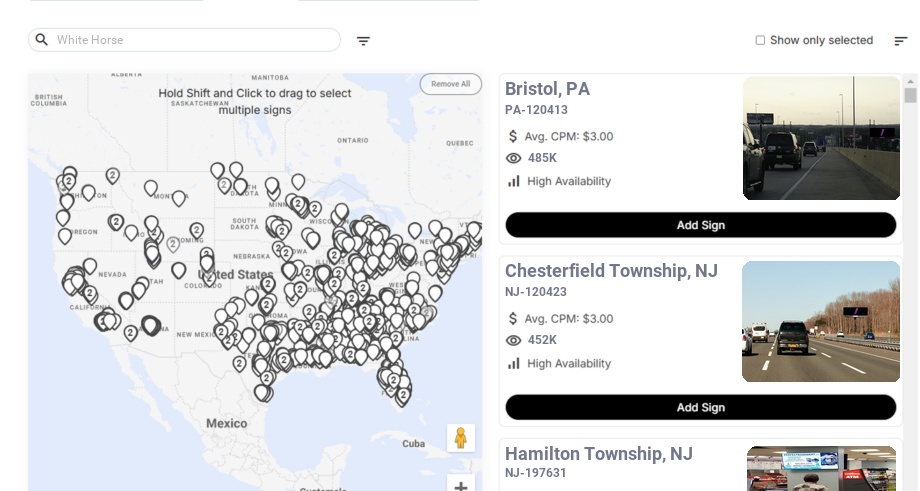



How much is a billboard near White Horse?
Why Choose Blip for Billboard Advertising near White Horse
-
Blip lets White Horse advertisers launch fast on I-295, I-195, Rt 33, and Rt 130 commuter traffic—no sales calls, just self-serve control.
-
Set a flexible daily budget in White Horse and reach Hamilton, Trenton, and Princeton drivers without locking into long contracts.
-
Daypart White Horse ads for 7-9 a.m. and 4-6 p.m. rushes on I-295/I-195, so your message hits peak commuter traffic.
-
Track White Horse campaign results in real time and shift spend as summer Shore traffic or Trenton government activity changes.
-
Use Blip's creative tools to swap White Horse messages for state workers, Princeton students, and family shoppers by the hour or day.
Frequently Asked Questions About Billboard Advertising near White Horse
How much does a billboard cost near White Horse, New Jersey with Blip?
With Blip, you choose your own daily budget and pay only for the individual “blips” your ad receives on digital White Horse billboards, so you can advertise in the White Horse area on any budget. Each blip is a 7.5 to 10-second display, and your total cost is simply the sum of all the blips you get, automatically kept within the budget you set and easily adjusted anytime. Costs change based on when and where your ad runs and local advertiser demand.
Where can I advertise with Blip near White Horse, New Jersey?
Blip makes it easy to launch flexible campaigns on 20 digital billboards near White Horse, New Jersey. These billboards serve the White Horse area from nearby Trenton, Hamilton Township, Robbinsville Township, Chesterfield Township, Ewing Township, and Princeton. The cluster of locations creates a powerful, cost-efficient coverage zone.
Who will see White Horse billboards in the White Horse area?
The White Horse area sits at a powerful crossroads of suburban neighborhoods, state government, higher education, and regional commuting. Mercer County has a diversified job base of more than 220,000 jobs, with major concentrations in government, education, healthcare, logistics, and professional services. Because White Horse is so close to major employment centers in Trenton and Princeton, a high share of residents commute by car.
When is the best time to run a billboard ad near White Horse, New Jersey with Blip?
Weekday morning commute traffic runs from about 6:30–9:30 a.m., while evening commute traffic is strongest from 3:30–7:00 p.m. Midday can work well for lunch, errands, and shopping-center traffic, and weekends bring more trips to shopping centers, recreation facilities, and events. With Blip’s flexible scheduling, you can concentrate your ad spend during the specific hours and days that align with your audience.
What roads carry the most traffic for White Horse billboards in New Jersey?
Our 20 digital billboards serving the White Horse area are positioned along the core traffic spine of central New Jersey. Key corridors include I‑295 and I‑195, U.S. Route 206 and Route 29 near Trenton, and Route 33 and Route 130 through Hamilton and Robbinsville. These highways regularly see tens of thousands of vehicles per day, with some segments reaching nearly 100,000.
Do I need a contract to advertise with Blip near White Horse?
No, Blip has no long-term contracts or minimum commitments. You can start, pause, or stop your campaign at any time.
How fast can I launch a billboard campaign with Blip near White Horse?
You can have your campaign live in minutes. Create a free account, select your locations, set your budget, upload your design, and start running once approved.
Where can I advertise with Blip near White Horse?
Blip has digital billboards near White Horse. You can browse available locations on a map, choose the ones that fit your audience, and start advertising right away.
Still have questions? Launch a campaign in minutes — no contracts, no commitments.
Start Your CampaignWhite Horse Billboard Advertising Guide
The White Horse, New Jersey area sits at a powerful crossroads of suburban neighborhoods, state government, higher education, and regional commuting. With 20 digital billboards serving the White Horse area from nearby Trenton Hamilton Township Robbinsville Township, Chesterfield Township Ewing Township, and Princeton
Understanding the White Horse Area Market
White Horse is an unincorporated community and census-designated place within Hamilton Township in Mercer County
Key market facts:
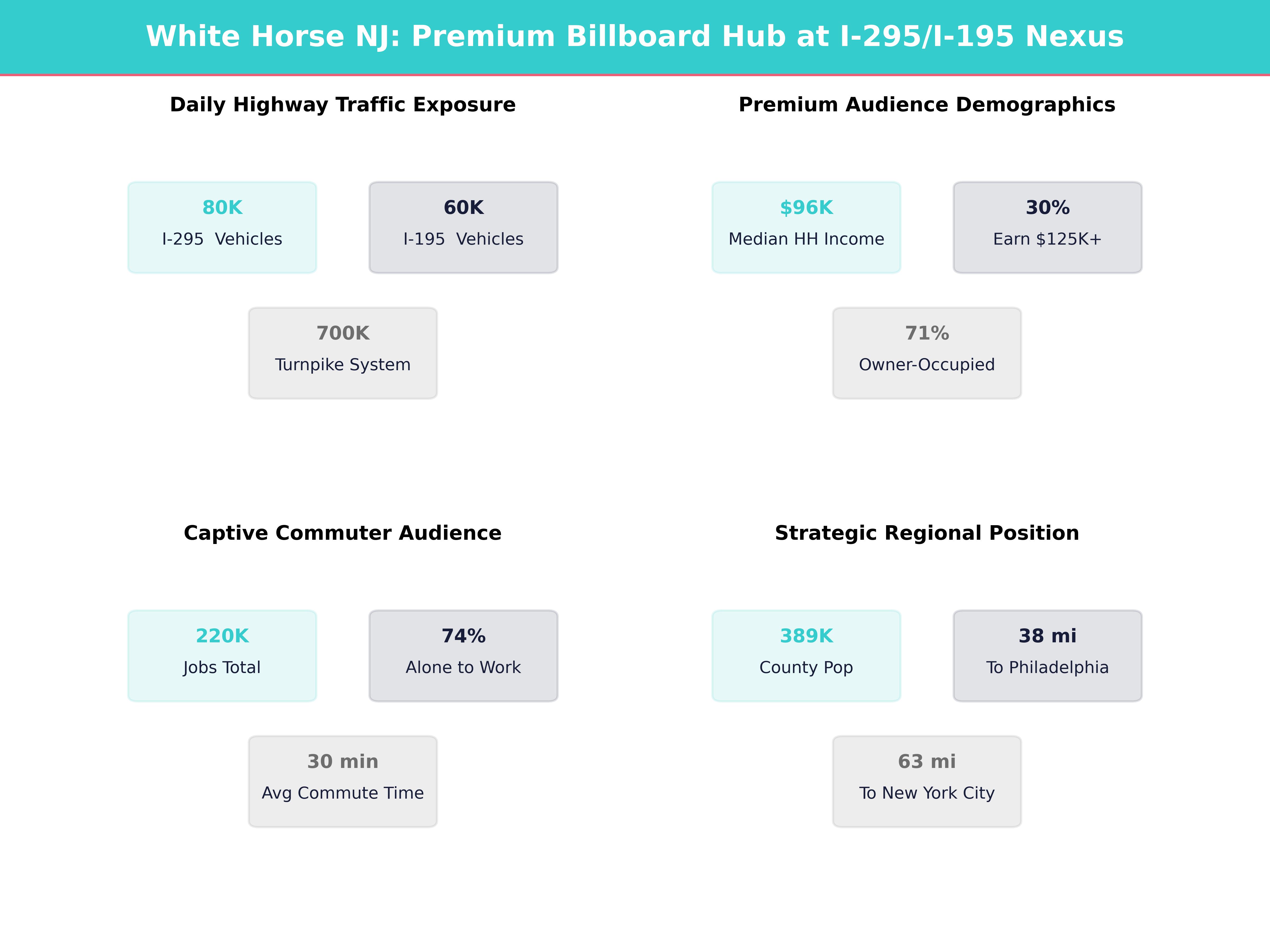
- The White Horse CDP has a population of roughly 9,800 residents, while Hamilton Township as a whole is home to about 92,000–93,000 people, according to township and county data compiled in 2023. The township offers additional demographic and community information at hamiltonnj.com
- Mercer County has a population of about 387,000–390,000 residents, with nearly 90,000 residents in nearby Trenton, the state capital. The City of Trenton provides helpful context and local information at trentonnj.org
- Recent county economic reports show median household income in Hamilton Township around $94,000–$98,000, compared with roughly $96,000 statewide. More than 30% of Hamilton households earn $125,000+ annually, indicating strong purchasing power in the White Horse trade area.
- Homeownership is a stabilizing force: about 70–72% of occupied housing units in Hamilton Township are owner-occupied, and more than 60% of households are family households.
- The nearby Princeton area, supported by Visit Princeton–Mercer
- Mercer County maintains a diversified job base of more than 220,000 jobs, with major concentrations in government, education, healthcare, logistics, and professional services, according to county labor reports on mercercounty.org
Because White Horse is so close to major employment centers in Trenton and Princeton, a high share of residents commute by car. In Mercer County, more than 72–75% of workers drive alone to work, about 8–10% carpool, and roughly 8–10% use public transit. Average commute times hover near 29–31 minutes. That means repeated daily exposure to digital billboards near the White Horse area along routes they use every day, and consistent visibility for any business investing in White Horse billboards.
Why Digital Billboards Work Near White Horse
Our 20 digital billboards serving the White Horse area are positioned along the core traffic spine of central New Jersey:
- I‑295 and I‑195, which wrap around the White Horse and Hamilton area and connect to the New Jersey Turnpike
- U.S. Route 206 and Route 29 near Trenton, leading to and from the state government district and urban neighborhoods.
- Route 33 and Route 130, high-traffic commercial corridors through Hamilton and Robbinsville.
- Arterials leading into Princeton and Ewing Township.
According to the New Jersey Department of Transportation, these highways regularly see tens of thousands of vehicles per day. Typical average annual daily traffic (AADT) counts in the area are:
- I‑295 near Hamilton/White Horse: often 70,000–90,000 vehicles per day, with some segments exceeding 95,000.
- I‑195 near Hamilton: in the 50,000–70,000 vehicles per day range, with summer weekend peaks even higher due to Jersey Shore travel.
- U.S. 1 near Lawrence/Princeton: exceeding 90,000 vehicles per day in some segments.
- Route 130 through Robbinsville and Chesterfield: commonly 45,000–60,000 vehicles per day.
- Route 33 in Hamilton/Robbinsville commercial zones: often 25,000–35,000 vehicles per day.
- Route 29 along the Trenton riverfront: generally 35,000–45,000 vehicles per day near downtown and state offices.
The nearby New Jersey Turnpike, managed by the New Jersey Turnpike Authority
Because our boards are spread across Trenton, Hamilton Township, Ewing Township, Princeton, Robbinsville Township, and Chesterfield Township, we can help you build a network of impressions that repeatedly reaches drivers who live, work, shop, or study in the White Horse area. Across these corridors, it is realistic for a single commuter to pass the same brand messages 10–20 times per week, which significantly boosts recall and makes billboard advertising near White Horse an efficient driver of local awareness.
Digital billboards offer several advantages here:
- Rapid message changes to keep pace with local events, governmental activity in Trenton, or seasonal tourism in the Princeton–Mercer region. Many advertisers rotate 3–6 creatives on the same board to stay fresh.
- Dayparting and scheduling to match commuter peaks on I‑295/I‑195 and shopping peaks on local arterials. Local traffic counts typically show weekday peaks near 7–9 a.m. and 4–6 p.m., with up to 2x higher volumes than overnight lows.
- Budget flexibility that lets smaller local businesses in the White Horse area compete alongside regional and national brands by buying precise times and locations instead of long fixed-term contracts. Many successful local campaigns start at just a few dollars per hour per board, yet still accumulate tens of thousands of weekly impressions, making modern billboard rental near White Horse accessible even to modest marketing budgets.
Who You’re Reaching in the White Horse Area
To plan an effective campaign, it helps to visualize the key audience segments that move through and around White Horse.
-
Local Residents and Suburban Families
- Hamilton Township’s population skew includes a large share of family households, with about 60–62% of households classified as family households and roughly 28–30% of residents under age 20, based on township planning data.
- About 70–72% of housing units are owner-occupied, and the average household size is approximately 2.6–2.7 people.
-
Strong middle-class incomes and stable homeownership make this a prime market for:
- Home services (HVAC, roofing, landscaping)
- Medical and dental practices
- Insurance and financial services
- Local restaurants and grocery stores
- Many of these residents regularly travel between White Horse, Hamilton commercial centers, and Trenton for work or services, creating frequent billboard exposure along corridors highlighted by Hamilton Township
-
State Government and Office Workers
- Trenton, just about 2.5 miles from White Horse, is home to New Jersey state government offices, large office buildings, and support services clustered around the Capitol Complex and downtown. State and local sources estimate more than 20,000–25,000 government employees and contractors working in and around Trenton on a typical weekday.
- Tens of thousands of these employees commute into the Trenton area daily, many using I‑295, I‑195, Route 29, or Route 206, with peak-hour traffic volumes on these links often 1.5–2 times higher than mid‑day levels.
-
This is ideal for:
- B2B campaigns (IT, legal, staffing, consulting)
- Transit and mobility services
- Cafés, quick-service restaurants, and after-work entertainment options.
- Legislative schedules, budget cycles, and public hearings—tracked by state updates and covered extensively by outlets like NJ.com’s Mercer County coverage
-
Students, Faculty, and High-Income Professionals
- Princeton University enrolls more than 8,300 undergraduate and graduate students and employs over 7,000 faculty and staff, according to university facts published at princeton.edu
- The broader Princeton region has some of the highest income levels in New Jersey; local data show median household incomes in several nearby municipalities topping $150,000, with a large share of residents employed in education, pharma, technology, and finance.
- Many of these travelers pass near the White Horse area via I‑295, U.S. 1, and local connectors; regional estimates suggest more than 30,000 daily work trips move between Mercer County townships and Princeton-area job centers.
-
Great targets for:
- Upscale dining and retail
- Cultural attractions
- Professional services
- Real estate and high-end automotive.
-
Regional Commuters and Through-Traffic
- The White Horse area sits between Philadelphia (about 35–40 miles) and New York City (about 60–65 miles) along key east–west and north–south routes.
- Drivers from Burlington, Monmouth, and Middlesex counties use I‑195, I‑295, and the New Jersey Turnpike, generating consistent through-traffic. Regional transportation data show more than 100,000 daily cross‑county work trips involving Mercer County, much of it funneled through these corridors.
- Seasonal travel amplifies volume: summer weekends can see traffic on I‑195 increase by 10–20% as travelers head to and from the Jersey Shore.
-
These are valuable impressions for:
- Statewide and regional brands
- Online services and apps
- Seasonal tourism promotions across New Jersey and Pennsylvania.
By selecting specific boards near Trenton, Hamilton Township, Robbinsville Township, and Princeton, we can help you prioritize the exact mix of local residents, commuters, and visitors that matters most for your campaign and tailor your White Horse billboards strategy to each audience.
Traffic Patterns and Optimal Times to Run Your Ads
The success of a digital billboard campaign in the White Horse area often comes down to timing. Using local commuting and retail patterns, we can recommend smart daypart strategies based on traffic-count curves published by the New Jersey Department of Transportation and local planning agencies.
Weekday Morning Commute (6:30–9:30 a.m.)
- Heavy inbound traffic to Trenton from the south and east via I‑295, I‑195, and Route 29. Inbound flows on some links can exceed 4,000–5,000 vehicles per hour.
- Strong flows from residential areas in Hamilton Township and White Horse toward Trenton and Ewing, with many school-related trips layered in between 7:00–8:30 a.m.
-
Best for:
- Coffee shops, breakfast spots, and QSR promos
- Traffic, news, or weather apps
- B2B offers and recruitment campaigns targeting state workers and office staff.
Midday (11 a.m.–2 p.m.)
- Lunch and errand runs within Hamilton, Trenton, and nearby communities. Volumes typically stay at 60–70% of peak but with longer dwell times around shopping centers.
- Older residents, caregivers, and remote workers moving between neighborhoods and shopping centers such as Hamilton Marketplace and local strip centers promoted by Hamilton Township
-
Best for:
- Medical and dental clinics, urgent care, and pharmacies
- Grocery and discount retail
- Government and community service messages.
Evening Commute (3:30–7:00 p.m.)
- Outbound traffic from downtown Trenton back into Hamilton Township, White Horse, and surrounding suburbs, with some outbound corridors reaching 4,500+ vehicles per hour at the height of the rush.
- Commuters heading toward Robbinsville, Chesterfield, and the New Jersey Turnpike, plus student and faculty travel between Princeton and Mercer County suburbs.
-
Best for:
- Restaurants and delivery services
- Gyms and fitness centers
- After-school programs and youth activities
- Entertainment, sports, and local events.
Weekends
- Increased trips to shopping centers, big-box stores, recreation facilities, and downtown Trenton and Princeton destinations. Retail centers in the Hamilton–Robbinsville area often report 20–30% higher traffic on Saturdays versus an average weekday.
- Visitors coming in for events, festivals, Trenton Thunder baseball at trenthunder.com Visit Princeton–Mercer
-
Best for:
- Tourism and attractions (museums, parks, historic sites)
- Car dealerships and test‑drive events
- Home improvement and garden centers
- Regional entertainment and sports.
With Blip’s flexible scheduling, we can concentrate your ad spend during the specific hours and days that align with your audience, rather than spreading impressions thinly across all times. That means you can fine-tune your billboard rental near White Horse to the exact dayparts that matter most.
Local Context: Events, Seasons, and News Cycles
The White Horse area shares a media and cultural ecosystem with Trenton and the greater Mercer County region, shaped by local events, politics, sports, and education.
Local Media and Community Pulse
- News outlets like The Trentonian and NJ.com’s Mercer County coverage Planet Princeton, further amplify neighborhood-level stories and university-related news.
- These outlets collectively reach tens of thousands of local readers each day; for example, regional media reports often cite combined monthly digital audiences in the hundreds of thousands across Mercer County.
- Aligning your messaging with prominent news cycles—tax season, school openings, major infrastructure changes—can significantly increase relevance and recall.
Government and Civic Calendar
- The presence of state government in Trenton means regular legislative sessions, rallies, hearings, and civic events around the State House complex. Legislative sessions can run for dozens of days per year, with key budget and policy deadlines heavily covered by local media.
- Mercer County and Hamilton Township also host frequent public meetings, health initiatives, and community programs listed on mercercounty.org hamiltonnj.com
-
This is particularly valuable for:
- Advocacy campaigns
- Public service announcements
- Campaign and ballot initiatives
- Timing issues-based messaging to coincide with legislative sessions or election periods (local and state) can amplify impact, especially when paired with targeted online outreach in the same ZIP codes.
Seasonal Factors
- Winter: Commuters are more road-focused due to weather; clear, high-contrast designs stand out especially in early sunsets. Shorter daylight periods (sunset as early as 4:30 p.m.) mean illuminated digital boards gain extra prominence during peak travel times.
- Spring: Home services, landscaping, and outdoor recreation ramp up as residents begin projects and outdoor activities. Local garden centers and contractors often see inquiry volumes rise 20–40% from March to May.
- Summer: Tourism traffic increases; families travel to the Jersey Shore via I‑195, and visitors come to Princeton and Trenton events. Tourism agencies report that New Jersey’s peak summer travel months can drive 30–40% of annual leisure visitation.
- Fall: Back-to-school, high school sports, and college football at Princeton influence family schedules and travel patterns. School calendars in Mercer County typically bring more than 30,000 K–12 students and staff back onto the roads, boosting daytime and early evening trips.
By rotating creative seasonally—something digital billboards make easy and cost-effective—we can keep your campaign in sync with what’s happening across Hamilton Township, Trenton, and the broader Mercer region and ensure your White Horse billboards remain timely and engaging.
Creative Best Practices for the White Horse Area
The visual environment around the White Horse area’s highways and arterials affects how we should approach billboard design.
Keep It Bold and Simple
- Drivers on I‑295 and I‑195 typically have 3–6 seconds to process your message, based on typical travel speeds of 55–65 mph and sightline distances.
-
Use:
- 6–10 words of text maximum
- Large, high-contrast fonts (light on dark or dark on light)
- One clear call to action (e.g., “Exit 60 – Next Right” or “Search: ‘White Horse HVAC’”).
- Industry studies of digital out-of-home suggest that simplifying copy can increase ad recall by up to 30% versus cluttered designs.
Reflect the Local Identity
-
Incorporate place-based cues that resonate with residents of the White Horse and Hamilton area:
- References to “Hamilton,” “White Horse area,” or “Trenton area” services.
- Imagery nodding to state government (for B2B or advocacy campaigns) or Princeton’s academic prestige (for education and professional services), leveraging recognition of icons like the New Jersey State House dome or Princeton’s collegiate architecture.
- Local pride is strong here; stressing that your business is “Mercer County-based” or “serving the Trenton–Hamilton community” can lift response rates, especially when reinforced by participation in local events listed on Hamilton Township
Use Directional and Exit-Based Messaging
-
With many boards near highway exits that serve the White Horse area, simple directions work very well:
- “2 miles ahead on Rt 33”
- “Next exit – White Horse area location”
- Localized directions can matter more here than website URLs alone, especially for on-the-go needs like food, gas, or urgent care. National research on out‑of‑home consistently finds that adding a clear directional cue can increase immediate visit intent by 20–30%.
Leverage Time- and Event-Sensitive Content
Digital billboards allow for multiple creatives and rotation:
- Morning vs evening versions (e.g., “Hot Coffee on the Way In” vs “Dinner Tonight in Hamilton”).
- Game-day or event-specific messages referencing high school matchups, Trenton Thunder games, or Princeton events.
- Limited-time offers that can change weekly or even daily to create urgency; advertisers who refresh offers at least once every 7–10 days typically see better engagement than static, unchanging messages.
Smart Use of Blip’s Tools in the White Horse Area
Blip’s platform lets you control where, when, and how often your ad appears. In a dense, interconnected area like White Horse–Trenton–Princeton, we recommend:
-
Start With a Core Coverage Ring
- Prioritize boards in Hamilton Township and Trenton—within about 5 miles of White Horse—to saturate daily commuting paths. Within this radius, you can easily reach 50,000–100,000+ daily vehicle trips on key corridors.
- Add boards in Robbinsville Township and Ewing Township for expanded reach across major job and retail centers, capturing additional flows to and from institutions like The College of New Jersey in Ewing, which enrolls around 7,000 students.
-
Layer in Princeton and Chesterfield Township for Growth
- For brands targeting higher-income or university-connected audiences, allocate a portion of impressions to Princeton-facing boards. The Princeton area’s high-income households and heavy visitor traffic can significantly raise average transaction values.
- For regional retail or logistics brands, include Chesterfield Township to capture Turnpike and Route 130 traffic, where AADT counts commonly exceed 45,000–60,000 vehicles per day.
-
Align Budget With Peak Times
-
Allocate a higher share of your daily budget to:
- Weekday rush hours for commuter-focused campaigns, when hourly volumes on major highways can be 2–3 times higher than overnight.
- Weekend daytime for retail, tourism, and family-oriented messaging, aligning with the late-morning to early-afternoon peak in shopping trips reported by local merchants.
- Use lighter coverage in off-peak hours to ensure constant presence without overspending; even 10–20% of impressions in shoulder periods can help maintain top-of-mind awareness.
-
Allocate a higher share of your daily budget to:
-
Test and Optimize Creatives
-
Run at least 2–3 creative variations simultaneously and compare performance in terms of:
- Store traffic
- Website visits
- Promo code redemptions or call volume
- Many advertisers see 10–25% performance differences between creative versions; replacing underperforming creatives quickly—one of the major advantages of digital formats over traditional static billboards—helps you direct more spend to the versions that work best and maximize the impact of billboard advertising near White Horse.
-
Run at least 2–3 creative variations simultaneously and compare performance in terms of:
Integrating Billboards With Other Local Marketing
The White Horse area responds well to multi-channel campaigns that combine out-of-home with digital and community presence.
-
Pair with Social and Search Ads
- Use the same tagline and imagery on billboards and online ads targeted to ZIP codes in and around Hamilton Township, Trenton, and Mercer County. Coordinated campaigns can improve brand recall by 20–40% compared to single-channel efforts, according to industry studies.
- Encourage branded search behaviors (“Search ‘White Horse Plumber’”) to capture people who remember your billboard later. Local service businesses often report that branded search queries rise 10–30% during well-executed billboard flights.
-
Support Events and Sponsorships
- If you sponsor local schools, sports teams, or charity events, amplify that on digital billboards near event venues in the Trenton and Hamilton area. For example, pairing stadium sponsorships at Trenton Thunder games with nearby highway billboards can extend reach from the thousands in the stadium to tens of thousands of daily drivers.
- Coordinate messaging with event details featured on local government sites
-
Measure Local Response
-
Set up:
- Unique URLs or QR codes for billboard viewers
- “Mention this billboard” offers
- Call-tracking numbers for campaigns focused on specific White Horse area services
- Businesses that add simple tracking elements like these often see 15–25% more attributable leads compared with untracked billboard campaigns.
- Compare performance across boards serving different corridors to refine which locations deserve more of your budget; reallocating spend to the top-performing 30–40% of placements can substantially lower your cost per lead and guide future billboard rental near White Horse.
-
Set up:
Putting It All Together
The White Horse, New Jersey area offers an unusually efficient combination of:
- Dense suburban neighborhoods with strong household incomes and homeownership rates above 70%.
- Proximity to the state capital in Trenton and the academic and professional hub of Princeton, together supporting well over 30,000 government, university, and related jobs.
- High-traffic highways and arterials carrying tens of thousands to nearly 100,000 vehicles daily through a compact radius of about 10 miles.
By using our 20 digital billboards serving the White Horse area strategically—selecting the right mix of nearby cities, timing your ads around commuting and shopping patterns, and tailoring creative to local identity—we can help you build a billboard campaign that delivers measurable, sustained impact for your brand across central New Jersey. Whether you need billboards near White Horse for a short-term promotion or a longer-term awareness push, the flexibility of digital billboard advertising near White Horse makes it easy to scale, test, and refine until you reach your goals.