Billboards in Ewing Township, NJ
No Minimum Spend. No Long-Term Contracts. Just Results.
Trusted by Leading Brands


Billboard advertising
in Ewing Township has never been easier



How much is a billboard in Ewing Township?
Why Choose Blip for Billboard Advertising in Ewing Township
-
Blip lets you launch fast in Ewing Township and reach I-295 commuters, TCNJ students, and Trenton-Mercer flyers without a long setup.
-
Flexible budgets fit Ewing Township’s mix of Route 31 shoppers and Route 29 weekend traffic, so you spend only when your ad plays.
-
Daypart your ads in Ewing Township for 6-10 a.m. commutes or 3-7 p.m. school runs on I-295 and Route 31.
-
No contracts means you can test Ewing Township near TCNJ or the airport, then pause or scale when results improve.
-
Blip’s real-time analytics help you spot what works in Ewing Township, from Mercer County commuters to cross-river drivers on I-295.
-
Use Blip’s creative tools to tailor Ewing Township ads for back-to-school at TCNJ, holiday retail, or airport pickup traffic.
Frequently Asked Questions About Billboard Advertising in Ewing Township
How much does a billboard cost in Ewing Township with Blip?
With Blip, billboard advertising in Ewing Township can fit a wide range of budgets because you only pay when your ad actually appears. Pricing starts at $0.01 per display, and each “blip” is a 7.5-to-10-second display on a rotating digital billboard. Your daily budget helps Blip’s algorithm bid for open ad slots, and the cost per blip changes based on time of day, location, and advertiser demand.
Where can Blip reach drivers in Ewing Township?
Ewing Township is a strong billboard market because it combines a resident base of 37,264 people with constant regional movement tied to The College of New Jersey, Trenton-Mercer Airport, and the highway network along Interstate 295, Route 29, and Route 31. The township is still a car-first market, so roadside media stays visible during routine daily travel, school runs, shopping trips, and airport pickups. That mix of local repetition and regional pass-through traffic makes Ewing especially useful for advertisers that need steady awareness rather than a one-time burst.
Why is Ewing Township a good place to advertise with Blip?
We should think of Ewing Township as a compact suburban market with outsized regional reach. Ewing grew from 35,790 residents in 2010 to 37,264 in 2020, which was an increase of about 4.1%. Over the same decade, Mercer County grew from 366,513 residents to 387,340, which was an increase of about 5.7%.
What Ewing Township roads are best for billboard ads?
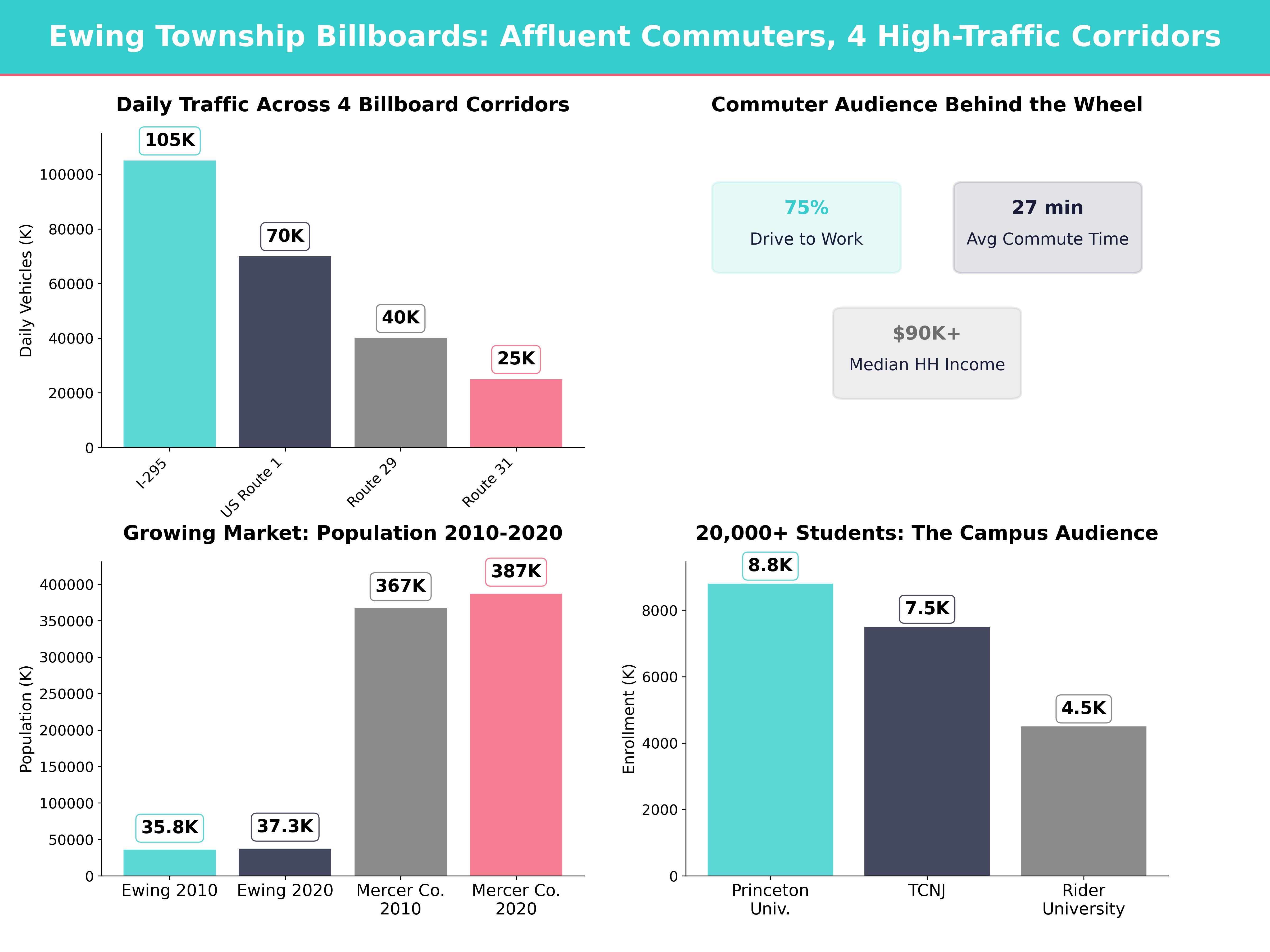
Interstate 295 is the dominant regional highway around Ewing, with nearby segments commonly carrying roughly 90,000 to 120,000 vehicles per day. Route 31, especially along Pennington Road through Ewing, is one of the township’s most valuable local advertising corridors, and NJDOT count patterns on this route are commonly in the 20,000 to 30,000 AADT range. Route 29 is another important corridor, with counts closer to Trenton and the river approaches often falling in the 30,000 to 50,000 vehicles per day band.
When is the best time for billboard advertising in Ewing Township with Blip?
Late August and September are major opportunities because The College of New Jersey comes back to life, and Ewing Public Schools return to session. The period from April through June is one of the most versatile advertising windows in the market, and from June through August, Ewing benefits from airport trips, park trips, river-town dining traffic, and family recreation across Mercer County and Bucks County. The November and December stretch is important for retail, healthcare enrollment, tax preparation teasers, charitable campaigns, and airport-related services.
Do I need a contract to advertise with Blip in Ewing Township?
No, Blip has no long-term contracts or minimum commitments. You can start, pause, or stop your campaign at any time.
How fast can I launch a billboard campaign with Blip in Ewing Township?
You can have your campaign live in minutes. Create a free account, select your locations, set your budget, upload your design, and start running once approved.
Where can I advertise with Blip in Ewing Township?
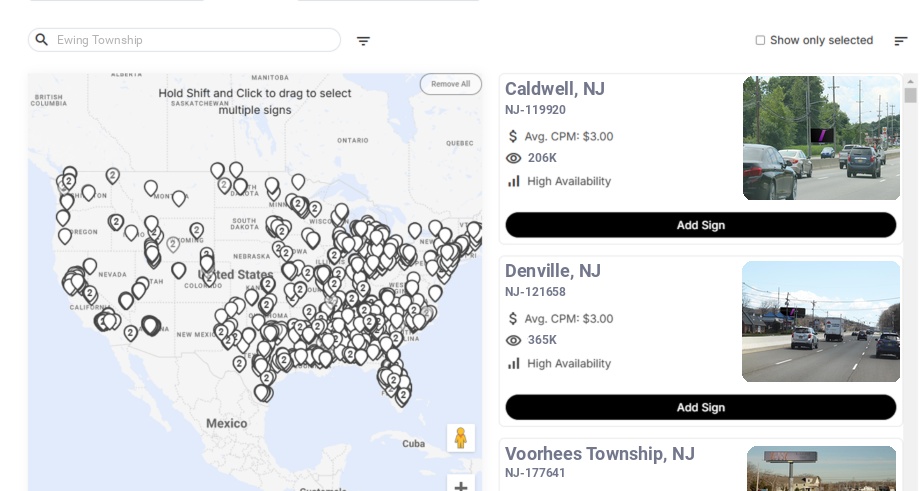
Blip has digital billboards in Ewing Township. You can browse available locations on a map, choose the ones that fit your audience, and start advertising right away.
Still have questions? Launch a campaign in minutes — no contracts, no commitments.
Start Your CampaignEwing Township Billboard Advertising Guide
Ewing Township is a strong billboard market because it combines a resident base of 37,264 people with constant regional movement tied to The College of New Jersey (about 7,500 students), Trenton-Mercer Airport Mercer County’s only commercial airport), and the highway network managed by the New Jersey Department of Transportation along Interstate 295, Route 29, and Route 31. We can reach not only Ewing households, but also a broader Mercer County 387,340 residents across 12 municipalities plus commuters moving between Trenton Princeton Bucks County. The township is still a car-first market, so roadside media stays visible during routine daily travel, school runs, shopping trips, and airport pickups. That mix of local repetition and regional pass-through traffic makes Ewing especially useful for advertisers that need steady awareness rather than a one-time burst.
Ewing Township Market Overview
We should think of Ewing Township as a compact suburban market with outsized regional reach. Ewing grew from 35,790 residents in 2010 to 37,264 in 2020, which was an increase of about 4.1%. Over the same decade, Mercer County grew from 366,513 residents to 387,340, which was an increase of about 5.7%. That growth matters because it tells us the market is not stagnant, and it gives billboard advertisers a larger year-round audience than Ewing’s township line alone might suggest.
Population, geography, and regional draw
Ewing sits about 5 miles from downtown Trenton 15 miles from Princeton 35 miles from Center City Philadelphia. We can use that geography to reach local shoppers, state-government workers, college audiences, and cross-river drivers from Pennsylvania in a single campaign. Mercer County also contains 12 municipalities, which gives advertisers several natural expansion paths if an Ewing-only flight performs well.
The local economy benefits from diversification. Ewing itself is anchored by The College of New Jersey, Trenton-Mercer Airport New Jersey State House, while the surrounding county adds healthcare, education, logistics, retail, and professional services. Recent survey estimates place median household income above $90,000 in both Ewing Township and Mercer County, which supports campaigns for healthcare, financial services, home improvement, education, and higher-consideration retail.
Commuting patterns and what they mean for advertisers
Ewing remains heavily auto-oriented. Recent survey estimates show roughly 75% of local workers commute by private vehicle, and average travel times sit near 27 minutes. The township has one rail option through SEPTA service at West Trenton, but most daily movement still happens on roads such as Interstate 295, Route 31, Route 29, Scotch Road, and nearby U.S. Route 1.
For billboard advertisers, that is an advantage. We get repeated exposure from the same drivers several times each week, and we can layer in regional reach from airport users, college visitors, and interstate traffic. In a market where so many trips are made by car, digital billboards can function as both an awareness tool and a directional tool.
Key Traffic Corridors for Ewing Township Billboards
Ewing’s travel patterns are dominated by a few regional corridors and several local feeders. When we understand what each road does, we can match billboard placements to the right customer intent.
Interstate 295 and the Scudder Falls approach in Ewing Township
According to traffic count patterns published by the New Jersey Department of Transportation, Interstate 295 is the dominant regional highway around Ewing, with nearby segments commonly carrying roughly 90,000 to 120,000 vehicles per day. That corridor connects central Mercer County to Pennsylvania, and it also funnels traffic toward Princeton-area employment, Trenton-area government, and airport access.
The Delaware River Joint Toll Bridge Commission replaced the old Scudder Falls span with a bridge that now carries 6 lanes instead of the previous 4, which improved cross-river capacity and strengthened Ewing’s role as a gateway between New Jersey and Pennsylvania. That matters for billboard strategy because the corridor now supports a steadier mix of local drivers and regional pass-through traffic.
This corridor works especially well for the following advertisers: Healthcare systems can capture commuters who are likely to travel for specialty care, urgent care, imaging, and primary care. Colleges and training programs can reach prospective students, parents, and adult learners coming from both New Jersey and Pennsylvania. Airport parking, auto services, insurance brands, and financial services can benefit from broad regional frequency on a high-speed route.
Route 31, Pennington Road, and central Ewing Township
Route 31, especially along Pennington Road through Ewing, is one of the township’s most valuable local advertising corridors. NJDOT count patterns on this route are commonly in the 20,000 to 30,000 AADT range, depending on the segment. That volume is lower than Interstate 295, but the audience is often more locally focused and more likely to act soon.
This stretch runs past The College of New Jersey, established residential neighborhoods, shopping pockets, and routes that connect to Hopewell Township
Route 29 and the Delaware River edge near Ewing Township
Route 29 is an important north-south corridor along the Delaware River. NJDOT counts closer to Trenton and the river approaches often fall in the 30,000 to 50,000 vehicles per day band. The route links Ewing with Trenton to the south and with destinations such as Lambertville, Washington Crossing State Park, and the broader Delaware River leisure market to the north.
We should use Route 29 when we want to capture a blend of weekday commuters and weekend destination travelers. That makes it a strong fit for attractions, restaurants, legal services, public affairs campaigns, live entertainment, and civic messaging tied to the capital region.
U.S. Route 1 as a regional companion to Ewing Township
U.S. Route 1 is not inside central Ewing, but it is too important to ignore in an Ewing-area strategy. Key Mercer County segments around Lawrence Township, West Windsor, and Princeton commonly run around 50,000 to 90,000 AADT. When we pair Ewing boards with Route 1 boards, we connect the township’s local frequency to one of central New Jersey’s biggest employment and retail corridors.
That combination is especially useful for regional hospitals, universities, major retailers, telecom brands, business services, and employers recruiting across the county. If a brand serves all of Mercer County rather than only Ewing, a two-corridor strategy often outperforms a one-corridor buy.
Ewing Township Audience Segments
The best Ewing campaigns start with audience clarity. We are not speaking to just one kind of resident here.
Commuters, government workers, and cross-border drivers
Because Ewing sits near the state capital and the Pennsylvania line, we can reach a dependable flow of weekday commuters. Some head toward Trenton New Jersey Legislature. Others move toward Princeton Lawrence Township, and Route 1 employment centers. Others still cross into Pennsylvania through the I-295 and river bridge network.
This segment responds well to practical offers and repeated frequency. Healthcare appointments, legal services, insurance, auto sales, fuel rewards, career recruitment, and commuter-friendly retail all fit the daily-trip mindset.
College students, parents, and education audiences in Ewing Township
Ewing has a built-in student audience because The College of New Jersey enrolls about 7,500 students. Within the broader regional drive shed, Rider University adds about 4,500 students, and Princeton University 8,800 more. That gives us a higher-education audience of more than 20,000 students within roughly 20 miles, even before we count faculty, staff, visiting families, and prospective students.
This audience is valuable for apartment communities, quick-service restaurants, banks, entertainment venues, healthcare providers, tutoring, test prep, and career-oriented graduate or certificate programs. Timing matters here because student attention peaks at semester starts, family weekends, admissions events, and graduation season.
Families, homeowners, and neighborhood consumers
Ewing’s residential base supports campaigns that need trust and repeat impressions. Home services, pediatric care, dental groups, grocery, personal injury law, local nonprofits, and community banks all benefit from neighborhood visibility. We should also remember that family life in Mercer County is tied to parks, school calendars, and recurring errands.
The leisure infrastructure around Ewing reinforces that family audience. Mercer County Park 2,500 acres, and nearby Grounds For Sculpture covers 42 acres in Hamilton Township
Leisure travelers, eventgoers, and airport users
Ewing is not a resort market, but it does have meaningful visitor traffic. Trenton-Mercer Airport Delaware and Raritan Canal State Park 70 miles, which supports outdoor recreation traffic in the wider region. Nearby destinations such as Lambertville, New Hope Grounds For Sculpture, Trenton Thunder, and CURE Insurance Arena create additional bursts of event and leisure travel.
We can use this segment for dining, attractions, hotels, entertainment, rideshare-related services, and airport-adjacent businesses. Weekend messaging often performs differently from weekday commuter messaging, so it is smart to separate the two.
Seasonal and Timing Opportunities in Ewing Township
Ewing rewards advertisers that plan around the calendar. The market has clear rhythms tied to college life, travel patterns, events, and year-end consumer behavior.
Back-to-school and move-in timing in Ewing Township
Late August and September are major opportunities because The College of New Jersey comes back to life, and Ewing Public Schools return to session. We should use this window for student housing, food and beverage, financial services, internet providers, urgent care, pharmacies, and any brand that benefits from renewed routine. A smaller but still useful reset arrives in January with spring semester activity and New Year consumer goals.
Spring activity, admissions, and commencement
The period from April through June is one of the most versatile advertising windows in the market. College visit traffic rises, commencement season arrives in May, outdoor destinations reopen their strongest season, and families spend more time on the road. Trenton Thunder also return to their regular baseball calendar in spring and summer, adding entertainment traffic to the mix.
We can make spring work for healthcare, education, event venues, restaurants, tourism partners, and retailers promoting graduation gifts or seasonal services. Creative with a clear date, offer, or event hook usually fits this period well.
Summer leisure and airport demand around Ewing Township
From June through August, Ewing benefits from warm-weather movement even though it is not a classic beach destination. We see airport trips, park trips, river-town dining traffic, and family recreation across Mercer County and Bucks County. This is a smart time for attractions, outdoor gear, casual dining, summer camps, destination retail, and airport parking offers.
Holiday retail and year-end service windows
The November and December stretch is important for retail, healthcare enrollment, tax preparation teasers, charitable campaigns, and airport-related services. Shorter daylight hours also make digital boards feel more prominent during the evening commute. Winter weather can slow traffic on I-295 and Route 31, which often increases the effective viewing time of a well-designed message.
Billboard Design Tips for the Ewing Township Market
The best billboard creative in Ewing feels local, practical, and easy to process. We should design for the road, the audience, and the reason that person is in the car.
Match the message to Ewing Township road speeds
On Interstate 295, drivers are moving fast. We should keep copy extremely short, lean on large numerals, and make the offer obvious in 5 to 7 words whenever possible. Price points, simple benefit statements, short URLs, and strong brand marks tend to work best there.
On Route 31 and parts of Route 29, we can sometimes add a little more context because speeds are lower and local repetition is stronger. A restaurant, urgent care center, or college program can often support one extra line of meaning on those roads, especially if the board sits near a decision point.
Reflect Ewing’s mix of college life, family life, and capital-region professionalism
Ewing is not a one-note suburb. We are speaking to students, parents, state employees, professionals, and cross-border drivers in the same market. Creative that is too playful may miss business commuters, while creative that is too formal may feel cold to students and families.
The best middle ground is usually clean, direct, and confident. Campus-season creative can use energetic color and youth-oriented imagery, while healthcare, legal, and financial creative should feel more polished and trust-building. For family-oriented businesses, imagery tied to neighborhoods, school routines, parks, and everyday convenience usually resonates better than abstract lifestyle photography.
Use local cues that feel real to Ewing Township drivers
Local specificity helps. Phrases such as “Near TCNJ,” “Off I-295,” “Minutes from Trenton-Mercer,” or “On Route 31” can make a billboard feel immediately relevant. When a business truly is close by, directional cues are powerful because many viewers already know the roads.
We should also think geographically. A message aimed at airport users should look different from a message aimed at Route 31 families. A message aimed at Trenton-bound professionals should look different from one aimed at weekend visitors heading toward Lambertville and New Hope
Build multiple versions for different Ewing Township audiences
Because Ewing has several audience types, one creative execution rarely does all the work. We usually get better results when we build at least 2 or 3 variants. One version can serve commuters, one can speak to students and parents, and one can lean into weekend leisure or family traffic.
Regional Strategies Around Ewing Township
A smart Ewing campaign often works best when we divide the market into functional zones. That helps us keep the message aligned with traveler intent.
Central Ewing Township and the Pennington Road area
This zone includes the The College of New Jersey area, neighborhood retail, and the township’s residential core. We should use it for local services, food, healthcare, childcare, tutoring, and education messaging. Businesses drawing heavily from a 5- to 10-mile radius often perform best here because the route network is more local and the audience is more likely to convert quickly.
The I-295 and airport zone in Ewing Township
This zone is about scale. It captures pass-through drivers, airport traffic, and cross-border travel toward Pennsylvania. Regional brands, hospitals, financial services, and institutions with wide trade areas should prioritize this zone because it delivers broader reach than a strictly neighborhood corridor.
The river-to-capital corridor toward Trenton
Boards that serve movement between Ewing and Trenton
The broader Mercer County extension beyond Ewing Township
When we need more scale, we should extend into Lawrence Township, Hamilton Township Hopewell Township Mercer County Community College, Rider University, Princeton University
Using Blip Tools in Ewing Township
Blip’s tools are especially useful in a market like Ewing because travel patterns shift by road, by season, and by audience. We can stay nimble without overcommitting to one static plan.
Daypart around Ewing Township commute behavior
For I-295 and other commuter-heavy routes, we should often emphasize weekday morning windows such as 6 a.m. to 10 a.m. and afternoon windows such as 3 p.m. to 7 p.m.. Those are the periods when work trips, school pickups, and airport-related movement overlap. If we are promoting restaurants, events, or entertainment, evening and weekend scheduling can be more efficient than an all-day flight.
Rotate creative by audience and season
Because Ewing has a student calendar, a commuter calendar, and a leisure calendar, we should not leave one creative up for months without adjustments. A back-to-school concept in August, a graduation concept in May, and a holiday retail concept in November can all run in the same geography with different timing. Blip makes that kind of local rotation practical.
Use analytics to compare Ewing Township zones
We can treat Ewing as a testing ground. If one cluster of boards near Route 31 outperforms another cluster near I-295, we can shift spend quickly. If a board near airport traffic produces better response during holiday travel than during midsummer, we can learn from that pattern and budget more intentionally next season.
Build local variants quickly
Ewing rewards customization. We can create one version that highlights convenience for commuters, one that references TCNJ, and one that uses directional language for airport or river-corridor traffic. Blip’s artwork tools make it easier to build those local versions without turning every change into a long production cycle.
Getting Started with Billboard Rental in Ewing Township
Renting a billboard in Ewing is easier when we begin with the audience, not the screen. We should first decide whether the goal is broad awareness, foot traffic, event attendance, recruiting, student acquisition, or route-based direction.
Start with a clear Ewing Township objective
A local dentist, urgent care center, or restaurant may care most about nearby drivers on Route 31. A regional university, hospital network, or airport-adjacent service may care more about I-295 reach. The clearer we are about the objective, the easier it becomes to choose the right board locations.
Evaluate each Ewing Township billboard for route fit
As we compare boards, we should ask a few practical questions. Who is on this road? We should identify whether the primary audience is commuters, students, families, airport users, or weekend visitors. How fast are they moving? Highway-speed boards usually need simpler creative than local arterial boards. How close is the decision point? A restaurant or urgent care center can benefit from proximity, while a regional brand may simply want repeated awareness. How often will the same person see the board? High-frequency local routes are excellent for trust-building and recall.
Use a test-and-scale approach in Ewing Township
In a market like Ewing, we often learn fastest by starting with 2 to 4 boards for 2 to 4 weeks, then reviewing results before expanding. That approach lets us compare local-route performance against regional-highway performance without locking into a rigid long-term structure. If one sub-area clearly wins, we can scale there first.
Why self-serve billboard rental works well in Ewing Township
Traditional billboard buying can be slow, inflexible, and oversized for a market that changes with semesters, events, and commuter demand. Ewing is exactly the kind of place where a self-serve platform helps because we can launch quickly, adjust timing, swap creative, and fine-tune geography without waiting through a long contract cycle. For advertisers who want to reach Mercer County drivers efficiently, Ewing offers a practical starting point and a scalable regional test bed.