Billboards near Little Ferry, NJ
No Minimum Spend. No Long-Term Contracts. Just Results.
Trusted by Leading Brands


Billboard advertising
near Little Ferry has never been easier
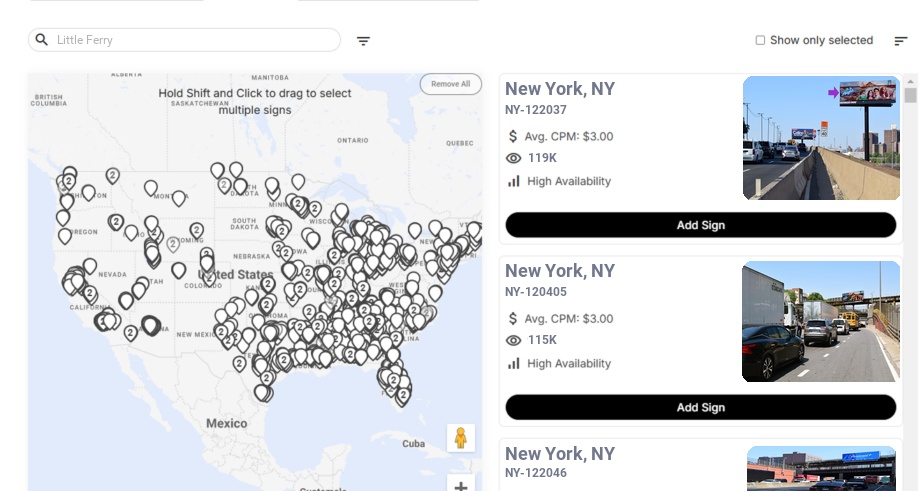



How much is a billboard near Little Ferry?
Why Choose Blip for Billboard Advertising near Little Ferry
-
Blip lets you launch on Little Ferry commuter routes fast, reaching Route 46, Route 17, and I-80 drivers without the usual barriers.
-
Set a flexible budget for Little Ferry and scale up during peak AM/PM traffic from Bergen County and cross-Hudson commuters.
-
No contracts means you can test Little Ferry billboards near Hackensack and Secaucus, then shift spend to what works.
-
Use real-time analytics to track Little Ferry impressions and react as weekend Meadowlands and American Dream traffic surges.
-
Blip's creative tools make it easy to tailor Little Ferry ads for bilingual Bergen County audiences and busy 7.5-10 second views.
Frequently Asked Questions About Billboard Advertising near Little Ferry
How much does a billboard cost near Little Ferry, New Jersey with Blip?
With Blip, you control exactly what you spend on Little Ferry billboards by setting a daily budget that can be adjusted any time, so you only pay for the brief 7.5–10 second “blips” your ad actually receives. Costs per blip vary based on the time of day, the locations serving the Little Ferry area, and real-time advertiser demand, giving you the flexibility to start small and scale when you’re ready. The total cost of your campaign is simply the sum of your purchased blips, making it easy to stay within your comfort zone while reaching people on billboards near Little Ferry, New Jersey.
Where can I advertise with Blip in Little Ferry, New Jersey?
There are 155 digital billboards serving the Little Ferry area from nearby cities like Ridgefield, Hackensack, North Bergen, Secaucus, Jersey City, and even New York City. These boards reach commuters, families, and cross-river shoppers moving through one of the densest travel networks in the country. Nearby routes and local connectors help you build campaigns around movement patterns rather than municipal boundaries.
What kind of audience do Little Ferry billboards reach?
Little Ferry itself is a compact borough of roughly 10,600 residents, but surrounding Bergen County hosts about 955,000 residents and more than 360,000 households. The area is commuter-heavy, middle- to upper-middle-income, and highly diverse, with more than 25 languages commonly spoken at home in Little Ferry. This makes billboard advertising near Little Ferry useful for both local and regional audiences.
When is the best time to run billboard ads in Little Ferry with Blip?
Weekdays are especially strong for commuter-oriented campaigns, with heavy AM and PM traffic flows toward and from New York and Hudson County. Weekends bring increased trips to malls, big-box stores, and regional destinations like the Meadowlands sports and entertainment complex. The page also recommends seasonal adjustments, such as winter weather messaging, spring home-improvement campaigns, summer travel promotions, and fall back-to-school ads.
What roads and traffic corridors make Little Ferry billboards effective?
Route 46, Route 17, and Route 4 near Little Ferry each carry tens of thousands of vehicles per day, with some busy stretches approaching 120,000 vehicles daily. I-95, the New Jersey Turnpike, and I-80 form a crucial spine near the area, and the George Washington Bridge alone routinely handles more than 280,000 vehicles per day. These high-volume corridors create frequent exposure for billboard advertising near Little Ferry.
Do I need a contract to advertise with Blip near Little Ferry?
No, Blip has no long-term contracts or minimum commitments. You can start, pause, or stop your campaign at any time.
How fast can I launch a billboard campaign with Blip near Little Ferry?
You can have your campaign live in minutes. Create a free account, select your locations, set your budget, upload your design, and start running once approved.
Where can I advertise with Blip near Little Ferry?
Blip has digital billboards near Little Ferry. You can browse available locations on a map, choose the ones that fit your audience, and start advertising right away.
Still have questions? Launch a campaign in minutes — no contracts, no commitments.
Start Your CampaignLittle Ferry Billboard Advertising Guide
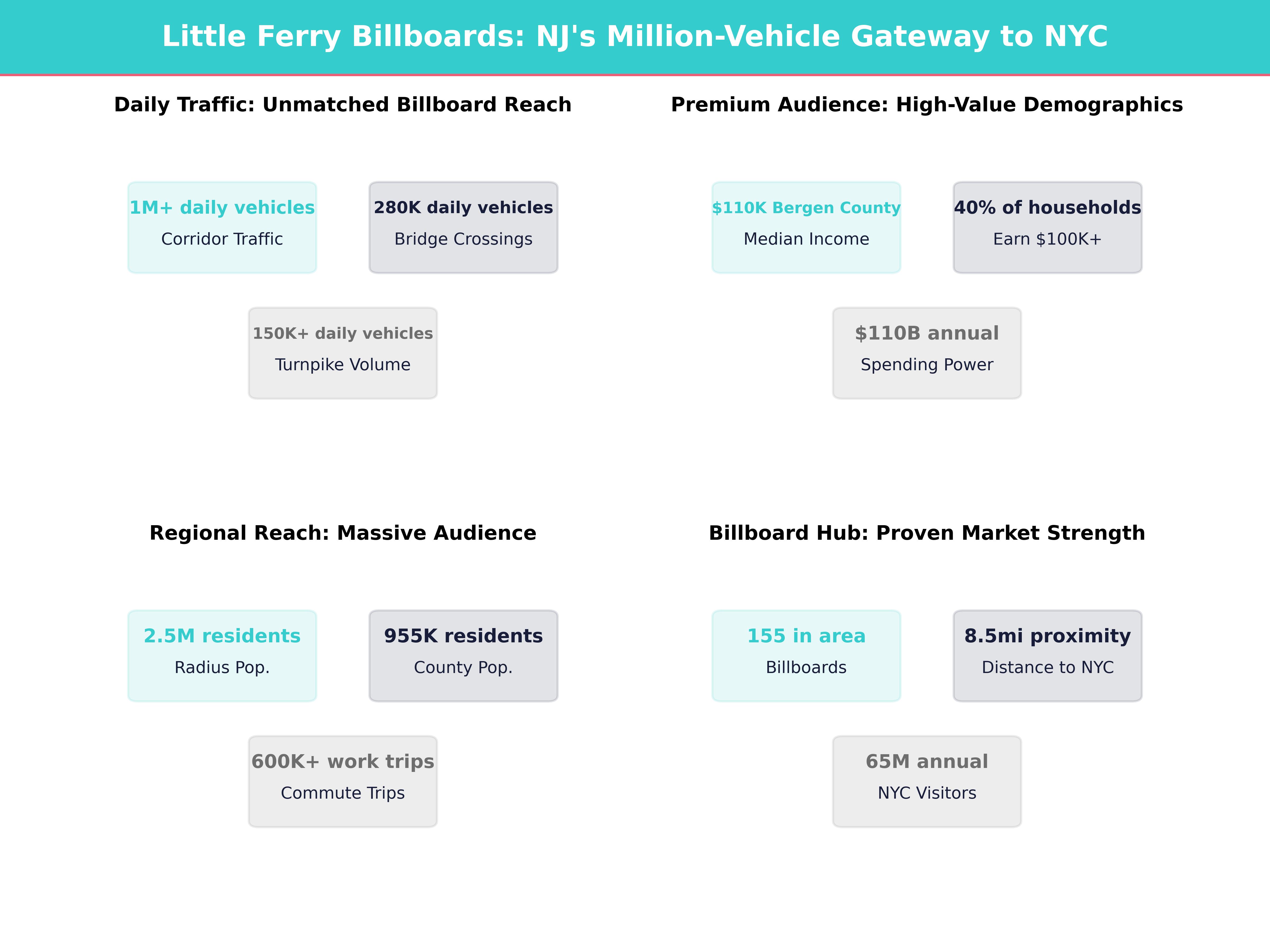
Sitting at the crossroads of Bergen County and the New York–New Jersey urban core, the Little Ferry area offers outsized advertising impact relative to its size. With 155 digital billboards serving the Little Ferry area from nearby cities like Ridgefield, Hackensack, North Bergen, Secaucus, Jersey City, and even New York City, we can reach commuters, families, and cross‑river shoppers moving through one of the densest travel networks in the country. Northern New Jersey’s core counties support more than 2.5 million residents within a 15‑mile radius of Little Ferry, and local traffic counts on major corridors routinely exceed 1 million vehicle trips per day combined, creating a high‑frequency, high‑reach environment for campaigns that use billboards near Little Ferry to speak to both local and regional audiences.
Understanding the Little Ferry Area Audience
Little Ferry itself is a compact borough of roughly 10,600 residents in under 1.7 square miles, giving it a population density above 6,200 people per square mile, which is high even by North Jersey standards. Surrounding Bergen County hosts about 955,000 residents, making it New Jersey’s most populous county, according to figures cited by Bergen County. This means any campaign serving the Little Ferry area inherently taps into a much larger regional market, including roughly 360,000 households and an estimated $110+ billion in annual consumer spending power across Bergen County alone. When you plan Little Ferry billboards, you’re effectively planning for a county‑wide and cross‑Hudson audience, not just a single neighborhood.
Key demographic and economic traits that should shape your billboard messaging:
-
Commuter-heavy community
- In Bergen County, roughly 72–75% of workers commute by car, truck, or van, and another 10–12% use public transit (bus or rail) into New York City and Hudson County job centers, based on regional planning and transportation reports.
- Average commute times are in the 31–34 minute range, with more than 40% of workers traveling 30 minutes or longer each way. This means a large share of residents are regularly on highways and major arterials where our digital billboards are located near Little Ferry.
- Local transportation plans from the North Jersey Transportation Planning Authority 600,000 daily work trips, a substantial portion of which flow past our coverage area and are reachable with targeted billboard advertising near Little Ferry.
-
Middle- to upper-middle-income households
- Median household incomes in the Little Ferry area fall in the $75,000–$90,000 range, with Bergen County’s median above $110,000 per year, according to economic data summarized by the Bergen County Economic Development office.
- More than 40% of Bergen County households earn $100,000+, and roughly 1 in 5 households earn $150,000+, supporting premium and discretionary categories like elective healthcare, financial services, travel, and luxury retail.
- Homeownership rates in surrounding communities are typically in the 55–65% range, fueling sustained demand for home improvement, landscaping, HVAC, and renovation services that benefit from always‑on visibility via Little Ferry billboards and nearby placements.
-
Diverse, multilingual population
- Bergen County’s population is now over 30% Hispanic/Latino and more than 18% Asian, with significant Korean, Chinese, Filipino, Indian, and Pakistani communities. Local school and municipal data show Little Ferry itself reflects this diversity, with more than 25 languages commonly spoken at home.
- In many nearby towns, more than 35% of residents speak a language other than English at home, and 15–20% are categorized as speaking English “less than very well,” creating clear value for bilingual outreach.
-
For advertisers, this supports:
- Bilingual or dual‑creative campaigns (e.g., English/Spanish or English/Korean).
- Visual storytelling that transcends language (bold imagery, icons, faces, local landmarks).
- Creative variations targeting specific cultural events and holidays.
-
Educated, career-oriented market
- Regional data indicate that 45–50% of adults in Bergen County hold at least a bachelor’s degree, significantly above national averages.
- A strong presence of healthcare, technology, finance, logistics, and professional services employers concentrates white‑collar workers within a 10–15 minute drive of Little Ferry, increasing the value of professionally targeted billboard advertising near Little Ferry and key employment hubs.
-
Local focus but regional mobility
- Residents shop, dine, and work across nearby hubs like Hackensack, Ridgefield, Secaucus, North Bergen, and Jersey City. Retail destinations such as the Bergen Town Center, Westfield Garden State Plaza, and the American Dream complex at the Meadowlands attract tens of millions of visitors per year from across the metro.
- Our 155 digital billboards serving the Little Ferry area let us follow these travel patterns, reinforcing your brand across multiple daily touchpoints.
When planning creative, we should imagine not just “people who live near Little Ferry” but regional travelers passing through multiple boroughs and cities each day who repeatedly encounter billboards near Little Ferry along their regular routes.
Key Travel Corridors Serving the Little Ferry Area
Billboard effectiveness near Little Ferry is heavily tied to the area’s dense roadway network and cross‑Hudson connections. While our boards are in nearby communities, they reach the same audiences that live, work, and shop near Little Ferry.
Major highways and arterials nearby
-
U.S. Route 46 & NJ Route 17
- Route 46 and Route 17, both within a few miles of Little Ferry, each carry tens of thousands of vehicles per day. NJDOT counts along these corridors regularly exceed 70,000–100,000 vehicles per day at key segments, according to the New Jersey Department of Transportation. On some busy stretches near Paramus retail hubs, volumes can approach 120,000 vehicles per day.
- These roads serve daily commuters, regional shoppers headed to malls in Paramus, and travelers moving between Passaic, Bergen, and Hudson counties.
- Average daily traffic on nearby Route 4, another key retail corridor, often surpasses 90,000 vehicles, adding yet another high‑impression layer around Little Ferry and supporting high‑frequency billboard advertising near Little Ferry for brands that rely on repeated exposure.
-
I‑95 / New Jersey Turnpike & I‑80
- Interstates I‑95 and I‑80 form a crucial spine near the Little Ferry area, feeding traffic into the George Washington Bridge and Lincoln Tunnel corridors.
- The George Washington Bridge alone routinely handles more than 280,000 vehicles per day, according to the Port Authority of New York and New Jersey. Annualized, that’s upwards of 100 million vehicle crossings per year.
- Segments of the New Jersey Turnpike north of I‑80 carry 150,000+ vehicles per day, while I‑80 near the Meadowlands often records 120,000–140,000 vehicles per day.
- This provides high‑volume exposure to both New Jersey residents and New York drivers heading to New Jersey shopping and services, making these interstates prime corridors for billboards near Little Ferry that speak to cross‑river traffic.
-
Local connectors through nearby towns
- Our digital billboards in Ridgefield, Bogota, Lodi, Hackensack, Maywood, North Bergen, Secaucus, Weehawken, Kearny, Jersey City, Little Falls, and Woodland Park are strategically placed along these feeder roads.
- Local arterials such as River Street and Essex Street in Hackensack, Tonnelle Avenue (U.S. 1/9) through North Bergen, and County Route 503 corridors often post 20,000–40,000 vehicles per day, capturing frequent, repeat local impressions.
- Drivers from the Little Ferry area frequently pass through these nearby cities en route to work, school, shopping, and events.
For advertisers, that means we can build campaigns around movement patterns rather than municipal boundaries, making sure your brand appears where Little Ferry area residents actually drive and see Little Ferry billboards multiple times per week.
Transit, Commuters, and Cross‑Hudson Audiences
Beyond road traffic, the Little Ferry area is intertwined with one of the busiest transit networks in the U.S.
-
Bus commuters
- The Little Ferry area is served by several NJ Transit bus routes connecting to the Port Authority Bus Terminal and to local employment centers. Key regional lines in Bergen and Hudson counties together move tens of thousands of riders per weekday, with many routes operating at 10–15 minute peak‑hour headways.
- The Port Authority Bus Terminal 260,000 passenger movements on an average weekday, and a large share of that volume comes via Bergen and Hudson County routes that pass near our billboard inventory.
- Many bus riders still engage in car travel for errands, evening outings, or weekend trips, meaning they encounter our digital billboards during non‑work travel windows.
-
Cross‑Hudson flows
- The Lincoln Tunnel averages around 110,000–120,000 vehicles per day, per Port Authority data. During peak hours, buses can comprise 1,800+ daily trips, moving more than 60,000 passengers between New Jersey and Manhattan.
- Combined flows over the George Washington Bridge, Lincoln Tunnel, and Holland Tunnel total well over 400,000 vehicles per day, a significant portion of which originate in or pass through Bergen and Hudson counties.
- Our billboards near Weehawken, Jersey City, and North Bergen allow you to reach New Jersey commuters heading to Manhattan as well as New York drivers visiting northern New Jersey.
-
Rail‑linked travel
- While Little Ferry itself is not a primary rail hub, nearby towns connect to PATH and NJ Transit rail lines through Secaucus Junction and Hoboken Terminal.
- Secaucus Junction 25,000–30,000 passengers, linking North Jersey lines to New York Penn Station.
- The PATH system and Hoboken Terminal collectively handle hundreds of thousands of passenger trips per weekday, and many of those riders access stations via park‑and‑ride lots or local roads that run past our signage.
- Drivers often park‑and‑ride or get dropped off at these hubs, passing through areas where our boards operate.
We can harness these patterns to target:
- AM directional commuters heading east/south toward Hudson County and New York.
- PM directional commuters heading back toward Bergen and Passaic counties.
- Weekend leisure traffic moving toward shopping centers, nightlife, and sports/entertainment venues in the Meadowlands and Jersey City.
How to Tailor Creative to the Little Ferry Area
The character of the Little Ferry area suggests specific creative strategies that work particularly well on digital billboards.
1. Commuter‑friendly messaging
Because so many impressions come from commuters:
- Keep copy to 7 words or fewer and prioritize a strong call to action: “Exit in 2 Miles – Auto Repair,” “Hackensack Office – Same‑Day Urgent Care.”
- Highlight time‑savings and convenience, e.g., “Skip NYC Parking – Dine Nearby Tonight.” Surveys of regional commuters consistently show that traffic and parking are top pain points, with more than 60% citing them as major daily frustrations.
- Use large fonts, high contrast, and one main visual so drivers can absorb your message at 55–65 mph, when typical viewing windows are just 6–8 seconds.
2. Hyperlocal identity
Residents identify strongly with Bergen County neighborhoods and nearby boroughs:
- Reference local anchors like Hackensack University Medical Center Bergen Town Center, and key roads (Route 46, Route 17, Route 4, I‑80). Municipal sources such as the City of Hackensack
- Use local language: “Serving Bergen County,” “Minutes from the Little Ferry area,” “Near Hackensack & Lodi.” These phrases help drivers immediately recognize that Little Ferry billboards are relevant to their daily lives.
- Feature recognizable skylines or bridges (NYC skyline, George Washington Bridge) to immediately signal location.
- Highlight proximity to attractions such as MetLife Stadium American Dream at the Meadowlands—venues that together can draw 80,000+ visitors on major event days—via resources from the New Jersey Sports and Exposition Authority.
3. Multilingual and culturally aware campaigns
Given the Little Ferry area’s diversity:
- Test bilingual creatives, especially English–Spanish and English–Korean, for services like healthcare, legal, financial services, and education. In nearby towns with large Korean and Hispanic populations, bilingual messaging can lift response rates significantly because 20–30% of residents may prefer non‑English language content.
-
Consider rotating creatives for key cultural holidays:
- Lunar New Year, Diwali, Eid, and Hispanic Heritage Month.
- Local festivals and fairs promoted through Bergen County and borough event calendars such as the Borough of Little Ferry
- Incorporate inclusive imagery and local cultural cues that match the communities you are targeting (e.g., family‑oriented visuals for child‑care and education; faith‑friendly imagery for holiday promotions).
Our digital format makes it easy to run parallel creatives—English‑only during high‑speed highway rotations and bilingual variants on slower roads or near commercial districts.
4. Clear value propositions
With relatively high income levels but intense competition for attention:
- Show specific offers: “$29 Oil Change,” “$0 Down Invisalign,” “Free Delivery to Little Ferry Area.” Price‑anchored messages are especially effective in roadside tests, often boosting recall by 20–30%.
- Emphasize trust and proximity: “Family‑Owned in Bergen County Since 1985.” In community surveys cited by local chambers, more than 60% of residents report preferring to buy from locally owned businesses when given a clear option.
- Use numbers and time constraints: “This Week Only,” “Join 5,000+ Local Members.” Scarcity and social‑proof cues make your limited billboard exposure more actionable.
Timing Your Campaign Around Local Rhythms
One of the biggest advantages of digital billboards with Blip is time‑based control. The Little Ferry area’s patterns suggest several powerful scheduling strategies that make billboard advertising near Little Ferry more efficient and cost‑effective.
Weekday vs. weekend behavior
-
Weekdays (Mon–Fri)
- Heavy AM (6–9 a.m.) and PM (4–7 p.m.) commuter flows toward and from New York and Hudson County. Regional traffic data show that peak‑hour volumes on major corridors can be 1.5–2.0 times mid‑day levels.
- Roughly 70–75% of weekday work trips occur between Monday and Friday, making these days critical for professional and commuter‑oriented services.
-
Best for:
- Professional services (law, finance, healthcare).
- B2B services targeting office workers and contractors.
- Quick‑service restaurants capturing commute meals and coffee breaks.
-
Weekends (Sat–Sun)
- Increased trips to malls, big‑box stores, and regional destinations like the Meadowlands sports and entertainment complex, including American Dream and MetLife Stadium
- Large retail centers in Paramus and the Meadowlands can see weekend traffic surges of 30–50% compared with weekdays.
-
Best for:
- Retail promotions and sales.
- Family attractions and events.
- Auto dealerships and test‑drive offers.
We can allocate more budget to commuter peaks for “workweek” offers and shift impressions to midday and weekend for leisure and shopping promotions.
Seasonal adjustments
-
Winter
- Weather‑driven messaging plays well: snow tires, heating services, urgent care, delivery restaurants.
- North Jersey typically experiences 10–20 measurable snow events per season, with multiple ice and freezing‑rain days that push demand for roadside assistance, auto repair, and urgent care.
- Use real‑time or day‑parted creatives like “Storm Coming? Stock Up Tonight – Exit 16W.”
-
Spring
- Strong season for home improvement, landscaping, tax services, and healthcare checkups.
- Many local contractors report 20–30% of annual revenue between March and June, making this an ideal window for high‑frequency billboard campaigns.
- Emphasize “refresh,” “renew,” and “prepare for summer” themes.
-
Summer
- Many trips to the Jersey Shore, parks, and outdoor events promoted via New Jersey tourism resources.
- Popular Shore destinations, state parks, and lake areas can experience 50%+ increases in weekend traffic from North Jersey.
- Use boards near Secaucus, North Bergen, and Jersey City to reach shore‑bound traffic and staycationers.
- Promote air‑conditioning services, summer camps, and tourism‑related offers as families adjust schedules for school break.
-
Fall
- Back‑to‑school, flu shots, and fall car maintenance resonate.
- Retailers often see a 15–25% sales bump around back‑to‑school and pre‑holiday shopping periods.
- Sports‑themed creative catches attention as interest in football and local high school sports spikes, especially with major events at MetLife Stadium and local fields.
Using Nearby Cities to Segment the Little Ferry Area
Our 155 digital billboards serving the Little Ferry area are distributed across multiple nearby municipalities. This lets us segment by audience and intent instead of advertising uniformly everywhere, and gives you flexible options for billboard rental near Little Ferry that match your specific customer profile.
Ridgefield, Bogota, Lodi, Maywood, and Hackensack
- These communities are closest to Little Ferry (all within about 3.5 miles).
- Combined, they represent more than 110,000 residents within roughly a 10–12 minute drive of Little Ferry, creating a natural “home zone” for neighborhood‑focused campaigns.
-
Ideal for:
- “Neighborhood radius” campaigns (e.g., gyms, preschools, dentists, local restaurants).
- Messages like “5 Minutes from Here,” “Serving the Little Ferry & Hackensack Area.”
-
Hackensack, the Bergen County seat, has a large daytime population due to government offices, the courthouse, and Hackensack University Medical Center
- Estimates from municipal and hospital sources suggest Hackensack’s daytime population can swell by 30–40% over its resident base because of commuters, patients, and visitors.
- These close‑in boards are ideal for “last‑mile” directions (“Turn Right at Next Light”) and for frequency‑building among residents who see the same routes multiple times per day.
North Bergen, Secaucus, and Weehawken
-
These Hudson County towns sit along major commuting and retail corridors, with a combined population above 110,000 and some of the highest residential densities in the state.
- Secaucus is a key node, home to Secaucus Junction and major outlets and corporate offices; Secaucus town resources
- Office parks and distribution centers in and around Secaucus employ tens of thousands of workers, many of whom commute via I‑95, Route 3, and local arterials.
- North Bergen’s Tonnelle Avenue (U.S. 1/9) corridor and Weehawken’s approach roads to the Lincoln Tunnel carry 40,000–60,000 vehicles per day on many segments.
-
Best for:
- Reaching daily New York commuters who still shop and use services around Little Ferry.
- Retail, hospitality, and entertainment targeting shoppers at outlets and malls.
- Brand awareness for Bergen‑based services seeking Hudson County spillover.
Jersey City and Kearny
-
Jersey City is New Jersey’s second‑largest city, with over 280,000 residents, according to City of Jersey City
- Waterfront neighborhoods and transit‑rich districts have seen strong population and income growth, with many ZIP codes reporting median household incomes above $100,000.
- Kearny, with around 40,000 residents, combines residential neighborhoods with large industrial and logistics zones, creating a mixed audience of workers, truck traffic, and local shoppers.
- High density and cross‑Hudson rail and ferry connections yield both car and transit travelers; PATH, ferries, and NJ Transit concentrate hundreds of thousands of daily trips through Jersey City alone.
-
Good for:
- Higher‑end services (financial, legal, medical) reaching affluent urban professionals who may live or work in Jersey City but seek services in quieter suburbs near Little Ferry.
- Events, nightlife, and cultural offerings that draw Bergen County residents across the river or down the Hudson corridor.
- E‑commerce and logistics brands that want to speak to warehouse and distribution workers in Kearny and adjacent industrial areas.
New York City proximity
-
Our digital billboards near New York City, roughly 8.5 miles from Little Ferry, are powerful for:
- New Jersey brands that want to project “big‑city” credibility.
- Tourist‑facing businesses (hotels, entertainment, restaurants) in northern New Jersey that seek to attract New York visitors by promoting easier parking, lower prices, or family‑friendly environments versus Manhattan.
- Greater New York City draws more than 65 million visitors per year in normal tourism cycles, and a segment of those visitors choose to stay or shop in nearby New Jersey for value and convenience.
-
For advertisers, this proximity makes it possible to reach:
- New Yorkers considering cross‑river shopping or medical services.
- Regional travelers using NYC as a pass‑through to other destinations.
By selectively choosing boards in these nearby cities, we can:
- Concentrate budget on high‑value corridors.
- Run different creative by cluster (e.g., Bergen‑family themed in Hackensack vs. commuter‑savings messages in Weehawken/Secaucus).
- Test which travel paths generate the strongest outcomes for your business and refine future billboard rental near Little Ferry based on real performance data.
Aligning with Local News, Events, and Community Life
Spotlighting what matters locally can significantly lift recall and engagement. The Little Ferry area follows regional narratives shaped by outlets like NorthJersey.com / The Record and NJ.com’s Hudson and Bergen coverage
Local surveys and case studies from similar suburban markets show that ads referencing community happenings can improve aided recall by 15–25% compared with generic messaging.
Ways we can align with that environment:
-
Event‑driven creative
- Support local parades, charity runs, and school events posted on the Borough of Little Ferry
- Feature sponsorship or participation in county‑wide events promoted by Bergen County, which may draw thousands of attendees per event.
- Example: “Proud to Support Little Ferry Day – Visit Our Booth.”
-
Sports and school‑spirit messaging
- Leverage high school sports schedules, playoffs, and rivalry games. Friday‑night lights and weekend tournaments generate concentrated local traffic spikes around fields and arenas.
- Congratulate local teams or highlight scholarship programs to build trust. Community‑support messaging is particularly effective for banks, healthcare providers, and educational programs.
-
Real‑time or topical promotions
- Tie creative to local headlines (“Property Taxes Up? Refinance with Us”) carefully and respectfully.
- Use weather‑triggered buys (e.g., during heat waves or snowstorms) to promote relevant products or services—HVAC, roofing, urgent care, grocery delivery, and auto services.
- Digital campaigns can be updated within hours, allowing you to reflect breaking news, new regulations, or sudden demand shifts faster than print or static out‑of‑home.
Digital’s flexibility lets us update creative quickly to stay timely with minimal added cost, which is especially valuable when you’re using Little Ferry billboards to reinforce a dynamic brand story.
Strategy Examples by Business Type
Here are practical ways different advertisers can use digital billboards serving the Little Ferry area:
Retail & Shopping
- Target boards along Route 17, Route 46, and I‑80 near Hackensack, Lodi, and Maywood, where combined traffic streams routinely exceed 250,000 vehicles per day.
- Run sale‑window campaigns (3–10 days) synchronized with store events. Retailers often see 20–40% of event‑period sales driven within just a few days of the start date, so aligning billboard bursts is critical.
- Use “Exit Now” or “Next 2 Exits” language where accurate; directional cues have been shown in out‑of‑home studies to increase store‑visit intent by 15–20%.
- For destination centers like American Dream or Paramus malls, highlight parking ease and extended hours—key differentiators versus Manhattan shopping.
- Combine these tactics with billboard advertising near Little Ferry neighborhoods to capture both destination shoppers and everyday local spend.
Healthcare & Wellness
- Focus on boards in Hackensack, Ridgefield, and North Bergen for proximity to hospitals and medical corridors.
- Emphasize convenience (“Evening & Weekend Hours”), insurances accepted, and online booking. Healthcare providers that clearly advertise same‑day or walk‑in availability often capture 10–20% more urgent cases from time‑sensitive patients.
- Use bilingual creatives if your staff can serve multiple languages; local providers report that 25–35% of their patient base may be more comfortable in a non‑English language depending on specialty and location.
- Highlight clinical specialties anchored to local needs (orthopedics, cardiology, pediatrics, urgent care) and leverage recognition of major institutions like Hackensack University Medical Center.
Restaurants & Food Service
- Day‑part creatives: breakfast in AM, lunch midday, dinner in PM. Quick‑service and casual dining brands frequently see 20–30% higher response rates when menus and visuals match time‑of‑day cravings.
- Highlight fast, accessible options during heavy traffic: “Off Route 46 – Order Ahead.”
- Promote third‑party delivery and online ordering to Little Ferry area neighborhoods; food‑delivery penetration in dense suburbs often exceeds 35–40% of households at least monthly.
- Leverage weekends and game days to capture traffic heading to or from MetLife Stadium and American Dream, using billboards near Little Ferry that sit directly on fan travel routes.
Home Services & Contractors
- Use boards on commuter routes to keep your brand top of mind for homeowners returning from work.
- Feature simple keywords: “Roofing,” “Plumbing,” “HVAC,” with a strong phone number or website. Including a clear category descriptor can lift recognition by 20%+ over brand‑only messaging.
-
Consider seasonal pushes:
- Pre‑winter heating checks and insulation.
- Spring roofing, siding, and gutter work (often a peak revenue season for contractors).
- Summer landscaping and outdoor living upgrades.
- Pair these seasonal messages with flexible billboard rental near Little Ferry so you can scale up in your busiest months and conserve budget when demand is slower.
Education, Camps, and Kids’ Activities
- Target family‑dense suburbs around Hackensack, Lodi, and Maywood, where households with children may account for 30–40% of all households.
- Run campaigns in late winter and early spring for summer camps, and late summer for after‑school programs—windows when parents are making decisions and comparison shopping.
- Show happy kids, clear age ranges, and simple benefits (“STEM Camp – Grades 3–8”). Parents frequently respond to messages that emphasize safety, convenience, and enrichment.
- Complement billboards with local sponsorships (school events, PTA, youth sports) and feature those partnerships on‑screen to build credibility.
Measuring and Optimizing Campaigns with Blip
Digital billboards near the Little Ferry area become most powerful when we use them iteratively:
-
Start with a focused geography
- Select clusters of boards in Ridgefield, Hackensack, Lodi, and Bogota to saturate the closest communities to the Little Ferry area. Together, these routes can deliver hundreds of thousands of weekly impressions to nearby residents.
- Layer in North Bergen and Secaucus boards if you want to reach cross‑Hudson commuters and Meadowlands visitors.
-
Test multiple creatives
-
Run 2–4 variants:
- Different language mixes.
- Offer vs. brand‑building.
- Different calls to action (“Call Today” vs. “Book Online”).
- Track which creatives correspond with increases in website traffic, calls, form fills, or walk‑ins. Advertisers that systematically A/B test creative often see 15–30% improvements in cost‑per‑response over time.
-
Run 2–4 variants:
-
Use time‑of‑day and day‑of‑week controls
- Allocate higher bids during your most profitable hours (e.g., drive‑time for commuter‑oriented services; midday weekends for retail).
- Reduce or eliminate overnight impressions unless your business specifically benefits (24‑hour gyms, emergency services, late‑night food).
- Over a month, shifting even 20–30% of impressions into peak windows can materially improve ROI without increasing total budget.
-
Align with your other channels
- Mirror billboard messaging in your social media, search ads, and local sponsorships.
- Use a short, memorable URL or promo code specific to your billboard campaign to track response. Businesses that use custom URLs or codes often find that 5–15% of new customers can be directly attributed to out‑of‑home exposure.
- Reference your presence in local media (e.g., features in NorthJersey.com / The Record) to reinforce credibility.
-
Refine based on performance
- If you see stronger results from boards near Hackensack vs. Jersey City, shift more of your budget there.
- If bilingual creative outperforms English‑only, adjust your mix accordingly.
- Plan quarterly reviews to respond to seasonality, new competition, and changes in local traffic patterns (construction, new retail openings, etc.).
By combining the strength of 155 digital billboards serving the Little Ferry area with a data‑driven understanding of local travel patterns, demographics, and community life, we can build campaigns that do more than generate impressions—they move people to act. Whether you’re trying to dominate Bergen County mindshare, tap into cross‑Hudson commuters, or become the go‑to local choice for residents near Little Ferry, we have the flexibility and local reach to help you get there with targeted billboard advertising near Little Ferry and scalable billboard rental near Little Ferry that fits your goals and budget.