Billboards near West New York, NJ
No Minimum Spend. No Long-Term Contracts. Just Results.
Trusted by Leading Brands


Billboard advertising
near West New York has never been easier



How much is a billboard near West New York?
Why Choose Blip for Billboard Advertising near West New York
-
Blip lets you launch West New York billboards in minutes, reaching Lincoln Tunnel and Route 495 commuters without traditional buying hurdles.
-
Use West New York's rush-hour flow to daypart Blip ads for mornings and evenings, when Manhattan-bound and returning drivers are most engaged.
-
With no contracts in West New York, you can test bilingual creative for the area's Spanish-speaking audience and shift fast based on response.
-
Set a flexible budget on Blip for West New York and scale spend around peak traffic on US-1/9, Weehawken ferries, and NJ Transit routes.
-
Blip's real-time analytics help West New York advertisers see what works, then optimize for commuter, retail, and family audiences across Hudson County.
-
Create and update West New York billboard artwork quickly with Blip's creative tools, perfect for fast-turn promos near Bergenline Ave and local events.
Frequently Asked Questions About Billboard Advertising near West New York
How much does a billboard cost near West New York, New Jersey with Blip?
With Blip, you control exactly what you spend on West New York billboards by setting a daily budget that can be adjusted anytime. Each “blip” is a brief 7.5–10 second ad display, and you only pay for the blips you receive, so even a modest budget can start getting your message on billboards near West New York, New Jersey. Costs per blip vary based on when and where your ads run and current advertiser demand, but Blip automatically keeps your campaign within the limits you choose.
Where can I advertise with Blip near West New York, New Jersey?
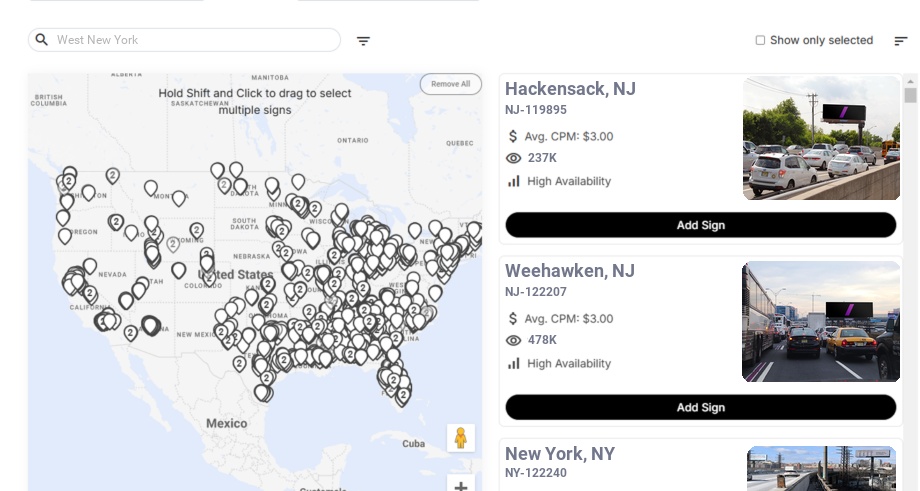
Blip instantly gives you access to 198 digital billboards near West New York, New Jersey, serving the West New York area with flexible, self-serve campaigns. The nearby coverage includes Weehawken, North Bergen, Secaucus, Jersey City, New York City, Brooklyn, Newark, and Bergen County. This mix lets advertisers saturate the core West New York area and extend reach into major commuter and regional travel corridors.
Who sees billboards in the West New York, New Jersey area?
West New York is one of the densest municipalities in the United States, with roughly 52,000 residents living in just over 1 square mile. The area is predominantly Hispanic/Latino, with roughly 75–80% of residents identifying as Hispanic or Latino, and many households are bilingual. It also has a very high renter share, making it ideal for campaigns related to housing, furniture, financial services, telecom, and everyday retail.
When is the best time to run billboards in West New York, New Jersey with Blip?
The best times depend on whether you want commuter or local traffic, but weekday rush hours are especially strong in the West New York area. Morning traffic runs from about 6:30–9:30 a.m., and evening traffic from 4:00–7:30 p.m., when congestion and dwell time are high. Midday and weekends can also be effective for retail, medical, entertainment, and family-focused campaigns.
Why is West New York, New Jersey a strong market for Blip billboard advertising?
The West New York area sits in one of the most valuable outdoor advertising corridors in the country, with extreme population density, heavy commuter flows into Manhattan, and major highways and transit hubs within a 10-mile radius. Thousands of residents travel daily across the Hudson via the Lincoln Tunnel, ferries, buses, and PATH rail, and key roadways feeding the area see annual average daily traffic counts of 120,000–150,000 vehicles on major segments. This combination creates strong impression volumes for both local and regional brands.
Do I need a contract to advertise with Blip near West New York?
No, Blip has no long-term contracts or minimum commitments. You can start, pause, or stop your campaign at any time.
How fast can I launch a billboard campaign with Blip near West New York?
You can have your campaign live in minutes. Create a free account, select your locations, set your budget, upload your design, and start running once approved.
Where can I advertise with Blip near West New York?
Blip has digital billboards near West New York. You can browse available locations on a map, choose the ones that fit your audience, and start advertising right away.
Still have questions? Launch a campaign in minutes — no contracts, no commitments.
Start Your CampaignWest New York Billboard Advertising Guide
The West New York, New Jersey area sits at one of the most valuable outdoor advertising corridors in the country. With extreme population density, heavy commuter flows into Manhattan, and major highways and transit hubs within a 10‑mile radius, digital billboards near West New York give us the ability to reach both local residents and regional commuters efficiently and flexibly. For brands actively looking for billboards near West New York, this corridor combines big-city visibility with neighborhood-level relevance, making West New York billboards a powerful part of any metro New York media mix.
Why the West New York Area Is a High-Impact OOH Market
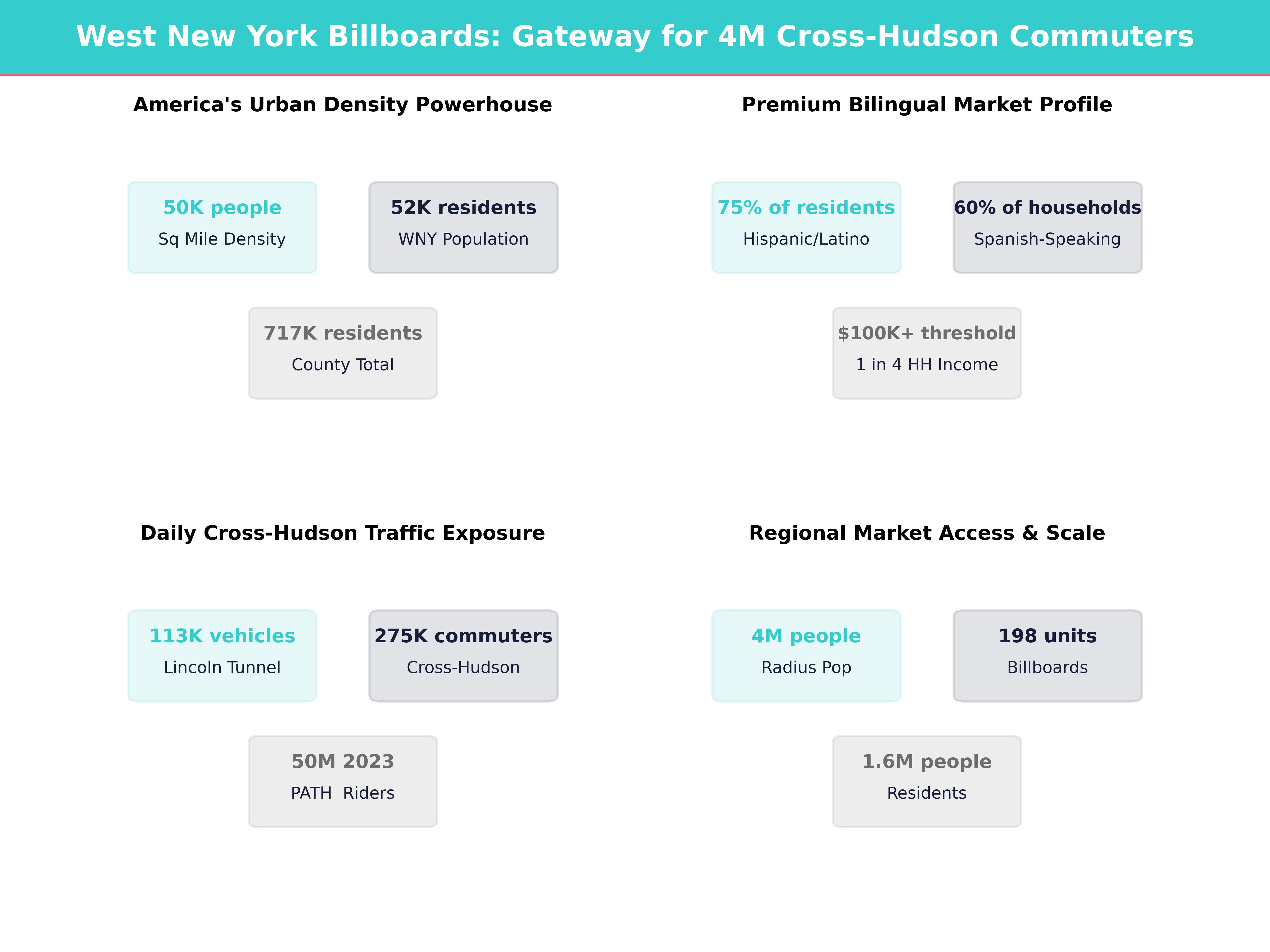
West New York is one of the densest municipalities in the United States. The town’s roughly 52,000 residents live in just over 1 square mile, yielding a density of more than 50,000 people per square mile. That dense residential fabric is stacked directly against some of the busiest commuter routes in the New York metropolitan region, which is why billboard advertising near West New York consistently delivers strong impression volumes for both local and regional brands.
Key reasons the West New York area is so powerful for digital billboards:
- Extreme local density: Hudson County 6–8% over the last decade, keeping demand for housing, retail, and services high in and around West New York.
- NYC commuter pipeline: Thousands of residents travel daily across the Hudson via the Lincoln Tunnel, Port Imperial ferries, and NJ Transit buses to Midtown and Downtown Manhattan. The Port Authority of New York and New Jersey reports that the Lincoln Tunnel handles around 113,000 vehicles per weekday and more than 21 million vehicles per year. PATH rail, operated by the Port Authority Trans-Hudson, carried over 50 million riders in 2023, with key stations in nearby Jersey City
- Car-first regional travel: New Jersey overall has about 1.9 vehicles per household, while Hudson County’s more urban profile brings that closer to 1.1–1.2 vehicles per household, according to state transportation and planning data. Major roadways—Route 495, US‑1/9, Route 3, the New Jersey Turnpike New Jersey Department of Transportation reports annual average daily traffic counts of 120,000–150,000 vehicles on key segments feeding the Lincoln Tunnel and Secaucus area, giving roadside billboards consistent exposure.
- Retail and dining concentration: Bergenline Avenue and nearby commercial strips draw shoppers from neighboring towns like North Bergen, Union City, and Guttenberg Newark further expand your potential customer base. Local economic data show that Hudson County supports 20,000+ retail and food service jobs, with retail and hospitality accounting for around 15–20% of local employment, underscoring the importance of consumer-facing advertising.
- Cross-state visibility: Our 198 digital billboards serving the West New York area span both New Jersey and New York, tapping into audiences moving between New York City, northern New Jersey, and points beyond. Within a 10‑mile radius, you can reach a combined regional population of well over 4 million people, including dense pockets in Manhattan, Brooklyn, Hudson County, and southern Bergen County, based on regional planning and metropolitan statistical area figures.
With Blip, we can use these patterns to concentrate impressions precisely where and when they’re most valuable, rather than paying for a static placement that’s always on, no matter the traffic level. This makes flexible billboard rental near West New York especially attractive for advertisers that want to match spend with peak audience movement.
Understanding West New York Area Audiences
To speak effectively to the West New York area, we need to understand who is moving through it and what motivates them. Thoughtful creative and scheduling turn generic West New York billboards into targeted media that feel tailored to each audience segment.
Demographics and household profile
- West New York is a predominantly Hispanic/Latino community. Local data indicate that roughly 75–80% of residents identify as Hispanic or Latino, with strong Cuban, Dominican, Central and South American communities. Across Hudson County, Hispanic/Latino residents make up around 45–50% of the population, one of the highest shares in New Jersey.
- Median household income in the area is in the $60,000–$70,000 range, reflecting a mix of working-class and lower-middle-income households with some higher-income professionals commuting into Manhattan. Countywide, about 1 in 4 households earn more than $100,000 per year, giving advertisers both value-driven and premium segments to target.
- The area has a very high renter share—local housing data consistently place renter-occupied units above 70% of households in West New York—making it ideal for campaigns related to housing, furniture, financial services, telecom, and everyday retail where people are sensitive to monthly budgets. In some nearby Hudson County cities, the renter share exceeds 75–80%, reinforcing the regional nature of this audience.
- Household sizes are relatively large; average household size in West New York is around 2.7–3.0 persons, with a notable share of homes hosting 3 or more adults. Multi-generational and multi-family living are common, meaning family-oriented and value-focused messaging performs well. Over 25% of households in many Hudson County communities include children under 18, strengthening the case for kid- and family-focused offers.
Language and culture
- A significant share of residents speak Spanish at home; in West New York and neighboring towns, 60–70% of households report speaking Spanish at home, and many are bilingual. This makes Spanish-inclusive messaging a practical necessity rather than an optional add-on.
-
For local campaigns, bilingual creative (English + Spanish) or carefully localized Spanish-only creative can dramatically increase resonance, especially for:
- Grocers and food brands
- Banks and credit unions
- Healthcare providers
- Education and job training programs
- Cultural touchpoints—Hispanic Heritage Month, major soccer tournaments, and religious holidays—can be leveraged with short, time-sensitive digital billboard bursts using Blip’s flexible scheduling. For example, TV ratings data show that major international soccer finals routinely draw 2–3x higher viewership among Hispanic audiences compared with non-event weeks, providing a clear opportunity for tie-in campaigns.
Commuter vs. local audiences
We can roughly think of the audience in the West New York area as:
-
Local residents (evenings, weekends, neighborhood streets):
- Families, service workers, small business owners
- Heavily influenced by convenience and price
- Responsive to local promotions within 1–5 miles
- In Hudson County, typical commute times are 32–36 minutes, and over 35–40% of workers use public transportation—higher than the New Jersey average—so “on the way home” or “near your bus stop” messaging is particularly effective.
-
Commuters (weekday rush hours, major routes, transit feeders):
- Office workers and professionals heading to Manhattan or Jersey City
- Higher daytime spending power, often in the $80,000+ household income bracket
- Responsive to dining, entertainment, mobility, fintech, and B2B services
- Regional transportation data show that more than 275,000 people cross the Hudson River on a typical weekday via tunnels, bridges, PATH, ferries, and commuter rail, providing a massive moving audience your ads can reach.
Using Blip, we can target both groups differently—tailoring creative and flighting to times of day and specific board locations that line up with how these audiences move, whether you’re focused on hyperlocal billboard advertising near West New York or broader regional awareness.
Where Our Nearby Billboards Reach Your Customers
While the town itself is compact, the West New York area is framed by a ring of high-traffic communities where our 198 digital billboards are located. Those boards give us coverage along the exact paths your customers travel daily, so billboards near West New York can intercept shoppers and commuters in multiple directions.
Key nearby markets and how they contribute to your reach:
-
Weehawken (about 1.7 miles away)
- Home to the Lincoln Tunnel helix, Port Imperial ferry terminal, and Hudson-Bergen Light Rail connections. The Township of Weehawken 15 mph, giving motorists more time to notice and absorb billboard messages.
- Port Imperial is a key node for NY Waterway ferries; across its system, NY Waterway carries tens of thousands of passengers on a typical weekday, with Port Imperial among its busiest terminals. Prime for targeting Manhattan-bound commuters and high-income ferry riders, who often have household incomes above $100,000 and higher discretionary spending on dining, travel, and services.
-
North Bergen (about 1.8 miles away)
- US‑1/9, Tonnelle Avenue, and major shopping centers drive heavy local and through-traffic. State traffic counts on US‑1/9 through North Bergen regularly exceed 90,000–100,000 vehicles per day.
- The Township of North Bergen is another of the most densely populated municipalities in the country, with more than 60,000 residents in roughly 5 square miles. Ideal for big-box retail, grocery, auto, and QSR promos targeting Hudson and Bergen County drivers.
-
Secaucus (about 2.6 miles away)
- Secaucus Junction, one of NJ Transit's busiest rail hubs, moves tens of thousands of passengers daily; pre-pandemic ridership estimates placed average weekday boardings in the 30,000–40,000 range. This hub connects multiple commuter rail lines from across New Jersey into New York Penn Station.
- The Town of Secaucus millions of visitors per year, according to regional tourism groups like VisitNJ and the Meadowlands Liberty Convention & Visitors Bureau
-
Jersey City (about 4.7 miles away)
- Over 283,000 residents, major waterfront office towers, and multiple PATH stations connecting directly to Manhattan. The city government estimates that Jersey City has added more than 30,000 residents over the last decade, and daytime population swells with tens of thousands of office workers and students.
- PATH stations in Jersey City account for a significant share of the system’s 50+ million annual riders, and waterfront attractions like Liberty State Park can welcome 4 million or more visitors per year. Perfect for campaigns that need to reach both West New York area residents and broader urban professionals.
-
New York, New York (about 5.2 miles away) and Brooklyn (about 8.1 miles away)
- Boards near the city expand your brand’s footprint to millions of New Yorkers while staying tethered to West New York commuters who cross the Hudson daily. Manhattan alone has a population of roughly 1.6 million residents, with daytime population soaring above 3 million when workers and visitors are included, while Brooklyn adds another 2.7 million residents to your potential reach.
- High-impact for regional or e‑commerce brands that want the halo of NYC exposure, especially near key hubs such as the Port Authority Bus Terminal Penn Station Brooklyn Bridge–Manhattan Bridge corridor
-
Newark (about 9.2 miles away)
- As New Jersey’s largest city and home to Newark Liberty International Airport, Newark adds another region of dense traffic and travelers to your reach. The City of Newark has around 310,000 residents, and the airport handled over 46 million passengers in 2023, according to the Port Authority. Major roadways like the Turnpike, I‑78, and US‑1/9 converge here, concentrating both local and long-distance traffic.
By selectively choosing boards near these communities, we allow advertisers to:
- Saturate the core West New York area (via Weehawken, North Bergen, Ridgefield, and Jersey City)
- Extend reach up into Bergen County (Bogota, Hackensack, Lodi, Maywood) where combined populations surpass 900,000 residents
- Capture bi-directional commuter flows with NYC- and Newark-adjacent placements that collectively touch hundreds of thousands of daily drivers and transit users
This mix ensures that your billboard advertising near West New York follows real-world travel patterns rather than being confined to a single zip code.
Timing Your Blip Campaign Around Local Traffic Patterns
Digital billboards near the West New York area sit along some of the most congested roadways in the region. Rather than paying for 24/7 exposure, we can buy “blips” only when traffic is heaviest, turning flexible billboard rental near West New York into a highly efficient tactic.
Transportation and navigation data consistently show that:
- Peak-period congestion on Hudson County approaches to the Lincoln Tunnel and Holland Tunnel can extend for 2–3 hours in the morning and evening.
- Average travel times on Route 495 and US‑1/9 can increase by 30–50% during rush hour compared to off-peak, which increases dwell time in front of roadside billboards.
Typical local patterns to leverage:
Weekday rush hours
-
Morning (6:30–9:30 a.m.)
- Heavy flows toward Manhattan via Lincoln Tunnel, ferries, and buses. The Port Authority Bus Terminal handles around 200,000 passengers on a busy weekday, many of whom originate in Hudson and Bergen Counties on NJ Transit and private carriers.
-
Best for:
- Coffee shops and quick breakfast QSRs
- Personal finance and banking (payday messaging around 1st & 15th)
- B2B services targeting office workers
- Target boards in Weehawken, Secaucus, and Jersey City for NYC-bound commuters.
-
Evening (4:00–7:30 p.m.)
- Return traffic toward West New York, North Bergen, and surrounding towns. Regional traffic analytics frequently show that PM congestion can last slightly longer than the AM period, with speeds dropping by 25–40% on key corridors.
-
Best for:
- Grocery, meal kit, and takeout offers (“Tonight only”)
- Gyms and fitness centers
- Local events, entertainment, and nightlife
Midday and weekend traffic
-
Midday (10:00 a.m.–3:00 p.m.)
- Errand-running residents, service workers on the move, and shift-change traffic. In many Hudson County retail corridors, pedestrian and vehicle counts stay steady through midday, creating a strong window for conversion-focused ads.
-
Strong for:
- Retail sales and seasonal promotions
- Medical, dental, and urgent care clinics
- Educational and training services
-
Weekends
- Shoppers heading to malls and big-box stores in Secaucus, North Bergen, and Bergen County. For example, the Secaucus and Meadowlands retail clusters register tens of thousands of weekend visitors, particularly during holiday and back-to-school seasons.
- Family outings to parks and waterfronts in Weehawken and Jersey City, and to attractions like Liberty Science Center
-
Optimize for:
- Automotive, furniture, and electronics
- Attractions, museums, and local experiences
- Real estate open houses and apartment communities
With Blip’s scheduling tools, we can:
- Concentrate spend on specific days of the week (e.g., retail promotions Thursday–Sunday, when many stores see 40–50% of their weekly foot traffic)
- Boost visibility during paycheck weeks (1st and 15th) and tax refund season (February–April), when financial institutions and tax preparers often report 20–30% higher customer activity
- Pulse campaigns around events reported by outlets like Hudson Reporter NJ Advance Media / NJ.com’s Hudson section Town of West New York and neighboring communities
Creative Strategies That Resonate in the West New York Area
Creative that works near West New York is:
- Fast to process in dense, high-speed traffic
- Culturally fluent and, often, bilingual
- Value-focused, with clear calls to action
Consider the following when designing your artwork so your West New York billboards stand out and drive response:
1. Bilingual and culturally relevant messaging
-
Use simple, direct copy in both English and Spanish when possible:
- “Low-Cost Health Care / Atención Médica a Bajo Costo”
- “Fast Internet for Your Family / Internet Rápido para tu Familia”
- Avoid overly literal translations; work with copy that feels natural to local Spanish speakers, reflecting the Cuban, Dominican, and broader Latin American communities that make up three-quarters or more of West New York’s residents.
- Incorporate cultural cues subtly (colors, food visual, family scenes) without resorting to stereotypes. Advertisers that tailor language and cultural cues to local audiences typically see double-digit percentage lifts in engagement and conversion compared with generic creative, according to industry case studies from major OOH networks.
2. Visual hierarchy for fast-read environments
- Keep to 6–8 words or fewer in your primary message. Eye-tracking studies on roadside advertising show that drivers typically have 3–6 seconds to absorb a billboard, so brevity matters.
- Use high-contrast color combinations (e.g., white or yellow text on deep blue or black background) for nighttime readability and daylight glare. Ensuring text heights of at least 18–24 inches on full-size boards improves legibility at highway speeds.
-
Feature one clear focal point:
- Logo + short offer (“$0 Down, Move In Today”)
- Logo + strong benefit (“Fast Cash, Same Day Approval”)
-
Add a short URL, QR code, or easy-to-remember phrase for follow-up:
- Short domains (e.g., MyClinicNJ.com) work better than long business names. Campaigns that pair billboards with trackable URLs or codes frequently report 10–30% more measurable response compared with offline-only calls to action.
3. Price and value emphasis
Given the income mix and renter-heavy population:
-
Highlight monthly payment amounts, discounts, and promotions:
- “$39/Month Gym – No Contract”
- “2 Lines for $60 – Taxes Included”
- For local retail, time-bound offers like “This Weekend Only” or “Ends Sunday” can dramatically increase response. Retail benchmarks show that limited-time messages can drive 20–50% higher short-term redemption rates versus evergreen offers in similar formats.
4. Commuter mindset alignment
During rush hour, commuters are often:
- Thinking about the day ahead or winding down from work
- Planning meals, errands, or entertainment
Plan creative accordingly:
-
Morning examples:
- “Skip Cooking Tonight – Order Online Now”
- “Your New Job is 15 Minutes Away – Apply Today”
-
Evening examples:
- “Open Until Midnight – Pharmacy & Groceries”
- “Next Exit: Free Checking, $200 Bonus”
Aligning copy with commuter needs (convenience, stress reduction, time savings) taps into a segment that typically spends more per transaction and is more likely to use mobile devices to act on an offer while in transit or immediately afterward.
Using Blip Tools to Target the West New York Area
Blip’s platform lets us treat the West New York area like a precise, data-driven market rather than a single city. This is especially valuable if you’re testing billboard rental near West New York for the first time and want quick feedback on what works.
Ways to use our tools effectively:
1. Geo-layering around West New York
- Start with boards in Weehawken, North Bergen, Secaucus, and Jersey City to lock in the core West New York audience. Combined, these municipalities represent over 400,000 residents plus tens of thousands of daily inbound workers and visitors.
- Add New York City or Brooklyn boards for campaigns that benefit from NYC halo exposure (e.g., universities, healthcare systems, regional franchises). NYC Tourism + Conventions reports 60–70 million visitors per year to the five boroughs, making these boards impactful for brands seeking broad regional awareness.
- Expand to Newark and Bergen County boards for businesses drawing from a wider service radius (auto dealers, hospitals, regional retail). Bergen County alone has around 950,000 residents, and destinations like American Dream in the Meadowlands attract millions of annual visitors, which you can tap into with nearby boards.
2. Daypart and day-of-week optimization
-
Allocate higher bids to:
- Weekday rush hours if you’re commuter-facing. Across many OOH campaigns, rush-hour impressions can account for 40–60% of total weekly views on commuter corridors.
- Weekends if you’re retail, entertainment, or real estate-focused, when shopping-center foot traffic and leisure travel spike.
- Reduce or pause spend in low-return hours (e.g., late overnight) unless you have a 24/7 service or nightlife brand. Late-night impressions can still be cost-effective for sectors like emergency healthcare, towing, nightlife, and 24-hour QSRs.
3. Multi-message rotations
Because digital boards can show multiple creatives in rotation, we can:
- Run language variants (English-only, Spanish-only, bilingual) and compare performance via web traffic or offer-code redemptions. Many advertisers see 15–25% better response from localized-language variants in heavily bilingual markets like Hudson County.
- Rotate seasonal offers automatically (e.g., back-to-school, tax season, holiday shopping), aligning with retail sales periods when consumer spending can rise 20–40% above typical weeks.
-
Test different calls to action:
- “Call Now”
- “Visit Today”
- “Text ‘WNY’ for Offer”
Over a multi-week campaign, these tests help refine which messages produce the highest click-throughs, store visits, or calls for your specific category and for your chosen West New York billboards.
Campaign Ideas by Industry for the West New York Area
Here are some concrete ways different sectors can use digital billboards serving the West New York area:
Local retail and grocery
- Promote weekly specials and “3‑Day Sale” events, timed Thursday–Sunday, when grocery and big-box chains typically see 40–50% of weekly sales.
- Use radius-based phrases like “5 Minutes from the Lincoln Tunnel” or “Off Tonnelle Ave in North Bergen” to orient drivers, taking advantage of the tens of thousands of vehicles per day on these roads.
- Add bilingual promos for staple products that resonate with Hispanic households, such as rice, beans, cooking oils, and fresh produce, which often represent a higher share of basket spend in these communities.
Restaurants and QSR
-
Target morning and evening rush hours with clear, appetizing visuals and simple prices:
- “Combo from $7.99 – Exit Now”
- Use geofenced delivery areas from platforms like Uber Eats or DoorDash to determine where to concentrate impressions. Delivery platforms report that urban and inner-ring suburban zones like Hudson County can generate orders per square mile several times higher than more suburban markets, making hyperlocal exposure critical.
- Highlight speed (“Ready in 10 Minutes”), delivery windows, or late-night hours to capture commuters and shift workers.
Healthcare and dental clinics
- Emphasize walk-in availability, low-cost visits, and bilingual staff. In Hudson County, uninsured and underinsured rates are higher than state averages, so mentions of “low-cost,” “sliding scale,” or “acceptamos la mayoría de los seguros” can be especially persuasive.
- Run daytime and early evening campaigns Monday–Saturday, when patients are most likely to call or visit. Many urgent care centers report that 60–70% of visits occur between 9:00 a.m. and 7:00 p.m., which is ideal for concentrated billboard exposure.
- Highlight proximity to known landmarks or transit stops, such as “2 blocks from Bergenline Ave” or “Near Journal Square PATH
Education, training, and immigration services
-
Focus on:
- ESL programs
- GED and technical training
- Immigration legal services
- Pair bilingual messaging with enrollment windows and info sessions; educational institutions often see spikes of 30–50% in inquiries around semester start dates or major registration pushes.
- Concentrate campaigns on late afternoon and evening slots when potential students are commuting home or already on their devices. In dense, transit-oriented neighborhoods, evening foot traffic around bus stops and rail stations can remain strong until 8:00–9:00 p.m.
Real estate and multi-family housing
-
Market new buildings or vacancy pushes near the West New York area with:
- “Now Leasing – 1 BR from $1,8xx / month”
- “No Broker Fee – 2 Stops to Midtown”
- Use boards in Weehawken, North Bergen, Jersey City, and Secaucus to surround the rental market. In Hudson County, more than 70% of occupied housing units are rentals, and annual apartment turnover rates can exceed 30%, meaning a constant pool of active renters.
- Highlight commute advantages (“15 minutes to Midtown,” “Shuttle to Port Imperial Ferry”) and amenities (parking, in-unit laundry, pet-friendly buildings) that influence renters’ decisions.
Financial services and banks
- Promote check-cashing, remittance services, low-fee accounts, and tax refund advances—services that are particularly relevant in communities with a higher share of cash-based workers and new immigrants.
- Increase impressions around paydays (1st, 15th, and Fridays) and during tax season (February–April), when financial traffic typically increases by 20–30% at branches and online.
- Communicate safety, trust, and community involvement; link to branch locations via a short URL. Featuring recognizable local corner locations—“On Bergenline & 60th St”—can significantly improve brand recall.
Measuring and Refining Your West New York Area Campaign
To get the most from your investment, we should plan from day one to measure results and refine over time, especially if you’re testing billboard advertising near West New York as part of a broader marketing strategy.
1. Align billboards with digital analytics
- Use unique URLs, QR codes, or promo codes only displayed on the billboards serving the West New York area. QR usage has surged in recent years; some campaigns now see 10–20% of responses come via QR scans instead of typed URLs.
-
Monitor:
- Direct and branded search spikes from ZIPs around West New York, North Bergen, Weehawken, and Jersey City.
- Landing page traffic and conversions during your active Blip hours.
- Call volume to trackable phone numbers during flight times.
2. Watch local trends and news
-
Follow local coverage via Hudson Reporter, NJ.com’s Hudson County section News 12 New Jersey, to:
- Time campaigns around community events, parades, street fairs, or school activities that can draw thousands of attendees on a single weekend.
- Pause or adapt messaging during weather events or major news, when traffic patterns and consumer priorities may shift.
- Tie into positive local stories (e.g., new park openings, transit upgrades) that increase neighborhood pride and engagement.
3. Optimize your board mix
-
After a few weeks, evaluate which nearby cities’ boards align with higher web or in-store response:
- Are Secaucus shoppers converting better than Newark drivers?
- Do Weehawken commuter boards outperform Bergen County boards for your service radius?
- Many advertisers find that 20–30% of their board locations drive a disproportionate share of measurable results. Shift budget and higher bids toward the best-performing segments while maintaining a baseline presence elsewhere to preserve brand visibility.
By combining the density and diversity of the West New York area with the flexibility and precision of Blip’s 198 nearby digital billboards, we can build campaigns that reach the right mix of residents and commuters—at the exact times and locations where they’re most likely to act, and with data-backed strategies that maximize every advertising dollar. Whether you need a short-term billboard rental near West New York or an always-on presence across the region, this market offers the scale and sophistication to support your goals.