Billboards in Camden, NJ
No Minimum Spend. No Long-Term Contracts. Just Results.
Trusted by Leading Brands


Billboard advertising
in Camden has never been easier



How much is a billboard in Camden?
Why Choose Blip for Billboard Advertising in Camden
-
Choose Blip in Camden to launch fast on I-676, US 30, and bridge approaches—ideal for Philly commuters and cross-river traffic.
-
Camden campaigns can flex by budget and timing, so you can hit Route 42 shore traffic or waterfront nights when it matters most.
-
No contracts with Blip means you can test Camden's hospital, student, and office audiences near Cooper, Rutgers-Camden, and the bridges.
-
Track Camden results in real time and shift spend toward busy corridors like I-76, Route 73, and Cherry Hill retail runs.
-
Use Blip's creative tools to tailor Camden ads for bilingual city audiences, concert nights, or holiday shopping on Route 70.
Frequently Asked Questions About Billboard Advertising in Camden
How much does a billboard cost in Camden with Blip?
With Blip, billboard advertising in Camden is designed to fit a wide range of budgets. Each 7.5-to-10-second display, or “blip,” can start at just $0.01, and the total cost is simply the sum of each blip over time. Because pricing changes based on time of day, location, and advertiser demand, you can control your spend while Blip works to maximize your reach.
Where can I advertise with Blip in Camden to reach the most traffic?
According to traffic data from NJDOT and the Delaware River Port Authority, the I-676 and US 30 approaches into Camden generally run in roughly the 70,000-to-100,000-vehicle-per-day range, depending on the exact segment and count year. I-76 around the Walt Whitman Bridge commonly exceeds 120,000 AADT, and major approach sections can push toward 150,000 vehicles per day. Route 42 also becomes especially valuable because it feeds the Atlantic City Expressway and carries heavy commuter and leisure traffic.
Why is Camden a strong billboard market for Blip advertisers?
Camden is one of those billboard markets where the usable audience is much larger than the city line suggests. It sits inside Camden County, directly across the bridge network from Philadelphia, and within a metro of roughly 6.2 million people. That position gives us dense commuter traffic, bridge crossings, suburban retail movement, college activity, hospital trips, and year-round waterfront visitation in one compact geography.
What kind of Camden audience can Blip reach on billboards?
Camden works because it is both a car market and a transit gateway. Roughly three-quarters of workers, or about 75%, commute by driving alone, and the average travel time is about 29 minutes. The city also has students, faculty, medical audiences, suburban shoppers, and waterfront visitors, which makes it useful for a wide range of campaigns.
When is the best time to run Blip billboard ads in Camden?
From May through September, the waterfront becomes one of Camden’s best ad-timing opportunities. On nights when Freedom Mortgage Pavilion approaches its 25,000-person capacity, nearby digital billboards can effectively promote restaurants, bars, parking, rideshare, late-night offers, and nearby attractions. Late August through October is also a reliable billboard window because routines restart for Rutgers University–Camden, Camden County College, and local school districts.
Do I need a contract to advertise with Blip in Camden?
No, Blip has no long-term contracts or minimum commitments. You can start, pause, or stop your campaign at any time.
How fast can I launch a billboard campaign with Blip in Camden?
You can have your campaign live in minutes. Create a free account, select your locations, set your budget, upload your design, and start running once approved.
Where can I advertise with Blip in Camden?
Blip has digital billboards in Camden. You can browse available locations on a map, choose the ones that fit your audience, and start advertising right away.
Still have questions? Launch a campaign in minutes — no contracts, no commitments.
Start Your CampaignCamden Billboard Advertising Guide
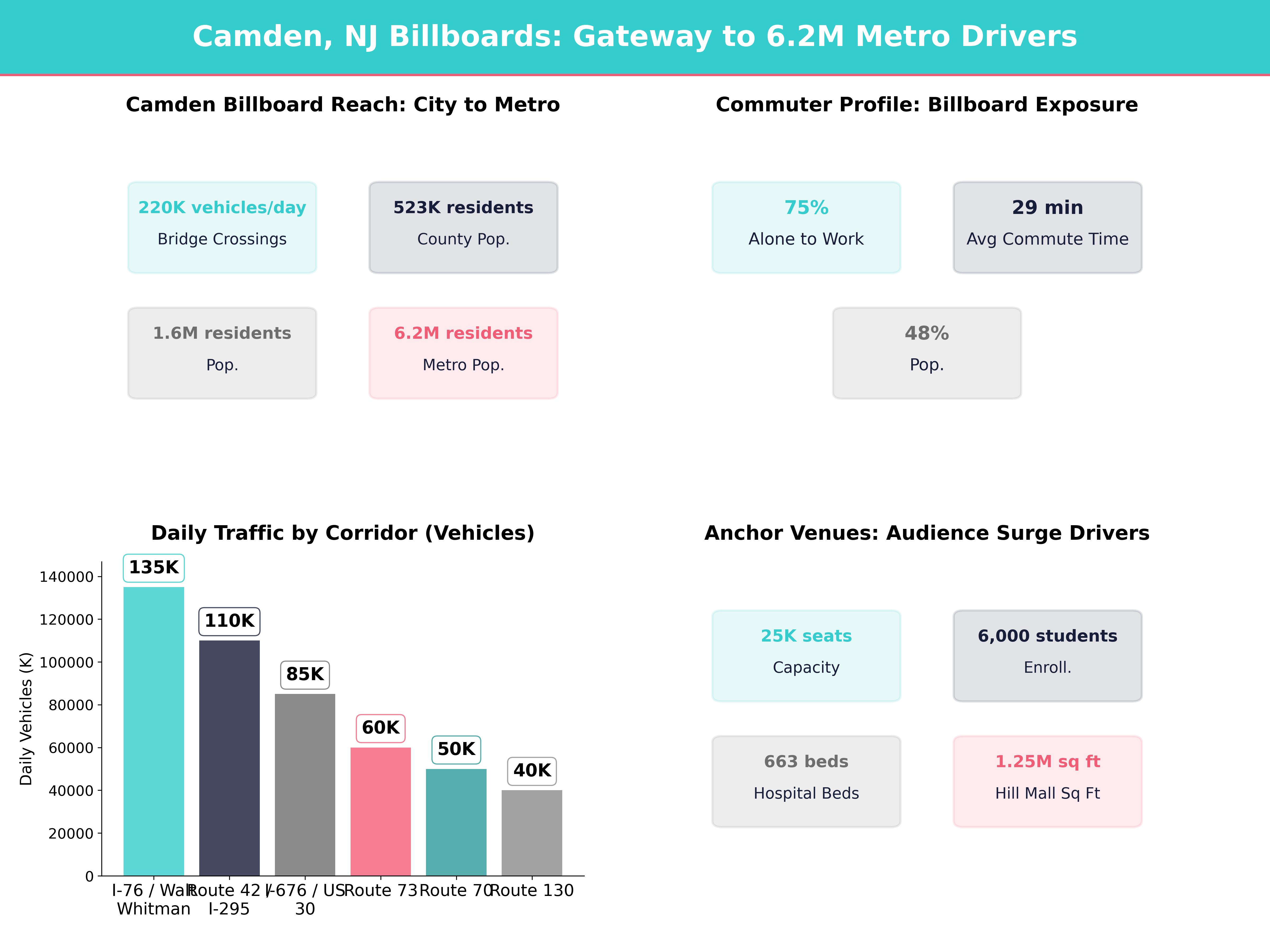
Camden, New Jersey is one of those billboard markets where the usable audience is much larger than the city line suggests. Camden had 71,791 residents in 2020, but it sits inside Camden County 523,485 residents, directly across the Delaware River Port Authority's bridge network from Philadelphia 1.6 million residents, and within a metro of roughly 6.2 million people. That position gives us dense commuter traffic, bridge crossings, suburban retail movement, college activity, hospital trips, and year-round waterfront visitation in one compact geography, with the Ben Franklin and Walt Whitman bridges together carrying roughly 220,000 vehicles per day. Because much of South Jersey commerce still flows by car on I-76, I-676, Route 42, Route 70, Route 73, and Route 130, Camden is a strong place to build repeated digital billboard exposure.
Camden Market Overview
Camden's population scale and growth patterns
When we plan billboard coverage in Camden, we need to think beyond the city border. The city itself moved from 77,344 residents in 2010 to 71,791 in 2020, while Camden County 523,485 residents, an increase of about 1.9% over the decade. That countywide gain equals nearly 10,000 additional residents, and it matters because much of the area’s consumer spending happens in suburban municipalities rather than inside the city core.
We also benefit from the county’s compact geography. Camden County 37 municipalities, which means we can reach very different consumer groups without leaving a relatively tight driving radius. In practical billboard terms, that gives us urban, inner-ring, waterfront, medical, student, and higher-spending suburban audiences in one buy.
Camden's commuting mix and travel behavior
Camden works because it is both a car market and a transit gateway. In the county, roughly three-quarters of workers, or about 75%, commute by driving alone, and the average travel time is about 29 minutes. That is long enough for repeated daily exposure to matter, but short enough that location relevance still drives response.
Transit still adds meaningful audience movement. PATCO operates a 13-station line between South Jersey and Philadelphia, and the NJ TRANSIT River LINE runs 34 miles between Camden and Trenton. We should think of those systems as audience multipliers, because they feed riders into park-and-ride lots, bus transfers, station access roads, and bridge approaches that remain highly visible to drivers.
Camden's economic anchors and what they mean for advertisers
Camden’s economy gives us more than simple pass-through traffic. Cooper University Health Care 663-bed academic medical center, Rutgers University–Camden enrolls more than 6,000 students, Camden County College serves students at 3 sites, and Cooper Medical School of Rowan University opened in 2012 as part of the city’s education and healthcare corridor. Those institutions create consistent trips for employees, students, patients, families, vendors, and service providers.
Corporate presence also matters. American Water, Subaru of America Campbell's 1869. For us, that means billboard campaigns here can support B2B services, recruiting, financial products, insurance, and professional services, not just consumer retail. The Camden County Regional Chamber of Commerce
Key Traffic Corridors for Camden Billboards
I-676, US 30, and the Ben Franklin Bridge in Camden
According to traffic data from NJDOT and the Delaware River Port Authority, the I-676 and US 30 approaches into Camden generally run in roughly the 70,000-to-100,000-vehicle-per-day range, depending on the exact segment and count year. Those roads feed the Ben Franklin Bridge 1926 and remains one of the most recognizable entries between South Jersey and Center City Philadelphia.
We like this corridor when we want both scale and prestige. These boards are strong for healthcare, legal services, entertainment, casinos, sports messaging, dining, and waterfront attractions because drivers are already making a city-to-city trip. If we need to reach people who work in Philadelphia, live in New Jersey, or move between both in the same week, this is one of Camden’s best billboard zones.
I-76 and the Walt Whitman Bridge near Camden
I-76 is one of the heaviest regional traffic corridors tied to Camden. On nearby segments around the Walt Whitman Bridge 120,000 AADT, and major approach sections can push toward 150,000 vehicles per day. Since the bridge opened in 1957, this route has served as a primary connector between South Jersey, South Philadelphia, the regional expressway system, and the New Jersey Turnpike Authority
For us, I-76 is where broad-reach advertisers often win. Hospital systems, auto dealers, home improvement brands, universities, legal firms, staffing companies, and regional retailers all benefit from the sheer repetition on this corridor. We also get a useful mix of work trips, event trips, and through-travel, which makes these boards more flexible than a pure downtown location.
Route 42 and Camden's shore-bound funnel
Route 42 is one of South Jersey’s signature traffic spines, and it matters to Camden advertisers even when the campaign goal is not inside the city. NJDOT counts on key sections near the I-76 and I-295 interchange routinely reach 100,000-plus vehicles per day, with some segments topping 120,000. Because Route 42 also feeds the Atlantic City Expressway
This is where we often position brands that need a wider South Jersey footprint. Family entertainment, convenience retail, gas and food offers, healthcare, shore hospitality, and destination attractions all benefit here. From Memorial Day to Labor Day, these boards also become more valuable for travelers heading toward the Shore, especially on Thursday afternoons, Friday evenings, and weekend mornings.
Route 70, Route 73, Route 38, and Route 130 in Camden County's retail belt
Camden County’s biggest everyday buying corridors sit east of the city. On major segments, Route 70 commonly carries about 40,000 to 60,000 vehicles per day, Route 73 often runs around 50,000 to 70,000, and Route 130 typically falls in the 30,000 to 50,000 range, depending on municipality and intersection. Those numbers matter because this is where Camden County’s higher-frequency retail and household spending tends to concentrate.
The trade area around Cherry Hill Township Pennsauken Township Cherry Hill Mall alone totals about 1.25 million square feet. If we are promoting furniture, healthcare, legal services, dining, auto repair, grocery, fitness, or home services, these suburban routes often give us the best mix of visibility and purchase intent.
Audience Segments We Can Reach in Camden
Camden commuters and cross-river professionals
Camden is a commute market first. We are working with a county of 523,485 residents at the edge of a city of 1.6 million, inside a metro of roughly 6.2 million. With about 75% of county workers driving alone, we get repeated weekday exposure that helps memory-based categories such as insurance, healthcare, recruiting, personal injury, banking, and professional services.
Cross-river behavior is especially important here. We are not only reaching Camden residents. We are reaching South Jersey residents driving into Philadelphia, Philadelphia workers heading to Camden institutions, and regional drivers using Camden’s bridges as part of larger travel patterns.
Camden students, faculty, and medical audiences
The education and healthcare cluster in Camden gives us a distinct audience segment that many mid-sized cities cannot match. Rutgers University–Camden brings more than 6,000 students into the city, Camden County College adds a multi-campus student base through its 3 locations, and Cooper Medical School of Rowan University adds an ongoing stream of medical education activity. Cooper University Health Care 663-bed hospital.
We should treat this as a high-value audience for apartments, food, telecom, financial services, apparel, education, and hiring. These consumers and professionals travel regularly, often on predictable schedules, and they are concentrated close to some of Camden’s most visible inventory.
Camden families and suburban shoppers
The Camden city story is important, but household spending often sits deeper in the county. Municipalities such as Cherry Hill Township Haddon Township, Collingswood, Haddonfield, and Pennsauken Township
For us, that means suburban Camden County boards are often the best fit for dentistry, urgent care, furniture, groceries, family attractions, child-focused businesses, and home services.
Camden tourists, concertgoers, and waterfront visitors
Camden’s waterfront adds an audience layer that far exceeds the city’s residential population. Adventure Aquarium features more than 2 million gallons of exhibits, Freedom Mortgage Pavilion holds about 25,000 people on a major concert night, and the Battleship New Jersey stretches 887 feet along the river.
The Camden Waterfront therefore creates meaningful demand for dining, rideshare, parking, tourism, family entertainment, and impulse stops. A market this size does not always come with this kind of destination density. That is one reason Camden can outperform expectations for event-driven billboard campaigns.
Camden's multicultural and bilingual audience
Message fit matters in Camden. Roughly 48% of city residents identify as Hispanic or Latino, so bilingual or Spanish-forward creative can be a smart strategic choice on city-centered routes, neighborhood retail corridors, and healthcare campaigns. We should not assume that one English-only message is the strongest option for every board in this market.
Seasonal and Timing Opportunities in Camden
Camden's spring and summer waterfront season
From May through September, the waterfront becomes one of Camden’s best ad-timing opportunities. Freedom Mortgage Pavilion loads the calendar with concert traffic, the Camden Waterfront sees more visitor movement, and family travel increases around Adventure Aquarium. On nights when the pavilion approaches its 25,000-person capacity, nearby digital billboards can effectively promote restaurants, bars, parking, rideshare, late-night offers, and nearby attractions.
Camden's summer shore traffic
Camden sits on the path to the Shore. From Memorial Day to Labor Day, Route 42, I-76, and the Atlantic City Expressway Atlantic County Cape May County
Camden's back-to-school and fall reset
Late August through October is a reliable billboard window in Camden. Rutgers University–Camden, Camden County College, and local school districts restart routines, and fall hiring tends to remain active in education and healthcare. We like this period for apartments, mobile carriers, banking, healthcare, tutoring, apparel, and recruiting campaigns because the audience is re-establishing habits.
Camden's holiday retail and winter visibility
The 6-to-8-week stretch before the December holidays is especially important on Route 70, Route 73, and around Cherry Hill Mall. South Jersey’s early winter darkness, with sunset arriving before 5 p.m. in December, helps digital boards stand out during the drive home. That makes evening-heavy schedules particularly useful for shopping, dining, gift, entertainment, and home-service advertisers.
Billboard Design Tips for the Camden Market
Use Camden-specific language and bilingual messaging
In Camden, generic regional copy is often weaker than place-specific messaging. Because roughly 48% of Camden residents are Hispanic or Latino, bilingual and Spanish-language headlines can be especially effective on city-facing boards. We also tend to get better relevance when we name actual places people recognize, such as Camden, the waterfront, Cherry Hill Township Pennsauken Township Collingswood.
Design for Camden's bridges, concrete, and speed
Camden’s roads are visually busy. We are competing with steel bridge structures, industrial backdrops, multiple-lane highways, and dense commercial signage. That means we should use one dominant image, one short promise, and one clear call to action. High-contrast palettes such as navy and white, black and yellow, or red and white usually perform better here than muted colors that disappear into gray infrastructure.
Match creative to the trip purpose in Camden
Trip intent changes by corridor, and our creative should reflect that. On bridge approaches and downtown routes, professional, civic, medical, and event imagery usually fits the audience best. On Route 70, Route 73, and Route 130, family, home, convenience, and value messaging often makes more sense because the surrounding trips are more suburban and retail-oriented.
We can also use local visual cues to speed up recognition. The Ben Franklin Bridge
Be direct when location matters in Camden
Camden is a market where directional clarity frequently beats clever branding. If the goal is a fast visit, we should mention the town, major road, bridge side, or neighborhood. That is especially true when the business is within a 10-to-15-minute drive of the board. For urgent care, restaurants, attractions, and event promotions, clarity usually wins.
Regional Strategies for Camden Billboard Campaigns
Downtown Camden and the Camden Waterfront
Downtown Camden is the right choice when we want to reach professionals, students, hospital workers, and visitors in the city core. We should use these placements for healthcare, higher education, civic messaging, recruiting, tourism, and event-driven campaigns tied to Adventure Aquarium, the Battleship New Jersey, and Freedom Mortgage Pavilion. Creative can be more place-specific here because the audience is already near the destination.
Camden bridge approaches and Philadelphia-facing boards
If we serve customers in both New Jersey and Pennsylvania, bridge-facing inventory is one of Camden’s biggest advantages. I-676 and I-76 placements help us reach New Jersey commuters heading into Philadelphia Camden, Cherry Hill Township
These are usually our best boards for brands with regional service areas, multi-location footprints, or broad awareness goals.
Inner-ring Camden County communities
Pennsauken Township Collingswood, Haddon Township, and Haddonfield combine strong local identity with heavy pass-through traffic. We like these communities for restaurants, fitness, health services, financial services, and home services because consumers are often close enough to act quickly. In these areas, our message should feel neighborhood-aware rather than purely metropolitan.
East and south Camden County retail corridors
Cherry Hill Township
If our primary KPI is store traffic instead of pure awareness, this is often where we begin.
Camden's industrial and logistics edge
The industrial side of Camden also deserves its own strategy. Corridors near the South Jersey Port Corporation, Route 130, I-76, and south Camden’s industrial areas are useful for staffing, trucking, construction, B2B supply, and trade services. These are repeat weekday drivers, so frequency is extremely valuable.
Straightforward copy about hiring, dispatch, same-day service, or fleet support usually performs better than image-heavy branding.
Blip Tools for Camden Billboard Campaigns
Use Camden timing instead of blanket scheduling
Camden rewards precise timing. We can use Blip to concentrate exposure during the hours that matter most on each corridor, rather than paying for a flat schedule that ignores local behavior. Morning and late-afternoon windows usually fit I-76, I-676, and bridge approaches best, while evening and weekend bursts often make more sense near the waterfront, Route 42, and suburban retail boards.
Split Camden creative by geography
We should not run the same message across every Camden board. A downtown board can emphasize trust, events, or institutions, while a Route 73 board can emphasize value, convenience, or family relevance. Blip makes it practical for us to test multiple creative versions across different sub-areas without building an overly complicated campaign.
Let Camden performance data guide the budget
Camden is compact enough that we can learn quickly. We can start with a few boards across urban, commuter, and suburban settings, watch results in real time, and shift budget toward the best-performing environments. That flexibility is especially useful in Camden because concert weeks, shore weekends, and back-to-school periods can change demand fast.
Getting Started with Billboard Rental in Camden
Start with our goal before we choose a Camden billboard
The best billboard in Camden is not automatically the one nearest our business. We should first decide whether we need commuter reach, same-day visits, event support, recruiting, bilingual awareness, or broad regional branding. Once we define that goal, the right corridor usually becomes much clearer.
Compare Camden locations by trip context
When we evaluate Camden boards, we should ask a few practical questions. We should ask whether the traffic is commuter or leisure traffic. We should ask whether drivers can act within the next 5 to 15 miles. We should ask whether the surrounding audience is urban, suburban, student, medical, or industrial. We should ask whether the route is steady all year or spikes seasonally.
Use a test-and-learn approach for Camden billboard rental
Traditional billboard buying often pushes us toward larger commitments before we know which corridor actually works. Blip simplifies that process because we can test downtown against suburban inventory, run bilingual and English-only creative, shift dayparts, and refine locations without getting locked into a rigid traditional buy. That matters in Camden, where Route 42 shoppers, waterfront visitors, and bridge commuters do not behave the same way.
Know what a strong Camden campaign looks like
The best Camden campaigns usually do three things well. They match the board to the trip purpose. They keep the message simple enough for fast-moving traffic. They use local context, whether that means the waterfront, a bridge, a suburb, or a season, to make the ad feel relevant right away. If we start there, Camden can deliver much more reach, frequency, and action than its city population alone would suggest.