Billboards near Trenton, NJ
No Minimum Spend. No Long-Term Contracts. Just Results.
Trusted by Leading Brands


Billboard advertising
near Trenton has never been easier



How much is a billboard near Trenton?
Why Choose Blip for Billboard Advertising near Trenton
-
In Trenton, Blip self-serve lets you launch fast on I-295, US 1, and Route 29—no sales calls, just map, set, go.
-
Trenton's weekday state-house and courthouse traffic shifts by hour; Blip dayparting helps your ads hit commuters, lunch rush, and after-work drives.
-
No contracts make Trenton easy to test—start small, then scale on Route 1 or I-195 as real-time analytics show what works.
-
Blip's flexible budgets fit Trenton's mix of downtown workers, students, and Pennsylvania commuters, so you can adjust spend anytime.
-
Use Blip creative tools to tailor Trenton ads for bilingual city corridors, college traffic, or holiday shoppers near Route 33 and Hamilton.
Frequently Asked Questions About Billboard Advertising near Trenton
How much does a billboard cost in Trenton with Blip?
With Blip, billboard advertising in Trenton can fit a range of budgets because you only pay when your ad actually appears. Pricing starts at just $0.01 per display, and each “blip” is a 7.5-to-10-second display on a rotating digital billboard. Costs change based on time of day, location, and advertiser demand, so you get flexible pricing without minimums or contracts.
Where are the best billboard locations in Trenton with Blip?
Trenton’s visibility comes from a relatively small number of corridors that carry a very large share of regional travel. Key I-295 segments through Ewing, Lawrence, and Hamilton regularly carry more than 100,000 vehicles per day, while US 1 is Trenton’s premium commercial corridor and I-195 links the city to broader travel flows. Route 29, Route 33, and Route 31 are also useful when you want stronger local context and frequency.
What kind of audience can I reach in Trenton with Blip?
Trenton gives advertisers a rare mix of capital-city weekday traffic, central New Jersey highway reach, and year-round regional visitation. Mercer County has 387,340 residents across 12 municipalities, and the market includes government workers, office commuters, students, families, visitors, and cross-river travelers. More than 40% of Trenton residents identify as Hispanic or Latino, which can make bilingual or bicultural messaging practical in city-centered campaigns.
When is the best time to advertise in Trenton with Blip?
Timing can be just as important as geography in Trenton. The period from March through June is especially important because budget negotiations, advocacy activity, and policy news intensify, while late August and September bring move-in and the start of the fall semester. Late November and December are also strong retail months, and winter digital boards stand out earlier in the evening because Trenton gets less than 9.5 hours of daylight near the December solstice.
Why is Trenton a strong market for billboard advertising with Blip?
Trenton is one of New Jersey’s more diverse small capitals and benefits from public-sector employment, higher education, healthcare, insurance, and regional services. Mercer County grew from 366,513 residents in 2010 to 387,340 in 2020, and the market also has a car-led commute pattern that makes repeated weekday exposure especially valuable. That combination gives billboard advertisers a compact but economically diverse audience.
Do I need a contract to advertise with Blip near Trenton?
No, Blip has no long-term contracts or minimum commitments. You can start, pause, or stop your campaign at any time.
How fast can I launch a billboard campaign with Blip near Trenton?
You can have your campaign live in minutes. Create a free account, select your locations, set your budget, upload your design, and start running once approved.
Where can I advertise with Blip near Trenton?
Blip has digital billboards near Trenton. You can browse available locations on a map, choose the ones that fit your audience, and start advertising right away.
Still have questions? Launch a campaign in minutes — no contracts, no commitments.
Start Your CampaignTrenton Billboard Advertising Guide
Trenton City of Trenton 90,871 residents in 2020, and the wider Mercer County 387,340 across 12 municipalities, which gives billboard advertisers a compact but economically diverse audience. Because so many local trips still happen by car on NJDOT corridors such as I-295, US 1, I-195, Route 29, and Route 33, we can build both broad reach and strong frequency with the right placements. We also benefit from Trenton's role as New Jersey's capital, a college hub, and a gateway for shoppers, students, and Pennsylvania commuters.
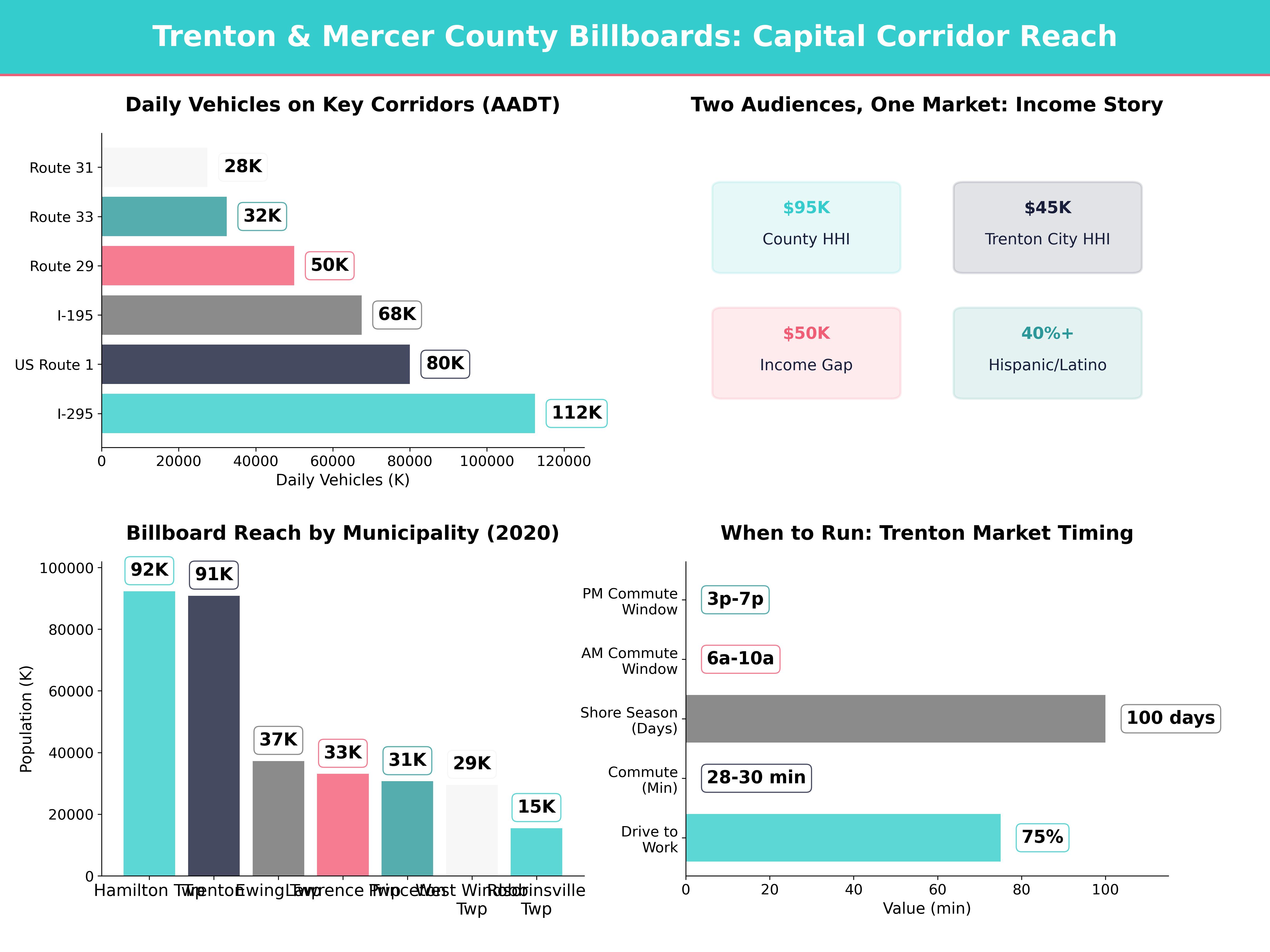
Trenton market overview for billboard advertisers
When we plan around Trenton, we are not buying a single municipality in isolation. We are tapping a countywide network of government offices, suburban households, colleges, medical campuses, shopping districts, and cross-river commuters within a market of 387,340 residents.
Demographics and economic mix
The market starts with steady population scale. Trenton grew from 84,913 residents in 2010 to 90,871 in 2020, which is an increase of about 7.0% or 5,958 residents. Mercer County grew from 366,513 residents in 2010 to 387,340 in 2020, which is about 5.7% growth, or 20,827 residents, across the decade.
That growth is spread across a useful mix of communities. Hamilton Township 92,297 residents in 2020, which made it slightly larger than Trenton itself. Ewing Township had 37,264 residents, Lawrence Township had 33,077, Princeton 30,681, West Windsor Township had 29,494, and Robbinsville Township had 15,476.
Mercer County also spans several income bands, which is valuable for billboard strategy. Recent local income estimates put Mercer County median household income at roughly $95,000, while Trenton is closer to $45,000. That spread tells us we can run different creative and different offers by corridor, rather than assuming one message will fit the entire market, with an income gap of about $50,000 between the county and the city.
Trenton is also one of New Jersey’s more diverse small capitals. More than 40% of Trenton residents identify as Hispanic or Latino, which makes bilingual or bicultural messaging practical in many city-centered campaigns. We can use that diversity to make creative feel more local and more useful.
Economically, Trenton benefits from public-sector employment, higher education, healthcare, insurance, and regional services. The New Jersey State House, Capital Health, NJM Insurance Group, Thomas Edison State University, The College of New Jersey, Rider University, Mercer County Community College, and Princeton University
Commute behavior and mobility patterns
Mercer County remains a car-led advertising market. Roughly 3 in 4 workers commute by car when we combine solo drivers and carpools, and typical commute times are about 28 to 30 minutes. That matters because repeat weekday exposure is what makes billboards especially efficient for awareness, recruiting, healthcare, retail, and service brands.
Trenton itself is more multimodal than its suburbs, which gives us a useful split audience. NJ Transit service at Trenton Transit Center connects riders to the Northeast Corridor and the River LINE, and SEPTA adds a direct Philadelphia connection. In practice, that means downtown boards can work for both motorists and transit-linked foot traffic, while the suburban boards around I-295, US 1, and I-195 carry the heaviest frequency.
Mercer County has 12 municipalities, but the travel patterns are concentrated enough that a well-chosen corridor strategy still reaches the region efficiently. That concentration is one of Trenton’s biggest advantages on digital billboards.
Key traffic corridors for Trenton billboard campaigns
Trenton’s visibility comes from a relatively small number of corridors that carry a very large share of regional travel. When we understand those corridors, we can choose placements that match commuter intent, retail behavior, and tourism flow.
Interstate 295 and the Delaware crossings
According to NJDOT traffic count maps, key I-295 segments through Ewing, Lawrence, and Hamilton regularly carry more than 100,000 vehicles per day, with several stretches falling in the 100,000 to 125,000 AADT range. This is one of the strongest billboard backbones in the Trenton market.
I-295 is especially important because it does more than serve Mercer County residents. It also pulls in Pennsylvania drivers via the Delaware River Joint Toll Bridge Commission crossings, including the Scudder Falls Bridge, and it funnels traffic between Bucks County, suburban Mercer, and the broader New York-Philadelphia corridor.
We usually like I-295 for advertisers that benefit from repeated commuter impressions. Healthcare systems, law firms, home services, insurers, business-to-business services, and recruiting campaigns all fit well here because the audience is broad, mobile, and consistent from Monday through Friday.
US Route 1 through Lawrence, West Windsor, and Princeton
US 1 is Trenton’s premium commercial corridor. Major segments around Lawrence, Princeton, and West Windsor often run in the 70,000 to 90,000 AADT band, and the route ties together office parks, hotels, shopping centers, and higher-education traffic.
This corridor touches some of Mercer County’s best-known consumer nodes, including Quaker Bridge Mall MarketFair, Princeton-area business parks, and the broader Princeton University
We typically recommend Route 1 for retail, dining, healthcare, financial services, education, and premium consumer offers. It is also a smart corridor for branding campaigns that need to look established, because the surrounding context already signals business activity and purchasing power.
Interstate 195 and the Turnpike connection
I-195 is the practical link between Trenton’s western side and New Jersey’s eastern travel flows. In the Hamilton and Robbinsville area, many segments fall roughly in the 55,000 to 80,000 AADT range, and the route becomes even more valuable where it interfaces with the New Jersey Turnpike Authority
This is where we can combine commuter traffic, warehouse and logistics movement, and seasonal leisure travel. During warmer months, I-195 also captures part of the Shore-bound audience moving east on Fridays and returning west on Sundays.
We like this corridor for quick-service restaurants, family entertainment, auto dealers, warehouse recruiting, travel-related brands, and businesses that want both weekday workers and weekend visitors. It is also useful for brands with multiple locations in Mercer, Monmouth, or Ocean counties.
Route 29, Route 33, and Route 31 for local frequency
Not every advertiser in Trenton needs the biggest highway. Sometimes we get better results from roads that provide stronger local context.
Route 29 along the Delaware waterfront and through Trenton commonly reaches 40,000 to 60,000 vehicles per day on busier segments. Route 33 through Hamilton often lands in the 25,000 to 40,000 AADT range. Route 31 through Ewing, Pennington, and Hopewell frequently falls around 20,000 to 35,000 AADT.
These routes are useful when we want to be close to decision points. Route 29 works well for downtown employers, government services, museums, and riverfront destinations. Route 33 is strong for suburban retail, dining, and healthcare in Hamilton. Route 31 helps us reach Ewing commuters, local professionals, and drivers heading toward Trenton-Mercer Airport Pennington, and Hopewell
Audience segments we can reach in Trenton
Trenton’s value is not just the number of drivers on the road. It is the variety of audiences using those roads for different reasons across the day and across the year.
Government workers, office commuters, and civic audiences
As the state capital, Trenton brings a distinct weekday audience that many similarly sized cities do not have. The New Jersey State House has anchored the city since 1792, and downtown also concentrates county government, courts, offices, and civic institutions.
That gives us a dependable audience for legal services, staffing, insurance, financial services, healthcare, public-information campaigns, and advocacy work. We can also lean on the business activity supported by Trenton Downtown Association, Mercer County NJM Insurance Group, and Thomas Edison State University.
Because these audiences often follow predictable schedules, billboard frequency matters. Morning and late-afternoon runs can be especially effective for downtown and Route 29 placements.
Students, faculty, and parent households
Mercer County has an unusually dense education cluster for a market of this size. The College of New Jersey enrolls about 7,000 undergraduates, Rider University serves about 4,000 students, Princeton University 8,500 students, and Mercer County Community College serves more than 10,000 students annually.
That creates several different advertising opportunities. We can target traditional undergraduates in Ewing and Lawrence, graduate and professional audiences in Princeton, community-college learners throughout the county, and parent traffic around move-in, open houses, and commencements.
Education, telecom, food, entertainment, housing, tutoring, banks, rideshare-adjacent services, and part-time recruiting all fit this audience well. College-heavy routes also reward timely creative because student decisions are often tied to a deadline or semester milestone.
Families and suburban households
The suburban side of the market is large enough to matter on its own. Hamilton’s 92,297 residents make it larger than Trenton itself, and the Route 1 municipalities of Lawrence, Princeton, and West Windsor combine for 93,252 residents.
These areas give us strong reach into family spending, homeownership, healthcare utilization, youth activities, and premium consumer services. They are especially effective for home improvement, orthodontics, personal injury, private education, grocery and dining, financial planning, and regional healthcare systems.
When we want household decision-makers instead of pure office traffic, Hamilton, Lawrence, West Windsor, Princeton, and Robbinsville usually deserve a meaningful share of the plan.
Visitors, event fans, and cross-river travelers
Trenton also has more leisure and destination traffic than many advertisers realize. Grounds For Sculpture is a 42-acre cultural campus in Hamilton. CURE Insurance Arena seats about 10,000 people. Trenton Thunder plays in a ballpark with 6,341 seats.
The region also benefits from outdoor and heritage attractions. New Jersey State Parks includes the 70-mile Delaware and Raritan Canal State Park corridor, Mercer County Park Commission 2,500-acre Mercer County Park, New Jersey State Museum brings families and school groups downtown, and Old Barracks Museum preserves a site that dates to 1758.
Because Trenton borders Pennsylvania, we also reach cross-river travelers coming from Bucks County, which has 646,538 residents, for work, shopping, dining, education, and healthcare. That is one reason bridge-adjacent and I-295 boards often overperform for regional brands.
Seasonal and timing opportunities in Trenton
In Trenton, timing can be just as important as geography. A smart campaign calendar lets us match spend to the city’s government, school, leisure, and shopping rhythms.
Government and legislative timing
Downtown Trenton becomes especially valuable when government activity rises. The New Jersey Legislature is most visible during the first half of the year, and the period from March through June is especially important because budget negotiations, advocacy activity, and policy news intensify.
We usually recommend stronger weekday daytime and commute targeting during these months for legal, public affairs, recruiting, professional services, and civic messaging. Election-season advertising can also build momentum from September through November, especially for issue campaigns and organizations with public-facing missions.
Academic calendar windows
The college market gives us several reliable timing spikes. Late August and September bring move-in, orientation, and the start of the fall semester. January brings a second reset for spring term activity. May and early June are key for commencements, housing, dining, gifting, and parent-focused campaigns.
These windows matter not only for students, but also for families, alumni, faculty, and campus visitors. When we align boards with those moments, short-run digital campaigns can feel much more intentional.
Spring and summer leisure traffic
From late spring into early fall, Trenton picks up event and recreation value. The Trenton Thunder season stretches across much of the warmer half of the year, and Visit Princeton-Mercer
I-195 becomes more interesting from Memorial Day to Labor Day because the roughly 100-day Shore travel window increases eastbound and westbound leisure movement. Friday afternoons, Saturday mornings, and Sunday evenings are particularly useful when we want to intercept travelers heading to or from the coast.
Holiday and winter visibility
Late November and December are strong retail months on Route 1 and in Hamilton, especially near shopping centers and restaurant clusters. Downtown also gains a seasonal heritage audience during Patriots Week, which typically runs from December 26 through December 31.
Winter has another advantage for outdoor media. Near the December solstice, Trenton gets less than 9.5 hours of daylight, so illuminated digital boards stand out earlier in the evening. That makes winter commute targeting especially efficient for restaurants, healthcare, entertainment, and last-minute retail messaging.
Billboard design tips for the Trenton market
The best Trenton creative feels local, fast to read, and matched to the road and audience. We can improve results noticeably when we build the design around how Mercer County actually moves.
Design for fast roads and short read times
On roads where traffic is moving 55 to 65 mph, we should treat the board like a headline, not a flyer. In most cases, 6 to 7 words of primary copy is enough. One brand mark, one offer, and one call to action usually beat crowded layouts.
This matters most on I-295, I-195, and parts of US 1. Those corridors reward bold contrast, simple typography, and a single takeaway. If we need more detail, we are usually better off pushing the audience to a memorable URL, a short phone number, or a branded search term.
Use Trenton’s civic identity to our advantage
Trenton responds well to creative that feels practical, credible, and rooted in place. The “Trenton Makes, The World Takes” bridge slogan has been part of the city’s identity since 1935, and that spirit still shapes how local messaging lands. Ads that feel hardworking and direct often fit better than ads that feel abstract or overly polished.
For downtown boards, we can use cues such as the State House dome, riverfront references, or familiar local place names. For suburban boards, we can shift to school, family, retail, or convenience cues without losing local relevance.
Consider bilingual or bicultural creative where it fits
Because more than 40% of Trenton residents are Hispanic or Latino, Spanish-language or bilingual creative can be a strong choice on city-centered routes, especially around Route 29, Route 33, and local service corridors. We usually recommend parallel messaging that reads in 1 to 2 seconds, rather than dense dual-language copy.
That approach is especially useful for healthcare, banking, telecom, education, grocery, community events, and public-information campaigns. When the message is simple and respectful, it feels helpful rather than forced.
Match the tone to the corridor
We get better results in Trenton when the creative looks like it belongs where it appears.
- Downtown Trenton creative should emphasize trust, urgency, and professionalism, which is why healthcare, legal, insurance, and public-service brands often do well with navy, white, green, and strong typography.
- Route 1 creative can feel more polished and aspirational, because Princeton, Lawrence, and West Windsor audiences often respond to premium imagery, education cues, and outcome-oriented messaging.
- Hamilton and I-195 creative can lean into family value, food, entertainment, and weekend planning, with warmer colors and timing words such as “Tonight,” “This Weekend,” or “Exit Ahead.”
- College-zone creative near Ewing, Lawrence, and Princeton works best when it presents a concrete next step, such as applying, registering, attending, or getting hired.
Regional strategies across Trenton and Mercer County
A strong Trenton campaign usually works best when we think in submarkets, not just city limits. Different parts of Mercer County play different roles in the media plan.
Downtown Trenton and the Route 29 riverfront
Downtown Trenton is where we focus on government, legal, civic, cultural, and weekday office audiences. Boards here are best for public-sector messaging, courthouse-adjacent services, lunch and after-work dining, museums, events, and professional recruiting.
We usually prioritize these placements when the campaign needs weekday relevance, political visibility, or a strong association with the capital city itself.
Hamilton and the Route 33 and I-195 belt
Hamilton Township 92,297 residents, substantial retail traffic, and excellent highway access. This is often the best submarket for family services, urgent care, restaurants, grocery, entertainment, and home improvement.
When we want scale without a purely urban context, Hamilton is often our first suburban choice. It also gives us good access to Route 33 shoppers and I-195 pass-through traffic.
Lawrence, Princeton, and West Windsor on Route 1
Lawrence Township, Princeton West Windsor Township combine for 93,252 residents and a large share of the county’s higher-income, education-heavy audience. This is where we place boards for higher education, healthcare, finance, premium retail, and business services that need a more affluent or institutionally connected audience.
This zone also works very well for brands that want to borrow credibility from the Princeton name without advertising only within Princeton itself.
Ewing, West Trenton, and airport-access corridors
Ewing Township brings 37,264 residents, access to The College of New Jersey, nearby NJM Insurance Group, and routes leading toward Trenton-Mercer Airport
If we also need Pennsylvania crossover, this area pairs well with I-295 and the Delaware bridge approaches.
Robbinsville and the Turnpike logistics edge
Robbinsville Township may have a smaller population at 15,476, but it matters because of its location near major warehouse, distribution, and Turnpike activity. We like this area for recruiting, industrial services, trucking, fleet, and quick-turn consumer offers aimed at workers on the move.
Using Blip tools and capabilities in Trenton
Blip is especially useful in Trenton because the market rewards timing, testing, and corridor-specific strategy more than one-size-fits-all buying.
Daypart around Trenton’s real traffic patterns
We can use morning commute windows such as 6 a.m. to 10 a.m. and evening windows such as 3 p.m. to 7 p.m. on I-295, US 1, Route 29, and Route 33 when the goal is commuter reach. We can shift toward 11 a.m. to 2 p.m. downtown for government and office-worker lunch traffic, or toward 4 p.m. to 8 p.m. for arena, dining, and event nights.
That kind of dayparting matters in Trenton because the same board can serve a very different audience at different hours.
Scale budgets up and down by season
We can increase presence during the March through June government window, the late August and September student return, the 100-day summer travel season on I-195, and the holiday retail stretch in late November and December. We can also pull back quickly when the calendar changes, which helps us keep spend aligned with actual opportunity.
Because digital billboard buying on Blip can start at $0.01 per display, we can test a corridor before committing more budget to it.
Test creative by submarket
Trenton is a market where side-by-side testing is useful. We can run one creative style downtown, another on Route 1, and a third on Hamilton family corridors, then use real-time analytics to see which message earns the strongest response.
We can also compare bilingual and English-only creative, premium and value framing, or weekday and weekend timing. Blip’s artwork tools make this easier because we can swap or refine creative without rebuilding the entire campaign.
Getting started with billboard rental in Trenton
Renting a billboard in Trenton becomes much simpler when we start with the business goal and then work backward to the right roads, audiences, and schedule.
Choose the goal before the location
If the goal is immediate store, restaurant, or event traffic, we usually want boards within 1 to 3 miles of the destination and close to decision points such as exits, bridges, shopping centers, or downtown turns. If the goal is broader awareness, recruiting, healthcare branding, education marketing, or legal visibility, commuter boards 5 to 15 miles out often make more sense because they build recognition before the audience is ready to act.
That distinction matters in Trenton because a downtown legal campaign, a Hamilton restaurant promotion, and a Princeton-area education campaign should not be judged by the same map logic.
Evaluate each Trenton board like a driver would
We recommend looking at every candidate board through four lenses. We want to know the direction of travel, the likely speed, the proximity to a decision point, and the match between the route and the message.
A board near an exit to Quaker Bridge Mall
Use Blip to simplify the rental process
Traditional billboard buying often revolves around negotiated packages and 4-week cycles. Blip simplifies that process by letting us choose digital boards on a map, set daily budgets, upload artwork, and adjust targeting without waiting for a long sales process or a fixed contract window.
That flexibility is especially valuable in Trenton because local opportunity changes quickly. We may want one burst for budget season, another for college move-in, and another for holiday retail. With Blip, we can start small, learn from live results, and expand only where the data says the market is responding.
Launch, measure, and optimize
We usually recommend starting with 2 or 3 strong locations, 2 or 3 creative versions, and a 2- to 4-week learning window. From there, we can look at which corridor, daypart, and message combination is carrying the campaign.
Once we find the right fit, scaling in Trenton is straightforward because the market’s travel patterns are concentrated and predictable. That is the core advantage of billboard rental in Trenton. We do not have to guess our way through the market. We can match the message to the corridor, the corridor to the audience, and the timing to the moment.