Billboards near Oakland, NJ
No Minimum Spend. No Long-Term Contracts. Just Results.
Trusted by Leading Brands


Billboard advertising
near Oakland has never been easier



How much is a billboard near Oakland?
Why Choose Blip for Billboard Advertising near Oakland
-
Blip lets Oakland brands launch fast on I-287 exits 57/58—self-serve, no contracts, just local reach where commuters actually drive.
-
In Oakland, flexible budgets help you test Route 208 and Ramapo Valley Road without a big upfront spend; pay only for the blips that play.
-
Daypart your Oakland ads for 6-9am and 3:30-7pm rushes, then shift to Saturday traffic near Ramapo Mountain State Forest and Campgaw.
-
Oakland campaigns stay nimble with Blip's real-time analytics, so you can adjust when Bergen County commuter traffic or weekend rec traffic wins.
-
Use Blip's creative tools to tailor Oakland billboards for school-year families, Route 202 shoppers, or winter Campgaw visitors in seconds.
Frequently Asked Questions About Billboard Advertising near Oakland
How much does a billboard cost in Oakland, New Jersey with Blip?
With Blip, billboard advertising in Oakland can be surprisingly affordable because you only pay when your ad actually appears. Each “blip” is a 7.5-to-10-second display on a rotating digital billboard, with pricing starting at $0.01 per display. Your daily budget is used by Blip’s algorithm to compete for open ad slots, and the cost per blip can change based on time of day, location, and advertiser demand.
Where can I advertise with Blip in Oakland, New Jersey for the most traffic?
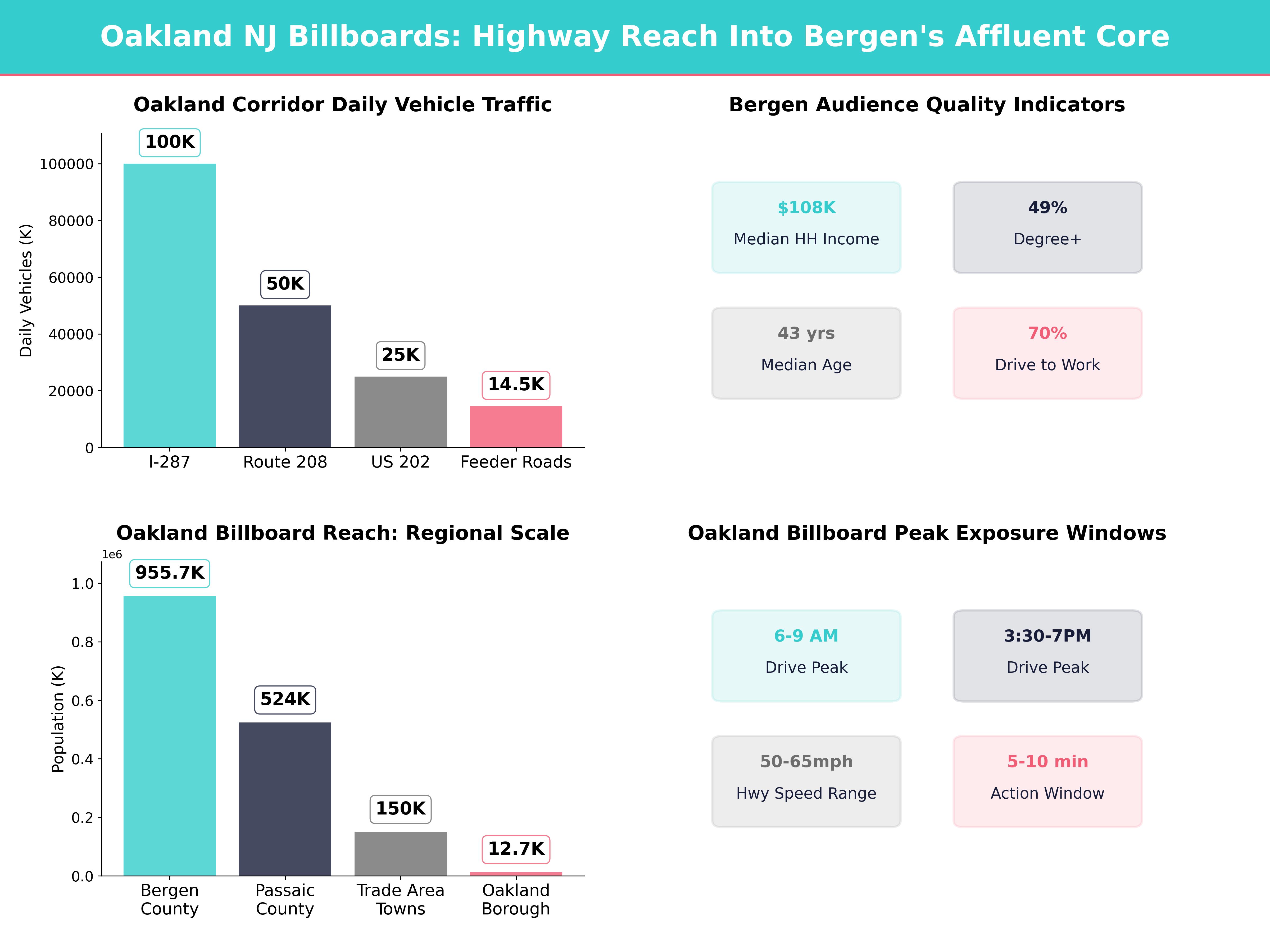
Oakland-area segments of Interstate 287 typically carry about 90,000 to 110,000 vehicles per day, and the borough is served directly by exits 57 and 58. Route 208 is another important feeder into Oakland from central and eastern Bergen County, and on northern segments approaching Oakland the traffic often falls in the 40,000 to 60,000 AADT range. U.S. 202, locally experienced as Ramapo Valley Road, is Oakland’s commercial spine and commonly lands in the 20,000 to 30,000 vehicles per day range on busier segments.
Why is Oakland, New Jersey a strong billboard market for Blip?
Oakland gives us a strong billboard market because it combines a stable local population with outsized regional traffic. The borough has roughly 12,700 residents, but it sits inside Bergen County with 955,732 people and along a North Jersey road network that pulls commuters, shoppers, and recreation visitors across county lines every day. Because Oakland has 0 rail stations and most daily movement happens by car, roadside media captures attention where local decisions actually get made.
What kind of people does billboard advertising in Oakland, New Jersey reach?
Recent county profile summaries show why Bergen County is attractive to advertisers: median household income is about $108,000, the county median age is about 43, and nearly 49% of adults 25 and older hold a bachelor’s degree or higher. Bergen County’s population is roughly 21% Hispanic or Latino and about 18% Asian, which means campaigns can perform better when they match language, imagery, and offers to the wider North Jersey audience. Oakland itself feels distinctly residential and family-oriented, but its roadway audience is broader than its town census.
When is the best time to run billboard ads in Oakland, New Jersey with Blip?
Oakland rewards dayparting because travel intent changes throughout the week. Weekday campaigns usually perform best in the 6:00 to 9:00 a.m. and 3:30 to 7:00 p.m. windows, when commuters and school traffic overlap. Friday afternoon campaigns work well for restaurants, retail, and recreation, while Saturday late morning and early afternoon campaigns work well for home services, family activities, and local retail.
Do I need a contract to advertise with Blip near Oakland?
No, Blip has no long-term contracts or minimum commitments. You can start, pause, or stop your campaign at any time.
How fast can I launch a billboard campaign with Blip near Oakland?
You can have your campaign live in minutes. Create a free account, select your locations, set your budget, upload your design, and start running once approved.
Where can I advertise with Blip near Oakland?
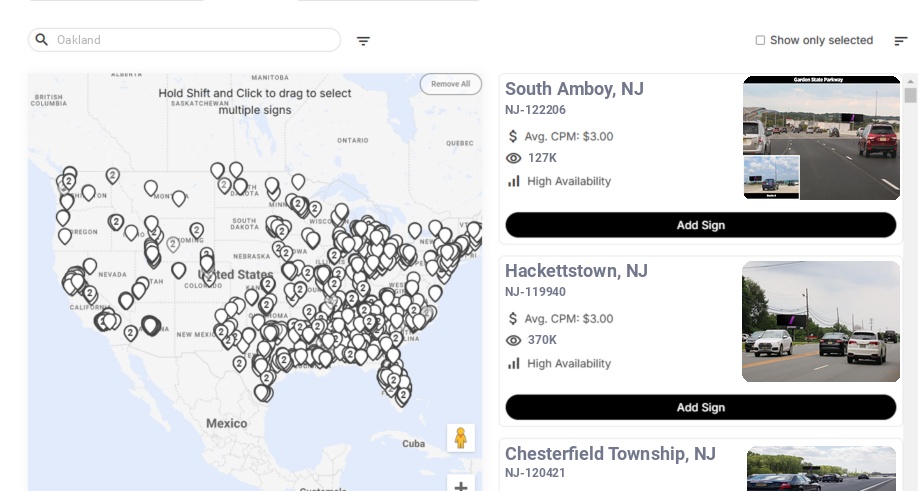
Blip has digital billboards near Oakland. You can browse available locations on a map, choose the ones that fit your audience, and start advertising right away.
Still have questions? Launch a campaign in minutes — no contracts, no commitments.
Start Your CampaignOakland Billboard Advertising Guide
Oakland New Jersey gives us a strong billboard market because it combines a stable local population with outsized regional traffic. The borough has roughly 12,700 residents, but it sits inside Bergen County with 955,732 people and along a North Jersey road network that pulls commuters, shoppers, and recreation visitors across county lines every day, including nearby Passaic County 524,000 residents. Because Oakland 0 rail stations and most daily movement happens by car, roadside media captures attention where local decisions actually get made. That mix of affluent households, repeat commuter exposure, and year-round outdoor traffic — including nearby 4,268-acre Ramapo Mountain State Forest and 1,351-acre Campgaw Mountain Reservation — makes Oakland an efficient place for digital billboard advertising.
Oakland, New Jersey Market Overview
Oakland is small on a municipal map, but we should not evaluate it as a small-town media buy. We should evaluate it as a gateway community between northwest Bergen County, southern Passaic County 524,000 residents, and the broader North Jersey commuter shed.
Oakland Sits in a Much Larger Consumer Belt
New Jersey had 9,288,994 residents in the 2020 Census, and Bergen County accounted for 955,732 of them. Bergen County added about 50,616 residents during the 2010s, which was roughly 5.6% growth, while New Jersey as a whole added 497,100 residents, or about 5.7%. That tells us this is not a fading market. It is a mature, high-value suburban market with steady household demand.
Within a short drive of Oakland, we also reach drivers from Mahwah Township Franklin Lakes, Wyckoff, Wayne Township, Pompton Lakes Wanaque. Those surrounding communities add well over 150,000 additional residents to Oakland’s realistic trade area. For billboard planning, that matters more than the borough line.
Bergen County Brings Affluence, Education, and Family Purchasing Power
Recent county profile summaries from the New Jersey Department of Labor and Workforce Development show why Bergen County is attractive to advertisers. Median household income in Bergen County is about $108,000, the county median age is about 43, and nearly 49% of adults 25 and older hold a bachelor’s degree or higher. Those are strong indicators for categories like healthcare, higher education, financial services, home improvement, legal services, premium retail, and family recreation.
The county is also diverse enough to reward thoughtful creative. Bergen County’s population is roughly 21% Hispanic or Latino and about 18% Asian, which means our campaigns can perform better when we match language, imagery, and offers to the wider North Jersey audience instead of assuming one generic suburban profile. Oakland itself feels distinctly residential and family-oriented, but its roadway audience is broader than its town census.
Oakland Is a Road-First Media Environment
Roadside media matters in Oakland because the borough is primarily experienced through driving. NJ Transit serves the area mainly by bus, including route 197, but Oakland has 0 rail stations. Even in Bergen County, where transit is more available than in many suburban counties, recent commuting data still shows that roughly 70% of workers commute by private vehicle when we combine driving alone and carpooling. In Oakland, that share is effectively higher because local errands, school trips, youth sports, medical appointments, and shopping runs are overwhelmingly road-based.
For advertisers, that means billboard exposure is not competing with subway tunnel clutter or heavy walk-by media. It is appearing in the exact environment where North Jersey households navigate, compare options, and decide where to stop next.
Key Traffic Corridors for Oakland, New Jersey Billboards
Oakland’s travel patterns are dominated by a few high-value roadways. When we understand how each corridor functions, we can match billboard placements to the right audience and message.
Interstate 287 in Oakland
According to traffic count resources from the New Jersey Department of Transportation, Oakland-area segments of Interstate 287 typically carry about 90,000 to 110,000 vehicles per day. The borough is served directly by exits 57 and 58, which makes I-287 the primary regional reach corridor for Oakland campaigns.
This is the route we should use when we want scale rather than purely local intent. I-287 connects drivers moving between Mahwah Township Wanaque, Wayne Township, and the broader Morris and Essex employment belts. It is especially effective for advertisers with larger trade areas.
- Regional healthcare systems perform well on I-287 because the route carries patients, caregivers, and shift workers across county lines.
- Auto dealers, tire shops, collision centers, and service businesses perform well because drivers are already in a vehicle-oriented mindset.
- Colleges, trade schools, and recruitment campaigns perform well because the corridor reaches both students and working adults during repetitive weekday travel.
- Home services, insurance, and legal advertisers perform well because frequency matters, and I-287 creates that frequency.
Route 208 Feeding Oakland
Route 208 is one of the most important feeders into Oakland from central and eastern Bergen County. NJDOT counts on northern segments approaching Oakland and the I-287 connection often fall in the 40,000 to 60,000 AADT range. That is smaller than I-287, but it is still substantial suburban traffic with strong household buying power.
Route 208 connects communities such as Fair Lawn, Glen Rock, Wyckoff, Franklin Lakes, and Oakland
- Grocery, pharmacy, urgent care, and consumer services benefit because Route 208 carries daily errand traffic.
- Furniture, kitchen remodeling, roofing, landscaping, and other higher-consideration home categories benefit because the surrounding towns are owner-heavy and affluent.
- Local retail and restaurants benefit when they use directional copy tied to a nearby exit or cross street.
U.S. 202 and Ramapo Valley Road in Oakland
U.S. 202, locally experienced as Ramapo Valley Road, is Oakland’s commercial spine. On busier segments through and near the borough, traffic volumes commonly land in the 20,000 to 30,000 vehicles per day range. That is the corridor we use when we want local conversion rather than just regional awareness.
Unlike I-287, U.S. 202 gives us slower approach speeds, more signalized intersections, and more time for drivers to process an offer. It connects Mahwah Township Pompton Lakes Wayne Township, and it captures in-town errands extremely well.
- Restaurants, banks, dentists, pediatric practices, orthodontists, gyms, and childcare providers benefit because the audience is close enough to act the same day.
- Municipal events, school fundraisers, and community-oriented promotions benefit because local recognition is high along this road.
- Service businesses benefit when we emphasize distance, convenience, and trust, such as “Minutes from downtown Oakland” or “Right off 202.”
Ringwood Avenue, Skyline Drive, and Other Cross-County Feeders Near Oakland
Smaller feeder roads matter in Oakland because they add context to the big highways. Corridors such as Ringwood Avenue and the Skyline Drive connection commonly carry about 11,000 to 18,000 vehicles per day, depending on the segment. Those volumes are lower, but the audience is often highly intentional.
These roads move people between Oakland Ringwood Wanaque, Pompton Lakes Ramapo Mountain State Forest and Campgaw Mountain Reservation. We should use these corridors when weekend intent matters more than sheer scale.
- Outdoor recreation brands, restaurants, breweries, and family attractions benefit because the traffic is often leisure-oriented.
- HVAC, plumbing, fuel delivery, and emergency home service brands benefit because these routes reach homeowners in low-density areas where reliability matters.
- Event-driven campaigns benefit because the audience is local enough to respond quickly and regional enough to expand beyond Oakland alone.
Oakland Audience Segments We Can Reach
The best Oakland billboard campaigns work because they reflect the real mix of people on the road. We are not only speaking to borough residents. We are speaking to several overlapping North Jersey audiences.
Oakland Commuters and Cross-County Professionals
Weekday commuters are the backbone of frequency in this market. Between I-287, Route 208, and U.S. 202, we can repeatedly reach professionals traveling between Bergen County, Passaic County, and the broader North Jersey job base. The presence of exits 57 and 58 on I-287 gives Oakland unusually strong roadway relevance for a borough of its size.
This segment is strong for:
- Healthcare, because appointments and provider choice are often regional.
- Financial and legal services, because trust builds through repetition.
- Business recruitment and staffing, because commuting workers see the same corridors multiple times per week.
- Auto, telecom, and insurance brands, because road-based attention is already present.
Oakland Families and Homeowners
Oakland and nearby towns such as Franklin Lakes, Wyckoff, and Mahwah Township $108,000 and bachelor’s-degree attainment near 49% point to an audience that is educated, family-centered, and comfortable making considered purchases.
This is why local billboard campaigns often perform well for:
- Home remodeling, roofing, windows, landscaping, and pools.
- Orthodontics, pediatric care, urgent care, and family dentistry.
- Private education, tutoring, enrichment, and youth sports programs.
- Financial planning, estate planning, and insurance.
Students, Parents, and Education Buyers Around Oakland
Oakland is also near meaningful higher education traffic. Ramapo College of New Jersey in Mahwah enrolls about 5,700 students, and William Paterson University in Wayne enrolls roughly 9,000. Those institutions create student, faculty, staff, and visiting-family traffic that overlaps with Oakland’s key roads.
The K-12 audience is substantial as well. Oakland Public Schools and the Ramapo Indian Hills Regional High School District keep school-year travel patterns highly consistent from late August through June. That makes Oakland billboards useful for tutoring, music lessons, test prep, youth healthcare, camps, and family entertainment.
Outdoor Recreation and Weekend Leisure Traffic Near Oakland
Oakland has a meaningful leisure audience that many suburban media plans miss. Ramapo Mountain State Forest covers 4,268 acres, and nearby Campgaw Mountain Reservation spans 1,351 acres. Add Ringwood State Park, Bergen County Parks, and the wider Ramapo recreation belt, and we get real weekend movement through the area.
This audience is ideal for:
- Restaurants and coffee shops.
- Outdoor gear, sporting goods, and auto accessories.
- Seasonal attractions and family outings.
- Real estate and destination retail targeting people already exploring the area.
Seasonal Advertising Opportunities in Oakland, New Jersey
Oakland is not purely a commuter market. It changes noticeably by season, and we should time campaigns accordingly.
Winter in Oakland
Winter gives us two useful patterns. First, there is practical winter-demand advertising for services like heating, plumbing, urgent care, tire shops, and pharmacies. Second, there is recreation-driven traffic tied to Campgaw Mountain Reservation, whose ski and snow activity typically runs from December through March, weather permitting.
During winter, we should lean into afternoon and early evening visibility. Darkness comes earlier, weather changes can be sudden, and drivers are often making fast decisions about service providers, takeout, or indoor activities. High-contrast creative performs especially well here.
Spring and Summer Around Oakland
Spring is excellent for home improvement, landscaping, garden centers, deck builders, and outdoor living brands. By late spring and summer, traffic also builds around hiking, camps, park visits, and day trips through the Ramapo area. Messages tied to convenience, family fun, and “open now” urgency can work well on Fridays and weekends.
This is also a good time for healthcare, orthodontics, tutoring, and camp marketing because parents are planning ahead. We should watch school calendars and start those campaigns before families are fully booked.
Fall in Oakland
Fall is one of Oakland’s best advertising windows. Back-to-school routines return in late August and September, and the area’s wooded landscape creates strong recreational and shopping movement through October. Ramapo College of New Jersey, William Paterson University, Oakland Public Schools, and the Ramapo Indian Hills Regional High School District all help restore predictable weekly traffic patterns.
We should use fall for:
- Education, tutoring, and youth programs.
- Healthcare screenings and elective care.
- Financial and tax planning lead generation before year end.
- Retail and restaurant campaigns that want to warm up before holiday competition peaks.
Weekly and Daily Timing in Oakland
Oakland rewards dayparting because travel intent changes throughout the week.
- Weekday campaigns usually perform best in the 6:00 to 9:00 a.m. and 3:30 to 7:00 p.m. windows, when commuters and school traffic overlap.
- Friday afternoon campaigns work well for restaurants, retail, and recreation because weekend plans are being made in real time.
- Saturday late morning and early afternoon campaigns work well for home services, family activities, and local retail.
- Tuesday through Thursday often work best for professional services and B2B-style recruiting messages because travel is more routine.
Billboard Design Tips for the Oakland, New Jersey Market
Oakland creative should feel local, practical, and trustworthy. The audience is suburban, educated, and often moving quickly.
We Should Use Local Directional Language
In Oakland, place matters. Drivers respond well to location-specific copy such as “Off I-287 Exit 58,” “Near Ramapo Valley Road,” or “Minutes from Mahwah and Wayne.” Those phrases work because they match how people actually navigate North Jersey.
This is especially important on I-287 and Route 208, where speeds are higher and read time is shorter. On those corridors, we should usually keep headlines to about 6 to 7 words and use one dominant visual. Simplicity is not generic best practice here. It is a local necessity on roads that often move at 50 to 65 mph.
Oakland Creative Should Feel Polished, Not Loud
Oakland’s surrounding trade area includes affluent Bergen County households that tend to respond to quality, convenience, expertise, and trust. We usually get better results with messages like “Board-Certified Care,” “Free In-Home Estimate,” or “Trusted by North Jersey Families” than with purely aggressive discount language.
That does not mean value messaging never works. It means we should match the corridor. Premium, service-led language fits eastbound Bergen suburban traffic particularly well, while more price-forward creative can work better when we are intentionally targeting a broader cross-county audience.
We Should Reflect the Region’s Natural and Seasonal Identity
Oakland sits near lakes, forests, and mountain scenery, so creative that references outdoor life often feels more native than generic urban imagery. Deep greens, blues, slate tones, and seasonal fall color palettes can feel especially aligned with the local environment. In winter, bold contrast matters because skies are darker and road conditions can be visually busy.
If we want to reach the wider Bergen County audience, we should also remember the county’s diversity. With roughly 21% Hispanic or Latino residents and about 18% Asian residents, multilingual or culturally tailored versions can be worth testing, especially when our offer is broad and our creative can stay concise within a 7.5- to 10-second digital billboard rotation.
Regional Strategies Around Oakland, Bergen County, and Nearby Passaic County
The best Oakland campaigns usually segment the area instead of treating every nearby road as identical.
The Oakland Core and U.S. 202 Strategy
When we want immediate local action, we should prioritize Oakland’s commercial spine. U.S. 202 and nearby in-town routes are best for restaurants, healthcare, gyms, banks, local retail, and community messaging. This is where we optimize for closeness, convenience, and same-day response.
Our creative here should answer one question quickly: “Why should we stop soon?” Distance-based copy, recognizable local landmarks, and clear category cues matter most.
The I-287 Strategy for Regional Reach
When our goal is broader awareness, I-287 should anchor the plan. It gives Oakland reach far beyond its municipal population and connects the borough to Mahwah Township Wayne Township, and the wider North Jersey commuter network. This is the right strategy for hospitals, colleges, recruitment, auto groups, regional entertainment, and multi-location service brands.
We should use boards near decision points, interchanges, and repeated commuter approaches whenever possible. Frequency is the advantage here.
The Eastern Bergen Suburb Strategy Through Route 208
If our ideal customer is an affluent Bergen household, Route 208 and the roads feeding it deserve special attention. The corridor toward Wyckoff and Franklin Lakes is especially strong for premium home services, elective healthcare, family recreation, and financial services.
Our tone should feel confident and useful, not noisy. High-quality visuals and proof-oriented claims usually outperform hype on this side of the market.
The Western and Southern Recreation Strategy
Toward Ringwood Wanaque, Pompton Lakes Wayne Township, we can lean harder into leisure, outdoor activity, value, and practical services. Weekend food, beverage, fuel, automotive, hardware, and recreation messages fit naturally here.
This submarket is also where weather-reactive campaigns can shine. Snow, heavy rain, holiday weekends, and school breaks all change trip intent quickly.
Using Blip Tools for Oakland, New Jersey Campaigns
Blip is especially useful in Oakland because the market has several distinct traffic types within a small geography. We do not have to guess once and lock ourselves in.
We Can Test Corridors Before Scaling
Oakland gives us at least three clear strategic lanes: I-287 for reach, Route 208 for Bergen suburban household traffic, and U.S. 202 for local conversion. With Blip’s flexible buying model, we can start with a modest budget, test all three, and let real performance tell us where our message resonates.
That matters in a place like Oakland, where a healthcare brand, a restaurant, and a home remodeler may all want very different roadway contexts.
We Can Daypart Around Real Local Behavior
Blip’s scheduling tools help us align with Oakland’s actual travel habits. We can weight commuter-heavy messages toward weekday morning and evening windows, then shift toward local retail and recreation on Friday afternoons and Saturdays. If our business depends on weather, school calendars, or weekend visitors, that flexibility is valuable.
We Can Rotate Creative by Season and Submarket
Oakland is a market where seasonal relevance matters. We can run one creative version for winter service demand, another for spring home improvement, and another for back-to-school or fall recreation. We can also tailor copy by corridor, such as regional messaging on I-287 and location-specific messaging on U.S. 202.
We Can Use Analytics to Tighten the Plan
Real-time reporting helps us see whether Oakland is acting more like a local conversion market or a regional awareness market for our category. If one board or one daypart clearly outperforms, we can reallocate quickly instead of waiting through a fixed traditional buy.
Getting Started with Billboard Rental in Oakland, New Jersey
Renting a billboard in Oakland is easiest when we start with the business goal, not the board.
We Should Define the Job of the Campaign First
Before we select locations, we should decide whether we want:
- Broad awareness across North Jersey.
- Immediate local visits in Oakland.
- Cross-county commuter frequency.
- Seasonal recreation traffic.
- School-year family reach.
That decision tells us whether to prioritize I-287, Route 208, U.S. 202, or a mixed approach.
We Should Evaluate Oakland Boards by Traffic Intent, Not Only by Price
A lower-cost board is not automatically the better board. In Oakland, we should evaluate each location by the direction of travel, proximity to exits 57 and 58, approach speed, distance from a decision point, and how closely the audience matches our customer profile.
We should also ask practical questions such as these:
- Are we trying to reach morning inbound commuters, evening homebound drivers, or both?
- Do we need regional visibility, or do we need drivers who can act within the next 5 to 10 minutes?
- Is our message simple enough for a high-speed highway read?
- Would a recreation corridor outperform a commuter corridor on weekends?
Blip Simplifies the Oakland Rental Process
Traditional billboard buying often means longer commitments, slower turnaround, and less room to test. With Blip, we can review digital billboard options on a map, choose the locations that fit our Oakland strategy, set our own budget, launch quickly, and adjust based on performance. That is a meaningful advantage in a market where traffic patterns differ so much between commuter highways, local commercial roads, and weekend recreation routes.
A smart Oakland campaign usually starts small, learns fast, and scales the placements that prove their value. When we combine local road knowledge with flexible digital buying, Oakland becomes a very efficient North Jersey billboard market.