Billboards near Princeton, NJ
No Minimum Spend. No Long-Term Contracts. Just Results.
Trusted by Leading Brands


Billboard advertising
near Princeton has never been easier
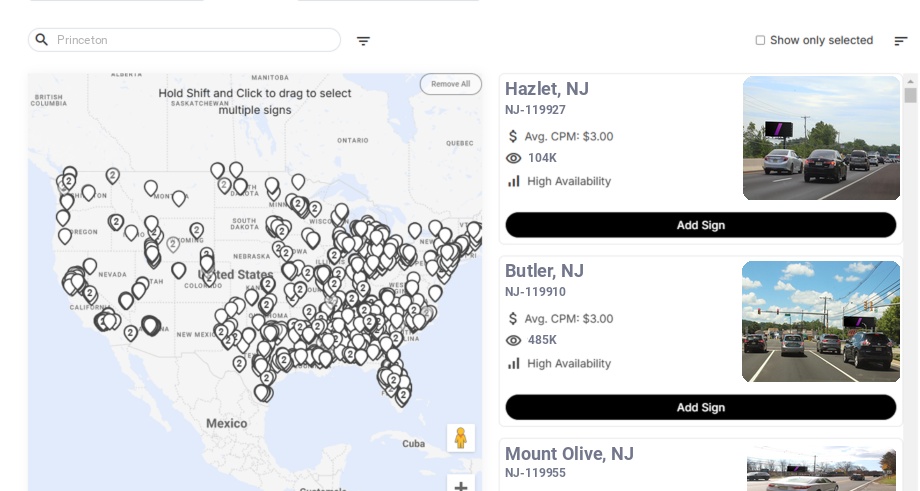



How much is a billboard near Princeton?
Why Choose Blip for Billboard Advertising near Princeton
-
Blip lets you launch in Princeton fast and self-serve, reaching Route 1 and I-295 commuters without the usual billboard hassle.
-
Set flexible budgets in Princeton and pay only for live blips—ideal for testing around Princeton University tours, Reunions, and Commencement.
-
Use dayparting in Princeton to hit 6-10 a.m. and 3-7 p.m. drive times on Route 1 with timing that matches commuter traffic.
-
No contracts in Princeton means you can pause or shift spend as Mercer County traffic changes between campus season and holiday shopping.
-
Track Princeton campaigns in real time and optimize on the fly for Nassau Street, Route 206, or the Princeton Junction commuter flow.
-
Blip's creative tools make it easy to tailor ads for Princeton's affluent, educated audience with polished messaging that stands out on digital billboards.
Frequently Asked Questions About Billboard Advertising near Princeton
How much does a billboard cost in Princeton with Blip?
With Blip, billboard advertising in Princeton can be surprisingly affordable because you only pay when your ad actually appears. Each “blip” is a 7.5-to-10-second display on a rotating digital billboard, with pricing starting at just $0.01 per display. You set a daily budget, and Blip’s algorithm uses it to bid for open ad slots, helping maximize your reach based on time of day, location, and advertiser demand.
Where can I advertise with Blip in Princeton to reach the most drivers?
US Route 1 is the backbone of the market, with the busiest local segments often in the 70,000 to 90,000 vehicles per day range. I-295 gives Princeton-area access to a larger regional audience, and Route 206 delivers a highly desirable local audience moving between Princeton, Montgomery Township, and nearby residential neighborhoods. Route 27, Nassau Street, and Princeton Junction approaches are better for precision and downtown-oriented traffic.
Who can Princeton billboard ads reach besides local residents?
Princeton gives advertisers access not only to the town’s 30,681 residents, but also the 387,340 people who live across Mercer County, plus commuters and visitors moving between New York City and Philadelphia. The area is anchored by Princeton University with more than 8,500 students and other institutions and employers that create a substantial daytime population beyond the resident count. That mix makes Princeton a high-quality market for both brand-building campaigns and direct-response advertising.
When is the best time to run billboard ads in Princeton with Blip?
Morning and evening billboard windows, especially from 6:00 to 10:00 a.m. and 3:00 to 7:00 p.m., are ideal for employment messaging, healthcare, financial services, and convenience-based retail. Spring is one of the most valuable advertising periods in Princeton because campus tours rise, Commencement approaches, and Princeton Reunions bring back about 25,000 visitors. Late August through November is another prime window as students return and commuter traffic normalizes after summer vacations.
Is Princeton a good market for Blip billboard advertising?
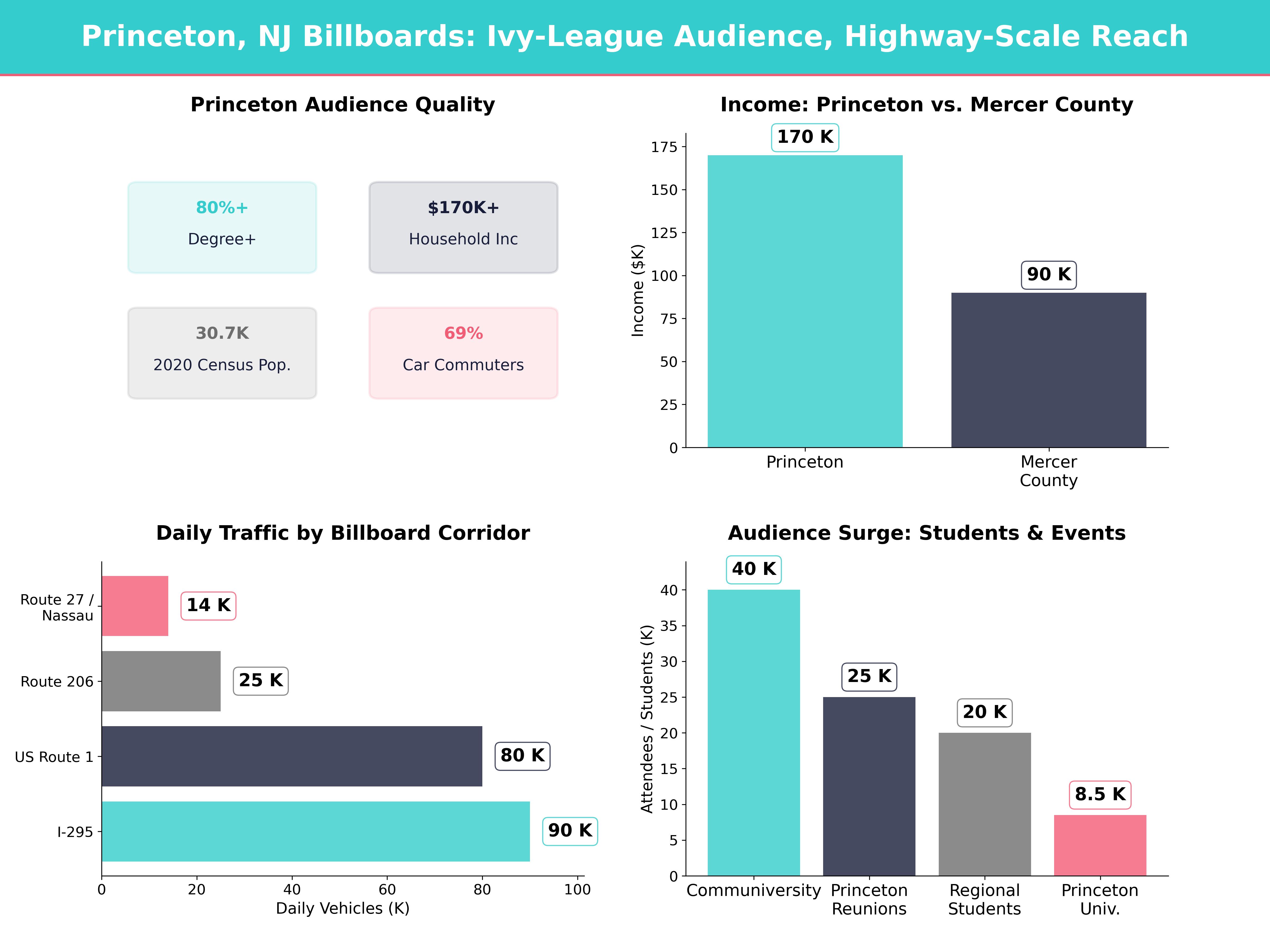
Princeton combines a 30,681-resident municipality with the spending power and travel patterns of a much larger regional trade area. Recent estimates place the town’s median household income above $170,000, and more than 80% of adults hold a bachelor’s degree or higher. That gives advertisers a rare combination of premium local buying power inside Princeton and strong mainstream reach across the county.
Do I need a contract to advertise with Blip near Princeton?
No, Blip has no long-term contracts or minimum commitments. You can start, pause, or stop your campaign at any time.
How fast can I launch a billboard campaign with Blip near Princeton?
You can have your campaign live in minutes. Create a free account, select your locations, set your budget, upload your design, and start running once approved.
Where can I advertise with Blip near Princeton?
Blip has digital billboards near Princeton. You can browse available locations on a map, choose the ones that fit your audience, and start advertising right away.
Still have questions? Launch a campaign in minutes — no contracts, no commitments.
Start Your CampaignPrinceton Billboard Advertising Guide
Princeton 30,681-resident municipality with the spending power and travel patterns of a much larger regional trade area. We can reach not only local residents in Princeton 387,340 people who live across Mercer County New York City Philadelphia Princeton University 8,500 students, steady car traffic on Route 1, Route 206, and I-295, and recurring tourism tied to Princeton University
Princeton Market Overview for Billboard Advertising
Princeton is a small municipality with outsized influence. The current town had 30,681 residents in the 2020 Census, and that represented growth of about 7.4% from the former borough-and-township combined population of 28,572 in 2010. The broader Mercer County 366,513 residents in 2010 to 387,340 in 2020, which was an increase of about 5.7%. For advertisers, that matters because we are not buying into a stagnant college town. We are buying into a growing, regionally connected, high-value consumer base.
Princeton also stands out for affluence and education. Recent estimates place the town’s median household income above $170,000, and more than 80% of adults hold a bachelor’s degree or higher. Mercer County is more diverse and broader in profile, but it still posts a median household income above $90,000. That gives us a rare combination of premium local buying power inside Princeton and strong mainstream reach across the county.
The economy is anchored by education, healthcare, research, and professional services. Princeton University 1746, brings more than 8,500 students into town and supports a large faculty, staff, and visitor ecosystem. Penn Medicine Princeton Medical Center in nearby Plainsboro 355 beds, which adds a constant flow of employees, patients, and visiting family members. Employers and institutions such as ETS, the Institute for Advanced Study, Princeton Theological Seminary, and corporate offices along the Route 1 corridor create a substantial daytime population beyond the resident count.
Even with rail access through NJ TRANSIT, this is still a road-driven advertising environment. In the wider county, roughly 7 in 10 (about 69%) workers commute by driving alone, and many more travel by car for shopping, school, healthcare, and recreation. Princeton Junction gives the area excellent rail access, but most daily decision-making still happens from behind the windshield. For billboard advertisers, that means repeated visual exposure can shape awareness before a consumer chooses a doctor, retailer, school, restaurant, or service provider.
What Princeton’s Market Means for Advertisers
Princeton works especially well when we want one of three things.
- We want to reach affluent households with strong purchasing power for healthcare, home services, financial services, education, and premium retail.
- We want to capture regional drivers moving through the Route 1 and I-295 network for restaurants, entertainment, destination retail, and recruitment.
- We want to align with high-intent event and visitor traffic tied to campus tours, move-in periods, reunions, holiday shopping, and cultural programming.
Key Traffic Corridors for Princeton Digital Billboards
Princeton’s billboard value comes from a handful of highly predictable travel paths. According to traffic count data from the New Jersey Department of Transportation, several Princeton-area corridors produce the volume and consistency that make outdoor media effective.
US Route 1 in Princeton, West Windsor, and Lawrence
US Route 1 is the backbone of the market. NJDOT count stations around Princeton regularly place the busiest local segments in roughly the 70,000 to 90,000 vehicles per day range, with the strongest stretches nearing 90,000 vehicles per day. This corridor ties together West Windsor, Plainsboro Lawrence Township, and the retail cluster around MarketFair, Quaker Bridge Mall
This is the best Princeton-area corridor for broad regional reach. We should favor Route 1 when we want to reach:
- Healthcare advertisers, because patients and staff travel to Penn Medicine Princeton Medical Center and other medical offices along the corridor.
- Retail and dining brands, because drivers are still deciding whether to stop at MarketFair, Quaker Bridge Mall Palmer Square, or downtown Princeton.
- Colleges, staffing firms, and recruiters, because the corridor carries professionals, students, and job seekers moving between multiple Mercer County destinations.
I-295 Near Princeton and Mercer County Gateways
I-295 gives us Princeton-area access to a larger regional audience. Nearby Mercer County segments often exceed 90,000 AADT, especially where the highway handles through traffic connecting to Route 1 and other major arterials. For advertisers that need scale beyond Princeton proper, I-295 extends reach into Hamilton Township Trenton
This corridor works especially well for regional healthcare systems, higher education, entertainment venues, auto dealers, personal injury firms, and value-oriented retail. People using I-295 are often in longer-trip mode, so they are receptive to clear destination messaging, event dates, and memorable brand cues.
Route 206 Through Princeton and Montgomery
Route 206 is a different kind of billboard environment. NJDOT counts in and around Princeton commonly place this corridor in the 20,000 to 30,000 vehicles per day range, depending on the segment. It does not offer Route 1 scale, but it delivers a highly desirable local audience moving between Princeton, Montgomery Township
We should use Route 206 when we want frequency with families, homeowners, and routine local shoppers. This corridor is especially useful for pediatric care, dentistry, tutoring, grocery, banking, senior living, real estate, and home services. Drivers on 206 are often on recurring local trips, which makes repetition valuable.
Route 27, Nassau Street, and Princeton Junction Approaches
The Route 27 corridor, including Nassau Street and the approaches that connect downtown Princeton to the NJ TRANSIT network, typically runs in the 10,000 to 18,000 vehicles per day range depending on the block and approach road. This is not the place to chase pure volume. This is where we pursue precision.
Traffic here includes downtown diners, campus visitors, students, local professionals, and people heading toward Princeton Junction via roads such as Alexander Road and Washington Road. Advertisers that benefit most include restaurants, arts organizations, luxury retail, local service businesses, real estate firms, and brands that want a stronger association with Princeton’s cultural identity.
Audience Segments We Can Reach in Princeton
Princeton is effective because its audience is layered. We are not limited to one consumer type.
Princeton Commuters and Professional Workers
The Route 1 corridor carries office workers, healthcare employees, university staff, and service professionals every weekday. Princeton’s position between New York City Philadelphia NJ TRANSIT, creates a commuter market with both local and regional characteristics. Morning and evening billboard windows, especially from 6:00 to 10:00 a.m. and 3:00 to 7:00 p.m., are ideal for employment messaging, healthcare, financial services, and convenience-based retail.
The local workforce is also unusually credentialed. That makes Princeton a strong market for advertisers who need trust, professionalism, and a clear value proposition rather than loud discount language alone.
Princeton Students, Faculty, and Academic Visitors
Princeton University 8,500 undergraduate and graduate students, and the town’s academic ecosystem extends beyond the main campus. Nearby The College of New Jersey enrolls about 7,000 students, and Rider University adds roughly 4,000 more. That means the Mercer-area higher education audience is already around 20,000 students before we even count other institutions and short-term academic visitors.
This segment matters for banks, apartments, food delivery, telecom, healthcare, apparel, entertainment, tutoring, and graduate program recruitment. It also matters for seasonal campaigns. Campus tours, move-in, homecoming, and commencement all create concentrated windows of high intent.
Princeton Families and Affluent Households
Princeton and its adjacent suburbs give us access to one of New Jersey’s most attractive family markets. Household incomes are high, educational attainment is exceptionally strong, and surrounding towns such as West Windsor, Plainsboro Princeton Public Schools and the West Windsor-Plainsboro Regional School District
For this audience, billboard campaigns work best when we highlight convenience, expertise, reputation, and proximity. Family households in this market respond well to messages about same-week appointments, local expertise, advanced care, test prep, premium fitness, and trusted neighborhood service.
Princeton Tourists, Eventgoers, and Weekend Visitors
Princeton is also a leisure and culture market. Princeton University 25,000 alumni and guests in late May. Communiversity, produced by the university and the Princeton-Mercer Regional Chamber, has historically drawn around 40,000 people. McCarter Theatre Center adds a major arts audience with its 1,100-seat Matthews Theatre and 360-seat Berlind Theatre, or 1,460 seats combined.
Princeton’s tourism appeal is not limited to campus. Visitors also move through Palmer Square, Morven Museum & Garden Princeton Garden Theatre Princeton Battlefield State Park, which commemorates the 1777 Battle of Princeton. Nassau Hall 1756. Those details matter because they shape the tone of the audience. Princeton visitors are often history-minded, culturally engaged, and willing to spend.
Seasonal and Timing Opportunities in Princeton
Princeton rewards timing. The market’s best campaigns are often tied to the calendar, not just the map.
Spring in Princeton Brings Reunions, Graduation, and Peak Event Traffic
Spring is one of the most valuable advertising periods in Princeton. Campus tours rise, Commencement approaches, and Princeton Reunions bring back about 25,000 visitors. Communiversity adds another major burst with roughly 40,000 attendees. During this window, we should prioritize hotels, restaurants, parking-related services, healthcare, luxury retail, local attractions, and brand campaigns aimed at high-income alumni.
Spring is also when we can run polished awareness campaigns for law firms, wealth managers, home remodeling companies, and medical specialists. The audience is affluent, mobile, and unusually attentive to local cues.
Summer in Princeton Favors Leisure, Family, and Home-Service Campaigns
Summer is quieter academically, but it is still productive. Families use the Route 1 corridor for shopping and recreation, camps operate across the region, and weekend visitors head to Princeton for dining, strolling, and nearby attractions such as Grounds For Sculpture, a 42-acre sculpture park in Hamilton. This is a strong period for pediatric providers, orthodontics, summer programming, home services, moving companies, and destination dining.
Summer also favors flexible bursts. We can support a concert run, a restaurant launch, or a short sale period without locking into a long traditional cycle.
Fall in Princeton Resets the Commuter and Academic Market
Late August through November is another prime window. Students return, faculty and staff settle back into routine travel patterns, and commuter traffic normalizes after summer vacations. This is the right time for recruitment campaigns, apartment marketing, tutoring, graduate programs, urgent care, and retail tied to back-to-school or fall events.
Cultural advertisers also benefit in fall. McCarter Theatre Center, downtown businesses, and Princeton-area event promoters can use boards to capture both weekday professionals and weekend visitors. For many local brands, September and October are ideal testing months because traffic is strong and audience behavior is more predictable than it is during holiday peaks.
Holiday and Winter Timing in Princeton Supports Shopping and Service Messaging
From Thanksgiving through December, Princeton becomes a destination. Palmer Square, Princeton Shopping Center MarketFair, and Quaker Bridge Mall
Winter also creates practical demand. Storms, cold snaps, and shorter days support campaigns for HVAC, plumbing, urgent care, tires, and home delivery. In a market as affluent as Princeton, weather-response advertising can perform especially well when the creative emphasizes speed, professionalism, and reliability.
Princeton Billboard Design Tips for This Local Market
Princeton responds best to creative that feels sharp, credible, and locally aware.
Match Princeton’s Educated Audience With Polished, Proof-Based Creative
Princeton is not a market where sloppy design helps us. We should use clean typography, high-contrast layouts, and a clear proof point. Claims such as “Serving Mercer County Since 1988,” “Same-Day Appointments,” “Top-Rated Local Team,” or “Now Open on Route 1” tend to fit the market better than vague hype.
On higher-speed roads such as Route 1 and I-295, we should keep primary copy to about 6 to 8 words and build around 1 headline, 1 visual, and 1 call to action. That approach fits how fast drivers process information on those corridors.
Use Princeton-Specific Place Cues Without Overdoing Them
Local relevance helps. References to “Route 1,” “Princeton Junction,” “Nassau Street,” or “Palmer Square” feel more grounded than generic “Central Jersey” language. Visual cues can also work if they are tasteful. Collegiate architecture, leafy streets, historic stonework, subtle orange-and-black accents, or refined lab-and-healthcare imagery all fit Princeton’s identity.
We should avoid using official university marks unless we have permission, and we should avoid generic skyline visuals that could belong to any market. Princeton is distinctive, so our creative should feel distinctive too.
Design for the Corridor, Not Just the City
Creative for a Route 1 board should look different from creative aimed at downtown Princeton. On Route 1 and I-295, bold retail, healthcare, and recruitment messages usually win because the roads are fast and the audience is broad. On Route 206 and downtown-adjacent placements, we can lean more into local pride, premium positioning, arts messaging, or event dates because the trip context is slower and more intentional.
Regional Strategies Around Princeton
The best Princeton campaigns usually combine submarkets rather than treating the whole area as one audience.
Downtown Princeton and Nassau Street
Downtown Princeton is where we should focus on prestige, culture, dining, boutique retail, and destination experiences. Palmer Square, Morven Museum & Garden McCarter Theatre Center, and the campus core create an audience that is more affluent, more leisure-oriented, and more likely to respond to polished branding.
If our offer depends on ambiance, quality, or local identity, downtown-oriented placements make sense. This is a good zone for upscale restaurants, arts organizations, medical specialists, luxury services, and real estate.
US Route 1, Plainsboro, and West Windsor
The Route 1 corridor is our scale engine. West Windsor and Plainsboro
This submarket is also ideal when we need drivers before they decide where to stop. A Princeton business often performs better by intercepting customers on Route 1 than by waiting for them to reach downtown.
Lawrence, Hamilton, and the I-295 Gateway
To the south and west, Lawrence Township, Hamilton Township
We should use this region when our customer base extends across Mercer County, not just into Princeton’s affluent core. It is also a strong expansion zone once a Princeton-centered campaign proves its message.
Montgomery and North Route 206
To the north, Montgomery Township
If we want frequency with homeowners rather than pure visitor traffic, this is one of the most useful Princeton-area strategies we can deploy.
Using Blip Tools for Princeton Campaigns
Blip works particularly well in Princeton because the market has so many distinct audiences. We can use the map to separate Route 1 reach from downtown precision, and we can set budgets that match the size of the audience we actually need.
Use Blip Dayparting for Princeton Travel Behavior
In Princeton, timing matters almost as much as location. We can emphasize weekday commuter windows from 6:00 to 10:00 a.m. and 3:00 to 7:00 p.m. for healthcare, recruiting, and convenience services. We can shift toward late afternoon, evening, and weekend delivery for restaurants, arts, retail, and event traffic. We can also concentrate spending around short windows such as Reunions, Commencement, Communiversity, and holiday shopping weeks instead of paying for low-priority periods.
Test Princeton Messages by Audience Segment
Because Princeton has affluent residents, students, commuters, and visitors, we should not force one creative to do every job. Blip makes it easy to test variants such as family-oriented healthcare on Route 206, student-oriented offers near campus approaches, and broad destination messaging on Route 1. If one message starts outperforming another, we can reallocate quickly instead of waiting for a long fixed cycle to end.
Scale from a Princeton Test to a Mercer County Strategy
A smart approach is to begin with one core audience, then expand. We might start with Route 1 boards to validate awareness, then add downtown or Route 206 placements for frequency. We might also begin with Princeton-only messaging, then widen into Lawrence, Hamilton, or West Windsor once we know which creative and dayparts produce the strongest results. Real-time reporting helps us make those decisions with less guesswork.
Getting Started With Billboard Rental in Princeton
Renting a billboard in Princeton is easiest when we start with the customer journey, not the inventory list.
Start With a Clear Goal for Princeton
We should first decide whether we need broad awareness, local store traffic, event attendance, recruiting, or lead generation. A hospital campaign on Route 1 will not use the same placement strategy as a downtown restaurant, a private school, or a home-services brand targeting Montgomery and West Windsor.
Evaluate Princeton Billboards by Travel Pattern
When we compare locations, we should ask a few practical questions.
- We should choose Route 1 if we need regional scale and high-frequency commuter exposure.
- We should choose Route 206 or north-south suburban feeders if we need repeat impressions with family households.
- We should choose downtown-adjacent placements if we need dining, arts, boutique retail, or visitor traffic.
- We should pay attention to direction of travel, because the correct side of the road can matter as much as the correct town.
- We should think about decision timing, because a board that appears 5 to 10 minutes before a destination often outperforms one that appears after the turn decision is already made.
Expect More Flexibility Than Traditional Billboard Buying
Traditional billboard companies often sell inventory in fixed 4-week periods and may require longer lead times or larger commitments. In Princeton, where seasonality and event timing matter so much, that model can be inefficient. Blip simplifies the process by letting us choose boards on a map, control pacing, and adjust creative or timing as we learn. That is especially useful for spring event bursts, fall recruiting pushes, and holiday retail promotions.
Launch Small in Princeton, Then Expand With Evidence
A practical Princeton rollout often looks like this. We start with a few strategically chosen digital boards, run two or three creative versions, monitor which corridors and dayparts deliver the best response, and then expand into adjacent Mercer County coverage. That approach helps us spend more intelligently, and it matches how consumers actually move through Princeton’s roads, campuses, shopping districts, and surrounding suburbs.
Princeton rewards advertisers who respect its complexity. If we align location, timing, and creative with the town’s affluent households, commuter corridors, university calendar, and regional visitor flow, billboard rental here can become one of the most efficient ways to stay visible in a high-value New Jersey market.