Billboards near Fort Lee, NJ
No Minimum Spend. No Long-Term Contracts. Just Results.
Trusted by Leading Brands


Billboard advertising
near Fort Lee has never been easier
How much is a billboard near Fort Lee?
Why Choose Blip for Billboard Advertising near Fort Lee
-
Blip lets you launch Fort Lee billboards fast, reaching GWB commuters and Route 4 traffic without a long setup.
-
Set a flexible budget for Fort Lee and scale up for holiday shopping on Paramus corridors or back-to-school spikes.
-
Use dayparting in Fort Lee to hit 6:30-9:30 a.m. bridge traffic and 4:30-7:30 p.m. return commuters.
-
No contracts means Fort Lee brands can test short bursts for Main Street diners, Bergen shoppers, or event promos.
-
Track Fort Lee performance in real time and shift spend toward the boards driving more traffic from the GWB and I-95.
-
Blip's creative tools make it easy to run clear, bilingual Fort Lee ads for the area's Korean, Chinese, and Spanish-speaking audiences.
Frequently Asked Questions About Billboard Advertising near Fort Lee
How much does a billboard cost near Fort Lee, New Jersey with Blip?
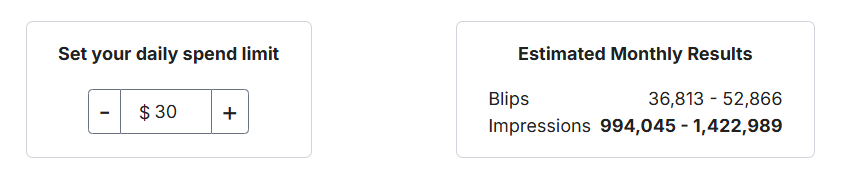
With Blip, you control exactly how much you spend on Fort Lee billboards by setting a daily budget that can be adjusted at any time. Each 7.5–10-second “blip” runs on rotating digital billboards serving the Fort Lee area, and you only pay for the blips you receive. Pricing is based on when and where your ad appears, along with real-time advertiser demand, so you can start with any budget and scale up as you see results.
Where can I advertise with Blip near Fort Lee, New Jersey?
Within 10 miles of Fort Lee, there are 173 digital billboards in nearby communities, effectively surrounding the Fort Lee area with coverage. Notable clusters include Ridgefield, Bogota, Hackensack, Maywood, Lodi, North Bergen, Weehawken, Jersey City, Manhattan, and Yonkers. These boards function as practical billboards near Fort Lee from the audience’s perspective because they align with how people live, shop, and commute.
Who do Fort Lee billboards reach in New Jersey?
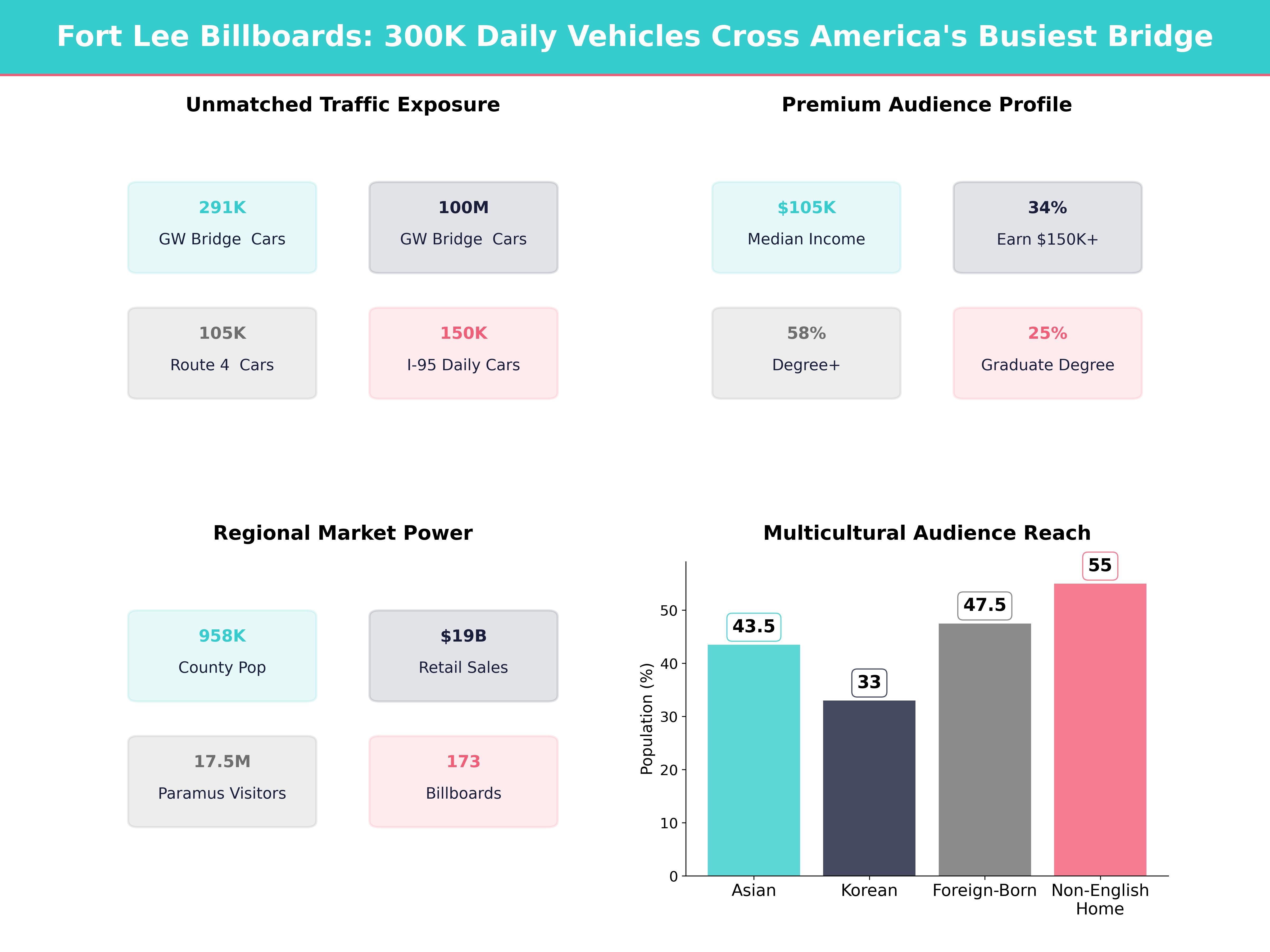
The Fort Lee area offers a dense, affluent local base with heavy commuter traffic and international diversity. Around 42–45% of Fort Lee residents identify as Asian, with Korean residents making up roughly one-third of the total population, and roughly 45–50% of residents were born outside the United States. More than 55% speak a language other than English at home, making multilingual creative especially relevant.
When is the best time to run billboard ads in Fort Lee?
Fort Lee’s morning commute typically runs from 6:30–9:30 a.m., and the evening commute usually runs from 4:30–7:30 p.m., when traffic congestion increases dwell time in view of roadside media. School traffic also creates bursts around 7:30–8:30 a.m. and 2:30–3:30 p.m. Weekend daytime traffic on Route 4 and Route 17 remains intense, particularly between 11 a.m. and 6 p.m. during peak shopping seasons.
Why are Fort Lee billboards effective for reaching commuters with Blip?
Fort Lee sits at the western landing of the George Washington Bridge, and the bridge carries around 282,000–300,000 vehicles per day on average. Route 4 near Fort Lee sees 90,000–120,000 vehicles per day on key segments, and I-95 / New Jersey Turnpike northern segments near the bridge often see 140,000–160,000 vehicles per day. These volumes support high-impact reach for campaigns targeting commuters, logistics, and destination businesses.
Do I need a contract to advertise with Blip near Fort Lee?
No, Blip has no long-term contracts or minimum commitments. You can start, pause, or stop your campaign at any time.
How fast can I launch a billboard campaign with Blip near Fort Lee?
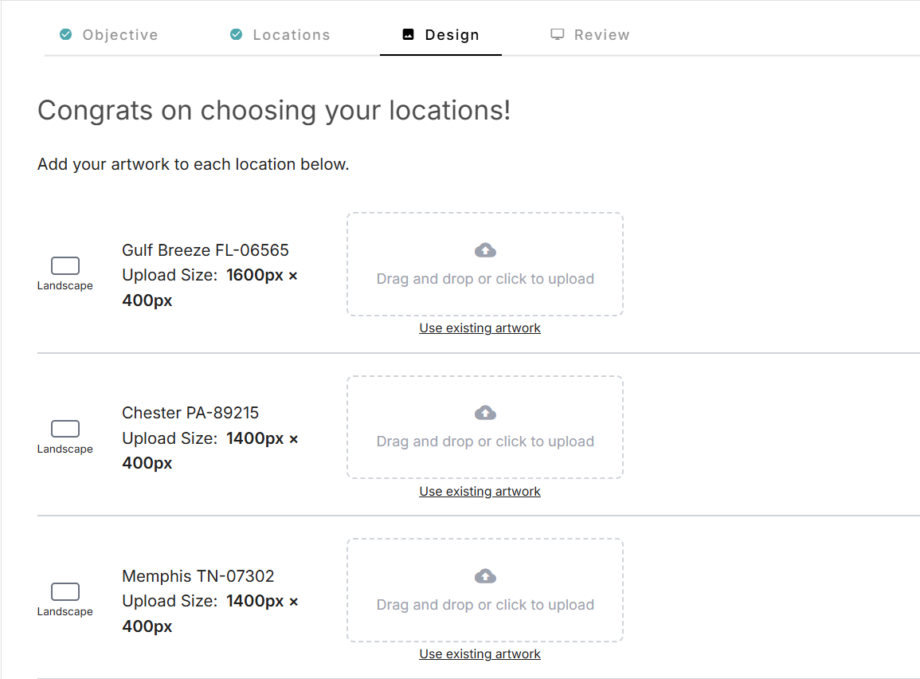
You can have your campaign live in minutes. Create a free account, select your locations, set your budget, upload your design, and start running once approved.
Where can I advertise with Blip near Fort Lee?
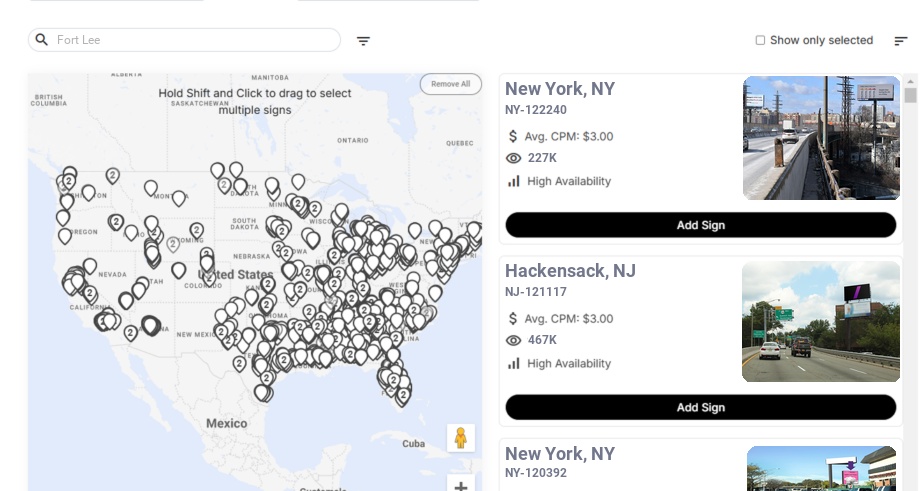
Blip has digital billboards near Fort Lee. You can browse available locations on a map, choose the ones that fit your audience, and start advertising right away.
Still have questions? Launch a campaign in minutes — no contracts, no commitments.
Start Your CampaignFort Lee Billboard Advertising Guide
Perched at the western landing of the George Washington Bridge and minutes from Midtown Manhattan, the Fort Lee area offers advertisers a rare combination of dense residential neighborhoods, affluent consumers, heavy commuter traffic, and international diversity—all within a few square miles. With 173 digital billboards serving the Fort Lee area from nearby cities like Bogota Ridgefield, Hackensack North Bergen, Weehawken Secaucus
Understanding the Fort Lee Area Market
Fort Lee is one of Bergen County’s most strategically located communities, making Fort Lee billboards especially valuable for regional outreach:
- Population: Approximately 40,200 residents in the borough across 2.9 square miles, with about 955,000–960,000 residents in Bergen County as a whole.
- Density: Fort Lee’s density exceeds 13,500–14,000 people per square mile, and some census tracts along the Palisades approach 25,000+ people per square mile, placing the borough among the most densely populated municipalities in New Jersey.
- Income: Median household income in Fort Lee is around $103,000–106,000 per year, compared with a New Jersey median near $96,000, and Bergen County’s median around $115,000, indicating strong regional purchasing power. Roughly 32–35% of Fort Lee households earn $150,000+ annually.
- Education: About 55–60% of adult residents (25+) hold a bachelor’s degree or higher, and nearly 25% hold a graduate or professional degree—well above national averages and attractive for professional services, financial, and healthcare campaigns.
- Housing: More than 80% of housing units are in multifamily structures, with a large share in buildings of 20+ units concentrated along Palisade Avenue and the Hudson River. Owner‑occupancy hovers around 48–50%, with median condo/co‑op values often exceeding $450,000–500,000 and luxury riverfront units reaching well above $1 million.
- Consumer activity: Bergen County routinely ranks among New Jersey’s top retail markets, with annual retail sales estimated above $18–20 billion, driven in part by regional destinations such as Paramus
Local civic and business information is available from the Borough of Fort Lee Fort Lee Regional Chamber of Commerce, and regional insights from Bergen County and Visit Bergen County. Together, they underscore how this compact community punches far above its size in economic impact and visibility, and why billboard advertising near Fort Lee can be a powerful addition to your media mix.
For advertisers, this means:
- A dense, affluent local base that responds well to offers for dining, retail, professional services, real estate, beauty/wellness, and health care. Bergen County’s median household expenditures on food away from home and personal services are both 10–15% above U.S. averages.
- Constant inflow and outflow of commuters using the George Washington Bridge and Route 4, expanding your reach beyond residents to include workers, visitors, and cross‑river travelers. More than 60% of Fort Lee’s employed residents commute outside the borough, and roughly 25–30% have average one‑way commute times of 45 minutes or more.
- Strong regional identity; local surveys and coverage by NorthJersey.com show many residents shop, dine, and socialize within a 5–10‑mile radius—even while working in Manhattan or other parts of North Jersey—making nearby digital boards functionally equivalent to Fort Lee billboards in terms of audience reach.
Demographic and Cultural Profile: Who You’re Reaching
The Fort Lee area is notably diverse and internationally oriented:
- Asian population: Around 42–45% of Fort Lee residents identify as Asian, with Korean residents making up roughly one‑third of the total population. Fort Lee is widely regarded as having one of the largest Korean‑American communities on the East Coast, reflected in vibrant local business districts on Lemoine Avenue and Main Street.
- Foreign born: Roughly 45–50% of residents were born outside the United States, and more than 55% speak a language other than English at home. Korean, Chinese, and Spanish are the most commonly spoken non‑English languages.
-
Age structure: A balanced mix of families, young professionals, and older residents—roughly:
- 18–20% under age 18
- 60–62% ages 18–64
- 18–20% age 65+
- Household composition: About 50% of households are family households, and roughly 25–30% of households include children under 18. Single‑person and couple‑only households are also common, supporting demand for both family‑oriented and convenience‑oriented products and services.
- Employment profile: Top employment sectors for residents include professional and business services, finance and insurance, healthcare and social assistance, and information/technology, providing a high concentration of white‑collar, high‑income commuters.
Local coverage from outlets like NorthJersey.com, The Fort Lee Patch, and the Fort Lee Daily Voice
Implications for your creative:
- Multilingual opportunities: Simple bilingual or Korean‑inclusive creative can resonate strongly, especially for local services, healthcare, banking, and community events. In a community where nearly 1 in 3 residents has Korean heritage and more than 1 in 2 speaks a non‑English language at home, even one short line of translated copy can significantly increase perceived relevance.
- Family‑centric messaging: Approximately one‑quarter of households include children, and Fort Lee Public Schools 3,700–4,000 students across K–12. Emphasize education, safety, convenience, and value for campaigns targeting schools, tutoring, family attractions, and pediatric or family healthcare.
- Upscale, design‑forward visuals: Given the above‑average income levels and proximity to Manhattan—Fort Lee is roughly 2–3 miles from Midtown via the George Washington Bridge—polished, modern creative tends to feel more “on brand” for the area than discount‑driven or cluttered designs. Luxury auto, premium skincare, high‑end dental/medical, and financial brands perform especially well in comparable high‑income commuter markets.
Traffic and Commuting Patterns: Where the Eyeballs Are
Fort Lee’s position at the foot of the George Washington Bridge creates unique traffic dynamics that make billboard advertising near Fort Lee particularly efficient. According to the Port Authority of New York and New Jersey:
- The George Washington Bridge carries around 282,000–300,000 vehicles per day on average, making it one of the busiest bridges in the world. Annual traffic exceeds 100 million vehicle crossings.
- Daily bus ridership across the bridge regularly tops 40,000–45,000 passenger trips, with more than 1,000 NJ TRANSIT and private carrier buses using the span on a typical weekday, connecting to the George Washington Bridge Bus Station
-
Traffic flows include:
- New Jersey to Manhattan commuters (eastbound in the morning, westbound in the evening).
- Interstate freight and long‑distance travelers on I‑95.
- Regional trips between New Jersey counties and upper Manhattan/Bronx.
Supplemental data from the NJ Department of Transportation show:
- Route 4 within a few miles of Fort Lee carries 90,000–120,000 vehicles per day on key segments between Paramus
- I‑95 / New Jersey Turnpike (northern segments) near the bridge often see 140,000–160,000 vehicles per day.
- Route 46 and feeder arterials like Broad Avenue, Grand Avenue, and Lemoine Avenue typically register 15,000–35,000 vehicles per day.
- Within a 10‑mile radius of Fort Lee, multiple major corridors (I‑80, Route 17, Route 3) also exceed 100,000 average daily vehicles, providing powerful extended‑reach options when you’re planning billboard rental near Fort Lee.
Nearby digital billboards in:
- Ridgefield, Bogota Hackensack Lodi, and Maywood intercept traffic on Route 4, I‑80, and local arterials feeding directly into the Fort Lee area. These corridors collectively see hundreds of thousands of vehicle trips daily, with weekday peak‑hour traffic often operating at 75–90% of roadway capacity.
- North Bergen, Weehawken Secaucus 113,000 vehicles per day, while the Holland Tunnel handles roughly 90,000.
- Yonkers locations extend your reach northward to Westchester commuters who regularly cross into New Jersey or Manhattan via the Henry Hudson Bridge, Broadway Bridge, and regional rail connections.
These volumes support high‑impact reach for campaigns targeting commuters, logistics, and destination businesses (malls, casinos, entertainment venues, medical centers). For example, even a modest Blip campaign reaching a fraction of Route 4’s 100,000+ daily drivers can deliver hundreds of thousands to millions of impressions per month, depending on budget and frequency, giving Fort Lee billboards and nearby inventory strong cost‑per‑impression value.
How we can leverage this:
- Use boards near Hackensack Lodi for westbound evening commuters heading home toward the Fort Lee area, when outbound bridge traffic can spike to 8,000–10,000 vehicles per hour.
- Use North Bergen, Weehawken Jersey City
- Pair New York City 10–25 miles each way.
Using Our 173 Digital Billboards to Reach the Fort Lee Area
Within 10 miles of Fort Lee, we have 173 digital billboards in nearby communities, effectively surrounding the Fort Lee area with coverage. While the structures are not inside Fort Lee itself, their locations create a media “halo” around the borough that aligns closely with how people live, shop, and commute, functioning as practical billboards near Fort Lee from the audience’s perspective.
Notable coverage clusters:
-
South & West of Fort Lee: Ridgefield, Bogota Hackensack Maywood, Lodi
- Ideal for: Reaching local shoppers headed to and from malls (e.g., Paramus Westfield Garden State Plaza drawing an estimated 15–20 million visitors annually.
- Also effective for: Reaching patients for major medical hubs; Hackensack is home to Hackensack University Medical Center 900+ beds and tens of thousands of annual inpatient discharges, plus significant outpatient traffic.
-
Hudson River Corridor: North Bergen, Weehawken Jersey City
- Ideal for: Cross‑Hudson commuters, waterfront residents, and nightlife/dining audiences. Hudson County’s riverfront communities have densities often exceeding 30,000–40,000 people per square mile, with large renter populations and high restaurant spend.
-
Manhattan and Yonkers: New York Yonkers, NY
- Ideal for: Positioning Fort Lee area businesses as an attractive, convenient alternative to Manhattan shopping and dining, or promoting events drawing audiences from both sides of the river. Midtown and Upper Manhattan neighborhoods within a 3–5 mile radius contain hundreds of thousands of workers and residents who can reach Fort Lee in 15–25 minutes off‑peak.
With Blip, you can:
- Concentrate your budget on a subset of these 173 boards that most closely match your audience—whether that’s a handful of high‑traffic commuter routes or a broader mix for upper‑funnel awareness, essentially tailoring billboard advertising near Fort Lee to your exact needs.
- Shift spend between clusters (for example, heavier New York City exposure during an event targeting Manhattan residents; heavier Bergen County focus during local retail sales or healthcare enrollment pushes).
- Test different board mixes over time to see which corridors drive more engagement or foot traffic, using simple metrics like store traffic counts, appointment volume, or changes in web sessions from ZIP codes where your selected boards are located.
Timing Your Campaigns Around Fort Lee Area Routines
Local routines are shaped by commuting and school schedules, as well as regional shopping and entertainment patterns:
- Morning commute: Typically 6:30–9:30 a.m., heavy eastbound traffic toward the George Washington Bridge and south toward the Lincoln Tunnel. During peak hours, Fort Lee approaches often operate at near‑capacity, with speeds dropping well below posted limits—ideal conditions for billboard readability.
- Evening commute: Typically 4:30–7:30 p.m., heavy westbound traffic exiting Manhattan into the Fort Lee and Bergen County area. Return‑trip congestion often extends onto Route 4 and I‑95, increasing dwell time in view of roadside media.
- School traffic: Dozens of public and private schools in and around Fort Lee, with Fort Lee Public Schools 7:30–8:30 a.m. and 2:30–3:30 p.m. Nearby districts in Leonia Englewood Palisades Park add to these bursts.
- Transit usage: Many Fort Lee residents commute by bus to Manhattan via NJ TRANSIT or private carriers, with regional data showing that in some Palisades‑adjacent corridors 25–30% of commuters use public transit. Digital billboards along major bus routes allow repeated exposure to the same riders daily.
- Weekend patterns: Strong flows toward shopping (Paramus malls, local Main Street districts), dining, and entertainment both in North Jersey and New York City. Weekend daytime traffic on Route 4 and Route 17 remains intense, particularly between 11 a.m. and 6 p.m. during peak shopping seasons.
Using Blip’s scheduling tools, we can align your message with these rhythms:
-
Morning focus (6–10 a.m.)
- Best for: Coffee shops, breakfast spots, transit‑oriented services, fitness studios, news/media, financial services, daycare and schools.
- Message approach: “On your way to work” themes, quick decisions (mobile apps, online services, last‑minute errands, same‑day bookings).
-
Daytime focus (10 a.m.–4 p.m.)
- Best for: Seniors, remote workers, parents, medical appointments, local services, B2B and professional services.
- Message approach: Appointments, consultations, same‑day service, shopping during off‑peak hours, “walk‑in welcome” healthcare or beauty services.
-
Evening focus (4–8 p.m.)
- Best for: Restaurants, entertainment, retail, grocery, family activities, fitness.
- Message approach: Tonight’s specials, happy hours, events “after work,” quick dinner solutions, same‑day promotions for shows or classes.
-
Late night (8 p.m.–midnight)
- Best for: Bars, late‑night dining, rideshare, streaming/media, casinos, emergency or 24‑hour services. In a region where nightlife in nearby Manhattan and Hudson County runs late, late‑night placements can still generate meaningful exposure.
Blip’s dayparting allows you to run heavier during your key windows and scale back—or pause—overnight or during low‑value times for your audience, smoothing out your effective cost per thousand impressions (eCPM) and reducing waste on your billboard rental near Fort Lee and surrounding areas.
Creative Strategy for the Fort Lee Area
Because most of your impressions near Fort Lee will be with drivers or transit riders at moderate to high speeds, clarity is critical.
Key creative guidelines:
-
Design for quick comprehension
- Use 7 words or fewer in your main headline; studies of roadside readability consistently show sharp drops in recall beyond 8–10 words.
- Contrast strongly: light text on dark background or vice versa, with font sizes equivalent to 18–24 inches high on standard highway faces (your designer can work from recommended pixel sizes).
- Include one main visual focus (logo/product/person), not a collage; aim for 3–5 total elements (headline, logo, one image, optional CTA).
-
Geo‑relevant copy
- Use references like “Just over the bridge,” “Minutes from Fort Lee,” or “Exit off Route 4” instead of vague distance claims. Drivers are far more likely to remember a specific exit or local landmark than an abstract mileage figure, especially when viewing billboards near Fort Lee during congested commute times.
- If your location is along a known corridor (e.g., Route 4, Route 46, I‑95), say so explicitly, and consider adding “Next 2 exits,” “Before the bridge,” or “Past Paramus” where accurate.
-
Bilingual & multicultural elements
- For Fort Lee area, adding simple Korean copy (even one short line) can be highly effective for certain sectors: medical, legal, banking, education, and real estate. In a market where Korean‑speaking households are a major segment, a small localization investment can dramatically increase word‑of‑mouth.
- When using multiple languages, keep both versions short—don’t double the text length. Use one shared visual and logo to avoid clutter; split the headline between languages or use English headline with a brief Korean support line.
-
Visual tone
- Lean into clean, urban, sophisticated aesthetics to match the Fort Lee/Manhattan corridor. Think minimal layouts, high‑quality photography, and modern typography aligned with brands residents see daily in Manhattan.
- For family‑oriented campaigns, balance upscale design with warmth (kids, parents, local landmarks like the George Washington Bridge or Fort Lee Historic Park
-
Clear calls to action (CTA)
- Use one concise CTA: “Exit at…,” “Order at…,” “Call…,” or “Visit [Brand].com.”
- Vanity URLs or short domains work best for recall from highways. A URL with 12 characters or fewer is easier to remember than a long descriptive domain.
- Where appropriate, pair with ultra‑simple offers (“Today only,” “This weekend,” “Open 7 days”) to add urgency.
Because Blip lets you upload multiple creatives, we encourage:
- Rotating several messages (e.g., different dishes for a restaurant, different service lines for a clinic, or multiple floor plans for a new residential building).
- Testing bilingual vs. English‑only versions to see which coincides with stronger response among your target ZIP codes.
- Comparing “New York‑centric” creative (appealing to Manhattan audiences with “Just across the GWB” or skyline imagery) vs. “local neighborhood” creative (for Bergen/Hudson County residents emphasizing convenience, parking, and community).
Seasonal and Event‑Driven Opportunities
The Fort Lee area is highly responsive to seasonal and event‑based messaging, with strong swings in traffic and consumer behavior across the calendar:
-
Back‑to‑school (late August–September)
- Focus on tutoring, after‑school programs, school supplies, medical checkups, and youth activities. Bergen County districts collectively serve well over 100,000 students, driving intensive August/September shopping and scheduling activity.
- Use dayparting to hit morning and mid‑afternoon school traffic and early evening parent commutes.
-
Holiday shopping (November–December)
- Fort Lee and nearby Bergen County corridors see heavy retail traffic, especially with nearby shopping destinations like Paramus tens of millions of visits in the November–December period, and retail sales during these months can account for 20–25% of annual revenue for many merchants.
- Promote local boutiques, salons, gift cards, and dining as Manhattan alternatives: “Skip the city crowds—shop in the Fort Lee area.” Highlight benefits like easier parking, shorter lines, and local loyalty programs.
-
Summer leisure (June–August)
- Emphasize outdoor dining, waterfront activities, camps, and family attractions. Hudson River waterfront parks and nearby destinations (such as Fort Lee Historic Park Palisades Interstate Park
- Target weekends with higher frequency and shift some budget from commute hours to midday, when families and tourists are more active.
-
Local events and festivals
- The Fort Lee Business District Alliance and Fort Lee Recreation Department
- Use Blip’s ability to quickly swap creative to promote weekend events, concerts, grand openings, or limited‑time offers, and then revert to evergreen branding creative once the event passes.
-
Tourism and regional travel
- New Jersey welcomes more than 100 million visitors per year statewide, and Bergen County benefits from spillover overnight stays tied to New York City travel. Local hotel occupancy along the I‑95 and Route 4 corridor tends to rise in peak tourism months and during major Manhattan events.
- Billboards near approach routes make it easy to capture out‑of‑town spending for dining, shopping, and entertainment in and around Fort Lee.
-
Weather‑responsive messaging
- On hot days (summer highs in the upper 80s–90s°F), promote ice cream, cold beverages, pools, indoor attractions, or air‑conditioning services.
- On snowy/rainy days (North Jersey averages 25–30 inches of snowfall per year), emphasize delivery, online services, indoor activities, or winter clearance sales. Short, weather‑themed copy can feel highly relevant when conditions change quickly.
Because Blip requires no long‑term contracts, you can run short bursts of high‑intensity exposure during these key periods instead of committing to year‑round static placements, helping you better match spend to revenue cycles while keeping your billboard rental near Fort Lee flexible.
Example Campaign Approaches by Industry
Here are ways advertisers commonly succeed in the Fort Lee area using digital billboards near the borough:
Restaurants & Cafés
- Target: Evening commuters, weekend shoppers, Manhattan residents looking to dine across the river, and local residents seeking nearby options within a 10‑minute drive.
-
Strategy:
- Focus spend 4–8 p.m. weekdays, plus weekends midday/evening when dining out peaks. Nationally, about 50% of restaurant spending happens during dinner hours; roadside exposure here matches that pattern.
- Use boards in North Bergen, Weehawken New York City
- Feature high‑impact food photography, clear exit directions, and quick promos such as “Free parking,” “No city surcharge,” or “Happy hour 4–7 p.m.”
Healthcare & Clinics
- Target: Families, seniors, professionals seeking specialists, urgent care, or dental services. In Fort Lee and surrounding ZIP codes, a high proportion of residents have private insurance and are willing to travel 5–10 miles for quality care.
-
Strategy:
- Run daytime and early evening (10 a.m.–6 p.m.) when appointment scheduling and visits are most common.
- Concentrate on Hackensack Bogota Ridgefield, and Lodi boards for local audience reach, tying into hospital and medical‑office clusters.
- Use simple benefits: “Same‑day appointments,” “Korean‑speaking staff,” “Accepting new patients,” “Open evenings & weekends.”
Real Estate & Property Management
- Target: Renters and buyers priced out of Manhattan or Hoboken, plus current local renters looking to upgrade. Over the last decade, median Manhattan condo prices have often been 2–3x higher than comparable luxury units in Fort Lee, creating strong value narratives.
-
Strategy:
- Use New York City Yonkers boards to reach commuters who might relocate to the Fort Lee area for more space and value. Highlight lower property taxes compared with New York City suburbs where applicable.
- Position Fort Lee as “15 minutes to Midtown” or “Luxury living with skyline views,” and include core proof points like in‑unit laundry, parking, and amenity spaces.
- Run consistently but increase budget around spring and early fall, typical moving seasons when national and regional data show spikes in lease turnovers and home closings.
Education & Tutoring
- Target: Parents in Fort Lee’s highly education‑focused community, where college‑degree attainment is 20+ percentage points above the national average.
-
Strategy:
- Concentrate impressions during back‑to‑school and exam seasons (August–October and February–May).
- Use morning and after‑school time slots to reach parents during drop‑off/pick‑up drives.
- Include clear services (SAT/ACT prep, math tutoring, language classes, enrichment camps) and location callouts like “5 minutes from Fort Lee High School” when geographically accurate.
Local Retail & Services
- Target: Residents within a 5–10‑mile radius, plus pass‑through traffic on Route 4, I‑95, and local arterials.
-
Strategy:
- Use Bergen County‑side boards to reach shoppers heading to malls and big‑box centers, where average trip spending can be $75–150 depending on category.
- Promote proximity: “5 minutes from the George Washington Bridge,” “On Route 4 near Hackensack,” or “Next to [well‑known local landmark]” to anchor your business in drivers’ mental maps.
- Change creatives for major sales weekends (Black Friday, Memorial Day, Labor Day, President’s Day) when retail sales can surge 30–50% over typical weekends.
Optimizing and Measuring Your Fort Lee Area Campaign
While billboards are primarily an upper‑funnel channel, there are practical ways to evaluate and improve performance when you’re investing in billboard advertising near Fort Lee:
-
Directional URLs and phone numbers
- Use a short URL or unique landing page for billboard traffic. Monitor direct visits and sessions attributed to that URL.
- Track visits, calls, or form fills that originate from that URL or number, and compare them to baseline periods without billboard activity.
-
Offer codes and keywords
- Include a simple code (“Mention FORTLEE for 10% off”) that staff can record at point of sale.
- Track how often this code is used during your flight dates, and calculate incremental revenue per impression or per dollar spent.
-
Location‑based analytics
- Use Google Analytics or similar tools to watch for traffic spikes from Fort Lee, Bergen County, and nearby New York ZIP codes that correlate with your campaign dates and dayparts.
- Compare organic brand‑name search volume from local ZIP codes before, during, and after flights as a proxy for brand lift.
-
Creative rotation tests
- Run multiple creatives at similar budgets and see which coincides with stronger upticks in web traffic, calls, or walk‑ins. For example, test image‑led vs. offer‑led creatives, or English‑only vs. bilingual.
- Use Blip’s flexibility to quickly pause underperforming versions and allocate more exposure to winners, improving results over successive weeks.
Because our inventory is purchased programmatically in small increments (“blips”), you’re not locked into a single board or message. You can continually refine location mix, timing, and creative based on what delivers the best results for your Fort Lee area objectives, instead of waiting out a traditional 4–12‑week static contract, making this one of the most agile options for billboard rental near Fort Lee.
Local Sensitivities and Best Practices
To keep your campaign both effective and community‑minded:
- Respect traffic safety: Avoid overly animated designs or tiny text that encourages drivers to stare too long. Stick to high contrast, large fonts, and static or gently transitioning creative in line with local regulations.
- Stay non‑controversial: The Fort Lee area is diverse and family‑oriented; avoid polarizing political or socially divisive messages that could draw negative attention or complaints.
- Comply with regulations: Digital billboards follow local and state guidelines; if your industry is regulated (e.g., cannabis, legal services, medical claims, gambling), make sure your messaging meets New Jersey advertising requirements and any municipal ordinances. The Borough of Fort Lee Bergen County websites are good starting points for understanding local standards.
- Reflect the community: Incorporating local imagery (skyline views, the bridge, neighborhood streets) or references to Fort Lee institutions can enhance relevance and goodwill. Highlight partnerships with local schools, nonprofits, or events when applicable.
Local government and organizations such as the Borough of Fort Lee VisitNJ’s Fort Lee listings, the Fort Lee Regional Chamber of Commerce, and Visit Bergen County provide insight into community priorities and calendars that can inform your campaign timing and tone and help you get more from billboards near Fort Lee.
By strategically using the 173 digital billboards serving the Fort Lee area—located across nearby North Jersey and New York communities—we can build campaigns that mirror how people actually move through this cross‑river corridor. With precise control over budget, timing, locations, and creative, Blip allows you to reach Fort Lee area audiences where they are: commuting, shopping, dining, and exploring on both sides of the Hudson, all while taking full advantage of flexible billboard advertising near Fort Lee.