Billboards in Berlin Township, NJ
No Minimum Spend. No Long-Term Contracts. Just Results.
Trusted by Leading Brands


Billboard advertising
in Berlin Township has never been easier



How much is a billboard in Berlin Township?
Why Choose Blip for Billboard Advertising in Berlin Township
-
Blip lets Berlin Township advertisers launch fast on Route 73 or White Horse Pike, reaching car-heavy commuters without a traditional buy-in.
-
Set flexible budgets in Berlin Township and keep pace with Route 42 and Atlantic City Expressway traffic without contracts or minimums.
-
Use dayparting in Berlin Township to hit 6-9 a.m. commuters and 10 a.m.-6 p.m. weekend shoppers near Diggerland and the Farmers Market.
-
Blip real-time analytics help Berlin Township campaigns shift spend as traffic moves between Philadelphia-bound mornings and southbound leisure trips.
-
Create and swap Berlin Township creative quickly with Blip tools—perfect for Route 73, family attractions, and seasonal shore-bound traffic.
Frequently Asked Questions About Billboard Advertising in Berlin Township
How much does a billboard cost in Berlin Township, New Jersey with Blip?
With Blip, billboard advertising in Berlin Township is flexible and easy to fit into your budget. Pricing starts at just $0.01 per display, and each “blip” is a 7.5-to-10-second display. Costs can change based on time of day, location, and advertiser demand, but you can set a daily budget and adjust or pause it anytime.
Where can I advertise with Blip in Berlin Township, New Jersey?
Route 73 is Berlin Township’s signature north-south spine, and the White Horse Pike is the classic east-west corridor for the Berlin market. The Atlantic City Expressway, Route 42, and I-295 also expand Berlin Township into a regional campaign. These roads help reach drivers moving among Camden, Cherry Hill Township, Deptford Township, Atlantic City, and the Shore.
Why is Berlin Township, New Jersey a good market for Blip billboard ads?
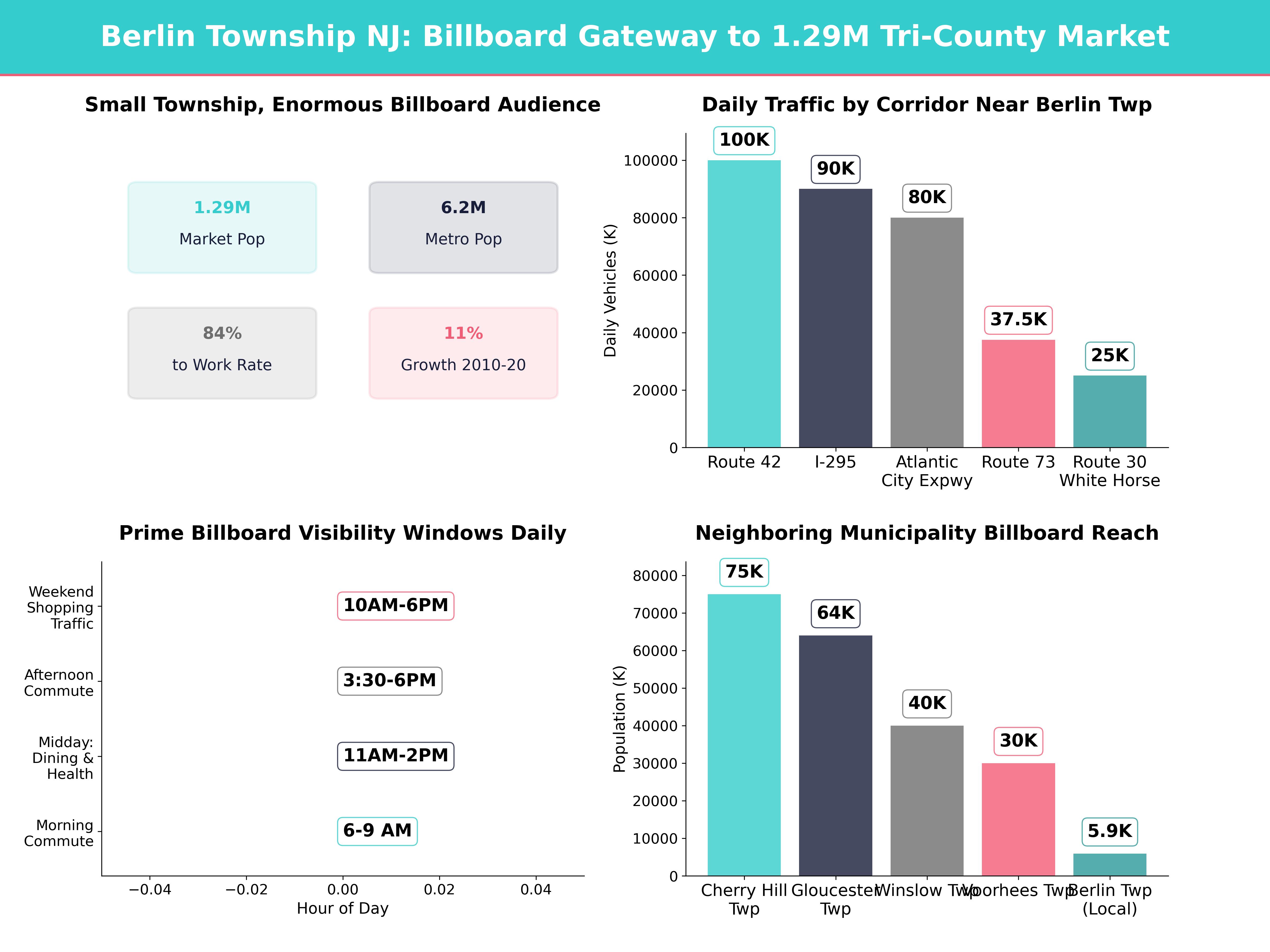
Berlin Township is a small municipality with outsized advertising value because it sits at the crossroads of suburban Camden County errands, Philadelphia-bound commuting, and South Jersey leisure travel. The township has about 5,900 residents in just over 3.3 square miles, but it is surrounded by much larger population centers and plugged into a regional market of about 1.29 million people across Camden, Burlington, and Gloucester counties. Because local life is highly auto-oriented, digital billboards can deliver repeated visibility without requiring a massive budget.
What kind of traffic and commuters does Berlin Township, New Jersey have for billboard advertising?
In Camden County, roughly 84% of workers commute by car, truck, or van, and Berlin Township is even more road-dependent because it does not have a direct heavy transit stop in town. Route 73 commonly falls in the 30,000 to 45,000 AADT range, and the White Horse Pike often falls in the 20,000 to 30,000 AADT range. Farther out, traffic near the Berlin-area interchanges on the Atlantic City Expressway often lands around 70,000 to 90,000 vehicles per day.
When is the best time to advertise in Berlin Township, New Jersey with Blip?
Summer is the biggest seasonal opportunity for Berlin Township, from Memorial Day through Labor Day, when family attractions, weekend market traffic, concert travel, and shore-bound movement all rise at the same time. Fall brings a powerful reset for local buying behavior as school resumes, college semesters start, and healthcare open enrollment messaging begins to matter. Winter also creates strong billboard moments, especially during the 6:00 to 9:00 a.m. and 3:30 to 6:30 p.m. commute windows.
Do I need a contract to advertise with Blip in Berlin Township?
No, Blip has no long-term contracts or minimum commitments. You can start, pause, or stop your campaign at any time.
How fast can I launch a billboard campaign with Blip in Berlin Township?
You can have your campaign live in minutes. Create a free account, select your locations, set your budget, upload your design, and start running once approved.
Where can I advertise with Blip in Berlin Township?
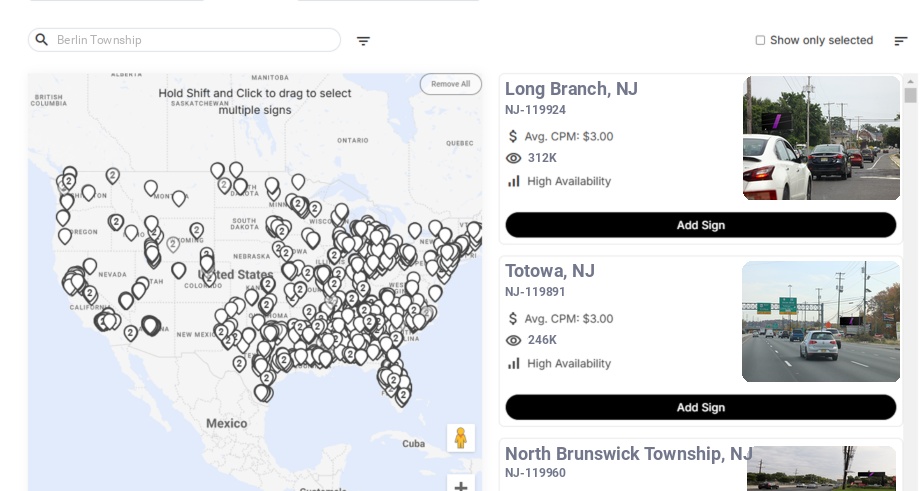
Blip has digital billboards in Berlin Township. You can browse available locations on a map, choose the ones that fit your audience, and start advertising right away.
Still have questions? Launch a campaign in minutes — no contracts, no commitments.
Start Your CampaignBerlin Township Billboard Advertising Guide
Berlin Township Camden County Philadelphia 5,900 residents in just over 3.3 square miles, but it is surrounded by much larger population centers and plugged into a regional market of about 1.29 million people across Camden, Burlington Gloucester 84% of workers commuting by car, truck, or van in Camden County, and Route 73, the White Horse Pike, and the nearby Atlantic City Expressway shaping daily movement, digital billboards can deliver repeated visibility without requiring a massive budget. We also benefit from family attractions such as Diggerland USA Big Kahuna's Water Park Berlin Farmers Market, which keep weekend and seasonal traffic active beyond the core commute.
Berlin Township Market Overview
Berlin Township is small, but its trade area is not.
When we advertise in Berlin Township, we are not buying a tiny, isolated audience. We are tapping into a South Jersey position between Berlin Borough, Voorhees Township Gloucester Township Cherry Hill Township 523,485 residents in 2020, neighboring Burlington County had 461,860, and Gloucester County had 302,294, which brings the immediate tri-county market to roughly 1.29 million people before we even count the wider Philadelphia region.
Berlin Township itself grew by roughly 11% from 2010 to 2020, which is meaningful for a built-out suburban municipality of this size. That growth matters because small-town name recognition combines with access to a much larger pool of drivers, shoppers, patients, and families moving through the area every day. We should think of Berlin Township as a strategic gateway market rather than a town-only campaign.
Berlin Township benefits from a larger commuter economy.
Berlin Township sits about 20 miles from Center City Philadelphia and about 45 miles from Atlantic City, which puts it in the path of both weekday and leisure travel. The Philadelphia-Camden-Wilmington metro area has about 6.2 million residents, and Berlin Township benefits from that gravity even though it feels distinctly suburban. Many residents travel north toward jobs, healthcare, and retail in Cherry Hill Township Camden, and Philadelphia, while others travel south and east for warehousing, trades, gaming, and shore-related spending.
Car travel dominates the local commute picture. In Camden County, roughly 84% of workers commute by car, truck, or van, and Berlin Township is even more road-dependent because it does not have a direct heavy transit stop in town. PATCO is important to the region, and its line has 13 stations, but the local ad opportunity is still overwhelmingly about roads, intersections, and drive-time visibility.
The local economy supports practical, high-intent advertising.
Camden County’s median age is about 39, which gives us a solid mix of families, mid-career professionals, and older consumers making major spending decisions. The county includes 37 municipalities, and that fragmented municipal map creates a highly local purchasing culture where nearby, familiar businesses have an edge. We tend to see especially strong billboard relevance here for healthcare, home improvement, legal services, auto repair, restaurants, education, financial services, family entertainment, and retail.
The economic base around Berlin Township is also diversified. Healthcare anchors such as Cooper University Health Care Virtua Health, and Jefferson Health draw patients from across South Jersey. Education anchors such as Camden County College, Rowan University, and Rutgers University–Camden create a steady flow of students, faculty, and parents. That combination gives us a billboard market where purchase intent is often immediate and measurable.
Key Traffic Corridors Around Berlin Township
Route 73 is Berlin Township’s signature north-south spine.
Recent New Jersey Department of Transportation traffic counts in and around the Berlin and Voorhees area commonly place Route 73 in the 30,000 to 45,000 AADT range, with heavier retail-oriented segments farther north carrying even more. This corridor is one of the most important billboard routes for Berlin Township because it links West Berlin with Voorhees Township
We should prioritize Route 73 boards when we want scale, frequency, and intent. This corridor is especially useful for the following categories:
- Healthcare advertisers can use Route 73 because patients already recognize it as a path toward major medical offices and hospital systems.
- Retail, dining, and quick-service brands can use Route 73 because drivers are often in active shopping mode rather than pure pass-through commuting mode.
- Auto dealers, repair shops, and insurance providers can use Route 73 because the audience is car-dependent and frequently making vehicle-related spending decisions.
- Family attractions can use Route 73 because the road captures weekend traffic heading toward West Berlin destinations.
U.S. Route 30, the White Horse Pike, delivers local and regional relevance.
The White Horse Pike is the classic east-west corridor for the Berlin market. NJDOT counts through the Berlin area often fall in the 20,000 to 30,000 AADT range, which is more than enough to support effective frequency for local advertisers. This is the road many drivers associate with Berlin itself, and it carries a strong mix of neighborhood trips, commuting, errands, and value-oriented shopping.
We like White Horse Pike placements for advertisers that want familiarity and immediate action. These boards tend to work well for the following objectives:
- Local service businesses can use White Horse Pike boards because nearby residents know the road and can act on an offer quickly.
- Restaurants, delis, pizza shops, and convenience retailers can use the corridor because many trips are short and unplanned.
- Furniture stores, discount retailers, and home services can perform well because the audience often includes practical household buyers comparing options close to home.
- Community brands can benefit because the corridor feels authentically local to people in Berlin, Clementon, Lindenwold, and nearby towns.
The Atlantic City Expressway, Route 42, and I-295 expand Berlin Township into a regional campaign.
The South Jersey Transportation Authority 44-mile Atlantic City Expressway, and it is crucial to the Berlin Township story even though it is not inside the township center. Traffic near the Berlin-area interchanges often lands around 70,000 to 90,000 vehicles per day, depending on segment and season. Farther northwest, Route 42 regularly carries 100,000+ vehicles per day, and I-295 segments in Camden County frequently exceed 90,000.
These roads matter because they turn a local Berlin Township campaign into a wider South Jersey reach strategy. We should use them when we want to capture drivers who are moving among Camden, Cherry Hill Township
- Destination entertainment brands can benefit because expressway drivers are often planning their day or weekend.
- Regional healthcare systems can benefit because patients will travel farther for specialty care than for routine retail.
- Higher education brands can benefit because colleges recruit across county lines.
- Hospitality and tourism advertisers can benefit because the route connects the Philadelphia side of South Jersey with resort and event destinations.
Audience Segments We Can Reach in Berlin Township
Berlin Township reaches daily commuters well beyond the township line.
The best billboard plans here are built around movement, not municipal boundaries. Berlin Township is surrounded by larger towns that contribute to the daily audience, including Cherry Hill Township 75,000 residents, Gloucester Township 64,000, Winslow Township 40,000, and Voorhees Township 30,000. That is why even a small-town board can be useful when it sits on a regional commuter path.
Morning northbound traffic tends to be strongest for professional services, healthcare, education, recruiting, and B2B messages. Afternoon southbound traffic often favors food, retail, urgent care, after-school services, and family entertainment. Because most people in this market travel by car, billboards can stay relevant across both commute directions.
Berlin Township is a strong family and household market.
Berlin Township and nearby West Berlin feel unmistakably suburban. That matters because suburban households respond well to offers that solve practical needs, save time, or create easy family outings. Ads for dentists, pediatric care, tutoring, HVAC, plumbing, roofing, flooring, auto maintenance, and local dining all make sense here.
We should also remember that family traffic is not limited to residents. Diggerland USA Big Kahuna's Water Park Berlin Farmers Market adds another steady draw for bargain-focused, repeat visitors who are accustomed to driving for value.
Berlin Township can also reach students, educators, and healthcare users.
This market is not only about homeowners and commuters. Rowan University enrolls more than 23,000 students, Rutgers University–Camden serves roughly 7,000, and Camden County College operates 3 locations in Blackwood, Camden, and Cherry Hill. Those institutions generate enrollment periods, move-in windows, event traffic, and parent travel.
Healthcare is equally important. South Jersey patients regularly travel across town and county lines for specialist visits, outpatient services, imaging, urgent care, surgery, and rehabilitation. That makes Berlin Township-area boards a practical tool for hospitals, surgical centers, orthopedics, dental specialists, behavioral health providers, and senior services.
Berlin Township benefits from leisure, event, and tourism traffic.
This area is stronger for leisure advertising than many small suburbs because it sits in the path of regional attractions. The Adventure Aquarium, the Battleship New Jersey, and the Freedom Mortgage Pavilion on the Camden waterfront draw visitors from across the region. Freedom Mortgage Pavilion seats about 25,000, so concert nights can create major directional traffic on surrounding routes.
We also benefit from shore-bound and Atlantic City-bound travel. Atlantic City is roughly 45 miles away, and many summer travelers use the Berlin market as part of their route. That creates billboard opportunities for casinos, beach gear, restaurants, gas and convenience brands, and stop-along-the-way destinations.
Seasonal and Timing Opportunities in Berlin Township
Summer is the biggest seasonal opportunity for Berlin Township.
From Memorial Day through Labor Day, the Berlin Township market gets a meaningful leisure boost. Visit South Jersey promotes the region heavily during this period, and local travel patterns reflect it. Family attractions in West Berlin, weekend market traffic, concert travel, and shore-bound movement all rise at the same time.
This is when we should emphasize family fun, water, air conditioning, cold drinks, convenience, and easy detours. Summer campaigns work especially well for amusement venues, casual dining, automotive maintenance, travel services, urgent care, HVAC, and roadside retail. Friday afternoons, Saturday mornings, and Sunday return windows are particularly important around the expressway network.
Fall brings a powerful reset for local buying behavior.
Late August through November is one of the most useful planning windows in Berlin Township because household routines become more predictable. School resumes, college semesters start, fall sports return, and healthcare open enrollment messaging begins to matter. This is also when Philadelphia Eagles, Philadelphia Phillies, Philadelphia Flyers, and Philadelphia 76ers
We should use fall for tutoring, family restaurants, orthodontics, healthcare systems, gyms, trade schools, community colleges, legal services, and home improvement. This is also a smart period for “local trust” creative, because people are back on regular weekday routes and notice repeated messages more quickly.
Winter and shoulder seasons still create strong billboard moments in Berlin Township.
Winter in South Jersey brings shorter days, earlier darkness, and a commuter audience that is often on the road before sunrise and after sunset. Digital billboards stand out in that environment, especially during the 6:00 to 9:00 a.m. and 3:30 to 6:30 p.m. commute windows. Midday campaigns from 11:00 a.m. to 2:00 p.m. can also work well for healthcare, dining, and errands, while weekend shopping and family traffic often concentrates between 10:00 a.m. and 6:00 p.m.
During colder months, we should emphasize utility, convenience, and urgency. Tax services, winter auto care, heating repair, healthcare, indoor entertainment, and comfort-food dining all fit the market. Holiday retail can also perform well because Berlin-area drivers are already moving between suburban shopping zones rather than relying on walkable downtown foot traffic.
Billboard Design Tips for the Berlin Township Market
Berlin Township creative should sound like a local driver would talk.
In this market, local geography is not background information. It is part of how people make decisions. We should use language such as “On Route 73,” “Off White Horse Pike,” “In West Berlin,” “Near Voorhees,” or “Minutes from Cherry Hill” when it is accurate. Those cues reduce mental effort and make the ad feel immediately useful.
We should also use town names that people in South Jersey actually say out loud. Berlin, West Berlin, Voorhees, Cherry Hill, Clementon, Lindenwold, and Sicklerville all mean more here than generic county-level language. Directional copy works well when it matches what drivers already know.
Berlin Township responds well to value, trust, and family-oriented cues.
This is not a market where abstract brand poetry usually outperforms practical messaging. South Jersey suburban audiences often respond best when we show a clear offer, a recognizable business type, and an easy next step. Phrases such as “Free Estimate,” “Same-Day Appointments,” “Family-Owned,” “Now Enrolling,” and “Open Late” tend to fit the local decision style.
Visually, we should lean into imagery that feels native to the area. Homes, family vehicles, youth sports, casual dining, backyard projects, Shore weekends, and local-service scenarios usually outperform flashy big-city tropes. If we want emotional resonance, Philadelphia sports colors or Shore-adjacent summer cues often connect better than generic stock scenes.
Berlin Township boards should be designed for arterial-speed reading.
Many of the key roads in this market have posted speeds in the 40 to 55 mph range, which means our message must land almost instantly. We should keep the headline tight, make the brand unmistakable, and use one main action. If we add too many claims, phone numbers, or tiny location details, the ad loses power before the driver finishes reading it.
Color contrast matters here because many boards sit against trees, overcast skies, or busy commercial backgrounds. High-contrast combinations usually read best. Seasonal swaps also matter. Summer creative can be brighter and more playful, while fall and winter creative should feel more direct, warm, and utility-driven.
Regional Strategies for Berlin Township Campaigns
West Berlin and Route 73 should anchor many Berlin Township campaigns.
If our goal is scale inside the immediate Berlin market, West Berlin and the Route 73 corridor are often the first places to look. This zone is where everyday suburban traffic, family entertainment, dining, and regional pass-through movement overlap. Advertisers with strong fit here include urgent care, family attractions, chain restaurants, auto services, dental offices, and regional retail.
This zone is also good for campaigns that need both weekday and weekend relevance. We can reach commuters Monday through Friday and still stay visible to parents and leisure traffic on Saturday and Sunday.
White Horse Pike and Berlin Borough support local-service domination.
If our goal is local market share, the White Horse Pike corridor through Berlin and nearby communities is often the smarter play. This is where we can feel close, familiar, and useful. Service businesses that depend on trust and repeat business usually benefit most from this approach.
We recommend this sub-area for HVAC, plumbing, roofing, electrical, legal, insurance, storage, daycare, learning centers, and neighborhood dining. These are the advertisers that win when consumers think, “That place is right around here.”
Northbound strategies should focus on commuters heading toward jobs and appointments.
Campaigns aimed at professional adults often work best when we face northbound traffic toward Voorhees Township Cherry Hill Township Camden, and Philadelphia. This direction aligns with many morning routines and higher-attention travel windows. It is a strong fit for healthcare systems, continuing education, financial services, recruiting, and B2B offers.
We should increase bids and visibility during the morning commute when the goal is appointment booking or brand awareness among working adults. Frequency matters more than novelty in this pattern.
Southbound and eastbound strategies should lean into leisure and household decisions.
When we target southbound or eastbound movement toward Winslow Township
This is also the right orientation for “stop on the way” messaging. If we have a nearby destination, we should say so plainly and make the turn easy to picture.
Using Blip Tools and Capabilities in Berlin Township
We should organize Berlin Township campaigns by corridor and daypart.
Berlin Township is a perfect market for flexible scheduling because traffic intent changes so much by road and time of day. We can put more budget into northbound morning commuter boards, shift toward southbound afternoon boards later in the day, and reserve weekend weight for Route 73 entertainment and shopping traffic. That is often more efficient than running the same schedule everywhere.
Because the market includes both local arterials and regional highways, we can also test whether frequency on a lower-cost local board beats raw volume on a bigger commuter route. That is a very practical use of Blip in South Jersey.
We should rotate creative for different Berlin Township audiences.
A single message rarely captures all of Berlin Township’s audience types. We can run one version for commuters, another for families, and another for weekend leisure traffic without rebuilding the entire campaign from scratch. For example, a healthcare advertiser might run appointment-focused copy in the morning and broader brand-reassurance creative later in the day.
Seasonal rotation is equally useful. Summer promotions, back-to-school messaging, holiday offers, and tax-season creative all have clear windows in this market. Berlin Township rewards advertisers who refresh often enough to stay relevant to local behavior.
We should use analytics to refine geography, timing, and creative.
Berlin Township is large enough to support meaningful testing, but small enough that we can see patterns quickly. If Route 73 boards outperform White Horse Pike boards for one category, we can lean in. If weekend family traffic responds better than weekday commuting for another, we can reallocate budget accordingly.
The creative tools also help because local adaptation matters here. We can generate multiple versions that reference Berlin, West Berlin, or Route 73 and then compare how those variants behave. That kind of rapid refinement is difficult with traditional billboard buying, but it is highly useful in a market this route-driven.
Getting Started With Billboard Rental in Berlin Township
We should start by defining the true service radius.
Before we rent a billboard in Berlin Township, we need to decide whether the campaign is local or regional. If we are promoting a restaurant, dental office, daycare, or repair shop, the real target may be just 3 to 5 miles around the business. If we are promoting a hospital system, college, entertainment venue, or major retailer, a 15 to 20 mile draw may be completely realistic.
That simple radius decision will shape everything else. It tells us whether to prioritize White Horse Pike familiarity, Route 73 scale, or expressway reach.
We should evaluate each Berlin Township board like a driver would.
The best board is not always the one with the biggest traffic number. We should look at how the board fits the actual action we want the audience to take.
- We should favor boards that match the correct direction of travel for the intended trip.
- We should check whether the ad appears before the turn, exit, or decision point, rather than after it.
- We should consider speed, lane complexity, and surrounding clutter, because a board on a 55 mph approach needs cleaner creative than one on a slower arterial.
- We should match the board environment to the offer, because a local services ad near neighborhood traffic behaves differently from a destination ad on an expressway feeder.
We should expect Berlin Township inventory to work best as part of a wider South Jersey plan.
Traditional billboard companies often steer advertisers into fixed schedules and 4-week commitments that are harder to adjust once the campaign starts. Blip makes Berlin Township easier because we can start with a focused test, watch how the route patterns behave, and then expand into nearby zones such as West Berlin, Voorhees, Cherry Hill, Gloucester Township, or expressway-adjacent inventory if the results justify it.
That flexibility is important because Berlin Township is rarely a one-board market. It is a network market. When we approach it that way, with the right corridors, the right timing, and creative that sounds local, Berlin Township becomes one of the more efficient digital billboard plays in suburban South Jersey.