Billboards in Burlington, NJ
No Minimum Spend. No Long-Term Contracts. Just Results.
Trusted by Leading Brands


Billboard advertising
in Burlington has never been easier

How much is a billboard in Burlington?
Why Choose Blip for Billboard Advertising in Burlington
-
Blip lets you self-serve Burlington, New Jersey billboards fast on I-295 and Route 130—no phone tag, just launch when commuter traffic peaks.
-
With flexible budgets, Burlington, New Jersey advertisers can start small and scale to bridge traffic from Bristol or the Route 130 retail belt.
-
No contracts means you can test Burlington, New Jersey campaigns around the 6-day Farm Fair, then pause or tweak anytime.
-
Use Blip's real-time analytics to see what works in Burlington, New Jersey on I-295 vs. local access roads, and optimize on the fly.
-
Blip's creative tools help Burlington, New Jersey ads stay clear and local for families, shoppers, and 80% of commuters who drive daily.
Frequently Asked Questions About Billboard Advertising in Burlington
How much does a billboard cost in Burlington, New Jersey with Blip?
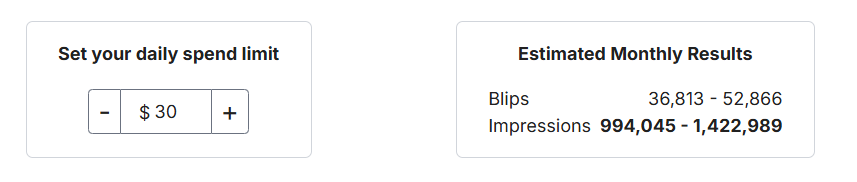
Pricing starts at $0.01 per display. You set a daily budget, and Blip’s algorithm uses it to bid on open ad slots, helping stretch your spend for the best possible reach. There are no minimums or contracts, so the total cost is simply the sum of your individual blips over time.
Where can I advertise in Burlington, New Jersey with Blip?
Burlington’s billboard value is driven by a handful of dependable commuter and shopping routes. Interstate 295 near Burlington County is the region’s biggest audience-delivery corridor, and U.S. Route 130 is Burlington’s classic commercial spine. Route 541, the New Jersey Turnpike, and the Burlington-Bristol Bridge also create strong local and cross-river reach.
Why is Burlington, New Jersey a strong market for billboard advertising?
Burlington combines local community visibility with regional pass-through traffic on corridors that can exceed 100,000 vehicles per day. Roughly 4 in 5 county workers commute by car, which creates repeated daily movement that makes billboards effective. The area also benefits from cross-river traffic, suburban retail patterns, and year-round local events.
When is the best time to run billboard ads in Burlington, New Jersey with Blip?
On commuter corridors, we often want stronger presence during 6 a.m. to 10 a.m. and 3 p.m. to 7 p.m. On Route 130, restaurants and convenience retail may benefit more from 11 a.m. to 2 p.m. and evening drive time. For family entertainment and local attractions, weekends and late afternoons can be more valuable than weekday mornings.
What kinds of Burlington, New Jersey businesses work best with Blip billboard ads?
This market is especially practical for retail and restaurants, healthcare and legal services, home services, education and training, and B2B and recruiting. Route 130 works especially well for restaurants, grocery, pharmacy, auto dealers, banks, dentists, and urgent care clinics. I-295 is ideal for hospitals, colleges, home improvement, insurance, legal services, and major retail destinations.
Do I need a contract to advertise with Blip in Burlington?
No, Blip has no long-term contracts or minimum commitments. You can start, pause, or stop your campaign at any time.
How fast can I launch a billboard campaign with Blip in Burlington?
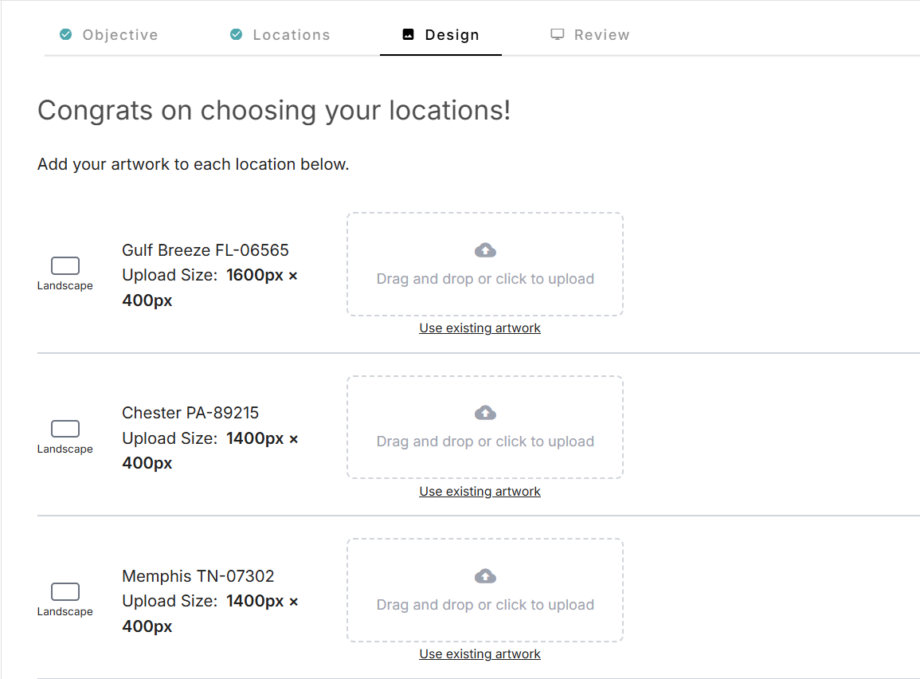
You can have your campaign live in minutes. Create a free account, select your locations, set your budget, upload your design, and start running once approved.
Where can I advertise with Blip in Burlington?
Blip has digital billboards in Burlington. You can browse available locations on a map, choose the ones that fit your audience, and start advertising right away.
Still have questions? Launch a campaign in minutes — no contracts, no commitments.
Start Your CampaignBurlington Billboard Advertising Guide
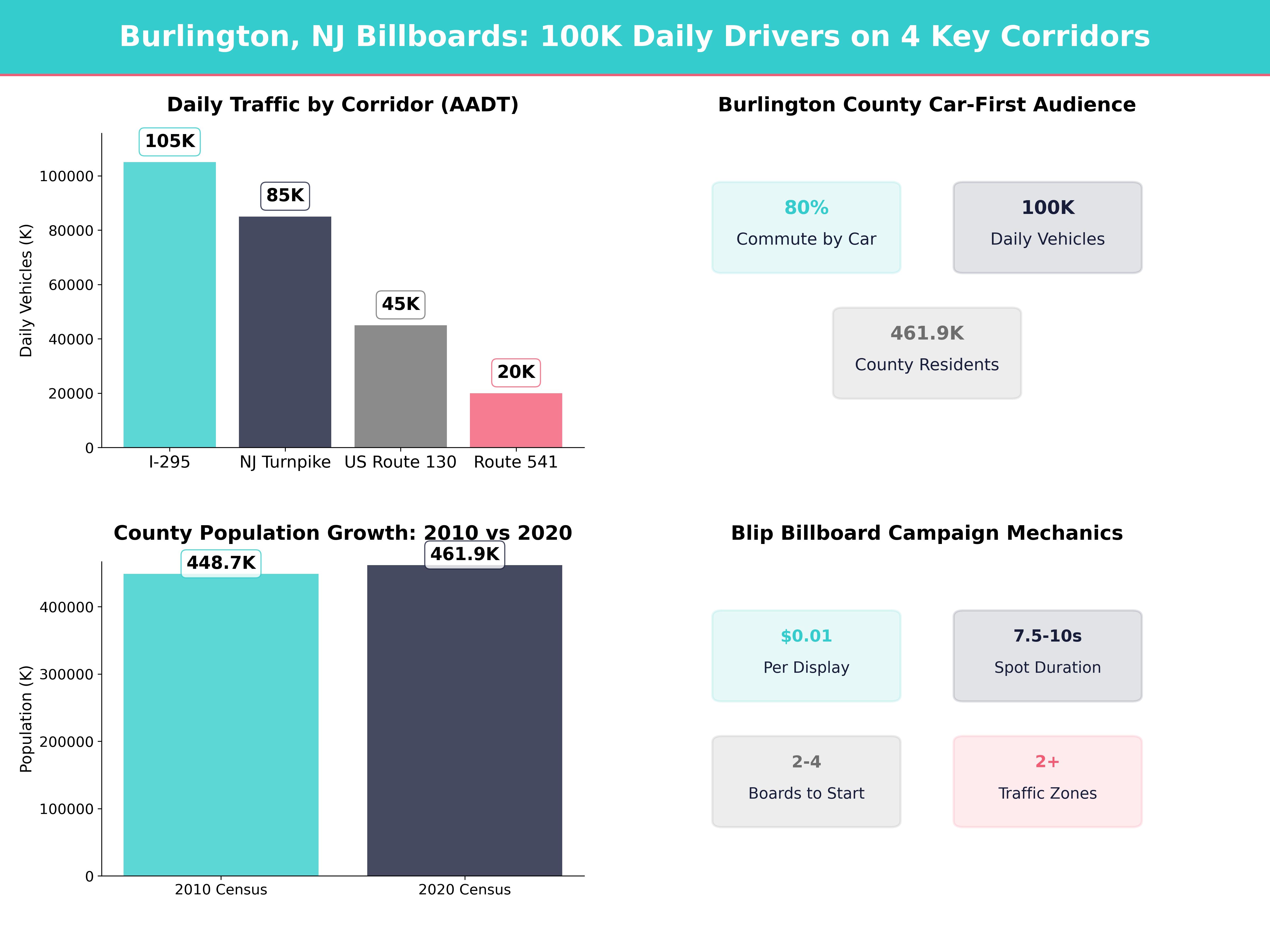
Burlington, New Jersey 100,000 vehicles per day. Burlington City 9,743 residents in the 2020 Census, but it sits inside Burlington County 461,860 residents, and along major South Jersey travel routes that connect to Philadelphia Trenton 4 in 5 county workers commuting by car, which is exactly the kind of repeated daily movement that makes billboards effective. We also benefit from cross-river traffic, suburban retail patterns, and year-round local events that give digital campaigns multiple moments to matter.
Burlington, New Jersey Market Overview
Population, growth, and local scale
Burlington works best when we think about it at two levels at once. Burlington City itself is compact, historic, and community-driven, while the surrounding county gives us much larger audience scale. In 2020, Burlington City counted 9,743 residents, down from 9,920 in 2010, which was a modest 1.8% decline. Over the same period, Burlington County grew from 448,734 to 461,860 residents, which was an increase of 13,126 people, or about 2.9%.
That split is useful for advertisers. A city-level campaign can build high frequency among local residents, downtown visitors, and bridge traffic, while a county-level campaign can layer on suburban shoppers, commuters, and service-area households. Burlington County also includes 40 municipalities, which means people regularly cross town lines for work, school, healthcare, errands, and recreation. For billboard planning, that kind of routine movement is a major advantage.
Burlington’s age is also part of its identity. The city dates to 1677, which gives it a different feel from newer suburban markets in South Jersey. That matters because creative that feels neighborly, credible, and place-aware usually fits better here than flashy metro-only messaging.
Economy, commuting, and what they mean for advertisers
The Burlington County Regional Chamber of Commerce reflects a business base that spans healthcare, education, logistics, retail, local government, and professional services. We do not need a single dominant industry for billboards to work well. In fact, a diversified local economy usually helps because different audiences move through the same corridors for different reasons throughout the day.
Commuting patterns strongly favor out-of-home media. Recent ACS commuting estimates consistently show that roughly 80% of workers in Burlington County get to work by car, whether driving alone or in a carpool. That creates repeated weekday exposure on roads like Interstate 295, U.S. Route 130, and the New Jersey Turnpike approach routes. When the same drivers see our message several times a week, recall rises without us needing a huge market-wide buy.
The county’s household buying power is also solid by South Jersey standards, and its population is spread across older river towns, middle-ring suburbs, and newer commercial areas. That mix makes Burlington a practical market for:
- Retail and restaurants, because shoppers travel between municipalities for convenience and price.
- Healthcare and legal services, because patients and clients often choose providers outside their home town.
- Home services, because the county has a broad residential base with ongoing repair, remodeling, and maintenance needs.
- Education and training, because students move between campuses, town centers, and transit stops.
- B2B and recruiting, because freight, warehousing, and regional commuting keep employment corridors active.
Key Traffic Corridors for Burlington, New Jersey
Burlington’s billboard value is driven by a handful of dependable commuter and shopping routes. According to NJDOT traffic count maps, the strongest local corridors consistently carry tens of thousands, and often well over 100,000, vehicles per day.
Interstate 295 near Burlington County
Interstate 295 is the region’s biggest audience-delivery corridor for Burlington campaigns. On Burlington County segments near places like Burlington Township Mount Laurel Township, and Bordentown City, NJDOT counts commonly place traffic in the 90,000 to 120,000+ AADT range, depending on the exact segment.
That volume makes I-295 ideal for advertisers that need regional reach rather than neighborhood-only awareness. We usually see the best fit here for:
- Hospitals, urgent care, and specialty practices, because patients travel across the county for care.
- Colleges and training programs, because the corridor connects multiple residential and employment centers.
- Home improvement, insurance, and legal services, because commuters can act later after repeated exposure.
- Major retail destinations, because shoppers often make destination trips instead of hyperlocal-only visits.
Because I-295 serves both local commutes and longer inter-county trips, it is one of the best places to build frequency with adults in active decision-making mode.
U.S. Route 130 through Burlington and Burlington Township
U.S. Route 130 is Burlington’s classic commercial spine. Through Burlington-area retail stretches, NJDOT traffic counts often fall in the 35,000 to 55,000 AADT band. The road is lined with shopping centers, quick-service restaurants, gas stations, auto services, and everyday retail, which means it captures people who are already close to spending.
This is the corridor we usually choose when our goal is immediate action. Route 130 works especially well for:
- Restaurants and takeout, because drivers can act within minutes.
- Grocery, pharmacy, and discount retail, because the route supports routine errand traffic.
- Auto dealers, repair shops, and oil change brands, because the audience is already in vehicles.
- Banks, dentists, and urgent care clinics, because convenience and location are major decision factors.
If our business depends on “next exit,” “today only,” or “minutes away” messaging, Route 130 often outperforms broader awareness corridors.
Route 541 and local access roads into Burlington
Route 541 gives us a more local, community-oriented audience. On developed sections around Burlington County commercial areas, traffic is often in the 15,000 to 25,000 AADT range. That is lower than I-295, but it can be more valuable for businesses that depend on local familiarity and frequent repeat exposure.
We typically like Route 541 for:
- Local professional services, such as law firms, accountants, and real estate offices.
- Community institutions, such as local schools, churches, and civic events.
- Healthcare providers, especially primary care, dental, and specialty clinics.
- Neighborhood retail and dining, where a familiar local name matters as much as a special offer.
These roads are especially useful when we want Burlington residents to see the same message several times each week in the course of ordinary life.
The New Jersey Turnpike
For broader regional reach, the New Jersey Turnpike 5 and 6 typically carry about 70,000 to 100,000+ vehicles per day, depending on the exact section. That traffic includes long-distance drivers, logistics activity, business travel, and commuters moving between South Jersey, Central Jersey, and Pennsylvania connections.
The Burlington County Bridge Commission 2 Delaware River bridges, and the Burlington area benefits directly from the Burlington-Bristol Bridge Bristol Borough, Pennsylvania five figures, which means cross-river campaigns are entirely viable for retailers, healthcare groups, legal services, and family entertainment brands.
We should also remember that Burlington has a transit layer. NJ Transit’s River LINE is 34 miles long, serves 21 stations, and provides peak service as often as every 15 minutes. The line connects Burlington to Camden County Bordentown City, and Trenton
Audience Segments We Can Reach in Burlington
Burlington commuters and cross-river travelers
The biggest audience in Burlington is still the daily commuter. With roughly 80% of county workers traveling by car, we can count on repeated weekday exposure from people heading to offices, healthcare campuses, retail centers, warehouses, and service jobs. Because Burlington also touches Pennsylvania-bound traffic through the bridge network, our campaign can influence both New Jersey residents and cross-river travelers in the same media footprint.
This segment is especially valuable for:
- Healthcare, legal, insurance, and financial brands, because commuters have time to absorb and remember a trusted name.
- Home services, because repeated message exposure supports later search and response.
- Recruiting campaigns, because workers frequently compare employers during their regular drive.
Students and education-focused households in Burlington County
Education is another meaningful audience segment. Rowan College at Burlington County serves more than 9,000 students annually, and its presence supports campaigns for colleges, trade programs, tutoring, apartments, food, banking, and technology services. Students also move through the county on mixed schedules, which makes dayparting especially useful.
The River LINE’s 21 stations also help us think beyond just drivers. Students, part-time workers, and younger adults are often moving between downtowns, campus areas, and regional job centers. For education advertisers, a Burlington campaign can blend commuter traffic with student movement in a way that is unusually efficient for a smaller market.
Families, shoppers, and household decision-makers in Burlington
Burlington County’s 461,860 residents across 40 municipalities create a large family and household-decision audience. These are the people choosing pediatricians, restaurants, grocery stores, car repair, back-to-school shopping, HVAC companies, and weekend activities. They are also highly responsive to convenience-based messaging because many of their trips are routine and repeatable.
Family-oriented campaigns become stronger when we align them with the area’s actual destinations. Virtua Health, Cooper University Health Care
Heritage tourists, park visitors, and event-goers in Burlington
Burlington’s tourism story is smaller than a shore town or ski market, but it is still meaningful. The city’s roots go back to 1677, and its Delaware River setting gives it real appeal for day-trippers. Nearby destinations such as the Roebling Museum, county park facilities managed by Burlington County
Smithville Park 312 acres, which is a useful reminder that Burlington County attracts recreation traffic as well as daily commuters. The Burlington County Farm Fair also gives us a reliable 6-day summer event window for fairgoers, families, food vendors, sponsors, and local retailers. If we coordinate with Burlington’s monthly downtown rhythm, we can refresh creative up to 12 times a year without the market feeling repetitive.
Seasonal Opportunities for Burlington Campaigns
Spring and summer in Burlington
Spring and summer expand the Burlington audience beyond pure commute traffic. Warmer weather increases discretionary trips for parks, riverfront walks, dining, recreation, graduations, and community events. This is when we should lean into family fun, outdoor services, local attractions, and hospitality-style messaging.
The 312-acre Smithville Park footprint, summer event calendars, and the 6-day Farm Fair all support heavier promotion for:
- Restaurants, ice cream, and family dining, because spontaneous visits increase.
- Home improvement and lawn care, because seasonal project demand rises.
- Museums, parks, and local events, because day-trip traffic broadens the audience.
- Retail and apparel, because graduations, weddings, and vacations create extra shopping demand.
For these campaigns, late-morning through evening visibility often matters more than early rush alone.
Back-to-school and fall timing in Burlington
The back-to-school window is one of Burlington’s best advertising moments. Most local K-12 schedules restart in late August or early September and run through early June, while college activity also ramps up at the same time. That creates a strong seasonal need for healthcare, tutoring, school supplies, apparel, quick meals, and student services.
Fall also tends to be ideal for practical-service advertisers. We usually see strong relevance for:
- Primary care, dental, and vision providers, because households reset routines after summer.
- Auto services and tires, because commuting normalizes again.
- HVAC, roofing, and home repair, because residents prepare homes for colder weather.
- Colleges and training programs, because enrollment and fall recruitment intensify.
For Burlington, this is often the season when commuter-focused messaging and local-family messaging overlap most cleanly.
Holiday retail and winter commutes in Burlington
From early November through late December, Burlington’s retail corridors become high-value visibility zones. Shoppers are traveling more often, and many are making quick decisions about gifts, dining, entertainment, and family services. This is a strong period for Route 130 messaging, especially when our offer is timely and close by.
Winter also changes the value of commute-focused placements. Shorter daylight hours and occasional weather slowdowns can stretch drive times, which gives drivers a little longer to notice outdoor advertising. In Burlington, we often like heavier weekday emphasis during 6 a.m. to 10 a.m. and 3 p.m. to 7 p.m. in winter, while tax services, healthcare scheduling, fitness, and home services can continue to perform well into January and February.
Billboard Design Tips for Burlington, New Jersey
Creative that feels right for Burlington
Burlington is not a market where generic “big city” creative always feels natural. We usually get better traction when our design feels grounded, local, and useful. Because Burlington combines a historic city core with suburban shopping behavior, the strongest visuals often balance trust and practicality.
In this market, we should usually emphasize:
- Simple local cues, such as Burlington Burlington Township Bristol Bordentown, or Route 130, because local geography matters to decision-making.
- Community-friendly imagery, such as families, storefronts, riverfront scenes, or approachable service professionals, because that fits the area’s tone.
- Clear distance or directional language, such as “2 miles ahead” or “minutes from Route 130,” because drivers often act on convenience.
- One strong offer, because crowded retail corridors reward clarity more than cleverness.
If our business serves both New Jersey and Pennsylvania customers, it can also help to reference both sides of the river directly. A line like “Easy from Burlington and Bristol” can feel more relevant than a broader regional claim.
Messaging for Burlington’s commuter and retail corridors
Creative should change based on the road. On I-295 and Turnpike-oriented placements, we should lead with brand, trust, and category. Drivers are moving fast, and many are farther from the point of purchase. On Route 130 and local commercial roads, we can be more action-oriented because the audience is closer to stores and service locations.
For Burlington-specific design, we usually recommend that we build separate creative versions for at least 2 contexts:
- A commuter version for I-295 or broader county reach, where the goal is memorability.
- A retail version for Route 130 or local access roads, where the goal is immediate response.
If our audience includes a meaningful Spanish-speaking customer base, Burlington’s regional diversity also makes it worth testing a bilingual variation on selected boards. We do not need to translate every campaign, but we should consider it where the service area and customer mix support it.
Regional Strategies Around Burlington, New Jersey
Burlington City and the riverfront core
In Burlington City itself, we usually want messaging that feels civic, neighborhood-oriented, and event-aware. This is the right zone for downtown businesses, restaurants, professional services, community events, and locally trusted brands. Frequency matters more than sheer scale here.
Campaigns in the city core work best when they tie directly to local behavior, such as downtown visits, bridge travel, or repeat neighborhood errands. If our goal is store visits or event attendance, this is where short bursts around specific dates can work especially well.
Burlington Township and the Route 130 commercial belt
Burlington Township
This submarket is especially effective for chains, franchise groups, and regional service providers because the audience is already in shopping mode.
Bordentown, the Turnpike node, and the logistics belt
Bordentown City and the surrounding Turnpike and I-295 access area are ideal for broader regional awareness, B2B messaging, recruiting, travel services, and freight-adjacent categories. This is where we can capture drivers who are not necessarily “from Burlington” but still pass through the area regularly.
For employers, logistics firms, truck services, staffing agencies, and regional healthcare networks, this belt gives us access to people in work mode rather than leisure mode. That usually favors concise, practical messages with one strong call to action.
Mount Laurel, Moorestown, and the higher-spend suburban ring
When we want to extend a Burlington campaign into a stronger suburban spending environment, Mount Laurel Township and Moorestown Township
We can think of this as the “Burlington plus suburban lift” strategy. A package across Burlington City, Burlington Township, Bordentown, Mount Laurel, and Moorestown can give us a balanced mix of local trust, commuter scale, retail intent, and household purchasing power.
Using Blip Tools in Burlington, New Jersey
Applying dayparting and flexible budgeting in Burlington
Burlington is a market where timing can improve relevance quickly. On commuter corridors, we often want stronger presence during 6 a.m. to 10 a.m. and 3 p.m. to 7 p.m. On Route 130, restaurants and convenience retail may benefit more from 11 a.m. to 2 p.m. and evening drive time. For family entertainment and local attractions, weekends and late afternoons can be more valuable than weekday mornings.
Because Blip lets us control timing and budget without traditional rigidity, we can match the spend to actual Burlington behavior instead of buying the same intensity all day. That is especially useful around the 6-day Farm Fair, back-to-school windows, holiday retail weeks, or short-term local promotions.
Testing local creative and optimizing with real-time feedback
Burlington is also a good market for creative testing because it contains several distinct audience contexts in a compact regional area. We can run one version focused on local trust, another focused on convenience, and another focused on a specific offer, then compare performance and keep the strongest option.
Blip’s analytics and artwork tools make that practical. We can localize copy for Burlington, Bristol, Route 130, or I-295, and we can adjust quickly if one message is clearly outperforming another. Since digital blips run for about 7.5 to 10 seconds, every word matters, and Burlington’s mix of slow retail roads and faster commuter routes gives us a useful testing ground.
Getting Started with Billboard Rental in Burlington, New Jersey
How we should choose billboard locations in Burlington
When we start renting billboard space in Burlington, the first step is not picking the prettiest board. The first step is matching the location to the business goal. If we want awareness, we should prioritize high-volume commuter corridors. If we want foot traffic or same-day response, we should prioritize boards close to retail clusters, bridges, and decision points.
We should usually evaluate Burlington boards by asking five practical questions:
- Is the board on a commute route or an errand route? The answer changes the kind of message we should run.
- How close is the board to the action point? A board that is within a few minutes of the store, office, or venue is better for immediate response.
- Which direction of travel matters most? Morning and afternoon traffic can produce very different audiences.
- What nearby landmarks shape behavior? Bridges, highway exits, shopping centers, and downtown gateways all matter.
- Does the board speak to locals, pass-through traffic, or both? Burlington has all three, and each requires slightly different creative.
What to expect from the rental process in Burlington
Traditional billboard buying in markets like Burlington often means fixed packages, manual proposals, and 4-week blocks that are harder to test. Blip simplifies that process. We can review locations on a map, choose the boards that fit our route strategy, upload creative, and launch without committing to an oversized plan.
For many Burlington advertisers, a smart starting point is a 2-to-4-board test across at least 2 traffic environments, such as one commuter corridor and one retail corridor. That setup helps us learn whether our message works better with broad awareness traffic or close-in purchase traffic. If our campaign is highly localized, we can stay tight around Burlington and Route 130. If our market is regional, we can add I-295, Turnpike-adjacent inventory, and cross-river visibility.
Because Blip uses pay-per-play pricing, with rates starting at $0.01 per display, we can start small, measure quickly, and expand only where the Burlington data support it. That is the biggest practical advantage in this market. Burlington is full of useful micro-geographies, and Blip makes it easy for us to test them without wasting budget on a one-size-fits-all buy.