Billboards near Paterson, NJ
No Minimum Spend. No Long-Term Contracts. Just Results.
Trusted by Leading Brands


Billboard advertising
near Paterson has never been easier



How much is a billboard near Paterson?
Why Choose Blip for Billboard Advertising near Paterson
-
Blip lets you launch fast on Paterson’s I-80, Route 46, and Route 19 corridors—no big-agency hassle.
-
Use flexible budgets in Paterson to reach commuters and shoppers on busy weekday peaks, then scale up or down anytime.
-
No contracts with Blip means you can test Paterson Great Falls, downtown, and Hackensack traffic for a short flight.
-
Paterson real-time analytics show what works, so you can adjust as traffic shifts on the Garden State Parkway and Route 4.
-
Blip’s creative tools make bilingual, bold Paterson ads easy for Spanish-speaking neighborhoods and fast-moving drivers.
Frequently Asked Questions About Billboard Advertising near Paterson
How much does a billboard cost near Paterson, New Jersey with Blip?
With Blip, you can advertise on digital Paterson billboards on any budget by setting a daily amount that Blip will automatically follow, so you’re always in control of how much you spend in the Paterson area. Each ad “blip” is a 7.5–10 second display, and you only pay for the blips you receive—our pay-per-blip model means your total cost is simply the sum of those brief displays. The price of billboards near Paterson, New Jersey adjusts based on the times you choose, the locations serving the Paterson area, and real-time advertiser demand.
Where can I advertise with Blip in Paterson, New Jersey?
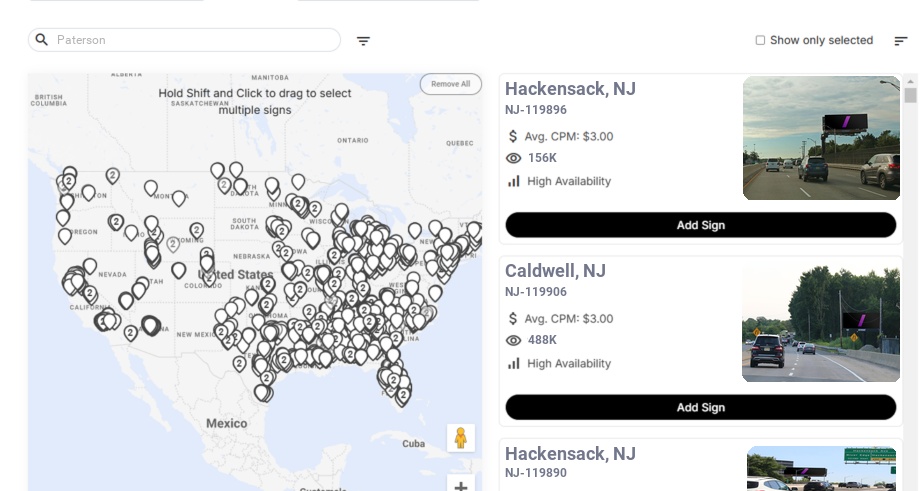
With 36 digital billboards serving the Paterson area in nearby communities such as Woodland Park, Totowa, Little Falls, Maywood, Lodi, Hackensack, Ridgefield, and others, we can build highly targeted, data-driven campaigns that keep your brand in front of the people who matter most. These Paterson billboards give you sustained visibility along the exact corridors your customers rely on every day. The boards are concentrated around high-flow corridors in cities like Woodland Park, Little Falls, Totowa, Maywood, Lodi, Hackensack, Bogota, Ridgefield, Oakland, Bloomingdale, and Caldwell.
What kind of audience do Paterson billboards with Blip reach?
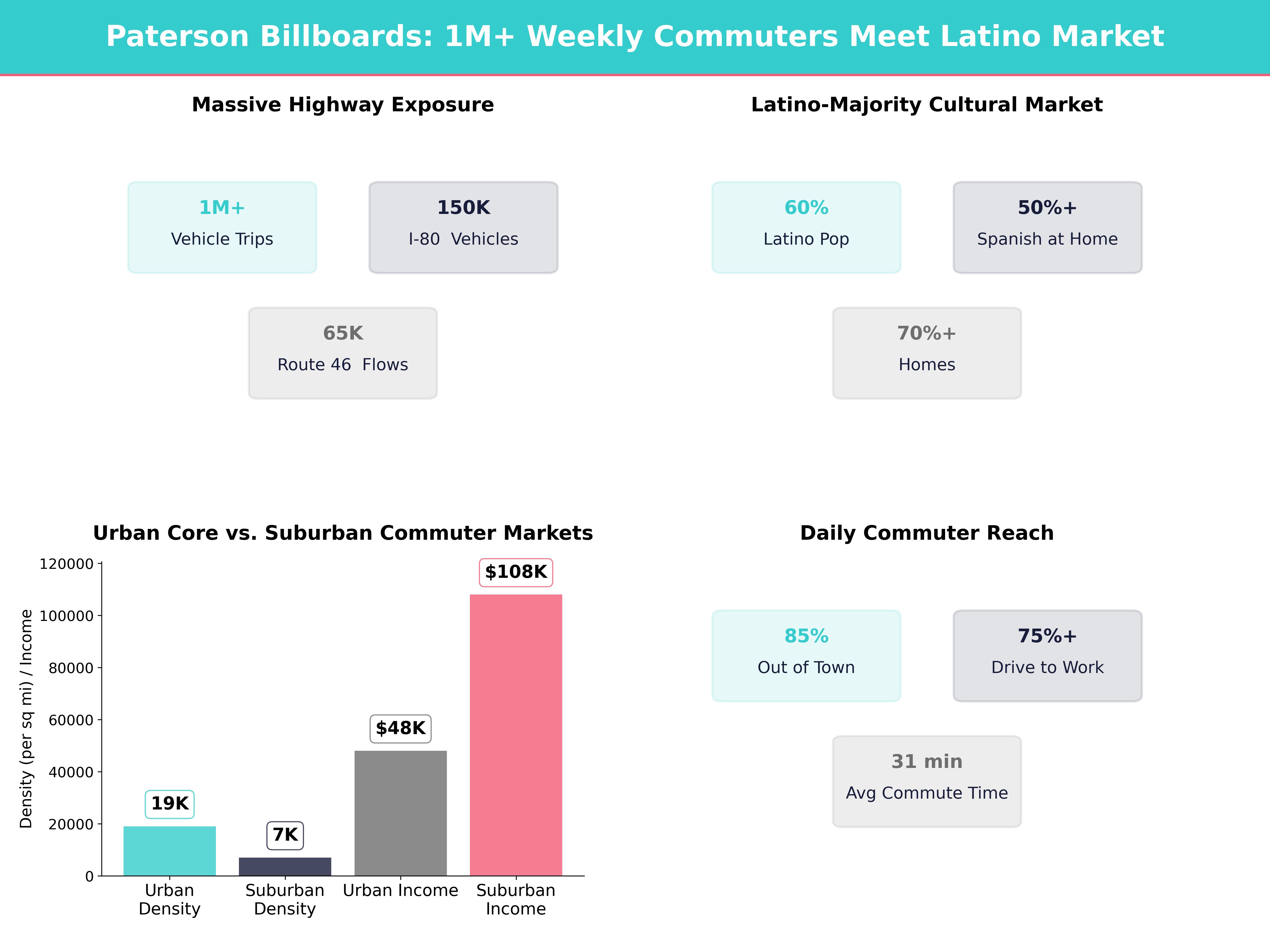
Paterson sits at the heart of one of the densest, most mobile markets in the country, with about 160,000 residents in the city and more than 520,000 residents in Passaic County. Paterson’s population density is over 19,000 residents per square mile, while many nearby suburbs range between 5,000–9,000 residents per square mile, creating a tightly packed, high-exposure environment for roadside media. The Paterson area is among the most diverse in the state, with Latino residents accounting for roughly 60% of the population, Black residents about 25%, and foreign-born residents about 35–40%.
When is the best time to run a billboard campaign in Paterson, New Jersey?
Weekday morning (6–10 a.m.) is strong for commuter-oriented messaging, with the morning peak typically occurring between 7–9 a.m., when directional traffic toward job centers can be 40–50% higher than mid-day baselines. Evening peak (3–7 p.m.) is also valuable, with outbound traffic heavy from 4–6 p.m. and high traffic volumes on I-80, Route 46, and the Garden State Parkway. Late evening and overnight traffic shrinks to 20–30% of daytime levels, but cost per impression often does as well.
What highways around Paterson, New Jersey get the most traffic for billboard ads?
The Paterson area is framed by some of New Jersey’s busiest highways. Interstate 80 near Paterson carries approximately 150,000–180,000 vehicles per day, and the Garden State Parkway just east of the area near Saddle Brook and Lodi reaches 160,000–180,000 vehicles per day. U.S. Route 46 around Totowa and Little Falls sees roughly 65,000–80,000 vehicles per day, making these corridors strong choices for billboard visibility.
Do I need a contract to advertise with Blip near Paterson?
No, Blip has no long-term contracts or minimum commitments. You can start, pause, or stop your campaign at any time.
How fast can I launch a billboard campaign with Blip near Paterson?
You can have your campaign live in minutes. Create a free account, select your locations, set your budget, upload your design, and start running once approved.
Where can I advertise with Blip near Paterson?
Blip has digital billboards near Paterson. You can browse available locations on a map, choose the ones that fit your audience, and start advertising right away.
Still have questions? Launch a campaign in minutes — no contracts, no commitments.
Start Your CampaignPaterson Billboard Advertising Guide
Paterson sits at the heart of one of the densest, most mobile markets in the country. With about 160,000 residents in the city and more than 520,000 residents in Passaic County, advertisers can use digital billboards near Paterson to intercept commuters, shoppers, and visitors moving between northern New Jersey and New York City. Paterson’s population density is over 19,000 residents per square mile, while many nearby suburbs range between 5,000–9,000 residents per square mile, creating a tightly packed, high‑exposure environment for roadside media.
With 36 digital billboards serving the Paterson area in nearby communities such as Woodland Park Totowa, Little Falls Maywood Lodi Hackensack, Ridgefield, and others, we can build highly targeted, data‑driven campaigns that keep your brand in front of the people who matter most. These Paterson billboards give you sustained visibility along the exact corridors your customers rely on every day.
Understanding the Paterson Area Market
Paterson is one of New Jersey’s largest and most diverse cities. According to the City of Paterson and analyses of recent American Community Survey data:
- Paterson has roughly 159,000–160,000 residents, making it New Jersey’s 3rd‑largest city by population after Newark and Jersey City.
- Passaic County, anchored by Paterson, has about 524,000 residents across 16 municipalities, from dense inner‑ring suburbs to more suburban and semi‑rural communities to the north and west.
- Population density in Paterson exceeds 19,000 people per square mile, compared with a New Jersey statewide average of about 1,300 people per square mile, which substantially increases potential impressions per board.
- The Paterson area is among the most diverse in the state. In Paterson itself, Latino residents account for roughly 60% of the population, Black residents about 25%, and foreign‑born residents about 35–40%. Neighborhood‑level data indicate that in some census tracts, 70% or more of households speak a language other than English at home, with Spanish the most common, followed by Arabic, Bengali, Turkish, and Urdu.
- Household incomes vary widely. Paterson’s median household income is in the $45,000–$50,000 range, compared with a New Jersey median around $90,000. Nearby towns where our billboards are located—such as Woodland Park Little Falls Caldwell—often report median household incomes in the $95,000–$120,000 range, and homeownership rates above 60% (versus under 30% in Paterson).
- A significant share of Paterson households do not own a car; ACS‑based estimates place this at around 25–30% of households, compared with roughly 10% statewide. In nearby suburbs like Totowa and Oakland 95% of households, and average vehicles per household is typically 2.0–2.2, which helps explain heavy traffic on the major corridors where our boards sit.
This mix has direct implications for billboard strategy near the Paterson area:
- Broad reach across income levels. Digital billboards serving the Paterson area can simultaneously reach working‑class city residents and higher‑income suburban households commuting through corridors like I‑80, Route 46, and the Garden State Parkway. For example, more than 70% of employed Paterson residents commute out of their home tract for work, and county‑level data show that over 60% of Passaic County workers use a car to commute, feeding steady traffic past our boards. Well‑placed billboard advertising near Paterson can tap into these daily flows.
- Multilingual potential. In several Paterson neighborhoods, 50–65% of residents report speaking Spanish at home. Bilingual or Spanish‑forward creative often performs well for consumer brands, local services, and recruitment campaigns looking to build trust with these communities.
- Neighborhood gravity. Local surveys and retail data show that a large share of purchases for groceries, quick‑service restaurants, and personal services happen within 1–3 miles of home. Many Paterson residents stay loyal to local retail corridors—such as Main Street, Market Street, and Broadway—while commuting outward for work. Our boards in nearby municipalities like Woodland Park Totowa, and Lodi
For a deeper feel for the community, we recommend reviewing local sources such as the City of Paterson, Passaic County Paterson Times NorthJersey.com’s Paterson coverage
Key Highways and Traffic Flows Near Paterson
The Paterson area is framed by some of New Jersey’s busiest highways. According to recent counts from the New Jersey Department of Transportation, typical average daily traffic (ADT) in and around the city includes:
- Interstate 80 (I‑80) near Paterson: approximately 150,000–180,000 vehicles per day, with truck traffic often accounting for 8–12% of total volume.
- U.S. Route 46 around Totowa and Little Falls: roughly 65,000–80,000 vehicles per day, including heavy retail and commuter traffic.
- State Route 19, which funnels traffic directly toward downtown Paterson and I‑80: about 50,000–60,000 vehicles per day on key segments.
- State Route 20 along the Passaic River corridor: often 40,000–50,000 vehicles per day, connecting Paterson to Clifton and other nearby municipalities.
- Garden State Parkway just east of the Paterson area near Saddle Brook and Lodi 160,000–180,000 vehicles per day, making it one of the state’s highest‑volume roads.
- State Route 4 near Hackensack: around 90,000–110,000 vehicles per day, driven in part by access to regional malls and the George Washington Bridge corridor.
Our 36 digital billboards serving the Paterson area are concentrated around these high‑flow corridors in cities such as:
- Woodland Park – Captures cross‑county commuters using I‑80 and Route 46, where peak‑hour speeds often drop below 30 mph, increasing dwell time and read rates.
- Little Falls Totowa (3.4–3.8 miles) – Strong reach to commuters traveling between western Passaic County, Essex County, and the Paterson area; combined ADT on I‑80 and Route 46 in this stretch typically exceeds 220,000 vehicles per day.
- Maywood Lodi Hackensack, Bogota, Ridgefield (5–9.4 miles) – Excellent positioning near Route 4, Route 17, and the Garden State Parkway to catch Paterson‑area drivers heading toward Hackensack University Medical Center, Paramus, and the George Washington Bridge.
- Oakland Bloomingdale, Caldwell (9.2–10 miles) – Reaches residents from more suburban and exurban communities who still regularly visit or commute near the Paterson area; many of these towns report commuter outflows above 70%, meaning a large share of residents drive through regional corridors daily.
Using Blip, we can selectively light up individual boards along these corridors to:
- Target inbound commuters toward the Paterson area in the morning, when directional flows on I‑80 and Route 46 can spike 20–30% above base volumes.
- Target outbound commuters heading to major job centers like Newark, Jersey City
- Saturate certain corridors (for example, I‑80 and Route 46) during key sales periods, grand openings, or event promotions, leveraging the fact that these routes collectively generate well over 1 million weekly vehicle trips in our coverage area.
Commuter Patterns, Transit, and When People Are on the Road
The Paterson area is a classic commuter hub. Data from the American Community Survey and NJ TRANSIT suggest:
- Average commute times for Paterson residents hover around 30–32 minutes, compared with a U.S. average near 26 minutes, indicating a significant share of regional, not just hyper‑local, travel.
- In Passaic County as a whole, roughly 75–80% of workers commute by car (driving alone or carpooling), 10–12% use public transit, and the remainder walk, bike, or work from home.
- A sizable share of workers commute to other parts of Passaic and Bergen Counties or into New York City, using I‑80, Route 46, Route 3, and the Garden State Parkway. More than 20,000 Passaic County residents are estimated to commute into New York City on a typical workday.
- NJ TRANSIT’s Main/Bergen County Line runs through the Paterson rail station, which handles thousands of passenger boardings per week and connects directly to Secaucus Junction and Hoboken.
- NJ TRANSIT bus routes such as the 72, 74, 161, 171, and 190 link Paterson with downtown Newark, Jersey City, the Meadowlands, and the Port Authority Bus Terminal in Manhattan, with some lines carrying over 5,000 riders per weekday.
- Many commuters drive to park‑and‑ride or rail stations in surrounding towns—passing our boards in Hackensack, Lodi
These patterns shape optimal dayparting strategies:
-
Weekday morning (6–10 a.m.)
- Morning peak typically occurs between 7–9 a.m., when directional traffic toward job centers can be 40–50% higher than mid‑day baselines.
- Strong for commuter‑oriented messaging (coffee, breakfast, fuel, quick‑service restaurants, financial services, and local employers).
- Good window for concise, “plan‑your‑day” calls to action (download an app, try a lunch special, book a same‑day appointment).
-
Midday (10 a.m.–3 p.m.)
- Traffic volumes are lower than peak, but still substantial; on some arterials like Route 46, midday ADT can be 60–70% of peak, with fewer backups and more consistent speeds.
- Reach stay‑at‑home parents, retirees, city employees, and shift‑workers.
- Great for local retailers, medical offices, government services, and community events.
- Particularly effective for boards near shopping centers in Woodland Park, Totowa, and Hackensack.
-
Evening peak (3–7 p.m.)
- Evening rush in North Jersey often extends past 6:30 p.m., with outbound traffic heavy from 4–6 p.m.
- High traffic volumes on I‑80, Route 46, and the Garden State Parkway.
- Ideal for dinner promotions, grocery stores, entertainment, and branding campaigns that benefit from repetitive exposure as drivers sit in congestion.
-
Late evening and overnight
- Traffic volumes shrink, sometimes to 20–30% of daytime levels, but cost per impression often does as well.
- Useful for budget‑sensitive brands, recruitment campaigns, and campaigns aimed at night‑shift workers heading to and from hospitals, logistics centers, and manufacturing facilities.
With Blip’s flexible scheduling, we can adjust ad frequency and timing across these windows and across specific billboards serving the Paterson area, so you pay for impressions when they’re most valuable to your audience.
Who You’re Reaching: Key Audience Segments
Because of its density and diversity, the Paterson area supports a wide range of campaign types. Some high‑impact audience segments include:
1. Local Residents and Neighborhood Shoppers
- Paterson itself has about 160,000 residents in just 8.4 square miles, making it one of the most densely populated cities in the country and ensuring that even neighborhood‑oriented boards can generate hundreds of thousands of weekly impressions.
- Within a 10‑mile radius—capturing nearby towns like Woodland Park Totowa, Little Falls Lodi Maywood 600,000 residents, many of whom frequently cross municipal lines for shopping and services.
- Local retail corridors (Market Street, Main Street, Broadway, Union Avenue) and strip centers in surrounding towns depend heavily on repeat visits; retail industry benchmarks show that 60–70% of sales at neighborhood stores come from repeat customers living within 3–5 miles.
Strategy ideas:
- Geographically targeted boards closest to your storefronts to drive immediate foot traffic (“Exit 55 – 1 mile ahead on Route 46”).
- Rotating promotions aligned with weekly shopping patterns—such as grocery specials early in the week and restaurant/entertainment promotions Thursday–Sunday, when restaurant spending in many communities can rise 20–30% over Monday–Wednesday.
- “Neighborhood pride” messaging that names specific communities (“Proud to serve Paterson families since 1990”) to tap into strong local identity and word‑of‑mouth.
2. Commuters to Regional Job Centers
- In Passaic County, more than 85% of employed residents commute to a job outside their home municipality, and thousands travel daily to Newark, Jersey City.
- Corridors like I‑80, Route 46, Route 3, the Garden State Parkway, and Route 4 serve as primary paths to those job centers, with cumulative weekday trips in the hundreds of thousands.
- Regional employment hubs such as the Meadowlands Sports & Entertainment District
Strategy ideas:
- Employment and recruitment campaigns for logistics, warehousing, healthcare, and manufacturing employers positioned along I‑80 and Route 46, especially during periods when regional unemployment changes or when local job fairs are promoted by Passaic County Workforce Development
- Brand campaigns for financial institutions, universities, and healthcare systems seeking to build daily familiarity with commuters through high‑frequency morning and evening impressions.
- Offers specifically framed around time savings or convenience (“Skip the city traffic—shop in Totowa tonight”) that resonate with commuters whose one‑way travel often exceeds 30–40 minutes.
3. Families and Youth
- The Paterson area has a relatively young population, with median ages in the low 30s, and a high share of children; in Paterson, roughly 25–27% of residents are under age 18.
- The Paterson Public Schools system serves more than 25,000 students across dozens of schools, making it one of the larger school districts in New Jersey.
- Nearby colleges, such as Passaic County Community College in downtown Paterson and William Paterson University in neighboring Wayne 5,000–10,000 range.
Strategy ideas:
- Campaigns for after‑school programs, youth sports, tutoring, and family entertainment scheduled around school commute hours (7–9 a.m. and 2–4 p.m.), when school‑related traffic can increase local volumes by 10–15%.
- Enrollment and open‑house campaigns for schools, colleges, and training centers during spring and late summer, when education‑related search and inquiry activity typically peaks.
- College‑age recruitment for local employers, healthcare systems, and public safety agencies, especially on boards near William Paterson University and Passaic County Community College.
4. Visitors and Regional Shoppers
The Paterson area attracts visitors for both shopping and tourism:
- Major retail destinations like the Garden State Plaza corridor in nearby Paramus (via Route 4 and Route 17) and shopping centers near Totowa and Woodland Park 10–20 million visits per year, depending on the property.
- The Paterson Great Falls National Historical Park, highlighted by New Jersey’s official tourism site, has recorded annual visitation in the 200,000–300,000 visitors per year range in recent years, making it one of North Jersey’s most distinctive urban natural attractions.
- Local tourism initiatives from Passaic County
Strategy ideas:
- Use boards on inbound routes (I‑80, Route 46, Route 4) to promote parking, dining, and attractions near the Great Falls or downtown Paterson, with simple directional copy (“Great Falls – 2 exits ahead”).
- Tourism and hospitality campaigns for hotels, museums, and entertainment venues across the county, such as those highlighted by Passaic County Tourism
- Retail brands can drive cross‑shopping, e.g., “Headed to Garden State Plaza? Stop at our Woodland Park store on the way,” capturing shoppers making multi‑stop trips.
Tailoring Creative for the Paterson Area
Given the fast‑moving traffic and multilingual environment, creative choices are critical. Data from the Outdoor Advertising Association of America and performance across similar markets suggest:
- Viewers have 6–8 seconds to absorb your message on a roadside digital board, and recall rates drop sharply when copy exceeds that window.
- Brand recall improves significantly when ads use fewer than 7 words, large fonts, high‑contrast colors, and a single focal image; campaigns following these guidelines have been shown to increase unaided recall by up to 30–40% compared with cluttered designs.
For the Paterson area, we recommend:
Clear, Bold Messaging
- Limit copy to a strong headline and perhaps a brief sub‑line (“Auto Insurance from $89/Month – Exit 54”).
- Use large, legible fonts that stand out against urban backgrounds and nighttime lighting; consider minimum font heights of 18–24 inches on final display for highway boards.
- Avoid clutter—no more than one logo, one image, and one call‑to‑action. OAAA case studies show that simplifying design can lift click‑through to associated digital channels by 15–20%.
Multilingual & Culturally Attuned Copy
With such a large share of Spanish‑speaking and other multilingual residents:
- Test Spanish‑language or bilingual creatives for consumer products, financial services, telecom, and grocery brands. In markets with similar language profiles, bilingual campaigns have produced 10–25% higher response among targeted households.
- Consider cultural references during key holidays (Three Kings Day, Ramadan, Eid, Diwali, etc.) aligned with the area’s communities, especially when paired with timely offers or community messages.
- Always ensure translations are professionally handled—no machine‑translated copy on a permanent creative—to avoid miscommunication and to build credibility.
Blip’s platform makes it easy to upload multiple versions of artwork and compare performance by time of day, location, and duration.
Local Context and Landmarks
Tie your creative to familiar local points of reference:
- “5 minutes from the Paterson Great Falls.”
- “Across from the Totowa Costco.”
- “Near St. Joseph’s University Medical Center in Paterson.”
By referencing known landmarks and local institutions, you transform your boards from generic ads into clear wayfinding tools, which can increase navigation‑driven store visits and appointment bookings.
Seasonal, Cultural, and Event‑Driven Opportunities
The Paterson area has strong seasonality and community events that can significantly boost campaign relevance:
-
Winter (January–March)
- Focus on tax prep, financial services, heating/oil services, and winter auto repair. In North Jersey, heating‑related service calls and auto repair demand typically spike 20–30% during cold snaps.
- Flexible Blip buys can also let you pulse during snowstorms or cold snaps when online ordering and grocery delivery can jump by 15–40%.
-
Spring (April–June)
- Home services (roofing, landscaping, contractors), graduation promotions, and school enrollment campaigns benefit from increased home improvement spending; national benchmarks show home services inquiries rising 15–25% versus winter.
- Seasonal tourism around the Paterson Great Falls, particularly late spring when flows are strong, is an excellent period for dining and hospitality ads targeting day‑trippers from neighboring counties.
-
Summer (July–August)
- Community festivals and local government initiatives; check calendars from Passaic County City of Paterson. Outdoor events, concerts, and youth programs are heavily promoted during this window.
- Great for promoting cooling services, summer school, camps, and amusement/entertainment destinations, especially on weekends when leisure travel volumes can outpace weekday commuter traffic on some secondary routes.
-
Fall (September–November)
- Back‑to‑school shopping, college enrollment, fall sports, and healthcare (flu shots, urgent care, open enrollment). Healthcare systems often concentrate flu‑shot campaigns in September and October, when vaccination demand surges.
- Retailers ramp up for early holiday promotions, particularly along major shopping corridors and around big‑box locations in Hackensack, Lodi, and Totowa.
-
Holiday season (November–December)
- Prime time for retail, e‑commerce, and donation campaigns for local nonprofits. Many retailers see 25–30% of annual sales in the November–December period.
- Heavy traffic around malls in Hackensack and along Route 4 and Route 17 makes our boards in that area especially valuable; mall‑adjacent traffic can increase 20–50% on key shopping days like Black Friday and the last weekend before Christmas.
Using Blip, we can spin campaigns up or down in a matter of days to align with these windows—no need to commit to a months‑long static installation. This is especially helpful if you are testing billboard rental near Paterson for the first time and want the flexibility to adjust quickly.
Matching Billboard Locations to Campaign Goals
With 36 digital billboards serving the Paterson area, thoughtful location selection is key. A few common patterns we see work particularly well:
Downtown, Healthcare, and Institutional Reach
- Boards in nearby communities like Woodland Park Totowa, and Little Falls reach city workers, patients, and visitors headed toward St. Joseph’s University Medical Center, the Passaic County Courthouse, and downtown Paterson offices.
- These facilities collectively serve tens of thousands of patients and visitors each month, alongside thousands of employees commuting from across the region.
- Ideal for hospitals, clinics, law firms, government announcements, and institutional branding that benefits from being seen repeatedly on main access routes.
Retail and Restaurant Traffic
- Billboards near shopping areas in Hackensack, Lodi Maywood align with high‑volume retail trips (including major malls and big‑box centers). Regional data show that 30–40% of weekday traffic in these corridors is shopping or errand related, with even higher shares on weekends.
- Useful for national brands and local independents seeking to influence purchase decisions right before store visits, particularly when combined with time‑sensitive offers (“Tonight only,” “Weekend sale,” etc.).
Upscale & Suburban Audiences
- Boards in Caldwell, Oakland Bloomingdale and other outer‑ring towns lean more suburban, with higher median incomes (often above $110,000) and more single‑family housing.
- Vehicle ownership and discretionary spending are higher here; households in these communities typically spend more on home improvement, vehicles, travel, and healthcare.
- Effective for home services, dealerships, private schools, and higher‑end healthcare or professional services that want to reach decision‑makers with greater purchasing power while still being connected to the Paterson urban core.
By mixing multiple locations in a Blip campaign, we can:
- Anchor your visibility around Paterson‑centric commuting patterns.
- Extend your brand into higher‑income suburbs or regional retail corridors.
- Create a “halo” effect so that residents feel they’re seeing your brand everywhere in the broader Paterson area, which research shows can boost brand favorability by 10–20% compared with single‑corridor campaigns.
Using Blip’s Flexibility to Test and Optimize
The Paterson area is ideal for data‑driven campaign testing because of its dense, varied traffic flows. With Blip, we can:
- Test multiple creatives on different boards at the same time—e.g., one English‑only creative in Caldwell and a bilingual version in Woodland Park—to see which yields better response (measured through web traffic, promo codes, or store visits). In similar markets, A/B‑testing creative has helped advertisers improve conversion metrics by 15–30% over initial designs.
- Concentrate spend around specific time windows—such as weekday rush hours or weekend afternoons—when your audience is most likely on the road, aligning spend with the top 30–40% of daily traffic volume.
- Adjust on the fly in response to news, weather, or local events. If the Paterson Times NorthJersey.com
A practical testing framework for the Paterson area might look like:
-
Weeks 1–2:
- Run 2–3 creatives across a broad mix of boards (I‑80, Route 46, and Garden State Parkway corridors).
- Focus on morning and evening peaks to capture at least 60–70% of daily traffic.
-
Weeks 3–4:
- Shift more impressions to the best‑performing creative.
- Double down on the top‑converting corridors (for instance, Route 46 near Totowa and Route 4 near Hackensack), where incremental frequency can significantly increase message recall.
-
Weeks 5+:
- Introduce small tweaks—price points, images, or language—and rerun the test cycle.
- Add seasonal or event‑specific messages as appropriate (tax season, back‑to‑school, holidays, or local festivals promoted by Passaic County
For many advertisers, this test‑and‑learn approach is the most efficient way to scale billboard advertising near Paterson while keeping budgets under control.
Practical Tips for Succeeding Near the Paterson Area
To get the most out of your digital billboard investment near the Paterson area, we recommend:
-
Align your creative with real‑world movement.
Think in terms of specific trips—“Heading home to Paterson from Hackensack,” “Driving from Wayne to Newark,” or “Shopping along Route 46”—and craft messages that make sense for that moment. Local travel surveys indicate that the average North Jersey resident makes 3–4 vehicle trips per day, often mixing work, school, and errands. -
Use strong local references.
Mention Paterson, nearby towns, streets, or landmarks so viewers instantly recognize the relevance. References to known locations like the Paterson Great Falls, Route 46 in Totowa, or downtown Hackensack help cut through clutter and can improve response on Paterson billboards and surrounding boards. -
Keep measurement simple but consistent.
- Use unique URLs, QR codes, or promo codes tied to your billboard campaign; even a 5–10% lift in web traffic or store visits during your flight is meaningful in a dense market like Paterson.
- Watch for correlated lifts in website traffic, calls, foot traffic, or online orders during your flight periods, and compare against prior periods and nearby markets where you are not advertising.
-
Plan around weather and seasonality.
Northern New Jersey gets winter snow, summer heat, and heavy rain—perfect triggers for home services, auto shops, and delivery services. Use Blip’s flexibility to pulse ads during peak needs; for example, a snowstorm can push demand for delivery, auto repair, and hardware up 20–40% within 24–48 hours. -
Consider community impact.
The Paterson area values institutions and brands that invest locally. Use your boards to highlight sponsorships, hiring local workers, or supporting community events and schools—like partnerships with Paterson Public Schools, local youth sports, or neighborhood clean‑ups promoted by the City of Paterson. Community‑focused messages can improve brand favorability and trust, even for strongly commercial campaigns.
By combining Paterson’s dense, diverse population with the reach of 36 strategically located digital billboards in surrounding communities, we can build campaigns that are nimble, data‑driven, and deeply rooted in how people actually move through the region. Whether you’re a neighborhood business or a regional brand, digital billboards near Paterson and flexible billboard rental near Paterson give you a powerful way to stay visible, relevant, and top of mind every single day.