Billboards near Westwood, NJ
No Minimum Spend. No Long-Term Contracts. Just Results.
Trusted by Leading Brands


Billboard advertising
near Westwood has never been easier



How much is a billboard near Westwood?
Why Choose Blip for Billboard Advertising near Westwood
-
Blip lets you launch Westwood billboards fast on Route 4, Route 17, I-80, or I-87 corridors that see heavy commuter traffic.
-
Set a flexible budget for Westwood and only pay for the blips you get, ideal for testing affluent Bergen County families and NYC commuters.
-
Use dayparting in Westwood to hit morning and evening rushes, plus weekends when Route 17 and Paramus shopping traffic spikes.
-
No contracts with Blip means Westwood advertisers can shift spend for back-to-school, holiday shopping, or spring home projects anytime.
-
Track real-time Westwood results and optimize around Hackensack, Lodi, Ramsey, or Yonkers as local traffic patterns change.
-
Blip's creative tools help tailor Westwood ads for quick-read commuters, Westwood Regional parents, and nearby medical or retail audiences.
Frequently Asked Questions About Billboard Advertising near Westwood
How much does a billboard cost near Westwood, New Jersey with Blip?
With Blip, you control exactly what you spend on Westwood billboards by setting a daily budget that can be adjusted anytime. Each “blip” is a short 7.5–10 second ad display, and you only pay for the blips you receive, so your total cost depends on when and where your ad runs and the current advertiser demand. This pay-per-blip approach lets you advertise on digital billboards near Westwood, New Jersey, even with a modest budget.
Where can I advertise with Blip near Westwood, New Jersey?
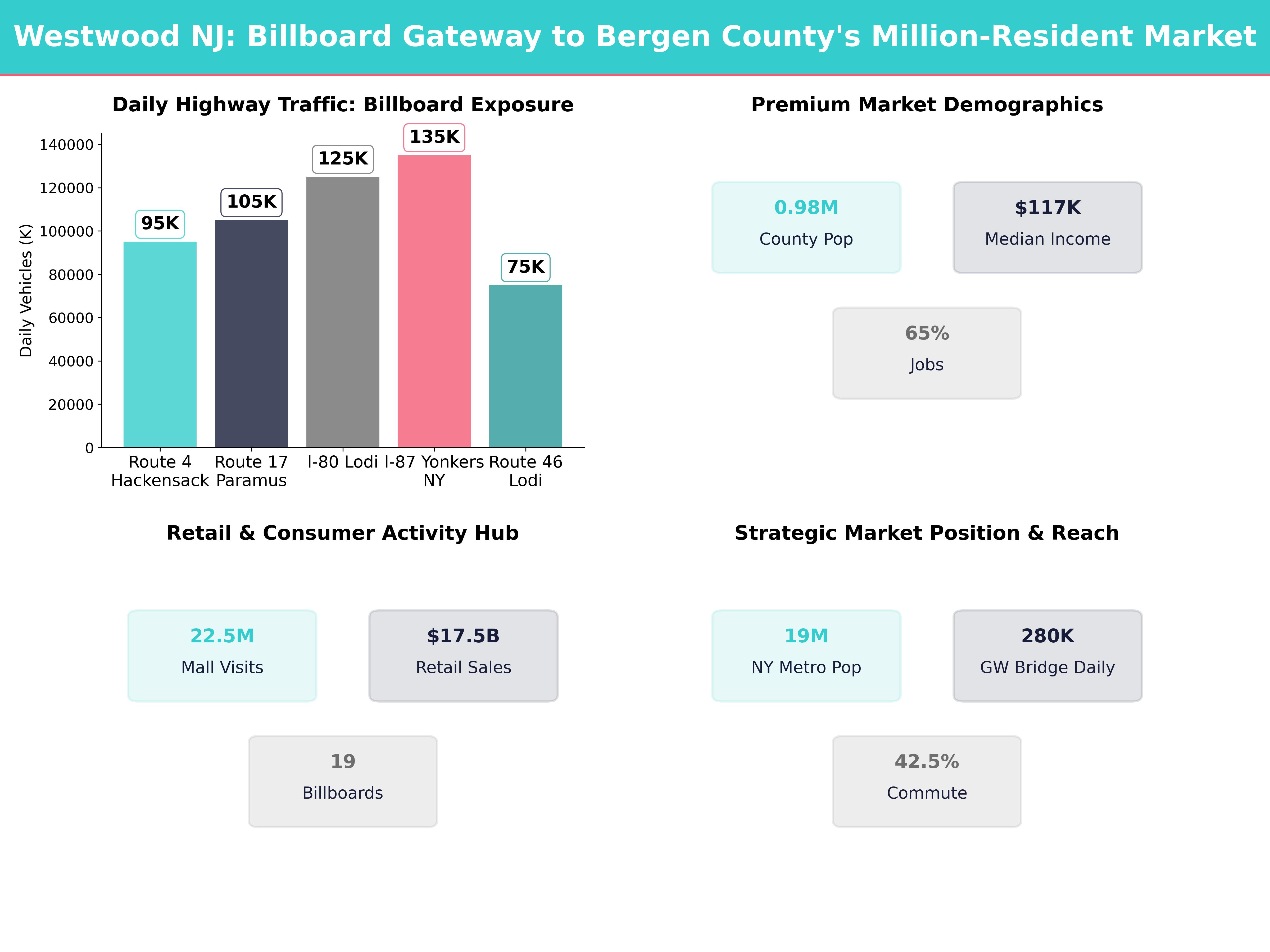
While the inventory is not positioned directly inside Westwood borough limits, the 19 digital billboards serve the Westwood area from nearby high-traffic cities. These include Hackensack, Maywood, Lodi, Bogota, Ramsey, and Yonkers. These corridors routinely see daily traffic volumes well above 80,000 vehicles on major arteries like Route 4 and Route 17, and well above 100,000 vehicles on I-80 and I-87.
What kind of audience do Westwood, New Jersey billboards reach?
The Westwood area sits in the heart of densely populated Bergen County and the greater New York City metro, making it a powerful place to reach affluent suburban families, commuters, and small-business decision-makers. Westwood’s median household income is in the $105,000–$115,000 range, and Bergen County’s is approximately $114,000–$120,000, indicating strong disposable income and purchasing power. The area is tightly integrated into the New York City commuter ecosystem, with 40–50% of Bergen County workers commuting out of their home municipality daily.
When is the best time to run billboards near Westwood, New Jersey with Blip?
Morning drive from 6–10 a.m. can hit commuters heading to Hackensack, Paramus, NYC, and industrial or business hubs. Afternoon drive from 3–7 p.m. reaches commuters, shoppers, parents on school pick-up runs, and service workers finishing shifts, while evenings and weekends are ideal for restaurants, entertainment, streaming, and e-commerce campaigns. With Blip, you can concentrate your budget on just the hours and days when your ideal audience is on the road.
Do I need a contract to advertise with Blip near Westwood?
No, Blip has no long-term contracts or minimum commitments. You can start, pause, or stop your campaign at any time.
How fast can I launch a billboard campaign with Blip near Westwood?
You can have your campaign live in minutes. Create a free account, select your locations, set your budget, upload your design, and start running once approved.
Where can I advertise with Blip near Westwood?
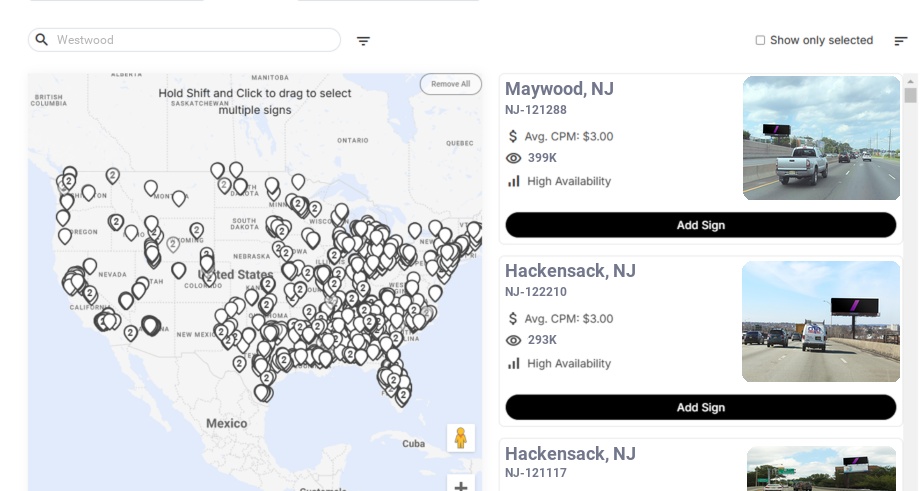
Blip has digital billboards near Westwood. You can browse available locations on a map, choose the ones that fit your audience, and start advertising right away.
Still have questions? Launch a campaign in minutes — no contracts, no commitments.
Start Your CampaignWestwood Billboard Advertising Guide
The Westwood, New Jersey area sits in the heart of densely populated Bergen County and the greater New York City metro, making it a powerful place to get messages in front of affluent suburban families, commuters, and small-business decision‑makers. With 19 digital billboards near Westwood serving the area from nearby cities like Hackensack, Maywood, Lodi, Bogota, Ramsey, and Yonkers, we can help you tap into heavy daily traffic patterns and highly engaged local audiences with flexible, data‑driven campaigns.
Understanding the Westwood Area Market
Westwood is a compact but influential borough in Bergen County. According to recent municipal and regional data:
- Westwood’s population is a little over 11,000 residents across about 2.3 square miles, for a density above 4,700 people per square mile, which is high for a small New Jersey borough.
- Bergen County as a whole has roughly 955,000–1,000,000 residents, making it New Jersey’s most populous county and part of a New York metro region of more than 19 million people.
- Median household income in Westwood is in the $105,000–$115,000 range, while Bergen County’s median is approximately $114,000–$120,000, both well above the New Jersey median (around $90,000–100,000), indicating strong disposable income and purchasing power.
- Owner‑occupied home values in much of the Westwood area commonly fall in the $550,000–$750,000 band, supporting substantial spending on renovations, furnishings, and professional services.
- Local labor‑force data indicate that 60–70% of employed residents in many Bergen County suburbs work in management, professional, sales, or office occupations, supporting demand for premium goods and services.
Key takeaways for advertisers:
- You’re reaching an affluent, highly mobile suburban audience that spends heavily on dining, home improvement, healthcare, education, and leisure—Bergen County retail sales alone total well over $15–20 billion annually.
- Westwood functions as a “hub town” for nearby communities such as Washington Township Hillsdale, Emerson, and River Vale; local school districts, youth sports leagues, and shopping patterns draw residents from a 5–10 mile radius.
- The area is tightly integrated into the New York City commuter ecosystem: regional planning data show that 40–50% of Bergen County workers commute out of their home municipality daily, with a significant share going into Manhattan and Hudson County local decision‑making and NYC‑oriented commuters.
For more local context, you can explore the Borough of Westwood website and Bergen County resources, which highlight community events, business districts, and infrastructure that shape daily travel patterns. Tourism and visitor behavior across the county are profiled by Visit Bergen County, which showcases the shopping, dining, and attractions that draw millions of visits each year.
Where Our Billboards Reach Near Westwood
While our inventory is not positioned directly inside Westwood borough limits, our 19 digital billboards serve the Westwood area from several high‑traffic nearby cities, giving you access to some of the most visible billboards near Westwood:
- Hackensack (≈6.6 miles) – The Bergen County seat and a major shopping/medical center, with significant traffic driven by Hackensack University Medical Center (a 700+ bed facility) and major retail corridors. According to state transportation counts, Route 4 and Route 17 near Hackensack each carry 80,000–110,000 vehicles per day in many segments.
- Maywood (≈7.0 miles) – Close to Route 17 and near shopping corridors between Paramus and Hackensack; many local segments of Route 17 around Maywood and Paramus approach or exceed 100,000 vehicles per day.
- Lodi (≈8.0 miles) – Near I‑80 and Route 46, both critical east‑west commuter routes. New Jersey traffic count data show portions of I‑80 through Lodi handling 110,000–140,000 vehicles daily, with Route 46 often in the 60,000–90,000 range.
- Bogota (≈8.4 miles) – Just south of Hackensack, serving drivers heading toward the George Washington Bridge corridor and Route 4. Local north–south connectors near Bogota feed heavy commuter flows into the Route 4 spine.
- Ramsey (≈8.5 miles) – Near Route 17 and I‑287, capturing north–south commuters and shoppers traveling between New York State and Bergen County. State data show this stretch of Route 17 around Ramsey generally in the 80,000–100,000 vehicles per day range.
- Yonkers, NY (≈8.3 miles) – A dense Westchester County city along I‑87 (NY Thruway) and the Saw Mill River Parkway. New York State traffic data for the Yonkers segment of I‑87 commonly show 120,000–150,000 vehicles daily, including many cross‑border shoppers and commuters.
These corridors routinely see daily traffic volumes well above 80,000 vehicles on major arteries like Route 4 and Route 17, and well above 100,000 vehicles on I‑80 and I‑87, based on New Jersey and New York transportation data from sources such as NJDOT traffic counts and the New York State Department of Transportation. By using Blip, you can place flexible billboard advertising near Westwood across these locations to saturate the greater Westwood area and surrounding Bergen/Westchester suburbs.
Who You’re Reaching in the Westwood Area
The Westwood area’s audience is diverse but follows some clear patterns that are very useful for campaign planning:
1. Suburban families and homeowners
- Bergen County’s homeownership rate is roughly 60–65%, and many homes in and around Westwood are single‑family houses on residential streets.
- In nearby Bergen County communities, 30–40% of households have children under 18, feeding local school systems and youth activities.
- School data from the Westwood Regional School District show thousands of students enrolled across elementary, middle, and high schools, with participation in sports, arts, and extracurriculars driving heavy parent travel to fields, gyms, and auditoriums multiple times per week.
Implications:
Great for family‑oriented products, home services, after‑school programs, tutoring, medical/dental practices, and local attractions that can tap into high‑frequency family trips.
2. Commuters to New York City and regional employment centers
- Regional transportation surveys indicate that in many Bergen County towns, 30–45% of workers commute outside the county, many into Manhattan, Jersey City, and other Hudson River job hubs.
- NJ TRANSIT’s Pascack Valley Line stops at Westwood Station, which serves hundreds of weekday riders; pre‑pandemic ridership data on similar Bergen County commuter rail stations often ranged from 500–1,500 boardings per weekday.
- Thousands more residents use nearby park‑and‑ride lots and feeder roads connecting to Route 4, Route 17, I‑80, and the George Washington Bridge, driving directly past our Hackensack, Maywood, Lodi, and Bogota boards.
Implications:
Ideal for financial services, professional services, higher education, healthcare, and premium consumer brands that benefit from weekday peak‑hour exposure to higher‑income commuters.
You can see how transit shapes local life by exploring NJ TRANSIT’s information on the Pascack Valley Line and regional bus routes.
3. Shoppers, diners, and leisure seekers
- Nearby Paramus (just south of our Hackensack/Maywood placements) is one of the busiest retail hubs in the United States. Malls such as Westfield Garden State Plaza, Paramus Park, and Bergen Town Center collectively attract an estimated 20–25 million visits per year, with Garden State Plaza alone often cited at over 15 million annual visitors.
- Retail corridors in Paramus and Hackensack are so busy that local regulations historically limited Sunday retail hours; during the rest of the week, traffic counts on adjacent highways frequently exceed 90,000–100,000 vehicles daily.
- Westwood’s downtown business district—highlighted by the Westwood Chamber of Commerce—features dozens of restaurants, boutiques, salons, and professional services that draw residents from neighboring towns like Emerson, Hillsdale, and River Vale.
Implications:
Billboards serving the Westwood area are valuable for restaurants, local retail, fitness studios, salons/spas, and entertainment venues, especially on evenings and weekends when shopping and dining trips spike.
4. Cross‑border audience from New York
- Our boards in Yonkers and near northern Bergen County (e.g., Ramsey) reach New York motorists who regularly shop or visit in New Jersey. Regional tax‑differential studies estimate that hundreds of millions of dollars in annual retail spending flow from New York into New Jersey border counties like Bergen.
- Cross‑Hudson travel volumes are substantial: the George Washington Bridge alone carries around 280,000 vehicle crossings per average weekday, and a portion of that traffic disperses through Bergen County corridors that connect with Westwood‑area destinations.
- Many Westchester County and Rockland County
Implications:
Great for destination businesses (like car dealerships, medical specialists, big‑box retail, and entertainment venues) that pull from a multi‑county radius across North Jersey and the lower Hudson Valley.
Key Corridors and Traffic Patterns to Leverage
Understanding when and where people travel near Westwood lets us use Blip’s scheduling tools more strategically.
Major roadway influences around our billboard locations:
- Route 4 (Hackensack/Bogota corridor) – NJDOT counts show segments near major malls and shopping centers frequently at 80,000–100,000+ vehicles per day, with peaks near Hackensack/Paramus retail zones.
- Route 17 (Maywood/Ramsey corridor) – One of New Jersey’s busiest retail/commuter highways, with daily traffic volumes commonly in the 90,000–120,000 range in key stretches through Maywood, Paramus, and up toward Ramsey.
- I‑80 and Route 46 (Lodi corridor) – Critical east–west routes carrying 100,000–140,000+ vehicles per day on I‑80 near major interchanges, and 60,000–90,000 on heavily commercialized sections of Route 46.
- I‑87 / NY Thruway (Yonkers corridor) – A core artery into and out of New York City and Westchester; many segments near Yonkers see 120,000–150,000 vehicles daily, according to NYSDOT traffic data.
Timing implications:
- Morning drive (6–10 a.m.) – Hit commuters from the Westwood area heading to Hackensack, Paramus, NYC, and industrial/business hubs. In many corridors, 30–35% of weekday daily traffic passes during the combined morning and evening peaks.
- Afternoon drive (3–7 p.m.) – Reach the same commuters plus shoppers, parents on school pick‑up runs, and service workers finishing shifts; traffic volumes on retail‑adjacent highways often peak between 4–6 p.m.
- Evenings (7–10 p.m.) – Ideal for restaurant, entertainment, streaming, and e‑commerce campaigns, especially near retail corridors where cinema and dining trips continue after work.
- Weekends – Traffic shifts more toward shopping and leisure; on some Paramus/Hackensack corridors, Saturday volumes can rival or surpass weekday averages, and weekend traffic can account for 25–30% of weekly vehicle counts.
With Blip, we can concentrate your budget on just the hours and days when your ideal audience is on the road, instead of paying for 24/7 coverage you don’t need.
Crafting Effective Creative for the Westwood Area
To resonate in the Westwood area, artwork should reflect both affluent suburban sensibilities and commuter attention spans.
1. Design for fast‑moving, high‑information drivers
- Aim for 6–8 words max of primary text. At typical highway speeds (50–65 mph), drivers have 5–7 seconds to process your message.
- Use 1 clear focal point (logo/product/face) rather than cluttered visuals; outdoor industry testing routinely shows that reducing copy and visual elements can increase recall by 20–30%.
- Make the call‑to‑action simple: “Exit 17 in Paramus,” “5 minutes from Westwood,” “Scan for 10% off,” etc.
2. Speak to local identity and geography
-
Reference nearby landmarks or towns:
- “Minutes from Westwood’s Downtown”
- “Serving Westwood, Hillsdale, and Emerson”
- “Your Bergen County Orthodontist”
- Use location cues that make sense based on each board’s position: e.g., on a Hackensack board, “Just north toward Westwood” or “Short drive up Kinderkamack Rd.”
- Consider referencing major institutions, like proximity to Hackensack University Medical Center, Bergen New Bridge Medical Center in Paramus, or popular malls noted on VisitNJ, to ground your message in familiar landmarks.
Review how local businesses position themselves on NorthJersey.com (a major regional news outlet) to align with the language residents already recognize.
3. Reflect the area’s lifestyle
- Highlight quality, trust, and community—values that resonate strongly with Bergen County families, where surveys often show above‑average concern for school quality, neighborhood safety, and healthcare access.
- For professionals and commuters, emphasize time savings, convenience, and premium benefits, such as “Same‑day appointments near Westwood Station” or “Skip the city traffic—shop in Bergen County.”
- For family‑oriented offerings, showcase kids, schools, parks, and health—Westwood has an active community life with youth sports and civic events frequently promoted on the borough’s site and by local organizations.
4. Seasonal and event‑based creative
The Westwood area’s calendar offers strong hooks:
- Back‑to‑school (late August–September) – Local school districts collectively serve tens of thousands of students; this is prime time for tutors, pediatric care, extracurriculars, retailers, and quick‑service restaurants.
- Holiday shopping (November–December) – Malls in Paramus and Hackensack see some of their highest foot‑traffic days of the year, with certain weekends generating 2–3x typical daily visits. Leverage this with gift‑oriented messaging.
- Spring home‑improvement season (March–May) – Real‑estate and contractor activity climb; regional listing data show many Bergen County home sales clustering in spring and early summer. Push contractors, landscapers, real‑estate agents, and furniture/home goods.
- Summer recreation (June–August) – Promote camps, day trips, beaches, and seasonal dining as families shift to vacation and local‑leisure modes. Municipal and county park systems in Bergen and nearby Rockland Westchester counties collectively host hundreds of events each summer.
With digital billboards, we can rotate seasonal messages automatically and even run multiple creatives in rotation to speak to different audience segments.
Using Blip’s Flexibility to Match Local Behavior
Blip’s pay‑per‑blip model and scheduling tools are especially powerful in a market like the Westwood area, where traffic patterns and purposes shift by day, time, and direction of travel.
1. Dayparting based on your category
- Medical & dental practices – Focus on early morning (7–9 a.m.) and late afternoon (3–6 p.m.) when parents are thinking about their family schedule and are already driving near offices, schools, and transit hubs. Many healthcare practices report that 60–70% of appointments cluster in these windows.
-
Restaurants & cafes – Cluster around meal windows:
- Breakfast: 6–9 a.m.
- Lunch: 11 a.m.–2 p.m.
- Dinner: 4–8 p.m.
Local restaurant data often show that 50%+ of daily revenue comes from the main dinner period, making targeted evening impressions especially valuable.
- Retail & e‑commerce – Strong during commuting hours plus weekend mid‑mornings and afternoons; retail studies of suburban customers frequently show peak in‑store traffic between 11 a.m. and 3 p.m. on Saturdays.
- Events & entertainment – Heavily weight the 3–9 p.m. window a few days leading into your event and on weekends, when people are planning nights out and family activities.
2. Geographic targeting among our 19 boards
Match your boards to your most important customer flows for the most efficient billboard rental near Westwood:
- Target Hackensack/Maywood/Bogota boards to reach residents from Westwood and River Vale heading to work, malls, and medical centers such as Hackensack University Medical Center and major Paramus retail.
- Use Lodi boards for campaigns that rely on I‑80/Route 46 regional reach (e.g., e‑commerce, large attractions, multi‑location businesses) since those highways carry over 100,000 vehicles daily across a broad regional catchment.
- Use Ramsey to attract northern Bergen County and Rockland County 100,000+ additional residents.
- Use Yonkers to capture New York residents who regularly shop or receive services in New Jersey and the Westwood area, particularly via I‑87 and cross‑county parkways.
We can distribute your impressions across these boards or concentrate spend on the corridors that matter most.
Strategies by Business Type in the Westwood Area
Different industries can take advantage of the Westwood area’s demographics and road network in very specific ways.
Local Retail & Services (salons, gyms, boutiques, auto repair)
- Target commuters passing near your location on their way to and from the Westwood area; in many suburban corridors, 40–50% of weekday traffic happens during the commute windows alone.
- Use distance‑based messaging: “3 miles north of Westwood,” “Next to Westwood Train Station,” etc., which outdoor studies show can increase navigation‑related response rates by 10–20%.
- Rotate offer‑based creatives weekly (e.g., “This Week Only,” “New Member Special”) to create urgency and give regular commuters a new reason to notice your ad.
Healthcare (primary care, specialists, dental, urgent care)
- Highlight trust, proximity, and convenience: “Same‑day appointments for Westwood families,” “Evening hours for commuters.” Patient surveys often list convenience and location among the top 3 factors in choosing providers.
- Run heavy during weekdays and back‑to‑school periods when health is top of mind—pediatric and family practices often see seasonal demand spikes of 15–30% around school start.
- Use multiple creatives to address different segments: adults vs. pediatrics vs. seniors, and consider highlighting major affiliations (e.g., near Hackensack: “Affiliated with top Bergen County hospitals”).
Education & Youth Programs (tutoring, private schools, sports, arts)
- Target school commute windows and boards most likely to be seen by parents driving to and from the Westwood area. Parent‑driven trips to schools and activities can account for hundreds of weekly miles per household in busy seasons.
- Use simple, aspirational messages: “Top test scores for Bergen County students,” “Build confidence on and off the field.”
- Align campaigns with enrollment periods: late winter/early spring for private schools; late spring/early summer for camps. Many programs see 60–70% of annual registrations in a tight 6–10 week window.
Real Estate & Home Services
- The high homeownership and home values around Westwood make this especially promising. In many Bergen County zip codes, annual home turnover averages 5–7% of housing units, providing a steady stream of motivated buyers and sellers.
- For real estate agents: promote “Just Listed” or “Under Contract” success stories in Westwood and neighboring towns to build social proof and signal market momentum.
- For contractors/landscapers: highlight specific neighborhoods: “Serving Westwood, Hillsdale, Emerson,” and emphasize response time, as local surveys often show that same‑week availability is a key decision factor.
- Weight campaigns heavily in spring and early summer, when listing and renovation activity typically peak.
Restaurants & Hospitality
- Use “Tonight,” “This Weekend,” or “Happy Hour 4–7” to capitalize on impulse decisions; quick‑service and casual‑dining operators report that last‑minute decisions can account for 30–40% of evening dining choices.
- Feature mouth‑watering imagery and one clear hook: live music, outdoor seating, or family‑friendly menus.
- Target boards closest to your location and tune dayparts around your busiest times; for example, promote brunch heavily between 9 a.m.–1 p.m. on weekends or late‑night offers after 9 p.m. near cinema and entertainment clusters.
Integrating Billboards with Digital and Local Media
Billboards serving the Westwood area become even more powerful when they’re integrated with other marketing channels.
1. Reinforce what people see online
Residents in the Westwood area are heavy users of social media, streaming, and local news sites like NorthJersey.com. Regional broadband and smartphone adoption rates exceed 90% in many suburban New Jersey communities, so most drivers who see your boards also encounter your brand online.
When your billboard creative mirrors your online ads:
- Brand recall improves as people repeatedly see the same visuals and offers; advertising research often shows 20–30% higher recall when out‑of‑home and digital creatives are aligned.
- You can retarget website visitors who were likely exposed to your boards based on geography and time windows.
2. Use trackable calls‑to‑action
- Create vanity URLs (e.g.,
YourBrandWestwood.com) that only appear on billboards so you can attribute site visits. - Use QR codes for pedestrians or low‑speed traffic near certain urban boards (careful not to rely on this at highway speeds); in controlled environments, QR‑based campaigns can see scan‑through rates of 1–3% of exposed pedestrians.
- Offer billboard‑only promo codes to gauge response (e.g., “Use code WESTWOOD10”) and compare redemptions to impressions and spend.
3. Coordinate with local events and news
- Align campaigns with local events listed on the Westwood borough calendar or regional tourism sources like VisitNJ and Visit Bergen County. Street fairs, summer concerts, and holiday events can attract thousands of attendees per event in popular towns.
- If your business participates in a street fair, charity event, or school sponsorship, use billboards nearby in the days leading up to it, and consider mentioning your participation in the creative to leverage community goodwill and local coverage from outlets such as NorthJersey.com.
Measuring and Optimizing Performance
While billboards serving the Westwood area are a top‑of‑funnel medium, we can still approach them with a performance mindset.
Key metrics to track:
- Website traffic from the region – Watch for lifts from ZIP codes around Westwood, Hackensack, Lodi, Ramsey, and Yonkers when your campaign is active. For many local advertisers, a well‑executed out‑of‑home campaign can drive 10–30% increases in site sessions from targeted areas.
- Direct & branded search volume – Increases in searches for your brand name or service plus “Westwood” are strong indicators of billboard impact; tracking week‑over‑week changes during and after your flight can reveal lift patterns.
- Store visits & inquiries – Track changes in foot traffic, phone calls, or appointment bookings during campaign periods. Simple methods like asking “How did you hear about us?” at checkout can capture directional data, and many businesses see noticeable spikes within 1–2 weeks of launch.
- Promo code or URL usage – If you use billboard‑specific offers, compare redemptions to your spend to estimate cost per response and refine future campaigns.
Optimization approaches with Blip:
- Shift budget toward top‑performing boards or corridors once you see geographic patterns emerge in your analytics or POS data. For example, if customers from northern Bergen County zip codes rise by 20%, you might increase impressions around Ramsey.
- Adjust dayparts based on lead quality—e.g., if morning commuters produce higher‑value customers (larger tickets, better retention), increase your morning blips and reduce lower‑performing windows.
- Test multiple creatives simultaneously to identify what messaging or visuals resonate best with the Westwood area audience; in A/B outdoor tests, creative optimization can improve response metrics by 15–25%.
Putting It All Together for the Westwood Area
The Westwood area combines dense suburban neighborhoods, affluent households, strong commuter flows, and major retail/medical destinations—all within a short drive of New York City. Our network of 19 digital Westwood billboards in nearby cities like Hackensack, Maywood, Lodi, Bogota, Ramsey, and Yonkers allows advertisers to:
- Saturate the daily routes residents take to work, school, shopping, and appointments, capturing impressions along corridors that collectively see hundreds of thousands of vehicles per day.
- Adapt campaigns quickly to seasons, events, and promotions relevant to Westwood’s community calendar and the broader Bergen/Westchester region.
- Use precise budgeting and scheduling tools to reach the right people at the right times, without overpaying for low‑value impressions.
By combining strong local insight, up‑to‑date traffic and demographic data, smart creative, and Blip’s flexible buying model, we can help you build billboard campaigns that genuinely move the needle for your business in the Westwood area, whether you need short‑term billboard rental near Westwood or ongoing visibility along key commuter routes.