Billboards near Ramsey, NJ
No Minimum Spend. No Long-Term Contracts. Just Results.
Trusted by Leading Brands


Billboard advertising
near Ramsey has never been easier



How much is a billboard near Ramsey?
Why Choose Blip for Billboard Advertising near Ramsey
-
Blip lets Ramsey businesses launch self-serve ads fast on Route 17, reaching the 50,000-60,000 daily drivers without agency delays.
-
In Ramsey, no contracts or minimums make it easy to test commuter and park-and-ride audiences near the NJ TRANSIT stations.
-
Use Blip dayparting in Ramsey to hit 6-10 a.m. commuters and 3-7 p.m. return traffic on Route 17 and I-287.
-
Blip real-time analytics help Ramsey advertisers see what's working and shift spend as shopping or commuter traffic changes.
-
Flexible budgets in Ramsey mean you can scale for Paramus retail weekends, then slow down when demand dips.
-
Blip's creative tools make it easy to tailor Ramsey ads with local cues like Route 17, Mahwah, and North Jersey commuter life.
Frequently Asked Questions About Billboard Advertising near Ramsey
How much does a billboard cost in Ramsey, New Jersey with Blip?
With Blip, billboard advertising in Ramsey can be surprisingly affordable because you only pay when your ad actually appears. Each “blip” is a 7.5-to-10-second display on a rotating digital billboard, and pricing starts at just $0.01 per display. Your daily budget is used by Blip’s algorithm to bid for available ad slots, helping maximize reach while keeping your spend under control.
Where can I advertise with Blip in Ramsey, New Jersey?
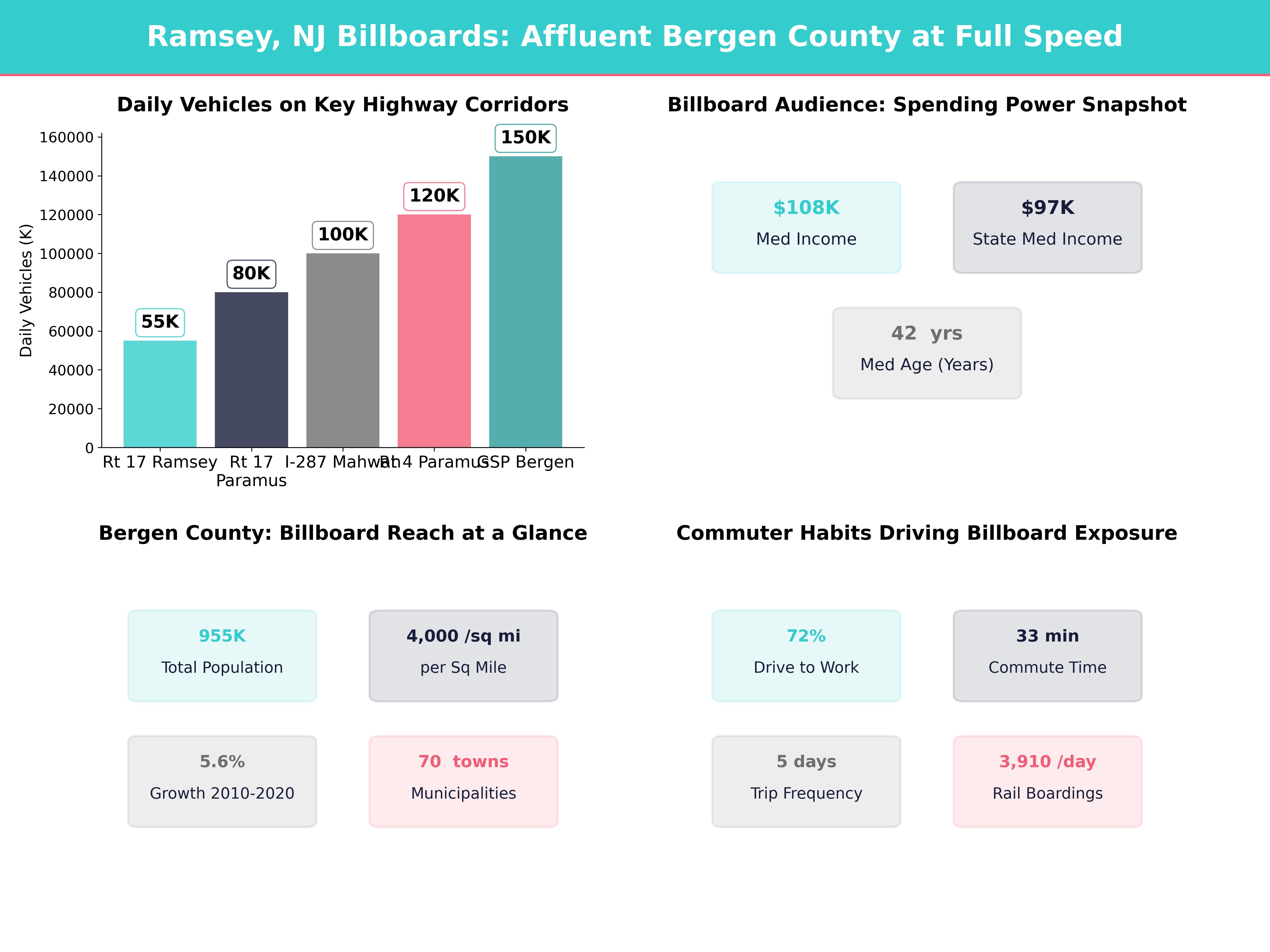
Route 17 is the defining corridor for Ramsey, with Ramsey-area stretches generally running in the 50,000 to 60,000 vehicles per day range. Just west of Ramsey, Interstate 287 is the other major regional artery, and busy segments near Mahwah exceed 100,000 vehicles per day. Those corridors give access to commuters, shoppers, and regional travelers moving through northwest Bergen County.
What kind of audience can Ramsey, New Jersey billboard ads reach?
Ramsey sits inside Bergen County's 955,732-person consumer base and along one of North Jersey’s most important commercial spines, Route 17. Recent ACS estimates show that about 72% of Bergen County workers commute by car, truck, or van, while roughly 14% use public transportation. The county is also affluent and diverse, with a median household income of about $108,000 and roughly 1 in 5 residents identifying as Hispanic and roughly 1 in 5 as Asian.
When is the best time to run billboard ads in Ramsey, New Jersey with Blip?
September is one of the strongest months for commuter-oriented messaging because schools are back in session, college semesters begin, and work routines normalize. January also offers a strong reset point for healthcare, fitness, professional services, and financial messaging. For event-driven messaging, the page says the best lift usually comes when campaigns start 3 to 5 days before a major event and hold through the day of travel.
How do Ramsey, New Jersey billboard ads fit commuter traffic?
Commuters are the backbone of the Ramsey billboard audience. About 72% of Bergen workers commute by car, and the area’s two NJ TRANSIT stations add thousands of weekday boardings on top of the already heavy roadway audience. That pattern is ideal for digital billboards because we can reach drivers repeatedly on the same corridors during the morning and evening commute.
Do I need a contract to advertise with Blip near Ramsey?
No, Blip has no long-term contracts or minimum commitments. You can start, pause, or stop your campaign at any time.
How fast can I launch a billboard campaign with Blip near Ramsey?
You can have your campaign live in minutes. Create a free account, select your locations, set your budget, upload your design, and start running once approved.
Where can I advertise with Blip near Ramsey?
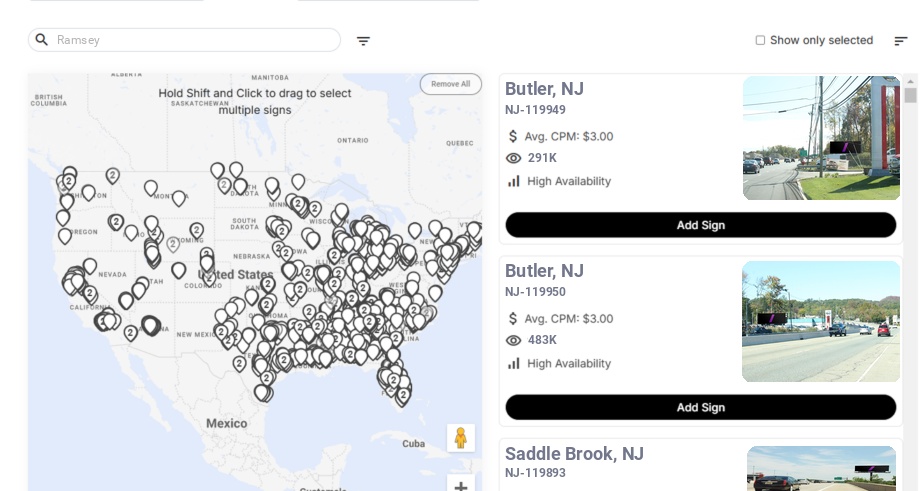
Blip has digital billboards near Ramsey. You can browse available locations on a map, choose the ones that fit your audience, and start advertising right away.
Still have questions? Launch a campaign in minutes — no contracts, no commitments.
Start Your CampaignRamsey Billboard Advertising Guide
Ramsey 14,473 residents sits inside Bergen County's 955,732-person consumer base and along one of North Jersey’s most important commercial spines, Route 17, which carries about 50,000 to 60,000 vehicles per day in Ramsey-area stretches. We are not buying an isolated small town when we advertise here. We are buying access to affluent households, daily drivers, park-and-ride commuters, and shoppers moving between Ramsey Mahwah Township Paramus Borough
Ramsey, New Jersey Market Overview
Ramsey works well for out-of-home because it combines local affluence with regional movement. We get the benefit of a stable borough audience, but we also tap into the much larger North Jersey and lower Hudson Valley travel pattern that passes through northwest Bergen County every day.
Demographics and economic strength in Ramsey
The Borough of Ramsey 14,473 residents in the 2020 Census, while Bergen County had 955,732 residents. Bergen grew from 905,116 residents in 2010 to 955,732 in 2020, which was an increase of 50,616 people, or about 5.6%. That matters because billboard advertising performs best where we can pair frequency with a large surrounding customer base.
Bergen County also contains 70 municipalities, which makes Ramsey part of a dense patchwork of communities rather than a standalone market. We are advertising in one of New Jersey’s most interconnected suburban counties, roughly 30 miles from Midtown Manhattan, with a countywide population density of about 4,000 residents per square mile. That proximity keeps the area tied to New York media habits, commuting patterns, and spending levels.
On the economic side, recent ACS estimates place Bergen County’s median household income at about $108,000, compared with roughly $97,000 statewide. The county’s median age is about 42, which supports a strong mix of families, established professionals, and high-value household decision makers. Bergen is also notably diverse, with Hispanic residents making up roughly 1 in 5 people and Asian residents roughly 1 in 5. For advertisers, that mix supports both broad-reach creative and more tailored messaging for multilingual or culturally specific audiences.
Commuting behavior and what it means for billboard reach in Ramsey
Recent ACS estimates show that about 72% of Bergen County workers commute by car, truck, or van, while roughly 14% use public transportation. The mean travel time to work is about 33 minutes, which is long enough for habitual route exposure to matter.
That pattern is ideal for digital billboards. We can reach drivers repeatedly on the same corridors during the morning and evening commute, and we can also catch rail users on roads feeding the stations. In Ramsey, that means we are often speaking to people who make the same trip 5 days a week, pass the same signs week after week, and still rely heavily on cars for errands even if they take NJ TRANSIT into Manhattan.
Key Traffic Corridors for Billboard Advertising in Ramsey
Ramsey’s billboard value comes from a few clear movement channels. When we understand where people are driving and why they are on the road, we can choose placements that fit the advertiser’s actual goal instead of just chasing raw volume.
Route 17 through Ramsey and Mahwah
New Jersey Department of Transportation traffic counts make clear that Route 17 is the defining corridor for Ramsey. Depending on the exact count station, Ramsey-area stretches generally run in the 50,000 to 60,000 vehicles per day range. As the corridor moves south toward Paramus, major segments climb into the 80,000-plus AADT range.
Route 17 is especially effective because it blends commuting with commerce. It links homes in northwest Bergen County to shopping, restaurants, healthcare, auto services, and offices. It also carries cross-border traffic from New York into New Jersey retail and employment centers.
Advertisers that tend to benefit most from Route 17 include the following:
- Retail and restaurant brands perform well because the route captures both routine weekday traffic and intentional shopping trips.
- Healthcare providers perform well because patients often choose convenient locations along familiar commuter roads.
- Home services perform well because homeowners in Ramsey, Mahwah, and surrounding towns repeatedly travel this corridor.
- Auto dealers, repair shops, and tire brands perform well because Route 17 is a natural context for vehicle-related decision making.
I-287 near Ramsey and Mahwah
Just west of Ramsey, Interstate 287 is the other major regional artery. On busy segments near Mahwah, NJDOT traffic counts exceed 100,000 vehicles per day. That gives us access to a broader regional audience than Ramsey alone, including travelers moving between Bergen County, Morris County, Passaic County, and the lower Hudson Valley.
I-287 is often the better choice when we want regional scale or business-oriented reach. It is especially useful for:
- Hospitals and specialty care groups that draw patients from a multishop county service area.
- Colleges and continuing education programs that recruit beyond one town.
- B2B services, logistics firms, and staffing companies that need regional visibility.
- Large employers that are hiring across North Jersey and southern New York.
Route 4, the Garden State Parkway, and south Bergen retail gravity
Even when our business is based in Ramsey, many of our target customers travel south into central Bergen County for shopping, entertainment, and healthcare. In Paramus, Route 4 exceeds 120,000 AADT on major segments, and the Garden State Parkway through central Bergen tops 150,000 vehicles per day on busy stretches.
Those are not Ramsey streets, but they are part of the Ramsey consumer ecosystem. Families from Ramsey regularly shop and seek services in Paramus. That makes south Bergen placements valuable for brands with a destination model, including medical groups, entertainment venues, furniture stores, and big-ticket retailers.
Commuter roads around Ramsey’s two NJ TRANSIT stations
Rail-fed road traffic is a meaningful part of Ramsey’s media picture. NJ TRANSIT has historically listed about 2,736 average weekday boardings at Ramsey Route 17 Station and about 1,174 average weekday boardings at Ramsey Station. Those are significant numbers for a borough this size.
The strongest plays near the stations are not only transit-oriented businesses. We also see strong fit for:
- Financial advisors, legal services, and real estate firms because station users are often employed professionals.
- Quick-service food, coffee, and convenience brands because commuter routines reward close-in messaging.
- NYC-adjacent service offers such as coworking, shuttle parking, and same-day appointments because these audiences think in terms of time saved.
Audience Segments We Can Reach Around Ramsey
The best Ramsey campaigns define the audience first and the board second. This market supports several distinct groups, and each one responds to different timing, creative, and location choices.
Daily commuters and park-and-ride users in Ramsey
Commuters are the backbone of the Ramsey billboard audience. About 72% of Bergen workers commute by car, and roughly 14% still use public transit. The area’s two NJ TRANSIT stations add thousands of weekday boardings on top of the already heavy roadway audience.
This segment is ideal for advertisers that need repetition and trust. We can use commuter-facing boards for banks, urgent care, hospitals, recruiters, home services, insurance, and subscription-based local businesses. These are audiences that often make decisions gradually, and repeated exposure on the same route helps keep our brand top of mind.
Families and affluent households in northwest Bergen County
Ramsey is surrounded by high-value suburban communities. Ramsey, Mahwah Township Paramus Borough Wyckoff Township, Allendale, Upper Saddle River, and Saddle River together account for just over 100,000 residents. That is a substantial family-oriented catchment concentrated in a relatively compact geography.
These households often respond to billboard offers built around convenience, reliability, and premium service. We usually see the best fit for:
- Pediatric, dental, orthodontic, and family healthcare services because families prefer nearby trusted providers.
- Home improvement, landscaping, and remodeling companies because northwest Bergen includes many owner-occupied homes.
- Youth activities, camps, tutoring, and enrichment brands because the area is highly education-oriented.
Students, faculty, and school communities near Ramsey
Ramsey also has a meaningful education audience. Nearby Ramapo College of New Jersey enrolls roughly 5,700 students, and Bergen Community College 13,000 students. Local K-12 communities, including the Ramsey School District and Don Bosco Prep
That makes Ramsey a useful market for:
- Food and beverage brands that want lunch, dinner, and after-school traffic.
- Education and test-prep companies that benefit from repeated local awareness.
- Apartment, storage, and moving services that can target college cycles.
- Health, wellness, and fitness brands that speak to students and parents alike.
Shoppers, eventgoers, and regional visitors connected to Ramsey
The Ramsey audience is not limited to local residents. Many trips from northwest Bergen flow toward the state’s major shopping and entertainment assets. Westfield Garden State Plaza offers more than 2 million square feet of retail and more than 300 shops, services, and restaurants. American Dream spans about 3 million square feet of retail and entertainment. MetLife Stadium seats 82,500 people.
For advertisers in Ramsey, those destinations matter because they create pre-trip and post-trip traffic patterns. If we sell dining, specialty medical care, entertainment, or destination retail, we can benefit from boards that intercept people on the way to bigger regional outings.
Seasonal and Timing Opportunities in Ramsey
Ramsey is not a one-season market. We can plan campaigns around retail peaks, academic cycles, weather, and regional events, then use timing tools to emphasize the moments when local intent is strongest.
Ramsey retail timing and the Paramus shopping calendar
The biggest shopping windows are predictable. Back-to-school campaigns typically build from late July through September, and holiday retail ramps from November into December. Those periods are especially powerful in Bergen County because so many Ramsey-area households travel toward Paramus for destination shopping.
One of the most local-specific timing factors is Paramus’s blue-law environment. Because much of Paramus Borough Friday evening, Saturday, and weekday commuter periods instead of assuming a standard Sunday shopping pattern. For restaurants, entertainment brands, and service businesses, that nuance matters.
School-year and commuter-season opportunities in Ramsey
After Labor Day, the North Jersey commute visibly re-accelerates. September is one of the strongest months for commuter-oriented messaging because schools are back in session, college semesters begin, and work routines normalize. January also offers a strong reset point for healthcare, fitness, professional services, and financial messaging.
We can build around three especially useful education windows:
- Late August to mid-September works well for college, tutoring, healthcare, and family services.
- January works well for spring-semester, wellness, and recruitment campaigns.
- May and June work well for camps, graduation-related services, and summer promotions.
Weather-driven demand in the Ramsey market
North Jersey weather creates real seasonal demand shifts. According to the Office of the New Jersey State Climatologist at Rutgers, northern parts of the state regularly deal with winter snow and ice, and many years bring roughly 20 to 30 inches of snowfall. In practical terms, that makes winter a strong season for:
- Tires, auto service, and roadside support because drivers are highly aware of weather risk.
- Urgent care and healthcare providers because winter illness and injury concerns rise.
- HVAC, plumbing, and emergency home services because cold-weather problems create immediate intent.
- Indoor entertainment and family activities because outdoor options narrow.
Spring is then ideal for home improvement, landscaping, pest control, and real estate. Summer supports parks, camps, dining, and weekend leisure messaging. Fall is particularly effective for family activities, healthcare enrollment, and holiday retail warm-up.
Event and recreation pulses that influence Ramsey traffic
Regional recreation also matters. Bergen County Parks, including Ramapo Valley County Reservation, Darlington County Park, and Campgaw Mountain Reservation, draw seasonal visitors from spring through fall, and Campgaw adds winter traffic.
We can also time campaigns around MetLife Stadium football games and major concerts. For event-driven messaging, we usually get the best lift when we start 3 to 5 days before a major event and hold through the day of travel.
Billboard Design Tips for the Ramsey Market
The creative that works in Ramsey usually feels local, direct, and time-conscious. We are speaking to busy suburban households, not leisurely pedestrian traffic, so clarity wins.
Design for fast reads on Ramsey-area highways
On Route 17 and nearby regional roads, drivers are often moving at 45 to 55 mph. That means our best creative usually has one main idea, one location cue, and one action. In this market, 6 to 8 words of primary copy often outperform longer headlines.
Local shorthand also helps. Messages like “Near Route 17,” “Minutes from Ramsey,” “Next Exit,” or “In Paramus” anchor the offer to actual travel behavior. When we use place-based cues, we make the ad feel relevant instead of generic.
Match Ramsey’s affluent suburban tone
Ramsey and its surrounding towns respond well to creative that feels polished and useful. We usually do better with “same-day appointments,” “trusted local care,” “premium service,” or “save time on your way home” than with bargain-bin language that feels out of step with the market.
For family-oriented audiences, imagery should look like North Jersey life. Clean suburban visuals, modern interiors, professional staff photography, and genuine family activity tend to resonate more than flashy stock art.
Reflect Bergen County’s diversity when our service area is broader
Bergen County’s population is diverse enough that language and cultural cues can matter. With roughly 1 in 5 residents identifying as Hispanic and roughly 1 in 5 as Asian, some campaigns benefit from bilingual versions or at least more inclusive visual casting.
We do not need to force multilingual creative in every Ramsey campaign. However, if our service area stretches across more of Bergen County, especially toward denser eastern or central municipalities, localized language testing can be a smart move.
Use imagery and offers that feel geographically believable
Ramsey is a commuter suburb with strong retail and family patterns. Offers that feel believable in that context usually win. Examples include healthcare access, home services, education, financial services, dining, fitness, and destination retail.
Creative themes that often fit Ramsey well include the following:
- Commute-saving language works because time is a major local currency.
- Seasonal service urgency works because weather and school calendars influence behavior.
- Family trust signals work because so many purchases are household-level decisions.
- Regional destination cues work because many trips naturally extend toward Paramus, the Meadowlands, or Mahwah.
Regional Strategies Around Ramsey, New Jersey
The smartest Ramsey billboard plans do not treat the entire area as one uniform market. We get better results when we separate the borough itself from the larger corridors around it.
Ramsey and the upper Route 17 corridor
For hyperlocal reach, we focus on Ramsey, Mahwah, and adjacent suburban towns. This is where we prioritize dentists, pediatricians, home services, gyms, local restaurants, real estate teams, and community-oriented brands. The audience here tends to value convenience over novelty, and proximity-based messages usually work best.
Mahwah and the I-287 employment belt
The Mahwah side of the market gives us a more regional and business-oriented audience. With Ramapo College of New Jersey, office and industrial activity, and heavy I-287 volume above 100,000 AADT, we can support recruiting, B2B, healthcare, higher education, and auto campaigns more effectively here than on a purely local Ramsey street.
Paramus and the central Bergen retail and healthcare hub
When our goal is destination traffic, we often extend the strategy south. Westfield Garden State Plaza, the Route 4 corridor, and major healthcare nodes such as The Valley Hospital
New York spillover north of Ramsey
Ramsey also benefits from New York crossover. Rockland County 338,329 residents in the 2020 Census, and nearby communities such as Suffern, Airmont, and Montebello regularly interact with the same roads and retail systems as northern Bergen. That means a Ramsey-area billboard can pull from both sides of the state line.
For brands that serve a broad trade area, this is a major advantage. We are not limited to New Jersey demand when we advertise here.
Using Blip Tools Effectively in Ramsey
Blip works especially well in Ramsey because this market rewards precision. We do not always need a huge blanket buy. We need the right roads, the right hours, and creative that matches the audience on that route.
Test Ramsey corridors with flexible budgeting
A practical Ramsey strategy is to split testing across two or three corridor types. We might run one cluster on Route 17 for commuter-retail overlap, one near I-287 for regional reach, and one farther south if destination shopping matters. Because Blip lets us adjust without a long-term lock-in, we can learn quickly which corridor is producing calls, visits, or search lift.
Daypart around Ramsey’s real movement patterns
Dayparting matters in this market. Morning commuter windows from about 6:00 a.m. to 10:00 a.m. are often ideal for healthcare, professional services, and business messaging. Afternoon and evening windows from about 3:00 p.m. to 7:00 p.m. are strong for restaurants, family services, gyms, and retail. Friday evenings and Saturdays are often better than Sundays for retail messaging tied to Paramus shopping behavior.
Use analytics to separate local intent from regional intent
Ramsey campaigns often attract more than one audience at once. With Blip’s reporting, we can compare how a local-service message performs on a Ramsey board versus how a regional destination message performs on an I-287 or Paramus-facing board. That kind of split helps us keep strong boards and cut underperforming ones without waiting for a long static contract to end.
Adapt artwork quickly for submarkets around Ramsey
This is also a market where small creative changes can make a big difference. We can run one version that says “Near Route 17 in Ramsey,” another that says “Worth the drive to Paramus,” and another that emphasizes “Easy from I-287.” Blip’s artwork tools make that kind of local variation practical, even for smaller advertisers.
Getting Started with Billboard Rental in Ramsey
Renting a billboard in Ramsey is easiest when we start with the business objective, not the map pin. Once we know whether we want awareness, appointments, store visits, event attendance, or recruiting, the right part of the market usually becomes much clearer.
Start with the Ramsey objective and trade area
We first decide whether our customer is truly local or more regional. A Ramsey pediatrician, for example, should usually stay focused on upper Bergen frequency. A specialty medical group, college, or destination retailer may need a wider corridor strategy that includes Mahwah, Paramus, or even New York crossover traffic.
Evaluate Ramsey billboard locations the same way a customer drives
When we review locations, we should ask a few practical questions.
- We should confirm whether the board faces the commuter direction that matters most to our business.
- We should check how close the location is to Route 17 ramps, station access roads, or the I-287 interchange.
- We should identify whether the audience is local residents, regional shoppers, or cross-border travelers.
- We should think about whether our category needs weekday commuter frequency, weekend retail timing, or both.
- We should compare whether the board’s geography matches our actual service radius.
Expect a simpler process than traditional billboard buying
Traditional billboard companies often sell on fixed 4-week cycles with manual proposals, heavier minimums, and slower creative changes. Blip simplifies that process by letting us choose boards on a map, control timing, and refine the campaign as results come in. That difference is especially useful in Ramsey, where commuter windows, shopping patterns, and seasonal shifts can all change the best plan.
Know what success looks like in Ramsey
A good Ramsey billboard campaign usually does at least one of three things. It increases local brand recall among repeat commuters. It improves traffic or inquiries during the specific dayparts we targeted. It expands our effective reach from the borough into the broader Bergen and lower Hudson market.
When we approach Ramsey with that mindset, billboard rental becomes much more than a visibility play. It becomes a flexible way to own the routes, routines, and decision moments that shape how people in northern Bergen County actually buy.