Billboards near Hoboken, NJ
No Minimum Spend. No Long-Term Contracts. Just Results.
Trusted by Leading Brands


Billboard advertising
near Hoboken has never been easier
How much is a billboard near Hoboken?
Why Choose Blip for Billboard Advertising near Hoboken
-
Blip lets you launch Hoboken billboards in minutes, reaching Lincoln Tunnel and PATH commuters without long setup delays.
-
Set a flexible budget for Hoboken and stay in control as traffic shifts between Washington Street, Jersey City, and Manhattan-bound routes.
-
Use dayparting on Blip to hit Hoboken's 6-10 a.m. and 4-8 p.m. commuter peaks when transit and tunnel traffic is busiest.
-
No contracts mean Hoboken brands can test campaigns near the waterfront, Stevens, or Hoboken Terminal and scale only what works.
-
Track Hoboken performance in real time and adjust creative fast for weekend dining crowds, summer waterfront events, or holiday shoppers.
-
Blip's creative tools help Hoboken ads stay bold and clear for fast-moving drivers on Route 495 and the Holland Tunnel approach.
Frequently Asked Questions About Billboard Advertising near Hoboken
How much does a billboard cost near Hoboken, New Jersey with Blip?
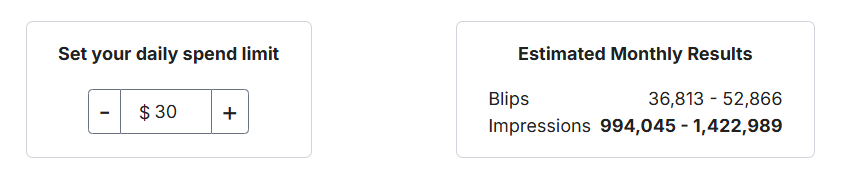
With Blip, you control exactly what you spend on Hoboken billboards by setting a daily budget that can be as small or as flexible as you’d like, and Blip automatically keeps your campaign within that amount. Each ad is a 7.5 to 10-second “blip,” and you only pay for the individual blips you receive, so your total cost simply adds up based on when and where your ads run and current advertiser demand. This pay-per-blip model makes billboards near Hoboken, New Jersey accessible to local businesses of any size.
Where can I advertise with Blip near Hoboken, New Jersey?
Blip has 182 digital billboards serving the Hoboken area from nearby cities like Weehawken, Jersey City, Secaucus, Newark, and Manhattan. These placements help advertisers tap into Hudson County residents, Manhattan commuters, and visitors moving through this compact, hyper-connected market. The network also reaches major gateways such as the Lincoln Tunnel and Holland Tunnel approaches.
Why is Hoboken, New Jersey a good market for billboard advertising with Blip?
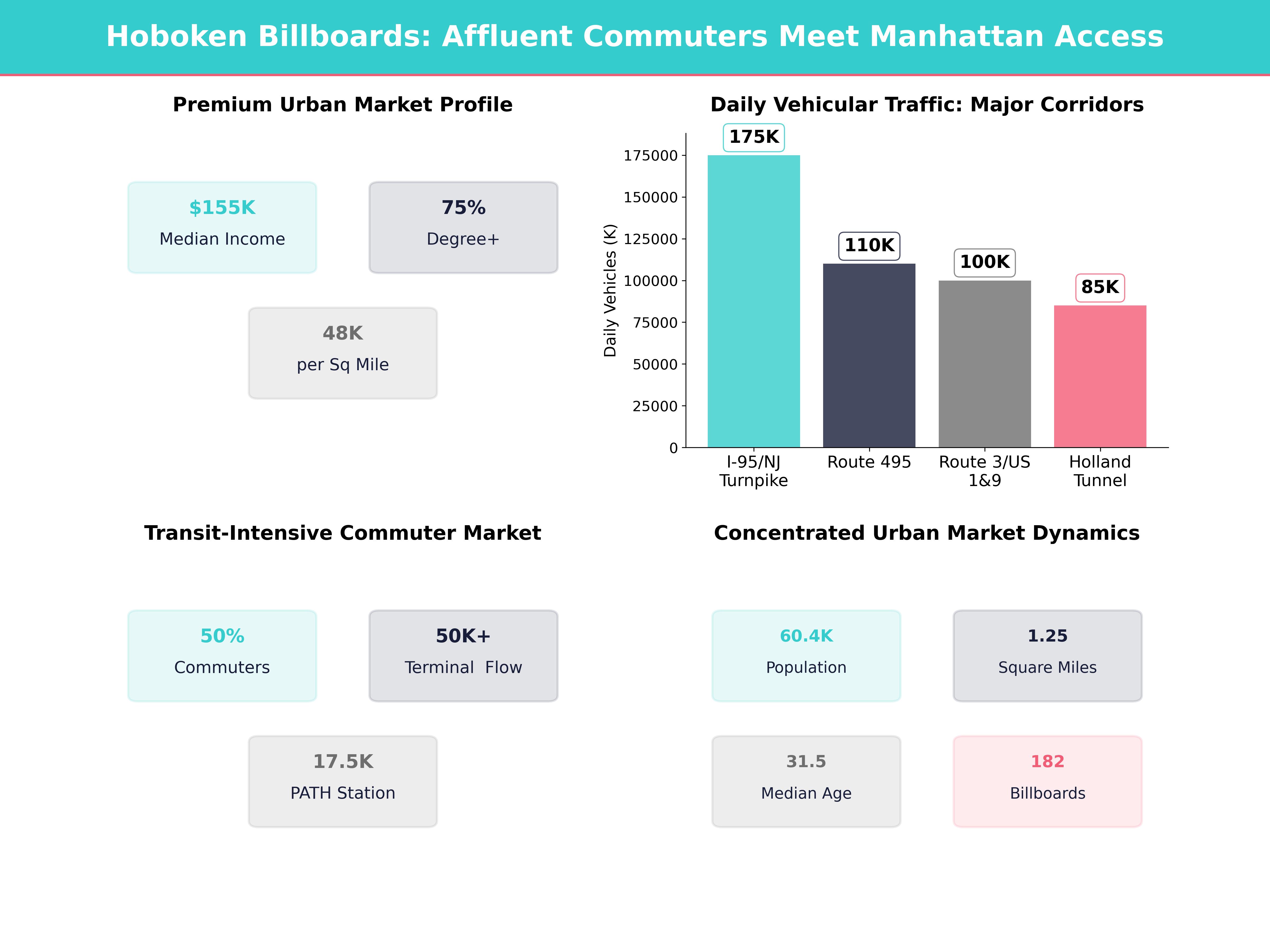
Hoboken offers one of the densest, most affluent, and most mobile audiences in the country, making it ideal for dynamic digital billboard campaigns. The city has just over 60,000 residents in 1.25 square miles, giving it a density of nearly 48,000 people per square mile. More than 50% of residents use public transportation to commute, which makes roadside media a strong way to reach them as they travel through nearby corridors.
What kinds of Hoboken, New Jersey audiences can Blip billboards reach?
The Hoboken area is ideal for young professionals, families, students, and visitors. Local economic profiles show a highly educated, affluent population, with more than 75% of residents 25+ holding at least a bachelor’s degree and median household income commonly reported around $150,000–$160,000. The area also includes Stevens Institute of Technology students, commuters, and regional day-trippers headed to the waterfront and Washington Street.
When is the best time to run billboards near Hoboken, New Jersey with Blip?
Blip lets you use dayparting so you can show ads during the hours that matter most for your audience. The page suggests commuter windows like 6–10 a.m. and 4–8 p.m., which together can account for more than half of weekday traffic on some corridors. It also notes that weekend and seasonal campaigns can work well for dining, leisure, and waterfront events.
Do I need a contract to advertise with Blip near Hoboken?
No, Blip has no long-term contracts or minimum commitments. You can start, pause, or stop your campaign at any time.
How fast can I launch a billboard campaign with Blip near Hoboken?
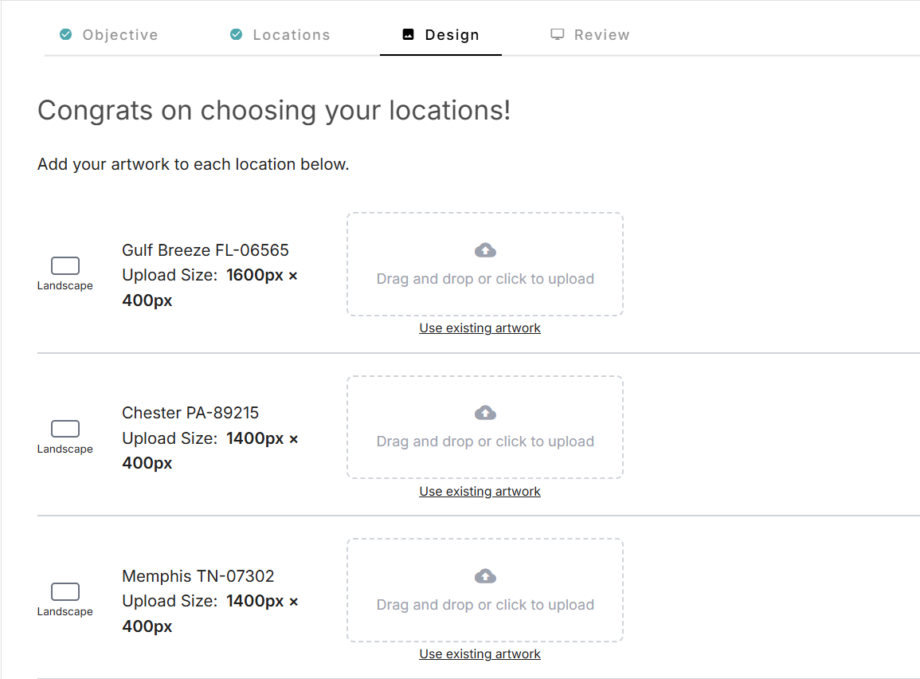
You can have your campaign live in minutes. Create a free account, select your locations, set your budget, upload your design, and start running once approved.
Where can I advertise with Blip near Hoboken?
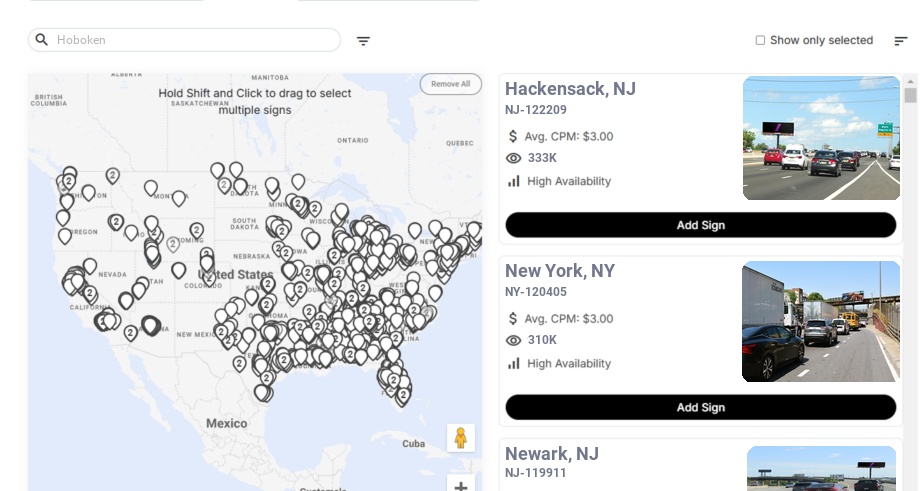
Blip has digital billboards near Hoboken. You can browse available locations on a map, choose the ones that fit your audience, and start advertising right away.
Still have questions? Launch a campaign in minutes — no contracts, no commitments.
Start Your CampaignHoboken Billboard Advertising Guide
Hoboken, New Jersey offers one of the densest, most affluent, and most mobile audiences in the country—perfect for dynamic digital billboard campaigns. With 182 digital billboards serving the Hoboken area from nearby cities like Weehawken Jersey City Secaucus Newark, and Manhattan, we can help advertisers tap into Hudson County residents, Manhattan commuters, and visitors moving through this compact, hyper-connected market with highly targeted billboard advertising near Hoboken.
Understanding the Hoboken Area Market
Hoboken packs a major punch into just 1.25 square miles. According to figures summarized by the City of Hoboken, the city’s population is just over 60,000, giving it a density of nearly 48,000 people per square mile—among the highest in the U.S. By comparison, Hudson County overall has a density of roughly 14,000 people per square mile, so Hoboken is more than 3x denser than the county average. This matters for billboard advertisers because:
- A relatively small geographic footprint concentrates residents and visitors along a few key corridors and transit gateways near Hoboken.
- Repetition is easy to achieve by targeting the same daily travel paths with multiple nearby boards.
- Even small shifts in board placement can put your message in front of thousands of incremental daily viewers.
For brands looking for Hoboken billboards, this density means that a thoughtfully placed board on a nearby corridor can function almost like a neighborhood fixture, seen repeatedly by the same high-value audience.
Key demographic and economic indicators, based on recent summaries from the City of Hoboken, Hudson County
- Population: ~60,400 residents
- Median age: about 31–32 years, vs. a national median around 38
- Educational attainment: more than 75% of residents 25+ hold at least a bachelor’s degree; in many tracts near the waterfront, college attainment exceeds 80%
- Median household income: commonly reported around $150,000–$160,000; in several census tracts facing the Hudson, median incomes exceed $200,000
- Housing: over 70% of residents rent, and in some buildings near the PATH and waterfront, renter share exceeds 85%, reflecting a highly mobile, lifestyle-focused audience
- Commute profile: local summaries indicate that more than 50% of Hoboken workers commute via public transit, 10–15% walk, and more than one-third of households are car-free
- Worker base: Hoboken is heavily oriented toward white-collar employment; local economic profiles show that well over 60% of employed residents work in management, business, science, and arts occupations
Hoboken is a classic “live-work-play” urban community. The Hoboken Business Alliance highlights hundreds of restaurants, bars, boutiques, and services along Washington Street and adjacent blocks. Its business directory lists more than 400 retail, food, and service businesses within city limits, many clustered within a half-mile of the PATH and waterfront. This mix favors campaigns for:
- Dining, nightlife, and entertainment
- Fitness and wellness
- E-commerce and app-based services
- Financial services and real estate
- Higher education and professional development
Hudson County as a whole is home to roughly 710,000 residents, according to county and municipal summaries, and more than 40% of households report speaking a language other than English at home—useful for bilingual or multicultural campaigns. With 182 digital billboards serving the Hoboken area from nearby cities within about 10 miles, we can strategically position brands near the major gateways that residents, commuters, and visitors use every day, making billboards near Hoboken an efficient way to amplify campaigns that also run in Manhattan or elsewhere in North Jersey.
Where the Traffic Flows: Key Corridors Serving the Hoboken Area
Hoboken’s audience doesn’t just stay in Hoboken. Many residents commute into Manhattan or other parts of New Jersey, and thousands of non-residents pass close to Hoboken on their way to New York City or along the regional highway network. Understanding these flows is crucial when planning billboard rental near Hoboken, since the most valuable placements will intercept both Hoboken-bound drivers and through-traffic.
Important corridors and hubs near Hoboken include:
-
Lincoln Tunnel North Bergen):
- Route 495, the main Lincoln Tunnel approach, carries roughly 100,000–120,000 vehicles per day toward the tunnel, based on counts cited by the New Jersey Department of Transportation.
- The Port Authority of New York and New Jersey reports that the Lincoln Tunnel handles on the order of 20–21 million vehicles annually, or about 55,000–60,000 vehicles per average day across all tubes.
- Our digital billboards in nearby Weehawken and North Bergen allow brands to reach drivers heading between New Jersey, Hoboken area neighborhoods, and Midtown Manhattan, including a high share of commuters with household incomes above $100,000. These placements function as some of the most visible billboards near Hoboken for both local residents and Manhattan-bound professionals.
-
Holland Tunnel and Jersey City
- The Holland Tunnel connects Jersey City to Lower Manhattan and is a critical route for Hudson County commuters and commercial traffic, with Port Authority data indicating more than 30 million vehicles annually in typical recent years (roughly 80,000–90,000 per day when averaged).
- Boards in Jersey City and Kearny can capture both Manhattan-bound drivers and those moving north-south along the New Jersey Turnpike
-
I‑95 / New Jersey Turnpike, Route 3, and U.S. 1&9:
- NJDOT traffic counts show that segments of I‑95 / New Jersey Turnpike in North Jersey regularly carry 150,000–200,000 vehicles per day. Key sections of U.S. 1&9 and Route 3 near Secaucus and North Bergen add another 80,000–120,000 vehicles per day each.
- Boards near Secaucus Ridgefield, Lodi Bogota serve regional commuters who live or work near Hoboken, Jersey City, and Manhattan, capturing both daily work trips and heavy weekend shopping and leisure traffic to regional malls and entertainment areas like the Meadowlands.
-
Newark and Newark Liberty International Airport:
- Newark Liberty International Airport handled approximately 49 million passengers in 2019, dipped during the pandemic, and rebounded to more than 45 million passengers in 2023, according to data reported by the Port Authority of New York and New Jersey
- That equates to well over 120,000 passengers per average day moving through terminals, plus tens of thousands of employees, rideshare drivers, and visitors using surrounding roadways.
- Boards near Newark can reach air travelers, hospitality workers, corporate visitors, and rideshare/taxi traffic destined for Hoboken area hotels and apartments. A small share of arriving passengers—often estimated at 5–10% for inner-ring cities—are heading to Hudson County destinations like Hoboken and Jersey City.
-
New York City
- Manhattan and Brooklyn together host more than 4 million jobs and tens of millions of annual visitors, according to figures summarized by the NYC Mayor’s Office of Economic Opportunity NYC Tourism + Conventions. Many Hoboken residents work in Midtown or Lower Manhattan, while visitors staying in New York often cross over to experience the Hoboken waterfront.
- Proximity to Manhattan and Brooklyn lets us use boards across the Hudson to reinforce brand presence for Hoboken area audiences while they are in New York.
- Manhattan and Brooklyn boards can also be used to drive New Yorkers to Hoboken restaurants, nightlife, real estate developments, or waterfront events promoted by groups like Visit Hudson and the Hoboken Business Alliance.
When planning a Blip campaign, we can think in terms of “gateways” to the Hoboken area: Lincoln Tunnel, Holland Tunnel, the Turnpike, and the airport. Concentrating blips on boards clustered around these points maximizes exposure to Hoboken-centric traffic that cumulatively can exceed several hundred thousand vehicle trips per day and provides a framework for scalable billboard advertising near Hoboken.
Transit-Heavy: Reaching Car-Light Audiences Through Roadside Media
Hoboken is famously car-light. According to local summaries of commuting data referenced by the City of Hoboken, more than 50% of residents use public transportation to commute, a rate that is roughly 3x the New Jersey statewide average. Around 10–15% walk or bike to work, and a growing share—often reported in the 10%+ range—works from home at least part of the week.
Key transit touchpoints:
-
Hoboken Terminal:
- Hub for NJ Transit rail, buses, and Hudson‑Bergen Light Rail
- PATH trains to Manhattan
- NY Waterway ferries
- NJ Transit ridership reports indicate that tens of thousands of riders use Hoboken Terminal on a typical weekday. Combining commuter rail, light rail, and buses, the terminal often sees 50,000+ weekday arrivals and departures.
- The PATH system as a whole carried more than 90 million riders in 2023 according to the Port Authority of New York and New Jersey, with Hoboken among its busiest stations, commonly estimated at 15,000–20,000 average weekday entries and exits.
- NY Waterway has reported several million annual passenger trips systemwide, with Hoboken routes among the core links between New Jersey and Manhattan.
This might sound like a challenge for billboard advertisers, but it actually helps strategy:
- Many transit users access the network by rideshare, drop‑off, or short drives that intersect major regional roads served by our boards; local surveys of Hoboken commuters show that thousands use app-based rides daily to reach Hoboken Terminal and the PATH.
- Commuters often combine transit with regional driving (e.g., park‑and‑ride lots, connecting buses, or weekend car usage). In Hudson County, more than 70% of households still have at least one vehicle, even if they do not drive to work daily.
- Even car-free residents still encounter roadside billboards while in friends’ cars, taxis, rideshare vehicles, delivery vehicles, or weekend trips; more than 90% of U.S. adults report noticing out-of-home advertising in a typical month, and Hoboken’s high mobility suggests a similar or higher figure locally.
We can design campaigns that treat roadside impressions as high-impact reinforcement for messages people also see on mobile and social channels. For example:
- Use geotargeted social ads and app campaigns in the Hoboken area.
- Pair them with digital billboards along Lincoln Tunnel approaches, Jersey City, or Secaucus.
- Coordinate timing so commuters see similar messages during morning or evening commutes.
Audience Segments in the Hoboken Area
Because of its urban, highly educated, and affluent population, the Hoboken area is ideal for several high-value audience segments. Local economic development summaries and housing reports from the City of Hoboken, Hudson County
1. Young Professionals and Dual-Income Households
- Median age early 30s, with a large concentration in the 25–44 age band (often more than 50% of residents).
- High concentration of finance, tech, media, and consulting workers commuting to Manhattan and Jersey City; in some neighborhood surveys, over 30% of residents report working in finance or professional services.
- High disposable income; a sizable share of households earn $200,000+ annually, and many delay larger life milestones (house purchase, kids) and spend heavily on lifestyle, dining, and experiences.
Ad categories that typically perform well:
- Fintech apps, investment platforms, and local banking
- Boutique fitness, studios, and health clubs
- Restaurants, cocktail bars, craft beer, and premium food delivery
- Travel, hospitality, and experiences
2. Families and Long-Term Residents
While Hoboken skews young, it has grown as a family destination:
- Multiple public schools and charter schools overseen by the Hoboken Public School District
- Parks and playgrounds, including the popular waterfront parks promoted by Visit Hudson and the City of Hoboken’s parks division
- Local housing analyses show that families with children represent a growing share of households, particularly in newer residential buildings along the western edge and waterfront.
Relevant campaigns might include:
- Real estate, mortgage, and relocation services
- Pediatric practices, family healthcare, and dental offices
- Enrichment programs, tutoring, and after‑school activities
- Home services: cleaning, storage, moving, and renovation
3. Students and Academic Community
- Stevens Institute of Technology enrolls roughly 8,000 students (undergraduate and graduate) plus faculty and staff, according to its institutional factbook.
- More than 3,500 students typically live in university housing on or near campus, with the remainder commuting from Hoboken, Jersey City, and surrounding towns.
- Many live on or near campus or commute via Hudson‑Bergen Light Rail, PATH, and ferries.
Effective billboard uses:
- Degree and certificate programs competing for Hoboken area students
- Tech employers seeking interns and entry-level talent
- Student-focused housing, banking, food, and nightlife
4. Visitors and Regional Day-Trippers
Hoboken’s waterfront, skyline views, and restaurant scene draw visitors from across the region:
- The New Jersey Division of Travel and Tourism reports that New Jersey welcomed more than 110 million visitors annually pre‑pandemic and exceeded 114 million visitors again in 2023, with visitor spending reaching over $70 billion. Northern New Jersey and Hudson County are consistently cited as major contributors to those figures.
- The Hudson County Office of Cultural & Heritage Affairs and Tourism Development promotes Hoboken as a key waterfront destination, highlighting its piers, skyline views, and events.
- Day-trippers and weekend visitors often arrive via Lincoln or Holland Tunnel, or via trains and ferries to Hoboken Terminal. On peak summer weekends, local police and transportation agencies report noticeable surges in pedestrian and vehicular volumes along the waterfront and Washington Street.
Campaigns can encourage:
- Dining and nightlife in the Hoboken area
- Events, festivals, and waterfront activities
- Boutique hotels and short-term rentals
Using Blip’s Flexibility to Target Hoboken Area Audiences
With Blip, advertisers buy time, not fixed contracts. That’s critical in a complex region like Hoboken’s, where audiences shift by time of day and direction of travel. It also means you can approach billboard rental near Hoboken as an agile, test-and-learn channel rather than a large, upfront commitment.
We can combine:
- 182 digital billboards within ~10 miles of Hoboken, across communities like Weehawken, Jersey City, North Bergen, Secaucus, Kearny, Ridgefield, Newark, Bayonne, Bogota, Lodi, New York, and Brooklyn. This network collectively reaches hundreds of thousands of daily impressions along major interstates, approaches to Manhattan, and arterial roads feeding Hoboken and Jersey City.
- Dayparting: Only show blips during the hours that matter for your audience; for example, limit spend to the 6–10 a.m. and 4–8 p.m. commuter windows, which together can account for more than half of weekday traffic on some corridors.
- Budget controls: Start with as little as a few dollars per day, then scale based on performance. Many local advertisers begin with test budgets in the $10–30/day range and ramp up once they see measurable lift in web traffic, calls, or in-store visits.
Examples of targeted strategies:
-
Morning commuter focus (6–10 a.m.):
- Target boards on Route 495, the Turnpike, and key Jersey City corridors with “Start your day” or “On your way to Manhattan?” messaging.
- Ideal for coffee shops, breakfast spots, productivity apps, and financial services, especially given that thousands of high-income professionals pass these points each hour.
-
Evening & nightlife focus (4–9 p.m.):
- Emphasize boards on Manhattan and Brooklyn exits, and Lincoln/Holland Tunnel approaches, reaching people returning to the Hoboken area.
- Great for restaurants, bars, delivery apps, gyms, and streaming/entertainment—categories where studies consistently show evening response and conversion rates peaking.
-
Weekend, leisure-heavy targeting:
- Concentrate blips on Fridays through Sundays on boards around Newark, Secaucus, and Manhattan to capture regional visitors heading toward the Hoboken waterfront.
- Ideal for events, waterfront attractions, retail, and real estate open houses. Weekend traffic on key retail corridors can run 10–20% above weekday baselines, making this a cost-efficient period for leisure-focused messaging.
Seasonal and Event-Based Opportunities
The Hoboken area has distinct seasonal patterns that we can take advantage of. Local event calendars from the Hoboken Business Alliance, the City of Hoboken, and tourism sites like Visit Hudson provide year-round visibility into festivals, street fairs, and waterfront programming. Aligning billboards near Hoboken with these events helps ensure your messaging appears when local interest and visitation are peaking.
Spring (March–May)
- Warmer weather drives people to the waterfront, parks, and outdoor dining. Hoboken’s waterfront parks and piers can see thousands of daily visitors on pleasant weekends.
- Stevens’ academic calendar adds move-in, midterms, and graduation peaks, bringing hundreds of visiting families on key weekends.
- Local news outlets such as NJ.com’s Hudson County section Hudson County View
Use cases:
- Launch outdoor seating, spring menus, or seasonal services.
- Boost fitness, allergy care, and wellness campaigns.
Summer (June–August)
- Many residents split time between the city and the Jersey Shore; weekend traffic on the Turnpike and Route 3 increases significantly, especially Friday evenings and Sunday afternoons.
- Hoboken waterfront events and nearby concerts at venues in Jersey City, Secaucus, and the Meadowlands draw visitors; concerts and fireworks nights can spike evening traffic by thousands of additional vehicles.
- Regional tourism peaks: New Jersey tourism data show that summer months account for a disproportionately large share of the state’s 100M+ annual visitors.
Use cases:
- Target boards along routes to shore points (via Turnpike and Route 3) to reach Hoboken area residents leaving the city.
- Promote summer sales, rooftop bars, and travel products.
Fall (September–November)
- Back-to-school and back-to-office rhythms; commuter volume stabilizes as vacation season ends, often returning to or exceeding pre-summer weekday averages.
- Real estate leasing and home buying often pick up after summer; local brokers in Hudson County frequently report strong activity in September and October.
- College sports and campus events at Stevens and nearby universities add weekend visitors.
Use cases:
- Back-to-school for families and college students.
- Financial services, real estate, and subscription services.
Winter & Holidays (December–February)
- Holiday shopping, restaurant gatherings, and New Year’s fitness pushes. Retail spending in November–December can account for 20–25% of annual sales for many bricks-and-mortar businesses.
- Weather can push more people toward delivery and e‑commerce; winter storms reliably boost grocery and prepared-food ordering in the region.
- Holiday events like Hoboken’s tree lighting and seasonal markets, often covered by outlets like Hoboken Girl and The Jersey Journal
Use cases:
- Holiday gift campaigns for local retailers and e‑commerce brands.
- “New Year, new you” for gyms, coaching, and mental health services.
Leverage local event calendars from the Hoboken Business Alliance and local news outlets like NJ.com’s Hudson County section
Creative Best Practices for Hoboken Area Billboards
Given fast-moving traffic and high message clutter near major tunnels and highways, creative needs to be extremely clear and tailored. Remember that on approaches to the Lincoln and Holland Tunnels, vehicles may be traveling 30–50 mph, giving drivers only 5–8 seconds to absorb a message. This is especially important when you are testing new billboard advertising near Hoboken and need every impression to count.
1. Design for Speed and Distance
- Keep to 6–8 words max plus logo/URL/app name.
- Use large, high-contrast fonts; dark text on light backgrounds or vice versa.
- Avoid intricate photos; favor bold imagery and clear focal points.
- Ensure key elements (brand name, call-to-action) are legible from 500–700 feet away, matching typical viewing distances on Route 495, the Turnpike, and local arterials.
2. Speak to the Urban, Affluent Mindset
- Emphasize convenience, quality, and time savings: “Skip the commute chaos,” “Dinner done in 20 minutes,” “Invest smarter on your ride home.”
- Highlight premium features rather than just low price—this audience spends for value and experience; local consumer spending reports show higher-than-average outlays on dining, fitness, and travel in Hoboken and adjacent ZIP codes.
- If your offering is new or niche, lead with the benefit, not just the brand name.
3. Localize Your Message
-
Reference the Hoboken area experience:
- “Beat the Lincoln Tunnel stress—order ahead.”
- “Hoboken’s fastest home cleaning service.”
- “Waterfront views, five minutes from home.”
-
For visitors:
- “Heading to Hoboken? Try [your restaurant] on Washington St.”
- “Make Hoboken your next night out.”
Localization taps into the strong neighborhood identity that local media like Hudson County View Hoboken Girl regularly highlight in their coverage of dining, nightlife, and local culture.
4. Make Digital Work Harder
Because Blip’s boards are digital, we can rotate multiple creatives and adjust messaging dynamically:
- A/B test two headlines and monitor lift in website traffic or app installs from the Hoboken area.
- Run time-specific messages: “Happy Hour 5–7 p.m. Tonight” in evening dayparts, “Brunch This Weekend” on Friday–Sunday.
- Align with weather: promote delivery and comfort foods on cold or rainy days; outdoor dining and events on sunny days (you can manually adjust schedules in response).
- Use short bursts—such as 7‑ to 14‑day flights—around specific events (e.g., Stevens move-in or waterfront festivals) to capitalize on spikes of several thousand additional daily visitors.
Multi-Touch Strategy: Pairing Billboards with Other Channels
Hoboken residents are heavy users of smartphones, streaming, and social media. Broadband penetration and smartphone ownership in high-income, urban New Jersey communities routinely exceeds 90%, according to state and local surveys. Billboards near the Hoboken area work best as part of a multi-channel strategy:
-
Search & Social:
- Use precise location targeting around the Hoboken area on Google, Meta, and TikTok. Focus on ZIP codes like 07030 and adjacent areas in Jersey City and Weehawken.
- Launch billboard campaigns concurrently and monitor brand search volume and CTR changes. Many advertisers aim for a 10–30% lift in branded search queries in key ZIPs during active billboard flights.
-
App-Based Services:
- For delivery, mobility, and fintech apps, track installs from ZIP codes associated with Hoboken and nearby neighborhoods (07030 and adjacent ZIPs).
- Trigger app retargeting or in‑app messages for users estimated to live in the Hoboken area. For example, send push notifications aligned with peak commute times highlighted by NJ Transit service schedules.
-
Email & CRM:
- Announce “Now showing on billboards near Hoboken” in emails and social posts to give existing customers social proof and pride-of-place.
- Offer time-limited promo codes that correspond with your billboard flight dates. Aim for measurable goals—such as 5–15% of redemptions coming from Hoboken area residents during the campaign period.
Measuring Success Around Hoboken
While digital billboards don’t provide clicks, we can still measure impact effectively.
1. Define a Clear, Trackable Goal
Examples:
- Increase brand search volume or website sessions from Hoboken area ZIP codes by 10–20% during the campaign.
- Generate a specific number of coupon redemptions or promo code uses tied exclusively to billboard messaging (e.g., 100–300 redemptions over a 4‑week period for a local restaurant).
- Drive registrations, reservations, or app installs with a unique URL (e.g., /hoboken) or QR code, and target a specific conversion cost ceiling based on your margins.
2. Use Geography in Your Analytics
-
Monitor website analytics by city/ZIP and compare:
- Before vs. during the campaign
- Hoboken area vs. control regions not served by your billboards
- For app-based businesses, check user acquisition by region and time window; look for statistically meaningful increases (e.g., 15–25% more new users from Hudson County compared to baseline weeks).
3. Align With Local News & Events
Track spikes in interest during times when your brand appears on both:
- Billboards near Hoboken area commuting routes
- Local media such as The City of Hoboken’s news page, NJ.com’s Hudson coverage Hudson County View Hoboken Girl
If you coordinate your campaign with a news story, sponsorship, or event, you can see compounding awareness effects. For example, pairing a 2‑week billboard burst with coverage of a new restaurant opening can drive a short-term surge in reservations beyond what either channel would do alone.
Putting It All Together: Sample Campaign Frameworks
To make this concrete, here are a few example frameworks we can adapt. Each illustrates how billboard rental near Hoboken can be structured around a clear objective, audience, and set of corridors.
Local Restaurant or Bar in the Hoboken Area
- Target boards in Weehawken, Jersey City, and Manhattan facing Lincoln/Holland Tunnel traffic; combined daily volumes on these approaches can exceed 150,000 vehicles.
- Daypart 4–9 p.m. weekdays, plus weekend afternoons when dining decisions are being made.
-
Creatives:
- Ad A: “Hoboken Happy Hour—2 Blocks from the Waterfront”
- Ad B: “Skip Midtown, Dine in Hoboken Tonight”
- Goal: 15% lift in reservations, measured through a “HOBOKEN” promo code or unique booking link, and a 10–20% increase in website visits from 07030 during the campaign period.
Real Estate Developer or Brokerage
- Target boards in Secaucus, Newark (for airport visitors), and Manhattan. Include inventory on high-volume corridors like the New Jersey Turnpike (150,000–200,000 vehicles/day in key segments).
- Run consistently over 4–8 weeks, with heavier presence on weekends when open houses occur.
-
Creatives:
- “Waterfront Living near Hoboken—from [price]”
- “5 Minutes to Manhattan, All the Hoboken Vibe”
- Track: website visits to listing pages from the Hoboken area, scheduled tours, and leads generated, aiming for a measurable lift (e.g., 20–30% increase in inquiries from Hudson County ZIP codes while the campaign runs).
Fintech / Banking Brand
- Emphasize commuting patterns: boards along Route 495, Turnpike, Jersey City, and Manhattan. These routes collectively expose your message to tens of thousands of high-income commuters every weekday.
- Daypart 6–10 a.m. and 4–8 p.m. on weekdays.
-
Creatives:
- “Invest While You Commute—Download [App Name]”
- “Hoboken Savers Earn More with [Brand]”
- Measure: new account sign-ups or app installs from Hoboken area ZIP codes, target a defined lift (e.g., 25% more new users from 07030 vs. the month prior) and monitor cost per acquisition against other channels.
By combining detailed local knowledge of the Hoboken area with the flexibility and precision of Blip’s 182 digital billboards nearby, we can build campaigns that reach the right people at the right times along their real-world paths—without committing to long-term, inflexible contracts, and with data-driven expectations for reach, frequency, and measurable business impact from Hoboken billboards and other billboards near Hoboken.