Billboards in Ridgefield, NJ
No Minimum Spend. No Long-Term Contracts. Just Results.
Trusted by Leading Brands


Billboard advertising
in Ridgefield has never been easier



How much is a billboard in Ridgefield?
Why Choose Blip for Billboard Advertising in Ridgefield
-
Blip lets you buy Ridgefield billboards on your schedule, so you can hit G.W. Bridge and Lincoln Tunnel commuters without long-term contracts.
-
Set flexible budgets in Ridgefield and stay visible on Route 1/9, Route 46, and the Turnpike—only paying for the blips you choose.
-
Use dayparting in Ridgefield to catch 6:30–9:30 a.m. commuters and 3:30–7:30 p.m. return traffic when dwell time is highest.
-
Track Ridgefield campaign results in real time and shift spend fast when Bergen County traffic spikes for MetLife events or holiday shopping.
-
Blip's creative tools make Ridgefield ads easy to update for bilingual households and fast-moving drivers near Broad Ave and nearby corridors.
Frequently Asked Questions About Billboard Advertising in Ridgefield
How much does a billboard cost in Ridgefield, New Jersey with Blip?
With Blip, you control exactly what you spend on Ridgefield billboards by setting a daily budget that can be as small or as large as you like. Each 7.5–10 second “blip” only runs when and where you choose, and Blip automatically keeps your campaign within the limit you set. Costs vary based on location, time, and advertiser demand, so you only pay for the blips you actually receive.
Where can I advertise with Blip in Ridgefield, New Jersey?
Ridgefield sits in one of the densest, most mobile media markets in the United States, and it gives advertisers a rare opportunity to reach local residents, regional commuters, and NYC-bound travelers with the same flexible digital billboard strategy. The area is minutes from the George Washington Bridge and Lincoln Tunnel approaches, and nearby corridors like US Route 1/9, Route 46, Route 4, and Route 17 carry heavy traffic. That makes Ridgefield billboard advertising effective for both hyper-local reach and broader North Jersey exposure.
What kind of audience do Ridgefield, New Jersey billboards reach with Blip?
Ridgefield’s value comes from its dense neighborhoods, commuter traffic, and access to Bergen County and the New York City metro. The borough has a population of roughly 11,500 packed into about 2.6 square miles, and Bergen County overall has over 950,000 residents. The area also includes a middle- to upper-middle-income customer base, with many bilingual households and a diverse mix of communities.
When is the best time to run billboards in Ridgefield, New Jersey with Blip?
Daily traffic peaks line up with classic commuting windows: roughly 6:30–9:30 a.m. and 3:30–7:30 p.m. on weekdays. Morning hours are strong for coffee, breakfast, transit, and banking messages, while evening hours are best for restaurants, grocery, gyms, childcare, and after-school programs. Weekends shift toward shopping, leisure, and family activities.
What roads around Ridgefield, New Jersey are best for billboard advertising?
According to New Jersey traffic counts, the New Jersey Turnpike near Ridgefield handles around 100,000–120,000 vehicles per day, with some peak segments topping 150,000 on the busiest days. US Route 1/9, Route 46, Route 4, and Route 17 also carry heavy daily volumes, often ranging from 60,000 to 110,000 vehicles per day. These corridors are especially valuable for billboard placement because they connect commuters, retail traffic, and cross-Hudson travel.
Do I need a contract to advertise with Blip in Ridgefield?
No, Blip has no long-term contracts or minimum commitments. You can start, pause, or stop your campaign at any time.
How fast can I launch a billboard campaign with Blip in Ridgefield?
You can have your campaign live in minutes. Create a free account, select your locations, set your budget, upload your design, and start running once approved.
Where can I advertise with Blip in Ridgefield?
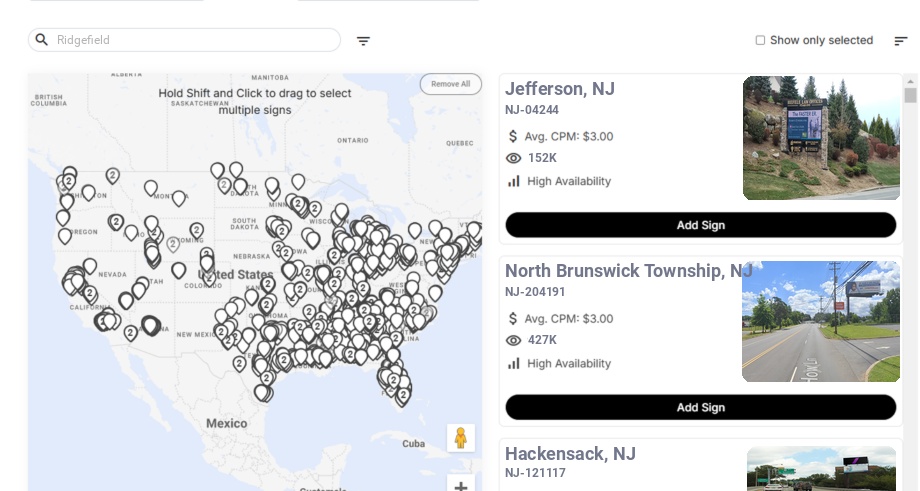
Blip has digital billboards in Ridgefield. You can browse available locations on a map, choose the ones that fit your audience, and start advertising right away.
Still have questions? Launch a campaign in minutes — no contracts, no commitments.
Start Your CampaignRidgefield Billboard Advertising Guide
Ridgefield, New Jersey sits in one of the densest, most mobile media markets in the United States. As part of Bergen County and the New York City metro, it gives us a rare opportunity: we can reach local residents, regional commuters, and NYC-bound travelers with the same flexible digital billboard strategy. With Blip’s tools, we can dial our campaigns up or down by time of day, day of week, and board location to match how people actually move through this corridor and to get maximum value from Ridgefield billboards.
Why Ridgefield, NJ Is A Strategic Market
Ridgefield’s value comes from its position at the junction of dense neighborhoods and high-traffic corridors, which makes billboards in Ridgefield work harder than in many similarly sized towns.
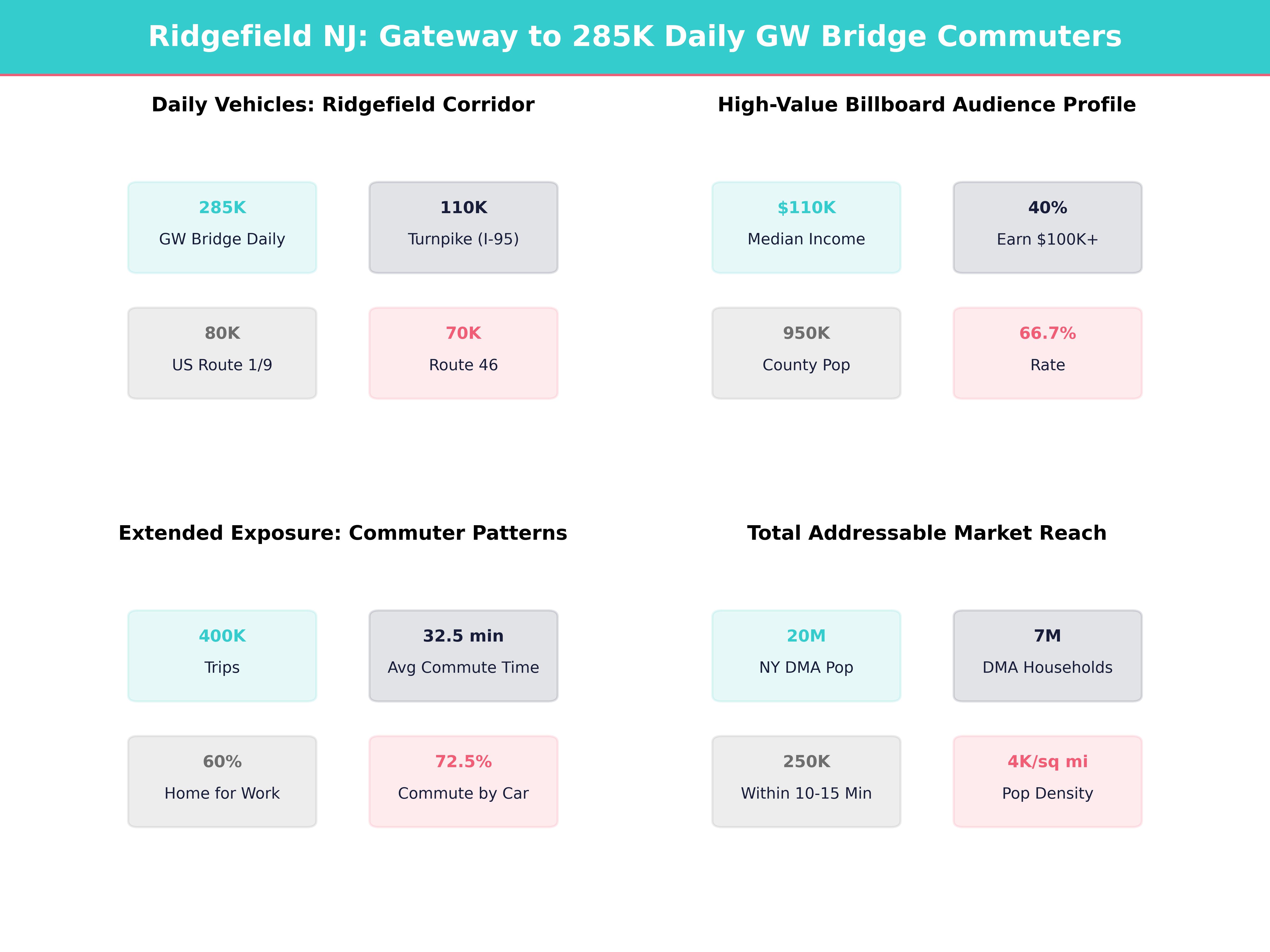
- The Borough of Ridgefield has a population of roughly 11,500 residents packed into about 2.6 square miles, a density of over 4,000 people per square mile, according to borough and county planning data. That’s more than double New Jersey’s statewide density and several times the national average, making every square mile of media coverage more valuable.
- Ridgefield is embedded in Bergen County, which has over 950,000 residents and ranks among the most populous counties in New Jersey, per county planning figures. The county alone would rank as one of the larger U.S. cities by population.
- The area is minutes from the George Washington Bridge and Lincoln Tunnel approaches; the Port Authority of New York & New Jersey reports that the George Washington Bridge alone typically carries around 280,000–290,000 vehicles per day across all hours and over 100 million vehicles per year.
- Nearby, the Lincoln Tunnel corridors add another 110,000–120,000 vehicles per day, and regional transit agencies estimate that well over 400,000 cross-Hudson trips (auto, bus, and rail combined) occur on a typical weekday in the greater Ridgefield–Hudson–Bergen funnel.
The result is a local market that behaves much larger than its raw population:
- We can reach Ridgefield residents plus significant pass-through traffic from Palisades Park, Fairview, Fort Lee, North Bergen, and other Hudson/Bergen communities, together representing well over 250,000 residents within a 10–15 minute drive.
- We’re speaking to a commuter-heavy audience: statewide, about 70%–75% of New Jersey workers commute by car, and county labor data for Bergen and Hudson consistently show that more than 60% of working residents leave their home municipality for work. In the cross-Hudson subregion, tens of thousands of daily trips are oriented toward Manhattan, Jersey City, and Newark.
- The New York DMA is the #1 media market in the country, with an estimated 7+ million TV households and 20+ million residents. Many brands are paying TV or streaming rates to reach this same population that we can touch via local digital billboards at a fraction of the cost—often delivering thousands of impressions for what a few prime-time TV spots would cost.
For advertisers, this means Ridgefield is ideal for:
- Local businesses pulling customers from a 3–7 mile radius
- Regional services (healthcare, auto, professional services) targeting all of Bergen County
- Brands that want “NYC market” exposure without paying Manhattan-level OOH rates
- Any organization that wants Ridgefield billboard advertising to build both local awareness and regional reach at the same time
Understanding Ridgefield’s Audience
To build effective creative and get the most from billboard rental in Ridgefield, we need to understand who lives and travels here.
Demographics and income
- Ridgefield’s median household income sits in the $75,000–$85,000 range, while Bergen County overall is higher, in the $105,000–$115,000 range, based on county and state economic profiles. More than 40% of Bergen County households earn $100,000 or more annually, and a significant share surpass $150,000, creating a strong base for discretionary spending.
- Owner-occupied housing rates in Bergen are around two-thirds of all occupied homes, reflecting a stable, family-oriented customer base.
- This signals a solid middle- to upper-middle-income customer base: ideal for retail, dining, auto, home improvement, healthcare, and financial services campaigns that rely on Ridgefield billboards for ongoing visibility.
Cultural diversity
Ridgefield and neighboring boroughs are part of one of the most diverse corridors in New Jersey:
- Bergen County has sizeable Korean-American, Hispanic/Latino, and other immigrant communities. Nearby Palisades Park, for example, is often cited as having a Korean population exceeding 50% of residents, and some corridors along Broad Avenue skew even higher for Korean-speaking households.
- In many of the nearby towns combined (Ridgefield, Palisades Park, Fort Lee, Fairview), it is common for 40%–60% of residents to speak a language other than English at home, with Korean, Spanish, and Portuguese particularly prominent.
- Many households are bilingual; Spanish and Korean are particularly common second languages. This means a large share of drivers can comfortably read simple English plus short lines in a second language.
What this implies for creative:
- Simple bilingual lines can be powerful. For example: “Fresh BBQ Tonight / 오늘 저녁 바베큐” or “Attorney for Your Family / Abogado para su familia.”
- Visuals should reflect the community’s diversity—families, multi-generational households, and images that can resonate across cultures.
- Clear, universal imagery (food, cars, homes, health, kids) often works best for a fast-moving, multi-lingual audience.
Commuters and routines
Ridgefield is dominated by commute patterns:
- Major arterials near the borough feed into the George Washington Bridge, Lincoln Tunnel, and Jersey City waterfront. According to the North Jersey Transportation Planning Authority (NJTPA)
- Daily traffic peaks line up with classic commuting windows: roughly 6:30–9:30 a.m. and 3:30–7:30 p.m. on weekdays. At these times, traffic often slows or backs up near key interchanges, increasing billboard dwell time.
This matters because with Blip, we can bid more heavily during these high-intent windows when:
- People are thinking about coffee, breakfast, transit, and their workday in the morning.
- They are considering dinner, errands, and weekend plans on the way home.
These same routine windows are where digital billboards in Ridgefield can repeatedly reach the same high-value commuters and build strong frequency.
Traffic Patterns and High-Impact Locations
Ridgefield’s billboard value comes largely from its road network and adjacent corridors. While exact board locations depend on current inventory, we can use traffic data to guide strategy and understand how Ridgefield billboard advertising can intersect with the heaviest flows of drivers.
Key corridors
According to the New Jersey Department of Transportation (NJDOT), traffic counts on the main roads around Ridgefield and the nearby Meadowlands typically include:
- New Jersey Turnpike (I‑95 Western Spur) near Ridgefield: several segments handle around 100,000–120,000 vehicles per day, with some peak segments of the Turnpike system in North Jersey topping 150,000 vehicles on the busiest days.
- US Route 1/9 just east and south of Ridgefield sees average daily traffic often in the 70,000–90,000 vehicles per day range, depending on segment.
- Route 46 near Ridgefield and Little Ferry often carries 60,000–80,000 vehicles per day.
- The nearby Route 4 and Route 17 corridors in Bergen County are also heavy, each commonly in the 80,000–110,000 vehicles per day range. These roads feed major retail destinations such as Westfield Garden State Plaza
The North Jersey Transportation Planning Authority (NJTPA)
What this means for placement
When we choose boards in and around Ridgefield, we typically want to:
- Prioritize inbound morning traffic for businesses that benefit from pre-work consideration (coffee, QSR, transit, healthcare reminders, radio shows, podcasts, B2B services). On corridors with 70,000+ daily vehicles, even capturing a fraction of the morning peak can translate to tens of thousands of impressions per week.
- Prioritize outbound evening traffic for restaurants, grocery, gyms, entertainment, and retail. With average evening congestion adding 10–15 minutes to many drives, drivers have more time to notice and recall messages.
- Use boards close to key ramps and intersections for “last exit” or “next right” messaging—especially along Route 46 and 1/9, where drivers are making quick decisions. Here, even modest directional uplift (e.g., 1%–3% of viewers converting into a stop) can mean dozens of incremental customers per day.
If you know your customers’ typical route—say, from Ridgefield to Manhattan via the George Washington Bridge—we can concentrate impressions on boards along that path and peak commute times. This kind of precise placement is where digital Ridgefield billboards outperform many other traditional local media options.
Timing Your Blip Campaign
With Blip, we don’t have to buy 24/7 coverage. We can focus on the hours and days that matter most in Ridgefield and structure billboard rental in Ridgefield so that you only pay for exposure when your audience is most likely to act.
Weekday vs. weekend strategy
In this area, weekday traffic is dominated by commuters; weekends shift toward shopping and leisure.
-
Weekdays (Mon–Fri)
- Morning 6:30–9:30 a.m.: strong for coffee shops, breakfast, transit, banking reminders (“Need a checking account? 5 minutes from here”). Regional counts frequently show that 30%–40% of a road’s daily traffic can occur in these morning and evening rush blocks combined.
- Midday 11 a.m.–2 p.m.: lunch offers, medical appointments, home services (“Book your roof inspection during lunch”). Many service businesses report higher call and booking volume in these hours, making billboard prompts especially timely.
- Evening 3:30–7:30 p.m.: best for restaurants, grocery, gyms, childcare, after-school programs. This window captures school pick-ups plus end-of-day commuters.
-
Weekends (Sat–Sun)
- 10 a.m.–6 p.m.: shoppers heading to Bergen County’s many retail centers and malls; families doing activities; traffic toward the Meadowlands Sports Complex
- When the New York Giants, New York Jets, or major concerts
Using Blip’s scheduling:
- We can concentrate budget on weekday rush hours if you’re targeting commuters.
- Or we can shift spend to weekends if your business is more leisure- or family-driven.
- For seasonal campaigns—like tax season, holiday shopping, or summer events—we can schedule start and end dates precisely, then adjust budgets in real time as performance data comes in.
Crafting Effective Creative for Ridgefield
Because drivers in this corridor move quickly and deal with heavy congestion, our creative should be extremely clear and instantly legible. Strong creative is what turns simple billboard rental in Ridgefield into measurable business results.
Core creative rules for this market
-
Big, simple message (6–8 words max)
- Traffic moves fast on 1/9 and Route 46; NJDOT spot studies show typical speeds of 40–55 mph between slowdowns. A cluttered board will be ignored.
- Example: “Korean BBQ – 2 Exits Ahead, Ridgefield” or “Same-Day Braces in Bergen County.”
-
High-contrast color schemes
- Dark background with light text or vice versa; avoid thin fonts or low-contrast color combinations.
- In adverse weather (fog, rain, snow), high contrast is critical. North Jersey averages around 45–50 inches of precipitation annually, plus multiple snow events each winter, making visibility a real factor.
-
One clear call-to-action
- “Next Right,” “Exit 67,” “2 Miles Ahead,” “Order at RidgefieldPizza.com,” or “Text RIDGE to 55555.”
- Pair a location cue (“5 minutes from this exit”) with any digital action (“Order online now”).
-
Use local anchors
- Mention recognizable points like “near Broad Ave,” “off Route 46,” or “5 minutes from the George Washington Bridge” if accurate.
- Tie into Bergen County identity: “Trusted by Bergen families since 1998.”
-
Leverage bilingual or multicultural touches
- Keep secondary language short and direct: one headline in English, one in Spanish or Korean, both saying essentially the same thing.
- Avoid long translations—billboard dwell time doesn’t support reading sentences in two languages.
Weather and seasonal considerations
North Jersey’s four-season climate influences consumer behavior:
-
Winter (Dec–Feb)
- Cold, snow, and early darkness: the region can experience average lows in the 20s (°F) and multiple snowstorms per season. Promote auto care (tires, service), heating services, delivery food, and e‑commerce.
- Creative: bold colors that cut through gray winter skies; “Stay Warm,” “Avoid the Cold,” and “We Deliver” angles.
-
Spring (Mar–May)
- Strong time for home improvement, landscaping, tax prep, and medical checkups. Many home services and healthcare practices see appointment spikes of 10%–20% as weather improves.
- Creative featuring fresh colors, home imagery, and “Spring Clean” messaging resonates.
-
Summer (Jun–Aug)
- More leisure driving, family outings, and tourism within New Jersey and into NYC. State tourism offices report tens of millions of annual visits to New Jersey, with North Jersey and the Meadowlands region
- Promote attractions, summer sales, outdoor dining, and back-to-school offers starting late July.
-
Fall (Sep–Nov)
- Back-to-school, football season at the Meadowlands, and early holiday shopping. MetLife’s football and event calendar often clusters 2–4 large events per month in this stretch.
- Tie into events and school routines: “After-School Tutoring – One Exit Away,” “Pre-Game Dinner Near MetLife.”
With Blip, we can rotate season-specific creatives automatically without printing costs, giving Ridgefield advertisers the ability to keep messaging fresh at low incremental cost.
Using Blip Tools Strategically in Ridgefield
Digital billboards via Blip allow us to micromanage when, where, and how often our message appears, giving Ridgefield billboard advertising campaigns a level of precision that traditional static buys can’t match.
Dayparting
We can set campaigns to only show during:
- Morning commutes if you run a coffee shop, breakfast spot, or transit-related service.
- After-school and evening windows if you offer youth programs, tutoring, or family restaurants. The Ridgefield Public Schools calendar and dismissal times can help pinpoint the ideal after-school window.
- Late-night bands or bars could focus on weekend evenings, when nightlife traffic increases in the wider metro area.
Because average drive times and congestion in North Jersey often exceed 30–40 minutes for regional commutes, even a relatively short daypart window can accumulate many impressions. On a corridor with 80,000 daily vehicles, targeting just 25% of the day’s hours can still reach 15,000–25,000 vehicle trips.
Geographic focus
Using Blip’s location tools, we can:
- Concentrate impressions on boards just before a key exit or intersection leading directly to your business.
- Split test creatives: for example, one message on westbound traffic (targeting homebound commuters) and another on eastbound traffic (targeting morning drivers heading to work or Manhattan).
- Expand your radius when running promotions that draw from the entire Bergen/Hudson region (e.g., healthcare systems, higher education, car dealerships). For example, a regional mall like American Dream or Garden State Plaza pulls customers from a 20–30 mile radius; similar destination businesses can mirror that reach.
This kind of geographic control makes billboards in Ridgefield effective not only for hyper-local reach but also for campaigns that need to cover a wider North Jersey footprint.
Budget flexibility
For Ridgefield, where audience volume is high but competition for billboard space can vary:
- Set a baseline daily budget to maintain presence and brand familiarity. Even modest budgets can deliver thousands of weekly impressions in this dense environment.
-
Increase budgets during high-opportunity times:
- Holiday shopping periods (November–December), when retail sales can rise 20%–40% over typical months.
- Back-to-school (late August–early September), when families are purchasing supplies, clothing, and services.
- Major event days at MetLife Stadium or Meadowlands, when 50,000–80,000 extra visitors are in the area.
Because Blip allows granular control of bids and budgets, we can throttle spend up for special weekends and then return to normal levels afterward—something static boards can’t easily offer. This flexibility is especially valuable for smaller businesses that want to test Ridgefield billboard advertising without locking into long, inflexible contracts.
Vertical-Specific Tips for Ridgefield Advertisers
Different industries can take distinct advantage of Ridgefield’s patterns and demographics.
Restaurants, cafes, and bakeries
- Focus on rush-hour and weekend dayparts. If your average ticket is $15–$25, converting even a small share of the tens of thousands of daily drivers can meaningfully lift revenue.
- Use exit-based directional messages: “Exit 67 – 3 Minutes to Ridgefield Diner.”
- Promote lunch specials to Route 46/1–9 drivers and dinner specials for inbound evening traffic.
- Consider multilingual snippets if you serve a specific community (e.g., Korean, Spanish), especially given that in several neighboring towns, 40%+ of residents speak a non-English language at home.
Auto dealerships, repair, and car wash
- New Jersey’s car ownership rate is high, with many households owning two or more vehicles; Bergen and Hudson combined account for hundreds of thousands of registered passenger vehicles. Daily commuters often face potholes, winter wear, and congestion.
- Use simple value hooks: “Brake Service Today – 1 Mile Ahead” or “Trade-In Bonus This Week Only.”
- Time heaviest spend around paydays (1st/15th of the month, Fridays) and ahead of harsh-weather months (October–December), when data from auto service providers often show 10%–20% increases in maintenance volume.
Healthcare, dental, and optical
- Bergen County families value easy access to healthcare and specialist services. Hospital and clinic networks in the county collectively serve hundreds of thousands of outpatient visits per year.
- Use morning and midday impressions to promote: “Same-Day Appointments,” “Walk-Ins Welcome,” “Open Evenings/Weekends.”
- Target boards used by commuters heading to or from NYC and Jersey City who may prefer providers closer to home, in Ridgefield and nearby towns, to avoid extra trips into Manhattan.
Professional services (attorneys, accountants, real estate, insurance)
- Ridgefield’s diverse, often multi-generational households create demand for immigration law, family law, real estate, and small-business accounting. Bergen County also supports tens of thousands of small businesses, many of which need local legal, tax, and insurance help.
- Emphasize trust and local expertise: “Serving Bergen County Families Since 2005.”
- Combine with simple CTAs: “Free Consultation – Call XXX‑XXXX” or “Near Broad Ave, Ridgefield.”
Retail and e‑commerce
- Use billboards to drive both in-store traffic and online conversions. In a corridor with 60,000–100,000 daily vehicles, even a 0.1%–0.3% conversion from impressions to website visits can create hundreds of incremental visitors over a campaign.
- Test short URLs or promo codes: “Use code RIDGE10 at checkout.”
- Heavily weight impressions around holiday and back-to-school periods, when regional retail spending spikes and malls like Garden State Plaza and Bergen Town Center see surges in foot traffic.
Measuring and Optimizing Performance
To keep Ridgefield campaigns efficient, we should treat billboards as part of a measurable marketing system, not a standalone tactic.
Trackable CTAs
- Use unique URLs, QR codes (for slow-traffic placements), or promo codes that only appear on your billboards.
- Watch for traffic spikes in Google Analytics within minutes of your most heavily scheduled Blip windows. When you see consistent patterns, double down on those dayparts and boards. If your site typically sees 100 visits per hour but jumps to 130–150 during certain scheduled windows, that’s a 30%–50% lift you can attribute in part to your OOH.
Align with local news and events
Stay tuned to:
- The Borough’s website and notices at Ridgefield Borough for festivals, parades, and local events.
- Regional coverage from NorthJersey.com (The Record) and NJ.com
- Event calendars for MetLife Stadium Meadowlands complex
- Transit service updates from NJ TRANSIT and the Port Authority Bus Terminal
We can then:
- Increase impressions before and after large events when people are already out and about.
- Tailor creative to those events: “Parking Full? Grab Dinner in Ridgefield,” or “Game Day Special – Show Your Ticket for 10% Off.”
Continuous refinement
Because Blip campaigns are dynamic:
- Start with a test phase of 2–4 weeks with multiple creatives and a mix of boards. This window is long enough to collect statistically useful patterns across weekdays vs. weekends.
- Monitor which times, locations, and messages correlate with more calls, website visits, or store traffic. Even simple metrics—like a 10% higher call volume on days when certain creatives run—provide useful direction.
- Reallocate budget to best-performing segments, pause underperforming creatives, and swap in new variations regularly.
By combining Ridgefield’s dense, diverse population with the massive daily traffic on adjacent highways, we can punch well above the borough’s size in terms of advertising impact. With thoughtful use of Blip’s scheduling, geography, and creative flexibility, advertisers can build campaigns that feel hyper-local yet reach a truly regional audience across Bergen County and the greater New York metro—maximizing the return on every dollar spent on Ridgefield billboards and digital billboard rental in Ridgefield.