Billboards near Glen Rock, NJ
No Minimum Spend. No Long-Term Contracts. Just Results.
Trusted by Leading Brands


Billboard advertising
near Glen Rock has never been easier



How much is a billboard near Glen Rock?
Why Choose Blip for Billboard Advertising near Glen Rock
-
Blip lets Glen Rock, New Jersey advertisers launch fast on I-80, Route 4, and Route 17 commuter corridors from your laptop.
-
Reach Glen Rock, New Jersey families on school-run and weekend shopping trips with flexible budgets that scale with demand.
-
No contracts for Glen Rock, New Jersey means you can test bursts near Paramus retail traffic and pause anytime.
-
Use real-time analytics to see what works in Glen Rock, New Jersey as commuters head to NYC and Bergen County job hubs.
-
Blip's creative tools help Glen Rock, New Jersey brands build clean, high-trust ads for affluent, educated suburban audiences.
Frequently Asked Questions About Billboard Advertising near Glen Rock
How much does a billboard cost near Glen Rock, New Jersey with Blip?
With Blip, you control exactly what you spend on Glen Rock billboards by setting a flexible daily budget that can be adjusted anytime. Each “blip” is a brief 7.5–10 second display on digital billboards near Glen Rock, New Jersey, and you only pay for the blips you receive. Costs vary based on when and where your ad runs and on advertiser demand, so your campaign can be as lean or as aggressive as you choose.
Where can I advertise with Blip near Glen Rock, New Jersey?
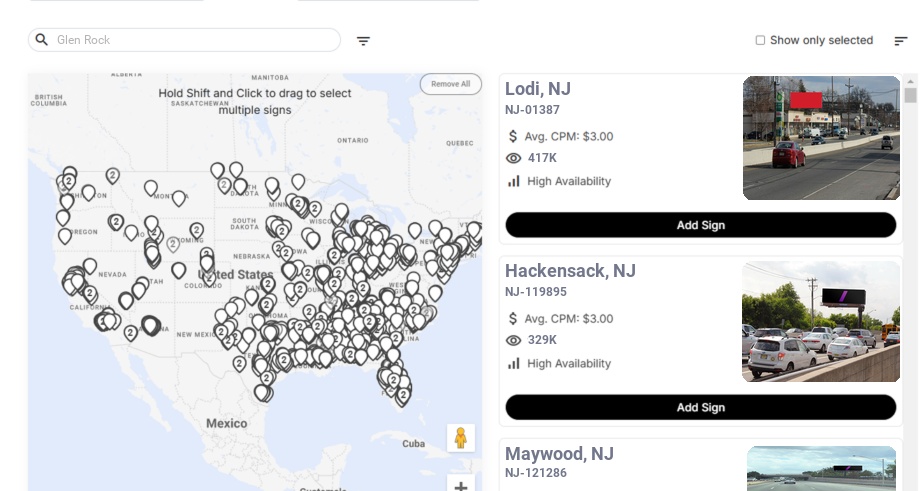
There are 30 nearby digital billboards in places like Maywood, Lodi, Ramsey, and Oakland that can help you reach the Glen Rock area. Key nearby cities with Blip-supported boards include Maywood, Hackensack & Lodi, Woodland Park, Totowa, Little Falls, Ramsey, Oakland, Bogota, and Bloomingdale. These boards plug into a regional network where state roads and interstates handle hundreds of thousands of vehicle trips every day across just a few miles.
Who do Glen Rock, New Jersey billboards reach?
Glen Rock sits in a commuter-heavy pocket of Bergen County, and the page says campaigns serving the area speak to dual-income professional households, families with school-aged children, high-frequency commuters to Manhattan and Jersey City, and residents who value quality and community reputation. It also notes that more than 55% of Bergen County workers commute outside their home municipality, and many Glen Rock residents follow this pattern. That makes billboard advertising near Glen Rock effective for reaching people in motion throughout the day.
When is the best time to run Blip billboards in Glen Rock, New Jersey?
The page recommends focusing budget on the hours and days that align with Glen Rock residents’ routines, since traffic volumes during peak periods can be 40–60% higher than midday. Weekday mornings are strong for coffee shops and professional services, afternoons for children’s programs and family dining, and evenings for restaurants, grocery, healthcare, gyms, and local retail. Saturdays are also especially useful for shopping-related campaigns near Paramus and Hackensack.
Why are Glen Rock, New Jersey billboards a good fit for commuters and shoppers?
Glen Rock is described as a classic NYC-commuter suburb with two NJ Transit rail stations and strong access to nearby highway corridors. The page highlights Route 4, Route 17, I-80, and the Garden State Parkway as major traffic arteries carrying heavy daily volumes. This means billboards near Hackensack, Maywood, Lodi, and Woodland Park can intercept Glen Rock residents as part of these massive daily flows.
Do I need a contract to advertise with Blip near Glen Rock?
No, Blip has no long-term contracts or minimum commitments. You can start, pause, or stop your campaign at any time.
How fast can I launch a billboard campaign with Blip near Glen Rock?
You can have your campaign live in minutes. Create a free account, select your locations, set your budget, upload your design, and start running once approved.
Where can I advertise with Blip near Glen Rock?
Blip has digital billboards near Glen Rock. You can browse available locations on a map, choose the ones that fit your audience, and start advertising right away.
Still have questions? Launch a campaign in minutes — no contracts, no commitments.
Start Your CampaignGlen Rock Billboard Advertising Guide
Glen Rock, New Jersey sits at the heart of one of the most affluent, tightly knit, and commuter-heavy pockets of Bergen County. With 30 nearby digital billboards in places like Maywood Lodi, Ramsey, and Oakland Glen Rock area, we can help you reach a mix of high-income suburban families, professionals commuting to New York City, and regional shoppers traveling through some of New Jersey’s busiest retail and highway corridors. For advertisers looking for billboards near Glen Rock without paying Manhattan prices, this cluster offers an efficient way to dominate local visibility.
Understanding the Glen Rock Area Market
The Borough of Glen Rock is a compact community of about 12,000 residents (12,133 per the 2020 Census) in just 2.7 square miles, giving it a density of roughly 4,500 people per square mile. The borough highlights its “small-town feel” and strong community focus on the official Glen Rock website, and this is backed up by data:
-
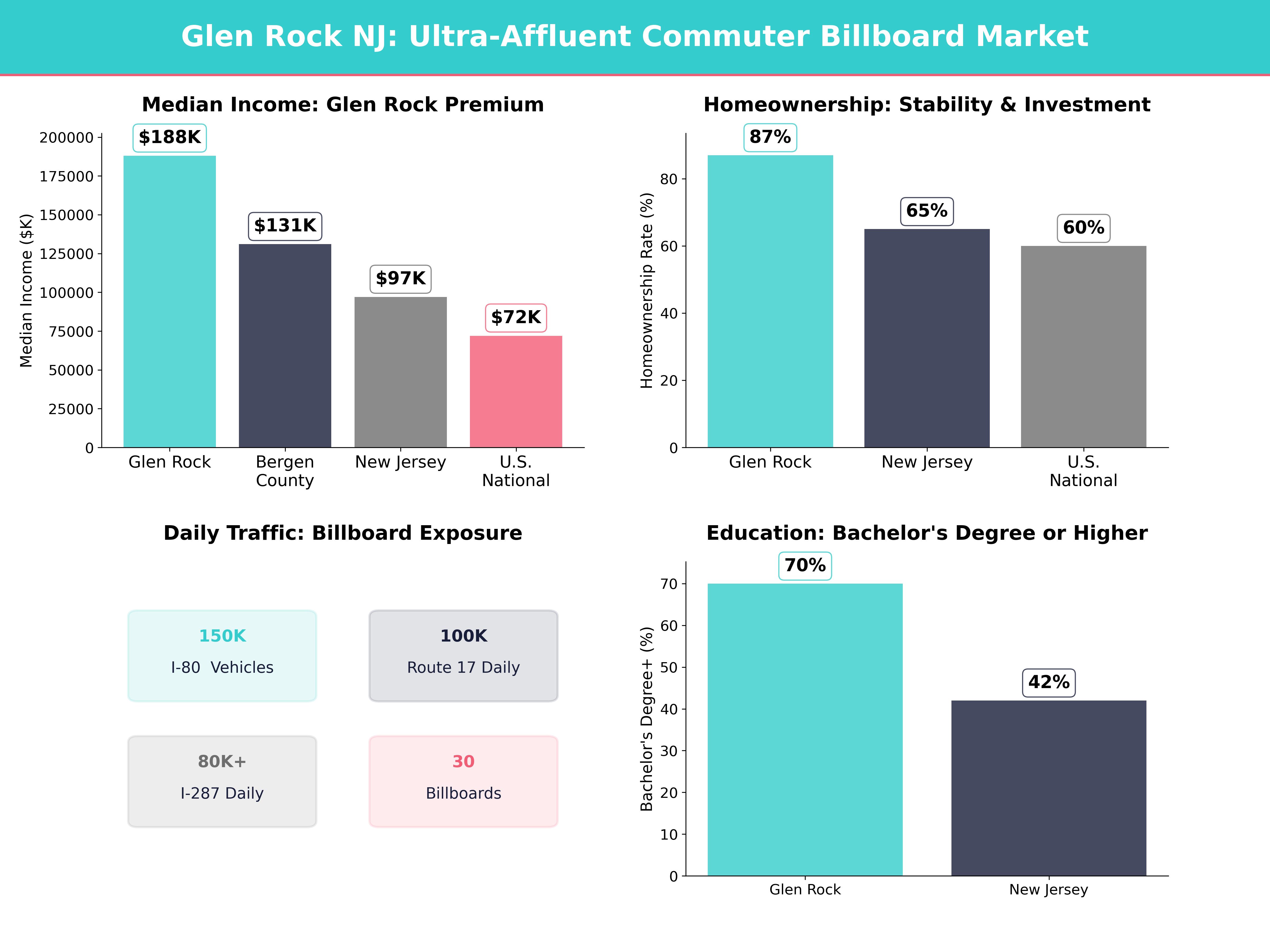
Affluence: Median household income is estimated in the $185,000–$190,000 range, which is roughly:
- About 90% higher than the New Jersey statewide median (around $97,000).
- Roughly 40–45% higher than the already affluent Bergen County median (about $127,000–$135,000, depending on the dataset year).
- More than 3× the U.S. median household income (around $69,000–$75,000 in recent estimates).
- Homeownership: Approximately 86–88% of Glen Rock housing units are owner-occupied, compared with roughly 65% statewide and about 60% nationwide. This indicates long-term residents, stable neighborhoods, and strong local loyalty—ideal conditions for building brand familiarity over time with well-placed Glen Rock billboards in nearby corridors.
- Housing values: Typical home values frequently exceed $800,000–$900,000, and many single-family homes list above $1 million, signaling strong purchasing power for home services, education, healthcare, and discretionary spending.
- Education: Over 70% of adults hold a bachelor’s degree or higher, compared with roughly 42% statewide. The local Glen Rock Public Schools
- Family orientation: A high share of households—often around 40–45%—include children under 18, outpacing state and national averages and reinforcing the importance of family-focused messaging.
Within the broader Bergen County market of roughly 955,000 residents in 70 municipalities, Glen Rock sits in a cluster of affluent, transit-rich towns like Ridgewood, Fair Lawn, and Paramus, all of which contribute to dense daily travel patterns and strong local commerce. More than 55% of Bergen County workers commute outside their home municipality, and a significant share of Glen Rock residents follow this pattern, especially toward New York City and eastern Bergen—exactly the kind of movement that makes billboard advertising near Glen Rock so effective.
When we plan billboard campaigns serving the Glen Rock area, we’re speaking to:
- Dual-income, professional households
- Families with school-aged children in activities, clubs, and sports
- High-frequency commuters to Manhattan, Jersey City, and regional job hubs
- Residents who value quality, reliability, and community reputation over bargain pricing
That means premium brands, professional services, healthcare, education, financial services, and local retail can all perform extremely well when messaging is crafted thoughtfully for this audience. The Glen Rock business community is also supported by organizations like the Glen Rock Chamber of Commerce, giving advertisers additional partnership and cross-promotion opportunities when they complement local efforts with Glen Rock billboards on nearby highways.
Key Nearby Billboard Locations Serving Glen Rock
Our 30 digital billboards near the Glen Rock area are concentrated in surrounding Bergen and Passaic County
Bergen County itself spans only about 247 square miles but supports nearly a million residents, making it one of the most densely populated counties in New Jersey and the U.S. According to Bergen County, the county’s highway and arterial network carries hundreds of thousands of vehicle trips daily, much of it concentrated along corridors directly linked to Glen Rock.
Key nearby cities with Blip-supported boards include:
-
Maywood (5.5 miles) – Near Route 17 and close to the Paramus retail corridor; excellent for reaching Glen Rock shoppers heading to major malls and big-box centers. Maywood is less than 3 miles from the Paramus cluster that includes Westfield Garden State Plaza, Paramus Park, and Bergen Town Center—combined, these centers draw tens of millions of visits per year.
- Learn more about the borough at the Borough of Maywood
-
Hackensack & Lodi (6.5 miles) – Access to I‑80, Route 4, and Route 46; strong for commuters and regional traffic. Hackensack, the county seat, has roughly 46,000 residents, thousands of office workers, and a large daytime population thanks to county government, Hackensack University Medical Center, and court facilities. These boards function as some of the most valuable Glen Rock billboards for reaching professionals headed toward Hudson County and Manhattan.
- See local information on City of Hackensack Borough of Lodi.
-
Woodland Park (5.9 miles), Totowa (7.1 miles), Little Falls (6.9 miles) – Along I‑80 and Route 46, picking up westbound Glen Rock commuters and weekend travelers. I‑80 runs across the entire state and, in this area, routinely moves 140,000–160,000 vehicles per day, according to NJDOT. For advertisers seeking flexible billboard rental near Glen Rock to reach both daily commuters and regional visitors, this cluster offers strong value.
- Learn more via Woodland Park Totowa, and Little Falls Township.
-
Ramsey (8.1 miles) & Oakland (8.5 miles) – Tied to Route 17 and I‑287 traffic, catching Glen Rock residents heading north and west for work, shopping, or recreation. Route 17’s northern Bergen segments see daily volumes around 90,000–110,000 vehicles, and I‑287 in this area often carries 80,000+ vehicles daily.
- Local details are available from Borough of Ramsey and Borough of Oakland
-
Bogota (8.4 miles) & Bloomingdale (9.7 miles) – Serve cross-county flows and longer regional trips, including traffic moving between eastern Bergen and Passaic/Morris counties.
- See Bogota and Bloomingdale.
These boards plug into a regional network where state roads and interstates handle hundreds of thousands of vehicle trips every day across just a few miles. By using Blip’s flexible platform, we can selectively concentrate impressions on specific signs aligned with Glen Rock commuting and shopping patterns—maximizing how often local residents see your message without paying for unrelated coverage further afield. For most advertisers, this targeted footprint functions like a custom-built system of billboards near Glen Rock rather than a generic, one-size-fits-all buy.
Traffic & Commuting Patterns: Where Your Audience Really Is
Glen Rock is a classic NYC-commuter suburb. The borough has two NJ Transit rail stations—Glen Rock Main Line and Glen Rock Boro Hall—feeding riders into Hoboken and Manhattan. According to NJ Transit, the Main/Bergen County Lines and the Bergen County-connected network carry well over 30,000 average weekday riders in typical pre-pandemic conditions, with Glen Rock’s two stations acting as high-usage nodes relative to the borough’s size. In many suburban rail towns in this area, 30–40% of employed residents use transit, carpooling, or multi-leg commutes, giving out-of-home ads multiple touchpoints per day.
In Bergen County, average commute times often fall in the 30–35 minute range, and Glen Rock’s NYC-bound professionals frequently spend 1–1.5 hours per day in transit or driving—extended windows where billboard impressions can compound.
Key travel patterns to leverage:
-
Rail commuters: Many residents drive 5–15 minutes to rail stations or park-and-ride lots, frequently traveling via:
- Route 208
- Maple Avenue / Prospect Street corridors
- Local connections toward Route 4, Route 17, and Route 507 (Maple Ave in nearby communities)
-
Highway arteries nearby:
- Route 4 (Paramus–Hackensack): NJDOT has reported segments carrying roughly 120,000–140,000 vehicles per day near Paramus and Hackensack.
- Route 17 (Paramus–Ramsey): One of New Jersey’s prime retail highways, with many segments seeing 100,000+ vehicles daily, plus a heavy mix of shoppers, commuters, and commercial vehicles.
- I‑80 (Hackensack–Woodland Park/Totowa): A major east–west interstate with daily volumes often exceeding 150,000 vehicles near key interchanges, placing your message in front of both local and through traffic.
- Garden State Parkway: Just east of Hackensack, typical volumes in this part of North Jersey surpass 200,000 vehicles per day on busy stretches, per NJDOT.
This means the billboards near Hackensack, Maywood, Lodi, and Woodland Park don’t just reach local traffic; they intercept Glen Rock residents as part of these massive daily flows. A typical Glen Rock professional might pass 10–20 separate billboard or digital sign faces during a single round-trip commute, which makes frequency and placement strategy critical when planning billboard advertising near Glen Rock.
When planning campaigns, we recommend:
- Commuter-focused coverage: Emphasize boards along I‑80, Route 4, and Route 17 for professional services, healthcare, higher education, and B2B plays targeting Glen Rock professionals.
- Retail and dining focus: Use Maywood, Hackensack, and Ramsey boards to reach Glen Rock families heading to Paramus-area retail or Route 17/4 shopping complexes, which collectively generate billions of dollars in annual retail sales.
- Recreation and weekend travel: Oakland and Bloomingdale locations are ideal for capturing outbound weekend traffic headed toward Northwest Jersey, the Highlands, or upstate New York via I‑287 and Route 23.
Audience Segments in the Glen Rock Area
The Glen Rock area isn’t a monolith. Blending local insights with regional data from Bergen County and nearby municipalities, we can break the audience into several actionable segments:
-
High-Income Commuter Families
- Ages: 35–55
- Household income: Often $175,000–$300,000+
- Housing: High owner-occupancy and home values near or above $900,000.
- Typical behaviors: Homeownership, multiple vehicles, heavy use of rail or highway commuting; many households report 2+ cars and frequent travel for both work and children’s activities.
- Best suited for: Financial advisors, private schools, college prep services, family-oriented healthcare, real estate, home renovation, and luxury auto.
-
Teens & Young Adults (Middle/High School & College)
- Glen Rock High School enrolls roughly 700–800 students, and the district’s overall student population approaches 2,500.
- Participation in athletics, arts, and clubs is high; it’s common for teens to have 3–5 weekly trips for practices, rehearsals, and games—usually by car.
- Many older teens and college students also commute to campuses, part-time jobs, and regional shopping centers.
- Best suited for: Quick-service restaurants, tutoring/test prep, local gyms, entertainment, retail, and seasonal jobs.
-
Local Small Business & Professional Services Users
- Residents who prefer local dentists, orthodontists, accountants, attorneys, contractors, and boutique retailers.
- In affluent suburban markets, repeated out-of-home exposure can lift brand familiarity by 20–40% when coordinated with digital and word-of-mouth efforts.
- Respond strongly to word-of-mouth and repeated brand impressions, especially when local credibility and years-in-business are emphasized.
- Best suited for: Any local business needing to “look bigger” and build trust via public, high-credibility media, such as targeted Glen Rock billboards on nearby feeder roads.
-
Regional Shoppers
- The Paramus–Hackensack—Route 4/17 cluster is one of the top retail areas in the U.S., with Paramus alone frequently cited as generating $5+ billion in annual retail sales.
- Major malls like Westfield Garden State Plaza and Paramus Park, along with Route 17 corridor retailers, draw visitors from across North Jersey and New York’s Rockland County.
- Glen Rock residents routinely travel to these hubs multiple times per month, particularly on weekends and during holiday seasons.
- Best suited for: Regional retail chains, auto dealers, big-box stores, and specialty medical offices.
By tailoring creative and placement to the right mix of these groups, we can avoid generic messaging and instead speak directly to the lifestyles and priorities of Glen Rock area residents.
Crafting High-Impact Creative for the Glen Rock Area
Because Glen Rock residents are highly educated and brand-savvy, weak creative stands out—in a bad way. In affluent, suburban New Jersey markets, studies of out-of-home effectiveness often show 20–30% higher recall when ads highlight trust, expertise, and local relevance rather than just discounts.
To resonate:
- Lean into quality and trust, not just price
- Emphasize credentials: “Board-Certified Orthodontist,” “Top-Rated by Bergen County Families,” or “Serving Bergen County for 25+ Years.”
- Use proof points: Ratings (“4.9★ from 300+ local reviews”) or local awards from outlets like NorthJersey.com or community publications.
- Healthcare, legal, and financial services in particular can see notable conversion lifts—often 10–20% more inquiries—when credibility badges are displayed prominently.
- Hyper-local cues build affinity
- Refer to familiar touchpoints: “Minutes from Glen Rock train stations,” “On Route 17 near Paramus malls,” or “Trusted by families across Glen Rock & Ridgewood.”
- Feature recognizable area names like “Bergen County,” “Route 4/17,” “Paramus,” rather than only a distant city.
- Including neighborhood or town names can boost ad relevance scores and recall, especially among commuters who pass those landmarks daily.
- Keep design simple for fast-moving traffic
For highways like Route 4, Route 17, and I‑80, you often have 3–5 seconds of viewing time:
- 6–8 words max in your main line.
- One clear logo and one call to action (e.g., URL, short phrase, or “Exit XX on I‑80”).
- High contrast: light text on dark background or vice versa.
- Large, bold fonts; avoid script or thin typefaces.
- Campaigns following these best practices routinely see 30–50% higher ad recall in post-campaign surveys compared with cluttered designs.
- Play to affluent tastes
- Use clean, refined aesthetics with ample whitespace—think “magazine ad” more than “flyer.”
- Avoid clutter, neon overload, or discount-driven chaos. Even value-driven offerings (e.g., summer camp, kids’ activities) should still feel professional and trustworthy.
- In high-income suburbs, aspirational but authentic imagery can increase perceived brand value and willingness to pay a premium.
- Consider family and school rhythms
- Ads for children’s programs, healthcare, or family services should visually reflect real local families (diverse, multi-ethnic, ages 5–18).
- Highlight convenience for busy parents: “Weekend hours,” “Same-day appointments,” “Near Route 208 & Route 4.”
- Parents in this area often juggle 3–6 separate weekly activities per child, making convenience and location major decision drivers.
With digital boards, we can quickly test multiple creatives (e.g., one focused on “Top-Rated” vs. one focused on “Convenient Location”) and watch which drives more web traffic or inquiries. Simple A/B tests over 2–4 weeks per creative can reveal clear winners to scale, especially when your goal is to optimize billboard advertising near Glen Rock for measurable outcomes.
Timing Your Campaign: When Impressions Matter Most
Blip’s flexibility allows us to focus your budget during the hours and days that align with Glen Rock residents’ routines. In commuter-heavy suburbs, traffic volumes during peak periods can be 40–60% higher than midday, dramatically changing the real value of an impression.
Weekday patterns
-
Morning commute (6:30–9:30 a.m.):
- Coffee shops, breakfast/QSR, transit parking services.
- Professional services (accounting, financial planning, legal, B2B) as you catch decision-makers at the start of their day.
-
Afternoon school/activities (2:30–5:30 p.m.):
- Great for children’s programs, tutoring, sports facilities, after-school care, and quick family dining.
- Many Glen Rock families make multiple short trips in this window, increasing repeated exposures.
-
Evening commute (4:30–7:30 p.m.):
- Strong for restaurants, grocery, healthcare, gyms, home services, and local retail.
- In many regional traffic counts, PM peak hour volumes reach 10–12% of total daily traffic in just one hour.
Weekend patterns
-
Saturday mid-morning to early evening:
- Heavy traffic toward shopping hubs like Paramus and Hackensack; perfect for retailers, automotive, and entertainment.
- Regional shopping centers often report 20–30% of weekly foot traffic on Saturdays alone.
-
Sunday afternoon:
- Good for big-ticket consideration purchases (real estate, healthcare, financial services, home improvement) as families plan their week.
- Traffic volumes are typically lower than Saturday but more “mission-driven,” which can increase responsiveness to thoughtful, information-forward messages.
We recommend using Blip’s scheduling tools to:
- Allocate a higher “blip” density during commuter peaks on weekday mornings/evenings.
- Shift some budget to Saturdays near key retail corridors for promotions or events.
- Reduce late-night impressions if your business is not open or relevant at those hours.
- Test time-of-day splits (e.g., 60% of impressions in peak windows vs. 40% spread across shoulder periods) and watch for 5–15% changes in web leads or store visits.
Seasonal and Event-Based Opportunities
Glen Rock’s strong community identity produces predictable peaks in local attention and movement. We can align your campaigns with:
-
Back-to-school (August–September):
- Ideal for tutors, after-school programs, pediatric healthcare, clothing retailers, and extracurriculars.
- Glen Rock and neighboring districts collectively serve tens of thousands of K–12 students, creating a surge in school-related travel when the year starts.
- Emphasize Glen Rock schools and nearby districts by name for added relevance.
-
Holiday shopping (November–December):
- Route 4/17 and Paramus retail corridors see significant traffic surges; some malls and big-box centers report double-digit percentage increases in visits versus typical months.
- Use boards near Maywood, Hackensack, and Ramsey to promote special offers, gift ideas, and time-limited campaigns.
-
Spring home improvement (March–May):
- High-income homeowners invest heavily in renovations, landscaping, roofing, solar, and interiors; suburban home improvement spending can spike 15–25% in spring relative to winter.
- Keep messages hyper-local (“Serving Glen Rock & Bergen County since 2005”) with simple CTAs.
-
Sports and youth activities year-round:
- Glen Rock’s youth sports culture is strong; tournaments and leagues run nearly every season and can draw hundreds of visiting families on peak weekends.
- Great timing for orthopedics, physical therapy, sporting goods, camps, and family restaurants.
Check the borough’s community calendar via the Glen Rock official site and county-wide event listings from Bergen County to sync campaigns with festivals, town days, and regional events. You can also watch regional visitor information from sites like Visit Bergen County and Visit NJ to anticipate spikes from tourism and day-trippers.
Using Blip Targeting to Reach Glen Rock Efficiently
Because our 30 boards serving the Glen Rock area span multiple nearby municipalities, we can build a highly focused, efficient footprint instead of paying for broad, unfocused coverage.
-
Core commuter ring
- Emphasize boards in Hackensack, Lodi, Maywood, and Woodland Park to reach Glen Rock residents heading to/from New York City and eastern job centers along I‑80 and Route 4.
- Prioritize peak-commute times for B2B and professional services.
- In many commuter markets, targeting these high-density windows can yield 20–40% more impressions per dollar compared with buying all-day schedules at the same budget.
-
Retail and lifestyle ring
- Use Maywood, Ramsey, Bogota, and Oakland to catch Glen Rock shoppers traveling to Paramus and regional malls, or heading north and west for recreation.
- Weekends and late afternoons are especially strong, often accounting for 30–40% of weekly shopper traffic.
- Coordinate with local events promoted by municipalities like Paramus, Ramsey, and Oakland
-
Directional messaging
- Tailor creatives by direction: “Next exit for [Your Business]” on boards closest to your location, and “Just 10 minutes from Glen Rock” on others.
- Consider different messages eastbound vs. westbound, or northbound vs. southbound, when traffic patterns differ.
- Brands that localize direction and distance cues often see higher navigation-app searches and map lookups, a strong sign that billboards are driving intent.
Because Blip charges per “blip” (a single display of your ad) rather than a fixed monthly lease, we can:
- Start small and test creatives and locations for billboard rental near Glen Rock without long-term commitments.
- Increase frequency on boards that show better web traffic or in-store lift.
- Quickly pivot as seasons, promotions, or business goals change.
- Run short “bursts” (e.g., 7–14 day high-frequency pushes) around key events, then scale back to a lower maintenance level.
Measuring and Improving Your Campaign
To make billboard advertising near the Glen Rock area as accountable as possible, we recommend:
-
Track web impact:
- Use a memorable, billboard-specific URL (e.g.,
YourBrandNJ.com/GR) and watch traffic to that page. - Monitor spikes in direct and branded search traffic during your flight dates; in many campaigns, branded search increases 10–30% while billboards run.
- Use Google Analytics or similar tools to segment by time and location.
- Use a memorable, billboard-specific URL (e.g.,
-
Use simple, trackable offers:
- “Mention GLEN ROCK for 10% off” or “Show this screenshot for a free consultation.”
- Track how many redemptions mention seeing your ad “on the highway” or “on the digital billboard.”
- Even a small sample (e.g., 30–50 reported visits) can give reliable signals about which boards and times work best.
-
Coordinate with local media:
- Align billboard messaging with local coverage in outlets like NorthJersey.com, local newsletters, or community Facebook groups.
- When residents see your brand across multiple channels, recall and trust climb sharply; integrated campaigns often report 20–60% better response rates than single-channel efforts.
-
Iterate creative:
- Run A/B variations (e.g., “Award-Winning Pediatrician” vs. “Same-Day Pediatric Appointments”) for a few weeks each.
- Double down on whichever message correlates with stronger inquiries or web engagement.
- Over 1–2 test cycles, many advertisers find clear “winner” creatives that deliver 15–25% more leads at the same spend.
By combining Glen Rock area-specific insights—affluent family demographics, strong commuter flows, and a deep-rooted community culture—with Blip’s flexible, data-aware buying model, we can design digital billboard campaigns that feel native to how residents really live, travel, and make decisions. Whether you’re exploring your first billboards near Glen Rock or optimizing an existing presence, this approach gives you concrete data to refine and improve results over time.